Easing of lockdown expected to lift SET amid overall gloom #ศาสตร์เกษตรดินปุ๋ย

#ศาสตร์เกษตรดินปุ๋ย : ขอบคุณแหล่งข้อมูล : หนังสือพิมพ์ The Nation.

https://www.nationthailand.com/business/30387832?utm_source=category&utm_medium=internal_referral

Easing of lockdown expected to lift SET amid overall gloom

May 14. 2020
By The Nation

The Stock Exchange of Thailand (SET) Index opened at 1,286.63, down 7.92 points, or 0.61 per cent, on Thursday morning (May 14).

A stock analyst expected the index to fall to between 1,280 and 1,285 as global indices slumped after the US Federal Reserve chairman warned that the US economy would face unprecedented risks from Covid-19 and uncertainty following the second wave of the outbreak.

“In addition, the mass sell-off during the final lap of the first quarter performance announcement would pressure the investment direction,” the stock analyst said.

“However, the index would rebound from hopes of the Centre for Covid-19 Situation Administration easing more lockdown measures after there were no new cases of Covid-19 on Wednesday [May 13].”

He advised investors to buy stocks as follows:

● Energy stocks, such as PTT, PTTEP, TOP, PTTGC, and SPRC, due to increased crude oil price.

● Retail stocks, such as CRC, CPN, HMPRO, GLOBAL, COM7, and DOHOME, due to CCSA’s aimed to ease more lockdown measures.

● Stocks calculated in the MSCI Thailand Index were AWC, BAM, and KTC.

Global easing of lockdown expected to strengthen baht #ศาสตร์เกษตรดินปุ๋ย

#ศาสตร์เกษตรดินปุ๋ย : ขอบคุณแหล่งข้อมูล : หนังสือพิมพ์ The Nation.

https://www.nationthailand.com/business/30387831?utm_source=category&utm_medium=internal_referral

Global easing of lockdown expected to strengthen baht

May 14. 2020
By The Nation

The baht opened at Bt32.09 to the US dollar on Thursday morning (May 13), unchanged from Wednesday’s close.

The baht is expected to move between Bt31.95 and Bt32.15 to the dollar today, SCB Securities senior market strategist Jitipol Puksamatanan said.

On Wednesday night, the S&P 500 fell by 1.75 per cent, while Euro Stoxx 50 fell by 2.55 per cent due to uncertainty following the prolonged economic slowdown and lack of new monetary policy.

Recently, US Federal Reserve chairman Jerome Powell said that he will not use negative interest rate policy as urged by the US President Donald Trump.

However, this issue did not affect the dollar, but it strengthened the yen and boosted the price of gold.

Meanwhile, the British pound and the Canadian dollar weakened due to the likelihood of the Bank of England easing monetary policy.

Jitipol said factors that would strengthen the baht are foreign investment in Thai bonds and mass sell-offs in assets among exporters.

“We do not expect renewal of lockdown measures in various countries, causing the baht to strengthen,” he said.

He added that the baht is expected to move to 31.90 against the dollar in the second quarter and to 31.50 at the end of this year due to uncertainty following the renewal of the US-China trade war before the US presidential election.

Powell warns of broad virus danger, bats down negative Fed rates #ศาสตร์เกษตรดินปุ๋ย

#ศาสตร์เกษตรดินปุ๋ย : ขอบคุณแหล่งข้อมูล : หนังสือพิมพ์ The Nation.

https://www.nationthailand.com/business/30387814?utm_source=category&utm_medium=internal_referral

Powell warns of broad virus danger, bats down negative Fed rates

May 14. 2020
Jerome Powell, chairman of the U.S. Federal Reserve, during a news conference in Washington, on March 3, 2020. MUST CREDIT: Bloomberg photo by Andrew Harrer.

Jerome Powell, chairman of the U.S. Federal Reserve, during a news conference in Washington, on March 3, 2020. MUST CREDIT: Bloomberg photo by Andrew Harrer.
By Syndication Washington Post, Bloomberg · Matthew Boesler, Craig Torres · BUSINESS, US-GLOBAL-MARKETS ·

The U.S. economy faces unprecedented risks from the coronavirus if fiscal and monetary policymakers don’t rise to the challenge, Federal Reserve Chair Jerome Powell said while pushing back against the notion of deploying negative interest rates.

“The recovery may take some time to gather momentum, and the passage of time can turn liquidity problems into solvency problems,” Powell said Wednesday in remarks to a virtual event hosted by the Peterson Institute for International Economics in Washington. “Additional fiscal support could be costly, but worth it if it helps avoid long-term economic damage and leaves us with a stronger recovery.”

Powell and his colleagues on the policy-setting Federal Open Market Committee have taken dramatic measures to shelter the U.S. economy during the coronavirus pandemic. They have cut their benchmark interest rate to nearly zero, engaged in open-ended bond buying and begun rolling out emergency lending programs as U.S. unemployment has soared to levels not seen since the 1930s Great Depression.

Some investors have speculated the Fed might follow other central banks in taking interest rates into negative territory to spur spending, with interest rate futures indicating a small chance it might happen. Powell acknowledged the discussion but said it was not being considered, though he stopped short of ruling the tool out as an option in the future.

“The committee’s view on negative rates really has not changed. This is not something that we’re looking at,” he said. “I know that there are fans of the policy, but for now, it’s not something that we’re considering. We think we have a good toolkit, and that’s the one we’ll be using.”

Traders of fed funds futures pushed bets on a negative policy rate into next year after Powell’s comments.

The Fed chair in his speech outlined the worrying scenario posed by mass bankruptcies and unemployment while asserting that policymakers may have to do more to prevent these from coming to pass. He said the Fed would publish a survey Thursday showing almost 40% of Americans in households making less than $40,000 a year had lost a job in March.

“Long stretches of unemployment can damage or end workers’ careers as their skills lose value and professional networks dry up, and leave families in greater debt,” Powell said. “The loss of thousands of small- and medium-sized businesses across the country would destroy the life’s work and family legacy of many business and community leaders and limit the strength of the recovery when it comes.”

Congressional lawmakers and President Donald Trump’s administration have passed almost $3 trillion in economic relief measures, including $454 billion to serve as a backstop for the central bank’s emergency programs. Democrats and Republicans are currently talking about another round of aid, including measures to shore up state and local governments whose tax revenues have been decimated by stay-at-home orders that have shuttered entire sectors of the economy.

“While the economic response has been both timely and appropriately large, it may not be the final chapter, given that the path ahead is both highly uncertain and subject to significant downside risks,” Powell said.

In an unprecedented step, the Fed this week also began buying exchange-traded funds invested in corporate debt to support liquidity in the market where large companies borrow.

Powell added that the central bank would “continue to use our tools to their fullest until the crisis has passed and the economic recovery is well under way,” but cautioned that it could only make loans and not spend money.

“When this crisis is behind us, we will put these emergency tools away,” he said.

Japan’s economy minister insists deflation to be kept at bay #ศาสตร์เกษตรดินปุ๋ย

#ศาสตร์เกษตรดินปุ๋ย : ขอบคุณแหล่งข้อมูล : หนังสือพิมพ์ The Nation.

https://www.nationthailand.com/business/30387817?utm_source=category&utm_medium=internal_referral

Japan’s economy minister insists deflation to be kept at bay

May 14. 2020
Yasutoshi Nishimura, Japan's newly-appointed economy minister, during a news conference in Tokyo on Sept. 11, 2019. MUST CREDIT: Bloomberg photo by Kiyoshi Ota.

Yasutoshi Nishimura, Japan’s newly-appointed economy minister, during a news conference in Tokyo on Sept. 11, 2019. MUST CREDIT: Bloomberg photo by Kiyoshi Ota.
By Syndication Washington Post, Bloomberg · Emi Nobuhiro, Isabel Reynolds, Toru Fujioka · BUSINESS, WORLD, ASIA-PACIFIC 

Japan’s government and central bank are united in their determination to stop the country sliding back into a negative cycle of falling prices and stagnation, according to economy minister Yasutoshi Nishimura.

At the same time, Japan must brace for more economic pain as the major urban areas of Tokyo and Osaka are likely to remain under a state of emergency at least until the end of May, said Nishimura, who also leads the government’s virus response.

“We share with the Bank of Japan a firm determination that we will absolutely not allow deflation to return,” Nishimura said in an interview Wednesday. “We also share a strong sense of crisis as we work together to deal with the current situation.”

Japan has seen the fewest confirmed covid-19 infections and related deaths of any Group of Seven leading democracy and Nishimura said the government is looking to end its national state of emergency at the end of this month. “Even if we do remove it, we will restore things gradually. It won’t mean that everything is immediately freed up.”

Nishimura’s emphasis on the need to avoid a reemergence of deflation as the pandemic triggers a cratering of global demand suggests more policy action could be in the works. It comes after senior government officials had notably refrained from referring to the BOJ’s 2% inflation goal.

Government experts are expected to advise on Thursday which regions of the country can start to resume more activities. Japan’s capital has been the worst-hit by the virus, with about 5,000 cases confirmed. It now looks to be emerging from the crisis, with about 10 new infections set to be announced Wednesday, according to news network JNN — the lowest figure since late March.

“It’s going to be difficult to lift the state of emergency in Tokyo tomorrow. So with urban areas still in a severe situation, we need to be prepared for a substantial downturn,” Nishimura said.Keeping the economic powerhouses of Tokyo and Osaka under virus restrictions would show the government prioritizing management of the health crisis over the economy after criticism that its response to the pandemic has been slow and insufficient.

Nishimura also said it was too early for Japan to start talking about loosening border restrictions, as some of its neighbors are doing.

Japanese households cut monthly spending by the most in five years in March, as the virus spread. Adding to the gloomy news, Japan’s biggest automaker, Toyota Motor Corp., warned this week that profit will fall 80% to a 9-year low as consumers hold off on major purchases.

The immediate focus of policy makers is to keep companies afloat and workers employed while containing the virus. But concerns are building that the likelihood of the worst economic contraction since World War II in the current quarter — combined with rock-bottom oil prices — could push Japan back into the deflation hole it has spent years trying to escape.

Economists surveyed by Bloomberg this month expect the economy to shrink at an annualized pace of 22% in the current quarter, while the BOJ sees inflation averaging as low as -0.7% over the 12 months to March 2021.

The question remains about how much Japan can do with the world’s largest public debt burden and few monetary tools left following more than seven years of unprecedented monetary easing. The central bank has already bought a mountain of assets that is bigger than the entire economy as part of its campaign to slay deflation.

Fears that other countries may also succumb to the stagnation seen in Japan in the past have generated much talk of the need to avoid the Japanification of economies globally.

In an unusual move, Nishimura has attended two BOJ policy meetings since March, asking the bank to continue to take appropriate policy by closely watching economic developments. The BOJ more than doubled its purchase of corporate bonds and promised to buy bonds without a limit at its April gathering.

Sontirat taps entrepreneurs, experts for solutions to enable economic recovery #ศาสตร์เกษตรดินปุ๋ย

#ศาสตร์เกษตรดินปุ๋ย : ขอบคุณแหล่งข้อมูล : หนังสือพิมพ์ The Nation.

https://www.nationthailand.com/business/30387576?utm_source=category&utm_medium=internal_referral

Sontirat taps entrepreneurs, experts for solutions to enable economic recovery

May 09. 2020
By THE NATION

Energy Minister Sontirat Sontijirawong has urged entrepreneurs and experts to suggest solutions for helping the country’s economic recovery after the Covid-19 crisis.

He made his remarks after visiting the oil depots and gas stations of PSP Specialities in Samut Sakhon province on Friday (May 8). He said he aimed to hear out oil depot operators’ problems during the Covid-19 crisis.

“We found that the demand for various fuels had dropped as people have to stay at home to contain the spread of Covid-19.

“Therefore, we have asked energy business entrepreneurs and academics to propose solutions and recommendations to the government, so that measures can be implemented to help the economy recover after the Covid-19 crisis is resolved.”

He said that the economic cabinet is currently considering a recovery plan focusing on boosting the grass-roots economy.

“We have instructed ministers of related ministries to propose recovery packages to the Cabinet as soon as possible,” he said.

He added that the Energy Ministry will discuss an economic recovery package for energy next week, adding that they would focus on boosting the grass-roots economy.

“We will consider using the ministry’s budget and take loans under the emergency decree,” he said.

He said the Energy Regulatory Commission would announce next week the purchase of electricity not exceeding 100 megawatts.

“Meanwhile, we expect the community power plant project to be approved within June this year,” he said.

He added that the ministry would consider scrapping sales of some diesel and benzene fuels, which would help reduce storage cost and types of fuels.

“However, we will promote B10 and E20 biofuels to generate income for farmers,” he added.

Meanwhile, Sint Krongphanich, chief executive officer of PSP Specialities, said that oil sales in April this year had dropped by some 30 per cent due to the Covid-19 outbreak.

“We have advised the government to consider tax assistance to increase the liquidity of entrepreneurs,” he said.

More than a quarter of workers faced job losses or underemployment in April #ศาสตร์เกษตรดินปุ๋ย

#ศาสตร์เกษตรดินปุ๋ย : ขอบคุณแหล่งข้อมูล : หนังสือพิมพ์ The Nation.

https://www.nationthailand.com/business/30387553?utm_source=category&utm_medium=internal_referral

More than a quarter of workers faced job losses or underemployment in April

May 09. 2020
Photo by: The Washington Post — The Washington Post

Photo by: The Washington Post — The Washington Post
By The Washington Post · Alyssa Fowers · NATIONAL, BUSINESS

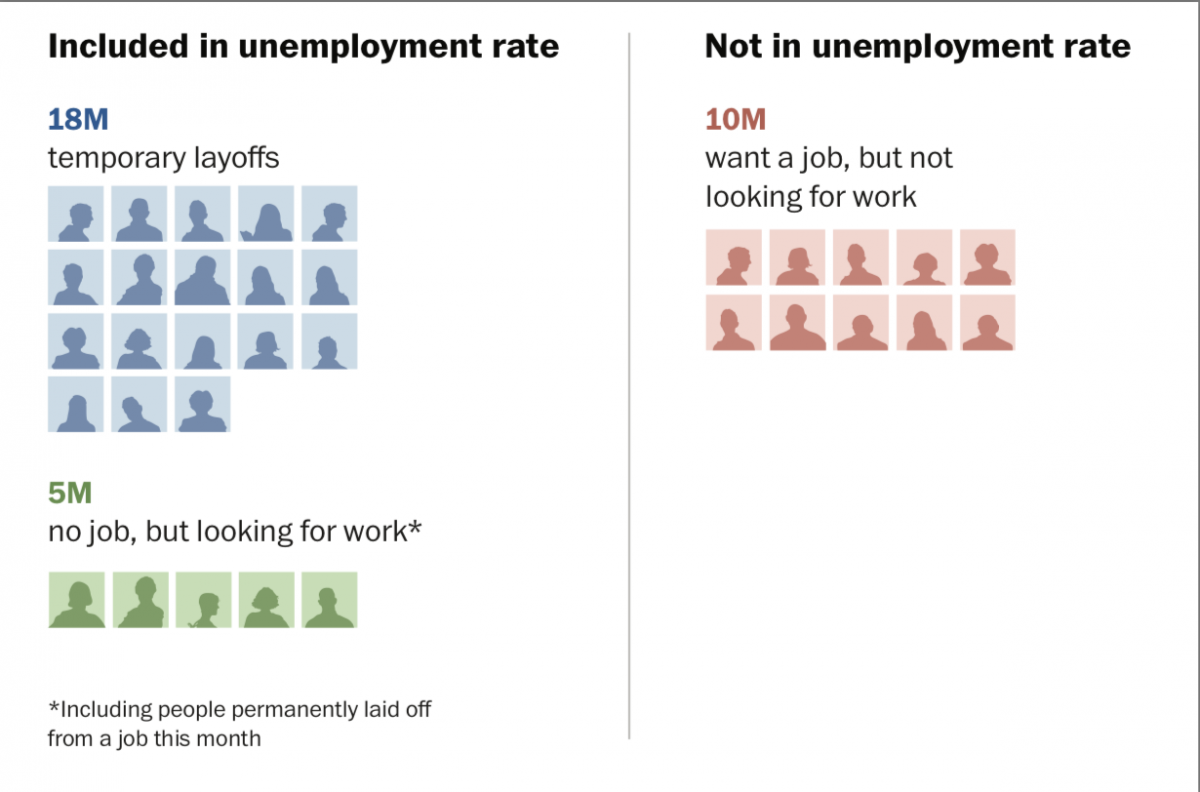
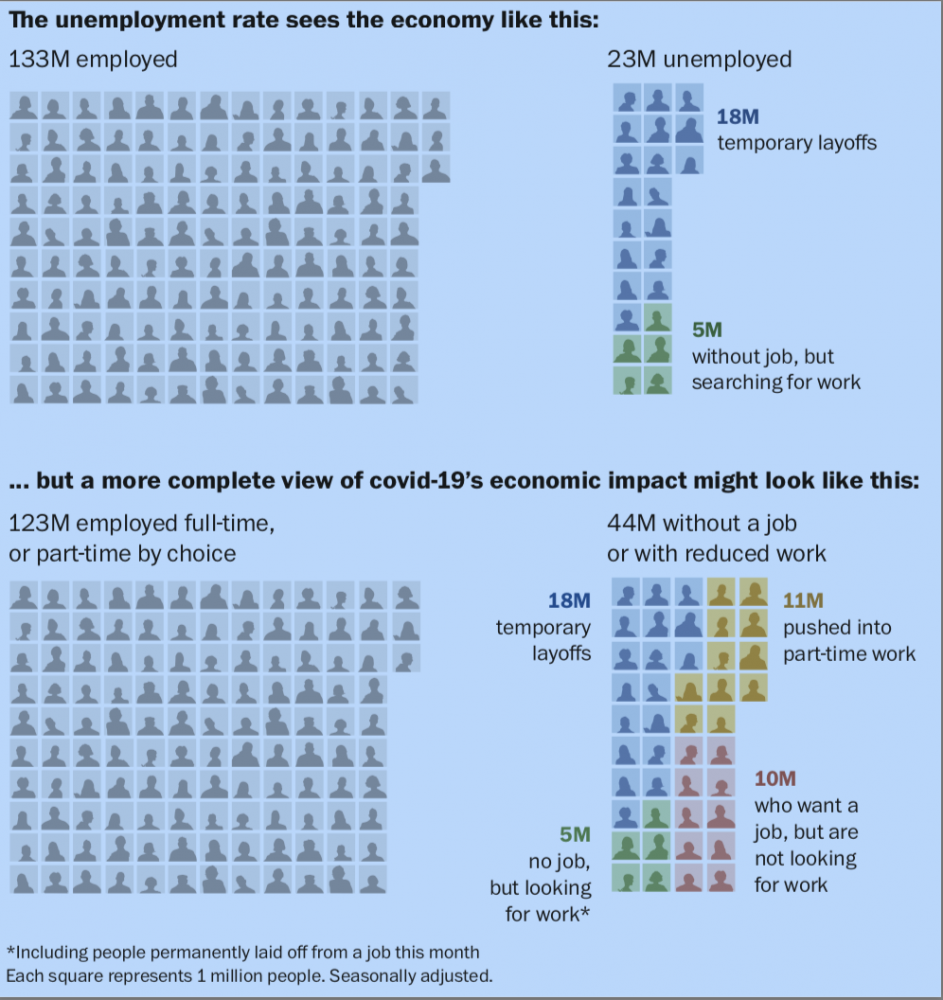
WASHINGTON – The U.S. economy is in trouble, and today’s staggering unemployment numbers only tell part of the story. More than 27 million people stopped working between March and April, but over a third of them are not included in the official unemployment rate of 14.7%.

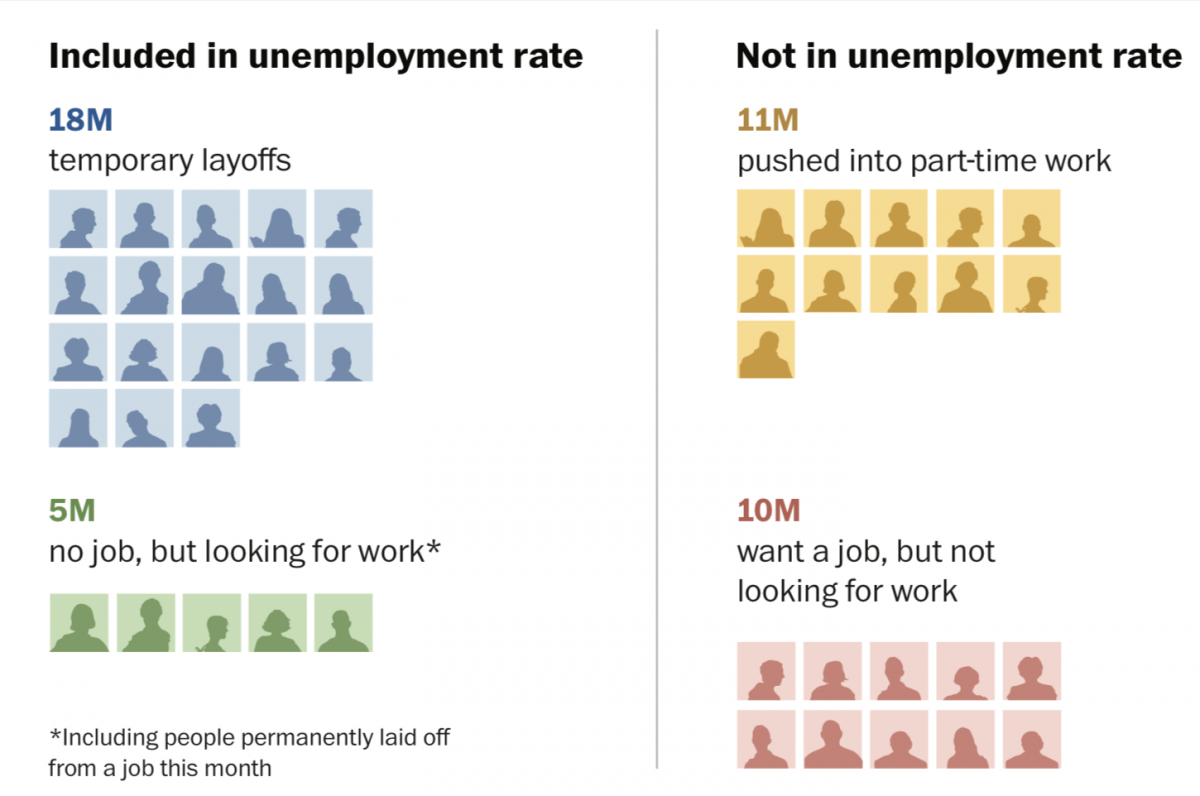
Millions have been pushed into part-time hours, or want a job but aren’t currently looking for one. Taking these people into account, 26.4% of American workers are employed below their capacity.

Photo by: The Washington Post — The Washington Post

Photo by: The Washington Post — The Washington Post

The official unemployment rate looks only at the labor force: people who are currently working, who have been “temporarily” laid off but expect to be recalled to their jobs, or who are actively seeking work. In ordinary times, this calculation makes sense. Retired people or stay-at-home parents shouldn’t count among America’s unemployed.

Photo by: The Washington Post — The Washington Post

Photo by: The Washington Post — The Washington Post

But these are not ordinary times. During the pandemic, many people have stopped looking for work. They may not feel safe working, or they are discouraged by the lack of jobs available during stay-at-home orders. 9.5 million Americans who worked in March exited the labor force in May, according to this month’s job report. That’s twice the number that went from employed to out of the labor force in January.

Most people who leave the labor force want to return to work at some point. The Bureau of Labor Statistics collects information about people who are not in the labor force but want a job. That group jumped by 4.4 million between the March and April jobs report. If you added these Americans to the official unemployment rate, you’d get a new rate as high as 19.8%.

Photo by: The Washington Post — The Washington Post

Photo by: The Washington Post — The Washington Post

But for millions of workers, keeping their jobs didn’t mean avoiding hardship. The number of people working part-time nearly doubled, from 5.8 million in the March report to 10.7 million in the April report. Every month some workers choose to go part-time, but this trend was driven by those who had their hours cut by their employer or were unable to find a full-time job.

Working hours dropped more in some industries than others. Manufacturing workers dropped to an average of 38.3 hours per week, down from 40.4 in March. That may seem like a small drop, but in a typical jobs report, the average hours worked changes by about six minutes from the previous month.

It’s by far the largest drop in hours in manufacturing since the Bureau of Labor Statistics began tracking average hours in 2006. The construction and wholesale trade industries also saw large drops in weekly working hours.

Henry Farber, an economist at Princeton University, explained that cutting hours could save on hiring and training down the road. “Many employers are laying people off reluctantly and expecting to bring them back,” Farber said. “It’s expensive to hire and train new workers, and the best way to stay attached to your workers is cut hours but keep them on the payroll.”

On the other hand, the cost of health insurance may push employers to cut jobs, rather than hours. “The fact that we tie health insurance to work complicates the labor market in all kinds of ways,” Farber said.

So if you take the official unemployment figure, add in people who want a job but are not looking for one, and then include everyone who has been pushed into part-time work, you could say that 26.4% of people lost work or work hours in April. More than one in four workers has been hit by the coronavirus fallout.

Even these measures don’t capture the breadth of economic pain. There are millions more Americans who don’t earn paychecks on their own, like stay-at-home parents, but are just as affected by losses in household income. An entire generation of new workers has seen their education disrupted.

There is still a long way to go before the economy recovers. While many states are starting to reopen, the number of daily deaths from the virus has not dropped off yet. April is the first jobs report to truly capture the scope of the economic crisis, but it is just the first of many.

Stocks surge on one of the unhappiest days in American economic history: Here’s why #ศาสตร์เกษตรดินปุ๋ย

#ศาสตร์เกษตรดินปุ๋ย : ขอบคุณแหล่งข้อมูล : หนังสือพิมพ์ The Nation.

https://www.nationthailand.com/business/30387552?utm_source=category&utm_medium=internal_referral

Stocks surge on one of the unhappiest days in American economic history: Here’s why

May 09. 2020
By The Washington Post · Thomas Heath · BUSINESS, US-GLOBAL-MARKETS

The worst unemployment report in American history screamed across computer and television screens Friday morning, announcing that a breathtaking 20.5 million Americans lost their jobs in April.

The next 60 seconds saw the Dow Jones industrial average jump, a 300-point pop that extended through the opening bell and into afternoon trading. The Standard & Poor’s index 500, a broader indicator of corporate America, likewise surged roughly 1.4 percent.

Stocks held onto their gains and pushed them higher in the last hour. The Dow finished up 455 points, or 1.9 percent to 24,331, ending the week with a total gain of 2.4 percent. The blue chips closed above 24,300. The S&P 500 finished the day at a 1.7 percent gain, to 2,929, and closed the week up 3.4 percent.

The Nasdaq composite was up 1.5 percent Friday and nearly 6 percent on the week.

Wall Street often behaves counterintuitively, as its reaction to 14.7 percent unemployment can attest. But Friday’s gains speak to investors’ willingness to look beyond the economic wreckage wrought by the coronavirus pandemic. Here are seven reasons why:

1. The stock market is a future indicator, not a rear-view mirror.

Investors are betting on how companies will be performing a month from now, six months from now, even a year from now.

“Stock prices are based on expectations,” said Howard Silverblatt of S&P Dow Jones Indices. “The current bad news was already baked in, as is more to come. But the longer-term hopes and expectations are for a reopening and corporate recovery.”

The stock market has been one of the best real-time measures for gauging what investors are thinking. The S&P 500 index is a reliable indicator of future performance for America’s 500 largest companies. Its role as a business indicator is based on the collective wisdom of millions of investors who are wagering tens of billions of dollars a day based on untold bits of available information. The efficient market theory, as it is known to its adherents, holds to the belief that the market prices most stocks correctly, based on the information available.

2. Technology stocks are killing it.

Tech giants Amazon, Apple, Google-parent Alphabet, Microsoft and Facebook have been on a serious tear for years and are behind a big chunk of recent gains. Microsoft shares have jumped 17 percent and Amazon has soared 28 percent since the start of the year. Facebook, Apple and Alphabet’s gains are hovering near 3 percent.

The five stocks comprise 21 percent of the S&P 500. They have lifted the Nasdaq composite into positive territory in 2020 even as the coronavirus pandemic has devastated the economy. (Amazon founder Jeff Bezos owns The Washington Post.)

“These are the stocks that have empowered the economy and have been the job-creation engines,” said Ivan Feinseth of Tigress Financial Partners. “They are enabling people to work at home. Investors realize the value they provide and they create and believe they will continue to be successful. Like it or not, Facebook kept people who are isolated from being alone.”

3. There’s hope on the health front.

Despite the pandemic’s terrible toll – 76,000 American deaths and climbing – the global pharmaceutical industry has massed its resources to laser focus on finding vaccines and treatments.

Johnson & Johnson, Pfizer and biotech company Moderna are among the companies racing to find a vaccine.

The Food and Drug Administration signed off this week on Moderna launching the next phase of testing on its coronavirus vaccine candidate. The company began its testing on 45 healthy adults in March, becoming one of the first companies to begin human clinical trials for a covid-19 vaccine.

Gilead Sciences reported “positive data” in a clinical trial by the National Institute of Allergy and Infectious Diseases for remdesivir, another possible treatment.

The trial showed that “a drug can block this virus,” Anthony Fauci, director of the institute, said in a news conference Wednesday.

The hardest hit states of New York, New Jersey and Connecticut have reported progress against the disease, with deaths, infections and hospitalizations down from their peaks weeks ago. While the disease is spreading in other parts of the country, hospitals do not appear to be overwhelmed with virus victims.

Goldman Sachs published a report this week that shows improvements around the globe but some mixed results in the U.S. as more states relax their lockdowns and businesses begin to open.

“The new information on the coronavirus has improved in Europe but has turned a bit worse in the U.S. relative to expectations on average over the past two weeks,” Goldman said in its report. “Compared with the recent trend, the current number of new infections has been broadly stable globally on net. This reflects further declines in Europe, very few new cases in China, roughly stable but elevated gains in the U.S. and further rises in emerging markets.”

Ed Yardeni, president of Yardeni Research, said “there are some signs of success on the health front. The market is looking at the rate of change of virus cases and deaths, and it doesn’t look like its getting worse. The market is expecting it’s going to get better as it has in China and in Italy. It is extrapolating from those countries’ experience.”

4. Oil markets are calming down and prices are rising, which is good for a key industry.

The price of oil is not where it needs to be, but it is going in the right direction for producers. U.S. crude oil is back near $25 per barrel and Brent crude, the international benchmark, is up near $30.

Producers need $50 or so per barrel to make money, but current prices are far better than they were just a couple of weeks ago. Holders of U.S. crude were paying people to take oil off their hands last month.

There is still a massive oil glut, but with the U.S. shale industry shutting down wells at a swift rate, the balance between supply and demand is getting close. The U.S. pumped 13.1 million barrels a day a few weeks ago. Now it is closer to 12 million and heading south. Meanwhile, drivers around the world are slowly getting back on the road. Gasoline usage is still down 30 percent from pre-virus levels, but it has improved from the 50 percent decline in March.

“The oil price stabilization and rise is a ray of light that we are getting through this economic darkness,” said John Kilduff of Again Capital. “It’s clear there is pent-up demand waiting to be unleashed, and we are seeing that in the rebound in gasoline numbers toward normal levels.”

5. The Federal Reserve and the U.S. government have flooded the economy with trillions in cash and easy credit.

Investors have credited the central bank with saving the markets from collapse and preventing a new financial crisis from making the recession worse. As trading seized up in March amid the initial panic, the Fed swiftly launched plans to buy massive quantities of government, corporate and municipal bonds.

The Fed is launching a program to lend directly to Main Street businesses that fall in the crack between financial markets and existing small-business programs. But the unusual effort is only getting started.

“The Fed went from bazookas that had mostly run out of ammo and skipped helicopters and went straight to the B-52s carpet bombing tons of cash on the financial markets and the economy,” Yardeni said.

The super-low interest rates promulgated by the Fed have sent investors out of bonds and running to equities in search of returns, helping raise stock prices.

The Trump administration launched an unprecedented small-business loan program designed to prevent companies from laying off their workers, part of nearly $3 trillion Congress approved to counter the pandemic’s medical and economic toll.

6. The U.S.-China trade war truce looks like it may not unravel, which is good for the economy.

U.S. Trade Representative Robert E. Lighthizer and Treasury Secretary Steven Mnuchin on Thursday held a conference call with Liu He, China’s vice premier and point man on the trade deal, to make sure the “phase one” agreement was on track.

Trump has said he is unhappy with China, which he has held responsible for allowing the virus to take hold and spread. Secretary of State Mike Pompeo pointedly criticized the Chinese for its role in the virus, raising fears of retaliation. But more than 30 million unemployed, many economists say it would be a bad idea for the administration to engage in a trade war.

7. Shanghai Disneyland has sold out.

Disney said tickets to it’s park in Shanghai, which opens Monday, sold out in minutes. Although the park will only admit 30 percent of it’s capacity, peoples’ appetite to get out and spend money bodes well for the U.S. Disney is looked at as a model for crowd control, so hospitality and entertainment companies will watch closely.

New interest rule introduced to relieve load on borrowers, cut NPLs #ศาสตร์เกษตรดินปุ๋ย

#ศาสตร์เกษตรดินปุ๋ย : ขอบคุณแหล่งข้อมูล : หนังสือพิมพ์ The Nation.

https://www.nationthailand.com/business/30387535?utm_source=category&utm_medium=internal_referral

New interest rule introduced to relieve load on borrowers, cut NPLs

May 09. 2020
Thanyanit Niyomkarn, the Bangkok of Thailand’s assistant governor

Thanyanit Niyomkarn, the Bangkok of Thailand’s assistant governor
By The Nation

In a bid to ease debt-repayment burden on borrowers as well as minimise the number of non-performing loans, the central bank has come up with a new method of calculating interest.

This new method of calculating interest charged on overdue debt was enforced on May 1, Thanyanit Niyomkarn, the Bangkok of Thailand’s assistant governor, said on Friday (May 8).

She added that this new practice is fair for both the borrower and the lender as the interest charged will be based on actual instalments that debtors have defaulted on.

Thanyanit explained that in the past, if a borrower failed to pay an instalment, the bank would charge extra interest on that instalment plus interest on the remaining balance of the principle. Under the new system, however, interest will only be charged on the defaulted instalment.

For instance, an individual has taken a 20-year housing loan to be paid in 240 instalments, and has paid the first 24 instalments without fail. However, if the borrower failed to pay the 25th instalment, the bank would charge interest on both the 25th instalment as well as the remaining 215 instalments.

However, under the new practice, banks can only charge extra interest on the 25th instalment.

This new practice takes into account the interest of both the creditor and the debtor, or credit risk and affordability risk respectively, she said.

Since many people’s income has either reduced or even stopped due to the pandemic, they may not be able to pay their debts on time. Hence, this new method of interest calculation will ease some burden on them and potentially cut down on the number of defaulting debts, she said.

At the same time, fair and transparent banking services will boost consumers’ confidence as well as benefit the sector in the long run, she said.

Banks can apply this new practice for debts that were overdue before May 1.

People can call the central bank 1213 hotline for more details.

Fear, federal aid make it hard for restaurants to staff up #ศาสตร์เกษตรดินปุ๋ย

#ศาสตร์เกษตรดินปุ๋ย : ขอบคุณแหล่งข้อมูล : หนังสือพิมพ์ The Nation.

https://www.nationthailand.com/business/30387547?utm_source=category&utm_medium=internal_referral

Fear, federal aid make it hard for restaurants to staff up

May 08. 2020
A customer wearing a protective mask enters a Dunkin' location in the New York borough of Brooklyn on April 27, 2020. MUST CREDIT: Bloomberg photo by Gabby Jones.

A customer wearing a protective mask enters a Dunkin’ location in the New York borough of Brooklyn on April 27, 2020. MUST CREDIT: Bloomberg photo by Gabby Jones.
By Syndication Washington Post, Bloomberg · Leslie Patton · BUSINESS, RETAIL

Restaurant managers are scrubbing tables, adding sanitizing stations and printing new menus as they get ready to open their doors. The one thing some of them are missing? People to make and serve the food.

More than 20 million Americans lost their jobs in April during the covid-19 crisis, but restaurants are still finding it hard to hire help.

Some former employees are making more money now thanks to an extra federal emergency payment of $600 weekly on top of state unemployment benefits. Others have found new jobs or are staying home with kids. Many are simply too nervous to interact with the public before the coronavirus outbreak subsides.

The labor challenges compound the financial hurdles for the restaurant industry, which, according to the National Restaurant Association, has lost about $80 billion in sales through the end of April due to the coronavirus shutdowns.

Companies eyeing a return to normal operations, including Dunkin’ Brands Group Inc., Salsarita’s Fresh Cantina and Shake Shack Inc., are grappling with how to staff their restaurants.

“Some stores are definitely having a challenge,” said Scott Murphy, president of Dunkin’s Americas region. Especially in hard-hit areas such as New York City, he said, the restaurants are “having trouble getting workers.”

Tina Watson used to work every weekday at a Wendy’s in Santee, South Carolina. But with broad stay-at-home mandates going into effect in March, her hours were cut back sharply, reducing her $500 biweekly paycheck to less than half.

She doesn’t qualify for unemployment at the moment. Despite the financial strain, Watson, 41, is wary about working. Sometimes she can’t go because she doesn’t have anyone to watch her 11-year-old son, whose school is closed, leaving her restaurant short-staffed.

“I don’t think I’m going to be able to go back to work knowing my son can’t go to school and I don’t have a reliable sitter,” she said.

Of the job cuts announced from mid-March to late April, almost two-thirds have been in the entertainment and leisure sector including dining, according to consulting firm Challenger, Gray & Christmas.

U.S. government efforts to support people who have lost their jobs has had the unintended consequence of keeping some restaurant workers away. Under March’s federal stimulus act, people eligible to get state unemployment assistance get an extra $600 a week funded by the federal government through the end of July.

The median pay for food preparation workers was $11.92 an hour in 2019, according to the U.S. Bureau of Labor Statistics, or $476.80 for a 40-hour week.

Steve Joyce, chief executive officer of Applebee’s-owner Dine Brands Global Inc., said the extra federal assistance “creates in a lot of markets a relatively high reimbursement rate for a limited amount of time.”

This is why some restaurants are resorting to financial incentives to get workers back. Shake Shack, for instance, is offering an extra 10% in pay as a “thank you” to new hires, according to job postings in Texas and Seattle. Some Dunkin’ franchisees are using bonuses and free meals to keep staff on the payroll, while the parent company weighs a new-hire ad campaign.

Not every company is having such a hard time finding workers. Papa John’s International Inc. has brought on thousands in the last six weeks amid a broad hiring effort, which CEO Rob Lynch said is intended to get locations “appropriately staffed” to handle higher demand.

“I think people want to work now even more so than they did even four to five weeks ago,” he said. “We’ve been hiring like crazy and we’re going to continue to do so.”

In fact, companies may need to hire even more workers than they had before the pandemic, to deal with extra cleaning measures, said Peter Saleh, a restaurant analyst at BTIG. “They’re probably going to want to over-staff in this environment and be prepared.”

These type of “labor inefficiencies” have been flagged by restaurants planning their reopening strategies. And refilling the same position can introduce new costs, particularly if restaurants have to hire inexperienced workers.

“If you can’t bring back people you know, you have to go through training,” said Salsarita’s CEO Phil Friedman.

Salsarita’s has had to delay reopenings in certain locations, including South Carolina, because it can’t find enough people. Hourly staff particularly are reluctant to return because many have found new jobs or are nervous about working, and it could take weeks to fill out the ranks, Friedman said.

“It really is a day by day,” he said.

Stocks rise in wake of unprecedented job losses #ศาสตร์เกษตรดินปุ๋ย

#ศาสตร์เกษตรดินปุ๋ย : ขอบคุณแหล่งข้อมูล : หนังสือพิมพ์ The Nation.

https://www.nationthailand.com/business/30387544?utm_source=category&utm_medium=internal_referral

Stocks rise in wake of unprecedented job losses

May 08. 2020
By Syndication Washington Post, Bloomberg · Vildana Hajric · BUSINESS, US-GLOBAL-MARKETS

Stocks rose for a second day with investors embracing risk in spite of the biggest monthly loss in jobs in at least 70 years. The dollar weakened and oil gained.

Shares of energy, industrial and financial companies put the S&P 500 on pace for its first weekly gain in three. The latest jobs report showed a cut of 20.5 million workers in April, propelling the jobless rate to 14.7%. While that was the highest since the Great Depression, investors were anticipating the damage and speculating it will mark a low point during the pandemic-fueled economic slump.

“The jobs report marks a sobering moment in our history, while it also likely marks the bottom of the economic contraction with hope for a better remainder of the year,” said Bryce Doty, senior portfolio manager at Sit Fixed Income Advisors.

Meanwhile, oil headed for its first back-to-back weekly gain since February as output cuts from the biggest producers and a nascent recovery in demand began to rebalance a market awash with crude.

Stocks remained higher even after President Donald Trump cast doubt on the future of his “phase one” trade deal with China, saying Friday that he’s struggling with Beijing in the wake of the coronavirus pandemic.

Building and travel stocks pulled the Euro Stoxx Index higher while U.K. markets were closed for a holiday. Japanese equities led a surge across Asia. Italian bonds climbed before a sovereign ratings decision.

Equities have so far managed to weather miserable economic data as well as a string of poor earnings reports as investors bet on a swift recovery, but the strong rebound in risk assets has left others questioning whether further gains are warranted.

“There had been some concerns that unemployment would hit closer to 25%, so today’s data is in some ways a positive surprise,” said Seema Shah, chief strategist for Principal Global Investors. “Today’s data has been weighing on negative sentiment for several weeks, so just having it out of the way lifts a cloud.”

Elsewhere, gold fluctuated. Bitcoin rose briefly above $10,000 for the first time since late February.

Stocks:

– The S&P 500 Index gained 1% to 2,915.15 as of 10:29 a.m. New York time.

– The Dow Jones Industrial Average climbed 1.2% to 24,195.10.

– The Nasdaq Composite Index increased 0.6% to 9,084.85, hitting the highest in 10 weeks with its fifth consecutive advance.

– The MSCI All-Country World Index rose 1.2% to 488.42.

Currencies:

– The Bloomberg Dollar Spot Index decreased 0.1% to 1,246.87.

– The Japanese yen weakened 0.3% to 106.58 per dollar.

– The euro was little changed at $1.0838.

– The British pound was little changed at $1.2425.

Bonds:

– The yield on two-year Treasuries decreased two basis points to 0.12%, the lowest on record.

– The yield on 10-year Treasuries rose one basis point to 0.65%.

– Germany’s 10-year yield gained one basis point to -0.54%.

– Britain’s 10-year yield increased less than one basis point to 0.235%.

Commodities:

– West Texas Intermediate crude gained 3.8% to $24.39 a barrel.

– Gold weakened 0.2% to $1,718.97 an ounce.