What the brutal jobs report means for Trump #ศาสตร์เกษตรดินปุ๋ย

#ศาสตร์เกษตรดินปุ๋ย : ขอบคุณแหล่งข้อมูล : หนังสือพิมพ์ The Nation.

https://www.nationthailand.com/business/30387538?utm_source=category&utm_medium=internal_referral

What the brutal jobs report means for Trump

May 08. 2020
President Trump

President Trump
By The Washington Post · Aaron Blake · NATIONAL, OPINION, BUSINESS, HEALTH, POLITICS, WHITEHOUSE, ESSAYS, US-GLOBAL-MARKETS 

JOBS-BLAKE-ANALYSIS: The unemployment rate hit its highest point since the Great Depression on Friday, spiking more than 10 points to 14.7%. The toll of shutting down large portions of the American economy for the coronavirus outbreak hadn’t completely registered in last month’s report, but this one was predictably brutal.

With that jobs report comes further confirmation that a severe economic downturn will loom over the 2020 election. And traditionally, that has meant curtains for an incumbent president like Donald Trump.

But is that necessarily the case today? There are reasons to be skeptical.

The comparison to the Great Depression will be tempting, given the size of the economic challenges we face. After the market crash in 1929, Herbert Hoover went on to lose to Franklin D. Roosevelt in a landslide in 1932.

But there are two very important and very different questions here: 1) How bad and sustained will the current economic downturn be? And 2) How much do people actually blame that on the president rather than on a situation they believe to be largely out of his control?

While in a traditional economic downturn, it would be rather easy and logical to blame the policies of incumbent politicians, but this one is a special case. The pandemic was something that we were going to have to contend with, to one degree or another. What matters from there is how much people actually attribute the loss of life and economic strife to Trump and other leaders, and how much they think those leaders exacerbated an already-bad situation.

And on that front, things are indeed less dire for Trump than the jobs numbers might suggest – though that could certainly change depending upon the actual numbers and what lay ahead.

While the growing jobs and economic crisis has been well established by this point, Americans by and large still see the economy as one of Trump’s strong points. An Economist/YouGov poll this week showed 53% of people continue to approve of Trump’s handling of jobs and the economy – a number similar to where he’s been at for months. An NPR/PBS/Marist College poll from a couple weeks ago showed an even, 49%-to-49% split on that question.

The YouGov poll, similarly, showed people have more confidence in Trump than in presumptive Democratic nominee Joe Biden on the economy. It asked whether the economy would get better or worse if either man was elected. Voters were split on the question on Trump (36% said it would get better, compared with 35% who said it would get worse), but were slightly negative on Biden (30% better vs. 38% worse).

The poll also asked how each man would handle a recession, and again the advantage was to Trump. While Americans were split (43%-43%) on whether they were confident in his ability to manage a recession, just 33% were confident in Biden’s ability to do so, while 44% said they were “uneasy.”

To the extent the economic downturn is truly registering with people, it doesn’t seem to be something they lay at Trump’s feet – at least not yet. And it doesn’t seem to be a situation in which they are thinking a change would help. That could always shift as the coronavirus outbreak progresses, but views of Trump on that response track strongly with his overall approval numbers, and views of his handling of the economy (which are better than his overall numbers) haven’t changed much.

Regardless of those numbers, this is clearly something that concerns Trump a great deal. From the beginning of the outbreak, he has made clear how concerned he is about being robbed of what he hoped to make his signature reelection issue: the economy. He’s now pushing for a reopening of the economy despite a steady death rate and despite cases in the country still growing outside the early hotbed of New York City. This has led to tensions with health officials who worry that relaxing mitigation measures might not just lead to increased loss of life but force a longer outbreak – a situation that would logically lead, by extension, to more economic turmoil.

As Trump presses forward, though, he may be better served paying attention to how much people truly blame him for the economic troubles versus how much they blame the virus. Viewing this as a zero-sum game in which a bad economy means Trump loses is overly simplistic. It’s true that Trump is polling like an underdog right now, but that’s been the case for a while, and the fundamentals of the race don’t seem to have changed significantly yet. It’s entirely possible that whatever economic pain comes won’t be laid at his feet.

A prolonged outbreak resulting from a failure to appreciate the size of the crisis and easing up too early, though? That could be just as dangerous – if not more. And that’s a much simpler question for voters to ask themselves, if the situation in this country continues to be one of the worst in the world or even deteriorates.

U.S. jobless rate triples to 14.7% in sharpest labor downturn #ศาสตร์เกษตรดินปุ๋ย

#ศาสตร์เกษตรดินปุ๋ย : ขอบคุณแหล่งข้อมูล : หนังสือพิมพ์ The Nation.

https://www.nationthailand.com/business/30387536?utm_source=category&utm_medium=internal_referral

U.S. jobless rate triples to 14.7% in sharpest labor downturn

May 08. 2020
File photo

File photo
By Syndication Washington Post, Bloomberg · Katia Dmitrieva · NATIONAL, BUSINESS

In the harshest downturn for American workers in U.S. history, employers cut an unprecedented 20.5 million jobs in April and the unemployment rate more than tripled to 14.7%.


Back in February, before the coronavirus pandemic brought the U.S. economy to a standstill, the rate hovered at just 3.5%. That had been the lowest level in five decades. April’s is the highest since just after the Great Depression of the 1930s.

The Labor Department said the unadjusted unemployment rate in April would have been almost 5 percentage points higher had workers been classified as unemployed on temporary layoff, rather than employed but absent from work due to other reasons. Furloughed workers accounted for about 4 out of every 5 unemployed Americans.

April’s losses erase roughly all of the jobs that the economy had added in this past decade’s expansion and lay bare just how precarious employment is for vast swaths of Americans.

With a steep recession now in progress, the destruction of jobs heaps election-year pressure on President Donald Trump to restart the economy and show results by November. But with little containment of a contagious disease that’s killed 75,000 Americans and counting, business is returning unevenly and slowly if at all, and signs are mounting that many employers will be forced to make the cuts permanent.

In the minutes after the report, the Bloomberg dollar index pared its decline for the day while the yield on benchmark 10-year Treasuries rose to its highs of the session after the report. S&P 500 futures maintained their gains.

Key details:

– Average hourly earnings rose 4.7% from the prior month and 7.9% from a year earlier, skewed higher by the disproportionate loss of low-wage workers from payrolls — rather than any wage pressures boosting employee pay.

– The labor-force participation rate fell to 60.2% from 62.7%.

– The underemployment rate, which includes discouraged workers and those working part-time who want full hours, rose to 22.8% from 8.7%.

Almost every industry was hit hard. Leisure and hospitality employers cut 7.65 million, manufacturers cut 1.33 million positions and retailers 2.1 million. Even health care jobs fell by 1.44 million as non-Covid visits and elective procedures dried up or offices closed.

The job losses may also fan calls for a fourth round of fiscal aid from Congress on top of trillions of dollars already dispatched, even with signs many Americans are having difficulty tapping the funds. The Federal Reserve is likely to keep pumping money into the economy while leaving interest rates near zero for an extended period.

Trump said Friday that the massive U.S. job losses from the coronavirus outbreak aren’t a surprise and that he shouldn’t be blamed for it.

“It’s totally expected, there’s no surprise,” he said on Fox News Channel, where he was being interviewed as the report was released. “Even the Democrats aren’t blaming me for that. What I can do is I can bring it back.”

While the pandemic has crushed economies around the world, job losses hurt more in the U.S. than in most other developed nations. That’s because about 160 million Americans get health insurance through employers, and without jobs, they could face steep monthly premiums or lose coverage entirely — which may exacerbate the economic impact of Covid-19.

The response rate for the household survey — which determines the unemployment rate — was 13 percentage points lower than usual, as in-person visits were halted. The establishment survey’s response rate was in line with typical rates.

SET buoyed by US-China trade talks, Thai lockdown timeline #ศาสตร์เกษตรดินปุ๋ย

#ศาสตร์เกษตรดินปุ๋ย : ขอบคุณแหล่งข้อมูล : หนังสือพิมพ์ The Nation.

https://www.nationthailand.com/business/30387528?utm_source=category&utm_medium=internal_referral

SET buoyed by US-China trade talks, Thai lockdown timeline

May 08. 2020
By THE NATION

The Stock Exchange of Thailand (SET) Index closed at 1,266.02 today (May 8), up 8.04 points or 0.64 percent.

The volume of total transactions was Bt44.086 billion with an index high of 1,270.54 and a low of 1,256.74.

A stock analyst at Krungsri Securities expected the index to rebound to between 1,270 and 1,280, with the US and China set to discuss the first phase of a trade agreement next week.

“Meanwhile, economic activities and investment will benefit as Thailand prepares to ease more lockdown measures on May 17, after the number of new Covid-19 cases dropped significantly,” the stock analyst said.

“However, applications for unemployment welfare in the US rose by 3.17 million to 33.5 million, while mass sell-offs due to uncertainty following the decline in companies’ first-quarter performances will drag down the index.”

The 10 stocks with the highest trade value today were CPALL, PTT, ADVANC, BAM, AOT, PTTGC, BDMS, PTTEP, GPSC and BBL.

As of 5pm, the price of crude oil rose by US$0.63 or 2.68 percent to $24.18 per barrel, while gold rose by $6.70 or 0.39 percent to $1,732.50 per ounce.

Meanwhile, global indices were on the rise:

Japan’s Nikkei Index closed at 20,179.09, up 504.32 points, or 2.56 percent.

China’s Shang Hai SE Composite Index closed at 2,895.34, up 23.82 points or 0.83 percent, while Shenzhen SE Component Index closed at 11,001.58, up 138.29 points or 1.27 percent.

Hong Kong’s Hang Seng Index closed at 24,230.17, up 249.54 points, or 1.04 percent.

South Korea’s KOSPI Index closed at 1,945.82, up 17.21 points, or 0.89 percent.

Taiwan’s TAIEX Index closed at 10,901.42, up 58.50 points, or 0.54 percent.

Daily consumer spending to rise further in second-phase of easing #ศาสตร์เกษตรดินปุ๋ย

#ศาสตร์เกษตรดินปุ๋ย : ขอบคุณแหล่งข้อมูล : หนังสือพิมพ์ The Nation.

https://www.nationthailand.com/business/30387527?utm_source=category&utm_medium=internal_referral

Daily consumer spending to rise further in second-phase of easing

May 08. 2020
Thanawat Phonvichai

Thanawat Phonvichai
By THE NATION

The planned further easing of restrictions on May 17 combined with the first phase of relaxation of measures may generate daily public spending of Bt6 billion to Bt8 billion, estimates the University of Thai Chamber of Commerce’s Centre for Economic and Business Forecasting.

Thanawat Phonvichai, the university’s president, said the lockdown in response to the Covid-19 outbreak had brought consumer spending down by Bt10 billion daily, though the first round of easing measures on May 3 brought Bt2 billion to Bt3 billion back into daily circulation.

The centre estimates that the second phase of easing will generate spending of between Bt4 billion to Bt5 billion daily, which added to the money brought in circulation from the first round, will see consumer spending of up to Bt8 billion daily.

The centre has also forecast Thailand’s economic growth this year at -3.5 percent to -5 percent, though believes growth may enter positive territory if the tourism sector recovers in the fourth quarter.

Thanawat added that according to the university’s survey, the Consumer Confidence Index in April was 47.2, the lowest in nearly 22 years, reflecting people’s concern that the country will be hit with recession in the wake of the pandemic.

Real estate stocks tumble on SET #ศาสตร์เกษตรดินปุ๋ย

#ศาสตร์เกษตรดินปุ๋ย : ขอบคุณแหล่งข้อมูล : หนังสือพิมพ์ The Nation.

https://www.nationthailand.com/business/30387514?utm_source=category&utm_medium=internal_referral

Real estate stocks tumble on SET

May 08. 2020
By THE NATION

Sinking real estate stocks dragged down the Stock Exchange of Thailand (SET) Index on Thursday (May 7).

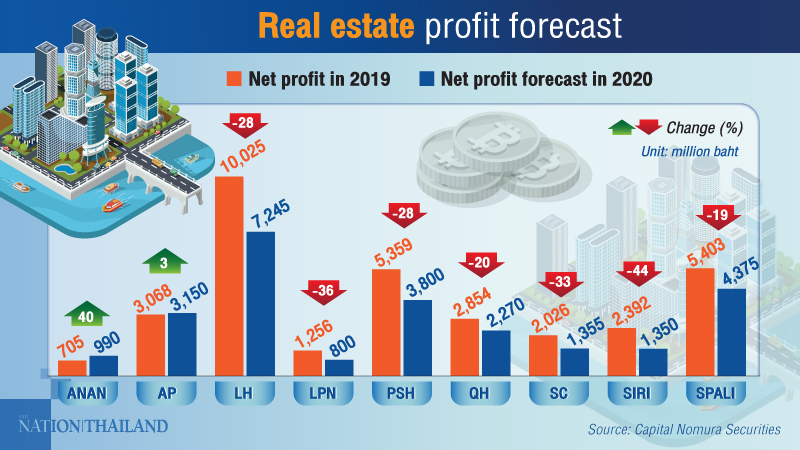
At Thursday’s close, the price of Land and Houses (LH), Origin Property (ORI), SC Asset Corporation (SC), Ananda Development (ANAN), Pruksa Holding (PSH) and Sansiri (SIRI) fell by 10.27, 5.43, 4.55, 4.24, 3.74 and 2.86 per cent, respectively. That helped the SET Index fall to 1,257.98 on Thursday, down 20.65 points or 1.62 per cent.

A stock analyst at Capital Nomura Securities said that real estate firms’ sales, transfers, and net profits are expected to drop by 11, 10 and 23 per cent, respectively, due to the decline in buying power, Loan-To-Value (LTV) measures, and strict terms for bank loans.

“We expect real estates’ net profit this year to be the lowest … since the floods in 2011-2012,” the stock analyst said.

“Though the real estate index has fallen more than 20 per cent and the price-to-earnings ratio fallen by 7.7 times, we advise investors to delay investment in these stocks because their dividend rate is expected to be approximately 7.5 per cent.”

Meanwhile, Padon Vannarat, assistant managing director at Yuanta Securities, said that the price of LH stock dropped sharply because the company had paid dividends of Bt0.40 per share.

“We advise investors to sell LH stocks because we expected the stock to lack positive sentiments,” he said.

“Although it is a large cap stock and pays high dividends, we recommend investors buy stocks at Bt6 per share or after the company announces its first-quarter performance.”

He projects the company’s net profit in the first quarter to be Bt1 billion, down 42.3 per cent year-on-year.

“We expect the company’s transfers to be Bt5.2 billion, down 9 per cent due to measures to contain the spread of Covid-19,” he added.

“Meanwhile, the revenue from rental business will drop 13 per cent as the hotel occupancy rate fell to below 10 per cent at the end of March this year.”

Rising US unemployment increases demand for gold #ศาสตร์เกษตรดินปุ๋ย

#ศาสตร์เกษตรดินปุ๋ย : ขอบคุณแหล่งข้อมูล : หนังสือพิมพ์ The Nation.

https://www.nationthailand.com/business/30387506?utm_source=category&utm_medium=internal_referral

Rising US unemployment increases demand for gold

May 08. 2020
By THE NATION

The price of gold dropped by Bt200 per baht weight in morning trade on Friday (May 8), the Gold Traders Association reported.

As of 9.25am, the buying price of a gold bar was Bt25,950 per baht weight and selling price Bt26,150, while gold ornaments cost Bt25,483.96 and Bt26,650, respectively.

At close on Thursday (May 7), the buying price of a gold bar was Bt25,750 per baht weight and selling price Bt25,950, while gold ornaments were priced at Bt25,286.88 and Bt26,450, respectively.

The Gold Spot Index price this morning moved to around US$1,718 per ounce after the price rose by $37.3 to $1,725.80 per ounce at close on Thursday.

Investors were buying gold as a safe haven asset after the US revealed a sharp rise in the number of registrants for unemployment welfare due to the Covid-19 outbreak.

Meanwhile, gold price in Hong Kong dropped by HK$210 to $15,840 per tael.

SET rebounds on news of US-China trade talks, second phase of easing lockdown #ศาสตร์เกษตรดินปุ๋ย

#ศาสตร์เกษตรดินปุ๋ย : ขอบคุณแหล่งข้อมูล : หนังสือพิมพ์ The Nation.

https://www.nationthailand.com/business/30387502?utm_source=category&utm_medium=internal_referral

SET rebounds on news of US-China trade talks, second phase of easing lockdown

May 08. 2020
By THE NATION

The Stock Exchange of Thailand (SET) Index rose by 10.71 points, or 0.85 per cent, to 1,268.69 on Friday morning (May 8).

A stock analyst at Krungsri Securities expected the index to rebound to between 1,270 and 1,280, as the US and China will discuss the first phase of a trade agreement next week.

“Meanwhile, economic activities and investment would benefit as Thailand is preparing to ease more lockdown measures on May 17, as the number of new Covid-19 cases in Thailand has dropped significantly,” the stock analyst said.

“However, the number of registrants for unemployment welfare in the US rose by 3.17 million people to 33.5 million people, and the mass sell-offs of stocks due to uncertainty following the decline in companies’ first-quarter performance would plunge the index.”

He suggested investors make selective buys from four groups of stocks:

● Retail stocks that would benefit from the second phase of the country easing the lockdown, such as CRC, CPN, HMPRO, GLOBAL and COM7.

● Stocks that would benefit from weather forecasts that the rainy season would begin in the middle of May, such as EASTW, CKP, GPSC, GULF and BGRIM.

● ICT and food stocks that have escaped the severe impact of the outbreak, such as ADVANC, INTUCH, DTAC and CPF.

● Stocks whose first-quarter performance are expected to improve, such as CPF, IVL, BCPG, GPSC and RS.

Fed’s Daly sees negative 2020, slow rebound for U.S. economy #ศาสตร์เกษตรดินปุ๋ย

#ศาสตร์เกษตรดินปุ๋ย : ขอบคุณแหล่งข้อมูล : หนังสือพิมพ์ The Nation.

https://www.nationthailand.com/business/30387480?utm_source=category&utm_medium=internal_referral

Fed’s Daly sees negative 2020, slow rebound for U.S. economy

May 08. 2020
Mary Daly, president of the Federal Reserve Bank of San Francisco, in San Francisco on Nov. 13, 2019. MUST CREDIT: Bloomberg photo by David Paul Morris.

Mary Daly, president of the Federal Reserve Bank of San Francisco, in San Francisco on Nov. 13, 2019. MUST CREDIT: Bloomberg photo by David Paul Morris.
By Syndication Washington Post, Bloomberg · Christopher Condon · BUSINESS, US-GLOBAL-MARKETS 

Federal Reserve Bank of San Francisco President Mary Daly said she expects the U.S. economy to shrink this year with a recovery only getting under way next year.

“2020 as a whole is going to be a negative year, and then we’ll start to see a positive year in 2021,” Daly said Thursday in an interview with Bloomberg Television’s Michael McKee. With elevated uncertainty around the spread of the coronavirus, she said “that’s about as good as forecasting can get right now.”

Nonetheless, Daly, who is not a voter this year on the interest-rate setting Federal Open Market Committee, expressed some optimism based on preparations she sees many companies in her district making as they anticipate re-opening for business.

“No one who I talk to is looking at a v-shaped recovery, they really think this will be gradual and it will take time to build confidence back up for both workers and consumers,” Daly said. “But they are more optimistic than you might think. They are ready to re-open and re-engage.”

Earlier Thursday, the Labor Department reported another 3.17 million workers claimed unemployment benefits last week, bringing the seven-week total to about 33.5 million as businesses shuttered across the country to limit the spread of the coronavirus.

The U.S. central bank has responded to the crisis aggressively, lowering rates to near zero, purchasing trillions of dollars in bonds and announcing nine emergency lending facilities — all aimed at keeping credit markets functioning or providing direct aid to companies, cities and states.

Daly said she doesn’t expect prices to suffer from deflation, or for inflation to exceed the Fed’s 2% target, partly because inflation expectations have remained stable.

“We are really looking at inflation being tepid not getting up to our 2% target for a while,” she said. The Fed will “do everything in our powers to achieve our dual-mandate goals and I think that gives market participants, households and businesses confidence.”

South Korea to make 5G and AI centerpieces of ‘Korean New Deal’ #ศาสตร์เกษตรดินปุ๋ย

#ศาสตร์เกษตรดินปุ๋ย : ขอบคุณแหล่งข้อมูล : หนังสือพิมพ์ The Nation.

https://www.nationthailand.com/business/30387475?utm_source=category&utm_medium=internal_referral

South Korea to make 5G and AI centerpieces of ‘Korean New Deal’

May 08. 2020
By Syndication The Washington Post, Bloomberg · Sam Kim

South Korea will make artificial intelligence and wireless communications centerpieces of what it is touting as a “New Deal” to create jobs and boost growth after the coronavirus pandemic subsides.

The government, in a statement Thursday, said it will promote AI and fifth-generation wireless technology to support the economy once the virus is brought under control. The statement said funding would come from a third emergency budget being drafted now and from annual budgets through 2022, but didn’t specify the amount.

President Moon Jae-in, after last month’s big election victory, said his government would pursue large-scale state projects to boost jobs and innovation in the post-virus era. He compared his vision to the New Deal launched by President Franklin Roosevelt in the 1930s to help the U.S. recover from the Great Depression.

Economist Kim Jung-sik at Seoul’s Yonsei University said Moon’s plan was designed to help support newer, Internet-based businesses but probably wouldn’t involve the kind of spending that the term New Deal would seem to imply.

“It’s different from the traditional New Deal which seeks massive jobs with massive spending,” he said. “South Korea’s financial ammunition is increasingly limited after a series of spending measures to stimulate the economy.”

The project comes as South Korea’s trade-dependent economy braces for more fallout from the pandemic. Even though the country has so far managed to bring its own outbreak under control, March was its worst month for job losses since the global financial crisis, with part-time workers and young people among the hardest-hit.

As part of its New Deal, South Korea plans to create a fund to support AI development, build sites for robot testing and help businesses launch new services that make use of data, according to the statement. The government will also support construction of a nationwide 5G network, it said.

The goal is to enhance South Korea’s economic growth potential and create sustainable jobs for future generations, the government said, adding that more specifics will be announced in June.

“The New Deal is essentially an industrial growth strategy with jobs as a priority,” said economist Joseph Han at the Korea Development Institute. “It could be a stepping stone for young people struggling to get more than temporary, short-term employment.”

What business looks like in the post-Covid era #ศาสตร์เกษตรดินปุ๋ย

#ศาสตร์เกษตรดินปุ๋ย : ขอบคุณแหล่งข้อมูล : หนังสือพิมพ์ The Nation.

https://www.nationthailand.com/business/30387470?utm_source=category&utm_medium=internal_referral

What business looks like in the post-Covid era

May 08. 2020
By The Nation

The retail and manufacturing sectors are likely to recover more quickly in Thailand and other countries from the Covid-19 fallout than the tourism, airline and other tourism-related industries, a Bank of Thailand survey learned.

#Tourism

Hard times are ahead for all tourism-related industries, ranging from hotels and airlines to tourist destinations, a survey conducted by the central bank’s Business Liaison Programme showed.

Though some hotels have adapted to the situation by focusing on food and food delivery, and tuk tuk and taxi drivers have gone into the delivery business, signs of recovery for this sector will only be seen in the fourth quarter and it will take another couple of years before things return to normal.

As for overseas travel, many major airlines have laid off a large number of staff, and are using this time of grounding to conduct repairs and maintenance of their aircraft.

However, demand for smaller airlines is expected to rise in the future due to lower operation and maintenance costs.

China is working on pulling its tourism business out of the crisis by creating a central labour pool for restaurants, hotels and related businesses. It has also revamped its e-tourist platforms by offering new services in the post-Covid era and is retraining its workforce.

#Retail

Retailers have decided to go online and are applying social-media tools as well as content marketing to sell their products. Online sales promotions have intensified, as new products like hand gel, face masks, cleaning tools and food are being introduced.

Retailers are also offering home delivery or pick-up services.

In China, businesses are creating applications that allow buyers to have other people purchase goods for them. Department stores are also encouraging their staff to sell products online via the WeChat social-media platform.

#Manufacturing

The manufacturing sector has ground to a halt due to a disruption in the supply chain. SMEs have been hit hard, though some auto-part manufacturers have started producing ambulance stretchers and electronic parts producers have started making medical devices.

The manufacturing industry is expected to start recovering once lockdown restrictions are eased across the world. The production of electrical home appliances has gradually started, now that Chinese factories have resumed their production.

Orders for rubber products have also started coming in from China.

Thailand’s manufacturing sector is expected to return to normal in the fourth quarter, as it will need to source raw materials from different suppliers in order to diversify its risks. Manufacturers are also expected to spend more on digital platforms and automation.

Food producers in China, meanwhile, are stocking up on produce and raw materials and focusing more on online platforms. Producers in the United States and Japan have also come up with contingency plans for logistics and are also focusing on online marketing, targeting potential customers and focusing on both virtual and live marketing campaigns.

#Property

Property developers have intensified their sales promotions by setting up sales booths and holding online exhibitions. They are also putting off new projects and focusing on real demand.

Due to concerns about oversupply, the property sector is only expected to recover once the Covid-19 outbreak ends.

Developers in the US and China are also focusing on online and lives sales, and have developed online booking systems to increase their sales, the survey found.