The pandemic’s long-term pain is just becoming clear to markets #ศาสตร์เกษตรดินปุ๋ย

#ศาสตร์เกษตรดินปุ๋ย : ขอบคุณแหล่งข้อมูล : หนังสือพิมพ์ The Nation.

https://www.nationthailand.com/business/30387136?utm_source=category&utm_medium=internal_referral

The pandemic’s long-term pain is just becoming clear to markets

May 01. 2020
A customer at a drive-through seafood stall in Seoul, South Korea, holds South Korean 10,000 won banknotes. MUST CREDIT: Bloomberg photo by SeongJoon Cho.

A customer at a drive-through seafood stall in Seoul, South Korea, holds South Korean 10,000 won banknotes. MUST CREDIT: Bloomberg photo by SeongJoon Cho.
By Syndication The Washington Post, Bloomberg · Christopher Anstey

The best month for global equities in almost a decade may be enough to convince investors the light at the end of the coronavirus tunnel isn’t a train, but the debate on what comes next is only just beginning as they adjust their focus to a financial landscape utterly changed by the pandemic.

An indisputable takeaway from the crisis is a massive expansion in global debt — given the more than $8 trillion in fiscal measures worldwide, according to a Bloomberg compilation. Corporate balance sheets will have changed, as CFOs seek to bolster their capital through equity and debt raisings. Millions will have lost their jobs at least for a time, and labor mobility between nations may be impaired. And supply lines will be reshaped, at least in some fashion.

Depending on how it all shakes out, there will be implications for corporate earnings and interest rates that will affect investment decisions for years if not decades to come, some analysts are now saying. Should the epidemic continue to ebb, that’s set to become the key debate in markets as the year progresses.

“The high debt levels across all sectors and large-scale nationalization of the economy will, in absence of an exit plan, restrain investment and reduce productivity in the long run, giving rise to secular stagnation or at some point stagflation,” said Commerzbank strategist Christoph Rieger. “Corporates will have to shoulder a large part of the bill.”

Even as they cheer news about economies reopening and progress on medical solutions for the coronavirus, investors are being diluted by corporate capital raising. And the biggest source of demand for shares in recent years — companies themselves — are unlikely to return to their previous pace of buybacks for years, if ever, according to Inigo Fraser-Jenkins and fellow analysts at Sanford C. Bernstein.

A deeper change could be sustained support for payments to portions of the labor force that have been severely affected by the crisis or at the fringes of economic prosperity in recent decades. As Stephen King, senior economic adviser at HSBC Holdings, put it, there could be “pressure to deliver new domestic ‘social contracts,'” not unlike occurred after World War II — when Europe built welfare systems and the U.S. enacted the GI Bill.

A new broad set of commitments “would be affordable only with a sizeable increase in the tax burden on corporations, high earners and the wealthy,” King wrote in an April 23 note. “To raise such taxes may require worldwide income-tax regimes for a country’s citizens (in line with existing U.S. tax policy) and significant restrictions on the mobility of wealth and capital.”

A stronger long-term role for the state is emerging in other aspects, as well. The long-term trend of privatizing public-sector enterprises “could now be slowed or even reversed,” Deutsche Bank wealth-management investment chiefs say.

“State ownership of industry will force a new debate on the role of competition and profit margins,” Christian Nolting and Markus Muller wrote in an April 29 note. “All this will create major challenges for economies and investors, but also opportunities.”

As for investors in government bonds, given how debt levels will have expanded versus GDP — the Congressional Budget Office says the U.S. government’s ratio could hit 101% by the end of this fiscal year, from 79% last year — it’s unlikely policymakers will let interest rates exceed inflation. So-called financial repression also helped major nations run down debt after WWII.

The surge in borrowing has also revived the debate about central banks directly monetizing government financing. At the end of the day, however, that simply swaps one type of obligation — government bonds — for another: reserves deposited with the central bank, as Commerzbank’s Rieger puts it.

“In the end, the asset side of central bank balance sheets will consist of giant quantities of low-yielding debt — inhibiting rate increases for decades,” he wrote.

Net-net, lower borrowing costs ought to be good for companies, and equity valuations in particular. Stephen Jen, who runs hedge fund and advisory firm Eurizon SLJ Capital, argues it “ought to be a major tailwind” for strong firms with good balance sheets. But his take suggests not all will benefit — something Deutsche Bank AG wealth-management investment chiefs agree with.

“Those sectors better able to innovate and adapt to the new post-coronavirus world will fare better; ‘creative destruction’ could force corporate failure and defaults elsewhere,” Nolting and Muller wrote. “Corporate earnings are likely to fall further than current consensus estimates.”

The bottom line: the debate on long-term effects for investors is just beginning.

Oil in first weekly gain in a month with output cuts starting #ศาสตร์เกษตรดินปุ๋ย

#ศาสตร์เกษตรดินปุ๋ย : ขอบคุณแหล่งข้อมูล : หนังสือพิมพ์ The Nation.

https://www.nationthailand.com/business/30387133?utm_source=category&utm_medium=internal_referral

Oil in first weekly gain in a month with output cuts starting

May 01. 2020
An automobile drives along an overpass past oil storage silos at an oil and gas storage facility in Belgrade, Serbia, on April 28, 2020. MUST CREDIT: Bloomberg photo by Oliver Bunic.

An automobile drives along an overpass past oil storage silos at an oil and gas storage facility in Belgrade, Serbia, on April 28, 2020. MUST CREDIT: Bloomberg photo by Oliver Bunic.
By Synidcation The Washington Post, Bloomberg · Elizabeth Low, Alex Longley

Oil headed for its first weekly gain in a month as global production cuts start to lift physical markets and demand shows tentative signs of recovery.

Futures in New York traded above $18 a barrel and are up 9% this week. OPEC+ is officially starting its unprecedented 9.7 million barrels a day of output reductions from Friday. The price of real crude is reacting to the curbs, with key grades from the Caspian to the North Sea trending higher in recent days.

There are also signals that the peak of the demand destruction may have passed. U.S. government data showed gasoline consumption rose by the most in almost a year last week, while rush-hour traffic in some of the biggest cities in China has recovered to pre-virus levels.

“We started last month with a focus on demand destruction and now we’re starting this month with a focus on the supply reduction,” said Olivier Jakob, managing director of consultant Petromatrix.

Still, the industry is nowhere close to being out of the woods as a massive glut persists. Royal Dutch Shell on Thursday forecast that its refineries won’t run at more than 70% of their capacity in the current quarter. Turkey will halt a 238,000 barrels a day plant as a result of a slowdown in demand. Global storage is also close to filling up and Citigroup warned the worst is likely yet to come for the oil market.

Since crude plunged into negative territory last week, investments have been fleeing the nearest futures contracts, increasing volatility. The United States Oil Fund LP, which came under pressure from regulators last month due to the size of its WTI position, said on Friday that it will halve its holdings in the July contract. It earlier said it may expand investments to include products beyond the benchmark New York crude grade.

There will be some respite from the big oversupply starting Friday as OPEC+ begins its cuts and producers from outside the group join them. Norway will curb output for the first time since 2002, while ConocoPhillips said it will cut more than 400,000 barrels a day in June. Shell said its upstream oil and gas production could fall by as much as a third.

Indonesia opens door to Thai butterfly pea exports #ศาสตร์เกษตรดินปุ๋ย

#ศาสตร์เกษตรดินปุ๋ย : ขอบคุณแหล่งข้อมูล : หนังสือพิมพ์ The Nation.

https://www.nationthailand.com/business/30387130?utm_source=category&utm_medium=internal_referral

Indonesia opens door to Thai butterfly pea exports

May 01. 2020
By The Nation

Thai growers have been given the green light to export butterfly pea flowers to Indonesia, where they can fetch Bt4,000 per kilogram.

The Department of Agriculture (DoA) requested access to the Indonesian market at the end of December, also asking the Indonesian Agricultural Quarantine Agency (IAQA) for technical information on pest-risk analysis for the flowers.

DoA director-general Sermsuk Salakphet confirmed on Friday (May 1) that Indonesia will accept shipments of Thai dried butterfly pea flowers from this month onwards.

Interested businesses must have a phytosanitary certificate issued by the Department of Agriculture attached with the product for export. Products must not be contaminated with live insects, pests, weeds, soil, roots, or materials that can carry pests. They must be oven-dried at a temperature of 50-60 degrees Celsius for 8-10 hours and packaged in a labelled container for verification.

Thailand already exports dried butterfly pea flowers to countries including Taiwan, Hong Kong, South Korea and Malaysia. In Australia, Thai butterfly pea flowers have an export value of up to Bt4,000 per kilo. The blue and purple flowers are mainly used to make tea and to dye sticky rice.

Khon Kaen ready to usher in post-Covid-19 economic era #ศาสตร์เกษตรดินปุ๋ย

#ศาสตร์เกษตรดินปุ๋ย : ขอบคุณแหล่งข้อมูล : หนังสือพิมพ์ The Nation.

https://www.nationthailand.com/business/30387129?utm_source=category&utm_medium=internal_referral

Khon Kaen ready to usher in post-Covid-19 economic era

May 01. 2020
By THE NATION

In a move to revive Khon Kaen’s economy after Covid-19, provincial authorities held a video conference on Friday (May 1) with representatives of the public and private sector as well as health officials to brainstorm on the province’s economic outlook and possible stimulus measures.

Governor Somsak Changtrakul said the meeting focused on how the province will adapt to the “new normal” and come up with innovations to cut down on the risk of future infections.

He added that the Khon Kaen Chamber of Commerce has come up with the KHONKAEN STOP COVID-19 application, which can, for instance, be used to book tickets, virtually queue up at a hairdressing salon or find out where Covid-19 infected persons had last visited.

Kamolpong Sanguantrakul, chairman of the chamber of commerce, said businesses in the province have to upgrade their health practices, which will be key for customers to consider if they want to buy their services or products.

He also advised businesses to embrace cashless options and delivery service, adding that his agency will help them adjust to this “new economy” landscape.

Fear of Chinese and U.S. buyers forces Europe onto defensive #ศาสตร์เกษตรดินปุ๋ย

#ศาสตร์เกษตรดินปุ๋ย : ขอบคุณแหล่งข้อมูล : หนังสือพิมพ์ The Nation.

https://www.nationthailand.com/business/30387105?utm_source=category&utm_medium=internal_referral

Fear of Chinese and U.S. buyers forces Europe onto defensive

May 01. 2020
Flags of the European Union fly outside the Berlaymont building, which houses offices of the European Commission, in Brussels, Belgium, on March 26, 2020. MUST CREDIT: Bloomberg photo by Olivier Matthys.

Flags of the European Union fly outside the Berlaymont building, which houses offices of the European Commission, in Brussels, Belgium, on March 26, 2020. MUST CREDIT: Bloomberg photo by Olivier Matthys.
By Syndication Washington Post, Bloomberg · Jonathan Stearns · BUSINESS, WORLD, US-GLOBAL-MARKETS, EUROPE

Europe is circling the wagons. Thrust into a new era of big government by the coronavirus pandemic, European Union officials are scrambling to protect their most prized assets after the worst stock-market rout in nearly a decade left them vulnerable to takeovers.

Berlin, Paris, Rome and Madrid have all increased their powers to veto investment from outside the EU in recent weeks and the bloc is ushering in the first continent-wide rules for screening takeovers on security grounds. Special safeguards have been offered to biotech firms as the race for a vaccine against Covid-19 takes on critical importance.

In a world where economic collapse has added to the uncertainties stirred up by China’s rise, America’s retreat and Russia’s muscle-flexing, the 27-nation EU is ditching its longstanding open-door policy amid signs that other global powers are looking to gain an advantage.

Chinese companies backed by the financial muscle of the communist state are already hunting for bargains in Europe. In 2018, Germany only learned belatedly about billionaire private investor Li Shufu’s stealth operation to become Daimler’s biggest shareholder. Officials in Berlin were also alarmed by reports in March of a U.S. government approach, denied by the White House, for a vaccine research firm.

“This is about the need to protect our critical infrastructure — to be not too naive about what could happen with some vulnerable sectors and vulnerable technologies from third-country interventions,” European Trade Commissioner Phil Hogan told EU lawmakers on April 21 in Brussels.

Until now, foreign investors have been mostly concerned with complying by the EU’s competition rules, said Pascal Dupeyrat, who advises non-European investors in France. “For the next five to 10 years, such transactions will have to be acceptable under the much broader measure of national security,” he said.

Still, what Europeans might call predatory behavior, others would consider fair game under the rules of modern capitalism. If anything, critics argue it underscores the creeping protectionism that has dogged Europe in the past years.

The EU must also tread carefully because of the importance of foreign direct investment, or FDI, to the European economy. FDI is directly responsible for around 16 million jobs in the EU and the bloc had attracted 7.2 trillion euros ($7.8 trillion) of foreign money by the end of 2018.

In that sense, Europe has been a barometer of the global economy. Worldwide, the ratio of FDI stocks to global gross domestic product increased almost sixfold to 40% in 2017 from 7% in 1990, according to the Organisation for Economic Cooperation and Development.

Despite the extra regulatory scrutiny, foreign investors’ interest in European assets will remain strong as a result of the equity-market slump likely to last well into next year, said Davina Garrod, a London-based investment and competition adviser at law firm Akin Gump Strauss Hauer & Feld.

“The tide is turning in Europe with heightened vigilance, particularly regarding the Chinese and Russians,” Garrod said. “But it’s not turning Europe into a fortress.”

In Germany, warnings about possible bids by foreign suitors have put the spotlight on industries ranging from machinery to software.

In early April , Chancellor Angela Merkel’s government tightened protections to enable it to block acquisitions that present “potential interference” to critical infrastructure. On Tuesday the economy minister added an extra provision for all investments of 10% or more in healthcare companies. France and Italy have introduced similar rules for all strategic businesses this month and broadened the definition of key firms to include healthcare.

And then there is the U.K., which left the EU and has seemed intent on showing it will do things differently. But the mood in London has cooled toward China and the post-Brexit dream of a “Global Britain” is likely to come under pressure as the government sees famous brands being swiped up.

Hong Kong billionaire Li Ka-shing recently bought pub operator Greene King and Mukesh Ambani, Asia’s richest man, acquired the iconic toy-store chain Hamleys last year. Over the past three months, executives from mainland China, Hong Kong and Singapore — including Li Ka-shing’s son Victor Li and Chinese billionaire Guo Guangchang — have said they are looking to pick up assets pummeled by the virus.

In Berlin, officials are on their guard.

Following reports of a U.S. offer to German biotech firm Curevac, Economy Minister Peter Altmaier said authorities were scrutinizing one concrete attempt to purchase a German company involved in “medical production” and examining several others.

“There are a number of other cases that we are monitoring very closely, in which we’re determined to stop potential takeovers,” he said.

Analysts suggest that the small- and medium-sized engineering firms that form the backbone of German industry could attract interest. They’ve highlighted companies like Jenoptik in the former communist east that specializes in precision lasers and optics and Deutz, the world’s oldest engine company, which is now developing electric drivetrains.

With memories still fresh of Chinese investments in the likes of Greece’s main seaport and of Portugal’s biggest utility during the euro-area debt crisis, Germans were alarmed by the takeover of robot maker Kuka by China’s Midea Group Co. in 2016.

A joint push in early 2017 by Germany, France and Italy led the EU as a whole to bolster its defenses and in 2018 the German government stopped a Chinese bid for the first time, vetoing the potential purchase of machine-tool manufacturer Leifeld Metal Spinning AG.

A new European law on screening foreign investments, due to take effect this October, aims to increase protection for “critical infrastructure,” including in the health, energy, transport and financial industries, and “critical technologies” such as artificial intelligence, robotics and semiconductors. That legislation was driven largely by unease over Chinese acquisitions.

Without taking the ultimate power of approving deals away from individual EU governments, the law sets up a bloc-wide “cooperation mechanism” for foreign direct investments. While waiting for the legislation to take full effect on Oct. 11, the European Commission is warning against complacency.

“The mood has shifted significantly in Europe,” said Joachim Pohl, an expert on foreign direct investment at the Paris-based OECD. “Security concerns have come to the fore.”

Lebanon turns to IMF after default with plea for $10 billion aid #ศาสตร์เกษตรดินปุ๋ย

#ศาสตร์เกษตรดินปุ๋ย : ขอบคุณแหล่งข้อมูล : หนังสือพิมพ์ The Nation.

https://www.nationthailand.com/business/30387101?utm_source=category&utm_medium=internal_referral

Lebanon turns to IMF after default with plea for $10 billion aid

May 01. 2020
File photo

File photo
By Syndication Washington Post, Bloomberg · Dana Khraiche · BUSINESS, WORLD, US-GLOBAL-MARKETS, MIDDLE-EAST 

Lebanon’s government will seek a loan from the International Monetary Fund after signing off on a rescue plan to begin overhauling an economy facing its worst financial crisis in decades.

“We will ask for a loan program from the International Monetary Fund and formalize our negotiations with Eurobond holders and move forward with that,” Prime Minister Hassan Diab said in a televised speech Thursday after his Cabinet approved the plan.

Lebanon will seek over $10 billion of external support and also wants to unlock another $11 billion in loans and grants that the international community had pledged in 2018, the premier said. He detailed some of the reforms laid out in the roadmap, saying the government will aim to reduce its ratio of debt to economic output below 100% from its current 178% and reform its ailing power sector.

Almost two months after Lebanon’s first-ever default on foreign debt, the government is starting to act with urgency as a public outcry over the crisis threatens to reignite a broad protest movement that had subsided with the coronavirus outbreak.

President Michel Aoun had earlier welcomed the proposals as historic, since for “the first time an economic, financial plan” had been approved that places Lebanon on the path of reform. Some of the items will require parliamentary approval.

Iran-backed Hezbollah, a key powerbroker in Lebanon that previously opposed an IMF program, has given the green light to the government to request assistance from the Washington-based lender, according to Annahar newspaper. The group, which the U.S. classifies as a terrorist organization and is represented in both parliament and government, fears IMF funds could come with conditions to squeeze its activities even further.

The German government on Wednesday banned Hezbollah from operating in the country. Its military arm has long been outlawed in Germany, though the group had been allowed to pursue political and social activities. The U.K. took similar measures last year.

As the government drew up plans after its default, people have grown angry over the sharp depreciation of the pound on the black market due to a severe dollar shortage. Demonstrations reignited particularly in the northern city of Tripoli, where clashes between rioters and the army left one dead this week and dozens of soldiers wounded.

The government is seeking billions of dollars to help one of the most indebted nations implement fiscal reforms, including the restructuring of both local and foreign debt, and an end to Lebanon’s currency peg, introduced in 1997. Politicians and ministers have argued over how and when to apply a weaker exchange rate and whether the government needs to impose losses on deposits.

Following the default in March, authorities are trying to overhaul Lebanon’s entire debt stock of $90 billion and engage in talks with bondholders, mainly local banks. Successive governments have repeatedly failed to implement changes to boost growth, reduce the budget deficit and fix the ailing power sector in return for financial aid.

The central bank has incurred losses of more than $40 billion, mainly from a program of so-called financial engineering it began conducting in 2016 to boost its reserves. Almost half of Lebanon’s bank assets are parked at the central bank as part of those operations and losses on them could reach around $62.2 billion, according to government estimates.

The plan envisages a restructuring of the financial sector, including lenders and the central bank. The government hired KPMG, Kroll and Oliver Wyman to audit the central bank’s balance sheet.

The premier said the government will distribute the losses fairly, require a bail-in for the banks and rely on the assets of the central bank and local lenders.

“We want a contribution from the unrealistic interests that were paid and from those who made profits from the engineering and those who broke the law and stole public money,” Diab said in his speech, reiterating that he would protect people’s deposits.

Stocks drop, but post best month since 1987 #ศาสตร์เกษตรดินปุ๋ย

#ศาสตร์เกษตรดินปุ๋ย : ขอบคุณแหล่งข้อมูล : หนังสือพิมพ์ The Nation.

https://www.nationthailand.com/business/30387090?utm_source=category&utm_medium=internal_referral

Stocks drop, but post best month since 1987

May 01. 2020
U.S. stocks slumped amid dire economic warnings, more dismal data and corporate results that reflected the coronavirus's toll, ending their best month in two decades on a slightly sour note.

U.S. stocks slumped amid dire economic warnings, more dismal data and corporate results that reflected the coronavirus’s toll, ending their best month in two decades on a slightly sour note.
By Syndication Washington Post, Bloomberg · Claire Ballentine · BUSINESS, US-GLOBAL-MARKETS

U.S. stocks slumped amid dire economic warnings, more dismal data and corporate results that reflected the coronavirus’s toll, ending their best month in two decades on a slightly sour note.

The S&P 500 Index fell from a seven-week high as the U.S. reported a larger-than-expected jump in unemployment claims, with about four stocks lower for every one in the green. Strong results from Microsoft, Facebook and Tesla limited losses on the tech-heavy Nasdaq gauges. Crude rose for a second day on signs fuel consumption is starting to recover in the world’s biggest economies.

Still, the S&P 500 posted its biggest monthly gain since 1987, climbing 13% amid speculation that damage from the coronavirus may be short-lived.

Investors continue to weigh a brutal economic picture against hopes for a coronavirus treatment and an eventual end to lockdown measures across the world. Food and Drug Administration Commissioner Stephen Hahn said the agency is moving at “lightning speed” to review data on Gilead Sciences’ experimental covid-19 treatment. But earnings reports from tech giants show some parts of the economy have remained resilient.

“It’s encouraging you’re seeing big tech earnings come in strong, but there’s still challenges,” said Brian Price, head of investment management for Commonwealth Financial Network. “There’s going to be a push-pull in the market for the foreseeable future.”

The Stoxx Europe 600 Index fell amid a barrage of bad economic readings and after European Central Bank President Christine Lagarde said the euro-area economy could shrink 12% this year. The ECB intensified its response to the coronavirus crisis and the Federal Reserve said it planned to expand its Main Street Lending Program.

Twitter slumped after reporting a drop in sales. Kraft Heinz fell as it said 2020 guidance remains uncertain. Royal Dutch Shell shares slipped after the firm cut its dividend for the first time since World War II.

Elsewhere, Japanese and Chinese equities rose over 1% as their Australian peers jumped more than 2%. Hong Kong and South Korea were shut for a holiday. Emerging-market stocks jumped.

These are the main moves in markets:

Stocks

– The S&P 500 Index dropped 0.9% at the close of trade in New York.

– The Stoxx Europe 600 Index decreased 2%.

– The MSCI Asia Pacific Index rose 0.8%.

– The MSCI Emerging Market Index gained 0.4%.

Currencies

– The Bloomberg Dollar Spot Index fell 0.1%.

– The euro rose 0.7% to $1.0955.

– The British pound rose 1% to $1.2591.

– The Japanese yen fell 0.6% to 107.34 per dollar.

Bonds

– The yield on 10-year Treasurys rose one basis point to 0.64%.

– Germany’s 10-year yield sank nine basis points to -0.59%.

– Britain’s 10-year yield declined five basis points to 0.23%.

Commodities

– West Texas Intermediate crude gained 26% to $18.99 a barrel.

– Gold weakened 1.5% to $1,687.82 an ounce.

Export target for rice ‘will be met this year’ #ศาสตร์เกษตรดินปุ๋ย

#ศาสตร์เกษตรดินปุ๋ย : ขอบคุณแหล่งข้อมูล : หนังสือพิมพ์ The Nation.

https://www.nationthailand.com/business/30387069?utm_source=category&utm_medium=internal_referral

Export target for rice ‘will be met this year’

May 01. 2020
By THE NATION

The Thai Rice Exporters Association is confident that the country will meet its export target of 7.5 million tonnes of rice this year, despite falling short in the first quarter, the association’s president Charoen Laothamatas said.

Thailand exported 1.5 million tonnes of rice in the first quarter against the target of 1.8 million tonnes and recorded a drop of 40 percent over the same period last year.

Charoen said that though the price of Thai rice is relatively higher when compared to those of its competitors, there will still be a demand due to its high quality.

He also said that Thailand has enough of the staple for domestic consumption and for export, adding that what the country needs to focus on now is improving the grain’s quality.

He also said that the rice export market has returned to normal.

Stronger baht may not be sustainable, central bank warns #ศาสตร์เกษตรดินปุ๋ย

#ศาสตร์เกษตรดินปุ๋ย : ขอบคุณแหล่งข้อมูล : หนังสือพิมพ์ The Nation.

https://www.nationthailand.com/business/30387087?utm_source=category&utm_medium=internal_referral

Stronger baht may not be sustainable, central bank warns

May 01. 2020
By Wichit Chaitrong
The Nation

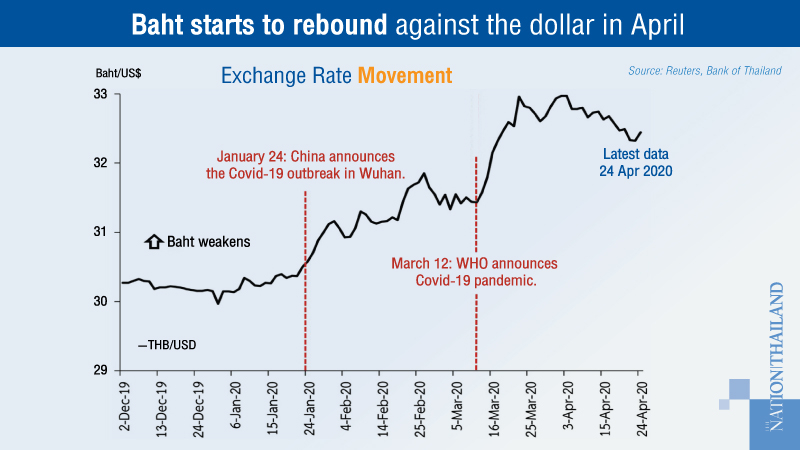
The recent strengthening of the baht against the dollar may not be sustainable, the central bank warned, though an analyst said he is cautious about the prospects of a weaker baht for the year and that it may actually be relatively strong towards the end of the year.

The baht, along with other regional currencies, has risen against the greenback now that there are signs of the novel coronavirus being contained, said Don Nakornthab, senior director at the Bank of Thailand.

The baht and other regional currencies were hit hard in March due to a fast-rising number of confirmed Covid-19 cases. The Thai currency weakened to about Bt33 against the dollar in March, but moved into the Bt32 range in recent weeks.

However, Don said the baht is still under pressure due to a sharp drop in the current account surplus resulting from a contraction in exports and a dwindling number of foreign arrivals.

The current account surplus in March dropped sharply to $700 million compared to surplus of $5.4 billion in February, he said, adding that the surplus may fall to zero if the pandemic lingers. He also pointed out that capital has been flowing out of Thailand in March largely due to foreign investors continuing to sell both equities and Thai government bonds, resulting in a capital and financial account deficit of $3.1 billion compared to a deficit of $4.4 billion a month earlier.

Tourism is usually the largest source of current account surplus, which was worth $37.9 billion last year with 39.7 million arrivals generating hard currency income for Thailand.

However, the number of tourists dropped 76.4 percent in March and is expected to drop down to 99 percent in April, Don added. Though governments across the world have started easing some lockdown measures, passenger transport is still limited, while Thailand has also extended the ban on incoming flights until the end of May.

The baht has also been less volatile in recent days as investors have seen indications that Thailand may have been successful in combating the outbreak, he said, citing the fact that new confirmed cases have been down to a single digit for four days in a row.

However, Kobsidthi Silpachai, chief of Kasikornbank’s capital markets research, said he was cautious about the prospect of a weakening baht. While the country’s current account has reduced, it is still in surplus territory, which means the demand for the currency is still greater than its supply, he said. There is also possibility that people are converting their US dollar accounts to baht as working capital becomes harder to come by because of Covid-19, Kobsidthi said.

Though there are still dividends to be paid to foreign investors in May, which could weaken the baht in the first half of this year, he conceded, adding: “But we see the baht going back to around Bt31.5 to Bt32 against the US dollar by the end of the year.”

Oil fields face disorderly shutdown despite OPEC cuts, IEA Says #ศาสตร์เกษตรดินปุ๋ย

#ศาสตร์เกษตรดินปุ๋ย : ขอบคุณแหล่งข้อมูล : หนังสือพิมพ์ The Nation.

https://www.nationthailand.com/business/30387089?utm_source=category&utm_medium=internal_referral

Oil fields face disorderly shutdown despite OPEC cuts, IEA Says

Apr 30. 2020
An OPEC sign hangs outside the OPEC Secretariat in Vienna. MUST CREDIT: Bloomberg photo by Akos Stiller.

An OPEC sign hangs outside the OPEC Secretariat in Vienna. MUST CREDIT: Bloomberg photo by Akos Stiller.
By Syndication Washington Post, Bloomberg · Grant Smith · BUSINESS, WORLD, US-GLOBAL-MARKETS 

Some oil fields are set to suffer chaotic stoppages despite efforts by OPEC to mitigate the impact of coronavirus on global markets, the International Energy Agency warned.

“Lockdown measures have caused unprecedented demand declines, whose speed and magnitude greatly exceed the normal market flexibility of supply,” the Paris-based IEA said in a report on Thursday. “Even with attempts at coordinated management, a disorderly production shutdown is likely in some places.”

Oil prices are experiencing a historic slump. The international benchmark Brent crude remains near the lowest since 2002, trading just above $20 a barrel in London, while U.S. futures fell briefly below zero last week. Even though OPEC and its partners have announced massive output cuts to offset the losses in demand, producers around the world are still under great stress.

Global oil demand is poised to slump by 9 million barrels a day, or about 9%, this year to the lowest level since 2012. Lockdowns implemented to slow the spread of the virus have triggered an unprecedented decline in transportation, the IEA said in its Global Energy Review.

The estimates are in line with those published by the agency in its latest monthly market report in mid-April. The IEA advises major economies on energy policy.

April experienced the hardest hit, with fuel consumption slumping almost a third to the lowest since 1995. By the end of March, road transport activity was down about 50% around the world, while air travel in some European countries had plunged more than 90%.

The report didn’t elaborate on where oil output will be abruptly halted, though in recent research the IEA has highlighted several vulnerable regions. The U.S., Brazil and Canada accounted for most of a 2.2 million barrel-a-day decline in supply over the past month, IEA Executive Director Fatih Birol said in a Bloomberg television interview on April 22.