New Yelp showing how the coronavirus is changes people’s behavior #ศาสตร์เกษตรดินปุ๋ย

#ศาสตร์เกษตรดินปุ๋ย : ขอบคุณแหล่งข้อมูล : หนังสือพิมพ์ The Nation

https://www.nationthailand.com/business/30384903?utm_source=category&utm_medium=internal_referral

New Yelp showing how the coronavirus is changes people’s behavior

Mar 27. 2020
Yelp data. Multiple graphics.
Photo by: The Washington Post — The Washington Post

Yelp data. Multiple graphics. Photo by: The Washington Post — The Washington Post
By The Washington Post · Andrew Van Dam · NATIONAL, BUSINESS, PERSONAL-FINANCE

The pandemic economy is taking shape. Beer, butchers, building supplies and blood-donation centers are popular. Buffets, breweries, bridal and bowling are not. And that’s just the letter B.

With every passing second, we learn more about how the coronavirus eviscerated the U.S. economy, thanks to the cottage industry that has sprung up around tracking the crisis in real time. These new sources are being widely cited as traditional economic data lags and the public and policymakers grow desperate for numbers.
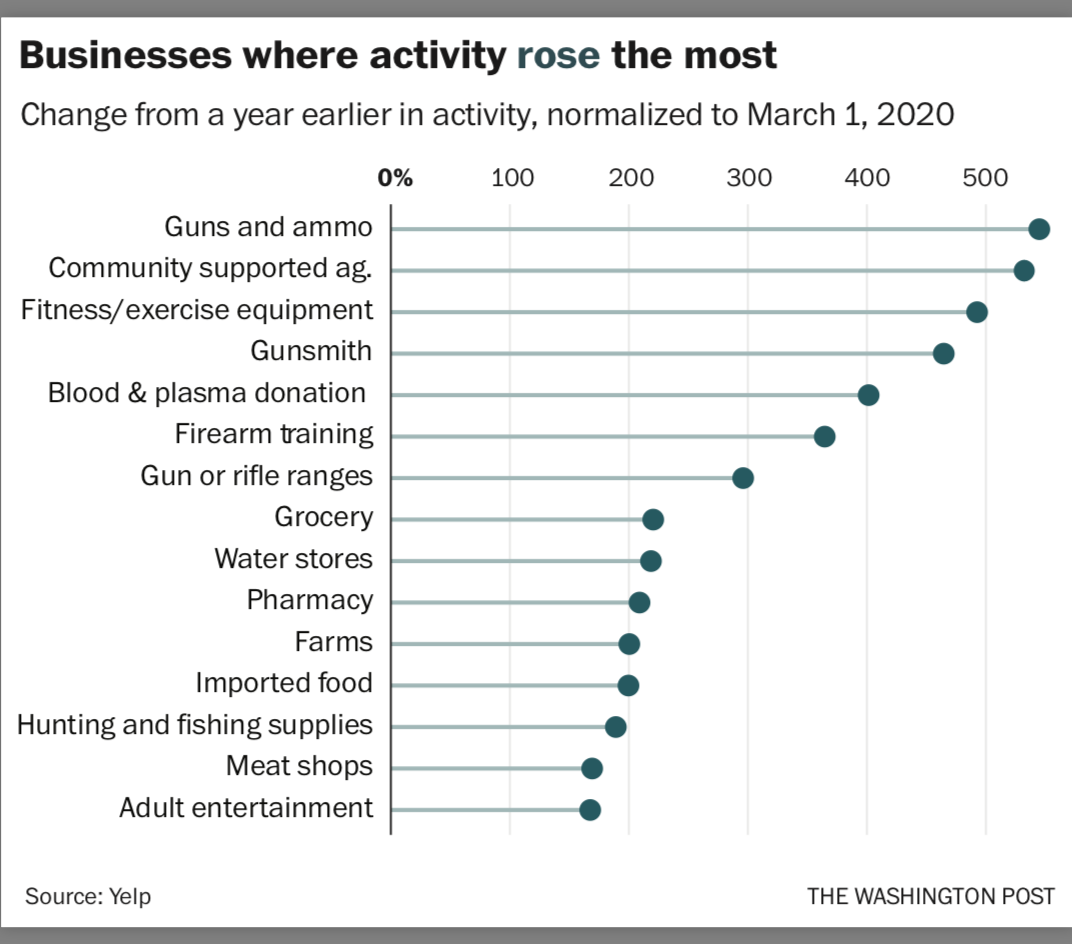
In one such effort, Carl Bialik, data science editor at the online review giant Yelp, measured how consumer interest – visiting pages, writing reviews, posting photos – in the site’s 500 largest categories changed from the beginning of March, when the country had fewer than 100 cases of the coronavirus, to early this week, when cases neared 50,000.
It reveals an inverted world. People are less interested in mortgage and tax services, and more interested in payday loans. Interest in amusement parks has cratered; interest in rifle ranges has soared.

The fastest-rising categories sound like a checklist to prepare for post-apocalyptic survival. People are seeking out weapons, hunting and fishing supplies, and fitness gear, while stockpiling water, meat, pharmaceuticals and groceries.
Among the more hopeful indicators? The surge in interest in community-supported agriculture, which was already reported by Theresa Davis in the Albuquerque Journal.

“Working with the earth and having as few hands as possible touch our produce feels good right now,” Andrea Romero of Tierra Sagrada Farm told the Albuquerque Journal.

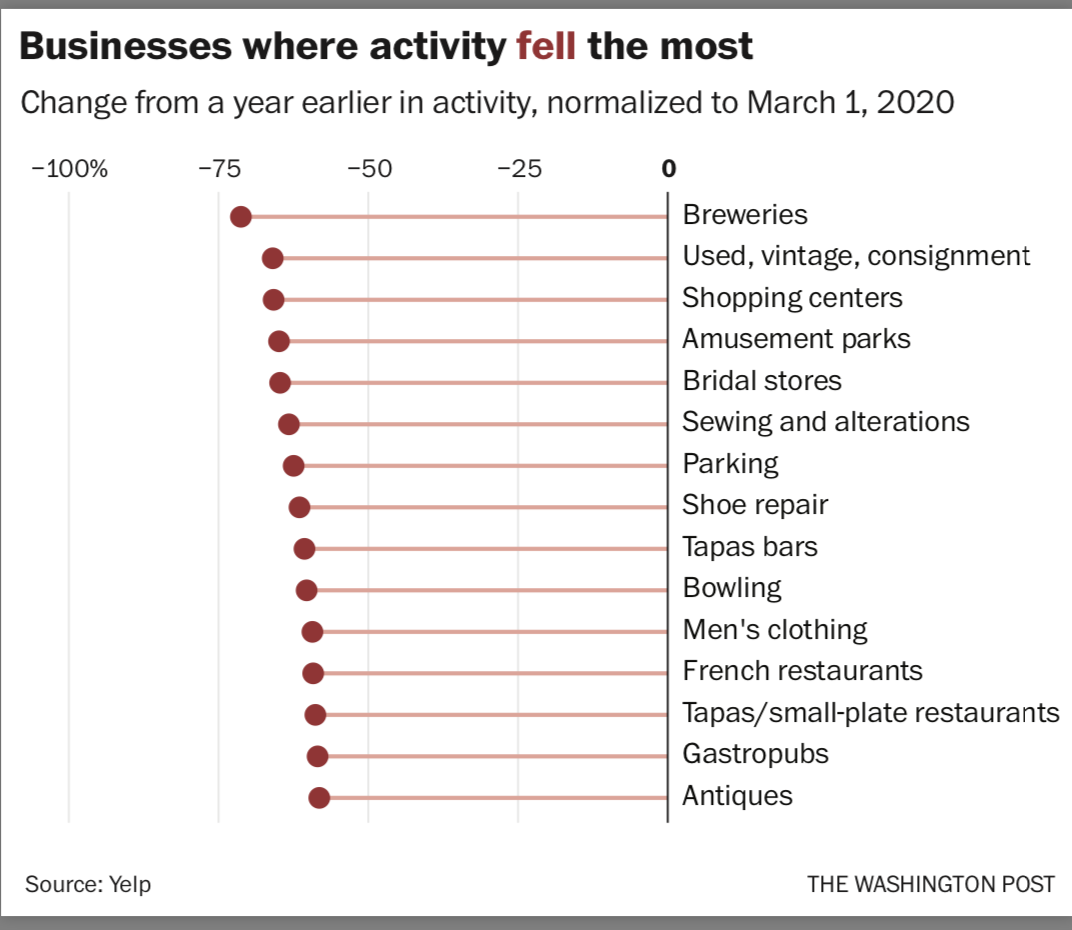
The fastest-falling categories, meanwhile, confirm what we already knew about this service industry-driven downturn. As governments continue to restrict Americans’ movements in a bid to slow the spread of the coronavirus, retail and food services are taking it hard. For businesses that rely heavily on bar sales, from breweries to gastropubs, customer interest has evaporated.

Entertainment is getting walloped as well, with amusement parks and bowling alleys both among the 15 segments hit hardest. Establishments such as these have been among the first to be closed by states as they batten the hatches in preparation for an outbreak.

How rapidly have things changed? As of Monday, the ratio of dine-in to takeout searches on the site was 83 times higher than it had been in the first week of March.

Google searches show the same trend. On the search engine, “takeout” overtook “reservations” around March 17. As with all of the new generation of real-time sources, we try to confirm patterns with multiple sources, and look at the direction and magnitude of the change rather than at precise levels.

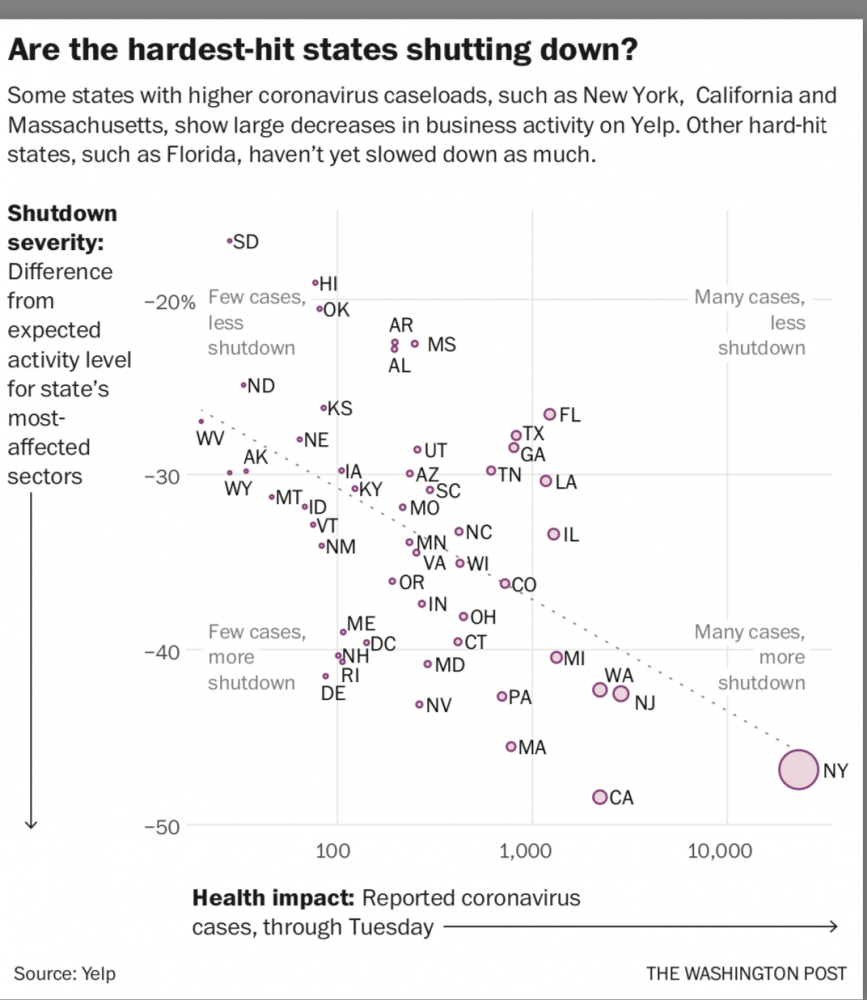
Yelp paints a portrait of a country struggling to adjust to new emergency restrictions. By their measure of social distancing, which focuses on peoples’ activity at businesses, there are big differences in the patterns of peoples’ business-related activity – even in places with similar infection levels.

Activity in the sectors hit hardest in New York and California has fallen to about half of where Yelp would expect them to be at this point in a normal year. Meanwhile, other states with high caseloads, particularly southern ones, such as Florida, are seeing much smaller declines.

According to a report from the left-leaning Economic Policy Institute, the South’s ability to respond to the pandemic has been hamstrung by a lack of paid sick leave policies, and the refusal of most Southern states to expand Medicaid.

BOT warns against panic sales of bond investment units #ศาสตร์เกษตรดินปุ๋ย

#ศาสตร์เกษตรดินปุ๋ย : ขอบคุณแหล่งข้อมูล : หนังสือพิมพ์ The Nation

https://www.nationthailand.com/business/30384898?utm_source=category&utm_medium=internal_referral

BOT warns against panic sales of bond investment units

Mar 27. 2020
Vachira Arromdee, Bank of Thailand's assistant governor.

Vachira Arromdee, Bank of Thailand’s assistant governor.
By The Nation

The Bank of Thailand has urged investors not to panic sell their investment units in bond mutual funds as returns are usually low during a market sell-off.

Vachira Arromdee, assistant governor, assured the bond market that central bank’s loans were adequate for mutual fund managers seeking liquidity via commercial banks.

She said bond investors should not rush to redeem their investment during a sell-off , given the very low rate of return.

Her comment came after TMBAM Eastspring announced on Thursday (March 26) that it had closed down two mutual funds, Thana Permpoon and Thana Paiboon, to avoid further losses to the investment of unit-holders.

The central bank launched its mutual fund liquidity facility (MFLF) on Sunday and promised to inject more than Bt1 trillion into the bond market if needed. The facility covers money market funds and daily fixed-income funds, thus its coverage extends to all bond mutual funds, she said, adding that fund managers could utilise this facility via commercial banks.

She also reassured investors that investment management companies had adequate collaterals for seeking loans under the facility from commercial banks. The central bank, she said , stands ready to provide loans to boost the confidence of investors while impact from closures of the two funds would be contained.

The central bank had started to provide loans but found few applicants, suggesting the market situation has already improved, she said.

Earlier, the Asian Development Bank said that local currency bonds in emerging Asia were facing liquidity problem as investors were concerned over impact of the Covid-19 pandemic.

Wall Street braces for dollar demand to spike at quarter-end #ศาสตร์เกษตรดินปุ๋ย

#ศาสตร์เกษตรดินปุ๋ย : ขอบคุณแหล่งข้อมูล : หนังสือพิมพ์ The Nation

https://www.nationthailand.com/business/30384902?utm_source=category&utm_medium=internal_referral

Wall Street braces for dollar demand to spike at quarter-end

Mar 26. 2020
By Syndication Washington Post, Bloomberg · Liz Capo McCormick, Anchalee Worrachate · NATIONAL, BUSINESS, US-GLOBAL-MARKETS · 

It’s taken unprecedented measures from governments and central banks the world over to bring the frenzied rush for dollars under control. A simple matter of calendar dates could help set it off again.

In the coming days, a massive allocation shift will take place as portfolio managers and corporate treasuries gear up for quarter-end, an event which often feeds into greenback strength. The worry on Wall Street is that it threatens to help reignite dollar demand and make the currency’s three-day losing streak through Thursday more of a pause than lasting pullback.

Already, rounds of Federal Reserve monetary support and a $2 trillion U.S. fiscal package in the works have failed to stamp out global dollar hoarding. Throw in a looming barrage of economic data that’s certain to be dire and it adds up yet more appreciation for the world’s reserve currency.

“We don’t think we’ve found a bottom in this crisis yet or the highs in the U.S. dollar,” said Zach Pandl, co-head of global currency and emerging-market strategy at Goldman Sachs Group Inc. “Given the sudden stop in the economy there could be some sticker shock around the incoming data over the next couple of weeks. The dollar will continue to benefit from safe-haven flows and other forces that have been lifting it.”

Thursday’s unemployment claims number was the first major data point to really show the unfolding hit of the virus to the largest economy. Claims surged to a record 3.28 million in the week ending March 21 from 282,000 a week earlier.

At the same time the extent of virus damage starts to show in data, Wells Fargo & Co. reckons the recent plunge in equities has left pension-fund portfolios so far out of balance that it will force them to dump about $40 billion in Treasuries and other debt before the month is out.

Even ignoring quarter-end, JPMorgan Chase & Co. was predicting pension and other investment funds would have to shift billions into equities to counter the historic rout.

These kinds of flows can create turmoil for currencies. The forum overseeing conduct on the $6.6-trillion-a-day foreign-exchange market warned on Thursday volatility may surge in the coming days.

“At the end of every month and even more so the end of every quarter, we tend to see strong corporate demand for the U.S. dollar,” said Athanasios Vamvakidis, head of G-10 foreign exchange strategy, Bank of America Merrill Lynch. “This seasonality is strong on our flows, particularly for end-quarter. Having said that, the global crisis may be a more important dollar driver now.”

The U.S. economic stimulus package is bigger than any seen before, but the fear in some corners is it may still fall short of what’s needed to prop up companies and Americans hit by the pandemic. Containing the outbreak has forced the economy to a sudden stop. Gross domestic product estimates vary wildly, but some economists project the worst drop in quarterly records dating back to 1947.

The dire outlook helped drive extreme moves earlier this quarter, and for some that means quarter-end flows could actually wind up capping dollar strength. The Bloomberg Dollar Spot Index dropped 0.9% as of 10:20 a.m. in New York, heading for a third day of declines after notching 10 gains in a row.

Nikolaos Panigirtzoglou at JPMorgan says so many corporations and investors dived for the greenback as equity, credit and rates markets all crashed at once that flows inevitably have to come back the other way. Meanwhile, the Fed actions have relieved some of the strains that had been driving greenback strength.

“Quarter-ends sometimes sees funding squeezes and tend to benefit the dollar as a result but this is usually in September or December,” the strategist said. “This time the central bank backstops are so huge that I envisage no funding issues into quarter end. The opposite.”

The Fed has already expanded and extended its dollar swap lines to foreign central banks, and backstops both the money-market mutual fund and commercial-paper markets where businesses turn for short-term credit.

Yet despite a raft of actions drawn from the 2008 playbook, it is still struggling to meaningfully move the needle in the shortfall in dollar funding.

Sebastien Galy, senior macro strategist at Nordea Investment Funds SA in Luxembourg, sees the dollar rising to levels lofty enough to spark U.S. intervention to weaken it, even though he expects any such action to be unsuccessful. Goldman’s Pandl also has raised the specter of intervention.

“The reality is the U.S. might intervene just to make a point even as it’s hugely inefficient as a tool,” Galy said. “The dollar relative to most of the rest of the world is probably going to remain relatively stable.”

The pandemic continues to spread, raising the prospect of more safe-haven flows. Cases worldwide have topped 480,000 and the U.S. death toll has climbed above 1,000.

“We are still going to get a series of horrible economic numbers and that will send more flows into the dollar, even given possible quarter-end rebalancing effects,” said Marc Chandler, chief market strategist at Bannockburn Global Forex. “With over $12 trillion in global credit and supply chains funded in dollars, the monetary and fiscal support isn’t enough to end the demand.”

Stocks jump on hope spending to blunt job losses #ศาสตร์เกษตรดินปุ๋ย

#ศาสตร์เกษตรดินปุ๋ย : ขอบคุณแหล่งข้อมูล : หนังสือพิมพ์ The Nation

https://www.nationthailand.com/business/30384901?utm_source=category&utm_medium=internal_referral

Stocks jump on hope spending to blunt job losses

Mar 26. 2020
By Syndication Washington Post, Bloomberg · Vildana Hajric · BUSINESS, US-GLOBAL-MARKETS

U.S. stocks rallied as investors speculated the $2 trillion rescue package poised to pass Congress will lessen the pandemic’s toll on the economy.

The S&P 500 extended its advance to as high as 4% in mid-morning, headed for its first three-day rally since February, with health stocks and utilities leading the way. Treasuries held gains and the dollar fell for a third day.

Jobless claims surged to a record 3.28 million Americans last week as businesses shut down to help prevent the spread of the virus. While the reading exceeded estimates, aid is on the way from the U.S. government to help offset the impact on workers and businesses. Federal Reserve Chairman Jerome Powell also sought to assure traders that the central bank wouldn’t run out of crisis-fighting ammunition.

“It’s no secret that times will be tough on the jobs front for the foreseeable future,” said Mike Loewengart, managing director of investment strategy at ETrade Financial. “The real question at hand now is if the current stimulus package is enough to give Americans the support they need.”

The claims data is one of the first major reports to show the extent of the damage to the American economy since states around the country began widespread business shutdowns aimed at preventing the coronavirus from spreading.

European stocks erased losses and edged higher. Sovereign debt rose after the region’s central bank announced it will scrap limits on bond purchases for its emergency program, a landmark decision that gives it almost unlimited firepower to fight the economic fallout from the virus. The euro strengthened as a gauge of the dollar headed for a third day falling.

The rescue measures across major economies are unprecedented, yet traders remain cognizant of the virus’s escalating toll. The world’s cases now top 451,000 with more than 20,000 deaths. The U.S. death toll topped 1,000.

“Investors need to remain vigilant about how the growth rate of new cases develops and how governments respond going forward,” said Oliver Blackbourn, a multi-asset portfolio manager at Janus Henderson Investors. “The support package should help to assuage the fears about the worst possible economic outcomes for individuals and companies.”

Elsewhere, oil declined after three days of gains. Gold rose. Emerging-market shares and currencies climbed.

These are the main moves in markets:

Stocks:

– The S&P 500 Index rose 3.2% as of 10:50 a.m. New York time.

– The Stoxx Europe 600 Index rose 0.1%.

– The MSCI Asia Pacific Index advanced 0.5%.

Currencies:

– The Bloomberg Dollar Spot Index decreased 1%.

– The euro advanced 0.7% to $1.0962.

– The British pound increased 1% to $1.1997.

– The Japanese yen advanced 1.2% to 109.88 per dollar.

Bonds:

– The yield on 10-year Treasuries dipped seven basis points to 0.80%.

– Germany’s 10-year yield decreased 10 basis points to -0.37%.

– Britain’s 10-year yield fell six basis points to 0.38%.

Commodities:

– Gold rose 0.8% to $1,629.52 an ounce.

– WTI oil decreased 2.7% to $23.80 a barrel.

SET rises on massive US Covid-19 relief #ศาสตร์เกษตรดินปุ๋ย

#ศาสตร์เกษตรดินปุ๋ย : ขอบคุณแหล่งข้อมูล : หนังสือพิมพ์ The Nation

https://www.nationthailand.com/business/30384893?utm_source=category&utm_medium=internal_referral

SET rises on massive US Covid-19 relief

Mar 26. 2020
By The Nation

Heavy investment in Covid-19 relief in the United States is credited with helping float the Stock Exchange of Thailand (SET) to another rise on Thursday (March 26).

The SET index closed at 1,091.96 for an increase of 11.93 points or 1.1 per cent over Wednesday’s finish.

Transactions amounted to Bt62.344 billion, with an index high of 1,103.59 points and a low of 1,072.94.

A stock analyst at Krungsri Securities said he expected the index to move between 1,065 and 1,100.

“Before the SET closed, the US Senate passed an historic $2.2-trillion bill to relieve the burden for Americans and businesses affected by the Covid-19 crisis, including handing out cash to citizens, hospitals and small enterprises,” he noted.

“Meanwhile, the US Federal Reserve’s decision to use the unlimited quantitative-easing bond-purchase programme to increase liquidity and boost the economy adds positive sentiment for overall investment.

“However, the Bank of Thailand’s Monetary Policy Committee has forecast that Thai gross domestic product this year will contract by 5.3 per cent because of Covid-19, and the emergency decree is slowing domestic economic activity and will pressure the index to slump.”

The stocks with the highest trade value today were BAM, PTT, PTTEP, ADVANC, CPALL, AOT, BH, SCC, CRC and KBANK.

The price of crude oil dropped by $0.74 per barrel or 3.02 per cent to $23.75 and that of gold by $9 or 0.55 per cent, to $1,624.40 per ounce.

As of 5pm, most regional stock markets were on the slide:

Japan’s Nikkei Index closed at 18,664.60, down 882.03 points or 4.51 per cent.

China’s Shanghai SE Composite Index closed at 2,764.91, down 16.68 or 0.6 per cent.

Shenzhen’s SE Component Index closed at 10,155.36, down 85.72 or 0.84 per cent.

Hong Kong’s Hang Seng Index closed at 23,352.34, down 174.85 or 0.74 per cent.

South Korea’s KOSPI Index closed at 1,686.24, down 18.52 or 1.09 per cent.

Taiwan’s TAIEX Index closed at 9,736.36, up 91.61 or 0.95 per cent.

Gold unchanged at close on Thursday #ศาสตร์เกษตรดินปุ๋ย

#ศาสตร์เกษตรดินปุ๋ย : ขอบคุณแหล่งข้อมูล : หนังสือพิมพ์ The Nation

https://www.nationthailand.com/business/30384891?utm_source=category&utm_medium=internal_referral

Gold unchanged at close on Thursday

Mar 26. 2020
By The Nation

Gold price was unchanged from Wednesday’s at the close today (March 26), the Gold Traders Association reported.

As of 1pm, gold bar stood at Bt24,250 per baht weight with selling price Bt24,550, while the buying price of gold ornament was Bt23,816.36 per baht weight with selling price at Bt25,050.

At Wednesday’s close, a gold bar cost Bt24,200 to buy and Bt24,500 to sell, while gold ornaments cost Bt23,770.88 to buy and Bt25,000 to sell.

As of 5pm, Gold contracts in COMEX to be delivered in April dropped by US$9.00 or 0.55 per cent to $1,624.40 per ounce as investors turned to buy risk assets after the US White House and Senate reached an agreement on relief measures for people and business sectors affected by Covid-19.

US move boosts crude price #ศาสตร์เกษตรดินปุ๋ย

#ศาสตร์เกษตรดินปุ๋ย : ขอบคุณแหล่งข้อมูล : หนังสือพิมพ์ The Nation

https://www.nationthailand.com/business/30384888?utm_source=category&utm_medium=internal_referral

US move boosts crude price

Mar 26. 2020
By The Nation

Crude price increased after the US announced an economic stimulus package of US$2 trillion as the Federal Reserve launched an unlimited quantitative easing bond purchase programme to mitigate economic impact from the Covid-19 outbreak.

The US Energy Information Administration (EIA) revealed that weekly crude oil reserves as of March 20 this year increased by 1.6 million barrels to 455.4 million, lower than market expectation of a rise to 2.8 million barrels.

Indian Prime Minister Narendra Modi has imposed a nationwide lockdown for 21 days from March 25, after over 500 new Covid-19 cases were reported on Tuesday. The move would lower oil usage in the third-largest oil consumer in the world.

Benzene fuel prices dropped in contrary to Dubai crude after India and Pakistan reduced imports of benzene fuels, while exports from China and South Korea slide.

Diesel fuel prices rose less than that of Dubai crude due to oversupply, while demand is expected to decrease further from the lockdown in India.

Stock investors find the silver lining #ศาสตร์เกษตรดินปุ๋ย

#ศาสตร์เกษตรดินปุ๋ย : ขอบคุณแหล่งข้อมูล : หนังสือพิมพ์ The Nation

https://www.nationthailand.com/business/30384887?utm_source=category&utm_medium=internal_referral

Stock investors find the silver lining

Mar 26. 2020
By The Nation

The closure of public venues to try and contain the spread of Covid-19 has benefited retail and ICT stocks.

The anti-virus measure triggered a rush to stockpile foods and other needed goods, a boon to retailers, and many ICT firms (information and communications technology) ordered employees to work from home, hiking purchases of the required equipment.

Both retail and ICT stocks reaped benefits, although prices decreased slightly due to volatile market conditions.

On the Stock Exchange of Thailand from March 16-24, retail stock prices dropped by 9.5 per cent, somewhat deeper than the index’s 9.25 per cent decline, while ICT stocks rose by 1.42 per cent.

Other stock prices were also falling with the notable exception of insurance stocks, which rose by 2.63 per cent.

Nuttawut Wongyaowarak, an analyst at Globlex Securities, has advised investors to gradually buy stocks that gain benefit during the crisis, such as Siam Makro (MAKRO), Berli Jucker (BJC), CP All (CPALL), Thai Union Group (TU) and Thai President Foods (TFMAMA).

On the ICT side he recommends Advanced Info Service (ADVANC), Intouch Holdings (INTUCH), Total Access Communication (DTAC), True Corporation (TRUE), Jasmine International (JAS), Jasmine Broadband Internet Infrastructure Fund (JASIF), Digital Telecommunications Infrastructure Fund (DIF), Com7 (COM7), SiS Distribution (Thailand) (SIS) and Synnex (Thailand) (SYNEX).

But the closing of popular public venues for 22 days has meanwhile disrupted economic activities and pressured listed companies’ profit forecasts, says an analyst at Asia Plus Securities.

“Our research department cut listed companies’ profit forecasts this year by Bt207 billion, to Bt793 billion, of which Bt110 billion has been cut on energy and petroleum stocks, Bt54 billion on commercial bank stocks, Bt47 billion on air transport and hotel stocks, and Bt10 billion on ICT stocks,” he said.

SET gains on the back of agreement in US on stimulus package #ศาสตร์เกษตรดินปุ๋ย

#ศาสตร์เกษตรดินปุ๋ย : ขอบคุณแหล่งข้อมูล : หนังสือพิมพ์ The Nation

https://www.nationthailand.com/business/30384859?utm_source=category&utm_medium=internal_referral

SET gains on the back of agreement in US on stimulus package

Mar 26. 2020
By The Nation

The Stock Exchange of Thailand (SET) Index rose by 14.99 points, or 1.39 per cent, to 1,095.02 in the morning session on Thursday (March 26).

A stock analyst at Krungsri Securities expected the index would move between 1,065 and 1,100.

“The market gained external support after the US White House and Senate reached an agreement on a US$2-trillion package to relieve the burden for Americans and business sectors affected by the Covid-19 impact, including handing out cash to citizens, hospitals, and small enterprises,” the stock analyst said.

“Meanwhile, the US Federal Reserve’s measure to use the unlimited quantitative easing bond purchase programme to increase liquidity and boost the economy will be a positive sentiment for overall investment.”

The analyst said the Monetary Policy Committee (MPC) had forecast that Thailand’s gross domestic product this year would contract by 5.3 per cent due to the Covid-19 outbreak. Besides, the slowing domestic economic activity following the emergency decree to contain the spread would pressure the index to slump.

The analyst recommended three groups of stocks for investors:

● ICT stocks which benefit from work from home trends, such as ADVANC, INTUCH, and DTAC.

● Retail stocks, which benefit from people stocking up products during the Covid-19 situation, such as CPALL and BJC.

● Food stocks, which would benefit from the weakening baht, such as CPF and TU.

Gold price rises but upside scope seen to be limited #ศาสตร์เกษตรดินปุ๋ย

#ศาสตร์เกษตรดินปุ๋ย : ขอบคุณแหล่งข้อมูล : หนังสือพิมพ์ The Nation

https://www.nationthailand.com/business/30384854?utm_source=category&utm_medium=internal_referral

Gold price rises but upside scope seen to be limited

Mar 26. 2020
By The Nation

The price of gold rose by Bt50 per baht weight on Thursday (March 26), the Gold Traders Association reported.

As of 9.29am, buying price of a gold bar was Bt24,250 per baht weight and selling price Bt24,550, while buying price of gold ornaments was Bt23,816.36 per baht weight and selling price Bt25,050.

Prices increased from the Wednesday’s close when buying price of a gold bar was Bt24,200 and selling price Bt24,500, while buying price of gold ornaments was Bt23,770.88 and selling price Bt25,000.

Gold contracts in COMEX futures dropped by US$27.40, closing at $1,633.40 per ounce as investors turned to buy risk assets after the US White House and Senate reached an agreement on measures to relieve Americans and business sectors affected by Covid-19.

An analyst at YLG Bullion and Futures advised investors to take profit if the gold price cannot rise over the line between US$1,628 and US$1,644 per ounce.

“We evaluated the support line at between 1,523 to 1,585 and resistance line at between 1,644 and 1,689,” the analyst said.