Gold prices jump #ศาสตร์เกษตรดินปุ๋ย

#ศาสตร์เกษตรดินปุ๋ย : ขอบคุณแหล่งข้อมูล : หนังสือพิมพ์ The Nation

https://www.nationthailand.com/business/30384737?utm_source=category&utm_medium=internal_referral

Gold prices jump

Mar 24. 2020
By The Nation

Gold prices rose sharply – by Bt1,150 per baht weight – this morning (March 24), the Gold Traders Association reported.

As of 9.28am, the buying price of a gold bar was Bt24,350 per baht weight and the selling price Bt24,450, while gold ornaments were Bt23,907.32 to buy and Bt24,950 to sell.

Prices increased from Monday’s close, when a gold bar cost Bt23,200 to buy and Bt23,300 to sell, with gold ornaments being Bt22,785.48 and Bt23,800, respectively.

Comex futures gold contracts rose by US$83 to $1,567.60 (Bt51,484.70) per ounce at Monday’s close as the US Federal Reserve announced massive economic stimulus measures to deal with the Covid-19 situation, which has impacted the economy.

Measures included the use of an unlimited quantitative easing bond purchase programme to support the market and enhance efficiency in using monetary policy.

The Fed also announced it would buy certain corporate bonds for the first time and increase the credit line by $300 billion, allowing businesses to borrow at lower interest during this crisis.

SET rebounds amid hopes of global stimulus measures #ศาสตร์เกษตรดินปุ๋ย

#ศาสตร์เกษตรดินปุ๋ย : ขอบคุณแหล่งข้อมูล : หนังสือพิมพ์ The Nation

https://www.nationthailand.com/business/30384730?utm_source=category&utm_medium=internal_referral

SET rebounds amid hopes of global stimulus measures

Mar 24. 2020
By The Nation

The Stock Exchange of Thailand (SET) Index rebounded by 11.79 points, or 1.15 per cent, to 1,036.25 in Tuesday’s (March 24) morning session.

A stock analyst at Krungsri Securities expected the index would rebound between 1,065 and 1,080 as central banks and governments worldwide issued economic stimulus measures.

“Although the market is still concerned that the outbreak of Covid-19 would pressure the global economy into recession, central banks and governments have moved to issue measures to deal with the situation and that would be a positive sentiment for investment,” the stock analyst said.

The analyst explained that the US Federal Reserve announced it would use an unlimited quantitative easing bond purchase programme and increase credit line by US$300 billion, allowing businesses to borrow at lower interest cost as part of a massive stimulus package.

“Investors hope that the US Senate will reach an agreement on measures to relieve the burden of the American people and businesses worth about US$2 trillion,” the stock analyst said.

“Meanwhile, the Thai Cabinet would issue measures to help those affected by the Covid-19 situation by granting money and low-interest loans at their meeting this afternoon.”

The analyst recommended three groups of stocks for investors:

● ICT stocks which benefit from work from home trends, such as ADVANC, INTUCH, and DTAC.

● Retail stocks, which benefit from people hoarding products during the Covid-19 situation, such as CPALL and BJC.

● Food stocks, which would benefit from the weakening baht, such as CPF and TU.

Wall Street recoils after massive coronavirus rescue bill trips up a second time; Dow sinks nearly 600 points #ศาสตร์เกษตรดินปุ๋ย

#ศาสตร์เกษตรดินปุ๋ย : ขอบคุณแหล่งข้อมูล : หนังสือพิมพ์ The Nation

https://www.nationthailand.com/business/30384709?utm_source=category&utm_medium=internal_referral

Wall Street recoils after massive coronavirus rescue bill trips up a second time; Dow sinks nearly 600 points

Mar 24. 2020
By The Washington Post · Rachel Siegel, Thomas Heath · BUSINESS, PERSONAL-FINANCE, US-GLOBAL-MARKETS

An unprecedented blank check from the Federal Reserve and the prospect of a $1.8 trillion stimulus package from Congress failed to slow a two-week stock purge as investors grasped for signs that progress is being made against the coronavirus.

Fresh off Wall Street’s worst week since the 2008 financial crisis, U.S. markets continued to skid Monday after the Senate failed for a second time to advance a $1.8 trillion coronavirus rescue package, even after the Federal Reserve announced unlimited bond purchases in an unprecedented move to lift the U.S. economy.

The Dow Jones industrial average and the Standard & Poor’s 500 index were plumbing lows not seen in years. The Dow closed down nearly 600 points, or 3%. The Dow is more than 35% off its all-time high of Feb. 12, 2020.

The broad S&P 500 sank 3% and the tech-heavy Nasdaq was close to flat.

The medical picture is getting worse, as New York state sees an exponential increase in reported coronavirus infections and as deaths mount around the globe.

“The last two weeks the market has been looking for some sign the virus is slowing, or that we have effective treatments for those infected or that there may be a vaccine,” said Randy Frederick, vice president of trading and derivatives at the Schwab Center for Financial Research. “This is a medical issue and we are trying to solve it with financial measures. If we are looking for a rebound, the market needs some positive health news, and they don’t see it yet.”

The markets saw a short-lived surge during futures trading after the Fed said it would purchase Treasurys and mortgage-backed securities “in the amounts needed to support smooth market functioning,” showing the central bank is willing to go far beyond the $700 billion in new purchases announced last week.

But those gains were quickly dissolved as bad news on the health front and a fiscal stimulus mount. Investors are increasingly concerned about the enormous stimulus bill the Senate is attempting to push through on Monday. On Sunday evening, Senate Democrats said the legislation did not offer enough help for individuals. Senators from both parties, as well as White House officials, said they would continue negotiations, overnight if necessary, to respond to the flood of layoffs affecting millions of Americans and the economic pillage felt by businesses in nearly every sector.

“Today’s sell-off is a combination of uncertainty in both the health side of the virus and the financial system,” said Sarat Sethi of Douglas C. Lane & Associates. “Markets hate uncertainty. The uncertainty created by Congress not being able to provide a stimulus, and by investors continuing to look for a glimmer of hope on slowing the virus, are causing additional pressure on stocks like we have seen the last couple of weeks.”

The bill would steer payments of $1,200 to most adults and include $500 for each child. It would also allocate $350 billion to small businesses to address layoffs and send billions more to hospitals and the unemployment insurance system. The measure also would create a $500 billion program for businesses, states, and localities.

“We’ve known that the magnitude of help needed has been massive and growing for days now,” wrote Mark Hamrick, senior economic analyst for Bankrate. “The Federal Reserve continues to do all it can to keep markets operating. Now, the spotlight is on elected leaders to do their jobs as well.”

On Friday, the Dow capped an especially turbulent week by shaving off more than 900 points, erasing all Trump-era gains. All three indexes are well into a bear-market – which marks at least a 20% reversal from their highs. Oil prices have plummeted as demand has evaporated and governments around the world urge people to stay in their homes to contain the spread of coronavirus.

Ed Yardeni, president of Yardeni Research, said in his morning note that the U.S. must slow the spread of the virus immediately, outlining three possible economic scenarios: “the Good, the Bad and the Ugly.”

Any “good” prospect – a growth recession with a stock market correction – was wishful thinking, Yardeni wrote.

“That leaves only the Bad and the Ugly for now,” he wrote. “The former is underway, with the global economy falling into a severe recession, the stock market in a bear market … and the Fed having lowered the federal funds rate to zero and restarted credit easing programs. The only question now is how bad will Bad be.”

Still, some argued that last week’s unprecedented actions from the Federal Reserve were showing benefits.

“At the end of a frenetic week there are optimistic signs that funding conditions are beginning to improve,” wrote Deutsche Bank Securities chef economist Torsten Sløk in a note Monday morning. “Although the peak of funding stress is likely behind us for now, we think that dollar funding will remain strained as long as markets are volatile and investors remain edgy.”

Global markets entered the week on equally shaky footing. Stocks flashed red across Europe, with Britain’s FTSE 100 down 2.75%. Germany’s DAX shed roughly 2%, and the pan-European Stoxx 3%. In Asia, Hong Kong’s Hang Seng plunged 4.86%, and the Shanghai composite dropped 3.1%.

Japan’s Nikkei 225 popped slightly and was 2% in the green after SoftBank – which is headquartered in Tokyo and controls a $100 billion tech investment fund – announced it would sell $41 billion in assets and buy its own dropping shares. Stocks of tech companies, many of which employ low-wage gig workers, have fallen precipitously as the pandemic forces consumers to travel and commute less.

Democrats again block key vote on $2 trillion coronavirus bill as Senate erupts with partisan anger #ศาสตร์เกษตรดินปุ๋ย

#ศาสตร์เกษตรดินปุ๋ย : ขอบคุณแหล่งข้อมูล : หนังสือพิมพ์ The Nation

https://www.nationthailand.com/business/30384708?utm_source=category&utm_medium=internal_referral

Democrats again block key vote on $2 trillion coronavirus bill as Senate erupts with partisan anger

Mar 24. 2020
By The Washington Post · Erica Werner, Paul Kane, Rachael Bade, Mike DeBonis · NATIONAL, BUSINESS, HEALTH, POLITICS, COURTSLAW, CONGRESS, US-GLOBAL-MARKETS
WASHINGTON – Democrats on Monday blocked a $2 trillion coronavirus rescue bill for the second day in a row as near-pandemonium erupted on the Senate floor, with lawmakers venting fury about their failed efforts to address the pandemic’s impact on the U.S. economy.
.

https://www.washingtonpost.com/video/c/embed/049f2b95-31ec-4e83-967b-65d679ac0ca3

Ahead of the vote, senators clashed angrily over delays that had bogged down the giant bill, reflecting uncertainty about whether Congress would be able to reach a deal in the coming hours or days. Some lawmakers had hoped to reach an agreement three days ago, but talks kept breaking down even as they negotiated throughout the weekend. Meanwhile the nation is reeling from the health consequences and economic pain inflicted by the virus as hope of a swift response from Congress appeared to drain away.

Democrats have argued that the Senate GOP bill is disproportionately tilted toward helping companies and needs to extend more benefits to families and health care providers. Republicans have countered that the bill – which would send checks to many individual Americans while creating giant loan programs for small businesses and industry – offers unprecedented financial assistance to the entire economy and needs to be passed before more people lose their jobs.

The vote Monday was 49-46, well short of the 60-vote threshold needed to advance the legislation for a final debate.

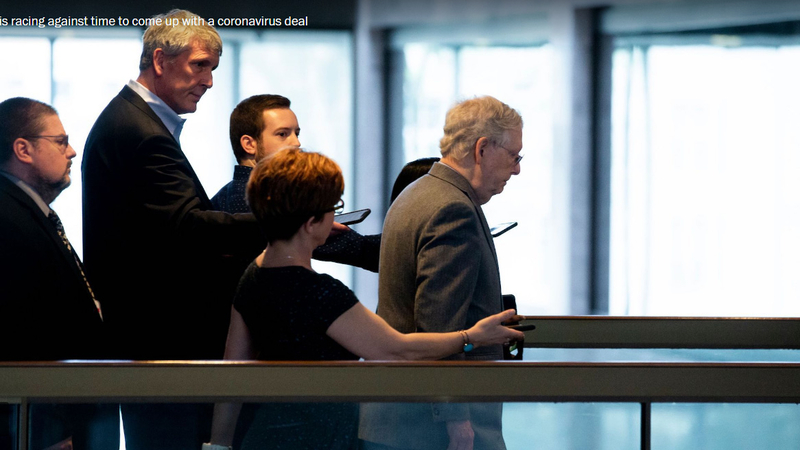
“This has got to stop and today is the day it has to stop,” an exasperated Senate Majority Leader Mitch McConnell, R-Ky., said. “The country is out of time.”

McConnell accused Democrats of holding up the sorely needed rescue package so they can try to add extraneous provisions sought by special interests and organized labor. Democrats have refused to support the key procedural vote that would have made it easier to pass the bill, with many complaining that the legislation did not include much transparency into which businesses could receive hundreds of billions of dollars in emergency loans.

Sen. Joe Manchin III, D-W.Va., said that the bill, which includes a huge $500 billion program for businesses, states, and cities makes the Senate look “more focused on the big corporations and the health of Wall Street than we are on the health care of the people in rural America and Main Street.” The Trump administration would have wide latitude to disburse these loans and loan guarantees, a dynamic that has given numerous Democrats pause.

Minority Leader Charles Schumer, D-N.Y., insisted he is continuing to negotiate in good faith with Treasury Secretary Steven Mnuchin and hopes to secure a deal as long as he can ensure worker protections are included, and that the fund for industries has appropriate controls.

“We have an obligation to get the details right, get them done quickly,” Schumer said. “That doesn’t mean blindly accepting a Republican-only bill.”

As markets fell on Monday, the Senate floor then descended into an uproar as Sen. Susan Collins, R-Maine, sought recognition to speak, which Schumer objected to, prompting Sen. Tom Cotton, R-Ark., to exclaim, “This is bullshit!” and Collins to say, “This is unbelievable.”

Schumer then argued with Sen. Ben Sasse, R-Neb., who was presiding over the Senate, to get recognized and get McConnell to explain the schedule ahead. Once that happened, the Senate agreed to proceed to a repeat of Sunday’s procedural vote, only to have it fail again.

The fireworks weren’t over on the floor as Manchin and McConnell got into it, with McConnell lecturing Manchin about Senate process in an unusual exchange.

Summing it all up was Sen. John Neely Kennedy, R-La., who took his turn on the Senate floor, shaking his head before declaring, “This country was founded by geniuses but it’s being run by a bunch of idiots.”

“You know what the American people are thinking right now?” Kennedy inquired rhetorically. “They’re thinking that the brain is an amazing organ. It starts working in a mother’s womb and it doesn’t stop working til you get elected to Congress.”

The fiery developments reflected rising tensions among lawmakers over the nation’s predicament and what’s happening in the Senate itself, where Sen. Rand Paul, R-Ky., announced Sunday he has covid-19 and four other GOP senators are quarantined. Sen. Amy Klobuchar, D-Minn., disclosed Monday that her husband, too, is infected with the virus.

The Dow Jones industrial average has lost more than 10,000 points in six weeks, and several million Americans have already lost their jobs as the economy contracts in the face of the coronavirus outbreak. A growing number of states are directing citizens to stay home to avoid more contagion, putting pressure on businesses who are losing workers and customers. Scores of companies have rushed to Washington seeking emergency assistance, and health care providers are overrun with the need for testing kits and safety equipment.

Sen. Richard Durbin, D-Ill., advised everyone to “assume the appropriate distance and take a deep breath” and also said the Senate needed to figure out how to vote remotely, something McConnell has opposed. “We should not be physically present on this floor at this moment,” Durbin said.

The situation was fluid and uncertain, but Mnuchin continued to insist progress was being made and a deal was in reach – essentially the same thing he’s been saying over three days of ultimately unsuccessful efforts.

“We are getting there. We are very close,” Mnuchin said as he exited a late afternoon meeting with McConnell, which was preceded by a meeting with Schumer.

The legislation aims to pour money into all corners of the economy, from individuals to small businesses to large industries amid a wave of layoffs and a sharp contraction in consumer spending. It would direct $1,200 to most adults and $500 to most children. It would also create a $500 billion lending program for businesses, cities and states and another $350 billion to help small businesses meet payroll costs.

Democratic concerns have focused on the $500 billion funding program for loans and loan guarantees Republicans want to create, which some Democrats are labeling a “slush fund” because the Treasury Department would have broad discretion over who receives the money. There is little precedent for a program with a similar size and scope.

Even as senators were clashing Monday on one side of the Capitol, on the other side House Speaker Nancy Pelosi, D-Calif., was holding a news conference to unveil House Democrats’ version of the stimulus bill. Pelosi’s $2.5 trillion-plus bill would send $1,500 to individual Americans, pump money into the health care system, unemployment insurance and schools and – according to a draft circulating Monday – require airlines and other companies that receive aid to pay a $15-an-hour minimum wage.

“Democrats take responsibility for our workers,” Pelosi said. “We require that any corporation that takes taxpayer dollars must protect their workers’ wages and benefits – not CEO pay, stock buybacks or layoffs.”

But if the House charts its own course on a competing piece of legislation, it could take even longer to arrive at a bipartisan consensus that can pass both chambers and get signed into law.

With more than 40,000 confirmed covid-19 cases in the United States, the impacts of the crisis were growing worse.

The $500 billion in loan programs in the Senate bill includes $425 billion for companies, states and cities, though it doesn’t prescribe many terms to dictate how Treasury determines who receives the assistance. Another $50 billion would go to helping passenger airline companies, $8 billion for cargo air companies and $17 billion to help firms deemed important for national security. And there would be an additional $350 billion in loan guarantees for small businesses to help them avoid layoffs, and many of those loans could be forgiven if firms meet certain metrics.

At the insistence of Democrats, who were participating in drafting the bill before bipartisan talks broke down over the weekend, more than $100 billion is being included for hospitals and some $250 billion to boost unemployment insurance. The sweeping economic package is designed to last for 10 to 12 weeks, after which the administration could revisit whether it would seek additional assistance from Congress.

The huge economic stimulus bill now under negotiation is Congress’ third attempt to address the coronavirus crisis. As the scope of the crisis started coming into focus early this month, Congress passed $8.3 billion in emergency spending for the public health system. Then Mnuchin and Pelosi negotiated a $100-billion-plus package that included paid sick leave, a Medicaid expansion, free vaccines and more, which the Senate passed last week despite misgivings voiced by many Senate Republicans over the structure of the paid sick leave program.

Along the way, intermittent bipartisanship has given way to occasional partisan outbursts, but partisan rancor now seems to have largely overtaken the process.


TDRI urges all-out efforts to contain Covid-19, urgent cash handouts to low-income earners #ศาสตร์เกษตรดินปุ๋ย

#ศาสตร์เกษตรดินปุ๋ย : ขอบคุณแหล่งข้อมูล : หนังสือพิมพ์ The Nation

https://www.nationthailand.com/business/30384689?utm_source=category&utm_medium=internal_referral

TDRI urges all-out efforts to contain Covid-19, urgent cash handouts to low-income earners

Mar 24. 2020
A large number of Thai labourers and migrants leave Bangkok for their hometowns, as many businesses in the capital temporarily shut down.

A large number of Thai labourers and migrants leave Bangkok for their hometowns, as many businesses in the capital temporarily shut down.
By The Nation

The government must quickly mobilise national resources to prevent the spread of Covid-19 and urgently and adequately provide financial support to low-income groups affected by the impact of the pandemic. Thailand Development Research Institute (TDRI), an independent think-tank, urged the government to step up efforts both to contain the virus and help the poor.

The research house said the government has to give priority to prevent the spread of the virus, deploying sufficient resources to deal with the pressing issue. The government has to ensure efficiency of screening, monitoring and quarantine of those who could spread the disease as they travel across the country now.

Patients have to be given proper treatment. Overtime payments, life insurance and health insurance coverage must be offered to medical personnel.

“The government should not worry about short-term fiscal position or economic growth in the short-run, but instead give top priority to public health,” said the research house.

It warned that given the rising number of new Covid-19 cases, Thailand may soon enter a crisis situation where the country’s health infrastructure may not be able to handle the outbreak and potentially lead to loss of many lives, as has happened in some countries.

The TDRI urged the government to provide adequate and timely support for low income and unemployed people. The government plans to extend the coverage of Social Security Fund to include unemployment caused by communicable disease, but that is not sufficient, said TDRI. It suggested that the government also look after those who currently are not covered by the fund. For example, taxi drivers account for 70 per cent of the informal labour force, said TDRI.

Every Thai family should be given cash handouts by the government. For example, a family with one or two members should get Bt1,500 per month for three months, those with three to four members Bt2,500 per month, and Bt500 for each extra member.

The Finance Ministry should review the database of its welfare card programme by cutting out families with higher income such as owners of land and property worth more than Bt3 million, those saving more than Bt100,000 per annum or those having salary above Bt15,000 for each member of the family. So the eligible families could be estimated to be about six to seven million, TDRI said.

The current Finance Ministry database is not accurate as it leaves out a large number of low-income earners estimated to be five to six million, or about 64 per cent of total low-income earners, TDRI noted.

The government is urged to support small and mid-sized businesses throuh rent assistance or partial labour cost in order to prevent layoffs.

The government should also cancel subsidies on tap water and electricity bills because such a support is not benefiting the right targets and even rich families are able to avail of the subsidies.

The government should run business in crisis mode not business as usual and it should not get complacent if new cases of infections decrease. The government should communicate with the public more efficiently in order to get full cooperation from them, the research house added.

Meanwhile, the Cabinet is expected to consider cash handout measures at Tuesday’s (March 24) meeting.

Petrol prices to drop 50 satang/litre #ศาสตร์เกษตรดินปุ๋ย

#ศาสตร์เกษตรดินปุ๋ย : ขอบคุณแหล่งข้อมูล : หนังสือพิมพ์ The Nation

https://www.nationthailand.com/business/30384685?utm_source=category&utm_medium=internal_referral

Petrol prices to drop 50 satang/litre

Mar 23. 2020
By THE NATION

The retail price of various types of petrol will be lowered by 50 satang per litre from tomorrow (March 24) following a decision by the Oil Fund Administrative Committee today to cut contribution to the state oil fund by the same amount.

Energy Minister Sontirat Sontijirawong said the committee also cut the contribution of B20 diesel to the fund by 25 satang per litre.

But it raised the contribution of E85 gasahol by 25 satang per litre.

The resolution is aimed at helping ease the cost of living amid the dire Covid-19 situation, the minister said.

SET plunges almost 10% over Covid-19 fears #ศาสตร์เกษตรดินปุ๋ย

#ศาสตร์เกษตรดินปุ๋ย : ขอบคุณแหล่งข้อมูล : หนังสือพิมพ์ The Nation

https://www.nationthailand.com/business/30384680?utm_source=category&utm_medium=internal_referral

SET plunges almost 10% over Covid-19 fears

Mar 23. 2020
By The Nation

The Stock Exchange of Thailand (SET) Index closed at 1,024.46 points today (March 23), a decrease of 102.78 points, or 9.12 per cent, from Friday’s close, forcing the SET to push the circuit breaker for the third time this month.

Transactions amounted to Bt59.677 billion, with an index high of 1,065.67 and a low of 1,022.83.

The SET pushed the circuit breaker yet again this month to halt trading for 30 minutes – from 3.25pm to 3.55pm – after the index dropped lower than 8 per cent.

A stock analyst at AIRA Securities expected the SET Index to fluctuate on the downside, while forecasting a support level from 1,100 points to 1,070 and a resistance level from 1,165 to 1,185.

“The market experienced negative sentiment from a decline in global stock markets after the number of confirmed Covid-19 cases in the US increased to 38,200, up 5,681 cases, or 20.9 per cent, causing worries of a global economic recession,” the stock analyst said.

The analyst said the market would gain positive sentiment from central banks in a number of countries relaxing monetary policy and issuing measures to deal with the Covid-19 impact.

“We expected that the market had already responded to this positive sentiment, but it would limit the recovery in banking stocks,” he said.

The analyst expected the Bangkok Metropolitan Administration’s move to close department stores and markets in the capital and ask the private sector to allow employees to work from home would cause short-term negative sentiment on department store and electric train stocks, while it would benefit retail stocks.

As of 4.49pm, global stocks were having a tendency to move downside.

The price of crude oil dropped by US$0.22, or 0.97 per cent, to $22.41 per barrel (Bt730.32), while the gold price rose by $10.50, or 0.71 per cent, to $1,495.10 per ounce.

The top ten stocks with the highest trade values today were BAM, PTT, CPAll, Gulf, AOT, Advanc, PTTEP, GPSC, KBank, and SCC.

Elsewhere in Asia, Japan’s Nikkei closed at 16,887.78, up 334.95 points, or 2.02 per cent.

China’s Shanghai SE Composite Index ended the day at 2,660.17, down 85.45 points, or 3.11 per cent, while the Shenzhen SE Component Index closed at 9,691.53, down 458.59 points, or 4.52 per cent.

Hong Kong’s Hang Seng ended at 21,696.13, down 1,108.94 points, or 4.86 per cent.

South Korea’s Kospi Index closed at 1,482.46, down 83.69 points, or 5.34 per cent.

Taiwan’s TaiEx ended at 8,890.03, down 344.06 points, or 3.73 per cent.

Gold further advances by Bt50/baht at close on Monday #ศาสตร์เกษตรดินปุ๋ย

#ศาสตร์เกษตรดินปุ๋ย : ขอบคุณแหล่งข้อมูล : หนังสือพิมพ์ The Nation

https://www.nationthailand.com/business/30384678?utm_source=category&utm_medium=internal_referral

Gold further advances by Bt50/baht at close on Monday

Mar 23. 2020
By The Nation

Gold price rose further by Bt50 per baht weight at the close of trade on Monday (March 23), the Gold Traders Association reported.

As of 4.11pm, buying price of a gold bar stood at Bt23,200 per baht weight and selling price Bt23,300, while gold ornament was Bt22,785.48 per baht weight to buy with selling price at Bt23,800.

Prices increased from the morning trade where a gold bar cost Bt23,150/baht to buy and Bt23,250 to sell and gold ornament cost Bt22,750/baht to buy and Bt23,750 to sell as investors turned to the precious metal amid economic uncertainties.

As of 4.49pm, Gold contracts in COMEX futures to be delivered in April rose by US$10.50 or 0.71 per cent to $1,495.10 per ounce.

Oil prices slump #ศาสตร์เกษตรดินปุ๋ย

#ศาสตร์เกษตรดินปุ๋ย : ขอบคุณแหล่งข้อมูล : หนังสือพิมพ์ The Nation

https://www.nationthailand.com/business/30384654?utm_source=category&utm_medium=internal_referral

Oil prices slump

Mar 23. 2020
By The Nation

Oil prices dropped after many governments locked down cities to prevent Covid-19 from spreading, leading to a plunge in demand, an energy analyst at Thai Oil said today (March 23).

West Texas Intermediate (WTI) and Brent crude prices dropped. The weekly WTI crude oil price dropped sharply since 1991, when the Gulf War took place, as many governments worldwide shut cities to tackle the Covid-19 virus.

Earlier, Opec and its partners led by Russia failed to come to an agreement on cutting production, causing market uncertainty amid rising crude oil volumes, while Saudi Arabia said it was prepared to increase its production capacity to a record high of 12.3 million barrels per day and increase exports.

The US planned to send Energy Department officials to Saudi Arabia to cooperate on stabilising the oil market. In addition, officials from the US state of Texas have consulted with the Opec secretary-general on the possibility of reducing oil production.

Benzene fuel prices rose more than those of Dubai crude after benzene sales increased due to low prices. The weekly benzene fuel volume in Singapore ending on March 18 dropped by 2.94 per cent.

Diesel prices rose more than those of Dubai crude after China increased imports for April due to rising diesel fuel demand in the country.

Gold prices rise by Bt50 #ศาสตร์เกษตรดินปุ๋ย

#ศาสตร์เกษตรดินปุ๋ย : ขอบคุณแหล่งข้อมูล : หนังสือพิมพ์ The Nation

https://www.nationthailand.com/business/30384653?utm_source=category&utm_medium=internal_referral

Gold prices rise by Bt50

Mar 23. 2020
By The Nation

Gold prices rose by Bt50 per baht weight today (March 23), the Gold Traders Association reported.

As of 9.29am, the buying price of a bar of gold was Bt23,150 per baht weight and the selling price was Bt23,250, while gold ornaments cost Bt22,750 per baht weight to buy and Bt23,750 to sell.

Prices increased from Saturday’s close, when a gold bar cost Bt23,100 to buy and Bt23,200 to sell, while gold ornaments cost Bt22,679.36 and Bt23,700, respectively.

Gold prices on the Gold Spot Index this morning moved to US$1,493 (Bt48,655.80) per ounce after the price increased by $5.3 to $1,484.6 per ounce at Friday’s close due to investors turning to buy the metal as a safe haven asset amid uncertainty following the economic impact from Covid-19, which hammered the US stock index and led to the dollar falling sharply.

Meanwhile, the price in the Hong Kong gold market dropped by HK$120 to $13,860 (Bt58,221) per tael.