With unprecedented force and speed, a global recession is likely taking hold #ศาสตร์เกษตรดินปุ๋ย

#ศาสตร์เกษตรดินปุ๋ย : ขอบคุณแหล่งข้อมูล : หนังสือพิมพ์ The Nation

https://www.nationthailand.com/business/30384137?utm_source=category&utm_medium=internal_referral

With unprecedented force and speed, a global recession is likely taking hold
Mar 16. 2020
By The Washington Post · David J. Lynch, Heather Long · BUSINESS 
ECON-ANALYSIS: The United States is suffering the most abrupt and widespread cessation of economic activity in its history, hurtling toward a recession that could mean lost jobs, income and wealth for millions of Americans.

Across the country, consumer spending – which supports 70 percent of the economy – is grinding to a halt as fears of the escalating coronavirus pandemic keep people from stores, restaurants, movie theaters and workplaces.

https://www.washingtonpost.com/video/c/embed/fc457529-bfd8-4a96-a69f-b3e475fa56b3

The rapid national shutdown already has caused layoffs and reverberated on Wall Street, driving stocks into their first bear market in 11 years. Amid panic selling, unusual strains have appeared in less visible market niches that are critical to the ability of businesses to operate normally.

For millions of workers, consumers and investors, the economy’s sudden stop comes as memories of the 2008 global financial crisis remain fresh. Less than 12 years ago, the economy sank into a painful recession after risky Wall Street investments tied to real estate went sour. The number of jobless workers more than doubled in the aftermath while the stock market lost more than half its value.

Some veterans of that tailspin – the worst since the Great Depression – say today’s epidemic is hammering the economy in complex ways that could prove even more difficult to combat.

“The problem is everyone in America is cutting back their consumption,” said Jason Furman, who led the Council of Economic Advisers during the Obama administration. “A lot of sectors are being hit, especially the services sector. A lot of income and spending is being reduced. That’s just an enormous shock to the economy.”

The economy has weathered numerous painful recessions and previous shocks, including natural disasters and terrorist attacks. But what’s different this time is the speed of decline and the comprehensive economic hit caused by an unpredictable health scare that interferes with Americans’ ability to produce and consume.

By the end of this month, the global economy probably will have shrunk by 1.2 percent – “not far short of the 1.6 percent drop in world output seen at the depth of the global final crisis” in the fourth quarter of 2008, according to Capital Economics in London. As the United States reels, Europe and Japan are also probably in recession.

“This is like a hurricane happening everywhere simultaneously for months and months on end,” Furman said.

The economic costs in the United States are mounting quickly. Apple Chief Executive Tim Cook said Saturday that the company is closing all stores outside China until March 27.

In Las Vegas, MGM Resorts – where several employees have tested positive for the virus – said late Friday that it would begin layoffs and furloughs in the coming week. “Business demand has decreased significantly,” CEO Bill Hornbuckle wrote in a letter to employees, which was first reported by the Las Vegas Review-Journal.

As Americans hunker down at home because of the health scare, eateries are among the hardest hit. Within three weeks of the first reported coronavirus death in a Seattle suburb, restaurant reservations in the city fell nearly 60 percent, according to OpenTable, the online service.

In Boston, Ayr Muir, who runs Clover Food Lab, a 12-restaurant chain, said he expects “a very serious drop-off” in sales. Several of his restaurants are on, or near, college campuses that are closing. Others are in business districts that have become ghost towns as workers telecommute.

https://www.washingtonpost.com/video/c/embed/e96febc9-34a7-420f-8c7e-b76b30505449

Muir said he knows of restaurants that have closed rather than risk incurring additional debt riding out an extended business interruption.

“”I think it’s less about people choosing not to go out and more that they’re not there,” he said. “I think this is going to end up being a pretty dramatic period, certainly for smaller businesses, but some larger ones, too.”

On the corporate front, the Big Three automakers and their suppliers pleaded with the Trump administration for a delay in the planned June 1 scheduled implementation of a new North American trade deal.

“We are in the midst of a global pandemic that is significantly disrupting our supply chains, and the industry is throwing all available resources into managing production through this crisis,” an industry statement said.

The eventual economic damage could be massive. More than 18 million Americans work in industries that are being hurt by the initial efforts to contain the virus: travel and tourism; spectator sports; museums; hotels; railways; and the performing arts, according to economist Michael Feroli of JPMorgan Chase.

Activity in this roughly $2 trillion slice of the economy will be significantly depressed for three months, he wrote in a note to clients Thursday, longer if the virus does not dissipate in the summer.

A sign of what’s ahead came Friday, when Delta Air Lines said it is slashing flights by 40 percent, the largest reduction in its history, surpassing even that executed after the Sept. 11 terrorist attacks. “The speed of the demand falloff is unlike anything we’ve seen – and we’ve seen a lot in our business,” Ed Bastian, Delta’s chief executive, wrote in a note to employees.

The U.S. economy that President Donald Trump hailed in January as “the best it has ever been” will be smaller at the end of June than it was on New Year’s Day, according to Feroli. And it will shrink in the second quarter at an annual rate that exceeds the decline at the time the failure of the investment bank Lehman Brothers turned the 2008 downturn into a cataclysm.

“If we don’t change the trajectory, we are certainly headed for a worse outcome than officials are indicating,” said Simon Johnson, who was the International Monetary Fund’s chief economist in 2008. “We’ve never experienced a shock like this.”

Still, many economists, including Feroli, anticipate an economic rebound in the second half. That assumes that the coronavirus outbreak ebbs, perhaps because of warmer weather. But amid tremendous uncertainty about the disease, all such forecasts are tentative.

On Friday, Treasury Secretary Steven Mnuchin said the president was moving quickly to counter the epidemic and ensure that the economy rebounds before year’s end. The House early Saturday passed legislation, backed by Trump, that would spend billions of dollars on medical tests, paid sick leave for affected workers and unemployment insurance.

“This isn’t like the financial crisis. We have a medical situation that has shut down and will shut down parts of the economy like we’ve never seen,” Mnuchin told CNBC. “But then they’re going to open back up and I think there’s going to be a lot of demand.”

In 2008, the economy felt the effects of problems that originated in the financial markets. This time, the virus-induced paralysis of real activity is putting key financial channels at risk of seizing up.

A key worry is the ability of businesses to access sufficient cash to fund their routine operations. As companies from Main Street to the oil patch fret about paying their bills, many are drawing down their bank credit lines.

Leaders of the largest U.S. banks told Trump on Wednesday that – thanks to deeper reserves and years of Federal Reserve stress tests – they are financially sound. But banks will face enormous pressure to keep funds flowing to businesses that are struggling to keep their doors open.

Minutes after the president’s prime-time coronavirus speech Wednesday, Linda Schreiber, owner of travel agency Starship Travel outside Chicago, started hunting for a financial lifeline.

Virus fears have resulted in numerous cancellations of spring break trips, graduations and destination weddings that account for most spring bookings. “It’s horrible timing for this to happen,” she said. “People are canceling left and right.”

The next day she secured a small-business loan to cover two months of overhead and salaries for 29 employees. If the downturn continues past the two-month window her loan covers, she plans to close one location and reduce her staff to part time.

“I’ve been through 9/11, Zika, MERS, SARS; I’ve been through it all over 34 years,” she said. “With this, the timing couldn’t have been worse.”

The resulting pressure has been most evident in bond markets. Typically, as stocks plummet, investors buy U.S. government bonds, which are widely viewed as a haven. But last week, both stocks and bonds sold off.

As stock prices plunged, some hedge funds sold Treasury bonds to raise cash to repay borrowings they had used to make risky investments. Cash-strapped energy companies likewise sought to turn their government securities into cash. And banks that needed cash to fund their business customers did the same.

“Bank treasurers are faced with a choice: Support their corporate customers who want a line of credit or deploy capital to markets. It’s clear which one they’re choosing: their customers,” said Guy LeBas, chief fixed income strategist at Janney Capital Management.

In the trading frenzy, bond sellers demanded much higher prices than the handful of ready buyers would accept – an extraordinary sign of dysfunction in a market that is usually the epitome of order.

“What happened is the Treasury market became one-sided: everyone is selling and not many people are buying,” said Roberto Perli, a former Fed official in 2008 and now a partner at Cornerstone Macro.

The Fed stepped in twice in recent days to inject extra cash to grease bond market operations. That came on top of the Fed’s March 3 interest rate cut of half a percentage point, which did little to calm the market. More aid might be needed and could come on or before the central bank’s next rate-setting meeting scheduled for Wednesday.

Further complicating the economic outlook is an intensifying oil price war involving Saudi Arabia and Russia.

Oil prices face a one-two punch. The coronavirus is idling people, trucks and ships, causing a collapse in demand. And after price-setting talks between the Organization of Petroleum Exporting Countries and Russia broke down this month, the Saudis opted to increase production. That flooded the market with oil and sent prices spiraling toward levels not seen since the late 1990s.

“We’ll see a huge surge in oil supply over the next few weeks and no demand for it. We think the price will dip into the $20 range and could even touch the teens,” said Francisco Blanch, head of commodities and derivatives research at Bank of America.

At those prices, the United States’ shale oil and gas boom is in trouble. Most U.S. and European companies can’t survive for long with oil below $40 a barrel, many analysts say. On Friday, the president announced that the government will buy oil on the open market to fill the nation’s strategic reserves.

The news nudged oil up a few dollars per barrel, but prices remain well below the break-even point for most producers. Goldman Sachs predicts that nearly one-third of the oil and oil services companies in the country will vanish, acquired by rivals or driven out of business.

Traders are watching for signs that energy companies may default on their debts, a development that would batter regional banks in Texas and Oklahoma and could cascade through the $10 trillion corporate bond market.

For now, analysts say the financial pain is unlikely to be as widespread as in 2008 because fewer financial products are linked to these securities in the way that mortgages were used to create complex derivatives during the housing bubble.

Even so, investors are nervous. Overall financial conditions – a measure of access to credit that takes into account interest rates, currency values and bond yields – are tighter than they have been in nearly a decade, since a 2011 scare over a potential sudden slowdown in China.

And when Wall Street opens Monday, analysts will be watching potential trouble spots such as risky corporate borrowings called leveraged loans and exchange-traded funds, a popular consumer investment, for any hint of bottlenecks.

Govt plans more stimulus packages to prop up economy #ศาสตร์เกษตรดินปุ๋ย

#ศาสตร์เกษตรดินปุ๋ย : ขอบคุณแหล่งข้อมูล : หนังสือพิมพ์ The Nation

https://www.nationthailand.com/business/30384138?utm_source=category&utm_medium=internal_referral

Govt plans more stimulus packages to prop up economy

Mar 16. 2020
Kobsak Pootrakool, secretary to the Council of Economic Ministers

Kobsak Pootrakool, secretary to the Council of Economic Ministers
By The Nation

More stimulus packages are in the pipeline to counter the impact of the Covid-19 outbreak, a senior official said, while an economist has urged the government to expand the fiscal deficit to up to Bt 600 billion.

Kobsak Pootrakool, secretary to the Council of Economic Ministers, said that economic ministers would consider extra packages as relief for certain sectors hit hard by the coronavirus pandemic after the government had recently implemented a stimulus package.

He said that the spread of the coronavirus is expected to end by the end of June and after that it would be a recovery phase for the economy. The government had implemented 14 measures on March 6 to counter the virus impact, but they may not be adequate, according to Korbsak who is also deputy secretary-general to the Prime Minister for Political Affairs.

He said currently half of the foreign tourists visiting Thailand las year still visited this year, but they are all expected to leave soon, resulting in an even larger impact on the already reeling tourism industry. The number of tourists last year touched 39.7 million, up 4.2 per cent year on year, while total revenue was Bt1.93 trillion, up 3 per cent over 2018.

If things go as forecast, the Thai economy will return to normal in the fourth quarter of this year, he said.

However, the government has to closely monitor the situation as Europe has become the epicentre of the pandemic and the United States has declared a national emergency in its efforts to deal with the infections. “The virus outbreak could stay with us for the whole year, then we have to think about how we could do more to shore up the economy,” he warned.

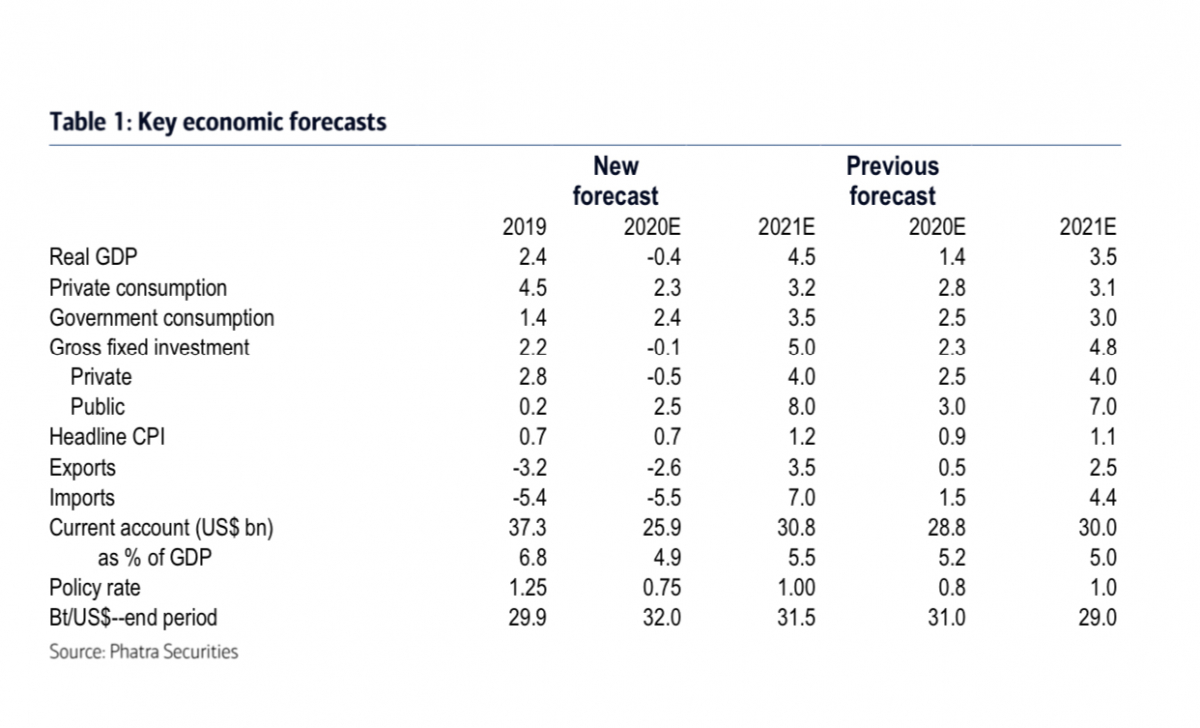
Phatra Securities has cut its gross domestic product forecast from 1.4 per cent to a contraction of 0.4 per cent due to the impact of the coronavirus outbreak.

The tourism industry, which accounts for 12 per cent of GDP, will be hard hit as the number of tourists will drop by 50 per cent in the first half of the year, said Phatra. Then it will slowly recover in the third and fourth quarters and lower oil prices will have little positive impact on growth. For the full year, the number of visitors are expected to drop by 25 per cent over 2019, said Phatra.

The US Federal Reserve is expected to cut its benchmark interest rate to zero at its meeting on March 25. The Fed’s move would press the Bank of Thailand to lower by 25 basis points the key policy rate to 0.75 per cent, which will be a historic low, added Phatra.

Meanwhile, Anusorn Tamajai, director of the Economic and Business Research Centre at Rangsit University, said that the BOT may need to introduce quantitative easing, or bond purchases in the next few months, as the central bank may need to inject large liquidity into the market to support businesses as the Fed, Bank of Japan and European Central Bank have been doing. The Thai central bank may also need to drastically cut policy rate, he suggested.

The Finance Ministry should consider increasing the fiscal deficit from Bt450 billion to Bt600 billion for the current fiscal year in order to have more funding to fight the coronavirus and shore up the economy. More stimulus package should prevent the economic growth rate from going below 1 per cent, he said.

If the government can maintain economic growth at around 1 per cent this year, public debt would stay at below 50 per cent of GDP. However, if economic conditions deteriorate further, debt-to-GDP could shoot up to 70-80 per cent of GDP in next five to seven years, he warned. As of January 31, public debt-to-GDP was 41.3 per cent, totalling Bt 6.98 trillion, versus Thailand’s GDP value of Bt 16.9 trillion. The government targets public debt at below 60 per cent of GDP given its fiscal prudence benchmark.

In tobacco country, Trump’s tariffs hit hard for growers and communities #ศาสตร์เกษตรดินปุ๋ย

#ศาสตร์เกษตรดินปุ๋ย : ขอบคุณแหล่งข้อมูล : หนังสือพิมพ์ The Nation

https://www.nationthailand.com/business/30384114?utm_source=category&utm_medium=internal_referral

In tobacco country, Trump’s tariffs hit hard for growers and communities

Mar 15. 2020
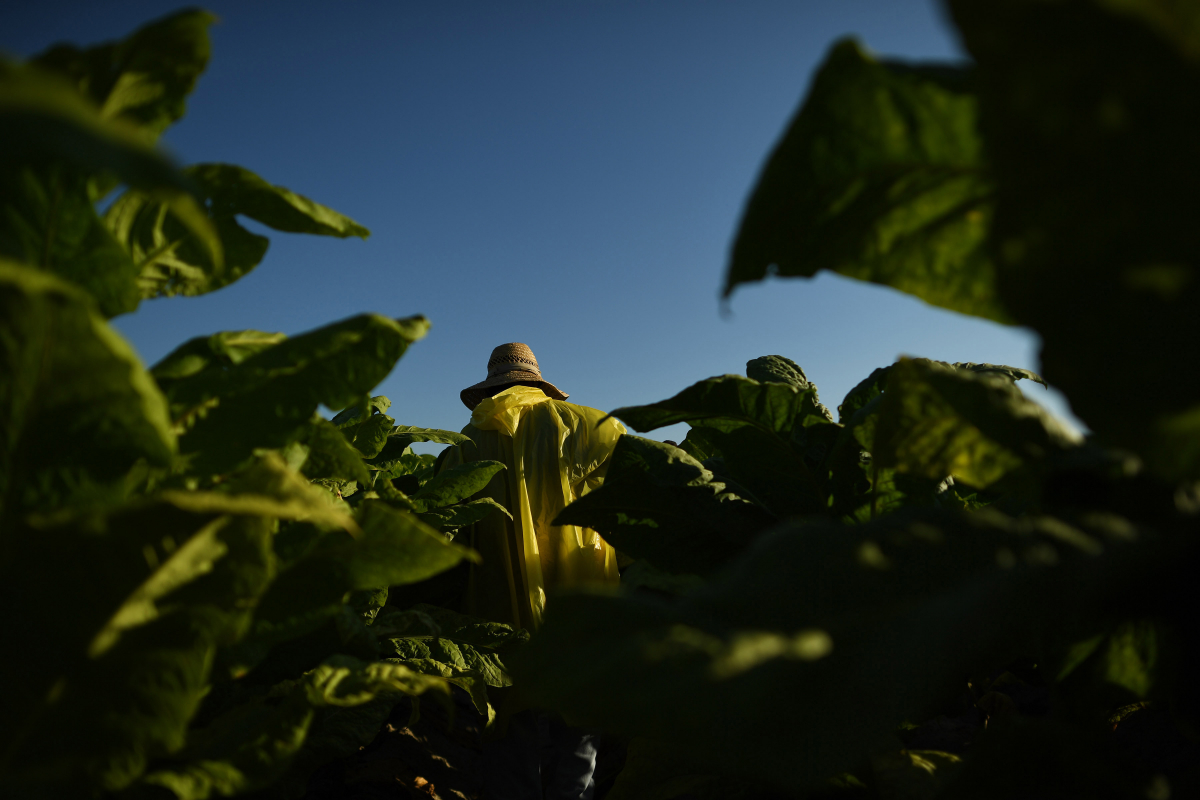
A worker picks tobacco in a field on July 8, 2016, in Deep Run, N.C. Tobacco growers have lost about $250 million since 2018, when tariffs caused China, their largest customer, to stop buying. MUST CREDIT: Washington Post photo by Matt McClain

A worker picks tobacco in a field on July 8, 2016, in Deep Run, N.C. Tobacco growers have lost about $250 million since 2018, when tariffs caused China, their largest customer, to stop buying. MUST CREDIT: Washington Post photo by Matt McClain
By  Special to The Washington Post · Amanda Abrams · NATIONAL, BUSINESS, WORLD

WILSON, N.C. – A generation ago, the annual opening of the tobacco market was a big event in this eastern North Carolina city. Bales of sweet-smelling tobacco leaves lined the warehouses downtown. People crowded in – politicians looking to boost their credentials with the powerful agriculture community, local reporters covering the market, farmers and their families and, of course, merchants ready to make a sale.

Today, that activity is privatized, with transactions taking place in offices, buildings and factories away from the public eye. The shift obscures the crisis facing growers throughout the South, as well as the industry and those depending on it.

A laborer works in a tobacco field on land on July 28, 2016, in Albertson, N.C. Lowered demand for tobacco has far-reaching impacts on communities that revolve around farming it, including fewer hired laborers and layoffs from large employers. Tobacco farmers affected by President Trump's tariffs were not eligible for government subsidies like other crop farmers, and it is still unclear how the November presidential election will be affected in purple North Carolina, which Trump won by only three points. MUST CREDIT: Washington Post photo by Matt McClain

A laborer works in a tobacco field on land on July 28, 2016, in Albertson, N.C. Lowered demand for tobacco has far-reaching impacts on communities that revolve around farming it, including fewer hired laborers and layoffs from large employers. Tobacco farmers affected by President Trump’s tariffs were not eligible for government subsidies like other crop farmers, and it is still unclear how the November presidential election will be affected in purple North Carolina, which Trump won by only three points. MUST CREDIT: Washington Post photo by Matt McClain

“You don’t see it, but a lot of these people are hurting bad,” says former Democratic congressman Bob Etheridge, who led the state office of the U.S. Farm Service Agency from 2014 through 2017.

“Devastating is the word,” says Rick Smith, president of the Independent Leaf Tobacco Co., who has spent a half-century buying and selling tobacco around the world. “The agricultural community is struggling. They’re all struggling.”

The pain is especially acute in North Carolina, where 2,000 growers are suffering from the loss of their biggest customer: China. Thanks to the tariffs on Chinese imports that President Donald Trump imposed in 2018, tobacco sales to that country have ground to a halt. In this state alone, growers have lost roughly $250 million since then. But unlike farmers raising soybeans or vegetables, cows or pigs, they weren’t eligible for federal bailout payments intended to soften the tariffs’ blow.

And despite 2020 opening with a new trade agreement and the potential for greater farm exports to China, much remains in limbo as spring nears. Seeds need to be planted in greenhouses this month so they can be transplanted to the fields in April and then harvested in late summer.

The uncertainty is endangering individual livelihoods, not just of growers but of the workers who earn offseason dollars in the processing plants. It’s also threatening rural communities, which have long been buoyed by tobacco money, and exacerbating the divide between them and North Carolina’s booming urban areas.

While many growers are still stalwart Trump fans, some wonder if there will be repercussions at the polls in November.

Wilson County farmer David Hinnant is feeling the pain. “We did take a hard hit. It’s cut all of us back,” he admitted recently.

Hinnant’s family has been in the area since the late 1700s, growing tobacco through the generations. Nowadays, thanks to the past profits from tobacco, he and his son also plant sweet potatoes, corn, soybeans and peanuts on their 3,000-acre farm.

“Tobacco enabled us to do these things,” said Hinnant, 67, whose weathered face and hands bear testament to a lifetime of work outdoors. “We didn’t get rich, but we made a living.”

Over the past few years, those profits have shrunk tremendously because of the trade war. Hinnant and his son are trying to figure out alternatives, but nothing brings in the kind of money tobacco once did.

The sandy soils in the eastern part of the state nurture some of the best flue-cured tobacco in the world, and about half of all tobacco produced in the United States comes from North Carolina. The crop had stayed relatively lucrative compared to others, especially since China started buying U.S. tobacco around 2005. In 2017, much of the 300 million-plus pounds of tobacco sold abroad went to that country.

Trump’s tariffs hit the following year, at a point when farmers already had a crop in the ground. Some did get paid for their harvest, but the inventory meant for China remains in U.S. warehouses. Last year was a complete bust between the tariffs and Hurricane Dorian, which destroyed many plants just before the end of the season. Ultimately, no North Carolina farmers got contracts for sales to China. The resulting glut has depressed market prices.

Tobacco cultivation has dropped considerably; last year, North Carolina farmers harvested 117,000 acres, down from 177,000 a decade earlier. Most now grow other crops; still, some are barely hanging on. According to the American Farm Bureau Federation, 16 family farms in North Carolina filed for bankruptcy in 2019, up from 12 the previous year.

The economic troubles ripple outward; one of the region’s biggest private employers, Vidant Health, announced possible layoffs a month ago. Economists have estimated that every dollar earned from tobacco results in almost $4 in new spending – on farm equipment, fertilizer, labor and other purchases in the community.

“Wages that aren’t earned aren’t spent,” said Graham Boyd, executive director of the North Carolina Tobacco Growers Association. “Churches feel the effect – farmers can’t tithe as much. So does the booster club at school, automobile dealerships, service people. It’s significant.”

In Wilson, located about 40 miles from the capital of Raleigh, the impact has been somewhat cushioned. Both the city and its surrounding county, which bears the same name, have had more success than others in the region at attracting manufacturing firms such as a Bridgestone tire plant and a Merck biopharmaceutical facility. Those have brought in new opportunities and dollars in recent years.

Yet Wilson County’s median household income of $42,850 is still $10,000 less than that of the state. And the economy still depends on tobacco. All the big companies, including U.S. Tobacco Cooperative, British American Tobacco, Philip Morris and Pyxus, have a presence here. Some responded last year by consolidating their facilities; others simply didn’t hire seasonal workers.

It’s unclear what all this might mean for presidential politics come November. Trump won this deeply purple state by three points in 2016 and largely had the support of white farmers. But eastern North Carolina is home to a high percentage of African-Americans, many of whom vote Democratic. Wilson County, for one, went for Hillary Clinton in the last election.

Tobacco farmers don’t seem to blame Trump for their tariff-related troubles. The trade imbalance had to be addressed, many say; they just happened to be in the crosshairs. “I can’t say I was angry at the government. Some adjustments needed to be made,” Hinnant explained.

In fact, notes longtime political analyst Thomas Mills, founder and publisher of the website PoliticsNC, the tariffs issue could wind up boosting Trump’s support.

“At least he’s standing up for [farmers], in their minds,” Mills said. “These small towns in rural communities have been taking hit after hit after hit. To blame it on Trump now is, in their minds, wrong.”

Etheridge, the former Farm Service Agency leader, warns that such support is not a given – especially if the Democratic challenger takes their needs seriously.

“A lot of those farmers voted for the current administration because no one was speaking to them,” he said. “I think if someone comes out with a policy and follows through, I think they’ll listen.”

Though hopeful about the recent trade deal with China, tobacco growers here have little clarity so far about its actual details. Many still don’t have contracts with buyers outlining exactly how much tobacco they need to grow.

Hinnant has already seeded over half of his greenhouses despite the continuing uncertainty. He’s taking the long view. “As farmers, we’re optimists. We’re optimistic that 2021 sets us back on track.”

Luxury shoppers in China emerge from quarantine to buy again #ศาสตร์เกษตรดินปุ๋ย

#ศาสตร์เกษตรดินปุ๋ย : ขอบคุณแหล่งข้อมูล : หนังสือพิมพ์ The Nation

https://www.nationthailand.com/business/30384113?utm_source=category&utm_medium=internal_referral

Luxury shoppers in China emerge from quarantine to buy again

Mar 15. 2020
A pedestrian wearing a protective mask and rain coat stands in front of a shopping mall at night in Shanghai on Feb. 12, 2020. MUST CREDIT: Bloomberg photo by Qilai Shen.

A pedestrian wearing a protective mask and rain coat stands in front of a shopping mall at night in Shanghai on Feb. 12, 2020. MUST CREDIT: Bloomberg photo by Qilai Shen.
By Syndication Washington Post, Bloomberg · Robert Williams, Jinshan Hong · BUSINESS, WORLD, RETAIL, ASIA-PACIFIC 

Chinese shoppers are slowly returning to the glitzy malls and boutiques where they’ve been driving growth of the global luxury industry as coronavirus quarantine measures relax.

Store traffic in China is creeping back up after falling as much as 80% at the virus outbreak’s peak there earlier this winter, hammering sales of brands ranging from Burberry Group to Gucci. The recovery could accelerate in the coming weeks, fueled by so-called “revenge spending” sprees.

Amrita Banta, managing director at Agility Research, used the term — previously coined to describe pent-up Chinese consumer demand that was unleashed in the 1980s after the chaos and poverty of the Cultural Revolution — to describe buying by luxury clients whose pockets are flush with cash after weeks of canceled plans.

“China seems to have turned the corner and bigger cities are showing cautious optimism,” she said. “We see a slow but definite bounce back.”

Chinese shoppers made up more than one-third of the luxury industry’s sales and about two-thirds of its growth in recent years. When Beijing imposed lockdowns in late January to stem the spread of the coronavirus, sales ground to a halt just as the key Lunar New Year vacation period was getting started.

What had previously seemed like a disastrous first quarter for the industry is poised to turn into a poor first half, as luxury hubs like Italy ramp up their own quarantine measures and the virus spreads in major markets like the U.S.

Even as the virus spreads globally, there are signs that China’s own outbreak is coming under control. The country reported only two-dozen new cases of the disease on Wednesday, down from hundreds or thousands per day a few weeks ago. And luxury brands such as Hermes International are reopening shops.

“We see a slow improvement in the business in China,” Salvatore Ferragamo Chief Executive Officer Micaela Le Divelec Lemmi said Tuesday. “On top of the traffic, the mood of the Chinese customers will also be relevant. After a month and a half of closures and restrictions, there is a will to come back and have a real life.”

Andy Li, who works in financial technology, agrees. The 29-year-old has already gone to the Maoye mall, in the northern Shanxi province, three times since quarantine measures eased two weeks ago. The mall, which houses brands including Kering’s Gucci and Bottega Veneta, checks shoppers’ temperatures before allowing them to enter. Guests must also wear masks.

“I was trapped in my home for an entire month,” Li said. “Our residential compound was chained up, and we were not allowed to go anywhere. Now I feel somewhat free again.”

He tried shopping more online during the quarantine, but said the products he ordered got stuck in customs amid logistics delays.

Hermes says it has reopened all but two of its stores in mainland China, after closing 11 locations when quarantine measures were at their peak. Chow Tai Fook Jewellery Group, the world’s biggest jeweler by sales, said about 85% of its more than 3,600 Chinese stores resumed operations this week.

Flight cancellations and restrictions on sales of package tours have made it harder for Chinese tourists to travel internationally, which could accelerate a shift to buying more at home rather than on shopping trips abroad. That trend had already taken hold as lower import duties and taxes made local shopping more attractive.

It’s unlikely that revenge spending will make up for all of the lost sales. The outbreak is likely to reduce industry sales by as much as 40 billion euros ($45 billion) in 2020, according to the survey of 28 top executives undertaken by Boston Consulting Group and Sanford C. Bernstein. And not everyone will be racing back to the mall as quarantine measures relax.

“It all comes down to the confidence of the consumers,” said Jason Yu, managing director at Kantar Worldpanel Greater China. Many people who work in the service sector or run smaller companies saw their incomes damaged by the epidemic, he said, and might be more likely to weed out non-essential spending from budgets.

While the number of officially confirmed new cases in China has slowed sharply, there’s a risk that infections could rise again now that more people are resuming activities. Travelers could spark new outbreaks by bringing the virus back to China from abroad.

Despite the grim first quarter — with revenue seen falling between 25% and 33% worldwide — Ferragamo still expects sales growth in China this year, but only if the coronavirus’s impact continues to fade. With limited visibility, the Florence, Italy-based brand said it’s cutting production and suspending all investments “not considered fundamental.”

“Like all our competitors, we have to live on a 24-hour basis,” Le Divelec Lemmi said.

Govt in bid to stop short sales of shares, create support fund to boost Thai bourse #ศาสตร์เกษตรดินปุ๋ย

#ศาสตร์เกษตรดินปุ๋ย : ขอบคุณแหล่งข้อมูล : หนังสือพิมพ์ The Nation

https://www.nationthailand.com/business/30384096?utm_source=category&utm_medium=internal_referral

Govt in bid to stop short sales of shares, create support fund to boost Thai bourse

Mar 14. 2020
By The Nation

Deputy Prime Minister Somkid Jausripitak has urged the Stock Exchange of Thailand (SET) and the Securities and Exchange Commission (SEC) to issue measures to prohibit short sales and delay forced sales of stocks, even as the government plans the establishment of a stock support fund.

He explained that the decline in stock market indexes this week has occurred worldwide due to uncertainty following the Covid-19 pandemic.

“Investors in the US were concerned about this situation, causing the Dow Jones Index and other global indexes to fell sharply,” he said.

“The Thai stock market still has good fundamentals, so we have to create confidence and set appropriate rules and tools to look after the index.”

He said that he had instructed SET President Pakorn Peetathawatchai to discuss with the SEC rules to prohibit short sales in stocks.

“For investors who buy stocks by using margin, the SET and SEC will consider extending the duration or limit of the investment to delay forced sale as well,” he said.

He said that he would propose to Prime Minister Prayut Chan-o-cha the establishment of a stock support fund on March 16.

“Also, we will establish a committee to supervise and manage the fund, with representatives from the Ministry of Finance, SET, SEC, and Bank of Thailand,” he said.

“This fund will not use budget but will use funds from the cooperation between government agencies, state banks, and the private sector.

“We are still not able to determine the fund size, but it would be large enough to create confidence among investors that we have a certain amount of money to look after our capital market.”

He said that in 1997, a stock support fund was established with a fund size of around Bt30 billion, which was able to calm down the market. “At this moment, we would need more money because our market has a large market capitalisation of about Bt16-17 trillion,” he said.

He added that once the fund was established, investors must consider the appropriate time to buy stocks as well.

U.S. markets surge on Trump’s emergency coronavirus declaration after wild day of trading #ศาสตร์เกษตรดินปุ๋ย

#ศาสตร์เกษตรดินปุ๋ย : ขอบคุณแหล่งข้อมูล : หนังสือพิมพ์ The Nation

https://www.nationthailand.com/business/30384075?utm_source=category&utm_medium=internal_referral

U.S. markets surge on Trump’s emergency coronavirus declaration after wild day of trading

Mar 14. 2020
By The Washington Post · Thomas Heath, Taylor Telford · NATIONAL, BUSINESS, US-GLOBAL-MARKETS 

Stocks surged on Friday to end a tumultuous week marked by some of the biggest extremes in trading history. Heading into the weekend, most investors are stranded deeply in the red for 2020 and trying to sort through the economic unknowns of the coronavirus.

The Dow Jones industrial average shot to its biggest point gain ever. The blue chips closed the day up 1,985 points, or 9.36 percent, at 23,185. The Standard & Poor’s 500 and Nasdaq jumped 9.29 percent and 9.35 percent on the day. It was Wall Street’s biggest rally since 2008.

The gains arrived after two days of misery, with the Dow losing 1,464 points on Wednesday and 2,352 on Thursday, its worst day since the 1987 crash. The sell-off came despite central banks around the world moved to shore up the economy against coronavirus fallout, which has battered global markets for weeks.

Investors are flattened as they head into the weekend with no end in sight. A month ago, the 11-year bull market was still reigning and the Dow, S&P and Nasdaq were resting on their record highs. But the inscrutable coronavirus struck, and within a few weeks the bull market was over and all three indexes were down 20 percent.

The S&P 500 lost 8.8 percent on the week and is down 19.9 percent in the 17 days since its all-time high. The Dow lost 10.36 percent this week and is 21 percent off its all-time high, according to S&P Dow Jones Indices. For 2020, the Dow is down 18 percent, S&P 500 is down 16 percent and the tech-heavy Nasdaq is 12 percent in the hole.

“Investors don’t know what to do,” David Donabedian, chief investment officer of CIBC Private Wealth Management, wrote in commentary Friday.” People are casting about so the period of extraordinary volatility is probably not over. Until we see more calm in the market, and better news on the path of COVID-19, a sustained recovery in markets is unlikely.”

Friday’s chaos was in line with the hyperactive trading on display all week, caused by investor anxiousness over the coronavirus. Even before the trading bell rang, S&P 500 futures had spiked 5 percent, triggering the New York Stock Exchange’s “limit up” brake that’s designed to temper excessive optimism and ensure orderly trading at the open.

Emergency action by the Federal Reserve to free up $1.5 trillion to smooth operations of the massive U.S. Treasury market and an Oval Office speech from President Donald Trump outlining the beginning of the White House’s response to the U.S. outbreak sent investors into complete panic Wednesday, resulting in a jaw-dropping 10 percent decline for the Dow and the week’s second forced halt to trading.

Wall Street’s stunning meltdown over the past month has erased most of the stock market gains since Trump’s surprise election in November 2016. At its Feb. 12 peak, the Dow had climbed more than 61 percent; by Thursday’s close, that number had been shaved to roughly 11 percent. That number improved Friday, but is far off the 61 percent of a month ago.

Some analysts believe a recession is already underway, and that the market swoon has further – some say much further – to go.

“The coronavirus likely tips us into a recession because we were hit with a one-two punch from the virus,” said Dan Niles of AlphaOne Capital Partners, a San Francisco hedge fund. “It is both demand and supply destruction, unlike 9/11 or the tech bubble bursting, which was just demand.”

Asian markets were gutted Friday, with Japan’s Nikkei 225 shedding more than 6 percent, while Hong Kong’s Hang Seng Index closed down about 1.1 percent. But European markets shared in the rebound after one of their worst days in history, boosted by intervention plans from the European Central Bank. The benchmark Stoxx 600 index finished Friday up 1 percent gain, a big rebound from its 11 percent loss Thursday.

Earlier this week, the World Health Organization designated the coronavirus a global pandemic. The disease has sickened more than 135,000 worldwide and killed nearly 5,000. And after months of edging closer, the coronavirus has taken root throughout the United States and upended daily life for the foreseeable future.

Scores of states have shuttered public schools, leaving parents to find child care or miss work. The NCAA canceled “March Madness,” its premier annual showcase, disappointing millions of fans. Major League Baseball and the National Hockey League likewise placed their seasons in limbo joining the National Basketball Association, which acted one day earlier.

Musicians are postponing tours or canceling them altogether. Public tours of the White House have been canceled and the U.S. Capitol and congressional office buildings will be off-limits to tourists starting April 1. Even Mickey Mouse was sidelined when Disneyland said it would close through the end of this month.

“At this point, almost everyone in the country who is paying attention knows about the problem, knows about the risks, and knows in some detail about what to do to mitigate those risks. We are at maximum public awareness – and probably at least close to maximum public fear,” Brad McMillan, chief investment officer at Commonwealth Financial Network, wrote in commentary Friday. “Given this maximum awareness, I would suggest we may also be close to maximum economic and market impact.”

Aviation board nods to relief package for airlines #ศาสตร์เกษตรดินปุ๋ย

#ศาสตร์เกษตรดินปุ๋ย : ขอบคุณแหล่งข้อมูล : หนังสือพิมพ์ The Nation

https://www.nationthailand.com/business/30384031?utm_source=category&utm_medium=internal_referral

Aviation board nods to relief package for airlines

Mar 14. 2020
By THE NATION

The Civil Aviation Board yesterday (March 13) approved five relief measures proposed to ease the financial burden of airlines which have been reeling from impact of the Covid-19 outbreak, said Transport Minister Saksayam Chidchob after a meeting.

He will submit the measures to the Cabinet on March 17. If approved, they will come into effect immediately.

Topping the list is a 50 per cent reduction in landing and parking fees for all Thai and foreign airliners from April 1 to December 31.

Another will cut the arrival and departure fee to Bt10 per passenger per flight from Bt15 for all foreign and Thai airlines, effective from April 1 to December 31.

The board also approved a reduction in office rental fees for Thai airlines.

Saudis send oil tanker rates soaring with huge booking spree #ศาสตร์เกษตรดินปุ๋ย

#ศาสตร์เกษตรดินปุ๋ย : ขอบคุณแหล่งข้อมูล : หนังสือพิมพ์ The Nation

https://www.nationthailand.com/business/30384053?utm_source=category&utm_medium=internal_referral

Saudis send oil tanker rates soaring with huge booking spree

Mar 14. 2020
By Syndication Washington Post, Bloomberg · Alex Longley, Jack Wittels, Firat Kayakiran · BUSINESS, US-GLOBAL-MARKETS 

Saudi Arabia is snapping up oil tankers as the kingdom prepares to flood the world with crude causing a surge in the cost of transporting crude.

The world’s largest exporter, which began hiring extra ships almost as soon as a pact with Russia to limit oil supplies fell apart, has now provisionally hired 25-30 giant carriers to load late this month or early next, according to six shipbrokers and executives involved in the market. It’s rare for Saudi Arabia’s state tanker company to book other companies’ ships as it’s doing now. The cargoes in question would be enough to supply France for about a month.

The Saudis’ forays into the tanker market come at a time when the country has told customers it will massively ramp up deliveries to regions including Europe at heavily discounted prices. The bookings have caused a ship shortage as well as a surge in tanker earnings and the shares of owners like Frontline Ltd. and Euronav NV. Crude is trading deep in a so-called contango price structure, where spot barrels are so cheap that traders try to store them at sea for sale at higher prices later.

“It’s a great time to be a tanker owner,” said Burak Cetinok, head of research at Arrow Shipping Group Ltd., a ship broker in London. “The near term prospects for the tanker market are exceptionally positive.”

The tankers booked by Bahri, Saudi Arabia’s tanker company, have so far mostly been for loading in late March or early April, one of the people said. It’s commonplace for at least some charters to fall through for a mix of commercial and operational reasons. Of the 25-30, the vast majority are Very Large Crude Carriers, or VLCCs, each designed to transport 2 million barrel cargoes, the people said.

A deal that Saudi Arabia had been proposing to restrict oil supply fell apart on March 6 when Russia declined to back the plan. A day later, Saudi Arabia announced huge crude-price discounts for refiners, and by Wednesday it was clear the kingdom would ship far more than normal.

Earnings from benchmark tanker rates jumped 700% the past week to $243,000 a day, according to data from the Baltic Exchange in London.

Over the past week, Saudi Arabia, Russia, Iraq, Nigeria and the United Arab Emirates have all indicated plans to lift supply in the coming months. That’s pushed charter rates to their highest level in 5 months, with tanker owners hoping to profit as long as the price war goes on.

“Fundamentally, the current spike in rates is driven by a surge in Saudi oil production and hence can be seen as an oil supply push,” Clarksons Platou analysts including Frode Moerkedal said in a note.

Traders are inquiring about crude tankers to store oil, following the return of a so-called super-contango structure. In such markets, companies can buy oil cheaply, store it on ships for a period of time, and then sell it at a higher price later, potentially making millions.

Frontline said earlier in the week that both oil traders and majors had been inquiring about such floating storage options. Vitol and Shell were among the companies looking to book ships with options for storage this week, according to fixture reports seen by Bloomberg. Product tanker company Torm said it has recently received several floating storage requests across various fuel markets. The surge in freight rates has diminished the appeal of storing.

Frontline is up 44% this week, Euronav 23%, while DHT Holdings Inc has gained 26%. Torm has rallied 20%.

Like floating storage, some vessels may also sail slower in order to reach their destination later, when a cargo is likely to be more valuable, Robert Hvide Macleod, the chief executive officer of Frontline’s management company said. Though oil tankers are generally contracted to sail at 13 knots, one newbuild supertanker was seen sailing from Asia to Europe at about 2 knots slower than that speed with a cargo on board.

The freight rates soared because first older vessels were hired as floating storage, which removed a factor that limits a surge in shipping rates, and secondly charterers rushed to secure tonnage to haul additional Saudi oil, according to Brian Gallagher, investor relations manager at Euronav.

“It looks like it will persist into April loading programs meaning tanker markets will benefit well into the second quarter,” he said.

Despite resurgent optimism among shipowners, there are still reasons to be cautious. Last time rates reached these levels, requests to book ships were subsequently canceled, with the market then dropping. On Friday, China’s top oil trader was said to be trying to get out of loading some cargoes from the Middle East after the most recent spike in freight.

Still, with Saudi Arabia continuing to underpin the market, some owners are starting to believe that this time may be different.

“Not only is Bahri going on a chartering spree, but also the traders and other majors are also joining the party,” said Randy Giveans, a shipping analyst at Jefferies. “We expect rates to remain near these record high levels for at least the next few weeks.”

Airbnb adds U.S. to virus refund policy after travel ban #ศาสตร์เกษตรดินปุ๋ย

#ศาสตร์เกษตรดินปุ๋ย : ขอบคุณแหล่งข้อมูล : หนังสือพิมพ์ The Nation

https://www.nationthailand.com/business/30384045?utm_source=category&utm_medium=internal_referral

Airbnb adds U.S. to virus refund policy after travel ban

Mar 14. 2020
By Syndication Washington Post, Bloomberg · Olivia Carville · BUSINESS, TECHNOLOGY 

Airbnb added the U.S. to its coronavirus refund policy after President Donald Trump limited travel to the country from most of Europe this week.

The San Francisco-based company announced Friday that guests would now be eligible for full refunds for reservations in the U.S. booked on or before Friday with a check-in date of April 1 or earlier.

The policy was also extended to travelers coming from the U.S. who have reservations in the Schengen Area of Europe, which includes 26 countries such as France, Germany, Poland, Portugal, the Netherlands, Spain and Switzerland. This applies to reservations made on or before March 11 for travel from March 13 to April 13, the company said.

As covid-19 brings travel to a grinding halt across the world, Airbnb has been under mounting pressure to extend its refund policy beyond China, Italy and South Korea. The late-stage startup has been fielding complaints from angry guests who have been forced to cancel travel plans beyond these three countries and have been denied a refund.

Unlike big hotel chains, Airbnb is a two-way platform, which means for every guest cancellation it approves there is a host at the other end who winds up out of pocket. As the company tries to strike a balance between the two, many guests have been left to negotiate over refunds with their hosts, who are not always willing to be flexible.

Airbnb takes a cut of reservations, so cancellations eat into its revenue at a time when the company is seeking to list its stock on the public market. The U.S. is Airbnb’s biggest market.

“We will continue to assess the situation and will provide further information as matters progress,” the company said in a statement on Friday. “We strongly advise all travelers to carefully review and select appropriate cancellation policies according to personal needs and the outlook on covid-19.”

Oil’s shocking crash drags prices toward worst week since 2008 #ศาสตร์เกษตรดินปุ๋ย

#ศาสตร์เกษตรดินปุ๋ย : ขอบคุณแหล่งข้อมูล : หนังสือพิมพ์ The Nation

https://www.nationthailand.com/business/30384044?utm_source=category&utm_medium=internal_referral

Oil’s shocking crash drags prices toward worst week since 2008

Mar 14. 2020
A pump jack in the Permian Basin area of Texas. MUST CREDIT: Bloomberg photo by Angus Mordant.

A pump jack in the Permian Basin area of Texas. MUST CREDIT: Bloomberg photo by Angus Mordant.
By Syndication Washington Post, Bloomberg · Jackie Davalos, Alex Longley · BUSINESS, US-GLOBAL-MARKETS

Oil is set to end its most dramatic week in recent memory with the biggest plunge since 2008, as major producers prepare to drench the market with supply just as the coronavirus crushes demand.

While futures fluctuated on Friday, prices are down about 24% this week. The crash was triggered by the collapse of talks between members of the OPEC+ group. Instead of reaching a deal to cut output to mitigate the fallout from the virus, producers led by Saudi Arabia and Russia embarked on a war for market share and pledged to pump more.

Crude has also been roiled by turmoil across global markets, with investors uncertain if efforts by policy makers worldwide will be enough to tackle the economic impact of the spreading corononavirus. Apart from battering economies who are dependent on energy revenue, oil’s collapse is also hitting U.S. shale producers by forcing them to cut spending and dividends.

The schism between Moscow and Riyadh is hardening with Russian oil producers planning to ramp up output next month, and no plans for a detente with Saudi Arabia. The kingdom said earlier in the week that it would boost output by more than 25% in April, while it sends a rush of crude to Europe, Russia’s traditional market.

“The cancellation of OPEC’s Joint Technical Committee meeting on March 18 sends a very clear signal that neither Russia nor Saudi Arabia are willing to blink just yet,” Paola Rodriguez, senior market analyst at Rystad Energy, said in an email.

Oil has now been pushed to levels more volatile than the 2008 financial crisis. Gasoline prices were also rattled, falling by a fifth on Thursday as U.S. President Donald Trump issued a travel ban from Europe as part of an effort to contain the spread of the virus.

Trump is said to have plans to declare a national emergency on Friday over the coronavirus outbreak, invoking the Stafford Act to open the door to more federal aid for states and municipalities.

Meanwhile, the oil market’s structure has already returned to a so-called super-contango, indicating a big oversupply.

“Demand is falling, refining margins are weakening, Saudi crude oil exports are surging: the super-contango is back,” Petromatrix Managing Director Olivier Jakob wrote in a report. “It will be difficult for Saudi Arabia to regain control of the markets.”

Global policymakers have so far been powerless to stem the coronavirus-driven rout that has threatened a global recession. Signs of stimulus in the U.S. came as House Speaker Nancy Pelosi said she’s near an agreement with the Trump administration on a bill to mitigate the impact of the virus. Meanwhile the European Central Bank left interest rates unchanged, although it took steps to boost liquidity.

West Texas Intermediate was down 0.6% to $31.32 a barrel on the New York Mercantile Exchange as of 11:43 a.m. local time.

Brent crude slipped 0.2% to $33.17 a barrel on the ICE Futures Europe exchange; it’s over 26% lower this week.

The global benchmark’s premium to WTI reached as little as $1.09 on Friday, the least since late 2016.