Coronavirus panic, stunning market declines fan recession fears #ศาสตร์เกษตรดินปุ๋ย

#ศาสตร์เกษตรดินปุ๋ย : ขอบคุณแหล่งข้อมูล : หนังสือพิมพ์ The Nation

https://www.nationthailand.com/business/30383791?utm_source=category&utm_medium=internal_referral

Coronavirus panic, stunning market declines fan recession fears

Mar 10. 2020
Photo by: The Washington Post — The Washington Post

Photo by: The Washington Post — The Washington Post
By The Washington Post · Heather Long, Thomas Heath, Will Englund, Taylor Telford · BUSINESS, PERSONAL-FINANCE, US-GLOBAL-MARKETS

The coronavirus outbreak fanned new fears of a worldwide recession on Monday, as well as an all-out oil price war, sending stock markets spiraling down to new record lows not seen since the 2008 financial crisis.

The Dow Jones industrial average shed 2,014 points, or 7.8%, on Monday, the largest decline since the financial crisis. Stocks fells so sharply, that they tripped a so-called “circuit breaker” that halted trading for 15 minutes. Oil prices tumbled 24%, its worst day since the 1991 Gulf War, as the coronavirus weakens demand for fuel, with Saudi Arabia and Russia refusing to scale back production.
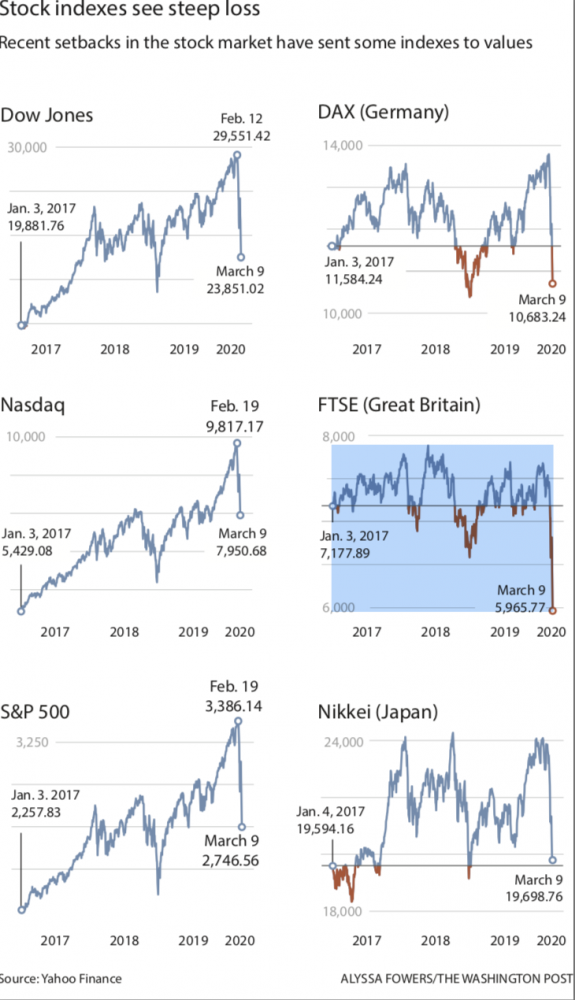
Photo by: The Washington Post — The Washington Post

Photo by: The Washington Post — The Washington Post

The outbreak continues to spread at a rapid clip with more than 113,000 cases worldwide, prompting Italy and Israel to take new extreme quarantine measures Monday. The director of the World Health Organization called the threat of a coronavirus pandemic “very real.”

At an impromptu presidential news conference Monday, President Donald Trump announced new plans to cut payroll taxes, relieve hourly workers, and help the airline, cruise, hotel and travel industries. He said more details about the administration’s economic response would be released Tuesday.

“We are going to take care of and have been taking care of the American public and the American economy,” Trump said.

The U.S. tally of known infections of covid-19, has passed 500 spanning across 30 states. The growing outbreak has wreaked havoc on the travel and tourism and manufacturing supply chains on a range from cars to smartphones. Americans are increasingly staying at home, choking off the spending that normally fuels the U.S. economy, and setting off alarms that a recession could be underway.

Many stores, restaurants, gyms and entertainment venues are seeing reduced traffic, an indication that the financial pain is spreading. That’s on top of ports, railroads and trucking companies seeing anemic business as the flow of goods and supplies from China has slowed sharply.

The economy faced a fresh blow over the weekend as oil prices dropped to about $30 a barrel, a level at which few American oil producers can survive for long.

There’s widespread agreement that the U.S. and global economies will come to a standstill this spring, a debilitating fall that carries major risks. Whether it turns into a full recession – defined as six straight months of contraction – depends largely on whether governments can act quickly enough to contain the virus and ensure that there is not a massive wave companies defaulting, layoffs mounting and Americans running out of cash.

“A global recession is more likely than not,” said Mark Zandi, chief economist at Moody’s Analytics. “The line between an expanding economy and recession is crossed when investors, businesses and – most important – consumers lose faith. Faith that they will have a job, that they will receive a paycheck, and that their retirement nest egg is safe.”

Uncertainty reigns over questions of how long the virus will stick around, how many people will be affected and whether the Trump administration can rise to the twin challenges of a health and economic crisis.

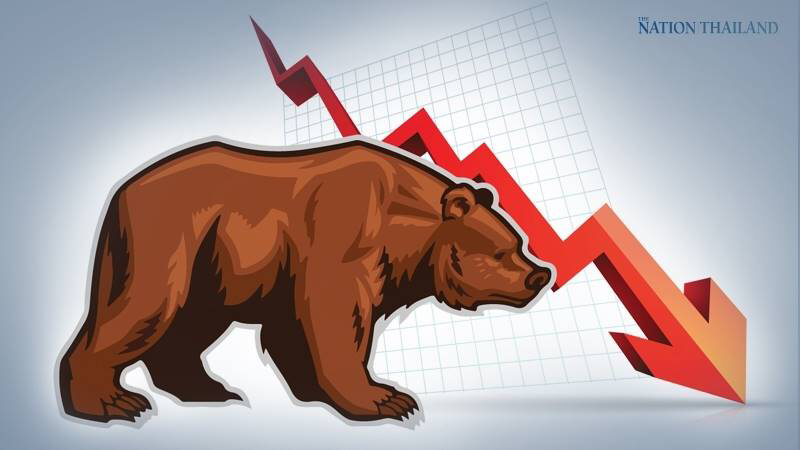
As the stock markets approached a 20% fall in value from its most recent high, stocks came close to so-called bear market territory. If the markets fall into a bear market, it would mark the end of an 11-year bull market run of rising stocks that began on March 9, 2009. At the end of trading Monday, the Dow had shed more than 19% since its record high from Feb. 12.

Minutes into the opening of the New York Stock Exchange, stocks had fallen so much, so quickly that they tripped the “circuit breaker.” That has not happened since 1997, and it immediately forced a 15-minute brake in trading on the hopes that investors would re-assess. When the timeout was temporary ended, stocks barely budged, staying at low levels all day.

Circuit breaker rules were put in place after 1987’s “Black Monday,” when a market plunge wiped out $500 billion in a single day – at the time the biggest single-day drop in history – and the equivalent of about $1.1 trillion today.

On coronavirus Monday, the market shed $1.87 trillion of value, according to analyst Howard Silverblatt of S&P Dow Jones Indices. Investors are waiting for clarity, many say, and they are unlikely to get it soon.

“Markets hate uncertainty and there is a ton of it currently in play,” said Greg McBride, chief financial analyst at Bankrate.com.

The other major force weighing on the markets Monday was the collapse of oil prices, which tumbled to about $30 a barrel range, off from about $45 a barrel last week, after Saudi Arabia and Russia deadlocked over production. The Saudis had been pushing for a cut in output to prop up prices but reversed course when Russia balked and decided, instead, to flood the market with hundreds of thousands of additional barrels per day – a move analysts fear may trigger a price war.

As oil prices sank, investors rushed to dump energy stocks. Continental Resources of Oklahoma lost half its value Monday, and Pioneer Natural Resources Company of Texas shed more than a third.

Trump cheered the lower oil prices because they make it cheaper for Americans to buy gas at the pump. Yet, as the United States has grown into a powerhouse energy player, lower prices can have devastating impacts on U.S. companies and regions of the country that rely heavily on oil and gas jobs. Pennsylvania has more than 36,000 people working in the shale gas industry, and neighboring Ohio has close to 18,000, according to Labor Department data.

“If these prices go on for too long, there will be a lot of bankruptcies,” said Jack Allardyce, an oil and gas research analyst at investment firm Cantor Fitzgerald Europe. “You need at least $40 a barrel to break even for production in the United States, and most won’t be making money at those prices.”

Fears are growing that some companies might default on their corporate debts. Initially the concern was centered on airlines and travel businesses that have been hit particularly hard by coronavirus fears, but the list of companies on the critical watch list has spread to include energy, transportation and possibly restaurants.

Investors are betting on a worst-case scenario for the economy. On Monday, yields on the popular 10-year U.S. government bond fell below 0.4% for the first time, an unthinkable level only a few weeks ago and a signal that economic growth is expected to be almost nonexistent.

Economists are also concerned about low-income Americans, many of whom live paycheck to paycheck. As more Americans stay home across the country, waiters and service workers get fewer hours and tips. Some workers do not get paid sick leave for that time. If unemployment, which is at a half-century low, starts to rise sharply in the coming months, that’s enough to weigh on confidence in the economy and spur consumers to pull back even more on spending.

“People who really don’t have a buffer are going to spend less on everything. We could see this soon. And if we start to see consumer spending slip, then we have a big problem,” said economist Claudia Sahm, one of the leading experts on downturns and the director of macroeconomic policy at the Washington Center for Equitable Growth. “I’m worried about a recession. I really am.”

Despite the rapid decline in markets, financial advisers overwhelmingly recommend that most Americans should not panic and stay invested. U.S. stocks have always rebounded. While many people worry about getting out of the market before it drops, it’s equally important to invest again before the market rises. Almost no one gets both those timing cues right, which is why it’s usually better to stay invested.

“For the individual investors, this shows how crazy it is to try to do market timing,” said James Angel, a finance professor at Georgetown University’s McDonough School of Business “You often see the biggest upturn right after a downturn. The best year for stocks was 1933.”


Gold prices fall by Bt100 #ศาสตร์เกษตรดินปุ๋ย

#ศาสตร์เกษตรดินปุ๋ย : ขอบคุณแหล่งข้อมูล : หนังสือพิมพ์ The Nation

https://www.nationthailand.com/business/30383790?utm_source=category&utm_medium=internal_referral

Gold prices fall by Bt100

Mar 10. 2020
By The Nation 

The price of gold fell by Bt100 per baht weight at close today (March 10), the Gold Traders Association reported. At 4.44pm, the buying price of a gold bar was Bt24,600 per baht weight and selling price Bt24,700, while prices of gold ornaments were Bt24,149.88 and Bt25,200, respectively.

The gold price dropped from morning trade, when the buying rate of a gold bar was Bt24,700 and the selling rate Bt24,800; gold ornaments were priced at Bt24,256 and Bt25,300, respectively.

Meanwhile, Comex futures gold contracts to be delivered in April increased by US$3.30 to $1,675.70 (Bt52,692) per ounce at Monday’s close due to uncertainty amid the dire Covid-19 situation and declining oil prices at the time, which is affecting the global economy.

West Texas Intermediate crude oil contracts today fell almost $30 per barrel after the Organisation of Petroleum Exporting Countries and its partners led by Russia were unable to reach an agreement to cut oil production at a meeting in Vienna last Friday, resulting in Saudi Arabia initiating an oil price war by unilaterally cutting prices.

In addition, oil prices were under pressure amid health worries, affecting oil demand after the World Health Organisation said that the number of Covid-19 patients worldwide had increased to more than 100,000, with 4,027 people having died.

The number of Covid-19 patients in the United States was put at 708, with 27 deaths so far.

SET rises ahead of central banks’ meetings #ศาสตร์เกษตรดินปุ๋ย

#ศาสตร์เกษตรดินปุ๋ย : ขอบคุณแหล่งข้อมูล : หนังสือพิมพ์ The Nation

https://www.nationthailand.com/business/30383789?utm_source=category&utm_medium=internal_referral

SET rises ahead of central banks’ meetings

Mar 10. 2020
By The Nation

The Stock Exchange of Thailand (SET) Index closed at 1,271.25 today (March 10), up 15.31 points(1.22 per cent) from Monday’s close with an index high of 1,285.65 and a low of 1,258.70 on a total trade transactions of Bt74.686 billion.

A stock analyst at Krungsri Securities predicted the index to move between 1,240 and 1,270 with investors expecting central banks worldwide to loosen monetary policy and cut interest rate to mitigate impact from the Covid-19 outbreak.

“The European Central Bank will convene for a meeting on March 12 , the US Federal Reserve during March 17-18, and the Thai Monetary Policy Committee on March 25,” the analyst said.

The top ten stocks with the highest trade values were PTT, PTTEP, BAM, CPALL, PTTGC, AOT, SCC, SCB, CPF, and IVL.

Elsewhere in Asia, Japan’s Nikkei Index closed at 19,867.12, up 168.36 points, or 0.85 per cent.

China’s Shanghai SE Composite Index closed at 2,996.76, up 53.47 points, or 1.82 per cent, while Shenzhen SE Component Index closed at 11,403.47, up 294.92 points, or 2.65 per cent.

Hong Kong’s Hang Seng Index closed at 25,392.51, up 352.05 points, or 1.41 per cent.

South Korea’s KOSPI Index closed at 1,962.93, up 8.16 points, or 0.42 per cent.

Taiwan’s TAIEX Index closed at 11,003.54, up 25.90 points, or 0.24 per cent.

Gold price falls, but worries mount about oil war #ศาสตร์เกษตรดินปุ๋ย

#ศาสตร์เกษตรดินปุ๋ย : ขอบคุณแหล่งข้อมูล : หนังสือพิมพ์ The Nation

https://www.nationthailand.com/business/30383772?utm_source=category&utm_medium=internal_referral

Gold price falls, but worries mount about oil war

Mar 10. 2020
By The Nation

The price of gold fell by Bt100 per baht weight on Tuesday morning (March 10), the Gold Traders Association reported.

Buying price of a gold bar was Bt24,700 per baht weight and selling price Bt24,800. Buying price of gold ornaments was Bt24,256 per baht weight and selling price Bt25,300.

The prices dropped from Monday’s close when buying price of gold bar was Bt24,800 and selling price Bt24,900. Gold ornaments were Bt24,346.96 to buy and Bt25,400 to sell.

Meanwhile, gold contracts in COMEX futures to be delivered in April increased by US$3.30 to $1,675.70 per ounce on Monday’s close due to uncertainty following the Covid-19 outbreak and declining oil prices which affect the global economy.

Crude oil contracts in West Texas Intermediate on Tuesday fell almost $30 per barrel after the Organisation of the Petroleum Exporting Countries and its partners led by Russia were unable to reach an agreement to cut oil production at a meeting in Vienna last Friday, resulting in Saudi Arabia initiating an oil price war by unilaterally cutting oil price.

In addition, oil prices were pressured from uncertainty following the Covid-19 outbreak, affecting oil demand after the World Health Organisation (WHO) revealed that the number of Covid-19 patients worldwide had increased to over 100,000 and 4,027 people has died.

The number of Covid-19 patients in the US is 708 and 27 have died.

SET Index rises on hopes of central banks loosening fiscal policy #ศาสตร์เกษตรดินปุ๋ย

#ศาสตร์เกษตรดินปุ๋ย : ขอบคุณแหล่งข้อมูล : หนังสือพิมพ์ The Nation

https://www.nationthailand.com/business/30383770?utm_source=category&utm_medium=internal_referral

SET Index rises on hopes of central banks loosening fiscal policy

Mar 10. 2020
By The Nation

The Stock Exchange of Thailand (SET) Index rose in morning session on Tuesday (March 10) by 29.14 points, or 2.32 per cent, to 1,285.08 over Monday’s close.

A stock analyst at Krungsri Securities expected that the SET Index would move between 1,240 and 1,270 since investors hope that central banks worldwide would loosen monetary policy and cut interest rate to tackle the economic recession amid Covid-19 outbreak.

“Investors still remain under pressure following the worldwide spread of Covid-19 with the number of patients worldwide rising to over 100,000,” the stock analyst said.

“Meanwhile, Italy’s move to lock down the country to control the outbreak would affect the European economy.”

An analyst said that oil prices tended to maintain a low level after Saudi Arabia announced cuts to oil prices and planned to increase oil production capacity by over 10 million barrels per day in April this year, resulting in negative sentiment for energy and petrochemical stocks.

“However, the stock index will rebound since investors hope that many central banks will loosen monetary policy and cut interest rate to tackle economic recession,” the stock analyst said.

“The European Central Bank will hold a meeting on March 12 this year, the US Federal Reserve will hold a meeting on March 17-18, and the Thai Monetary Policy Committee will meet on March 25.”

The analyst recommended four groups of stocks for investors:

● Stocks that would benefit from the declining oil price, such as TASCO and EPG.

● Hotel and retail stocks, which would benefit from the economic Cabinet’s approval of Bt100 billion economic stimulus measures, such as CENTEL, ERW, HMPRO, and BJC.

● Financial stocks, which responded to reduced financial costs due to interest rate cut trends, such as MTC, SAWAD, and KTC.

● Defensive stocks which pay high dividends, such as ADVANC, INTUCH, and TTW.

Tisco advises gradual accumulation of stocks in bearish market #ศาสตร์เกษตรดินปุ๋ย

#ศาสตร์เกษตรดินปุ๋ย : ขอบคุณแหล่งข้อมูล : หนังสือพิมพ์ The Nation

https://www.nationthailand.com/business/30383769?utm_source=category&utm_medium=internal_referral

Tisco advises gradual accumulation of stocks in bearish market

Mar 10. 2020
By The Nation

Tisco Securities recommended that investors gradually buy stocks during fluctuations in the stock market.

A stock analyst at Tisco Securities said that the Stock Exchange of Thailand (SET) on Monday (March 9) almost called for the “circuit breaker” after the SET Index hit the lowest level at 1,249.31 or 8.4 per cent.

When the market is beset by high fluctuations, the SET will automatically use the “circuit breaker” to allow investors to follow news that affects investment for 30 minutes when the index falls more than 10 per cent and for one hour when the index falls more than 20 per cent.

“The SET has used the circuit breaker three times. The first time was on December 18, 2006, when the Bank of Thailand shocked both the currency and equity markets with its announcement that foreign inflows would be subject to a 30 per cent reserve requirement, resulting in the SET Index on December 19, 2006 hitting the lowest level by 19.5 per cent,” the stock analyst said.

“The second and third times occurred on October 10 and 27, 2008 due to the global economic crisis, also called “Hamburger Crisis”, resulting in the SET Index falling by 10.1 per cent and 10.5 per cent, respectively.”

The analyst said that after the three events, the SET Index took about five to seven months to recover.

“The first time took about five months, while the second and third time took about seven months,” the stock analyst said.

“Irrespective of whether the circuit breaker measure will be used in this period, we believe the bearish SET Index would have a limited downside at 1,220 based on the lowest level of the bear market in the past.”

The analyst suggested that investors gradually buy stocks during fluctuations in the stock markets.

“Large and stocks with good fundamentals that fell sharply have a chance to recover first and have lesser risk than medium and small stocks,” the stock analyst added.

“We recommended buying BTS with base value at Bt15.1 per share, KBANK at Bt154, VGI at Bt10.7, AP at Bt8.6, and KKP at Bt85.”

SEC may ban shorts, shut market in effort to halt panic #ศาสตร์เกษตรดินปุ๋ย

#ศาสตร์เกษตรดินปุ๋ย : ขอบคุณแหล่งข้อมูล : หนังสือพิมพ์ The Nation

https://www.nationthailand.com/business/30383737?utm_source=category&utm_medium=internal_referral

SEC may ban shorts, shut market in effort to halt panic

Mar 10. 2020
By Syndication Washington Post, Bloomberg · Jesse Westbrook · BUSINESS, US-GLOBAL-MARKETS

The coronavirus-fueled sell-off for stocks is prompting traders to ask what else regulators can do to intervene in cascading markets.

The virus’s spread – combined with a harrowing decline for oil after top producers initiated a price war – already set off a circuit breaker Monday that halted trading for 15 minutes when the S&P 500 Index plunged more than 7% from the previous day’s close.

If the carnage worsens, the U.S. Securities and Exchange Commission and other financial watchdogs around the globe could conceivably step in and take more extreme measures. These include banning short selling, imposing stricter halts in trading of companies whose shares suffer precipitous falls and, though it would be a radical measure, shutting down stock markets.

Wall Street has a bit of a love-hate relationship with such tactics. Many industry executives consider them an unnecessary intrusion in the markets and question whether they actually work. Some even argue that the moves can exacerbate slumps by making nervous traders more anxious.

But Wall Street embraced regulatory intervention during the 2008 financial crisis. Bank leaders started fretting that their cratering share prices could contribute to runs on their firms, with clients and depositors potentially pulling funds en masse from seemingly teetering institutions. Bank chief executive officers weren’t shy about expressing their concerns to regulators, who ultimately banned bearish bets against almost 1,000 financial stocks. It was a highly questioned and scrutinized decision.

With markets again sliding, here’s an overview of the weapons regulators have in their arsenals to fight back:

– – –

Circuit breakers

Circuit breakers were introduced in the U.S. after the Dow Jones Industrial Average plunged 23% on Black Monday in October 1987. They trigger a timeout from trading after prices tumble by a predetermined amount.

The marketwide circuit breaker for the S&P 500 works like this: If the index falls 7% intraday, trading is paused for 15 minutes. If trading restarts and the index then falls by 13% from the previous day’s close, trading is halted for another 15 minutes. If the decline hits 20%, markets close for the day.

After the 2010 “flash crash,” in which stocks plunged almost 10% in minutes before quickly recovering, trading limits were implemented for individual securities. The current restrictions, known as limit up and limit down, aim to curb stocks from mistakenly trading outside of specified price bands. As a result, stocks can’t be quoted 5% lower or higher than their average reference price in the preceding five minutes for most of the day. If no trades can be executed within that band, then trading is halted for five minutes.

Presumably, regulators could tighten these safeguards to respond to coronavirus.

Proponents of circuit breakers argue that they can slow sell-offs and help restore market confidence. But getting them right isn’t easy. If the pauses are set too wide, they’re rarely triggered. And too narrow of pauses can lead to frequent, unwanted stoppages. The bigger upshot: it’s unclear whether circuit breakers actually remedy panic selling.

– – –

Banning shorts

The SEC’s September 2008 decision to temporarily prohibit short-selling of financial stocks wasn’t made lightly and came amid intense pressure on the agency from the Federal Reserve and Treasury Department.

Wall Street was rampant with speculation that hedge funds were engaging in manipulation by betting against banks and then spreading falsehoods that the firms were close to insolvency. John Mack, Morgan Stanley’s CEO at the time, sent a memo to employees, arguing that the market was “controlled by fear and rumors.”

In a 2013 paper, Harvard University researchers argued that there’s little evidence that the ban lifted stock prices. In drawing that conclusion, they noted that the SEC announced the prohibition on the same day that there was a much more important catalyst for bank stocks – the Fed and Treasury revealed that they were working on a plan to bail out Wall Street.

Companies that were later added to the SEC’s list of shares for which short selling was banned never experienced a price bump as a whole, the Harvard academics wrote. In fact, these companies had negative returns.

– – –

Shuttering markets

Market closures are rare – U.S. trading was shuttered for two days in October 2012 due to Hurricane Sandy and for a week after the Sept. 11, 2001, terrorist attacks. Trading was never suspended during the 2008 financial crisis, a sign of how hesitant regulators and exchanges are to do so.

Based on precedent, coronavirus is more likely to cause a market closure because it’s preventing financial industry employees from getting to work than because it’s spurring a prolonged market slump.

– – –

Uptick rule

For decades, traders were prohibited from short selling U.S. stocks until their prices experienced an uptick. In other words, if every price that a stock traded at was lower than the preceding trade, then a market participant couldn’t ever bet against it.

In 2007, the SEC did away with the uptick rule after determining that it didn’t prevent manipulation but did reduce market liquidity. There were also serious questions raised about whether the regulation still made sense in the era of lightning-fast electronic trading.

When stocks tanked during the financial crisis, many on Wall Street and in Congress partly blamed the removal of the uptick rule. So in 2010, the SEC brought the regulation back in a modified form. In the new version, short selling is restricted if a stock falls 10% from the previous day’s close. When the 10% threshold is triggered, traders can only execute short sales at a price above the market’s best bid, and the curb is in place through the following trading day.

Some traders, including legendary money manager Leon Cooperman, are known to argue during market downturns that the SEC should re-institute the original uptick rule because doing so would reduce volatility.

That seems unlikely to happen. Brett Redfearn, the official who runs the SEC division that oversees stock trading, told CNBC in a December 2018 interview that the uptick rule didn’t work.

Historic day in markets has traders rethinking what’s possible #ศาสตร์เกษตรดินปุ๋ย

#ศาสตร์เกษตรดินปุ๋ย : ขอบคุณแหล่งข้อมูล : หนังสือพิมพ์ The Nation

https://www.nationthailand.com/business/30383732?utm_source=category&utm_medium=internal_referral

Historic day in markets has traders rethinking what’s possible

Mar 10. 2020
By Syndication Washington Post, Bloomberg · No Author · BUSINESS 

What started with the biggest oil-price collapse since 1991 is shaping up to be one of the wildest days in years for global markets.

Panic selling, margin calls, vanishing liquidity and coronavirus work-from-home arrangements were just some of the challenges traders faced as risk assets plunged, currency volatility soared and money flooded into government bonds. They also had to figure out how an oil-price war and rapidly spreading outbreak will affect the global economy, companies and geopolitics.

“The day has been absolutely chaotic,” said Eugene Kang, whose team trades assets including Russian government bonds at NH Investment & Securities Co. in Seoul. “Financial markets have been caught off guard.”

Here’s how the turmoil is playing out on trading desks around the world.

– Blowout in Oil

Zhang Chenfeng, an oil-trading analyst at Chinese hedge fund Shanghai Youlin Investment Management Co., hardly slept last night. He knew Saudi Arabia’s decision to launch an all-out price war with Russia would pummel the market, but the 30%-plus decline on Monday still came as a punch to the gut. “It was shocking,” Zhang said. “It was historical.”

It also quickly spread to other markets. The 10-year Treasury yield fell below 0.5% for the first time. Oil-sensitive currencies plunged, with the Mexican peso weakening 6%. Futures on the S&P 500 Index sank about 5% — triggering trading curbs — and European stocks looked set to follow Japan into a bear market.

– Hypnotized by Selling

Some trading floors were eerily quiet. “It’s almost like everyone is hypnotized together and levels are just going south with nobody able to halt the slide,” said Tsutomu Soma, a bond trader at Monex Inc. in Tokyo, who has been in the market long enough to experience the Black Monday crash in 1987. “It’s been a while since I saw this kind of sell-off,” he said. “But I’m not seeing the kind of yelling across the trading floor or people throwing in their towels like back in the old days. Perhaps it’s a difference in the generations I’m surrounded by now.”

For one of those millenials, 29-year-old Futures First research analyst Rishi Mishra, market madness has given way to hysteria. “To me, personally, it’s just funny now! The kind of prices that traded today, no one could make any sense out of them.”

“These moves are pretty amazing,” said Takeo Kamai, head of execution services at CLSA Securities Japan. “We are witnessing once-in-a-career type moves and I think many professionals are left in awe. Only a handful could have fathomed this type of scenario for global markets in 2020.”

– Currencies Gone Wild

As the turbulence spread to currencies, some traders struggled to keep up with rapid swings in markets that had only just recently seen volatility plunge to record lows. Both the Australian and New Zealand dollars had quick legs down before recovering some of the losses. The yen surged as much as 3.6% and Norway’s krone slid 4.7%.

“When you see a 4% move in just a couple of minutes, it tends to be pretty safe to take the other side of the short — but this time it was just too short a window,” said Stuart Simmons, a senior portfolio manager in Brisbane, Australia, at QIC Ltd., which oversees $54 billion (A$83 billion) in assets. “When they start triggering stop losses, the currencies end up cascading on themselves. Price action turns dysfunctional.”

Margin calls may have added to the volatility, said Margaret Yang, a strategist at CMC Markets Singapore Pte. “We have seen more margin calls and fundings this morning,” she said. But some clients were also topping up to take larger positions, Yang added, a sign that at least some viewed Monday’s turbulence as an opportunity.

– Coping With Panic

With fear in the air, the only topic of discussion at GAM Investment Management is how much worse this can get, said Paul McNamara, who oversees more than $7 billion of developing-market fixed-income assets.

In Taipei, where the normally subdued Taiex index plunged more than 3% and closed at its low for the day, two fund managers took starkly different approaches to the rout. Shin Kong Investment Trust’s Sean Lee sped up adjustments to his holdings, saying he needed to act fast because “it’s hard to say what will happen next.”

By contrast, SinoPac Securities Investment Trust’s Hiroki Lu is planning to wait before making big moves.

“I just checked market performance when it opened and moved on to do other things. There is no point of monitoring markets in a situation like this — it’s too volatile and investors are too panicky,” Lu said. “It’s not the first time that the market has been so panicked, so I am cool about it. My clients didn’t ask about it, either.”

– Working From Home

Mandatory work-from-home arrangements imposed by financial firms to contain risks from the coronavirus outbreak added another layer of uncertainty.

“When you’re working at home without colleagues, you feel more nervous about things because you’re on your own,” said Shane Oliver, head of investment strategy and chief economist at AMP Capital Investors.

Kirby Wang, managing director at Beijing Haihuiyuan Investment Co., has been working from his home office for more than four weeks. He has to balance his time spent on investing with teaching his young children Chinese poetry, after their school moved all classes online. The market is bringing back uncomfortable memories of 2008, when he worked at Lazard Asset Management in New York. “I certainly hope this won’t be as bad as 2008, but it’s not out of the question,” he said.

Luke Hickmore, a money manager at Aberdeen Standard Investments, is finding having a dog is helping him deal with the plunge in Treasury yields.

“It’s a lot calmer with a labrador,” he said. “I did try to explain it to her — she licked my cheek, fair reaction.”

– Welcoming Volatility

For some investors, the return of market volatility couldn’t have come sooner. Chris McGuire, whose Phalanx Japan AustralAsiaMulti-strategy Fund is geared to profit from widening price swings, has gained nearly 10% this year through March 6, after a rough past three years that saw his firm’s assets under management drop to $22 million from about $160 million.

Chicago-based McGuire, whose fund is still up about 13-fold since April 2005, said his bets on Japanese convertible bonds have “finally” started to pay off again. “Covid-19, at least for now, is providing the black swan event that the markets never realized could happen,” he said.

Ali El Adou, head of asset management at Daman Investments in Dubai, said he rushed to the office much earlier than usual on Monday so he could invest quickly if needed: “Although markets are crashing and volatility is spiking, we are closely monitoring prospective investment opportunities.”

Fed rates at 0% now seen within months amid global bond frenzy #ศาสตร์เกษตรดินปุ๋ย

#ศาสตร์เกษตรดินปุ๋ย : ขอบคุณแหล่งข้อมูล : หนังสือพิมพ์ The Nation

https://www.nationthailand.com/business/30383731?utm_source=category&utm_medium=internal_referral

Fed rates at 0% now seen within months amid global bond frenzy

Mar 10. 2020
By Syndication Washington Post, Bloomberg · Stephen Spratt, Ruth Carson, Dana El Baltaji · BUSINESS, US-GLOBAL-MARKETS

The entire U.S. yield curve fell below 1% for the first time in history as rising expectations that the Federal Reserve will cut policy rates to zero in the coming months drove investors to reach for longer-dated securities.

Traders are pricing in about 80 basis points of cuts in March, and 100 basis points by July, which would drag borrowing costs down to zero. Those bets fueled a rally in U.S. Treasuries, with the rate on 30-year bonds diving as much as 59 basis points and pushing the entire yield curve below 1% for the first time ever. Benchmark U.K. bond yields tumbled below zero for the first time, Germany’s two-year bonds and rates in Australia and New Zealand fell to new lows.

The latest frenzy in markets, spurred by concerns over an oil price war between Russia and Saudi Arabia, prompted the New York Fed to say it will boost the size of this week’s overnight and term repo operations to ensure reserves are ample and reduce the risk of pressures in money markets.

“The more I think about it, the more it makes sense to me that the U.S. cash rate will fall below zero some time very, very soon,” said Chris Rands, portfolio manager at Nikko Asset Management Ltd. in Sydney. “I wouldn’t be surprised if the U.S. tries negative rates, especially with the tailspin in oil now adding to the virus fears.”

Goldman Sachs Group Inc. economists said Monday that they now expect the Fed to slash interest rates back to the record low of 2015 as the U.S. economy stagnates because of the coronavirus. The Fed will cut its benchmark rate by 50 basis points when policy makers gather on March 17-18 and again at their April 28-29 meeting, Jan Hatzius, Goldman Sachs’s chief economist, said in a report to clients on Monday.

The spread of the deadly outbreak and its fallout on supply chains and consumer spending have seen a dramatic repricing of global interest-rate expectations in the past month. The jolt lower in oil from the price war will sap inflation.

The stampede for Treasuries comes after a weekend dominated by crisis headlines including the oil price-war, plunging Chinese exports and Italy’s virus-induced lockdown. Adding to the sense of malaise, Japan posted its biggest economic contraction in more than five years, while France said its economy may barely expand.

Risk assets plunged with the S&P 500 dropping almost 5%, whipsawing back from losses that topped 7% and triggered a trading halt. European stocks plunged by the most since 2016, putting the STOXX Europe 600 Index on course for a bear market. Commodity-linked currencies weakened, including the Norway’s krone and Canada’s dollar falling against the U.S. dollar. Five-year German government debt yields slid, hovering at about minus 1%.

Gains in the yen and euro weighed on the dollar, sending the Bloomberg dollar spot index to a two-month low amid concerns that more Fed cuts would hurt the greenback’s appeal.

Treasuries, the world’s deepest pool of haven assets, have been rallying in the past few weeks as the virus wreaked havoc across the globe. Fed Chairman Jerome Powell surprised markets last week with an emergency rate cut of 50 basis points, raising the specter that the virus fallout will be longer and worse than anticipated.

The yield on 10-year bonds dropped as much as 45 basis points to 0.31%, before rebounding to about 0.59% as of 11:59 a.m. in New York. Most of the German curve is now trading under negative 0.55%, which, together with the euro’s advance, may give the European Central Bank food for thought when it decides on interest rates this week.

“We know what the financial crisis looked like, the tech wreck, but this bond rally we’re seeing is just unchartered waters,” said Stephen Miller, adviser at GSFM, a unit of Canada’s CI Financial Group. “A global recession is now a probability, not a possibility.”

On Monday, the Fed lifted the amount of temporary cash it’s willing to provide markets as pressure intensifies for the U.S. central bank to tackle the risk of a worldwide credit crunch.

The movements in fed funds futures shows the market is pricing in the chance the Fed slashes rates to zero — from a range of 1% to 1.25% currently — by the end of the first-half of the year. The implied rate on the July contract, at about 14 basis points, aligns with the base of the Fed’s target rate range being at zero in June.

Fed Boston President Eric Rosengren said Friday that policy makers should be allowed to buy a broader range of assets if they lack sufficient ammunition to fight off a recession with interest-rate cuts and bond purchases.

And money managers are expecting the Reserve Bank of Australia to turn to quantitative easing as soon as the middle of the year, while bets are increasing for the Bank of Japan to ease this month.

“The market is panicking,” said Shinji Hiramatsu, a senior investment manager at Sompo Japan Nipponkoa Asset Management Co. in Tokyo. “Position adjustment, loss-cut buying and all sorts of buying are emerging. Everybody’s buying Treasuries.”

“The economy appears is hitting a dead-spot in March as the coronavirus spreads and as social distancing and self-quarantine measures take hold,” Neil Dutta, head of U.S. economics at Renaissance Macro Research, said in a note. “We expect the Fed to cut to zero in the March meeting. This is already priced in the market. ”

Heirs of ultra-wealthy can profit even when markets plunge #ศาสตร์เกษตรดินปุ๋ย

#ศาสตร์เกษตรดินปุ๋ย : ขอบคุณแหล่งข้อมูล : หนังสือพิมพ์ The Nation

https://www.nationthailand.com/business/30383721?utm_source=category&utm_medium=internal_referral

Heirs of ultra-wealthy can profit even when markets plunge

Mar 09. 2020
By Syndication Washington Post, Bloomberg · Ben Steverman · BUSINESS, US-GLOBAL-MARKETS 

The worldwide worry over coronavirus creates a glimmer of good news for at least one segment of the U.S. population: the top 0.1%.

The super-wealthy can deploy sophisticated strategies to pass on billions of dollars to their descendants tax-free. Plunging interest rates, combined with lower stock prices, make it even easier to protect those fortunes from the Internal Revenue Service.

The ultra-rich and their advisers can also take a longer-term view of market volatility because their beneficiaries are future generations — some who haven’t even been born yet.

“They have more money than they could ever spend,” Ali Hutchinson, a senior wealth planner at Brown Brothers Harriman, said of her clients. “Even though this volatility could go on for months, they’re not thinking about it in that short-term way. The smart ones are using it as an opportunity.”

The richer you are, the more options you have to insulate yourself from the virus and its effects. Operators of private jets are seeing more demand from wealthy travelers reluctant to fly commercial. Members of the top 0.1% say they’re in close touch with world-class doctors and are considering fleeing to remote vacation homes in the event of a serious outbreak.

The virus can also be a chance for the wealthy to make money. The most intuitive way is to buy beaten-down stocks in industries like airlines and hotels that are being damaged by the virus but will ultimately survive even a devastating pandemic.

“Are people going to travel in 10 years?” Hutchinson asks rhetorically.

Using the financial turmoil to avoid taxes requires more complex planning. But lower rates and market valuations make this an ideal time to try, advisers to the wealthy say.

“You could almost say it’s a perfect storm for wealth-transfer planning,” said David Stein, a partner on the private client and tax team at Withersworldwide.

The IRS levies a 40% estate and gift tax on the biggest fortunes, exempting transfers of $11.6 million in 2020 for individuals and more than $23 million for married couples. For Americans richer than that, a popular tool to pass money to children and grandchildren tax-free is the grantor retained annuity trust, or GRAT.

Here’s how it works: A rich family will put a stock or other asset in a GRAT, a transaction that is technically a loan. If the stock rises in value, those proceeds go to beneficiaries tax-free. If the stock drops, there’s no harm done — shares just go back to the donor.

“It’s not ‘heads I win, tails I lose,’ it’s ‘heads I win, tails I break even,'” Stein said. Clients often set up multiple GRATs holding different investments, creating new ones whenever old trusts expire.

While they’re already widely used, “it’s a time when a lot of folks are looking at doing GRATs,” said Bryan Kirk, director of financial and estate planning at Fiduciary Trust Co. International.

One reason is market declines, which give assets in GRATs more upside potential. BBH’s Hutchinson also is advising clients to give up on old GRATs that have losses. She cites research by her firm showing that GRATs with even small initial losses are unlikely to succeed over their life. It’s better to start over with new GRATs, seeded with stocks now trading at lower valuations.

Plunging interest rates are another reason for new attention on GRATs. When taxpayers loan money to set up GRATs or other trusts, the IRS requires that trusts pay interest back to the lender. The rates, which are set by a formula and published each month, are a hurdle that GRAT investments must clear in order for returns to flow to beneficiaries.

The hurdle rate for a typical GRAT has fallen by half since the end of 2018, to 1.8% this month. That doesn’t reflect the impact of the Federal Reserve’s surprise rate cut on Tuesday. With Treasury yields hitting record lows, Stein expects the IRS’s April rate could drop to about 1.2% or even lower.

That means the wealthy may be tempted to wait until next month to start GRATs, though advisers say timing the market well is ultimately more advantageous than grabbing a slightly lower interest rate. “The thing that really makes a difference is what happens to asset values,” Fiduciary Trust’s Kirk said.

Similar IRS rules apply to loans within families, another popular strategy to pass on wealth while avoiding the estate tax. As the IRS-required rates drop, advisers say they’re helping rich families refinance those loans, so heirs and their trusts are paying less back to benefactors. Kirk also expects his clients to make more new loans to children and grandchildren, giving next generations the cash to ride out volatility.

“A lot of people don’t want to sell when the market is down,” Kirk said. “If they need liquidity, borrowing from an older generation that has cash available is an option.”