Declining oil price to hurt petroleum stocks: analyst #ศาสตร์เกษตรดินปุ๋ย

#ศาสตร์เกษตรดินปุ๋ย : ขอบคุณแหล่งข้อมูล : หนังสือพิมพ์ The Nation

https://www.nationthailand.com/business/30383685?utm_source=category&utm_medium=internal_referral

Declining oil price to hurt petroleum stocks: analyst

Mar 09. 2020
By The Nation

Tisco Securities expects petroleum stocks to be hit by the declining oil price, which fell sharply by 30 per cent due to Opec and its partners failing to reach an agreement on cutting oil production capacity.

A stock analyst at Tisco Securities said an oil price war has started after Saudi Arabia cut Arab Light’s official selling price, causing the original premium oil to be delivered in April at $2.9 less per barrel, a 2.9 per cent discount over March.

“Also, Saudi Arabia warned it would increase production capacity by the next month to 10 million barrels per day,” the stock analyst said.

The analyst expected that Saudi Arabia’s move would affect petroleum stocks, especially PTTEP and PTTCG.

“In contrast, oil refineries would benefit from reduced operation costs, but naphtha refinery would not benefit as much as others because of the decline in demand due to the Covid-19 outbreak,” the stock analyst said.

“The declining oil price, which fell by $10 per barrel, will cause a 21 per cent drop in earnings in 2020, or 14 per cent if stock losses are excluded.”

The analyst explained that the current PTTEP stock price at Bt106.5 accounted for Brent’s crude oil price at $55.

“If the crude price is $40 per barrel, the net asset value of PTTEP and PTT will be at Bt70 and Bt34, respectively,” the stock analyst said.

The analyst recommended investors to buy SPRC stock with an appropriate value at Bt8.80 per share.

“Although the company’s operation was worse than the market expectation, its performance will return to the upside in 2020,” the stock analyst added. “This stock has risks including volatile crude oil prices, fluctuation in refinery and chemical stocks, and production problems.”

Rising demand for gold pushes price up #ศาสตร์เกษตรดินปุ๋ย

#ศาสตร์เกษตรดินปุ๋ย : ขอบคุณแหล่งข้อมูล : หนังสือพิมพ์ The Nation

https://www.nationthailand.com/business/30383670?utm_source=category&utm_medium=internal_referral

Rising demand for gold pushes price up

Mar 09. 2020
By The Nation

The price of gold rose by Bt350 per baht weight on Monday morning (March 9), the Gold Traders Association reported.

A gold bar was Bt25,150 per baht weight to buy and Bt25,250 to sell, while gold ornaments were Bt24,695.64 per baht weight to buy and Bt25,750 to sell.

The prices rose from the Saturday’s close of Bt24,800 to buy gold bar and Bt24,900 to sell, while gold ornaments cost Bt24,346.96 to buy and Bt25,400 to sell.

Meanwhile, gold contracts in COMEX futures increased by US$22.80, or 1.36 per cent, to $1,695.20 per ounce on Monday at 6.25am Thailand time since investors turned to buy gold as safe haven assets after the Dow Jones Index dropped sharply by 900 points due to declining oil prices and the Covid-19 outbreak.

Crude oil contracts in West Texas Intermediate which traded at the New York Mercantile Exchange (NYMEX) market fell by $8.75, or 21.20 per cent, to $32.53 per barrel due to the Organisation of the Petroleum Exporting Countries and its partners led by Russia unable to reach an agreement to cut oil production at a meeting in Vienna last Friday.

As a result, Saudi Arabia officially announced to cut the oil price which signalling the beginning of the oil price war.

White House, Fed are at odds over how to stave off problems from coronavirus #ศาสตร์เกษตรดินปุ๋ย

#ศาสตร์เกษตรดินปุ๋ย : ขอบคุณแหล่งข้อมูล : หนังสือพิมพ์ The Nation

https://www.nationthailand.com/business/30383665?utm_source=category&utm_medium=internal_referral

White House, Fed are at odds over how to stave off problems from coronavirus

Mar 09. 2020
Treasury Secretary Steven Mnuchin speaks with White House economic adviser Larry Kudlow at the White House on May 16, 2019. MUST CREDIT: Washington Post photo by Jabin Botsford

Treasury Secretary Steven Mnuchin speaks with White House economic adviser Larry Kudlow at the White House on May 16, 2019. MUST CREDIT: Washington Post photo by Jabin Botsford
By The Washington Post · Heather Long, Jeff Stein · NATIONAL, BUSINESS, US-GLOBAL-MARKETS 

WASHINGTON – As he concluded meetings in Saudi Arabia on Feb. 23, Federal Reserve Chair Jerome Powell sent urgent emails to his staff about the coronavirus. The outbreak was escalating in South Korea, Italy and Iran, and the central bank needed to intensify its response to the economic shock.

While Fed economists began to run through scenarios of what could go wrong, senior White House officials both privately and publicly maintained that there was virtually no reason for concern. On Feb. 25, as Powell began meeting with staffers to prepare contingency plans, White House economic adviser Larry Kudlow said the U.S. had an almost “airtight” containment on the outbreak, a day after urging investors to “buy these dips” in the stock market.

The coronavirus is threatening the economy, with supply chains stalling, tourism falling sharply and the oil markets plunging 30% on Sunday night. Yet U.S. economic leaders are divided about how to respond, with Powell and his Trump administration counterparts, Kudlow and Treasury Secretary Steven Mnuchin, differing in their assessments of the risks as well as the policies best suited to address the economic threat.

Not only do the Fed and the White House appear to disagree on the severity of the potential economic hit, they’re at odds about the power of interest rate cuts to stem the panic. Trump and Kudlow have emphasized the Fed’s power to cut interest rates as the primary economic response to the crisis.

Although they have moved to cut rates, Powell and others at the Fed have suggested that they have only a limited role to play, with some Fed officials arguing that spending or tax stimulus from Congress and the president would have a greater effect.

The White House hasn’t, however, shown consistent support for such stimulus, with Trump and his top advisers showing daylight among themselves. Although the president has raised the idea of a payroll tax cut to put more money in people’s pockets, Kudlow has rejected such broad-based efforts and on Friday called for more targeted relief for specific industries. Others in the White House are advocating tax reductions on investment income, a longtime conservative wish, or tariff relief with China, but these ideas have not moved forward. Some White House officials have said they would consider more dramatic action, if necessary.

This discord, described in new detail from interviews with more than 15 current and former Trump administration officials and Fed leaders, threatens to undermine how Trump’s team handles its gravest economic challenge to date. The Washington Post spoke to many of these sources on the condition of anonymity to share candid assessments.

A White House spokesman declined to comment.

Unlike the seasoned economists and Wall Street players who dealt with the 2008 financial panic such as Lawrence Summers, Timothy Geithner and Ben Bernanke, or the 1999 “Committee to Save the World” that quelled the Asian financial crisis, today’s top policymakers have less expertise steering the government through a crisis.

“There is not any sense yet of a coherent American economic strategy for responding to what’s clearly a very important set of developments,” said Summers, a former treasury secretary who played a key role in financial crises in the Clinton and Obama administrations. “From the outside, things seem amateurish in terms of international coordination, cooperation with international financial institutions, and the presentation of a joint front by treasury and the Fed.”

During the Asian financial crisis, Summers said, it was not unusual for the Treasury to talk to Fed Chair Alan Greenspan multiple times a day along with the International Monetary Fund and the World Bank.

Today there is a more awkward relationship among the key players. Trump distrusts many global institutions, and he frequently criticizes Powell on Twitter, even calling him an “enemy” in August. These repeated attacks on the Fed alarm many who have steered the economy in the past.

“Throughout both the Bush and Obama administrations, both the president and the treasury secretary left monetary policy alone,” said Bernanke, a former Fed chair who led the central bank during the 2008 financial crisis. “It’s worrisome that the president seems to think cutting interest rates is the first line of defense.”

Wall Street’s wild roller coaster ride in recent days shows how worried investors are that the health crisis is turning into an economic crisis. Travel and airline companies have been getting hammered. U.S. stocks are in a correction. Riskier corporate debt is showing signs of trouble as investors rush to exit weaker companies. And employers are canceling events and telling workers to stay home. The market is implying a 90% chance of a recession, JPMorgan told clients, though most experts still put the odds around a coin toss, which is high.

Looming over the widening economic fallout lies the 2020 presidential reelection campaign – on which Trump has long pinned the performance of the economy and the stock market.

“A sitting president who has a recession at the time of their election doesn’t stand a good shot at getting reelected,” said Scott Minerd, global chief investment officer at Guggenheim Partners.

On Feb. 28, as the market closed after its worst week since the 2008 financial crisis, calls grew for the Fed to slash rates. Powell, a lawyer and former private equity investor, spent the weekend of Feb. 28 calling and emailing Fed leaders and central bank chiefs from around the world, except for a brief dinner Saturday with an old friend. As the weekend ended, Fed leaders came to the conclusion that the risk was too great not to act.

The diverging approaches between the Fed and the White House were on display Monday. As Fed leaders met by video conference that evening to vote on a rate cut, the White House called various Wall Street leaders. White House officials said the most important step the government can take is cutting interest rates. A person on one call who spoke on the condition of anonymity said it was “not confidence-inspiring.”

“A lot of their thinking is short-term right now,” said one former senior White House official. “We are almost going to need another fiscal response, regardless of what the White House is saying right now. The likelihood has to be growing each week.”

The Fed moved decisively, enacting on March 3 the largest emergency cut to interest rates since 2008 in a bid to boost confidence and prevent a worst-case scenario.

“By going to 50 basis points, what the Fed did [Tuesday] was to say, ‘We did our thing. Stop looking at us,’ ” said Tony Fratto, a Treasury Department official for President George W. Bush. “They tried taking themselves off the field.”

Rather than stem the panic in the markets, the cut appeared to accelerate it. Stocks fell significantly on Tuesday. Critics said Powell’s sudden response confirmed investors’ fears of a growing emergency. And Trump immediately fumed that the Fed was not doing enough to prop up markets and backstop the economy.

Wall Street and business leaders are looking to the Treasury Department for leadership and aid, but its response is hindered by so many vacancies in top positions, including the assistant secretary for financial markets, several former staff members said.

At the Treasury, Mnuchin acts as the bridge between all the key players. Kudlow and Powell have talked only once this year, said people familiar with their schedules. In contrast, the treasury secretary meets weekly with the Fed chair for breakfast or lunch, a precedent that has been in place for years.

The solid working relationship between Powell and Mnuchin helped drive a coordinated phone call Tuesday among all the central bank leaders and finance ministers of the Group of Seven economies. Yet the group stopped short of announcing concrete action. And the Fed made its own rate cut announcement a few hours later.

Mnuchin praised the Fed’s rate cut, and Powell was careful to tell reporters that it’s “not our role to give advice to the fiscal policymakers.”

Powell’s constant mantra is to stay in his lane and focus solely on what the Fed can do.

Many economists say it’s increasingly clear that more fiscal response is needed. A fiscal response could include cutting business taxes or strengthening sick leave. But some former Treasury officials worry that Mnuchin’s approach has been too hands-off.

Other industrialized nations, especially those hit harder by the coronavirus, such as Italy and South Korea, have moved swiftly to stimulate their economies with tax cuts and other measures. But Kudlow, a longtime supply-side conservative and former aide to President Ronald Reagan, has suggested that such stimulus is ineffective – a marked contrast from how Democrats and Republicans have dealt with previous economic crises.

Kudlow built a career on TV in part by telling investors not to overreact to short-term financial panics. He used the same phrase ― “buy these dips” ― on his 2014 podcast when markets careened during the Ebola crisis under President Barack Obama. Kudlow believes he was vindicated last summer when he urged calm amid fear that tensions with China would spark a recession.

But his approach has caused internal frustration. Health officials, even in the Trump administration, are angered that he played down the risks of coronavirus. Since January, public health officials have been urging others in the administration not to use the word “contained” in reference to the virus. They were alarmed when Kudlow said the virus was “contained” during a CNBC interview on Feb. 25.

Kudlow’s posture also pits him against his boss. Trump has tweeted about supporting a payroll tax cut to help businesses weather the coronavirus. But Trump has done little to develop the idea into concrete details, and aides to senior Republicans in Congress say they have not been in contact with the White House about preparing a package.

Many in Congress largely respect Mnuchin and think he has been a good partner in negotiations. Yet he is considered often unwilling to stick his neck out against Trump, a former White House official said.

“Larry’s real skill is in how he does not make the president feel like Larry is the smartest guy in the room – and that’s where others have badly failed. He has the benefit of being the happy warrior,” said another former senior White House insider. “But he’s not as malleable as Mnuchin. If Trump digs in, you don’t see a lot of pushback from Mnuchin.”

Yet, on Friday, Kudlow opened the door for a White House response. He suggested that some “targeted” relief might be needed for companies hit the hardest, especially airlines and hospitality operations, and possibly some sort of relief for Americans in cities such as Seattle, which Kudlow said is a “place you would avoid for now.”

And with new coronavirus cases popping up in the United States over the weekend and more broadly around the world, the uncertainty about the global economy continues.

“The possibility of a downward spiral is quite large,” said Adam Posen, president of the Peterson Institute for International Economics. “It will be devastating for small business and lower-wage workers throughout the economy. It’s just bizarre there’s not more action.”

Fed officials have opened the door to greater measures. Boston Fed President Eric Rosengren said Friday that it would be wise to “allow the central bank to purchase a broader range of securities or assets.” His comments were widely considered an indication that the central bank might be willing to step in and purchase troubled corporate debt similar to how the Fed bought troubled mortgage securities during the 2008 financial crisis.

Rosengren’s idea would require a law change by Congress, and many people think it is unwise to have the central bank heavily intervene in the private market. But the fact that it even came up is an indication of just how much the Fed is preparing for worst-case scenarios.

Stock futures sink deep into red as oil prices plummet and coronavirus fears spread #ศาสตร์เกษตรดินปุ๋ย

#ศาสตร์เกษตรดินปุ๋ย : ขอบคุณแหล่งข้อมูล : หนังสือพิมพ์ The Nation

https://www.nationthailand.com/business/30383664?utm_source=category&utm_medium=internal_referral

Stock futures sink deep into red as oil prices plummet and coronavirus fears spread

Mar 09. 2020
By The Washington Post · Will Englund · BUSINESS, US-GLOBAL-MARKETS

Stock futures sank deep into the red Sunday, with the Dow expected to open as much as 1,000 points down Monday morning, as a new oil war sparked by the coronavirus outbreak sent prices plummeting.

The price of West Texas Intermediate crude, largely used in the United States, fell from about $41 to $32 a barrel Sunday night, a low not seen in four years. While the tumble should lower prices at the pump for consumers, it is terrible news for stock markets, as well as oil companies and their massive workforces, which could see hard times ahead.

Asian markets plunged on the news, with Japanese stocks falling 3% when they opened Sunday night. Australia’s market declined 5% at the open. Meanwhile, the yield on the U.S. 10-year treasury momentarily slipped below 0.5% for the first time in history on Sunday night as investors fled for safe havens.

Saudi Arabia had pushed last week for a steep cut in production by OPEC countries and by those oil producers in league with OPEC, particularly Russia. The idea was to prop up prices in the wake of a global decline in demand because of the epidemic of covid-19, the disease caused by the novel coronavirus. But Russia balked, not wanting to give up market share, and over the weekend, the Saudis turned 180 degrees.

They are now moving to flood the market with hundreds of thousands of barrels of additional oil per day and offering steep discounts to refineries around the world.

Analysts fear the move is the beginning of a price war between the Saudis and Russia – which will squeeze American shale oil producers as prices are heading sharply downward.

West Texas Intermediate crude, one of the industry’s price benchmarks, fell 10% Friday before the Saudi announcement, closing at $41.28 a barrel. By Sunday evening, it had fallen an additional 25%. The last time West Texas Intermediate fell below $40 was in August 2016.

“$20 oil in 2020 is coming,” Ali Khedery, a former U.S. official in Iraq and onetime Middle East expert with Exxon, wrote on Twitter. “Huge geopolitical implications. Timely stimulus for net consumers. Catastrophic for failed/failing petro-kleptocracies Iraq, Iran, etc. – may prove existential 1-2 punch when paired with COVID19.”

In the face of Russian intransigence, the Saudis were unwilling to make unilateral cuts in production. But the problem they face as they enter into a price war is that Russia is better positioned to sustain a stretch of cheap oil.

The Russians believe cutting production would open the door to more American competition, by raising prices and reducing supply, said Mikhail Leontiev, a spokesman for the Russian oil giant Rosneft.

“From the point of view of Russian interests, this deal [to cut production] is simply meaningless,” Leontiev told the Ria Novosti news agency Sunday. “We, yielding our own markets, remove cheap Arab and Russian oil from them in order to clear a place for expensive American shale. And to ensure the efficiency of its production. Our volumes are simply replaced by the volumes of our competitors. This is masochism.”

The Saudi oil company Aramco is offering discounts of between $6 and $8 for delivery in April, it announced late Saturday. Its shares fell below their original IPO price on Sunday for the first time on the Saudi exchange.

A production-cut agreement could still happen. An advisory-level OPEC meeting is scheduled for later this month, and the Russians have said they are open to further talks.

SET Index plunges almost 6 per cent amid oil price uncertainty #ศาสตร์เกษตรดินปุ๋ย

#ศาสตร์เกษตรดินปุ๋ย : ขอบคุณแหล่งข้อมูล : หนังสือพิมพ์ The Nation

https://www.nationthailand.com/business/30383663?utm_source=category&utm_medium=internal_referral

SET Index plunges almost 6 per cent amid oil price uncertainty

Mar 09. 2020
By The Nation

The Stock Exchange of Thailand (SET) Index fell in Monday morning’s (March 9) session by 74.27 points, or 5.44 per cent, to 1,290.30 over Friday’s close.

A stock analyst at Krungsri Securities expected the SET Index would fall to the lowest level at 1,320 due to the decline in oil price after Opec and its partners last week did not reach a conclusion on reducing oil production.

“As a result, Saudi Arabia responded by lowering oil prices and announcing readiness to increase oil production to gain market share from Russia, causing negative sentiment in oil refinery and petroleum stocks,” the stock analyst said.

“Moreover, the uncertainty following the Covid-19 outbreak in which the number of infected people has increased over 100,000 people will damage the global economy, resulting in investors turning to safe haven assets, which can be seen from rising gold prices and declining US bond yield.”

The analyst recommended four groups of stocks to investors:

● Stocks that would benefit from the declining oil price, such as TASCO, EPG, STEC, and CK.

● Hotel and retail stocks that would benefit from the economic Cabinet’s approval of Bt100 billion economic stimulus measures, such as CENTEL, ERW, CPALL, HMPRO, and BJC.

● Financial stocks that responded to reduced financial costs due to interest rate cut trends, such as MTC, SAWAD, and KTC.

● Defensive stocks that pay high dividends, such as ADVANC, INTUCH, and TTW.

Elsewhere in Asia, Japan’s Nikkei Index was at 19,545.19, down 1,204.56 points, or 5.81 per cent; China’s Shanghai SE Composite Index was at 2,961.29, down 73.22 points, or 2.41 per cent, while Shenzhen SE Component Index was at 11,254.01, down 328.80 points, or 2.84 per cent; Hong Kong’s Hang Seng Index was at 25,230.55, down 916.12 points, or 3.50 per cent; South Korea’s KOSPI Index was at 1,962.27, down 77.95 points, or 3.82 per cent;Taiwan’s TAIEX Index was at 11,078.24, down 243.57 points, or 2.15 per cent.

Virus seen denting tax revenues as well #ศาสตร์เกษตรดินปุ๋ย

#ศาสตร์เกษตรดินปุ๋ย : ขอบคุณแหล่งข้อมูล : หนังสือพิมพ์ The Nation

https://www.nationthailand.com/business/30383524?utm_source=category&utm_medium=internal_referral

Virus seen denting tax revenues as well

Mar 09. 2020
By THE NATION

The Revenue Department could lower its tax revenue target for fiscal 2020 because business has been stunted by the Covid-19 outbreak, spokeswoman Sommai Siriudomset said on Friday (March 6).

The target is currently Bt2.116 trillion, she said, but many state economic agencies have lowered growth forecasts for gross domestic product in 2020.

To ease taxpayers’ burden in the midst of the virus crisis, the department has extended the deadline for payment to June from March.

It collected Bt540 billion in the first five months of fiscal 2020, which began in October.

The Excise Department collected Bt212 billion and the Customs Department more than Bt35 billion.

Thailand heading towards recession as Covid-19 ravages world economy #ศาสตร์เกษตรดินปุ๋ย

#ศาสตร์เกษตรดินปุ๋ย : ขอบคุณแหล่งข้อมูล : หนังสือพิมพ์ The Nation

https://www.nationthailand.com/business/30383648?utm_source=category&utm_medium=internal_referral

Thailand heading towards recession as Covid-19 ravages world economy

Mar 09. 2020
People queue up to buy eggs, face masks and other necessities provided by the Commerce Ministry's mobile unit in front of a Big C store in the Saphan Khwai area on Sunday. Face mask stocks are in short supply due to high demand, driven by public panic about the Covid-19 virus spreading. Nation Photo/ Kunlaphun Siripimamporn.

People queue up to buy eggs, face masks and other necessities provided by the Commerce Ministry’s mobile unit in front of a Big C store in the Saphan Khwai area on Sunday. Face mask stocks are in short supply due to high demand, driven by public panic about the Covid-19 virus spreading. Nation Photo/ Kunlaphun Siripimamporn.
By The Nation

Thailand will fall into an economic recession in the first half of this year and the middle- and lower-income groups will be hard hit, an economist has warned

“There is high chance that the country will be in a technical recession — contraction of the economy for two consecutive quarters,” said Anusorn Tamajai, director of Economic and Business Research Centre at Rangsit University.

The Thai economy has been largely impacted by slower growth as the coronavirus has spread globally.

The Thai economy in the first quarter — from January to March — is expected to contract by 2 per cent year on year. The second quarter will also see negative growth, he warned. The Thai economy last year grew 2.4 per cent for the full year.

Middle-income and lower-income groups are expected to be hit hard as tourism and small business are severely impacted by the Covid-19 outbreak, he said. It is unlike the 1997 crisis when large businesses were hit as they borrowed too much, he said.

During the Asian financial crisis of 1997, the Thai economy sank almost three per cent in 1997 and then sharply contracted by 7.6 per cent in 1998. Thailand also faced a technical recession during the global financial crisis in 2008-09, then again in 2013 and 2014, he said.

During the Asian financial crisis in 1997-1998, Thailand faced an economic crisis and growth contraction for four consecutive quarters.

He said that this year, recession will be less severe than in 1997-98, and added that projection is difficult while the virus continues to spread worldwide.

He said the government’s planned stimulus package may lessen the burden for people and small businesses in the short-term.

However, as the government has often launched stimulus packages, it may erode the financial position of the country in the long run. Thailand’s fiscal base is not as strong as that of Singapore and Hong Kong, said Anusorn.

The government plans to hand out Bt2,000 each to low-income people, estimated to be about 14 million. Anusorn said to make it effective, the government should target those currently holding State Welfare cards and members of the National Savings Fund.

The stimulus may boost the economy by 0.015 to 0.03 percentage point, preventing it from contracting by more than two per cent.

He did not agree with any government plan to allow employers to delay their contributions to the Social Security Fund. The government should find other ways to lessen cost for business, he said.

The government can boost confidence by making sure the government could deal with the virus outbreak effectively. The government should also uphold the rule of law and democracy, he added, apparently referring to several recent scandals related to Cabinet members and law enforcement.

Stimulus package, Covid-19 situation hold key to SET Index direction #ศาสตร์เกษตรดินปุ๋ย

#ศาสตร์เกษตรดินปุ๋ย : ขอบคุณแหล่งข้อมูล : หนังสือพิมพ์ The Nation

https://www.nationthailand.com/business/30383643?utm_source=category&utm_medium=internal_referral

Stimulus package, Covid-19 situation hold key to SET Index direction

Mar 09. 2020
By The Nation

The SET Index is expected to react this week to the government’s new stimulus package and the latest developments in the new coronavirus (Covid-19) situation.

The Stock Exchange of Thailand Index is expected to move to the support level of 1,355 to 1,335 lower bound while resistance level is expected to be between 1,380 to 1,400 this week (March 9-13), Kasikorn Research Centre predicted.

Investors are advised to monitor a new economic stimulus package expected to be approved by the Cabinet this week and the latest developments on the global Covid-19 outbreak.

Global economic indicators to be closely watched include February’s consumer price index and producer price index in the US, the result of the European Central Bank meeting, the fourth quarter economic report by Japan and the euro-zone. China will also release a report on the consumer price index and the producer price index.

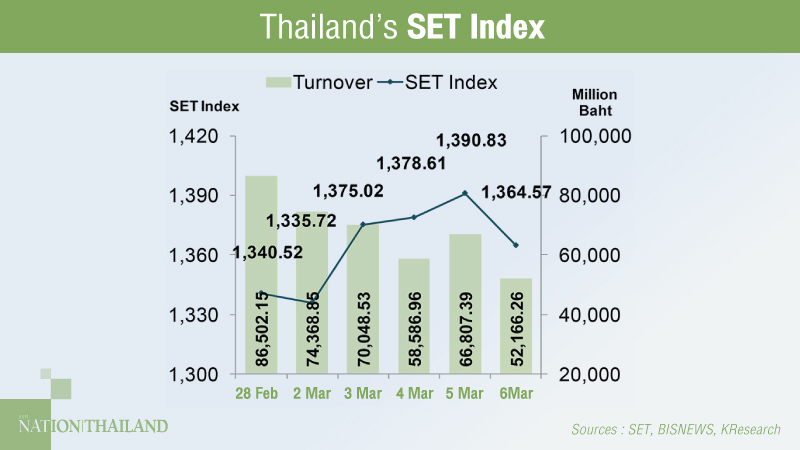
Last week (March 2-6), the SET Index retreated at the end of the week from large gains in previous days, as renewed worry over the coronavirus outbreak gripped the market.

The index, however, was up 1.79 per cent over the previous week, closing at 1,364.57 with daily trade volume of Bt 64.4 billion, down 21.8 per cent from the previous week. The MAI (Market for Alternative Investment) Index was up 2.9 per cent , closing at 269.34.

The SET Index was down in the beginning of the week, but rebounded sharply in the middle as investor sentiment was boosted by rate cuts by global central banks. Then the index retreated as investors worried about the worsening virus spreading outside China.

Covid-19 situation to influence direction of baht this week #ศาสตร์เกษตรดินปุ๋ย

#ศาสตร์เกษตรดินปุ๋ย : ขอบคุณแหล่งข้อมูล : หนังสือพิมพ์ The Nation

https://www.nationthailand.com/business/30383638?utm_source=category&utm_medium=internal_referral

Covid-19 situation to influence direction of baht this week

Mar 09. 2020
By The Nation

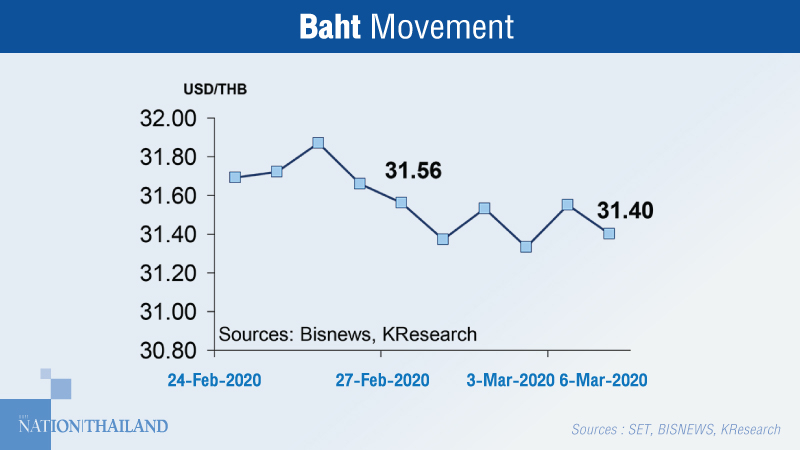
The baht’s direction this week will be determined by developments in the spread of the new coronavirus outside China after the baht moved up against the US dollar last week, says Kasikorn Research Centre The baht this week from March 9-13 is expected to move in a range of Bt31.20-31.80/USD, Kasikorn Research Centre has forecast.

The most important factor to affect the direction of the baht is the latest coronavirus spreading outside China. Key economic indicators include the US February inflation rate measured by consumer price index and producer index, the primary survey of consumer confidence in March, the meeting of European Central Bank on March 12, China’s February economic indicators and report of the fourth-quarter GDP growth of Japan and the euro-zone.

Last week, the baht strengthened in the latter part of the week, but moved in a narrow range against the US dollar for the whole week.

The baht was under pressure similar to other regional currencies, as investors were worried about the impact of Covid-19 on the economy.

Foreign investors made net sales of both equities and bonds in mid-week. However, the baht regained some of its losses after the US Federal Reserve made an urgent rate cut by half a percentage point.

The baht was also boosted by the selling of the dollar before releasing the US non-agriculture labour employment report.

The baht hovered at around Bt31.40/USD on Friday, up from Bt31.56/USD on February 28.

Wall Street is falling out of love with a once-coveted fossil fuel #ศาสตร์เกษตรดินปุ๋ย

#ศาสตร์เกษตรดินปุ๋ย : ขอบคุณแหล่งข้อมูล : หนังสือพิมพ์ The Nation

https://www.nationthailand.com/business/30383644?utm_source=category&utm_medium=internal_referral

Wall Street is falling out of love with a once-coveted fossil fuel

Mar 08. 2020
An oil pumping jack, also known as a 'nodding donkey' and flare stack in an oil field in Russia. MUST CREDIT: Bloomberg photo by Andrey Rudakov.

An oil pumping jack, also known as a ‘nodding donkey’ and flare stack in an oil field in Russia. MUST CREDIT: Bloomberg photo by Andrey Rudakov.
By Syndication Washington Post, Bloomberg · Gerson Freitas Jr, Vanessa Dezem · BUSINESS, US-GLOBAL-MARKETS

For years investors were willing to pay more for shares of natural gas utilities compared to electric ones. That’s no longer the case.

In the past few days, electric utility valuations blew past those for gas, a sign that investor confidence in the future of fossil fuels has reached a tipping point. With climate advocates pushing to eliminate natural gas from homes and businesses and lawmakers from New York to California taking a stand against greenhouse gas emissions, pipeline developers are facing an uncertain future.

“Right now, anyway you look at it, natural gas is not seen as something that is very friendly,” says Shahriar Pourreza, an analyst at Guggenheim Securities.

For the first time in about a decade, local gas distributors are selling for less than electric utilities in relation to their projected earnings. The Standard and Poor’s Gas Utilities Index is now trading at an average of 16.7 times projected earnings, while the S&P’s electric utilities index is trading at 17.1, according to data compiled weekly by Bloomberg. NextEra Energy, the world’s largest investor-owned developer of wind and solar, is trading at a staggering 28 times projected earnings.

The natural gas discount is a reflection of the fuel’s dimming long-term prospects. The near term, however, still looks bright. In the absence of easy-to-source, low-cost alternatives for essential tasks such as heating, cooking, and manufacturing, natural gas seems destined to remain a primary source of energy in the U.S. for years to come. Hydraulic fracturing has made gas extraordinarily cheap and plentiful, and its use as a substitute for dirtier coal in power generation has allowed utilities to slash carbon emissions by a quarter in the past decade. It’s also able to keep the grid stable when wind and solar farms aren’t producing.

For these reasons, defenders such as BlackRock say gas should have a long life as a bridge to clean energy. The world’s largest asset manager sees the fossil fuel as part of a long-term energy transition and calls the constraints imposed on development “few and far between,” according to Mark Florian, head of energy and power infrastructure funds. “My sense is it hasn’t really impacted natural gas company valuations at this point, but I think that’s a risk to monitor.”

With dozens of cities across the U.S. enacting bans on new gas infrastructure, however, a decline appears inevitable. In addition to climate concerns, a series of gas leaks and fires over the past two years including a 2018 deadly blast in Merrimack Valley, Massachusetts, sparked concerns about safety that led investors to question whether gas companies should be really trading at a premium, according to Pourreza.

Ryan Kelley, who manages a gas utility fund at Hennessy Funds, says higher uncertainty has probably eroded the valuations of natural gas companies even as their earnings growth should remain robust in the foreseeable future. “People are getting a little bit ahead of themselves in trying to figure out what the long-term implications of this is,” Kelley says.

For now, electric utilities are themselves still the largest users of natural gas. But as Joseph Sauvage, head of Citigroup Inc.’s global power group, pointed out at an S&P conference in New York last month, they’re also better positioned to benefit from the societal shift toward favoring investment in renewables, energy storage, all-electric construction, and electric vehicle-charging infrastructure. “Some think these companies are having lot more opportunities now that electrification gets closer,” Sauvage says.

Prospects for natural gas companies seem to be narrowing not only in the U.S. but also in Europe as the bloc vows to slash carbon emissions in the next few decades. European electric utilities including powerhouses Enel and Iberdrola are also trading at a premium to gas companies. “With policy in the continent moving toward low carbon emissions, you need to tell your shareholder that you are investing in decarbonization, rather than saying you are funding a gas pipeline,” says Elchin Mammadov, a European utilities analyst at Bloomberg Intelligence. “The growth prospects in power are much higher than in natural gas.”