Headwinds unabated, SCB analysts foresee 2.7% rise for Thai economy #ศาสตร์เกษตรดินปุ๋ย

#ศาสตร์เกษตรดินปุ๋ย : ขอบคุณแหล่งข้อมูล : หนังสือพิมพ์ The Nation

https://www.nationthailand.com/business/30380712?utm_source=category&utm_medium=internal_referral

Headwinds unabated, SCB analysts foresee 2.7% rise for Thai economy

Jan 17. 2020
Yunyong Thaicharoen

Yunyong Thaicharoen
By THE NATION

Siam Commercial Bank’s Economic Intelligence Centre expects the Thai economy to grow 2.7 per cent in 2020, representing a modest improvement from the 2.5 per cent projected for 2019.

Yunyong Thaicharoen, the centre’s chief economist, said on Friday (January 17) the expansion would be driven by an anticipated gradual recovery of merchandise exports following signs of restored health in global trade, which is due in part to the Phase 1 trade agreement between the United States and China.

Also supporting growth are more accommodative monetary and fiscal stimulus measures being enacted by many countries.

Nevertheless, the baht, which has appreciated by more than 24 per cent against other currencies in the past six years and is expected to maintain its strength, will continue to cut into exporter earnings and render Thai exports less competitive.

Tourism income is due for a decline with foreigners tending to spend less individually. The number of visitors is expected to rise, but Yunyong sees the rate of growth likely moderating.

Private domestic demand is projected to expand more slowly than last year. Even with exports expected to recover, private consumption and investment are forecast to cool further due to several adverse factors.

A decline in employment especially in manufacturing, deterioration of consumer confidence, a contraction in non-farm income, a reduction in farm income due to drought, and the high level of household debt will together choke household spending, particularly on durable goods, he said.

Private investment is expected to slow, in line with subdued domestic purchasing power.

Low capital utilisation and high inventory in the manufacturing sector will contribute to a deceleration in private investment in coming quarters.

In addition, the persistent contraction in consumer and commercial vehicle sales, as well as a decline in real estate construction due to LTV (loan-to-value) requirements from the previous period, will likely further weigh on domestic demand.

However, the government is expected to play a larger role in supporting growth in 2020 through the use of stimulus packages, short-term support for vulnerable groups and infrastructure investments.

It will also enable the private sector to take part in supporting growth, such as auctioning off 5G-spectrum licences, which should set in motion additional investments in telecommunications and related sectors.

With regard to domestic financial conditions, interest rates are expected to remain low throughout the year, while the baht should continue to face appreciation pressures.

Yunyong expects the Monetary Policy Committee to maintain an accommodative stance to lend support to economic recovery.

It will likely keep the policy rate unchanged at 1.25 per cent throughout 2020. The centre still sees the probability of a rate cut in the first half of 30 per cent on three possible conditions – weaker-than-expected growth, much higher non-performing loans and the baht’s continued appreciation.

Supported by a massive current-account surplus, the baht is expected to remain persistently strong, closing 2020 at 29.5-30.5 per US dollar.

Additional relaxation in capital outflows, both for overseas business operations and investment in foreign assets, will only marginally help ease pressure on the baht in the short run. More time is needed to tackle structural limitations such as financial literacy, foreign investment capabilities and impeding rules and regulations.

Only after that would capital outflow be sizeable enough to significantly mitigate appreciation pressures on the baht.

There are three key risk factors for the Thai economy in 2020 – trade war uncertainties, geopolitical risks and household and business financial vulnerabilities.

Despite completion of the Phase 1 trade deal between the US and China, many uncertainties remain around America’s protectionist policies that can impact global trade, such as the next phase of the negotiation, potential trade retaliations with Europe, and the decision to cut GSP privileges for many trading partners.

At the same time, geopolitical risks, especially from the conflict between the US and Iran, the prolonged protests in Hong Kong, and Brexit, will continue to pose challenges for global growth recovery.

Domestically, key risks to growth include financial vulnerabilities among households and businesses, particularly those with high debt and whose income suffers from the economic slowdown, technological disruptions and increasing competition.
World Bank lists steps for stalled Thailand to become high-income nation #ศาสตร์เกษตรดินปุ๋ย

#ศาสตร์เกษตรดินปุ๋ย : ขอบคุณแหล่งข้อมูล : หนังสือพิมพ์ The Nation

https://www.nationthailand.com/business/30380708?utm_source=category&utm_medium=internal_referral

World Bank lists steps for stalled Thailand to become high-income nation

Jan 17. 2020
By THE NATION

The Thai economy is projected to grow a modest 2.7 per cent this year thanks to recovering private consumption recovers and investment in large public infrastructure projects, the World Bank said in its “Thailand Economic Monitor” report released on Friday (January 17).

It said Thai growth slowed to about 2.5 per cent in 2019 from 4.1 per cent in 2018 due to both external and domestic factors.

Boosting productivity and reviving private investment will be essential if Thailand is to meet its goal of being a “high-income status” country by 2037, the report said.

Global economic growth is forecast to edge up to 2.5 per cent this year as investment and trade gradually regain strength, but risks persist.

These include a re-escalation of trade tensions and trade policy uncertainty, a sharper-than-expected downturn in major economies, and financial turmoil in emerging markets and developing economies.

“A continued deceleration of economic activity in China, the euro area and the United States could have adverse repercussions across East Asia through weaker demand for exports and the disruptions of global value chains,” said Birgit Hansl, World Bank country manager for Thailand.

“Financial investment, commodity and confidence channels could further weaken the global economy and adversely impact Thailand’s exports.”

In 2019, declining exports and weakening domestic demand were the main factors slowing Thailand’s growth.

Agricultural exports declined by 7 per cent in the first three quarters of 2019, led by sharp decreases in export volumes for major products such as rice and rubber.

Manufacturing exports declined by 6 per cent in the same period, with electronics exports hardest hit. Thailand’s strong currency, which has appreciated by 8.9 per cent since last year – making the baht the strongest it has been in six years – has also impacted foreign tourism and merchandise exports.

The government responded swiftly through accommodative monetary policies and a fiscal stimulus package to boost economic growth, the World Bank said.

The report recommends that it next consider policies to enhance the effectiveness of the stimuli by focusing on major public investment projects, improving efficiency in public-investment management and providing social protection coverage for vulnerable families.

The slowdown highlighted Thailand’s long-standing structural constraints with sluggish investment and low productivity growth.

Thai productivity growth has fallen to 1.3 per cent over 2010-2016 from 3.6 per cent over 1999-2007.

Private investment has halved, from 30 per cent of GDP in 1997 to 15 per cent in 2018, as foreign direct investments shrank and progress stalled on the Eastern Economic Corridor.

The report projects that, if current trends continue, with no significant pickup in investment and productivity growth, Thailand’s average annual growth rate will remain below 3 per cent.

To become a high-income country by 2037, it said, Thailand must sustain long-run growth rates above 5 per cent, which would require a productivity growth rate of 3 per cent and an increase in investment of to 40 per cent of GDP.

“Boosting productivity will be a critical part of Thailand’s long-term structural reform,” said Kiatipong Ariyapruchya, World Bank senior economist for Thailand. “Increasing productivity, particularly of manufacturing firms, will depend on increasing competition and openness to foreign direct investments, and improving skills.”

Sustaining higher productivity growth will require removing constraints that prevent new firms, especially foreign ones, and skilled professionals, from entering the domestic market.

These constraints include restrictive laws, particularly in the services sector, implementing the new Competition Act with clear guidelines related to state-owned enterprises and price controls, and developing policies to build the skills and human capital needed for an innovative knowledge-based economy.

Palladium soaring again sparks concern of bubble #ศาสตร์เกษตรดินปุ๋ย

#ศาสตร์เกษตรดินปุ๋ย : ขอบคุณแหล่งข้อมูล : หนังสือพิมพ์ The Nation

https://www.nationthailand.com/business/30380686?utm_source=category&utm_medium=internal_referral

Palladium soaring again sparks concern of bubble

Jan 17. 2020
A

A “Made in Russia” engraving sits on a palladium ingot at the JSC Krastsvetmet non-ferrous metals plant in Krasnoyarsk, Russia, on Nov. 5, 2019. MUST CREDIT: Bloomberg photo by Andrey Rudakov.
By Syndication Washington Post, Bloomberg · Elena Mazneva, Justina Vasquez 

The palladium rally continues to defy all expectations.

The silvery-white precious metal used in catalytic converters has been on a tear this year that shows no signs of slowing. On Thursday it rallied to a record $2,395.71 an ounce and has notched a 19% gain for 2020 after skyrocketing 54% last year.

The gains are surprising even the most seasoned market watchers, who say there’s little chance that tight supply conditions will ease. South Africa, a major miner, reported a sharp drop in platinum-group metal production in November. Adding to the bullish mood was the U.S.-China trade truce, and record car sales in Europe last month even though they are unlikely to be repeated.

“The dynamics are so strong. Nobody can tell me that this is just fundamentals,” said Commerzbank analyst Carsten Fritsch. “This is already becoming a bubble.”

Palladium’s rise also has been fueled by strong demand as stricter emissions targets force carmakers to use more of the metal in autocatalysts. As low mine production continues to be eclipsed by demand, investors with exposure to exchange-traded funds backed by the metal are holding on tightly, further limiting supply.

“My guess is it’s getting more and more difficult to find someone willing to sell ETF positions to cover the market deficit,” Giovanni Staunovo, a commodity analyst at UBS Wealth Management, said by phone Thursday. “This is part of the theory, if it’s driven by the above-ground stocks. If you were to have it and you know there is no one willing to sell either tomorrow, why would you sell it now at a lower price if you know you can get it tomorrow at an even higher price?”

On Thursday, spot prices jumped by as much as 5.7%, or nearly $130 an ounce. The metal traded up 2.2% at $2,315.37 as of 10:06 a.m. in New York.

Palladium’s less expensive sister, platinum, touched $1,041.71 an ounce in the spot market, the highest in nearly three years, before reversing. Gold and silver both dipped.

Still, palladium’s technicals are stretched and some analysts expect a sharp and brief retreat. The metal’s 14-day relative strength index has held above 80 for seven days — the longest since 2016.

“It’s overbought but ignoring it,” said Rhona O’Connell, head of market analysis for EMEA and Asia at INTL FCStone. There should be a sharp pull-back at some point, she said.

Several market players meanwhile raised their palladium price forecasts for 2020, including HSBC Securities (USA) Inc. and UBS Group, confirming their bullish outlook for the metal amid a continuing supply deficit.

“The risk on the downside lies with some speculative profit taking, but any correction should be met with aggressive buying and remain short-lived,” precious metals refiner and trader MKS PAMP Group said in a note.

U.S. to change procedures for release of major economic data #ศาสตร์เกษตรดินปุ๋ย

#ศาสตร์เกษตรดินปุ๋ย : ขอบคุณแหล่งข้อมูล : หนังสือพิมพ์ The Nation

https://www.nationthailand.com/business/30380685?utm_source=category&utm_medium=internal_referral

U.S. to change procedures for release of major economic data

Jan 17. 2020
By Syndication Washington Post, Bloomberg · Scott Lanman 

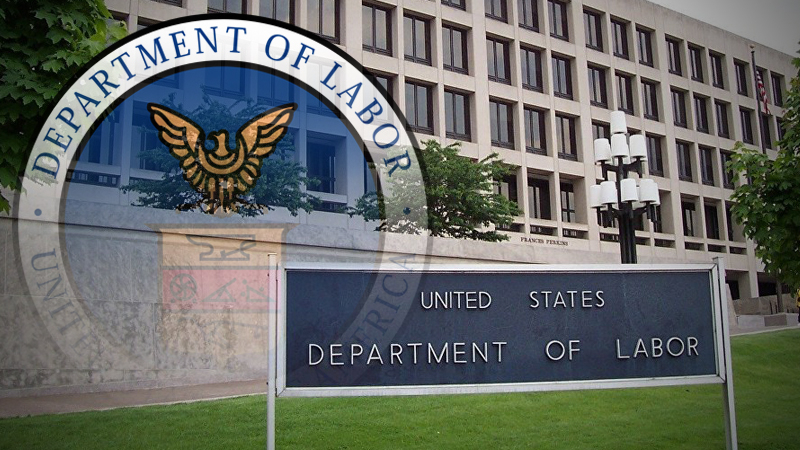
The U.S. Labor Department said it will ban all electronics including computers from the room where journalists receive advance access to major economic reports, in an effort to ensure a level playing field.

Currently, the department hosts “lockups” in Washington for major reports lasting 30 to 60 minutes, where journalists receive the data in a secure room, write stories on computers disconnected from the internet, and transmit them when connections are restored at the release time. Other electronic devices were already prohibited.

Bureau of Labor Statistics Commissioner William Beach said in a letter Thursday that BLS and other Labor agencies have raised concerns about data-security stemming from the lockups, and cited a 2014 report by the department’s inspector general saying several news organizations that participate are able to profit by providing the numbers to algorithmic traders in a format that provides them an advantage.

Lockups will continue and journalists will be able to ask questions of statistics officials, Beach wrote. Releases will continue to be posted on Labor websites and on Twitter, and journalists can leave the room to file stories once the embargo lifts, Beach wrote.

The change will take effect March 1, Beach said.

Labor Department officials were asked on a conference call with journalists if the change was specifically aimed at Bloomberg News, which participates in the lockups and whose founder and majority owner, Michael Bloomberg, is running for the Democratic presidential nomination. They denied any political motivation.

Tech, financial shares lead surge to record highs #ศาสตร์เกษตรดินปุ๋ย

#ศาสตร์เกษตรดินปุ๋ย : ขอบคุณแหล่งข้อมูล : หนังสือพิมพ์ The Nation

https://www.nationthailand.com/business/30380678?utm_source=category&utm_medium=internal_referral

Tech, financial shares lead surge to record highs

Jan 17. 2020
All three main U.S. stock benchmarks surged to all-time highs after setting multiple records earlier this week, with technology and financial shares leading the surge.

All three main U.S. stock benchmarks surged to all-time highs after setting multiple records earlier this week, with technology and financial shares leading the surge.
By Syndication Washington Post, Bloomberg · Claire Ballentine, Vildana Hajric

The record-setting rally in U.S. equities accelerated in the wake of Wednesday’s China trade deal and signs consumer demand remains strong. Bond yields rose.

All three main U.S. stock benchmarks surged to all-time highs after setting multiple records earlier this week, with technology and financial shares leading the surge. Alphabet Inc.’s market valuation hit $1 trillion for the first time. Banks and chipmakers rallied after solid earnings reports from Taiwan Semiconductor Manufacturing Co. and Morgan Stanley. Treasuries fell after data showed U.S. retail sales strengthened in December, while the dollar gained.

“The consumer is really in positive shape,” said Ryan Detrick, senior market strategist at LPL Financial. “Then when you factor in the alleviation of the U.S.-China tensions, the market is in a pretty good spot.”

The Senate approved President Donald Trump’s U.S.-Mexico-Canada free trade agreement, handing the president a major political win on the same day senators were sworn in as jurors in his impeachment trial.

The formal signing of a phase one deal between the world’s two biggest economies has put the trade war on hold as far as many investors are concerned. Assuming the detente lasts, traders will be seeking fresh catalysts, most likely in economic data and the ramp-up of earnings season.

“The question is if we can keep up the momentum,” said Mike Loewengart, vice president of investment strategy at E*Trade Financial. “Up next, housing, an economic bellwether, which will provide yet another data point of how our economy closed out the year.”

West Texas crude fluctuated in a narrow range before pushing higher.

Elsewhere, the Stoxx Europe 600 index closed at a record high after swinging between gains and losses. The euro erased earlier gains, while most European bonds edged up. The ruble slipped in the wake of Russian President Vladimir Putin’s call for sweeping constitutional changes and subsequent replacement of his long-serving prime minister.

Meanwhile, soybeans slumped overnight after China signaled purchases would be based on demand, rather than a pre-set amount.

Here are some events to watch for this week:

–China GDP, along with key monthly data for December, come on Friday.

–A final reading on the euro-zone’s December inflation is also due on Friday.

There are some of the main moves in markets:

Stocks

-The S&P 500 index jumped 0.8% to 3,316.89 as of 4:03 p.m. New York time, the highest on record with the largest climb in two weeks.

-The Dow Jones Industrial Average jumped 0.9% to 29,297.57, the highest on record with the biggest increase in two weeks.

-The Nasdaq Composite index climbed 1.1% to 9,357.13, the highest on record with the largest surge in two weeks.

-The Stoxx Europe 600 index climbed 0.2% to 420.54, the highest on record.

Currencies

-The Bloomberg Dollar Spot Index advanced 0.1% to 1,192.28, the largest gain in a week.

-The euro dipped 0.1% to $1.1138, the biggest decrease in more than a week.

-The Japanese yen depreciated 0.2% to 110.15 per dollar, the weakest in eight months.

Bonds

-The yield on two-year Treasuries climbed one basis point to 1.56%.

-The yield on 10-year Treasuries advanced two basis points to 1.80%.

-Britain’s 10-year yield dipped one basis point to 0.643%, reaching the lowest in 11 weeks on its fifth straight decline.

-Germany’s 10-year yield declined two basis points to -0.22%, the lowest in more than a week.

Commodities

-West Texas Intermediate crude climbed 1.2% to $58.53 a barrel, the biggest increase in almost two weeks.

-Gold weakened 0.1% to $1,554.03 an ounce.

Foreign investors expected to continue sales of Thai bonds #ศาสตร์เกษตรดินปุ๋ย

#ศาสตร์เกษตรดินปุ๋ย : ขอบคุณแหล่งข้อมูล : หนังสือพิมพ์ The Nation

https://www.nationthailand.com/business/30380671?utm_source=category&utm_medium=internal_referral

Foreign investors expected to continue sales of Thai bonds

Jan 17. 2020
By Wichit Chaitrong
The Nation

Foreign investors are expected to continue selling Thai government bonds to the tune of almost Bt100 billion this year, according to the Thai Bond Market Association (ThaiBMA) which also predicted the central bank cutting its benchmark rate in the current quarter.

ThaiBMA President Tada Phutthitada said on Thursday (January 16) that foreign investors made net sale of Bt84.5 billion in short-term Thai bonds for the purchases of long-term bonds last year.

Foreign investors held Bt911.8 billion in Thai bonds as of the end of last year, down Bt771.2 billion year on year. Their combined holding Thai government bond and Bank of Thailand bonds represented 10.5 per cent of total market capitalisation last year, a drop of 11.9 per cent from 2018.

Foreign investors reaped high returns to investment in Thai government bonds in 2019, he said.

Investment return in government bonds was estimated at 15.3 per cent, compared with 5 per cent from equities. The return calculation was based on the assumption that investors invested proportionally in bonds available in the market, or investing in bonds with an average maturity of 12 years.

Thai investors mostly invested in short-term bonds with lower returns.

The high return from bond investment last year mainly came from capital gain given that bond yields were at a historic low.

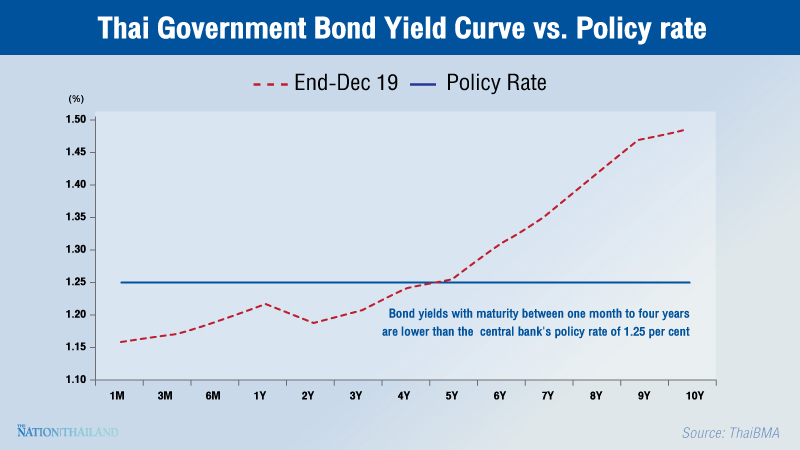
Yield of 10-year maturity bonds stood at 1.36 per cent on January 6 this year, compared to the lowest level of 1.43 per cent on August 29, 2019, while bond yields with maturity between one month to four years were lower than the central bank’s policy rate of 1.25 per cent.

“As bond yields (one-month to 4-year bonds) have been lower than the BOT’s one-day repurchase rate, we expect the central bank to cut its benchmark rate in the first quarter of this year,” said Tada.

The bond yield’s inversion curve suggests that investors expected lower interest rate in the coming months, he added.

Emerging markets present US$10 trn opportunity for sustainable development #ศาสตร์เกษตรดินปุ๋ย

#ศาสตร์เกษตรดินปุ๋ย : ขอบคุณแหล่งข้อมูล : หนังสือพิมพ์ The Nation

https://www.nationthailand.com/business/30380662?utm_source=category&utm_medium=internal_referral

Emerging markets present US$10 trn opportunity for sustainable development

Jan 16. 2020
Plakorn Wanglee, President & CEO at Standard Chartered Bank (Thai)

Plakorn Wanglee, President & CEO at Standard Chartered Bank (Thai)
By THE NATION

Thailand presents a US$58 billion opportunity for the private sector to invest in sustainable development, according to a report released by Standard Chartered on Thursday (January 16).

Titled “Opportunity2030: The Standard Chartered SDG Investment Map”, it reveals an almost US$10 trillion (Bt302 trillion) opportunity for private-sector investors across all emerging markets, with Thailand representing around US$58 billion of that total.

The study identifies opportunities for the private sector to contribute to three infrastructure-focused goals between now and 2030: SDG 6: Clean Water and Sanitation, SDG 7: Affordable and Clean Energy and SDG 9: Industry, Innovation and Infrastructure across emerging markets.

Rapid progress, vast potential

In Thailand, the greatest SDG (Sustainable Development Goal) investment opportunities are found in transport infrastructure and improving digital access, both key indicators of SDG 9, which encourages improvement in industry, innovation and infrastructure.

Opportunity2030 finds that a significant improvment of Thailand’s transport infrastructure will require an estimated private-sector investment of US$40.6 billion between now and 2030, and to achieve universal digital adoption – a combination of mobile phone subscriptions rates and internet connectivity – will require private-sector investment of around US$17 billion.

Thailand already has universal access to power (a key SDG 7 indicator) and 99 per cent of the population has access to clean water and sanitation (a key SDG 6 indicator).

Achieving universal access to clean water and sanitation therefore represents a relatively modest opportunity for the private sector of US$0.7 billion.

Plakorn Wanglee, President & CEO at Standard Chartered Bank (Thai) said: “Thailand is an SDG success story so far. As the country continues its efforts towards the goals, the private sector has a central role to play, especially with the government expressing commitment to encourage more private sector investment.

“Opportunity2030 provides an important map of the SDG opportunities for private sector investors looking to invest with impact and improve the lives of millions of Thais over the next decade”.

Bill Winters, Group Chief Executive at Standard Chartered, said:“The UN Sustainable Development Goals are among the most ambitious projects humanity has ever attempted. As well as offering our best hope yet of tackling the world’s most serious challenges, they also offer a unique opportunity for the private sector. For the goals to be met, the private sector must play a central role in deploying capital to get projects off the ground. Opportunity2030 provides a map of these opportunities, revealing the sectors and markets where investors can best contribute to the SDGs whilst achieving sustainable returns.”

“Currently, not enough capital is reaching the countries that need it the most. With the UN’s 2030 deadline for achieving SDGs just 10 years away, the time to act is now.”


Opportunity2030: The Standard Chartered SDG Investment Map is a macroeconomic study that draws on global data sources and indicative private-sector participation rates to provide companies, institutional investors and other stakeholders with an overview of where their investments could have the greatest impact. It spans 15 of the world’s fastest-growing economies and estimates the potential private-sector investment opportunity to contribute to three of the most investment-ready SDGs (6,7 and 9).

*Thailand already has universal access to power so the investment opportunity to achieve this is not included in the country’s total investment opportunity figure. However, with a growing economy, there will be an additional need for continual investment in affordable and clean energy to maintain access in a sustainable way.

Food association optimistic for 2-5% export hike in 2020 #ศาสตร์เกษตรดินปุ๋ย

#ศาสตร์เกษตรดินปุ๋ย : ขอบคุณแหล่งข้อมูล : หนังสือพิมพ์ The Nation

https://www.nationthailand.com/business/30380655?utm_source=category&utm_medium=internal_referral

Food association optimistic for 2-5% export hike in 2020

Jan 16. 2020
By THE NATION

Exports of raw foods declined by 2 per cent in 2019 while those of processed foods increased by the same amount, resulting in a 1.3-per-cent drop for the overall food industry, according to Wisit Limleucha, president of the Instant Food Manufacturers Association.

“This decrease is the lowest in four years and the main factor was the baht’s appreciation, which raised production costs,” he said this week.

But this year could see food exports grow by 2-5 per cent, Wisit speculated, with processed foods in particular benefiting from more positivity in the global market as the United States and China negotiate the second phase of their trade agreement.

“The raw foods sector is less likely to grow due to the drought, which could limit domestic production,” he said.

“Chicken is the most promising product this year since Thailand is free of the bird flu epidemic affecting some of our competitors.

“Meanwhile the spread of African swine fever in China last year has driven up demand there for alternatives to pork.”

The Thai food industry is valued at Bt3 trillion per annum, with a third of that generated by exports, Wisit noted.

“There is still room for the food industry to grow, especially on the domestic front,” he said. “Thailand has 70 million consumers domestically and more than 40 million foreign tourists a year, so the total is over 100 million.”

U.S. stocks hit records amid China trade pact optimism #ศาสตร์เกษตรดินปุ๋ย

#ศาสตร์เกษตรดินปุ๋ย : ขอบคุณแหล่งข้อมูล : หนังสือพิมพ์ The Nation

https://www.nationthailand.com/business/30380628?utm_source=category&utm_medium=internal_referral

U.S. stocks hit records amid China trade pact optimism

Jan 16. 2020
U.S. stocks closed at record highs as investors assessed the details of the partial trade deal with China. Treasuries gained and the dollar weakened.

U.S. stocks closed at record highs as investors assessed the details of the partial trade deal with China. Treasuries gained and the dollar weakened.
By Syndication Washington Post, Bloomberg · Vildana Hajric, Sarah Ponczek

U.S. stocks closed at record highs as investors assessed the details of the partial trade deal with China. Treasuries gained and the dollar weakened.

The benchmark S&P 500 finished short of an earlier all-time intraday high after President Donald Trump presided over a signing ceremony with Chinese officials. The deal commits China to do more to crack down on the theft of American technology and corporate secrets by its companies and state entities, while outlining a $200 billion spending spree to try to close its trade imbalance with the U.S. Soybeans slumped after China signaled purchases would be demand-based.

“While it does not appear that the ‘phase one’ deal addresses many of the structural issues that started the trade spat, it does mitigate the uncertainty that ongoing trade tensions present, namely the threat of new tariffs at a moment’s notice,” said Jason Pride, chief investment officer of private wealth at Glenmede Trust Co. in Philadelphia.

The S&P 500 set an intraday record for the sixth consecutive trading session, largely ignoring disappointing quarterly results from Goldman Sachs Group Inc. and Bank of America Corp. The Nasdaq Composite and Dow Jones Industrial Average indexes also set fresh highs. U.S. markets received an added boost earlier after White House economic adviser Larry Kudlow promoted more tax cuts.

Commodity markets got some numbers on China’s commitments to buy agricultural products, but doubts remain. Currency traders assessed the section that reaffirmed existing G-20 commitments, and investors in tech stocks pored over details on intellectual property concessions.

“It’s anti-climatic,” said Jim Paulsen, chief investment strategist at the Leuthold Group. “It was in there and people knew this for a while now, it’s about what you thought.”

Meanwhile, the Stoxx Europe 600 index finished little changed, while equities across most of Asia fell.

Russia’s currency weakened as much as 0.6% against the dollar. President Vladimir Putin replaced his long-serving prime minister and called for sweeping constitutional changes, fueling speculation that the Russian leader is moving to extend his grip on power beyond the end of his term in 2024.

Oil futures drifted, with West Texas Intermediate trading around $58 a barrel. Gold nudged higher.

Here are some events to watch for this week:

-It’s earnings season for the biggest American financial institutions, with Morgan Stanley and Bank of New York Mellon Corp. still to come.

–The Federal Reserve’s Beige Book report on regional economic conditions is due on Wednesday.

-China GDP, along with key monthly data for December, come on Friday.

-A final reading on the euro-zone’s December inflation is also due on Friday.

There are some of the main moves in markets:

Stocks

-The Dow Jones Industrial Average increased 0.3% to 29,030.28, the highest on record.

-The Nasdaq Composite Index climbed 0.1% to 9,258.70.

-The MSCI All-Country World index advanced 0.1% to 573.80, the highest on record.

-The Stoxx Europe 600 index was little changed at 419.63.

Currencies

-The Bloomberg Dollar Spot index decreased 0.1% to 1,191.76, the lowest in a week.

-The Japanese yen strengthened 0.1% to 109.90 per dollar, the largest rise in more than a week.

-The euro gained 0.2% to $1.1151, the strongest in a week on the biggest gain in more than a week.

-The British pound gained 0.1% to $1.3028.

Bonds

-The yield on two-year Treasuries fell one basis point to 1.56%, the lowest in a week.

-The yield on 10-year Treasuries fell three basis points to 1.78%, the lowest in almost six weeks.

-Germany’s 10-year yield declined three basis points to -0.20%, the biggest drop in more than a week.

-Britain’s 10-year yield decreased seven basis points to 0.654%, the lowest in seven weeks on the largest dip in six weeks.

Commodities

-West Texas Intermediate crude declined 0.4% to $57.96 a barrel, the lowest in six weeks.

-Gold strengthened 0.6% to $1,556.05 an ounce.

U.S. and China sign phase one of trade deal #ศาสตร์เกษตรดินปุ๋ย

#ศาสตร์เกษตรดินปุ๋ย : ขอบคุณแหล่งข้อมูล : หนังสือพิมพ์ The Nation

https://www.nationthailand.com/business/30380626?utm_source=category&utm_medium=internal_referral

U.S. and China sign phase one of trade deal

Jan 16. 2020
President Trump speaks during a signing ceremony for the U.S.-China

President Trump speaks during a signing ceremony for the U.S.-China “phase-one” trade agreement in Washington on Jan. 15., 2020. MUST CREDIT: Bloomberg photo by Zach Gibson.
By Syndication Washington Post, Bloomberg · Shawn Donnan, Josh Wingrove, Saleha Mohsin

The U.S. and China signed what they’re billing as the first phase of a broader trade pact on Wednesday amid persistent questions over whether President Donald Trump’s efforts to rewrite the economic relationship with Beijing will ever go any further.

The deal commits China to do more to crack down on the theft of American technology and corporate secrets by its companies and state entities, while outlining a $200 billion spending spree to try to close its trade imbalance with the U.S. It also binds Beijing to avoiding currency manipulation to gain an advantage and includes an enforcement system to ensure promises are kept.

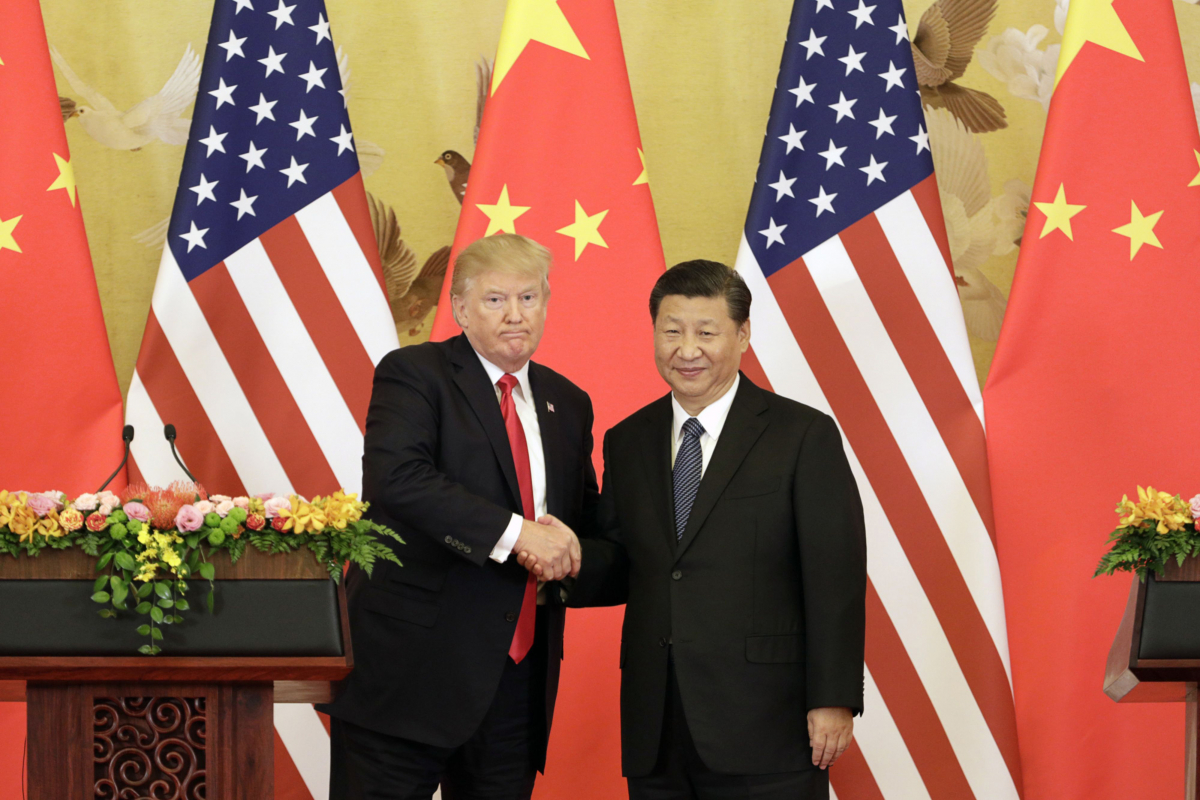
File photo of President Donald Trump, left, and Xi Jinping, China's president, shaking hands during a news conference at the Great Hall of the People in Beijing on Nov. 9, 2017. MUST CREDIT: Bloomberg photo by Qilai Shen.

File photo of President Donald Trump, left, and Xi Jinping, China’s president, shaking hands during a news conference at the Great Hall of the People in Beijing on Nov. 9, 2017. MUST CREDIT: Bloomberg photo by Qilai Shen.

The ceremony at the White House, which included Trump, dozens of American business people and Chinese officials, was a rare moment of friendship lately between the world’s two largest economies. Acrimonious talks stretching back almost three years have roiled financial markets, cast a cloud of uncertainty over investment decisions and hurt growth in both nations.

“This is a very important and remarkable occasion,” Trump said at the signing. “Together we are righting the wrongs of the past.”

The benchmark S&P 500 Index set an intraday record high for the sixth consecutive trading session.

The deal, sealed on the same day the House prepared to refer articles of Trump’s impeachment to the Senate, has already been criticized for what is missing. It does nothing to address areas like what U.S. authorities have long claimed is China’s state-backed hacking of American companies and government institutions. Nor does it require the Asian nation to reform the vast web of state subsidies that form the spine of its model of state capitalism and have helped fuel the rapid growth of Chinese companies compete internationally.

The administration says many of those issues will be covered in a second phase of a deal, though when those talks will begin and how long they will take remains uncertain. In the meantime, the U.S. is also set to maintain tariffs on roughly two-thirds of imports from China.

“As soon as this kicks in we’re starting phase two,” Trump said. “I will agree to take those tariffs off if we’re able to do phase two, otherwise we don’t have any cards to negotiate with. They will all come off as soon as we finish phase two.”

At the ceremony, Chinese Vice Premier Liu He read a letter from President Xi Jinping, stating the two sides have to implement the agreement “in real earnest.”

“I hope the U.S. side will treat fairly Chinese companies,” he said through an interpreter. In his own comments, Liu said China will “strictly honor” the pact.

Trump’s top negotiator, U.S. Trade Representative Robert Lighthizer, told reporters ahead of the signing that the administration was focused on implementing the initial agreement in the short term. Any further negotiations will only come after that, he said.

Officials also insist that they are harvesting significant commitments from Beijing that mean the phase one agreement will benefit U.S. businesses and workers even if discussions never go any further.

The deal requires China to do more to stop the sale of pirated goods and to apply criminal penalties on anyone caught steeling commercial secrets. It also requires Beijing to deliver an action plan withing 30 days of the deal taking effect on how it intends to meet its commitments.

It also requires China to stop pressuring American companies investing in the country to share technology with local joint-venture partners. The agreement stipulates that the Chinese must stop supporting or directing the acquisition of overseas investment aimed at buying up technologies.

“This is an enormous win,” Treasury Secretary Steven Mnuchin told reporters ahead of the signing, pointing to Chinese commitments on IP that will affect the technology sector as well as other reforms on currency, the opening up of the financial services sector to U.S. companies and the promised spending spree.

Other supporters of Trump’s trade policies insist that the initial deal goes a long way toward addressing the IP issues that were at the core of the case brought against China. “Anyone complaining that this doesn’t resolve every U.S.-China issue needs to recall that this entire negotiation was based on a report on China’s IP and techtransfer policies,” said Clete Willems, who until last year was a member of Trump’s national economic council and is now at law firm Akin Gump.

China has already moved to address some U.S. complaints on IP. Over the past year, it has made a rapid-fire series of legal changes amid the negotiations to beef up protection. A new foreign investment law that took effect on Jan. 1 bans administrative agencies from forcing companies to transfer technological knowhow as a cost of entry to the Chinese market. It also exposes officials who disclose or leak trade secrets gleaned from regulatory approvals to potential criminal penalties.

The U.S. is also moving to address remaining issues like industrial subsidies in other ways. On Tuesday the U.S., European Union, and Japan said they had agreed on the content of new stricter global rules on subsidies aimed largely at China and would be mounting a joint push to build support for them internationally.

The Trump administration says what separates its deal most from others is the enforcement mechanism it establishes. Rather than rely on a slow-moving World Trade Organization dispute system that Trump in any case has already hobbled by blocking the appointment of top judges, the new agreement with China would allow the administration to move to punish Beijing with tariffs or other measures within 90 days if officials decided it was breaking its promises.

But even Lighthizer acknowledges how effective that mechanism will be depends on Beijing. “This deal will work if China wants it to work,” he said Wednesday.

The deal is also unique in the breadth of specific Chinese purchase commitments it contains, which some critics in the U.S. see as uncomfortably reminiscent of the sort of state-directed central planning American diplomats have spent decades trying to get China to abandon. Even those purchase promises, the details of which are contained in a secret annex to the agreement signed on Tuesday, face questions.

The text of the deal released Wednesday specifies $77.7 billion in Chinese purchases of manufactured goods including aircraft, $32 billion in agricultural products, $52.4 billion in energy and $37.9 billion in services in the two years through December 2021.

Much of the attention has focused on whether U.S. farm exports to China can reach the $40 billion to $50 billion annual level that Trump has promised, which would mean doubling the $24 billion in agriculture and related products it imported from the U.S. in 2017, before the trade war began.

There are also questions over a Chinese commitment to buy an additional $50 billion in U.S. oil and gas over two years and pledges to step up purchases of cars, planes and other manufactured goods.

To meet the energy target, China would have to import roughly one-third of the 3 million barrels a day of crude that the U.S. exported last year over a two year period, according to Bloomberg calculations. Which is why analysts believe meeting that deal may depend heavily on buying natural gas, which is usually traded via long-term contracts rather than spot purchases.

However, China may not have much appetite for any additional gas right now beyond the long-term contracts it has already committed to as it continues to struggle with a slowing economy and a slowdown in demand growth and already-brimming stockpiles. Likewise, U.S. LNG export plants have most of their volumes tied up in their own long-term contracts and would only be able to provide China with a marginal amount of spot supply over the next two years.