Central bank’s interest rate cut a case of ‘too little, too late’

ศาสตร์เกษตรดินปุ๋ย : ขอบคุณแหล่งข้อมูล : หนังสือพิมพ์ The Nation

https://www.nationthailand.com/business/30378128?utm_source=category&utm_medium=internal_referral

Central bank’s interest rate cut a case of ‘too little, too late’

Nov 07. 2019
Amornthep Chawala, head of research at CIMB Thai says central bank's rate cut is too small and too late.

Amornthep Chawala, head of research at CIMB Thai says central bank’s rate cut is too small and too late.
By The Nation

1,448 Viewed

The interest rate cut by the central bank on Wednesday is too little and too late, according to one analyst, while another analyst forecast that it will be the last cut for this year.

Amornthep Chawala, head of research at CIMB Thai, said the Bank of Thailand (BOT)’s decision to cut the key interest rate to 1.25 per cent, the lowest rate since 2009, was a reflection of the worry among members of the BOT’s Monetary Policy Committee (MPC). Thailand’s economic growth has been affected by the global trade war, which has caused a contraction in exports, as well as a slowdown in household consumption and private investment. His comments came after five out of the seven MPC members voted to cut the policy interest rate on Wednesday (November 6). With the government yet to accelerate public investment, the central bank has had to step in and provide support to the economy.

“But the [rate] cut is too small and too late. We have to wait and see whether it can save the Thai economy, which has slowed down significantly,” he cautioned.

Meanwhile, Krungsri Bank said that the cut was expected to be the last one for this year.

The rate cut by 25 basis points to 1.25 per cent marks a historic low for the key policy rate, Krungsri Bank said on Wednesday.

The baht is the currency that has strengthened the most in the Asian region, appreciating by around 7 per cent since early this year, the bank said.

The baht reacted immediately to the rate cut, weakening to around Bt30.40 per dollar, said the bank.

The MPC cited economic slowdown exceeding expectations as justification for the cut. The MPC will meet again on December 18, but they are expected to maintain the rate at 1.25 per cent for the rest of this year, the bank said.

BOT relaxes rules to stimulate capital outflows

ศาสตร์เกษตรดินปุ๋ย : ขอบคุณแหล่งข้อมูล : หนังสือพิมพ์ The Nation

https://www.nationthailand.com/business/30378127?utm_source=category&utm_medium=internal_referral

BOT relaxes rules to stimulate capital outflows

Nov 07. 2019
Bank of Thailand moves to rein in baht's appreciation.

Bank of Thailand moves to rein in baht’s appreciation.
By The Nation

1,288 Viewed

The Bank of Thailand (BOT) relaxes rules to stimulate capital outflows and lessen pressure on the Thai baht.

Central bank governor Veerathai Santiprabhob announced the measures on Wednesday  as a bid to slow the baht’s worryingly rapid appreciation. The new measures will come into effect on Friday (November 8), he said.

The  details are as follows:

The Thai baht has been under pressure due to imbalanced capital flows in the current environment of highly uncertain and volatile external conditions, the Ministry of Finance (MOF) and the Bank of Thailand (BOT) decided to relax regulations to stimulate capital outflows to help promote capital flow balance and lessen pressure on the baht. Such relaxations include allowing exporters to keep foreign currency proceeds overseas, allowing retail investors to invest in foreign securities without going through a Thai intermediary institution and allowing businesses and individuals to transfer funds abroad more freely. These relaxations will be effective 8 November 2019, with details as follows:

  1. Repatriation of export proceeds
  • Exporters with proceeds below USD 200,000 per bill of lading will be allowed to keep the proceeds abroad, without a time limit (a relaxation from the current USD 50,000 threshold.)  In 2018, bills of lading with value less than USD 200,000 amounted to export value of over USD 100 billion, accounting for almost half of all Thai exports.
  • Exporters with foreign currency proceeds exceeding the above new threshold will be allowed to use the revenues to offset foreign currency expenses, without having to repatriate the funds. Exporters can simply register with the BOT and provide necessary documentation to commercial banks, without prior approval from the BOT.
  • Rules on foreign currency deposit (FCD) account held with onshore banks will be streamlined to provide flexibility in managing foreign currencies.

The above relaxations will help businesses reduce fund transfer costs and manage foreign exchange risks more efficiently. In addition, the BOT has been in discussion with the Minister of Finance to increase the threshold for export proceeds that do not need to be repatriated to USD 1 million per bill of lading within the next three months. Such proceeds account for approximately 80 percent of all exports.

2.  Investment in foreign securities

  • Retail investors will be allowed to invest up to USD 200,000 per year in foreign securities, without having to invest via a Thai intermediary institution. Previously, they would need to meet a specified criteria in terms of asset ownership in order to invest directly.
  • The aggregate investment limit allocated to investors regulated by the Thai Securities and Exchange Commission (SEC) will be increased to USD 150 billion.  This relaxation helps facilitate the increasing demand for foreign portfolio investment. In addition, investors will be able to retain the allocated limit for investment over a longer period, thus enhancing efficiency in investment planning and management.

3. Outward transfers

  • Outward transfers, which are currently allowed based on a positive list of specific purposes, will now be allowed freely except for a few specific purposes (negative list), such as for settlement of FX/THB transactions with financial institutions abroad.
  • Individuals who wish to relocate abroad or transfer funds to relatives abroad will be able to do so freely.  While those who wish to purchase real estate abroad will be allowed to do so up to USD 50 million per year as previously, but the property can now be in the name of a family member.  This relaxation will help facilitate migration as well as sending children to study abroad.
  • Documentation will no longer need to be provided to commercial banks when conducting outward transfers of less than USD 200,000. This is an increase from the USD 50,000 threshold currently in place, to reduce the burden of providing documents and facilitate the ease of conducting foreign exchange transactions.

4. Settlement of gold trading in foreign currency

Thai investors will be allowed to trade gold in foreign currencies (through FCD accounts opened with onshore commercial banks) with designated gold trading companies that have received approval from the BOT. Previously, such transactions could only be done in baht. This is to reduce the pressure on the Thai baht from gold-related transactions. Investors are able to keep foreign currency proceeds from gold investment in their FCD accounts, without having to exchange into baht for subsequent purchases. This relaxation will increase investment options for investors and will be aligned with the more relaxed foreign investment regulations. In addition, the BOT is also prepared to approve gold futures trading in foreign currencies in the next phase.

Central bank takes extraordinary steps to cool off baht

ศาสตร์เกษตรดินปุ๋ย : ขอบคุณแหล่งข้อมูล : หนังสือพิมพ์ The Nation

https://www.nationthailand.com/business/30378120?utm_source=category&utm_medium=internal_referral

Central bank takes extraordinary steps to cool off baht

Nov 06. 2019
Central bank governor Veerathai Santiprabhob, centre, announces measures aimed at liberalising capital outflow to stem the baht’s rapid rise in value.

Central bank governor Veerathai Santiprabhob, centre, announces measures aimed at liberalising capital outflow to stem the baht’s rapid rise in value.
By Wichit Chaitrong
The Nation

3,043 Viewed

The Bank of Thailand has taken unprecedented steps to liberalise capital outflow, allowing residents of the country to take money overseas to invest directly and the domestic trading in gold in foreign currencies.

Central bank governor Veerathai Santiprabhob announced the measures this week as a bid to slow the baht’s worryingly rapid appreciation.

The new measures will come into effect on Friday (November 8), he said.

Exporters will be allowed to park their earnings abroad – up to US$200,000 per invoice, increased from the current $50,000. The figure will rise to $1 million within three months, Veerathai told reporters.

“This is so exporters can manage their exchange risk better, since they’ll be able to bring their money back when exchange rate is more favourable for them, or they could use their foreign currency for their businesses abroad,” he said.

Retail investors are allowed to invest up to $200,000 per annum directly in foreign financial assets. Currently they must go through brokerage firms or mutual funds, and even then, only high-net-worth individuals with Bt50 million or more in savings.

“Those who plan to invest overseas should understand the risks,” Veerathai said. “If not, they are advised to invest via brokerage firms.”

The central bank will also increase the amount of money fund managers can invest in foreign financial assets, from $100 billion a year to $150 billion, he said, though it must be under the supervision of the Securities and Exchanges Commission.

Individuals can take money out of the country more freely – the central bank will no longer apply its “positive list” summarising what’s allowed, but only its “negative list” of what’s prohibited, such as taking money abroad to speculate on exchange rates.

It’s now allowed to transfer up to $200,000 overseas without submitting supportive documents to a commercial bank, a rise from the current $50,000.

And it’s alright to buy a home abroad in someone else’s name, such as a child or other relative living overseas.

Gold traders are now allowed to use foreign currency in domestic transactions. Veerathai explained that the gold trade has added pressure on the baht because Thai investors sell gold abroad, then bring their earnings back when the gold price rises.

“The baht is seen as a safe haven,” he said, referring to investors buying baht-denominated assets during the global slowdown and market volatility. “And gold traders have pushed the baht up against other currencies.”

Since Thailand is not a target in any international trade war, the baht has been seen as a safe investment, he noted.

The measures are designed to curb the baht’s rapid rise in value, in the past few days to a six-year high against the dollar. Most analysts believe its value will stay around Bt30 per dollar this year but could surpass that level next year or hover between Bt28-Bt29. Exporters would prefer to see Bt32.

Veerathai credited the baht’s rise largely to a high current-account surplus of $26.4 billion in the first nine months of this year.

Foreign direct investment in the same period was also high, at nearly $8 billion, leading to total inflow of $34.4 billion, whereas the outflow from the stock and bond markets was $3.1 billion.

“This shows that current-account surplus, not funds flowing out of the financial market, has had the largest effect on the baht’s value,” he said.

Related story:

Bank of Thailand cuts rate to 1.25 per cent

GDP, export growth forecasts maintained for remainder of 2019

ศาสตร์เกษตรดินปุ๋ย : ขอบคุณแหล่งข้อมูล : หนังสือพิมพ์ The Nation

https://www.nationthailand.com/business/30378112?utm_source=category&utm_medium=internal_referral

GDP, export growth forecasts maintained for remainder of 2019

Nov 06. 2019
Kalin Sarasin

Kalin Sarasin
By THE NATION

1,613 Viewed

The Joint Standing Committee on Commerce, Industry and Banking maintained its October forecast of Thailand’s gross domestic product (GDP) growth this year at between 2.7 per cent and 3 per cent at its meeting today (November 6).

Its forecast of export growth this year is also maintained at between a minus 2 per cent and a zero-per-cent growth.

Thailand’s GDP expanded 2.6 per cent in the first half of this year.

Looking forward, Thailand’s economy is still considered at risk from the global decline, which has kept pressure on the country’s export sector and its global competitive advantage. If this situation lasts for a long time, it could affect the employment rate and domestic spending on a larger scale.

As part of the short-term measures, a working panel made up of committee members and representative of other state agencies and the central bank should be set up to jointly seek solutions to the impacts of the stronger baht, according to the committee chairman Kalin Sarasin.

The meeting also discussed on the US decision on October 25 to suspend $1.3 billion in trade preferences for Thailand under the Generalised System of Preferences (GSP) based on its failure to adequately provide internationally recognised worker rights.

GSP eligibility will be revoked, effective six months from October 25, for approximately one-third of Thailand’s GSP trade, which totalled $4.4 billion in 2018.

The meeting is of the view that the government should rush to negotiate with the US to solve this problem. Moreover, it should set up an early warning system to alert producers of the other products that are at risk of facing the same GSP suspension.

Lazada to use music, entertainment to push 11.11 campaign

ศาสตร์เกษตรดินปุ๋ย : ขอบคุณแหล่งข้อมูล : หนังสือพิมพ์ The Nation

https://www.nationthailand.com/business/30378099?utm_source=category&utm_medium=internal_referral

Lazada to use music, entertainment to push 11.11 campaign

Nov 06. 2019
By THE NATION

349 Viewed

Jack Zhang, deputy chief executive of Lazada Thailand, said on Tuesday (Nov 5) that Lazada is now the fastest growing e-commerce provider in Southeast Asia with more than 50 million active users per year and growth in orders of more than 128 per cent over the same period last year.

“Last year, orders in Thailand spiked around the 11.11 festival, which Lazada holds annually during November,” he said. “We see that e-commerce in this region has strong potential, with the Thailand, Malaysia and Singapore markets growing at 20-30 per cent and Vietnam and Indonesia expanding at 40 per cent.”

“We expect the total regional value of e-commerce to reach US$300 billion by 2025,” he added.

Paradee Sinthawanarong, chief marketing officer, added that the company is readying various promotional campaigns to make this year’s 11.11 festival the biggest online shopping event of the year. “The theme is ‘Lazada 11.11 Biggest One Day Sale’ and we are employing music marketing techniques by inviting pop singers and stars to create the ‘shoppertainment’ experience with live concerts, games, variety shows and offline to online (O2O) activities on our platform,” she said. “We are also planning to issue 111 million discount coupons during the festival.”

This year too Lazada is using artificial intelligence on its platform to help customers search for desired products using simple phrase or even pictures. “Moreover, we partnered with local retail stores for the ‘Stamp Hunt’ campaign, where customers can buy products from partner stores and scan the QR code there to collect discount coupons to be used on our website.”

“We estimate that the top three best-selling groups this year will electronics (mobile phones and tablets), beauty products and food supplements, while the target groups of this campaign are consumers aged between 18 and 34,” Paradee said.


Related Story: Lazada’s mega event excels with skyrocketing sales

Related Story: Citi, Lazada issue co-branded credit card

New IMF boss highlights risks from China-US trade war

ศาสตร์เกษตรดินปุ๋ย : ขอบคุณแหล่งข้อมูล : หนังสือพิมพ์ The Nation

https://www.nationthailand.com/business/30378097?utm_source=category&utm_medium=internal_referral

New IMF boss highlights risks from China-US trade war

Nov 06. 2019
Kristalina Georgieva, the newly appointed Managing Director of the International Monetary Fund(IMF) shares the stage with central bank governor Veerathai Santiprabhob at the “BOT-IMF High-Level Conference” yesterday (November 5).

Kristalina Georgieva, the newly appointed Managing Director of the International Monetary Fund(IMF) shares the stage with central bank governor Veerathai Santiprabhob at the “BOT-IMF High-Level Conference” yesterday (November 5).
By The Nation

1,066 Viewed

IMF has warned Thailand and other Asean countries of the downside risks from the US-China trade war despite emerging signs of relief.

It also urged the MPC to be cautious on interest rate decisions.

Newly-appointed Managing Director of the International Monetary Fund(IMF) Kristalina Georgieva said Thailand and Asean are exposed to potential risks from the US-China trade dispute.

She made the comment during the “BOT-IMF High-Level Conference” at the Bank of Thailand’s headquarters in Bangkok today. Georgieva also attended the Asean Summit and Related Summits, held November 2-4.

Central bank governor Veerathai Santiprabhob said IMF members had benefited from structural reforms advocated and safety net provided by the world fund.

The IMF also supported Asean in creating the Chiang Mai Initiative, an emergency lending fund for Thailand and countries in the region to deal with external risks, he said.

He said IMF’s risk assessment also helped policy makers in management. The IMF estimated that damages from the trade war would amount to about $700 billion, or reducing global gross domestic product by 0.8 percentage point this year.

The IMF has recently downgraded its previous forecast of global economic growth to 3 per cent this year and 3.4 per cent next year. It also revised down its forecast for Asean to 4.6 per cent this year and 4.8 per cent next year. Asean growth rate was 5 per cent on average last year.

There are some signs of relief to the US-China trade war, Georgieva said in referring to market expectation of a deal in the next few months but risks remain.

Geopolitical tensions and uncertainty of Brexit also pose risks to the global economy, she noted.

She called for Asean and other countries to stimulate their economies productively in order to slow down decline of the global economy.

She said Thailand has both fiscal and monetary resources to deal with a global slowdown, citing the country’s more than $200 billion in international reserves.

She said the central bank’s monetary policy committee, which will meet today (November 6), should save some munitions to deal with future risks. Implementing of monetary policy should be conducted carefully, she said.

Thailand has also faced challenges in managing its monetary policy as low interest rates led to capital inflow into the country and caused the baht to appreciate. This capital flow constraints the effectiveness of the central bank’s monetary policy, she noted.

She said Thailand had been successful in reducing poverty since 1997, reducing the number of people below the poverty line from 67 per cent to less than 10 per cent.

Asean as a whole has make progress in moving towards the goal of sustainability development, she said.

Asean economic expansion has contributed 10 per cent of global growth, the same rate as the US while the European Union leads with 11 per cent, this suggests Asean economy is a key part of the global economy, she said.

Georgieva also welcomed Asean leaders at the Asean Summit in Bangkok as they sought closer cooperation in topics ranging from economy, global climate change to plastic wastes .

She told the 15 countries under the Regional Comprehensive Economic Partnership (RCEP) that cooperation should not only cover free movement of goods, but should also include free trade in services, free movement of labour, and e-commerce.

Three MoUs on cooperation signed with China

ศาสตร์เกษตรดินปุ๋ย : ขอบคุณแหล่งข้อมูล : หนังสือพิมพ์ The Nation

https://www.nationthailand.com/business/30378091?utm_source=category&utm_medium=internal_referral

Three MoUs on cooperation signed with China

Nov 05. 2019
Chinese Premier Li Keqiang, left ,and PM Prayut Chan-o-cha

Chinese Premier Li Keqiang, left ,and PM Prayut Chan-o-cha
By THE NATION

1,629 Viewed

The governments of Thailand and China today (November 5) signed three memorandum of understanding (MoUs) on cooperation in the fields of science and technology, innovation and defence, as well as collaboration under the Mekong-Lancang Cooperation framework.

The signing was witnessed by Prime Minister General Prayut Chan-o-cha and Chinese Premier Li Keqiang after a meeting on a range of topics from economy, society to national security.

JOINT PRESS STATEMENT between the Government of the Kingdom of Thailand and the Government of the People’s Republic of China issued on 5 November 2019, Bangkok

American firms looking at relocating production bases to Thailand amid US-China trade war

ศาสตร์เกษตรดินปุ๋ย : ขอบคุณแหล่งข้อมูล : หนังสือพิมพ์ The Nation

https://www.nationthailand.com/business/30378080?utm_source=category&utm_medium=internal_referral

American firms looking at relocating production bases to Thailand amid US-China trade war

Nov 05. 2019
US Secretary of Commerce Wilbur Ross meets Finance Minister Uttama Savanayana on Monday to promote the United States’ Indo-Pacific strategy.

US Secretary of Commerce Wilbur Ross meets Finance Minister Uttama Savanayana on Monday to promote the United States’ Indo-Pacific strategy.
By Wichit Chaitrong
The Nation

3,086 Viewed

US business leaders on a visit to Thailand are seeking opportunities, especially potential relocation of their production bases, as they manage risks stemming from the US-China trade war, director-general of the Finance Ministry’s Fiscal Policy Office Lavaron Sangsnit said on Tuesday (September 5).

US Secretary of Commerce Wilbur Ross and the delegation of executives representing 16 American companies met Finance Minister Uttama Savanayana to discuss trade and investment between the two countries on the sidelines of Asean Summit on Monday.

US firms are interested in investing in the Eastern Economic Corridor (EEC), the government’s flagship project.

Baxter International, one of world’s leading medical supplies manufacturers, has already invested in the EEC.

The company executives are also looking at energy, infrastructure and financial services areas, Lavaron said.

Ross and the US delegation are visiting Thailand, Indonesia and Vietnam as part of the Trump administration’s efforts to promote its Indo-Pacific strategy, which has been seen as counter move against China’s Belt and Road Initiative.

Ross also expressed US support for Thailand 4.0 and praised the kingdom for moving up to the 21st place in the Doing Business ranking and successfully hosting the Asean Summit and Related Summits between November 2 and 4 in Bangkok.

Exports, imports witness drop in September

ศาสตร์เกษตรดินปุ๋ย : ขอบคุณแหล่งข้อมูล : หนังสือพิมพ์ The Nation

https://www.nationthailand.com/business/30378079?utm_source=category&utm_medium=internal_referral

Exports, imports witness drop in September

Nov 05. 2019
By THE NATION

1,170 Viewed

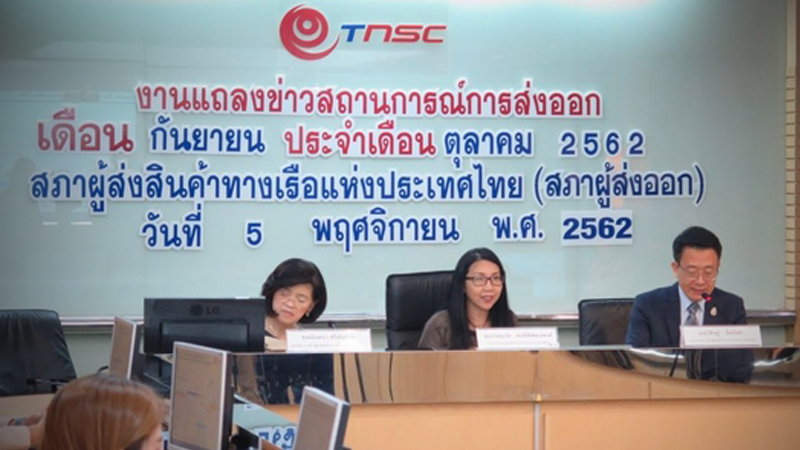
Thailand’s exports in September shrank 1.4 per cent year on year to US$20.48 billion (Bt617.5 billion), while imports dropped 4.2 per cent to $19.20 billion, according to a statement from the Thai National Shipper’s Council today (November 5).

This resulted in Thailand’s trade surplus being $1.275 billion.

Exports during the January-September period also fell 2.1 per cent year on year to $186.572 billion, while imports declined 3.7 per cent to $179.19 billion, which resulted in a trade surplus of $7.381 billion.

The council has maintained its forecast of export decline of 1.5 per cent this year on the assumption that the baht value will be around 33 per US dollar. It has also maintained the forecast that exports will grow between zero and one per cent next year on the assumption that the baht value will be 30.50 per dollar.

Among the existing risk factors are the continued decline of the global economy and the possible impact from the US decision to suspend the Generalised System of Preferences (GSP) granted to some Thai export products.

US Secretary of Commerce Wilbur Ross said in Thailand on Monday that the suspension of tariff privileges under the GSP is “not a big deal” as it represents only $1.3 billion of Thailand’s $4.4-billion exports under the GSP to the United States and is a small fraction of total Thai exports.

He said the two countries still have time to discuss the underlying issue of workers’ rights before the removal of GSP takes effect in April next year. The commerce secretary was in Bangkok to give a keynote address at the Indo-Pacific Business Forum.

Ross: GSP suspension not a big deal

ศาสตร์เกษตรดินปุ๋ย : ขอบคุณแหล่งข้อมูล : หนังสือพิมพ์ The Nation

https://www.nationthailand.com/business/30378054?utm_source=category&utm_medium=internal_referral

Ross: GSP suspension not a big deal

Nov 04. 2019
US Secretary of Commerce Wilbur Ross

US Secretary of Commerce Wilbur Ross
By Wichit Chaitrong

The Nation

2,249 Viewed

US Secretary of Commerce Wilbur Ross said the suspension of tariff privileges under the Generalised System of Preferences (GSP) given to Thailand is “not a big deal” as it represents only $1.3 billion (Bt39.05 billion) of Thailand’s $4.4-billion exports under the GSP to the United States and is a small fraction of total Thai exports.

He said the two countries still have time to discuss the underlying issue of workers’ rights before the removal of GSP takes effect in April next year.

The commerce secretary was in Bangkok on Monday (November 4) to give a keynote address at the Indo-Pacific Business Forum.

Ross reiterated that the US government has placed priority on the Indo-Pacific region and is optimistic that more two-way trade and investment are coming.

US President Donald Trump has given priority to the region as he has met Indian Prime Minister Narendra Modi recently and visited Vietnam in 2017, he added.

Trump did not attend the Asean Summit and Related Summits between November 2 and 4. He assigned special envoy Robert C O’Brien to attend the Asean-US Summit on Monday.

Ross was accompanied by American business leaders at the Indo-Pacific forum, the second time it is being held after the first meeting in Washington in July 2018.

More than 1,000 business and government leaders from the United States and across the Indo-Pacific region gathered on November 4 in Bangkok for the business forum to promote the value of high-standard investment, transparency, rule of law, and private-sector-led economic development, according to information provided by US officials.

Ross said he and the US delegation would make a trip to Indonesia and Vietnam after their visit to Thailand.

He cited many statistics pointing to rapid growth in trade, investment and projects to back up his claim that the US has a strong commitment to the region.

“In fact, the US is the largest source of FDI in the Indo-Pacific region, with total investment at the end of last year being some $866 billion, far more than China’s foreign direct investment in the region worth $504 billion,” he said.

According to the fact sheet provided by US officials, since July 2018, the Department of Commerce has assisted more than 9,000 US companies doing business in the Into-Pacific region and facilitated more than $7.65 billion in US exports, of which $3.1 billion was for government tenders won by US firms. It also assisted more than 2,500 Indo-Pacific companies seeking to invest in the US, facilitating $18 billion of inward investment in the US from the Indo-Pacific. Meanwhile the Department of Commerce’s Advocacy Centre, which is focused on supporting US exporters pursuing public sector projects, has l,412 active cases in the Indo-Pacific valued at approximately $631 billion, with approximately $491 billion in potential US exports.

According to the US information, in November 2017, Trump laid out the US vision for a free and open Indo-Pacific, in which all nations are sovereign, strong and prosperous. Stretching from the US west coast to India’s west coast, with the dynamic Association of Southeast Asian Nations (Asean) at its centre, the Indo-Pacific region is home to the world’s fastest growing markets and offers unprecedented potential to strengthen the US economy while also improving lives in Asia and around the world. The Indo-Pacific region currently accounts for more than one-fourth of all US exports, and those numbers are growing.

According to the East-West Centre, two-way trade with the region last year amounted to more than $1.9 trillion, supporting three million jobs in the US and 5.1 million jobs in the Indo-Pacific region. US exports of goods and services to the region increased by 4.5 per cent in the past year.

Asean is the top destination for US investment in the Indo-Pacific. In 2018, cumulative US investment in Asean was $271 billion.

From 2017 to 2018, Indo-Pacific-announced greenfield investment in the US rose 7.5 per cent to 439 projects, and the US-announced greenfield investment in the Into-Pacific region rose nearly 23 per cent to 1,022 projects, according to FDI Markets.

Greenfield investments are those when companies establish new operations in a country or invest in new facilities and therefore have a strong impact on job creation.