Household debts of Thais alarm economists

ศาสตร์เกษตรดินปุ๋ย : ขอบคุณแหล่งข้อมูล : หนังสือพิมพ์ The Nation

https://www.nationthailand.com/business/30377647

Household debts of Thais alarm economists

Oct 22. 2019
By The Nation
830 Viewed

The ratio of household debt to GDP has risen by 78.8 per cent meaning that Thai citizens have combined debts of Bt13 trillion debts, the second-highest in Asia, according to a recent seminar on the subject of household debt and homeownership organized by the Real Estate Information Centre of Government Housing Bank (GHB).

A massive 21 million are now in debt, with people under the age of 30 considered the most fragile group. Because of the money they owe, these millennials have less buying power and that is having a knock-on effect on the government’s first-time house buyer project.

The seminar made the point that adolescents and new graduates are finding themselves in debt much too early in their lives.

A senior adviser to the National Economic and Social Development Council, Jinanggoon Rojananan said that even though household debt in the second quarter of 2019 dropped by 5.8 per cent from the first quarter, the situation is still risky.

More than 50 per cent of debts are long-time real estate loans and another 30 per cent are made up of personal debts, credit card debts, and car loan debts. These are considered high risk because they are repayable in the short term and can easily turn into bad debts, which will affect requests for loans by first-time house buyers.

People aged between 26-30 years old are most likely to get into debt as a result of unmanageable home loans.

Sakkapop Panyanukul, a senior executive with the Bank of Thailand (BOT)’s Financial Stability Unit, noted that most Thais overspent and saved 15 per cent less money over the past five years resulting in less buying power while the director of the Finance Ministry’s Macroeconomic Analysis Division Pisit Puapan said he believed that the Thai economy would continue to slow as a result of lower investment.

Consumers were encouraged to make financial plans and evaluate their needs before entering into more debt in the slowing economy.

Economies can benefit from IPR: Southeast Asia Project chief

ศาสตร์เกษตรดินปุ๋ย : ขอบคุณแหล่งข้อมูล : หนังสือพิมพ์ The Nation

https://www.nationthailand.com/business/30377640

Economies can benefit from IPR: Southeast Asia Project chief

Oct 22. 2019
Tiago Guerreiro, project leader of the IP Key Southeast Asia Project

Tiago Guerreiro, project leader of the IP Key Southeast Asia Project
By THE NATION

1,443 Viewed

Intellectual Property Rights (IPR) are beneficial to the economy, Tiago Guerreiro, project leader of the IP Key Southeast Asia Project, said.

Guerreiro cited a recent joint study released by the European Union Intellectual Property Office (EUIPO) and the European Patent Office (EPO), which showed that industries or businesses that use different kinds of intellectual property rights, namely copyright, industrial designs, patents and trademarks, account for 45 per cent of GDP, or about €6.6 trillion (Bt222.5 trillion) and generate 29 per cent of all jobs in the EU. This translates to 63 million jobs.

The study, released in September 2019, is an update of two prior studies conducted by the EUIPO and the EUPO and covers the 2014-2016 period.

The same study showed that trademark-intensive industries or those that use trademarks heavily were shown to have supported 46.7 million jobs in the EU. The study also pointed to a very interesting finding that these IPR-intensive industries pay better (48 per cent higher) than those that do not have intellectual property rights.

“Trademarks are very important to businesses, big or small, because they distinguish products and services and contribute to creating goodwill for trademark owners,” Guerreiro said.

A similar study commissioned by the International Trademark Association (INTA), which covered the period of 2009-2014, showed that trademark-intensive industries contributed to 13 per cent of employment in Thailand and their direct contribution to the GDP was 22 per cent.

The study was based on the methodology of the EUIPO and EPO study which was first released in 2013. The INTA study did not cover other IPRs.

In addition to Thailand, the other Southeast Asian countries included in the INTA-commissioned study were Indonesia, Malaysia, Philippines and Singapore.

In the other Southeast Asian countries, the contribution to employment ranged from 15 to 29 per cent, and to the GDP, the range was from 17 to 50 per cent.

Guerreiro noted that EU and SEA trademark experts recommend that business owners secure trademark registrations as early as possible as it is a preventive measure that protects the rights of trademark owners.

“Vigilance is also important – effective monitoring is necessary to prevent third parties from unlawfully using or securing registration over marks that rightfully belong to legitimate trademark owners.

Guerreiro added that enforcement of trademarks is becoming more complicated because rapid changes in technology and the online environment have made it easier for third parties to copy trademarks belonging to legitimate owners and to sell products that are being passed off as legitimate ones.

He said the new forms of trademarks or non-traditional trademarks are also now being developed by trademark owners, and related offices need to reinvent themselves to meet the demands of this evolving global landscape.

Traditional marks are the typical word, figurative marks, a combination of these marks, while non-traditional marks are hologram marks, movement marks, 3D marks, and the non-visible marks.

“We now see different forms of marks such as hologram marks, movement marks, even sound marks,” he said.

He added that in Europe, some companies even filed to register a “scent mark”, like the smell of fruits. However, so far none of the IP offices in European countries have accepted these filings.

Guerreiro said technology has made trademark examination more efficient because IP offices now have the tools that make trademark searches and examination easier and faster.

“We now even have an online image search that shows examiners whether figurative marks are similar to others registered or applied earlier. With these tools, the quality of examination has also improved because the likelihood that a conflicting mark will be registered has become lower,” he said.

The IP Key Southeast Asia Project organised a conference on trademarks on October 15-16 in Bangkok.

The two-day conference aimed to promote the improvement of trademark examination, protection and enforcement, including the quality and enforceability of trademark applications filed in IP offices in Southeast Asia.

In addition to the protection of well-known marks, the conference also focused on measures taken by owners and IP offices to prevent “bad faith” registrations.

Other topics of conversation included competency-based trademark examination and the issues that trademark owners and IP attorneys face when protecting marks in the digital environment.

The two-day conference was attended by experts from the EU, IP offices from Southeast Asia, the academic and business communities, IP attorneys, the World Intellectual Property Organisation (WIPO), and the International Trademark Association.

The EUIPO is an agency of the EU, based in Alicante, Spain. It manages the registration of the European Union trademark and the registered community design, both of which provide protection in all 28 EU member states, as well as carrying out cooperation activities with the national and regional intellectual property offices of the EU.

Under the goals of its Strategic Plan 2020, the EUIPO, in cooperation with national and regional EU IP offices, aims to promote global cooperation on IP between EU partners, third countries and multilateral organisations.

Video: https://youtu.be/0Kk_ng0bhmc

Hong Kong unrest sees interest in Thai condo market rise

ศาสตร์เกษตรดินปุ๋ย : ขอบคุณแหล่งข้อมูล : หนังสือพิมพ์ The Nation

https://www.nationthailand.com/business/30377638

Hong Kong unrest sees interest in Thai condo market rise

Oct 22. 2019
By The Nation

1,298 Viewed

Several Hong Kong citizens have bought condominiums among Sukhumvit Road, eager to take advantage of its central location and ease of travel for foreigners who aren’t familiar with Bangkok.

The most demanded units are priced between Bt5 – Bt10 million and have one or two bedrooms, Wongsakorn Prasitwipat, managing director of Property Perfect, said.

Even though the actual number has yet to be assessed, customers appear more interested in buying condominiums than usual and developers should prepare for a potential increase in demand.

Hong Kong is not a big market but buyers want to live in the centre of the city, unlike mainland Chinese buyers who willingly buy condominiums in the outskirts of Bangkok to take advantage of cheaper prices.

Piya Prayong, chief executive of Pruksa Real Estate, has said that real estate agents from Hong Kong are tending to contact the larger agencies in Thailand, as demand is likely to increase over the long term due to limited residential spaces.

Hong Kongers interested in buying condominiums in the centre of Bangkok via agencies have increased by 20 per cent. They are eyeing units priced between Bt3 million and Bt5 million and Pruksa Real Estate’s The Privacy on Sukhumvit 101 could meet this demand, Piya added.

Wasan Kiangsiri, president of the Housing Business, noted that the ongoing unrest in Hong Kong was not the key factor in the increased interest, as residents were waiting to see what will happen next.

Yasushi Yamada of Sotheby’s International Realty, disagreed, expressing the view that the crisis in Hong Kong could well result in new investment in other countries, especially those in the ASEAN region.

Thitiwat Teerakulthanyaroj of Century 21 (Thailand) noted that some investors and real estate agencies in Hong Kong have already initiated agreements in Thailand, such as Fortune Hand Ventures from Hong Kong which has collaborated with BTS Group Holdings to develop real estate projects valued at Bt5 billion.

Moreover, small investors are likely to choose Thailand as a second residence due to the crisis while those who have more buying power choose England, Canada, or Singapore for their geographic familiarity to Hong Kong.

Customers from Hong Kong will buy condominiums in Thailand for investment, ownership, or residence if an unexpected situation arises but the number of those really interested in living in Thailand is still small, he said.

Cyber security, fintech at core of Thai-Russian MoU on cooperation

ศาสตร์เกษตรดินปุ๋ย : ขอบคุณแหล่งข้อมูล : หนังสือพิมพ์ The Nation

https://www.nationthailand.com/business/30377619

Cyber security, fintech at core of Thai-Russian MoU on cooperation

Oct 22. 2019
Bank of Thailand Governor Veerathai Santiprabhob(left) and  Elvira Nabiullina, Governor of the Central Bank of the Russian Federation.

Bank of Thailand Governor Veerathai Santiprabhob(left) and Elvira Nabiullina, Governor of the Central Bank of the Russian Federation.
By The Nation

1,436 Viewed

Bank of Thailand Governor Veerathai Santiprabhob signed a Memorandum of Understanding on Cooperation with Elvira Nabiullina, Governor of the Central Bank of the Russian Federation on October 18 at the IMF-WBG annual meetings in Washington, DC.

The agreement aims to strengthen bilateral ties and cooperation between the two central banks through exchanging views and experiences on central banking functions and policies such as monetary policy, banking supervision, payment and settlement systems, fintech innovations, cyber security as well as promoting other financial cooperation leading to further economic and financial connectivity between the two countries, according to a BOT statement issued today (October 21).

A close cooperation between the central bank and its Russian counterpart should help the tourism industry, because Thailand is a popular destination among Russians.

Thailand, Myanmar agree to use baht, kyat for cross-border payments

ศาสตร์เกษตรดินปุ๋ย : ขอบคุณแหล่งข้อมูล : หนังสือพิมพ์ The Nation

https://www.nationthailand.com/business/30377618

Thailand, Myanmar agree to use baht, kyat for cross-border payments

Oct 22. 2019

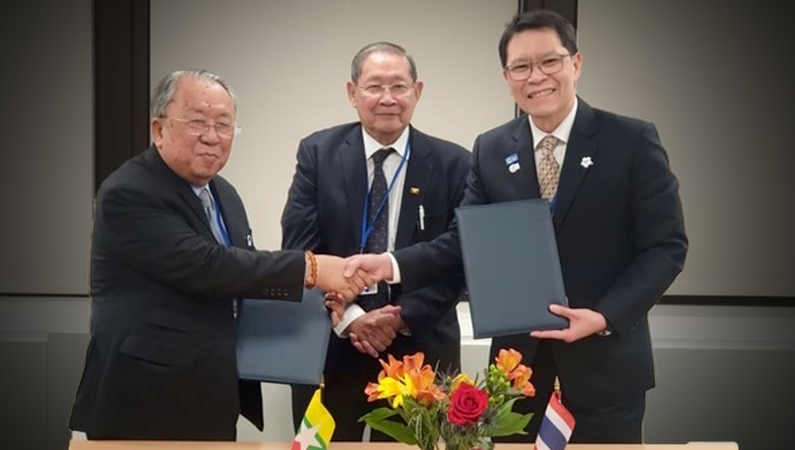
Right to left: Veerathai, U Soe Win and U Kyaw Kyaw Maung

Right to left: Veerathai, U Soe Win and U Kyaw Kyaw Maung
By The Nation1,044 Viewed

Veerathai Santiprabhob, governor of the Bank of Thailand, and his Myanmar counterpart U Kyaw Kyaw Maung, signed two memoranda of understanding (MoU) on October 18 during the IMF-World Bank meeting in the US.

The signing was witnessed by Myanmar’s Minister for Planning and Finance U Soe Win, according central bank statement on October 21.

The two MoUs are as follows:

1) Collaboration to promote the use of the Myanmar kyat and the Thai baht for cross-border payment and settlement between the two countries; and

2) Cooperation in the areas of financial innovation and payments systems, which aims to enhance collaboration on financial innovation and payment services to promote more efficient and secure domestic and cross-border fund transfers.

The Bank of Thailand has been promoting the use of baht and other local currencies in the region as part of its efforts to curb the strengthening of the Thai currency.

Branded goods not getting cheaper in Thailand any time soon

ศาสตร์เกษตรดินปุ๋ย : ขอบคุณแหล่งข้อมูล : หนังสือพิมพ์ The Nation

https://www.nationthailand.com/business/30377624

Branded goods not getting cheaper in Thailand any time soon

Oct 21. 2019
The Finance Minister Uttama Savanayana

The Finance Minister Uttama Savanayana
By THE NATION

838 Viewed

The Finance Minister Uttama Savanayana denied he has discussed the possibility of reducing tariff on branded goods to 5 per cent from the current 30 per cent with the Tourism Authority of Thailand.

He said he needs to study the issue in detail first before he can tell if the tariff should be reduced.

Meanwhile, the Fiscal Policy Office’s director-general Lavaron Sangsnit said the minister has yet to tell the office to study the case.

Recently, Tourism and Sports Minister Phiphat Ratchakitprakarn said he wants cuts in tariffs of well-known brands to attract more tourists.

Egat gets nod for first time to import LNG

ศาสตร์เกษตรดินปุ๋ย : ขอบคุณแหล่งข้อมูล : หนังสือพิมพ์ The Nation

https://www.nationthailand.com/business/30377612

Egat gets nod for first time to import LNG

Oct 21. 2019
Energy Minister Sontirat Sontijirawong

Energy Minister Sontirat Sontijirawong
By THE NATION

1,118 Viewed

The Energy Policy Administrative Committee on Monday gave the Electricity Generating Authority of Thailand (Egat) the go-ahead for the first time to import Liquefied Natural Gas (LNG) totalling 130,000 tonnes.

Energy Minister Sontirat Sontijirawong said after a committee meeting that it acknowledged Egat’s plan to import LNG purchased on spot markets on a trial basis.

The state agency will import LNG in two cargoes, each carrying 65,000 tonnes. The first import will take place in December and the second in April next year.

PTTOR aims to open first petrol station in Myanmar next year

ศาสตร์เกษตรดินปุ๋ย : ขอบคุณแหล่งข้อมูล : หนังสือพิมพ์ The Nation

https://www.nationthailand.com/business/30377531

PTTOR aims to open first petrol station in Myanmar next year

Oct 21. 2019
By THE NATION

1,234 Viewed

Buranin Rattanasombat, executive vice-president of planning at PTT Oil and Retail Business (PTTOR), revealed on Friday (October 18) that the company is planning to expand its markets in neighbouring countries as part of its overseas business strategy.

“As of June, we had 281 PTT stations in Cambodia, Laos and Philippines,” he said. “The first PTT station in Myanmar is slated to open before the second quarter of next year.”

Buranin further explained that PTTOR had received approval from the Myanmar government for a joint venture project with local partners to build an LPG and oil reserve facility in Myanmar. “The construction of reserve facility should be completed within a year, while a PTT petrol station usually takes 4-6 months to build,” he said.

PTTOR will be working with Myanmar’s biggest private conglomerate, Kanbawza KBZ Group, to build a comprehensive oil and gas facility complete with storage depot, logistics port and gas packing factory. “When completed, it will be the biggest oil and gas reserve in Myanmar, with a storage capacity of 1 million barrels of oil and 4,500 tonnes of LPG,” said Buranin.

“Since Myanmar has no oil refinery, we hope that this project will serve as a fuel storage centre to handle the delivery and quality control of PTT products that will come by sea from Singapore and by land from Thailand,” said Buranin. “The facility is located in Yangon and is connected to a comprehensive logistics network nationwide.”

PTTOR has adopted the same practice in Cambodia, Laos and Philippines to ensure ease of delivery and efficient quality control.

Buranin also revealed that Café Amazon, another successful franchise of PTTOR, is now operating 222 branches in Cambodia, Laos, Philippines, Oman, Japan, Singapore, China, Malaysia, and Myanmar.


Related news:

PTT board to discuss plans to list its oil, retail businesses

PTTOR aims for a bright digital future with latest camp

More manufacturers relocating to Thailand from China, HK

ศาสตร์เกษตรดินปุ๋ย : ขอบคุณแหล่งข้อมูล : หนังสือพิมพ์ The Nation

https://www.nationthailand.com/business/30377526

More manufacturers relocating to Thailand from China, HK

Oct 21. 2019
By THE NATION

1,582 Viewed

An increasing number of manufacturers are moving their production bases from China and Hong Kong to Thailand due to the US-China trade war, the Board of Investment (BOI) has said.

BOI deputy secretary-general Narit Therdsteerasukdi said recently that investment applications last year from Chinese and Hong Kong investors for BOI tax privileges had reached a 10-year high of 164 projects worth almost Bt60 billion.

He added that the number of such applications continued to increase during the first half of this year, totalling 111 projects worth more than Bt31 billion.

Most of them are in the auto parts, plastics, machinery and furniture businesses.

He added that the production bases of Taiwanese and South Korean companies in China, which export to the US, are also relocating their plants to Asean countries, including Thailand.

Last month, the BOI approved Thailand Plus incentives, aimed at attracting foreign businesses to relocate and expedite large-scale investment as well as strengthen workforce development.

These new measures include an enhanced incentive package for projects worth at least Bt1 billion of investment, additional incentives for companies engaged in human resource development, and revised incentives to encourage corporates to set up STEM (Science, Technology, Engineering and Mathematics), or educational or vocational training institutions.

BOI will also launch a roadshow to woo investments from China and Hong Kong next year.

Deputy Prime Minister Somkid Jatusripitak is visiting Guangdong province in China and the Hong Kong Special Administrative Region from Sunday (October 20) to October 25.

The visit aims to promote relations and strengthen collaboration between Thailand and China.

He is accompanied by executives from the Eastern Economic Corridor Office and BOI.

According to BOI data, the total value of applications received by the BOI from foreign investors more than doubled to Bt147.2 billion in the first half of 2019, as compared to the corresponding period last year.

In terms of the source of the foreign direct investment applications, out of a total of 468 projects, Japanese companies ranked first with applications for 114 projects worth Bt42.45 billion, followed by China, with 81 projects worth 24.28 billion baht, and Switzerland, with 10 projects worth Bt11.44 billion.

Auntie’s fermented fish safe from salt tax, says govt

ศาสตร์เกษตรดินปุ๋ย : ขอบคุณแหล่งข้อมูล : หนังสือพิมพ์ The Nation

https://www.nationthailand.com/business/30377582

Auntie’s fermented fish safe from salt tax, says govt

Oct 20. 2019
Nathakorn

Nathakorn
By The Nation

1,370 Viewed

A planned tax on salted foods will not apply to traditional dishes made within communities, the Excise Department insists.

Deputy spokesman Nathakorn Uthainsut said ordinary cooks and vendors needn’t worry about the incoming excise tax on food products with high sodium content.

The tax will not be applied to salted dried fish, fermented fish or shrimp or other food products in which the salt has always been used as a preservative.

The tax is instead aimed at larger-scale manufacturers who add salt to enhance the tastiness of snacks, instant noodles and canned food, Nathakorn said.

The objective is to lower people’s sodium intake for the sake of their health, he said, noting that the World Health Organisation advocates no more than 2,000 milligrams per day and Thailand’s Public Health Ministry accepts 2,400mg.

Nathakorn said it hadn’t been determined which of those limits will be reflected in the terms of the new excise tax.

A schedule of new tax rates should be ready by year-end, he said.

The department will allow food producers an adjustment period of up to two years, just as makers of sugary beverages were given breathing space when a sugar tax was introduced.