Weather hampers bid to improve Thai salt quality

ศาสตร์เกษตรดินปุ๋ย : ขอบคุณแหล่งข้อมูล : หนังสือพิมพ์ The Nation

https://www.nationthailand.com/business/30377284

Weather hampers bid to improve Thai salt quality

Oct 10. 2019
By The Nation

592 Viewed

Owners of salt farms are struggling not just with ruinous weather phenomena but also with overseas competition. The solution to the latter problem could be just a matter of improving quality.

Juadee Pongmaneerat, secretary-general of the National Bureau of Agricultural Commodities and Food Standards, said this week that the 1,200 households in possession of 84,500 rai of salt farms must adhere to “Good Agricultural Practices” (GAP) to ensure their product is acceptable to foreign markets.

Katekaew Sumpaothong, a salt farmer in Petchaburi, said more salt is lately being imported from India, sending the price of Thai salt tumbling.

“The price has dropped from Bt2-Bt3 per kilogram to Bt1 since the beginning of the year, and that means no profit for farmers,” she said. “Most farmers are heavily in debt due to accumulated loss.”

Thailand imported 151,480 tonnes of salt in 2017 worth Bt216 million, and the figures doubled the next year, to 389,589 tonnes and Bt437 million.

In the first quarter of this year alone, 100,819 tonnes worth Bt120 million were imported.

“Now that India is our biggest competitor, the Department of Agriculture, Fisheries and Livestock Development need to apply the GAP to guarantee quality and standards for consumers and industries,” Juadee said. “Salt imports also have to be lowered to help our farmers.”

She cited the Thai Salt Strategic Plan 2017-2021, which aims to improve quality and standards to meet market expectations and develop eco-friendly farming methods to ensure sustainable operations and stabilise prices in the long term.

Just three Central provinces – Phetchaburi, Samut Sakhon, and Samut Songkhram – are responsible for 90 per cent of the salt produced in Thailand. The rest comes from Chonburi, Chanthaburi, Chachoengsao, and Pattani.

Domestic annual production is in excess of one million tonnes and generates at least Bt2 billion in revenue. India’s salt tends to be cheaper.

But the climate and other environmental conditions hamper efforts to improve the quality of Thai salt.

The season begins in early November and ends in mid-May, a period when there is less rain.

Salt grains can be harvested by mid-January, after which wholesalers begin buying it or farmers sell via cooperatives. The salt then moves on to food factories, mills, and storehouses.

BOT plans measures to curb baht’s rapid appreciation

ศาสตร์เกษตรดินปุ๋ย : ขอบคุณแหล่งข้อมูล : หนังสือพิมพ์ The Nation

https://www.nationthailand.com/business/30377279

BOT plans measures to curb baht’s rapid appreciation

Oct 10. 2019
BOT Governor Veerathai Santiprabhob

BOT Governor Veerathai Santiprabhob
By THE NATION

2,719 Viewed

The Bank of Thailand (BOT) plans new measures within a few months to curb the baht’s rise, the central bank’s governor said on Thursday.

Among the measures being considered are liberalisation of capital outflows.

BOT Governor Veerathai Santiprabhob said the central bank’s Monetary Policy Committee has been worried much about the appreciation of the baht.

The BOT is planning additional measures to rein in the rising baht, and it would be ready in one or two months, he told reporters.

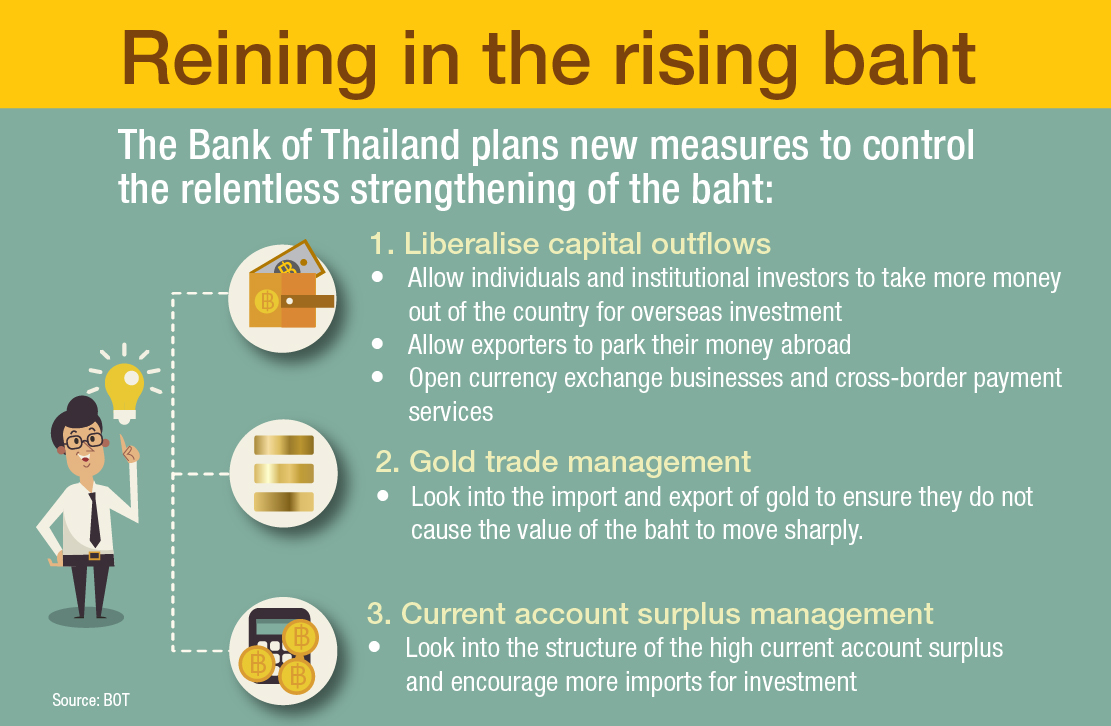
The new package of measures would cover three key areas, he explained.

First, the BOT will liberalise capital outflows by allowing individual investors and institutional investors to take more money out of the country for investment abroad. Exporters will also be allowed to park their money abroad when they earn income overseas. The BOT will also liberalise the currency exchange business and cross-border payment services in order to reduce the cost of cross-border transactions for people and businesses.

Second, the central bank will look into the import and export of gold in order to ensure that the gold trade would not move the value of the baht sharply. Veerathai insisted that the central bank would not limit or control the gold trade.

Third, the BOT will look into the structure of current account surplus. For example, the bank may encourage more import of capital goods for infrastructure investment, such as more investment to support infrastructure of digital economy.

Veerathai, however, clarified that the fast appreciation of the baht over the past few days had been a result of investors bringing in more money to invest in one large company. He did not reveal the name of that company. However, it is widely known in the market that the company being mentioned is Asset World Corp, a leading real estate developer led by billionaire Charoen Sirivadhanabhakdi’s family. The company made its debut in the stock market on Thursday.

The baht hit a six-year high on Wednesday and on Thursday it moved at around Bt30.30 per US dollar while some analysts expected it would strengthen to Bt30.

Consumer confidence continues decline

ศาสตร์เกษตรดินปุ๋ย : ขอบคุณแหล่งข้อมูล : หนังสือพิมพ์ The Nation

https://www.nationthailand.com/business/30377274

Consumer confidence continues decline

Oct 10. 2019
Thanawat Polvichai, the director of the University of the Thai Chamber of Commerce’s Centre for Economic and Business Forecasting

Thanawat Polvichai, the director of the University of the Thai Chamber of Commerce’s Centre for Economic and Business Forecasting
By The Nation

1,080 Viewed

The Consumer Confidence Index fell again in September for the seventh consecutive month despite the introduction of economic stimulus measures, the director of the University of the Thai Chamber of Commerce’s Centre for Economic and Business Forecasting said on Thursday (October 10).

Thanawat Polvichai said the index dropped to 72.2, its lowest point in 39 months. It stood at 73.5 in July 2016.

The assessment indicates that consumers believe the global economy has yet to recover, Thanawat said.

He attributed the lack of confidence to uncertainties over global trade, Brexit, Thai politics and low prices commanded by Thai farm products.

Regional growth slows under trade tensions and global uncertainties: World Bank

ศาสตร์เกษตรดินปุ๋ย : ขอบคุณแหล่งข้อมูล : หนังสือพิมพ์ The Nation

https://www.nationthailand.com/business/30377268

Regional growth slows under trade tensions and global uncertainties: World Bank

Oct 10. 2019
By THE NATION

918 Viewed

Growth in developing East Asian and Pacific economies is expected to slow from 6.3 per cent in 2018 to 5.8 per cent in 2019 and then to 5.7 and 5.6 per cent in 2020 and 2021, respectively, according to a World Bank news release on Thursday (October 10).

The slowing reflects a broad-based decline in export growth and manufacturing activity, said the Bank.

Weakening global demand, including from China, and heightened uncertainty around ongoing US-China trade tensions has led to a decline in exports and investment growth, testing the resilience of the region, according to “Weathering Growing Risks”, the October 2019 edition of the World Bank’s East Asia and Pacific Economic Update, released today.

In the region excluding China, consumption growth remained steady, though slightly lower than the same period last year, supported by monetary and fiscal policies.

Growth in the smaller economies of the region, however, remained robust, reflecting country-specific circumstances including steady growth in the tourism, real estate and extractive sectors.

“As growth slows, so does the rate of poverty reduction,” said Victoria Kwakwa, the World Bank vice president for East Asia and the Pacific.

“We now estimate that almost a quarter of the population of developing East Asia and the Pacific lives below the upper-middle-income poverty line of US$5.50 (Bt166.68) a day. This includes nearly 7 million more people than we projected in April, when regional growth was looking more robust.”

The report makes clear that increasing trade tensions pose a long-term threat to regional growth.

While some countries have hoped to benefit from a reconfiguration of the global trade landscape, the inflexibility of global value chains limits the upside for countries in the region in the near term.

“While companies are searching for ways to avoid tariffs, it will be difficult for countries in developing East Asia and the Pacific to replace China’s role in global value chains in the short-term due to inadequate infrastructure and small scales of production,” said Andrew Mason, the World Bank lead economist for East Asia and the Pacific.

The report warns that downside risks to the region’s growth prospects have intensified.

Prolonged trade tensions between China and the United States would continue to hurt investment growth, given high levels of uncertainty.

A faster-than-expected slowdown in China, the Euro Area and the United States, as well as a disorderly Brexit, could further weaken the external demand for the region’s exports.

High and rising debt levels in some countries are also putting limits on their abilities to use fiscal and monetary policies to ease the impacts of the slowdown.

In addition, any abrupt changes in global financial conditions could translate into higher borrowing costs for the region, dampening credit growth and further weighing on private investment and economic growth in the region.

To weather growing risks, the report recommends that countries with sufficient policy space use fiscal and/or monetary measures to help stimulate their economies, while guarding fiscal and debt sustainability. Countries in the region will also benefit from staying the course on trade openness and by deepening regional trade integration.

The ongoing US-China trade dispute, along with slowing global growth, also increase the need for countries in the region to undertake reforms to improve their productivity and boost growth. This includes regulatory reforms that improve the trade and investment climate to attract investment and facilitate the movement of goods, technology and know-how.

Government on track for full digitalisation by 2022

ศาสตร์เกษตรดินปุ๋ย : ขอบคุณแหล่งข้อมูล : หนังสือพิมพ์ The Nation

https://www.nationthailand.com/business/30377247

Government on track for full digitalisation by 2022

Oct 10. 2019
Kobsak

Kobsak
By THE NATION

559 Viewed

Deputy Prime Minister Somkid Jatusripitak has set a timeframe for the government to become fully digital by 2022.

He instructed the Digital Government Development Agency on Wednesday (October 9) to prioritise its proposals and forward them next month to a committee tasked with electronically integrating all government bodies and services.

The agency must set out clear goals for every government entity to develop and adapt their services based on digital technology, Somkid said. It will then help them reorganise public policy using the massive state database in order to better serve the public.

Somkid also asked the Ministry of Digital Economy and Society to have IT-savvy personnel in all state agencies prepared to be “chief IT officers” overseeing the adoption of digital technology.

Kobsak Pootrakool, deputy secretary-general to the prime minister for political affairs, said the Digital Government Development Agency had played a key role in laying the foundation for the process, developing several online applications that benefit citizens.

It is also developing a convenient “OSS Foreigner” mobile application for foreigners staying longer than 90 days to report their whereabouts to the Immigration Bureau by supplying the required information and a “selfie” photo.

Doing so will save them trekking to the Immigration offices, and the innovation could encourage more foreigners to stay to Thailand, Kobsak said.

‘Eat, Shop, Spend’ phase 2 registration might be halved

ศาสตร์เกษตรดินปุ๋ย : ขอบคุณแหล่งข้อมูล : หนังสือพิมพ์ The Nation

https://www.nationthailand.com/business/30377242

‘Eat, Shop, Spend’ phase 2 registration might be halved

Oct 10. 2019
Finance Minister Uttama Savanayana

Finance Minister Uttama Savanayana
By THE NATION

522 Viewed

The number of registrants allowed for the second phase of the government’s “Eat, Shop, Spend” economic stimulus campaign might be limited to 5 million, Finance Minister Uttama Savanayana said on Wednesday (October 9).

The scheme is designed to encourage people to spend more in provinces with second-tier tourist attractions.

Uttama plans to submit details of the second phase to the Cabinet later this month with an eye to extending the campaign into November and December.

Registrants in the first phase are eligible for the second. The limit was 10 million for the first phase launched last month.

Uttama added that the ministry would try and drive gross domestic product growth this year as close as possible to the 3 per cent target, but the results depended as much on exports as stimulus packages.

The government will launch two other campaigns to complement “Eat, Shop, Spend”.

In one, the Tourism Authority of Thailand (TAT) would help hotels, spas and entertainment venues sell 40,000 domestic tour packages priced at Bt100 each.

In the second, aimed at boosting travellers’ spending, the TAT and private-sector partners would offer 70 per cent discounts on weekdays on luxury products and services at participating hotels, shopping malls, spas, hospitals, restaurants, jewellery stores and amusement parks.

The TAT will announce the details on October 17.

Uttama meanwhile directed the Treasury Department to use modern technology to collect data on its land holdings across the country and determine how they are currently being used.

Lack of critical thinking makes Thailand’s competitiveness ranking slip

ศาสตร์เกษตรดินปุ๋ย : ขอบคุณแหล่งข้อมูล : หนังสือพิมพ์ The Nation

https://www.nationthailand.com/business/30377258

Lack of critical thinking makes Thailand’s competitiveness ranking slip

Oct 10. 2019
By Wichit Chaitrong
The Nation

802 Viewed

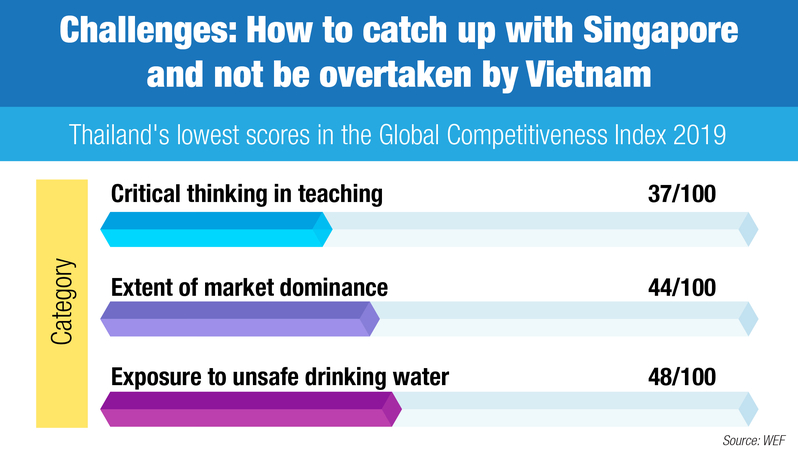
Thailand could improve its competitiveness among nations by tackling its weakest points – a lack of critical thinking in teaching, failure to dominate any markets, and unsafe drinking water, according to Switzerland-based World Economic Forum.

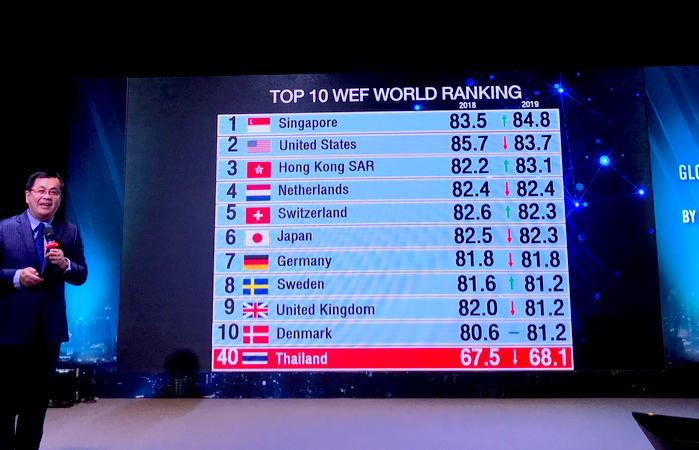
Thailand’s ranking among 141 economies has dropped to 40th place from 38 in 2018 in the just-released WEF Global Competitiveness Index.

Singapore tops the rankings, overtaking the United States, while Vietnam jumped 10 spots to 67th

place, according to a survey by the WEF, which seeks to promote public-private cooperation.

Kobsak Pootrakool, deputy secretary-general to the prime minister for political affairs, on Wednesday (October 9) acknowledged Thailand’s ranking slipping even as some scores rose. “It’s like a running competition – if our pace is slower, others will overtake us, so we have to run faster,” he said.

Assistant Professor Wilert Puriwat, dean of the Chulalongkorn Business School, which is allied with the WEF, said that, If Thailand wants to improve its ranking, labour skills must be improved.

“The survey found that skills among new university graduates have declined, especially in the area of critical thinking,” he said.

The way students are taught needs to change, he said, noting that Thailand’s score on critical thinking in the classroom was the world’s lowest at 37 out of 100 points. In assessing skills possessed by the future workforce, the survey names Finland first for critical thinking in teaching, with 89 points.

“We’ve failed the exam and it can’t be fixed by simply retaking the test – we need to restart learning,” Wilert said, alluding to Thai students routinely performing poorly on tests compared to foreign counterparts, a lag blamed on the traditional reliance here on rote learning through memorisation.

The WEF urged Thailand to encourage creative and critical individual thinking in the classroom instead.

Finland ranks second for skills of current workforce, scoring 75.8 points compared to Thailand’s 52.2. The WEF recommended better staff training and increased attention to digital skills.

Noting the only a few large Thai companies dominate the domestic market, muscling aside smaller contenders, Wilert said Switzerland provides a model for spreading dominance among many firms by helping smaller ones gain market share. Switzerland ranks first in the sharing of market dominance, he noted.

“This will take time since the few big firms have dominated the market for so long,” he said.

Although tap water has become widely available widely across the country, it is not as safe to drink as that found in developed countries, said Wilert.

The index covers four main categories.

First is proving an “enabling environment” and assesses institutions, infrastructure, ICT adoption and macroeconomic stability. Second is “human capital” and examines health and skills.

In the third, product markets, the labour market, the financial system and market size are compared. Fourth is the “innovation ecosystem”, which looks at business dynamism and capacity for innovation.

In all there are 103 separate factors examined for which up to 100 points can be awarded.

Thailand’s 68.1 GCI ranking places it in the top 40 among the 141 economies surveyed, but it it progressing more slowly than other countries, Wilert noted.

Its identified weaknesses are in institutions, innovation capability, product markets and skills. Its strengths are the financial system, public health and macro-economic stability.

The score for institutions dropped from 55.1 in 2018 to 54.8 this year, the ranking from 67 to 60. Corruption and an inefficient legal framework for challenging regulations were the key damaging factors, the WEF said.

The score for infrastructure fell from 69.7 to 67.8 and the ranking from 71st to 60th place due to continued reliance on an inefficient railway service.

“Improvement in the rankings will come if there is rapid progress in several areas, such as reducing corruption, improving infrastructure and workforce skills, and boosting the level of domestic market competition,” Wilert said.

Baht hits 6-year high, reversing trend of regional currencies

ศาสตร์เกษตรดินปุ๋ย : ขอบคุณแหล่งข้อมูล : หนังสือพิมพ์ The Nation

https://www.nationthailand.com/business/30377257

Baht hits 6-year high, reversing trend of regional currencies

Oct 10. 2019
By The Nation

601 Viewed

The baht closed at Bt30.33 against the US dollar on Wednesday (October 9), up from Bt30.42 against the greenback when trading opened. During the day, the baht shot up to Bt30.29 against the dollar, marking a record six-year high since May 30, 2012.

Since early this year, the baht has surged 7.3 per cent – more than any other Asian currency.

Roong Sanuangruang, an analyst at Krungsri Bank, said the baht’s strengthening has reversed the trend of other currencies in the region. The reason behind this is the fact that Thailand has a high current-account surplus at 7 to 8 per cent of the GDP and that it has high international reserves worth US$220 billion (Bt6.67 trillion) in line with the central bank’s long position of $33.1 billion, or total international reserves of $253 billion as of September 27.

“Foreign investors see the baht as a safe haven even though Thailand’s economic growth is not high, and the baht may even move up to Bt30 per dollar in the short term,” she said.

Meanwhile, Finance Minister Uttama Savanayana said that while exporters may be adversely affected by the strengthening of the baht, importers will gain from it.

“This is the best time for manufacturers to import machinery and invest in capital goods as prices are low,” he added.

Bank of Thailand’s monetary policy division had earlier expressed concerns about the fast-rising baht, saying the currency’s appreciation could potentially hurt exports and the economy as Thai products will become more expensive compared to those of competitors. Also, Thai exporters have long complained about the impact of the exchange rate appreciation and some exporters have even asked the central bank to make the baht stay at around Bt32 per dollar.

The central bank’s executives have also said that they will try to come up with new measures to encourage Thais to invest money overseas in a move to balance the inflow.

‘High speed’ needed to name new SRT board

ศาสตร์เกษตรดินปุ๋ย : ขอบคุณแหล่งข้อมูล : หนังสือพิมพ์ The Nation

https://www.nationthailand.com/business/30377234

‘High speed’ needed to name new SRT board

Oct 09. 2019
Finance Minister Uttama Savanayana reaffirms the ministry’s full support for the project.

Finance Minister Uttama Savanayana reaffirms the ministry’s full support for the project.
By THE NATION

1,099 Viewed

The Finance Ministry has spurred on the State Enterprise Policy Office (Sepo) to work with the Transport Ministry in quickly appointing new board members to the State Railways of Thailand (SRT).

The SRT has to sign a contract with a consortium led by Charoen Pokphand (CP) led by October 25 to develop the high-speed railway linking three major international airports.

Finance Minister Uttama Savanayana reaffirmed the ministry’s full support for the project and noted that Sepo already has a list of prospective new SRT directors and a chairman. He declined to disclose their names.

Transport Minister Saksayam Chidchob already postponed the deadline for the contract signing to October 25 from October 15 pending the board appointments.

The previous board resigned en masse on October 1.

Saksayam said that, without board approval, the SRT would be unable to submit the signed documents for Cabinet approval.

The CP-led consortium had the lowest bid for the project linking Don Mueang, Suvarnabhumi and U-tapao airports by rail.

Consortium partners are Bangkok Expressway and Metro Plc, China Railway Construction Corp, Ch Karnchang Plc and Italian-Thai Development Plc.

Thailand competitiveness ranking drops 2 spots to 40th place

ศาสตร์เกษตรดินปุ๋ย : ขอบคุณแหล่งข้อมูล : หนังสือพิมพ์ The Nation

https://www.nationthailand.com/business/30377229

Thailand competitiveness ranking drops 2 spots to 40th place

Oct 09. 2019
By The Nation

3,800 Viewed

Thailand’s competitiveness ranking for 2019 has dropped two spots from 38th to 40th among 141 world economies, despite the government’s Thailand 4.0 programme.

The World Economic Forum’s Global Competitiveness Index rankings for 2019 were announced on Wednesday (October 9) at the Chulalongkorn Business School.

The drop occurred despite the Thailand 4.0 programme, noted Ass’t Professor Wilert Puriwat, Dean of Chulalongkorn Business School.

“Other countries made faster progress in increasing their competitiveness,” he said.

Still, Thailand’s scores rose from 67.5 to 68.1, he added.

Singapore is ranked first place, followed by the US and Hong Kong.

The index is divided into four major categories and built on 12 pillars:

1. Enabling Environment, which covers institutions, infrastructure, ICT adoption and macroeconomic stability;

2. Human capital, in which health and skills are assessed;

3. Markets, which includes product markets, labour market, financial system and market size;

4. Innovation ecosystem, in which business dynamism and inoculation capacity are assessed.

The rankings are determined by the World Economic Forum in alliance with the Chulalongkorn Business School at Chulalongkorn University.