Singapore is world’s most competitive economy: World Economic Forum

ศาสตร์เกษตรดินปุ๋ย : ขอบคุณแหล่งข้อมูล : หนังสือพิมพ์ The Nation

https://www.nationthailand.com/business/30377228

Singapore is world’s most competitive economy: World Economic Forum

Oct 09. 2019
Singapore scored 84.8 out of a possible 100, beating the United States to the top spot in the rankings of 141 economies.ST PHOTO: LIM YAOHUI

Singapore scored 84.8 out of a possible 100, beating the United States to the top spot in the rankings of 141 economies.ST PHOTO: LIM YAOHUI
By The Straits Times

1,389 Viewed

SINGAPORE – Singapore is the world’s most competitive economy, according to an updated global league table.

It scored 84.8 out of a possible 100, beating the United States to the top spot in the rankings of 141 economies.

The US, which topped the charts last year, scored 83.7.

“Singapore improves from an already high base,” the World Economic Forum said on Wednesday (Oct 9), adding that the country ranked first for infrastructure – one of the index’s 12 assessment pillars.

Singapore also was number one for two of the index’s other pillars – citizens’ healthy life expectancy years and labour markets.

Other high-scoring areas included the financial system, market efficiency and macroeconomic stability.

“Singapore ranks second for the quality of public institutions, behind Finland, but its performance is undermined by limited checks and balances,” the report said.

“Singapore notably ranks 124th on the Freedom of the Press Index – and lack of commitment to sustainability.”

The report added that Singapore will need to promote entrepreneurship and further improve its skills base to become a global innovation hub.

It also noted that the US performed better in domestic competition and trade openness last year.

“Despite an overall weaker performance this year, the US remains one of the most competitive economies in the world. It is still an innovation powerhouse, ranking second on the innovation capability pillar and first in terms of business dynamism… and home to one of the most dynamic financial systems in the world.”

Hong Kong rose four spots to third place.

The report said the territory ranks first on four pillars – macroeconomic stability, health, financial system and product market – the most of any economy.

“Hong Kong’s biggest weakness is undoubtedly its limited capability to innovate,” the report said, adding that the region also lags behind Singapore in worker protection.

The Netherlands and Switzerland round up the top five most competitive economies. The Netherlands jumped two spots to fourth place while Switzerland fell one to fifth.

The Global Competitiveness Report series was launched in 1979 to provide an annual assessment of the drivers of productivity and long-term economic growth.

https://www.straitstimes.com/business/economy/singapore-is-worlds-most-competitive-economy-world-economic-forum

Cabinet set to deliberate on EEC land-use, development plans

ศาสตร์เกษตรดินปุ๋ย : ขอบคุณแหล่งข้อมูล : หนังสือพิมพ์ The Nation

https://www.nationthailand.com/business/30377209

Cabinet set to deliberate on EEC land-use, development plans

Oct 09. 2019
By THE NATION

721 Viewed

The Eastern Economic Corridor (EEC) Policy Committee will soon submit plans to the Cabinet for the use of land and the development of utilities infrastructure in the EEC.

Kanit Sangsubhan, secretary-general of the EEC Office, said the plans will cover the development of the EEC zone for 20 years.

The EEC zone covers Chachoengsao, Chon Buri and Rayong provinces, and once the plans are approved by the Cabinet, the Department of Public Works and Town and Country Planning will draw up new plans for the three provinces.

He added that the latest plan only changed the land-use specifications by 8 per cent, so forest areas and good agricultural land can be maintained, and only 3 per cent of rural zones will be developed.

Tasanee Kiatpatraporn, the committee’s deputy secretary-general and part of Strategic Area and Community Development Group, said the plan on the use of land in EEC should be tabled before the Cabinet on October 15. If approved, it will be published in the Royal Gazette and go into effect immediately. She added that the new plans will encourage more companies to set up business in the EEC.

According to the Industrial Estate Authority of Thailand, 18 industrial estate operators have applied to set up industrial zones covering 35,788 rai. Of the estates to be set up, eight will be in Chachoengsao, six in Chon Buri and four in Rayong.

Community power plants considered as means to fight air pollution

ศาสตร์เกษตรดินปุ๋ย : ขอบคุณแหล่งข้อมูล : หนังสือพิมพ์ The Nation

https://www.nationthailand.com/business/30377206

Community power plants considered as means to fight air pollution

Oct 09. 2019
Sontirat Sontijirawong

Sontirat Sontijirawong
By The Nation

662 Viewed

Energy Minister Sontirat Sontijirawong said as part of measures to reduce air pollution, the Department of Energy Development and Promotion will hold a public hearing on Wednesday (October 9) on community-based power projects.

He added that his ministry will also complete plans to promote the use of B10 diesel within this month, while the government plans to launch a promotion for electric vehicles within this year.

“We plan to have at least one power-plant per community. This will not only reduce air pollution but will also strengthen the local economy as these plants will be fed by energy-producing crops and farm by-products. Details of the plan will be announced before the end of this year,” Sontirat said.

Apart from building community-based power plants and promoting the use of B10 diesel from January onwards, Sontirat has also tasked the Department of Energy Business to promote the use of ethanol among car owners and oil-manufacturing companies. The option of promoting the use of electric vehicles is also being discussed with related parties such as the Industry and Finance ministries, the private sector and local and international automakers.

Meanwhile, the Energy Conservation Fund committee, led by Deputy Prime Minister Somkid Jatusripitak, will be meeting on Thursday (October 10) to discuss the funds required for the community-based power project, which is currently estimated to cost Bt12 billion per year.

Transport Ministry seeks to revise Bt122-bn Orange line project

ศาสตร์เกษตรดินปุ๋ย : ขอบคุณแหล่งข้อมูล : หนังสือพิมพ์ The Nation

https://www.nationthailand.com/business/30377214

Transport Ministry seeks to revise Bt122-bn Orange line project

Oct 08. 2019
By The Nation

1,157 Viewed

Deputy Prime Minister and Public Health Minister Anuthin Charnvirakul said the Transport Ministry has proposed a revision of the Bt122-billion Orange mass transit line project – running from Thailand Cultural Centre to Bang Khun Non in Thonburi, west of Bangkok.

It was approved by the previous government but bidding has not been called.

The former junta-backed government designated the project a public-private partnership (PPP), coming under a single contract for both construction and operation. It planned  to start public services of the orange line in 2026.

However, the Transport Ministry under new minister Saksayam Chidchob, now wants to split the project into two contracts of construction and operation, against the Finance Ministry’s preference for a single contract as approved by the former government.

Several government agencies have calculated different internal rate of return of the project, Anuthin said.

Transport officials would meet today (September 10) to discuss all related issues, before making a proposal to the Cabinet.

“Personally, I like a split of the contract into two as risks would be diversified. It would also allow the participation of more contractors,” he added.

Ministry mulls second phase of ‘Eat, Shop, Spend’ campaign

ศาสตร์เกษตรดินปุ๋ย : ขอบคุณแหล่งข้อมูล : หนังสือพิมพ์ The Nation

https://www.nationthailand.com/business/30377207

Ministry mulls second phase of ‘Eat, Shop, Spend’ campaign

Oct 08. 2019
By THE NATION

545 Viewed

Finance Minister Uttama Savanayana today (October 8) held a meeting with officials of tourism-related agencies on the second phase of the ‘Eat, Shop, Spend’ campaign, said the minister’s secretary Thanakorn Wangboonkongch.

The ministry is expected to decide this week if the second phase should be implemented, following launch of the first pahase last month. The campaign is aimed at stimulating economic growth.

Thanakorn said registered consumers in the first phase of the campaign do not have to use up the handout in a single purchase as the package would stay valid until November 30.

He denied criticism of some Opposition members that the package could only be used at major shopping malls.

According to Finance Ministry, he said, spending at big retail stores in the first phase constitutes only 19.78 per cent of the total so far, with the bulk going to participating community shops and mom and pop stores.

A list of participating businesses is available at the http://www.ชิมช้อปใช้.com homepage.

SCB Economic Intelligence Centre revises down GDP growth

ศาสตร์เกษตรดินปุ๋ย : ขอบคุณแหล่งข้อมูล : หนังสือพิมพ์ The Nation

https://www.nationthailand.com/business/30377201

SCB Economic Intelligence Centre revises down GDP growth

Oct 08. 2019
Yunyong Thaicharoen

Yunyong Thaicharoen
By THE NATION

717 Viewed

Siam Commercial Bank’s Economic Intelligence Centre (EIC) has revised down its forecast for gross domestic product (GDP) growth this year to 2.8 per cent from the previous 3.0 per cent, due to the prolonged trade war between the United States and China, according to chief economist Yunyong Thaicharoen.

The tariff battle not only adversely affects global manufacturing and international trade and investment, but also slows down the services sector, the EIC said in its paper.

Moreover, technical recession risks have been rising in countries with a high degree of openness, including Germany, Hong Kong and Singapore.

In response to the global economic slowdown and rising downside risks, central banks around the globe have eased their monetary policies. Countries with the advantage of fiscal policy space have also implemented stimulus measures.

Regarding the Thai economy, the exports and tourism sectors are not affected only by the global slowdown but also a strengthening of the baht.

As a result, the EIC has revised down its forecast for 2019 export growth to -2.5 per cent year on year.

And while tourist arrivals are still expected to reach 40.1 million, a strong baht has prompted the centre to revise down tourist spending per head.

As for domestic demand, recent private consumption and investment spending are showing signs of a slowdown, especially in the property sector and domestic car sales.

Moreover, weak economic conditions are reflected by falling employment, especially in the manufacturing sector, a slowdown in tourism spending and farm income, and weakening consumer confidence as well as more cautious lending by commercial banks on the back of deteriorating loan payback conditions and a tightening of loans.

The EIC expects the impact from stimulus measures announced in August to mainly shore up non-durable consumption in the fourth quarter this year.

The centre also forecast 2.8 per cent year on year of GDP growth next year amid the global slowdown and subdued domestic purchasing power due to stubbornly high household debt. The key concerns are downside risks from prolonged and widespread trade war effects, combined with the rising risk of a technical recession in countries with a high degree of openness.

As a result, the EIC expects a precarious global economic recovery next year and hence a sluggish recovery for Thai exports of 0.2 per cent year on year in 2020.

Concerning private domestic demand, the centre foresees a slowdown in private investment due to fragile export recovery and feeble residential construction on the back of tightening LTV (loan-to-value) measures.

Similarly, private consumption in 2020 is expected to slow down amid high household debt and more cautious lending by banks.

Consequently, public investment in infrastructure projects, public consumption and government stimulus measures are likely to be key factors in shoring up the Thai economic recovery in 2020.

On the monetary policy outlook, the EIC has maintained the view of another policy rate cut in the fourth quarter this year to 1.25 per cent, with the policy rate at a record low level throughout 2020.

In 2020, the Monetary Policy Committee (MPC) is likely to keep its policy at 1.25 per cent throughout the year to boost domestic purchasing power through lower financing costs.

The lower costs might not boost substantial new lending, but it is likely to lower debt service expenses for households and SME businesses.

The EIC expects pressure on the baht to intensify, compared to its regional peers, because of a massive current account surplus and smaller policy rate cuts by the MPC as well as capital inflows into the country, resulting from the baht’s status as a regional safe haven currency.

The centre believes the baht will move in the range of Bt30-31 to the US dollar next year.

IVL set for Bt15-bn debenture issue in November

ศาสตร์เกษตรดินปุ๋ย : ขอบคุณแหล่งข้อมูล : หนังสือพิมพ์ The Nation

https://www.nationthailand.com/business/30377199

IVL set for Bt15-bn debenture issue in November

Oct 08. 2019
Aloke Lohia, Group CEO of Indorama Ventures

Aloke Lohia, Group CEO of Indorama Ventures
By THE NATION

1,227 Viewed

Indorama Ventures Public Company Limited (IVL), a world-class chemicals producer, will offer Bt15 billion in subordinated perpetual debentures next month, according to a company statement today (October 8).

On September 26, Tris assigned a company rating to IVL of “AA-” with “Stable” outlook and an issue rating of “A” with “Stable” outlook for the proposed subordinated perpetual debentures.

The proposed issuance will come with a coupon rate of 5 per cent a year, payable quarterly. The coupon rate is attractive in the decreasing interest rate environment wherein the policy rate sits at 1.50 per cent, government bond yields at 1.40 per cent for five years and 1.49 per cent for 10 years.

The company appointed Bangkok Bank, Krungthai Bank, Kasikornbank and Siam Commercial Bank as sales managers with the subscription period for investors scheduled from November 4 to 7, 2019.

IVL ranks 35th among chemical companies globally, based on total sales in 2018 as per Chemical Week, an international chemical industry publication.

Aloke Lohia, Group CEO of Indorama Ventures said: “To keep pace with the growth and diversification, the management bandwidth has been expanded at the Corporate Office, Regional Offices and Business segments. The strategic direction and prudent growth initiatives taken in the last 5 years has resulted in creating multiple revenue streams and cash flow streams which will lead to long term sustainable growth”.

Deadline to sign contract on high-speed train project postponed

ศาสตร์เกษตรดินปุ๋ย : ขอบคุณแหล่งข้อมูล : หนังสือพิมพ์ The Nation

https://www.nationthailand.com/business/30377197

Deadline to sign contract on high-speed train project postponed

Oct 08. 2019
Saksayam

Saksayam
By THE NATION

1,627 Viewed

Transport Minister Saksayam Chidchob has postponed the deadline for the Charoen Pokphand-led group to sign a contract with the State Railway of Thailand (SRT) on a high-speed train project to October 25 from the previous October 15, pending the complete appointment of a new SRT board.

The minister said the contract signing needs the approval of the SRT board. The board had resigned en mass on October 1.

Saksayam said that without board approval, the SRT would not be able to submit the signed documents for Cabinet approval.

The State Enterprise Policy Office is nominating members for the new SRT board, the names of which will be forwarded to the ministry for consideration this week. The ministry will then hand the list to the Cabinet on October 15 for approval.

Saksayam added that no one expected the SRT board to resign.

The committee tasked with overseeing bidding for the high-speed train project earlier set October 15 as the deadline for signing the contract.

The CP-led consortium proposed the lowest price to develop the project that will link three major international airports – Don Mueang Airport, Suvarnabhumi Airport and U-Tapao Airport.

Saksayam said the SRT has already handed over 72 per cent of the total area for the project.

Partners in the CP-led consortium comprise Bangkok Expressway and Metro Plc, China Railway Construction Corporation, Ch Karnchang Plc, and Italian-Thai Development Plc.

Thailand, India to boost trade and cooperation

ศาสตร์เกษตรดินปุ๋ย : ขอบคุณแหล่งข้อมูล : หนังสือพิมพ์ The Nation

https://www.nationthailand.com/business/30377190

Thailand, India to boost trade and cooperation

Oct 08. 2019
By THE NATION

695 Viewed

The Cabinet on October 7 approved a draft statement on bilateral cooperation for the 8th joint meeting between Thailand and India, according to deputy government’s spokeswoman Ratchada Thanadirek.

It is expected to be signed by members of a joint committee at the meeting in India on October 9-10.

The paper covers nine areas of cooperation and the promotion of bilateral trade and investment between the two countries.

BOT gets top marks from IMF, World Bank for supervision of commercial banks

ศาสตร์เกษตรดินปุ๋ย : ขอบคุณแหล่งข้อมูล : หนังสือพิมพ์ The Nation

https://www.nationthailand.com/business/30377176

BOT gets top marks from IMF, World Bank for supervision of commercial banks

Oct 08. 2019
By Wichit Chaitrong
The Nation

1,031 Viewed

The International Monetary Fund (IMF) and the World Bank (WB) have said they are happy with the Bank of Thailand (BOT)’s supervision of commercial banks, though they are urging it to strengthen the overseeing of state-owned banks and savings cooperatives.

The two global institutions are also concerned about high household debts in Thailand and have suggested that regulators implement more preventive measures to ensure the stability of the financial system.

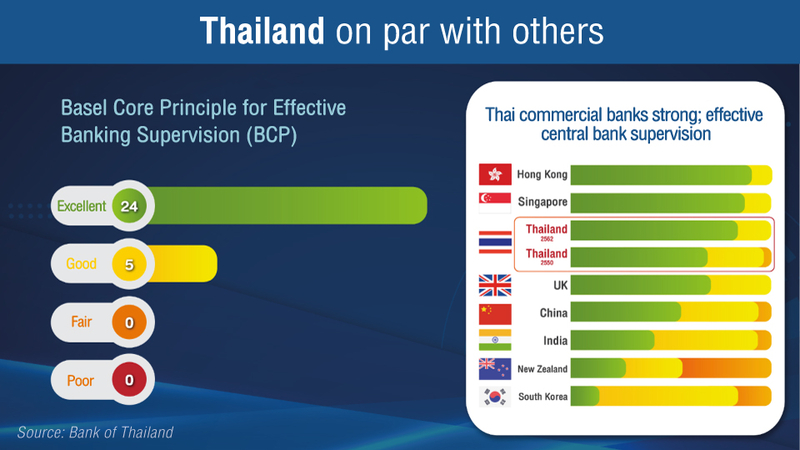
BOT governor Veerathai Santiprabhob on Monday (October 7) revealed the outcome of the Financial Sector Assessment Program (FSAP) conducted by IMF and WB, saying Thailand’s financial system is strong and can withstand market volatility well, while the standards of regulating the market is on par with those in developed countries.

Over the past 10 years, commercial banks have played a key role in the financial sector, while capital market and insurance sector have grown significantly.

“Overall, the country’s financial system has achieved stability, but there are some weak areas that need to be improved,” Veerathai said.

“The weak spots include the fragility of households due to high debts, and the two global institutions have suggested that Thailand implement more preventive measures or a so-called macroprudential policy to ensure the debt problem does not spread to wider sectors of the economy,” he said.

As for effective banking supervision, the central bank has won an excellent score in 24 key areas and a good score on five out of a total of 29 calibrations.

Meanwhile, IMF and WB are urging BOT to strengthen its supervision of state-owned banks, also known as specialised financial institutions (SFIs), and savings cooperatives on par with its supervision of commercial banks. The institutions also urged the central bank to implement more preventives measures to ensure the stability of SFIs and savings cooperatives, as well as establish a committee that is in charge of ensuring the country’s financial stability.

The BOT, meanwhile, will assess risks in the financial system using a forward-looking approach to ensure the system can cope with changes in the future, understand how new risks may emerge and how regulators can handle them.

“The BOT will work closely with related regulators in order to better understand financial risks and adjust regulations in time to guard financial stability in a sustainable manner,” he added.

Apart from BOT, the IMF and the World Bank also evaluated the other two major financial market regulators, namely the Securities and Exchange Commission and the Office of Insurance Commission.

The FSAP aims to promote prudential supervision, strengthen financial systems as well as boost confidence in the local financial market and the economy as a whole.