Sea freight untouched by rising oil prices

ศาสตร์เกษตรดินปุ๋ย : ขอบคุณแหล่งข้อมูล : หนังสือพิมพ์ The Nation

https://www.nationthailand.com/business/30376382

Sea freight untouched by rising oil prices

Sep 18. 2019
By The Nation

596 Viewed

Though Thai businesses have been warned to closely monitor the situation in the Middle East, the rising price of oil after the attacks on Saudi oil facilities have yet to affect the cost of sea freight.

Wisit Limluecha, vice chair of the Thai National Shippers’ Council (TNSC), speaking as a representative of the Thai exporters, said the attacks should not disrupt the production of oil in Saudi Arabia for too long, so it should not have an impact on sea transport. He also said the cost of sea freight should remain unchanged as long as oil prices stay at around US$70 to $80 (Bt2,137 to Bt2,442) per barrel.

He said that though there is concern about whether the attacks in Saudi Arabia will affect the supply, preliminary assessment shows that the impact will be minimal because Saudi has many oil fields to cover global demands. The United States is also a big producer of oil, so it can meet demands. This disruption has also opened the window for other oil producers, while traders with oil reserves can also start selling at higher prices.

However, he said, if the price of crude oil rises well above $80 per barrel, it may adversely impact the export sector as the price of goods will rise due to an increase in production cost, but prices will not rise by much.

Wisit also pointed out that Thailand was able to handle things when the price of crude oil hit $100 per barrel, so this disruption should not have much of an impact.

“However, Thai businesses will have to closely monitor the situation, especially if the current tensions lead to a full-blown war and sea routes are closed. Then an economic crisis will be unavoidable. But for the time being, there’s no shortage of oil,” he added.

As of August 2019, there was no change to shipping freight costs, according to TNSC. For instance, a 20-foot equivalent unit (TEU) from Thailand to Shanghai costs $200 and a 40-foot equivalent unit (FEU) costs $300. For the Thailand-Hong Kong route, a TEU costs $100 and FEU $200; for Thailand-Japan a TEU costs $300 and FEU $400; and for Thailand-Australia a TEU costs $300 and FEU $600.

Thailand’s gain as Chinese shun pork for chicken

ศาสตร์เกษตรดินปุ๋ย : ขอบคุณแหล่งข้อมูล : หนังสือพิมพ์ The Nation

https://www.nationthailand.com/business/30376377

Thailand’s gain as Chinese shun pork for chicken

Sep 18. 2019
By The Nation

617 Viewed

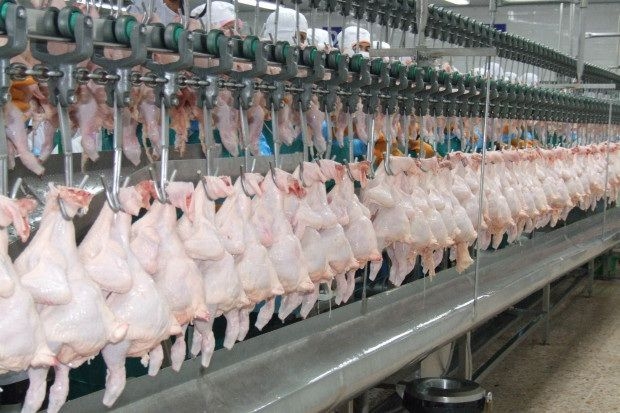
African swine fever has turned out to be a boon for Thai poultry exporters.

Seven Thai firms are licensed to ship poultry to China, where the disease was first detected in August 2018 and led to the culling of tens of thousands of pigs in a bid to stem its spread.

It also resulted in a dramatic shift in Chinese meat preferences from pork to chicken – and a matching hike in the retail price of poultry.

African swine fever – which cannot be transmitted to humans – has in the past year made its way around the world, affecting 10 European countries, four in Africa and four in Asia, migrating from China to Mongolia, Vietnam and Cambodia. The spread has yet to be contained.

Kukrit Areepakorn, manager of the Thai Broiler Processing Exporters Association, said the price of pork in China has skyrocketed since the government there began culling pigs, but the mass shift to chicken has also doubled the price of poultry.

China’s Certification and Accreditation Administration last year authorised just seven Thai chicken processors to export frozen meat and by-products there. Two are affiliates of CPF and the others are GFPT, Saha Farm, Goldenline, Thai Food Group and F&F Food.

“We haven’t seen chicken prices like this before,” Kukrit said. “Chicken’s feet sell for $4,200 per tonne, up from $2,000 last year, and mid-joint wings have gone from $3,000 to $5,300. It’s extremely fortunate for the seven companies that are able to export to China.”

The number of Thai firms involved could grow.

Given the growing demand and massive amounts needed, inspectors from China’s Bureau of Import and Export Food Safety have been sent to Thailand to conduct random but careful inspections at more processing factories and their findings will be announced soon, which could lead to more companies being approved to ship their poultry there.

Thai firms are doubly fortunate in that Thailand and Chile are the only countries on whose goods China collects no import duties, and Thailand is at an advantage again in terms of geographical proximity.

In the first seven months of 2019, Thailand exported 540,000 tonnes of poultry overseas, a 9.8-per-cent increase over the same period last year.

China alone imported 33,500 tonnes of chicken and by-products from Thailand in those seven months, a 712-per-cent jump, becoming the Kingdom’s third-biggest export market for poultry after the European Union and Japan.

Kukrit forecast that chicken exports will exceed the expected 900,000 tonnes over the full year.

Norway’s seafood council sets up regional office in Bangkok

ศาสตร์เกษตรดินปุ๋ย : ขอบคุณแหล่งข้อมูล : หนังสือพิมพ์ The Nation

https://www.nationthailand.com/business/30376369

Norway’s seafood council sets up regional office in Bangkok

Sep 18. 2019
Kjersti Rodsmoen, left, Norway’s ambassador to Thailand, and Asbjorn Warvik Rortveit

Kjersti Rodsmoen, left, Norway’s ambassador to Thailand, and Asbjorn Warvik Rortveit
By THE NATION

705 Viewed

The Norwegian Seafood Council (NSC) has set up its regional office in Bangkok to strengthen operations in Southeast Asia.

Asbjorn Warvik Rortveit, NSC’s Southeast Asia regional director, said: “I’m very proud to represent the Norwegian Seafood Council in this region, and I’m especially happy to be stationed here in Bangkok. The Norwegian seafood industry highlights food safety, animal welfare, sustainable production, and minimal use of antibiotics, things we know Thai consumers pay attention to. I, therefore, look forward to teach Thai consumers the benefits of seafood from Norway”.

The NSC said Thailand is the fastest-growing seafood market in Southeast Asia with export volume of 29,000 tonnes worth Bt4.5 billion. Seafood, especially salmon, has become very popular in Thailand as a healthy lifestyle has become more trendy.

The NSC said it was committed to developing a closer relationship between the Norwegian and Thai seafood industries.

Norway exports high-quality seafood to various markets globally. Thailand is currently the most significant market in Southeast Asia with high potential for growth in the future, the NSC said.

Thailand imports large volumes of fresh seafood from Norway, especially salmon, and Norway has dominated the fresh export market with a market share of 98 per cent  since 2018. The volume of fresh Norwegian salmon exported to Thailand exceeded 10,000 tonnes for the first time in 2018.

By the third quarter of 2019, salmon and trout exports exceeded 11,000 tonnes. The NSC also plans market activities in both business-to-business (B2B) and business-to-customer (B2C). Particularly in the B2B market, the NSC has partnered with many restaurants in Thailand such as Sushi Den, Zen, S&P and Thammachart, the NSC said. “Salmon Academy is a popular training programme we use to educate our partners about Norwegian salmon and fjord trout. For the B2C market, the NSC aims to build a clear identity for fresh Norwegian salmon and fjord trout, and strengthen the position as the most suitable fish for raw consumption,” the NSC said

“In Thailand, there is a good potential for growth for the Norwegian seafood industry. The Norwegian Seafood Council is committed to provide the world’s best-quality seafood to Thailand and Southeast Asia,” Rortveit said.

Kjersti Rodsmoen, Norway’s ambassador to Thailand, said: “I am delighted to continue the long-established bond of Thailand and Norway by welcoming the new regional office of NSC in the Embassy of Norway in Bangkok and supporting the best seafood products from Norway to Thailand.”

Gov’t reaches Bt349 bn fiscal deficit for 11 months

ศาสตร์เกษตรดินปุ๋ย : ขอบคุณแหล่งข้อมูล : หนังสือพิมพ์ The Nation

https://www.nationthailand.com/business/30376354

Gov’t reaches Bt349 bn fiscal deficit for 11 months

Sep 18. 2019
By The Nation

894 Viewed

The government has accumulated a Bt348.97 billion fiscal balance deficit for the first 11 months of the fiscal year 2019 (October 2018 to August 2019), the Fiscal Policy Office and Ministry of Finance report. 

The government has received Bt2.309 trillion in revenue for the 11-month period, Lavaron Sangsnit, the director–general of the Fiscal Policy Office and the Ministry of Finance spokesperson, said.

Government disbursements were Bt2.7 trillion. To finance the deficit, the government has borrowed Bt348.978 billion, thus leaving a treasury reserve of Bt512.27 billion at the end of August 2019.

AOT considers bidding for Don Mueang’s Bt34-bn Phase Three

ศาสตร์เกษตรดินปุ๋ย : ขอบคุณแหล่งข้อมูล : หนังสือพิมพ์ The Nation

https://www.nationthailand.com/business/30376339

AOT considers bidding for Don Mueang’s Bt34-bn Phase Three

Sep 18. 2019
By The Nation

1,229 Viewed

Nitinai Sirismatthakarn, president of the Airports of Thailand (AOT), said the third phase of the Don Mueang Airport is being considered, though the agency has to consult with the State Enterprise Policy Office (SEPO) first.

He said if the two agree with the plan, then AOT will submit the plan to the Transport Ministry before it is forwarded to the Cabinet for approval.

He said the airport’s third phase will cost Bt34.3 billion and will include the building of Terminal 3, expanding the parking lot and adjacent buildings to connect with the Red Line Skytrain, hotel and the automated people moving system.

Nitinai added that the AOT is almost ready to start a bidding for this public-private partnership investment project.

The Don Mueang International Airport currently welcomes 40 million passengers per year, but its capacity is only for 30 million, which causes congestion during rush hour. The AOT will initially work on solving urgent problems, such as increasing the areas for Visa on Arrival and immigration channels, adding more check-in counters, expanding the waiting area at the bus gate and will later consider building a terminal to accommodate 1,200 to 3,000 package tourists per hour, with the aim of having it completed by 2020.

For the construction of Terminal 3, the domestic terminal and airplane parking No 6 will have to be demolished. The AOT will also renovate Terminal 1 to accommodate as many as 22 million domestic passengers per year. Warehouses Nos 1 and 2 will also be renovated, the traffic system and aircraft parking lot expanded and the utility system improved.

Cabinet okays Bt11 bn for six waterworks projects

ศาสตร์เกษตรดินปุ๋ย : ขอบคุณแหล่งข้อมูล : หนังสือพิมพ์ The Nation

https://www.nationthailand.com/business/30376338

Cabinet okays Bt11 bn for six waterworks projects

Sep 18. 2019
By The Nation

1,147 Viewed

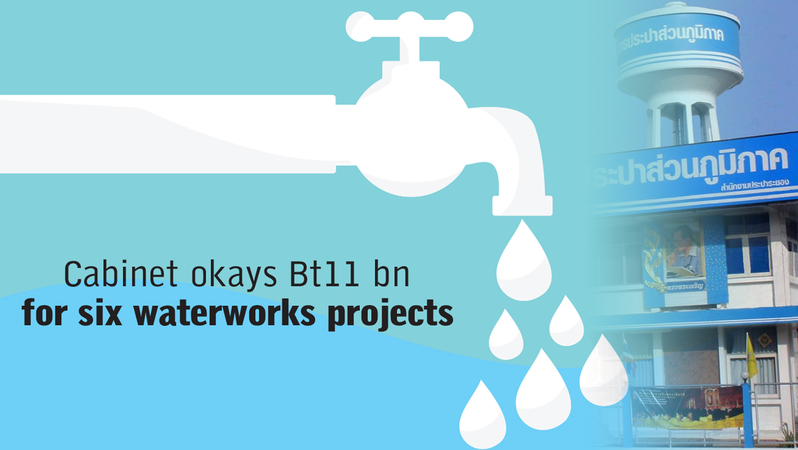
The Cabinet has approved a Bt11-billion budget for the Provincial Waterworks Authority (PWA)’s six projects that were approved in 2018 with the aim of benefiting more than 200,000 people in provincial areas.

Ratchada Thanadirek, deputy government spokesperson, said the Bt11 billion will be divided into Bt7.3 billion worth of government subsidies, Bt2.4 billion as domestic loans and Bt1.2 billion as income for PWA.

The projects are as follows:

1. Construction of raw-water plumbing station and water production and distribution station, including water pipes in PWA’s Ban Chang project to supply to the Eastern Economic Corridor;

2. Construction of a raw-water plumbing station and water production and distribution station to improve raw water storage capacity in PWA’s Phang Nga-Phuket branch;

3. Construction of a raw-water plumbing station and production and distribution station as well as the laying of water pipes at the Udon Than-Nong Kha-Nong Bua Lamphu branch;

4. Construction of a raw-water plumbing station and water production and distribution station including laying of water pipes at Mae Sai branch (Huay Krai-Mae Chan-Chiang Saen) to supply the special economic zone;

5. Construction of raw-water plumbing station, water chute and water production and distribution station as well as laying water pipes at the Nakhon Si Thammarat branch;

6. Construction of raw-water plumbing station and water production and distribution station including the laying of water pipes in the Kantang branch (Sikao-Pak Meng).

These projects are scheduled to be ready for use by 2021 and should provide water for an additional 239,618 users with an increased supply of 332,400 cubic metres of water per day.

Smuggling keeps lid on sticky rice price

ศาสตร์เกษตรดินปุ๋ย : ขอบคุณแหล่งข้อมูล : หนังสือพิมพ์ The Nation

https://www.nationthailand.com/business/30376337

Smuggling keeps lid on sticky rice price

Sep 18. 2019
By The Nation

1,191 Viewed

Sticky rice have been  smuggled into the country, but ironically it has helped curb soaring price, said Chukiat Opaswong, honorary president of the Thai Rice Exporters Association.

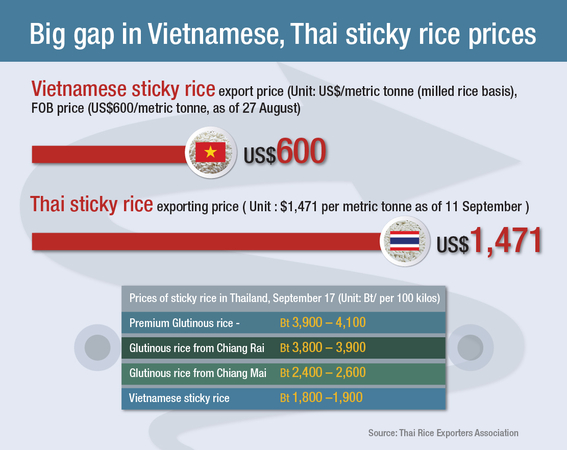
Some merchants, he said, had smuggled 100,000 tonnes of glutinous rice into the country  from Vietnam via Thailand’s neighboring countries, adding that they were then mixed with Thai glutinous rice before going on sale in the local market.

Thai sticky rice is currently priced at Bt45,000-46,000 per tonne or Bt45-46 per kilogram while it could rise to US$ 1,500/tonne in export,  compared to  $600 per tonne  or Bt18-19 per kilogram in Vietnam. Thus, smugglers stand to make a profit of Bt25 per kilogram.

Some merchants have been  arrested and charged for their wrong-doing, with some smuggled batches weighing up 30 tonnes each.

The quality of Vietnamese sticky rice is lower than their Thai counterpart as it tends to turn crumbly, not sticky, when cooked.  However, their quality improve when mixed with Thai produce.

If consumers feel the quality of glutinous rice is not good enough,  they can assume that they were smuggled in from Vietnam, Chukiat said.

However, Chukiat said  it is widely believed that the  price of sticky rice would have risen to Bt 60-70 per kilogram if not for the smuggling.

Recently, the price fell to Bt 40-41/ kilogram with the launch of packaged bags, targeting  low-income people.  Also, merchants have refrained from price speculation due to strict stock checking and the fact that  the new harvest of glutinous rice will enter the market next month.

Wichai Phochitkit, director-general of Internal Trade Department said  the new supply will soon be released into the market, adding that the department will set the appropriate price as it has a direct impact on farmers’ income.

It is reported that Thong Fah shops and the local communities have pushed the Ministry of Commerce for  further releases of  glutinous rice bags through the Department of Internal Trade.

The ministry has been releasing glutinous rice stock since 11 September. However, it has yet to reach   consumers  in many parts of the country while supply to Thong Fah stores will be delivered  this wee

Attacks on Aramco prompt cut in contribution to Oil Fund

ศาสตร์เกษตรดินปุ๋ย : ขอบคุณแหล่งข้อมูล : หนังสือพิมพ์ The Nation

https://www.nationthailand.com/business/30376329

Attacks on Aramco prompt cut in contribution to Oil Fund

Sep 17. 2019
By THE NATION

1,045 Viewed

The Energy Policy Administration Committee today (September 17) resolved to lower the contribution of retail oil operators to the Oil Fund by Bt1 per litre for benzene and Bt0.60 per litre for diesel in a move to stabilise retail fuel prices.

Energy Minister Sontirat Sontijirawong said after a meeting that the measure would take effective tomorrow (September 18).

The reduction was a step in preparation for a possible surge in local oil prices after the drone attacks on two major oil-processing facilities of Saudi Arabia’s Aramco.

Sontirat added that the attacks in Saudi Arabia will prompt the global crude oil price to peak at between US$60 and $70 per barrel, adding that the cut in the Oil Fund’s contribution is sufficient to deal with the situation.

He also said that in case the global oil price spikes beyond $70 per barrel, he will call a meeting with the committee again to launch more measures, though he said he is confident the price will not exceed $70 per barrel.

Thailand, Cambodia sign MoU to link up their capital markets

ศาสตร์เกษตรดินปุ๋ย : ขอบคุณแหล่งข้อมูล : หนังสือพิมพ์ The Nation

https://www.nationthailand.com/business/30376325

Thailand, Cambodia sign MoU to link up their capital markets

Sep 17. 2019
765 Viewed

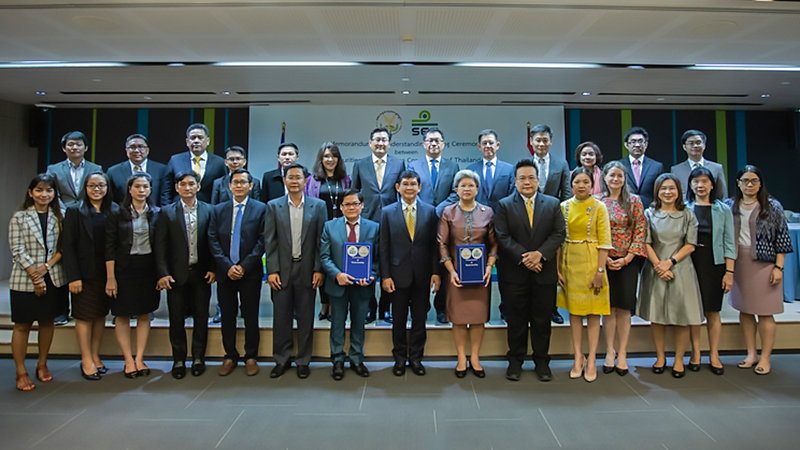
Thailand’s Securities and Exchange Commission (SEC) and the Securities and Exchange Commission of Cambodia (SECC) signed a memorandum of understanding on Tuesday (September 17) to cooperate and exchange information on cross-border equity offerings and the issuing of depository receipts with the SEC.

The aim of the MoU is to push for the successful implementation of cross-border offerings of securities that link both countries’ capital markets. The deal is the result of a fruitful discussion between the two agencies in early August this year and is being seen as an important milestone to reflect strong bilateral ties as well as to further strengthen a previous MoU signed in 2014.

The latest MoU covers the establishment and setting up the functions of a task force to work on the process of implementing cross-border equity offerings and the issuing of debt receipts. It also covers guidelines for those who wish to offer securities both in Thailand and Cambodia.

“Cambodia and Thailand are well connected in economic, social and cultural terms,” said Ruenvadee Suwanmongkol, SEC secretary-general, said. “Both SEC Thailand and the SECC also have been enjoying a friendly, cooperative relationship both at bilateral and multilateral levels over the past several years.

“The MoU signed today marks a significant milestone in enhancing capital-market cooperation between the two regulators to make a strong contribution to the successful implementation of cross-border equity offering and debt receipts with the aim of allowing issuers from both countries to list or make an offer of their equity securities outside the issuer’s home jurisdiction,” she said.

“With this strong collaboration, it is expected that a corporation from Cambodia will become the first foreign company listed on the Stock Exchange of Thailand, after the SEC regulation on cross-border equity offering became effective in 2015. Debt receipt is another financial instrument that has been received with great interest by businesses in both countries. Thus, we strongly believe this MoU will create greater business opportunities as well as sustainable growth and prosperity of the region.”

Sou Socheat, director general of SECC, said: “The additional MoU signing marks a long friendship, market development and cooperation between SECC and SEC Thailand. This MoU will provide alternative ways for companies both in Cambodia and Thailand to have access to capital, help expand the issuers’ businesses, increase their liquidity derived from trading in more than one exchange and access to larger pool of potential investors.

“In addition, we are sure this MoU’s implementation will lead to a good model for cooperation in the region and we are optimistic that capital markets in the region will grow together.”

Attacks on Saudi oil infrastructure bring geopolitical risks to the forefront: S&P Global Platts

ศาสตร์เกษตรดินปุ๋ย : ขอบคุณแหล่งข้อมูล : หนังสือพิมพ์ The Nation

https://www.nationthailand.com/business/30376324

Attacks on Saudi oil infrastructure bring geopolitical risks to the forefront: S&P Global Platts

Sep 17. 2019
Mriganka Jaipuriyar

Mriganka Jaipuriyar
By MRIGANKA JAIPURIYAR
SPECIAL TO THE NATION

635 Viewed

Recent attacks on key oil infrastructure in Saudi Arabia sent prices sharply higher, and while the risk to near-term supply disruption may be low, the event squarely brings to the forefront the vulnerability of Middle East supply.

The drone strikes early on Saturday on the Abqaiq processing facility and the Khurais field caused 5.7 million barrels per day of crude production – nearly 60 per cent of Saudi Arabia’s current production – to be shut down.

The Abqaiq facility processes around 7 million b/d of crude, making it Saudi Aramco’s largest oil processing facility. Khurais is the second-largest oil field in that country, with a capacity to pump around 1.5 million b/d of crude.

Front-month Brent crude futures on ICE jumped 20 per cent to $71.95 (Bt2,192) per barrel on September 16 in an initial reaction to the attacks.

S&P Global Platts Analytics expects Brent prices to test the high $70s/barrel previously forecast, if not higher.

This incident signals a significant escalation by Iran-backed groups, which until now have demonstrated awareness of critical infrastructure such as the east-west pipeline and the Strait of Hormuz, while having limited impact, Platts Analytics said in a report, adding that the output disruption indicates an alarming level of effectiveness and sophistication, and more importantly a change in tactics towards a more direct and serious offensive.

“While in the short term the direct physical impact on the market might be limited, this should move the market away from its bearish macroeconomic cycle and raise the risk premium in the market as funds reduce their short positions,” said Chris Midgley, global head of Analytics at Platts.

The sudden change in geopolitical risk warrants not only an elimination of the $5-10/barrel discount on bearish sentiment, but adds a potential $5-10/barrel premium to account for now-undeniably high Middle Eastern dangers to supply and the sudden elimination of spare capacity, Midgley said.

Underscoring the market’s vulnerability to supply-side risks, Platts Analytics estimates that global spare capacity is currently at 2.3 million b/d, but more than 1.6 million b/d of that is in Saudi Arabia.

Asian consumers not panicking yet

Following the attack, Saudi Arabia was quick to assure buyers of its crude, with newly appointed Energy Minister Prince Abdulaziz bin Salman saying the kingdom’s customers would be supplied from its stocks.

The International Energy Agency also said that for now the markets are well-supplied with ample commercial stocks, and US President Donald Trump said on Sunday that he had authorised a release of US strategic oil stocks “if needed, in a to-be-determined amount” to keep the oil market well supplied following the attack on Saudi Arabia’s oil plants.

Asian oil consumers are also unlikely to press the panic button for now as major Saudi crude buyers in both Northeast and South Asia hold adequate oil reserves, while companies have a wide range of alternative supply sources.

Chinese state-run and independent refiners said the companies expect the Saudi supply disruption to be short, while China’s current inventory could cover any near-term shortfall. In addition, China is more than capable of sourcing medium and heavy sour crudes outside the Middle East.

South Korea’s rigorous efforts to diversify crude imports will hold it in good stead. South Korea saw the share of Middle Eastern crude in the monthly procurement basket fall below 68 per cent in recent months, compared with more than 85 per cent in 2015, data from Korea National Oil Corp showed.

South Korea is capable of sourcing medium and heavy sour crude elsewhere, for example from Mexico and Russia’s Urals.

In South Asia, Indian refiners’ wide range of crude import sources and flexible feedstock procurement strategies mean that companies are more concerned about a potential global price spike than the cutback in Saudi supplies.

The extent and duration of the shutdown was not immediately known, but if the reduction persists, Asia is expected to be the hardest hit.

While all major Asian importers have SPRs and other type of crude stocks as cushions, the challenge is the length of the potential disruptions as Asia is vulnerable to a prolonged absence of lower crude supplies from Saudi Arabia, according to Platts Analytics.

An extended outage from Saudi Arabia could also have OPEC reassessing its plans to tighten compliance with crude production quotas.

The oil producing bloc had just announced on September 12 that it would keep its 1.2 million b/d supply cut agreement with Russia and nine other allies unchanged through its scheduled expiry of March 2020, though with improved adherence by Iraq and Nigeria to their quotas. The UAE had also declared its intent to lower its production to over-comply with its committed cut.

“In the short term, Saudi Arabia will be able to maintain exports and use reserves in Japan to ensure supply security, but any evidence of prolonged disruption of production would heavily impact OPEC spare capacity and the ability of the IEA to use strategic petroleum reserves to shore up the market,” Platts Analytics said.

Mriganka Jaipuriyar is head of news, Asia, S&P Global Platts.