No decision yet on LNG import plan

ศาสตร์เกษตรดินปุ๋ย : ขอบคุณแหล่งข้อมูล : หนังสือพิมพ์ The Nation

https://www.nationthailand.com/business/30376444

No decision yet on LNG import plan

Sep 20. 2019
File  photo credit: Petronas : Petronas LNG facilities

File photo credit: Petronas : Petronas LNG facilities
By The Nation

1,198 Viewed

Energy Minister Sontirat Sontijirawong said on Thursday that the ministry has yet to decide on the plan to import 1.5 million tonnes of liquefied natural gas (LNG) annually from Malaysia’s Petronas LNG.

He was responding to a report which suggested that the ministry had cancelled an auction organised by the Electricity Generating Authority of Thailand(Egat) for the imports of LNG for eight consecutive years, estimated to worth more than Bt 100 billion. Egat uses LNG as input for electricity production.

“Egat is still negotiating with Petronas, we have not reached a conclusion,” he said.

Should Egat and Petronas agree on the deal, it still have to be forwarded for consideration by the Energy Policy Administrative Committee(EPAC), Sontirat said.

The Energy Ministry wanted Egat to buy LNG on the spot market, starting with small amounts and not exceeding 90,000-180,000 tonnes per purchase.

Large amounts of import will lead to higher costs for storage and electricity production and could have an impact on consumers.

Another issue involves the advance payment condition, which may increase the financial burden on Egat. Sontirat said the ministry will appoint Kulit Sombatsiri, within September 24, the new chairman of Egat in replacement of the previous chairman who had resigned. Kulit, currently Energy Ministry’s permanent secretary, is expected to solve many issues as the next chairman of Egat.

Beyond Beauty Asean returns to Impact for 6th edition

ศาสตร์เกษตรดินปุ๋ย : ขอบคุณแหล่งข้อมูล : หนังสือพิมพ์ The Nation

https://www.nationthailand.com/business/30376439

Beyond Beauty Asean returns to Impact for 6th edition

Sep 19. 2019
By THE NATION

680 Viewed

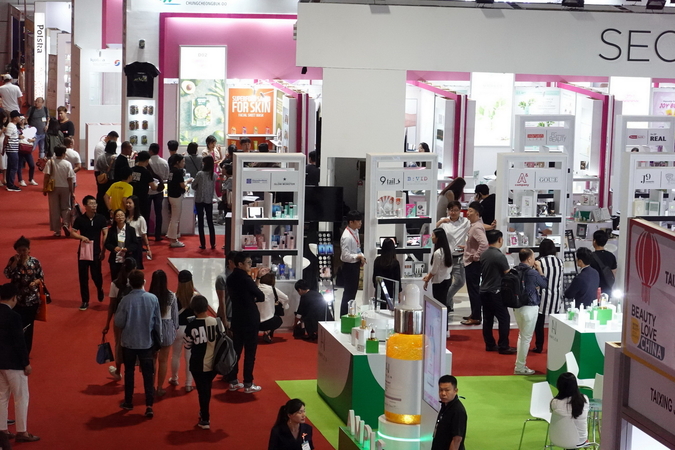
Her Royal Highness Princess Chulabhorn Krom Phra Srisavangavadhana graciously appointed Surapit Kirtiputra, Vice President for International Affairs of the Chulabhorn Research Institute, as her representative in presiding over the opening ceremony of “Beyond Beauty Asean-Bangkok 2019”, being held at the Impact Exhibition and Convention Centre from September 19 (today) to September 21.

The opening ceremony saw the attendance of  Suphan Mongkolsuthree,  chairman of the event;  Kriengkrai Thiennukul, vice chairman; Ketmanee Lertkitcha, deputy secretary-general of The Federation of Thai Industries and president of the Thai Cosmetic Manufacturers Association, and Vichaya Soonthornsaratoon,  vice president and  administrator of Thailand Convention & Exhibition Bureau (TCEB).

After five consecutive years of success, the sixth edition of Beyond Beauty Asean Bangkok (BBAB), the number one trade show in the Asean beauty market, has returned to the Impact Exhibition and Convention Centre.  Organised by Informa Markets and Impact, in cooperation with The Federation of Thai Industries, the event provides local and international players in the industry the opportunities for business connections and  market expansion.

BBAB 2019  showcases the latest beauty innovations and products from around 600 exhibitors and is expected to attract more than 16,000 visitors. It features two main zones: the BBAB Finished Products zone, presenting a variety of finished beauty and cosmetic products and the BBAB Supply Chain zone, which is designed especially for OEM / ODM businesses and their clients.  In addition , there is “Beauty Made in Thailand”, a special zone for Thai beauty and cosmetic brands.

“The healthcare and beauty sectors in Thailand have experienced  continuous growth. In 2018, the country’s beauty and personal care market topped US$6.2 billion in value. The industry grew by 7 per cent annually over the last six years, and ranked 1st among the largest export income earners in Asean,” said Suphan Mongkolsuthree, Chairman of the Federation of Thai Industries (FTI).

“By representing the industrial sector, FTI is working closely with the government  to promote the development of technologies and innovations that benefit the industry. This is a strategic approach to empower large, medium and small industrial entrepreneurs and enable them to keep pace with changes in the behaviours of health- and beauty-conscious consumers and the entry into an aging society”.

“Beyond Beauty Asean Bangkok 2019″, he said,  is expected to provide entrepreneurs with access to the latest health and beauty trends, and a venue for exchange of experience and points of view on further business development. The event’s special zone, Beauty Made in Thailand, gathers all locally manufactured products relevant to health and beauty. It helps Thai entrepreneurs to capitalise on technologies and innovations to penetrate new markets and create new opportunities for further expansion in the global business network. It’s also certain that by participating in this event, Thai entrepreneurs will be  equipped with the  ability to address new challenges arising from fiercer competition in the industry. They will be well-prepared to grow in a stable and sustainable way. This is in line with the government’s policy of transforming Thailand into a regional medical hub where all related products and services are smartly integrated.”

Vichaya Soonthornsaratoon, vice president and administrator of Thailand Convention & Exhibition Bureau (TCEB), said the agency’s sixth commitment to BBAB reflects Thailand’s goal of becoming the gateway to Southeast Asian beauty and cosmetics markets as the country is recognised as a centre of international trade fairs in the region.

TCEB  recently announced a surge of 206.65 per cent last year from 2017 in the number of  MICE travellers from CLMV market to Thailand. Aside from creating business opportunities for the beauty and health industry in Thailand, TCEB also hopes BBAB 2019 will lead to continuous  growth of the international exhibition industry in Thailand, and to support Thailand as a base for  international businesses seeking to penetrate the markets of  neighbouring countries, and Asean.

This year, TCEB has set a growth target of 30 – 40 per cent in CLMV travellers. TCEB has organised overseas roadshows and campaigns to draw foreign  exhibitors and visitors to international exhibitions in Thailand.

Claudia Bonfiglioli,  general manager/Beauty Global of Informa Markets stated: “Beauty markets in Southeast Asia have great potentials and that’s why international brands are quite active here. We hope Beyond Beauty Asean Bangkok can build a bridge between Thailand and other countries to create a marketplace that generate business opportunities”.

Loy Joon How, general manager, Impact Exhibition Management Co Ltd said “Thai entrepreneurs who are interested in the beauty business or in overseas expansion are given the opportunity to share their visions with both local and international visitors. We are confident that BBAB 2019 will be well received by the beauty and cosmetics community, and as a platform for enabling the exchange of ideas and knowledge, to further strengthen the industry in our region”.

Global volatility squeezes growth of Thai household financial assets

ศาสตร์เกษตรดินปุ๋ย : ขอบคุณแหล่งข้อมูล : หนังสือพิมพ์ The Nation

https://www.nationthailand.com/business/30376424

Global volatility squeezes growth of Thai household financial assets

Sep 19. 2019
By The Nation

589 Viewed

The gross financial assets of Thai households rose by a meagre 0.8 per cent in 2018, one of the weakest increases since the financial crisis in 2008, according to the 10th edition of Allianz’s Global Wealth Report.


In the previous two years, growth rates of around 9 per cent were achieved, which puts the asset and debt situation of households in more than 50 countries/regions under the microscope, financial assets in 2018 across industrial and emerging countries/regions declined simultaneously for the first time, the report said.

Savers worldwide have found themselves in a bind, due to the escalating trade conflict between the US and China, Brexit and increasing geopolitical tensions, the tightening of monetary conditions and the normalisation of monetary policy.

The stock markets reacted accordingly, with global equity prices falling by around 12 per cent in 2018, which had a direct impact on asset growth. Global gross financial assets of private households fell by 0.1 per cent and remained more or less flat at 172.5 trillion euros, according to the report.

“The increasing uncertainty takes its toll,” said Michael Heise, chief economist of Allianz Group. “The dismantling of the rule-based global economic order is poisonous for wealth accumulation. The numbers for asset growth also make it evident: Trade is a no-zero-sum game. Either all are on the winning side – as in the past – or all are on the losing side – as happened last year. Aggressive protectionism knows no winners.”

The dismal performance was mainly due to a sharp drop in securities, by 6.6 per cent. Insurance and pensions, too, posted rather disappointing growth: They advance by just 3.2 per cent in 2018, the weakest increase in the last two decades. Bank deposits, on the other hand, increased by a more robust 4.8 per cent, clocking the highest growth in the last five years. Growth in liabilities accelerated to 6 per cent – the strongest increase since 2014. Thus, the debt ratio of households has crept up to 78.4 per cent, well above the regional average of 52.4 per cent (Asia ex-Japan), the report said.

The gross financial assets of Asian households declined by 0.9 per cent in 2018, marking the first decline since the 2008 financial crisis. The decline was triggered by a sharp fall in securities, mainly equities and investment funds, by 14 per cent. Bank deposits, on the other hand, and insurance and pensions were growing healthily by 8.7 per cent and 8.2 per cent, respectively.

When analysing portfolio structures, one trend becomes obvious: As Asian financial markets have become more sophisticated, the share of assets held in simple bank deposits has dropped significantly. It stood at 46.4 per cent at the end of 2018, 16 percentage points below the level at the beginning of the century, the report said. Correspondingly, the share of securities rose from around 20 per cent to 36.2 per cent, as more and more households invest their savings in capital markets. The share of insurance and pensions, however, was a mere 16 per cent, ie, half the global level.

“It is a paradox savings behaviour,” said Michaela Grimm, Allianz Group senior economist and co-author of the report. “Asian countries/regions age rapidly and many people save more because public pension schemes in many of these countries/regions are still in their infancy or provide only a basic pension in old age. But they seem not to embrace those products that offer the most effective old-age protection, namely life insurance and annuities. Both governments and the industry should step up their efforts further to offer attractive solutions in this field. This also holds true for initiatives to improve financial literacy and accessibility.”

Worldwide household liabilities rose by 5.7 per cent in 2018, a tad below the previous year’s level of 6 per cent, but also well above the long-term average annual growth rate of 3.6 per cent. The global debt ratio (liabilities as a percentage of GDP), however, remained stable at 65.1 per cent, thanks to still robust economic growth. Most regions saw a similar development in that respect. But Asia (excluding Japan) is a different story. True, debt growth slowed down in 2018, to 13.8 per cent (2017: 15.7 per cent). But in the last three years alone, the debt ratio jumped by almost ten percentage points to 52.4 per cent, driven mainly by China where it increased by a whopping 15 percentage points to 54.0 per cent, the report said.

“Debt dynamics in Asia and particularly in China are of concern,” said Patricia Pelayo Romero, Allianz Group economist and co-author of the report. “Chinese households are already relatively as indebted as, say, German or Italian ones. The last time we had to witness such a rapid increase in private indebtedness was in the US, Spain and Ireland shortly before the financial crisis. However, compared to most industrialised countries/regions, debt levels in China are still markedly lower. There is still time to cope with the development and avoid a debt crisis,” according to the Allianz Global Wealth Report

Kasikorn research predicts BOT to keep policy rate

ศาสตร์เกษตรดินปุ๋ย : ขอบคุณแหล่งข้อมูล : หนังสือพิมพ์ The Nation

https://www.nationthailand.com/business/30376412

Kasikorn research predicts BOT to keep policy rate

Sep 19. 2019
By The Nation

541 Viewed

The Kasikorn Research Centre has forecast that the Monetary Policy Committee (MPC) will decide to keep the policy interest rate at 1.50 per cent in its sixth meeting this year on September 25. The decision will be based on internal financial factors rather than the US Federal Reserve board’s direction, which saw a cut announced on Thursday.

The committee can be expected to evaluate the direction of the Thai economy, carefully considering both the positive factor that would aid in the recovery as well as the risks, said the centre.

Kasikorn will monitor the Bank of Thailand’s opinion on economic growth to see if it shows concern about future economic growth in 2019 and 2020, after performance dropped by 3.5 per cent. This could send a signal to the BOT to consider reducing the rate in the period ahead.

EXIM Bank comes to the aid of flood victims

ศาสตร์เกษตรดินปุ๋ย : ขอบคุณแหล่งข้อมูล : หนังสือพิมพ์ The Nation

https://www.nationthailand.com/business/30376410

EXIM Bank comes to the aid of flood victims

Sep 19. 2019
By The Nation

754 Viewed

Pisit Serewiwattana, president of the Export-Import Bank of Thailand (EXIM Thailand), has announced that customers directly and indirectly hit by the severe flooding in the north and northeast regions will see their debt and interest payments suspended.

The bank will reduce the interest rate and extend the payment period. Those affected by the floods are also invited to apply for loans for business rehabilitation and repairs in order to continue their export business.

Customers who suffered flooding of their premises and damage to products meaning that these can no longer distributed or exported will receive the following remedial measures:

1. Revolving credit and long-term loan customers will be exempt from debt and interest payment for a maximum 6 months and will see a reduction in the interest rate by 1 per cent for 6 – 12 months depending on the flood impact.

2. Revolving credit customers will have the promissory note period extended. The extension must be included with the remaining time and is limited to 360 days. Customers can also take out loans to repair heavily damaged building with a repayment period of up to 5 years with a grace period in the first year and 5 per cent of interest in the second year. The bank will later consider further measures for each customer.

Customers who live in flooded areas or are indirectly affected by the inundation, such as damaged premises and/or goods, or who have been unable to receive supplies due to the impact of flooding on road transport, will receive the following:

1. Revolving credit and long term loan customers will be exempted from debt and interest payment for maximum 6 months and see a reduction in the interest rate by 1 per cent for 6 months

2. Revolving credit customers will see an extension to promissory notes. The extended time has to be included with the remaining time and is limited to 180 days

Federal Reserve makes small interest rate cut. Trump slams central bank for having ‘no guts.’

ศาสตร์เกษตรดินปุ๋ย : ขอบคุณแหล่งข้อมูล : หนังสือพิมพ์ The Nation

https://www.nationthailand.com/business/30376391

Federal Reserve makes small interest rate cut. Trump slams central bank for having ‘no guts.’

Sep 19. 2019
Powell

Powell
By The Washington Post

360 Viewed

The Federal Reserve made a modest reduction in interest rates Wednesday in an effort to keep the U.S. economy strong, a measured approach that stopped far short of the dramatic action President Trump has demanded for months.

In an extremely unusual move, Trump blastedthe Fed’s announcement just 25 minutes after it was made public, targeting Fed Chair Jerome H. Powell’s leadership in particular.

“Jay Powell and the Federal Reserve Fail Again,” Trump wrote on Twitter, berating the Fed chair he handpicked. “No ‘guts,’ no sense, no vision! A terrible communicator.”

The Fed’s decision to lower its benchmark interest rate just shy of 2 percent, down from about 2.25 percent, brought into sharp contrast the competing views of the economy that are emanating from the White House and the central bank less than 14 months before the 2020 election.

While Trump has insisted that most problems with the economy are squarely the Fed’s fault, Powell on Wednesday said trade uncertainty was a key factor weighing on growth. Powell didn’t single out Trump for causing the trade uncertainty, but many business executives and lawmakers have.

“Trade developments have been up and down and then up, I guess, or back up, perhaps over the course of this intervening period. In any case, they’ve been quite volatile,” Powell said at a news conference following the announcement of the new rate. “We do see those risks as actually more heightened now.”

Stocks initially fell sharply after the Fed news as investors thought the central bank was signaling it would not cut again this year, but stocks rebounded amid speculation that the Fed might change course. The Dow Jones industrial average ended the day up 36 points.

“History teaches us it’s better to be proactive in adjusting policy if you can,” Powell said. “The idea that if you see trouble approaching on the horizon, you steer away from it if you can.”

The small, quarter-point reduction was meant to address fears about slowing growth in Europe and parts of Asia, as well as concerns that Trump’s trade war with countries around the world would remain a drag on growth well into the future. The Fed said it would “act as appropriate” to keep the economy growing. But a majority of the Fed’s voting members signaled they don’t expect to lower interest rates again before the end of the year.

The quarter-point reduction Wednesday was widely expected but stood in sharp contrast to the “big” cutTrump has recently advocated. Trump has called for lowering the benchmark rate to zero, or even pushing it negative as a way to lure investment to the United States.

Powell on Wednesday largely ruled out supporting negative interest rates and suggested he would lower rates further only if there was evidence the economy was slowing.

The Fed’s decision, which was not unanimous, comes at a pivotal time for the central bank, the economy and the White House. Fed officials are trying to help keep the economy growing without fanning inflation or squelching growth. The economy is sending mixed signals about whether it might slow markedly next year or continue chugging along. And a strong economy is key to Trump’s reelection effort in 2020. He has tried to frame the Fed as a primary culprit if there’s any slowdown.

For decades, White House officials had largely avoided commenting directly on the Fed’s monetary policy decisions, seeking to preserve the central bank’s independence and credibility. Trump has shattered that norm and even asked aides whether he could replace Powell, a person he picked for the job in late 2017. Powell on Wednesday wouldn’t respond to Trump’s latest criticism, saying instead that the central bank made its decisions “without regard to political considerations.”


Only seven of the 17 Fed leaders penciled in another rate cut this year, according to economic forecasts released Wednesday. The rest predict rates will stay where they are — or rise.

The Fed painted a mostly upbeat picture of the economy, saying the job market remains “strong” and consumer spending is “rising at a strong pace.” The Fed predicts the economy will grow 2.2 percent this year, weaker than the roughly 3 percent target that White House officials have cited. The economy grew 2.9 percent in 2018.

“The Fed wants to stop the economy from slipping into a recession, but Fed leaders aren’t going to do anything to push growth higher,” said Eric Winograd, senior economist at AllianceBernstein.


Fed leaders have characterized these rate cuts as insurance to protect the economy against the global slowdown and worsening trade war. Fed officials traditionally raise interest rates when the economy is growing as a way to combat inflation, and they tend to cut interest rates when they are guarding against a downturn as a way to try to provoke more borrowing and spending in the economy.

“Although household spending has been rising at a strong pace, business fixed investment and exports have weakened,” the Fed wrote in a statement.

The U.S. economy is in a tricky place, and Fed leaders remain divided over what to do. Consumers keep spending, but the U.S. manufacturing sector is struggling and business investment has collapsed as many companies fear Trump’s trade war won’t be resolved anytime soon. His standoff with China has been a particular concern. The president has repeatedly dialed up and then dialed back threats and penalties against China, one of the world’s largest economies, in the past year in an effort to force the country to make major changes to its economic relationship with the United States. Powell on Wednesday said trade risks are “more heightened now” following new tariffs against Chinese imports.

“We do feel trade uncertainty is having an effect,” Powell said. Officials “see it in weak business investment and weak exports.”

Trump has recently said he thinks he will reach a deal with China, but it might not come until after the 2020 elections. He has already imposed tariffs on more than $250 billion in Chinese imports and larger penalties are set to kick in next month and then even more in December.

Some economists have questioned whether the Fed should be reducing rates at all given how healthy the economic fundamentals look. Two out of the 10 members of the Fed’s committee that determines interest rates voted against the cut, preferring to leave rates unchanged. On the flip side, one member dissented against the latest decision because he felt the Fed should have cut rates by half a percentage point.

“Powell has the votes for a quarter-point cut, but he can’t commit to anything else,” said Diane Swonk, chief economist at Grant Thornton. “He can’t promise additional rate cuts, which will disappoint the market.”

Since the Fed’s last meeting, on July 31, Trump has tweeted or retweeted 43 times criticizing the central bank and calling for deeper rate cuts. He has called Powell a “bonehead” and “enemy” for not lowering rates faster.

On top of political pressures, the Fed faced an unusual situation this week where the interest rate on overnight loans to banks spiked above 8 percent, well above the Fed’s target and the highest level since the last financial crisis. Powell downplayed concerns about the situation and said the central bank would continue to pump a bit more money into the system to get the rate back down under 2 percent.

ETDA to help incubate local Unicorns with open working space

ศาสตร์เกษตรดินปุ๋ย : ขอบคุณแหล่งข้อมูล : หนังสือพิมพ์ The Nation

https://www.nationthailand.com/business/30376387

ETDA to help incubate local Unicorns with open working space

Sep 19. 2019
By KWANCHAI RUNGFAPAISARN
THE NATION

614 Viewed

The Electronic Transactions Development Agency (ETDA) will on November 13 officially launch its first open working space for digital start-ups on the seventh floor of the True Digital Park complex on Bangkok’s Sukhumvit Soi 101.

ETDA said it has dedicated this space for local start-ups with the aim of helping them improve their business capabilities and competitiveness. Joining the agency in its efforts are public and private partners, including the Fintech Association, Blockchain Institute and the Thai Digital Trade Association, who will provide not just funding but also technical and management know-how.

This 95.5 square metres of open space is in addition to the e-commerce park at Srinakharinwirot University (Prasarnmit Campus) in central Bangkok that ETDA launched early this year to help promote e-commerce among sole entrepreneurs.

ETDA CEO Surangkana Wayuparb said her agency has continuously supported and promoted local start-ups to realise their dreams. However, she said, the current market mechanisms have not encouraged them to achieve these dreams fully.

“Local start-ups have still not been able to achieve any practically business requirements. They need coaching, probably from local private associations,” she said.

“As a public organisation under the Digital Economy and Society Ministry, our task is to regulate and promote electronic transactions and commerce in line with the ministry’s vision to bring Thailand into the digital economy era. We and our partners have already launched many works and conditions to solve this problem in a strategic manner,” she said, citing the requirement for digital transformation of government agencies as an example.

Surangkana said the launch of this open working space for local start-ups will boost their success by scaling them to Series A and Series B levels until they finally become Unicorns.

Meanwhile, in his keynote address at the opening of TOP – Togetherness of Possibilities Tech Conference on Wednesday (September 18), Deputy Prime Minister Somkid Jatusripitak said that in order to move forward, Thailand requires diversified industries that are sustainable and have value-added offerings.

The forum, hosted by True Digital Park, brought together top executives and entrepreneurs to inspire, share knowledge and experiences with others to help drive sustainable digital economic development in Thailand and the region.

“In the past, the country only relied on five or six key industries. I want to see the country become a start-up nation that helps ordinary people become entrepreneurs,” he said, adding that Thailand should not stay still and let others leap forward.

“It is crucial for Thailand to do new things to maintain its competitiveness. Space dedicated to innovation opens the way for new inventions. I believe we have ideas, we just have to make them happen,” he said.

Suriya off to Japan to lure investment

ศาสตร์เกษตรดินปุ๋ย : ขอบคุณแหล่งข้อมูล : หนังสือพิมพ์ The Nation

https://www.nationthailand.com/business/30376375

Suriya off to Japan to lure investment

Sep 19. 2019
Suriya

Suriya
By THE NATION

1,101 Viewed

Industry Minister Suriya Juangroongruangkit will lead a delegation to Japan from September 24-27 to try and woo investment.

Passakorn Chairat, deputy director-general of the Industrial Promotion Department, said they would meet the head of Mitsubishi Motors on September 25 and invite him to expand investment in Thailand, especially in the next-generation automotive business.

The ministry is ready to facilitate such a move, Passakorn said.

Suriya will also address about 20 corporate representatives who are members of the Keidanren Japan Business Federation about possible collaborations in Thailand.

The Thai delegation will visit the city of Toyama on September 26, meet the governor and outline Thailand’s industrial policy at a seminar expected to draw more than 100 businesspeople.

Passakorn said Toyama is renowned as a hub for smart electronics, next-generation automotive components and medical innovations.

That evening, the delegation will meet with the New Energy and Industrial Technology Development Organisation regarding collaboration in forging a circular economy, including the recycling of electronic and automotive waste.

They will also meet with representatives of the Japanese Minister of Economy, Trade and Industry to discuss expanding trade and economic ties further between the countries.

Asean countries in stiff competition for bigger slice of China’s fruit market

ศาสตร์เกษตรดินปุ๋ย : ขอบคุณแหล่งข้อมูล : หนังสือพิมพ์ The Nation

https://www.nationthailand.com/business/30376386

Asean countries in stiff competition for bigger slice of China’s fruit market

Sep 19. 2019
By The Nation

1,472 Viewed

Thailand, Malaysia, Vietnam and Philippines are competing fiercely for a larger share of China’s fruit market.

China imported fruits worth US$7.62 billion, up 36 per cent from the previous year, according to statistics from the Customs Department of China in 2018.

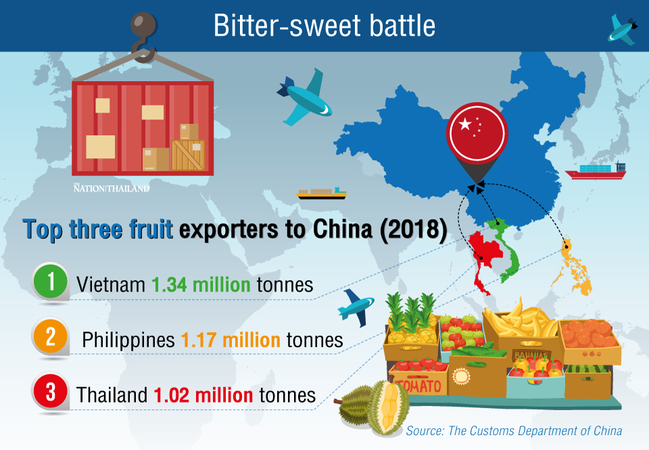
The total imported quantity exceeded 5.52 million tonnes and was a 25 per cent increase over the previous year. China imported 1.34 million tonnes of fruit from Vietnam, 1.17 million tonnes from the Philippines and 1.02 million tonnes from Thailand. The five fruit China imported the most were: cherry, durian, banana, grape and orange.

The director-general of the Department of Trade Negotiations at the Commerce Ministry, Auramon Supthaweethum, said there were many factors that led to intense competition among Asean countries to export fruit to China such as the Asean-China Free Trade Area (FTA), and Chinese tourists’ love of Thai fruits. Also, the ongoing trade war between the United States and China has led to China imposing a 30 per cent tariff on fruit from the United States, resulting in China importing more fruit from Asean.

Currently China allows Malaysia to export 10 kinds of fruit, including longan, mangosteen, lychee, coconut, watermelon, durian and pear, which will be effective from October 12. Malaysia is also negotiating with China for export of jackfruit. China has allowed Vietnam to export nine kinds of fruit such dragon fruit, watermelon, lychee, longan, mango, banana, rambutan, pineapple and mangosteen, effective from August 27.

The data of the Commerce Ministry as well as that of the Customs Department showed that Thailand exported chilled, frozen and dried fruit worldwide worth Bt 85.1 billion, a 11-per-cent year-on-year growth, and China is Thailand’s largest export market. The top five fruit exports by Thailand were durian, mangosteen, longan, banana and pineapple.

Goodies await travellers under ‘Eat, Shop, Spend’ scheme

ศาสตร์เกษตรดินปุ๋ย : ขอบคุณแหล่งข้อมูล : หนังสือพิมพ์ The Nation

https://www.nationthailand.com/business/30376383

Goodies await travellers under ‘Eat, Shop, Spend’ scheme

Sep 18. 2019
By The Nation

443 Viewed

More than 100,000 shops and providers of tourism-related services have been invited to serve 10 million tourists under the government’s “Eat, Shop, Spend” scheme, the Finance Ministry’s Comptroller-General’s Department said.

As of September 17, 55,579 shops and service providers had registered, said Suttirat Rattanachot, director-general of the Comptroller-General’s Department, adding that she hopes more will join before the September 20 deadline. Those interested can register at booths and registration points set up by the government and Krungthai Bank.

The “Eat, Shop, Spend” scheme is part of the government’s Bt316-billion stimulus package designed to boost economic growth.

New shops and services providers combined with shops that already have the “Thong Fah” stamp and community shops backed by Commerce Ministry could bring the total number of participants to more than 135,000, which should be enough to service an estimated 10 million local tourists, she said.

Those seeking credit or cash handouts from the government have from September 23 to November 15 to register via http://www.ชิมช้อปใช้.com. The first 10 million applicants will be given travel subsidies provided they declare where they are headed, and that their destination is not in their hometown. Applicants must be at least 18 years old, hold Thai nationality, have a national ID, a smartphone and an email address.

After registering, applicants will receive a confirmation SMS within three days, and they can start using the privileges via the e-wallet application within 14 days after getting the message. There are two account channels in the app: “G-wallet 1” is for purchasing goods and services in specified provinces; while “G-wallet 2” gives users discounts on foods, drinks, accommodation or purchases made at shops that have joined the project. This offer is valid until November 30.

In “G-wallet 1”, users are given Bt1,000 credit, while users of “G-wallet 2” get 15 per cent cash back on total spending, but no more than Bt4,500 per person. Those travelling under the scheme will also get a 15 per cent cash rebate in December.

Visit www.cgd.go.th, YouTube and Facebook for more information, or call (02) 270 6400 extension 7.