Govt Savings Bank plans Bt150 billion loans to lower-income people

ศาสตร์เกษตรดินปุ๋ย : ขอบคุณแหล่งข้อมูล : หนังสือพิมพ์ The Nation

https://www.nationthailand.com/business/30376541

Govt Savings Bank plans Bt150 billion loans to lower-income people

Sep 21. 2019
By The Nation

808 Viewed

The Government Savings Bank (GSB) expects to provide loans of up to Bt150 billion to more than 2 million lower-income people, the bank’s president and chief executive officer, Chatchai Payuhanaveechai, said at seminar on Saturday. 

Speaking at the “Join forces to drive sustainable economic development; Pracharat creates Thailand” seminar at Impact Muang Thong Thani, he said the bank will approve on average loans of Bt75,000 per person to small retailers and street vendors, aiming to target 100,000 retailers with total loans of Bt5 billion.

Loans for street food will not exceed Bt3 million per case, and loans for lower-income people to restructure their shark loans will not exceed Bt50,000 per case, he said.

“All these measures are ways to support lower-income people to improve their quality of living and have enough cash flow to operate their businesses,” he said.

BAAC unveils loan schemes to lift standard of living of farmers

ศาสตร์เกษตรดินปุ๋ย : ขอบคุณแหล่งข้อมูล : หนังสือพิมพ์ The Nation

https://www.nationthailand.com/business/30376539

BAAC unveils loan schemes to lift standard of living of farmers

Sep 21. 2019
By The Nation

824 Viewed

The Bank for Agriculture and Agricultural Cooperatives (BAAC) has come up with a series of measures to raise the standard of living of farmers.

The bank has formulated a policy to increase the incomes of lower-income farmers by more than 10 per cent a year and ensure their savings are not less than 10 per cent of income. The BAAC will also provide knowledge to farmers on how to increase their agricultural output by more than 20 per cent from the current levels, the bank’s president, Apirom Sukprasert, said at a seminar entitled “Join forces to drive sustainable economic development; Pracharat creates Thailand”, at Impact Muang Thong Thani in Nonthaburi province on Saturday.

Under the new policy, the BAAC will provide new loans to smart farmers of up to Bt10 billion in 2019 targeting about 100,000 smart farmers and Bt20 billion in 2020 for 200,000 smart farmers at the minimum retail rate. The bank aims to loan Bt30 billion to 300,000 smart farmers in 2021.

The bank also will offer loans to small and medium-sized agricultural enterprises (SMAEs) with an interest rate of 4 per cent per annum in 2019. The target is to disburse some Bt10 billion to 10,000 SMAEs, increasing the amount to Bt20 billion to 20,000 SMAEs in 2020, and loans worth Bt30 billion to 30,000 SMAEs in 2021.

The bank is also offering an interest rate of only 0.01 per cent for Thai communities enterprises and agricultural cooperative, aiming to provide loans worth Bt10 billion to 10,000 communities enterprises, and another Bt10 billion to 1,000 agricultural cooperatives this year.

In 2020, Bt20 billion loans will be provided to 20,000 community enterprises, and Bt20 billion to 1,200 agricultural cooperatives.

In 2021, loans worth Bt40 billion will be on offer to 40,000 community enterprises, and Bt30 billion for 1,500 agricultural cooperatives.

“All these loans are expected to improve the quality of living and increase the incomes of farmers in order to achieve our target,” Apirom said.

Chinese official gives the nod for Thai fruit fair in Guangxi

ศาสตร์เกษตรดินปุ๋ย : ขอบคุณแหล่งข้อมูล : หนังสือพิมพ์ The Nation

https://www.nationthailand.com/business/30376528

Chinese official gives the nod for Thai fruit fair in Guangxi

Sep 21. 2019
Deputy Prime Minister and Commerce Minister Jurin Laksanawisit (right) meeting with Lu Xinshe, the secretary of the Guangxi Communist Party, on Friday. (Photo by Commerce Ministry)

Deputy Prime Minister and Commerce Minister Jurin Laksanawisit (right) meeting with Lu Xinshe, the secretary of the Guangxi Communist Party, on Friday. (Photo by Commerce Ministry)
By The Nation

785 Viewed

Deputy Prime Minister and Commerce Minister Jurin Laksanawisit said his visit to Guangxi, China this week was successful after Lu Xinshe, the secretary of the Guangxi Communist Party, on Friday agreed for the holding of a Thai fruit fair in the province.

Jurin and a Commerce Ministry team made a two-day visit on Thursday and Friday to Guangxi to promote exports and investment.

Jurin said he had met Lu on Friday evening and the Chinese official had agreed with the Thai proposal to hold a fruit fair, which will help increase overall Thai fruit exports to China.

At the meeting at Nanning, Jurin and the Chinese official also discussed the trade value between Guangxi and Thailand, especially logistics systems between the two countries by sea and road.

“We also invited Chinese investors from Guangxi to expand their investments in Thailand, especially in the Eastern Economic Corridor and the South of Thailand, including furniture from rubber. This is to improve rubber prices in the long term,” Jurin said.

He said that Lu was supportive and expressed interest in promoting investments from Guangxi in Thailand, especially in the rubber industry.

Malaysia-Thailand celebrate 40 years of success in joint petroleum development

ศาสตร์เกษตรดินปุ๋ย : ขอบคุณแหล่งข้อมูล : หนังสือพิมพ์ The Nation

https://www.nationthailand.com/business/30376506

Malaysia-Thailand celebrate 40 years of success in joint petroleum development

Sep 20. 2019
Sonthirat Sonthi-Jirawong, Energy Minister

Sonthirat Sonthi-Jirawong, Energy Minister
By THE NATION

721 Viewed

The Malaysia-Thailand Joint Authority (MTJA) is celebrating the 40th anniversary of the signing of the memorandum of understanding for petroleum development in the Joint Development Area (JDA).

The JDA is considered a prime example of bilateral cooperation between two countries sharing a maritime border, finding a way to jointly develop an area with overlapping claims for the benefit of both parties.

Representatives of both parties at the anniversary celebration on Friday reiterated their commitment to continue the partnership.

Energy Minister Sonthirat Sonthi-Jirawong said that Thailand and Malaysia have shared a long partnership, and have shared elements of culture, society and history for many centuries with the shared mindset of peace and cooperation.

“The Malaysia-Thailand Joint Authority is considered the beginning of a grand mission between two countries to work on behalf of our governments for the benefit of both countries in the Malaysia-Thailand Joint Development Area, which spans a total of approximately 7,250 square kilometres. The agreement also includes sharing cost and benefits from the exploration and production of petroleum under the Production Sharing Contract over the course of 50 years, which shares responsibilities and profits between the two governments in a 50:50 ratio.

Malaysia’s Minister of Economic Affairs of Malaysia Azmin Ali jointly presided over the event with Sonthirat.

Dr Kurujit Nakornthap, MTJA Thai co-chairman, added that this area is of great importance and has created enormous benefits for Thailand because it is a key source of natural gas. The 509 million cubic feet per day of gas Thailand draws from the source accounts for16 per cent of the country’s natural gas procurement (3.252 billion cubic feet per day). This procured source is divided into two sections. The first section – 163 million cubic feet – is transported to Songkhla province and Chana Power Plant to become the main source of fuel for logistics in the southern-most provinces, and to be a source of NGV 12 gas at fuel stations across Surat Thani, Nakorn Si Thammarat, Songkhla and Pattani provinces.

Natural gas is the main source of fuel for the production of electricity at Chana Power Plant, which is a crucial element of the economic security for businesses and households of the South. Secondly, 346 million cubic feet of the gas from the JDA is sent to Rayong province to become the raw material for the petrochemical industry, as well as fuel in the production of electricity for Central and Eastern provinces of Thailand.

Assessment of the potential of petroleum in the area by the MTJA has concluded that there is still a high volume of natural gas, which can create energy security for both Thailand and Malaysia for at least the next 20 years, and will also create other related benefits for the population and communities in the surrounding areas for both countries as well. These benefits include the promotion of the use of raw materials, increased employment, stimulation of development of economics and industry, the development of related infrastructure, as well as being a concrete example for the international community of beneficial ways to resolve conflicts over disputed areas of land and sea.

Rahamat Bivi Binti Yusoff, MTJA Malaysian co-chairman, said that the MTJA has been working for the past 40 years with great cooperation from Thailand. The JDA is incredibly important in demonstrating the possibilities for collaboration and cooperation in solving a disputed maritime border, she said.

Currently, the JDA has three blocks of production of petroleum and natural gas, which are A-18, B-17, C-19 and B-17-01, that produce a variety of economic benefits, including employing more than 50,000 people and their support of 16 research grants for universities with a value of approximately US$25 million. Research in 2019 has also demonstrated that the area can produce around 1,200 million cubic feet per day of natural gas in line with agreements, an average of 16,700 barrels per day of condensate, which could provide a combined income for the two countries of around $10 billion.

In addition to the income generated, there are also “intangible profits” for both sides, such as the exchange of knowledge, skills development, increased capacity for production, and the growth of a strong base for research in the production of natural gas directly at the source.

After the contract period of the agreement in 2029, both countries believe that there will be continued cooperation in this area with increased parameters for the work done there to lift the quality of life and way of life for the people living in the area. It will also continue to create direct improvements for the economies of these areas, as well as create potential for other similar cooperation projects with other countries in Asean.

In addition to development in the energy sector, the two countries also have a framework for building sustainability both short-term and long-term in the form of an   MTJA fund that focuses on research into technology and clean energy and creating more participation in solving climate change.

The focus will now be on deeper research, creating genuine participation in education and knowledge-sharing so that this knowledge can be passed on to the next generation with the aim of true and continued sustainable development for everyone.

Red Line awaits Cabinet’s deliberation

ศาสตร์เกษตรดินปุ๋ย : ขอบคุณแหล่งข้อมูล : หนังสือพิมพ์ The Nation

https://www.nationthailand.com/business/30376502

Red Line awaits Cabinet’s deliberation

Sep 20. 2019
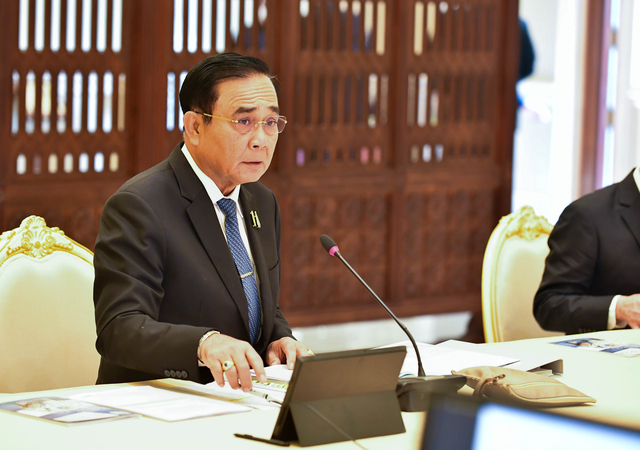
PM Prayut Chan-o cha is seeking to expedite mass transit projects as well as launching new economic stimulus packages to revive the sagging economy.

PM Prayut Chan-o cha is seeking to expedite mass transit projects as well as launching new economic stimulus packages to revive the sagging economy.
By THE NATION

699 Viewed

The Council of Economic Ministries today (September 20) resolved to submit to the Cabinet the Orange Line mass transit project for the western section of Bangkok, said the council’s secretary Kobsak Pootrakool after a meeting.

The project will be forwarded for Cabinet consideration in the next two weeks, he added.

Costing Bt120 billion and running between the Thailand Cultural Centre and Bang Khun Non, the route will

be developed on a public-private partnership (PPP) basis.

Prime Minister Prayut Chan-o cha is seeking to expedite mass transit projects as well as launching new economic stimulus packages to revive the sagging economy.

The project had been approved by the Public-Private Partnership panel of the previous government.

The meeting, chaired by Prayut, also acknowledged the progress of 44 transport projects worth a combined Bt1.94 trillion.

Of the total, 13 projects worth Bt551.170 billion will be submitted to the Cabinet soon, including the Red Line mass transit route of Bangsue-Hua Lam Pong and Bangsue-Hua Mark, the Thai Airways International’s procurement of the 38 new aircraft till 2026, the third phase of the Don Meung International Airport, and the development of seven double-rail tracks.

BOI approves Thailand Plus incentives

ศาสตร์เกษตรดินปุ๋ย : ขอบคุณแหล่งข้อมูล : หนังสือพิมพ์ The Nation

https://www.nationthailand.com/business/30376487

BOI approves Thailand Plus incentives

Sep 20. 2019
Prime Minister Prayut Chan-o-cha (Photo credit:  Royal Thai Government's homepage)

Prime Minister Prayut Chan-o-cha (Photo credit: Royal Thai Government’s homepage)
By THE NATION

869 Viewed

The Board of Investment (BOI) has approved fresh “Thailand Plus” incentives to help convince foreign businesses to relocate to Thailand.

They’ll be offered benefits including an additional 50-per-cent reduction in corporate income tax for five years, double the allowance for training expenses and a five-year corporate tax exemption for establishing skills development institutions.

BOI secretary-general Duangjai Asawachintachit said on Friday (September 20) after a board meeting chaired by Prime Minister Prayut Chan-o-cha that the board agreed with the measures endorsed by economic ministers on September 6.

The package features means to accelerate foreign investment and expedite large-scale projects in targeted industries.

An additional 50 per cent reduction in corporate income tax for five years will be offered to corporations located outside Bangkok that are eligible for five- to eight-year tax exemptions.

Applications must be submitted to the BOI by the end of 2020 and actual investment must be at least Bt1 billion, expedited within 2021.

To develop human resources and build up the high-skilled workforce, companies are encouraged to provide training and engage in the education of the future workforce before it enters the employment market.

They are also to be encouraged to establish professional training and educational institutions in science, technology and engineering (STEM).

Investment or expenses related to human resource development can be included in the allowance for corporate tax exemption with no minimum expense condition. Two categories of investment in HR development can benefit from these measures.

Category 1: Corporates will receive additional corporate tax exemption allowance of one time the actual expenses or investment in STEM training of students in Dual Education, Cooperative Education or Work-Integrated Learning programs.

Category 2: Corporates will receive additional corporate tax exemption allowance of two times the actual expenses or investment in providing employee training related to targeted technologies. The training courses must be endorsed by the Ministry of Higher Education, Science, Research and Innovation, or the Easter Economic Corridor Policy Committee for training institutions in EEC.

Applications for these additional incentives must be submitted by the year 2021 and before the end of the project’s corporate tax exemption period.

Parent companies investing in the establishment of training institutions endorsed by the Ministry of Education will be eligible for a five-year corporate tax exemption for all of the invested funding. Newly established institutions will receive import tax exemption for machinery needed.

Applications must be submitted by 2021 and applicants must be in sectors under the BOI’s current investment promotion scheme.

The BOI meanwhile approved Songkhla’s Chana district as Thailand’s fourth model city, aiming to create cross-border economic links with Malaysia and Singapore and support industrial development in the South.

Investors in Chana will receive the same incentives applied in the three other model cities – Nong Chik in Pattani, Betong in Yala and Su-ngai Kolok in Narathiwat.

These include an eight-year corporate tax exemption for new projects and a five-year exemption for existing projects, and other privileges such as a 90-per-cent reduction in normal import tax for 10 years for raw materials or materials needed for manufacturing products for the domestic market.

Incentives given to major production, data facilities

ศาสตร์เกษตรดินปุ๋ย : ขอบคุณแหล่งข้อมูล : หนังสือพิมพ์ The Nation

https://www.nationthailand.com/business/30376481

Incentives given to major production, data facilities

Sep 20. 2019
 BOI secretary-general Duangjai Asawachintachit

BOI secretary-general Duangjai Asawachintachit
By THE NATION

882 Viewed

The Board of Investment (BOI) on Friday (September 20) approved incentives for four large projects together worth over Bt28 billion.

The aim is to boost Thai competitiveness in targeted advanced-technology industries, BOI secretary-general Duangjai Asawachintachit said after a board meeting chaired by Prime Minister Prayut Chan-o-cha.

Nasipat Jira-olanwit was granted investment-promotion incentives for a polycarbonate resin factory worth Bt18.48 billion.

The Thai-Japanese-Taiwanese joint venture, based at Asia Industrial Estate in Rayong, will produce the tough, high-heat resistant and transparent thermoplastics for use in construction, automaking and electronics.

The plant will annually use more than Bt9.5 billion worth of local materials and export 49 per cent of its output.

Technology Asset Co Ltd was granted incentives for a data centre worth Bt4.45 billion.

The Thai- Singaporean joint venture in Bangkok will provide data services including storage for computer server, system maintenance and contingency workspace.

Ajinomoto Co (Thailand) Ltd was granted incentives for a biotechnological-produced monosodium glutamate plant worth Bt2.75 billion.

The Thai-Japanese joint venture will export 54 per cent of its output and work with the Research University Network to develop biotechnology curricula and run research and development.

Jiang Yong Ming was granted incentives to produce advanced material-sintered metal parts utilising a manufacturing process and modern technology new to Thailand.

The Bt2.59-billion factory wholly owned by Chinese investors will be located at WHA Eastern Seaboard Industrial Estate 2 in Chonburi.

The parent company is the largest producer of tungsten metal powder and tungsten carbide powder in China, with manufacturing bases in Japan, Taiwan and Germany.

Companies failing to prepare for economic downturn: research report

ศาสตร์เกษตรดินปุ๋ย : ขอบคุณแหล่งข้อมูล : หนังสือพิมพ์ The Nation

https://www.nationthailand.com/business/30376475

Companies failing to prepare for economic downturn: research report

Sep 20. 2019
By THE NATION

441 Viewed

Despite a long run of strong economic growth across Southeast Asia, the next global downturn will have serious effects here, new research suggests.

Many of the traits that cushioned the region during the last global downturn offer less of a buffer today, making it more vulnerable. New research from Bain & Company, “A Downturn Favors the Prepared, Even for Southeast Asian Companies”, suggests that well-prepared companies emerged as winners during and after past downturns. Yet, many senior executives in Southeast Asia have not begun to seriously prepare for a downturn. This could make it harder for their companies to recover once the economy rebounds, although the impact felt will differ by countries across the region.

Bain & Company’s recent survey of CEOs and CFOs in the region found that 77 per cent of them expected a severe downturn in the region within the next two years, yet only 37 per cent expected a severe effect on their own company. Very few, 20 per cent, have significant actions or plans in place. According to conversations with them, some are loath to even think about cost programmes while they are growing, or have never weathered a downturn as senior executives. Others are simply overly optimistic or believe they have time to wait.

These executives may not recognise how the region has become more vulnerable relative to its position during the last global downturn. Several structural shifts stand out that raise risks for the region: economic growth rates are lower, the current account balance is lower because of a decline in net trade, the region is exposed to slower growth in China and commodity prices have dropped. For Southeast Asia’s business leaders, the critical action is getting ready to seize the moment now, when they have more options.

“Preparing now enables companies in the region to gain market share and accelerate: winners pulled away from losers during the last downturn and widened the profit gap during the subsequent expansion,” said Thomas Olsen, who leads Bain & Company’s strategy and corporate finance practices in Asia-Pacific, and co-authored the report. “By taking a “future back” approach on what they want their company to look like in 5 to 10 years, they can use the downturn as an opportunity to achieve future growth through more efficient operations and selective investments when asset prices and borrowing costs are lower.”

The Bain analysis found that during the last global financial crisis, a group of 200 public Southeast Asian companies posted double-digit earnings growth, on average. As soon as the storm hit, performance diverged sharply: The winners, on average, realized a compound annual growth rate (CAGR) of 20 per cent from 2007 through 2009 in stark contrast to the losers, which barely mustered a 2 per cent CAGR. What’s more, winners locked in gains to grow at an average of 7 per cent after the downturn, from 2012 through 2017, while the losers slipped at negative 3 per cent.

What specifically distinguishes eventual winners? Bain & Company’s research teased out several moves by companies that outperformed peers, involving four areas:

1. Focusing on cost productivity without cutting muscle. Bain analysed the cost productivity of 200 public companies in Southeast Asia, defining cost productivity as earnings growth less revenue growth – namely, the part of earnings growth attributable to cost rather than revenue. During the 2007 to 2009 slowdown, winners had a 20 per cent CAGR in earnings, with 10 percentage points of that coming from cost productivity. The losers’ had just a 2 per cent CAGR in earnings, with cost productivity actually dropping by 2 points. This divergence continued during the subsequent recovery.

2. Putting the financial house in order. Downturns often wreak havoc on balance sheets. The winners managed the balance sheet as strategically as they did profit and loss (P&L). They tightly managed cash, working capital and capex, all to create fuel to invest throughout the cycle. Many companies also divested non-core assets to invest further in the core business or explored new ownership models in typically capital-intensive industries.

3. Playing offence by reinvesting selectively for commercial growth. Coming out of the last downturn, the strongest companies went on offence early while many of their peers focused on survival and waited for the cycle to clear.

4. Pursuing a proactive M&A pipeline. For the well positioned, the last downturn presented a window to use mergers and acquisitions to reshape the portfolio of businesses. Acquirers bought new product lines, customer segments or capabilities at lower prices. Others exited businesses that didn’t fit strategically with the company’s future.

“Astute leaders throughout Southeast Asia realise the value of preparing for the coming downturn now, even if their companies have not yet felt the pain and are currently focused on managing growth,” said Olsen. “If past patterns are any guide, their downturn-proof moves will allow them to steal a march on competitors who falter and drop to a trailing position.”

Thai exports see 4% drop in August

ศาสตร์เกษตรดินปุ๋ย : ขอบคุณแหล่งข้อมูล : หนังสือพิมพ์ The Nation

https://www.nationthailand.com/business/30376468

Thai exports see 4% drop in August

Sep 20. 2019
By Somluck Srimalee
The Nation

761 Viewed

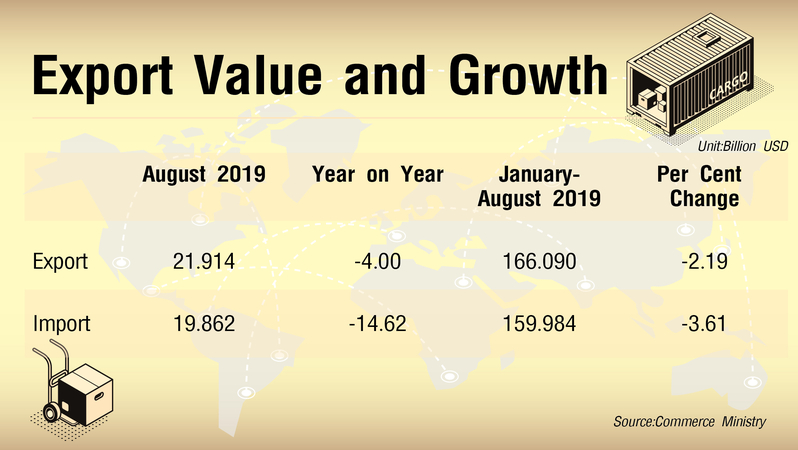
Thai exports dropped 4 per cent in August, representing a loss of US$21.9 billion, largely as a result of imports being front-loaded to avoid US tariffs coming into effect on September 1, the Commerce Ministry reported on Friday.

Thai exports thus contracted 2.2 per cent in the first eight months of the year.

The ministry is nevertheless maintaining its export target at 3 per cent by using mature markets, expanding into new ones and restoring trade with long-lost partners.

Minister Jurin Laksanawisit will soon visit China and India to expand market opportunities for agricultural commodities and aims to unlock obstacles to trade with neighbouring countries.

The ministry noted that uncertainty stemming from international trade disputes is having a worldwide impact and also slowing the economies of most of Thailand’s major trading partners, particularly in South and Southeast Asia.

A decline in global oil prices is meanwhile suppressing the export of oil-related products, and a global oversupply of agricultural products and the baht’s appreciation both threaten Thailand’s situation.

Thai exports to some destinations have expanded, up 5.8 per cent to the US, 18.4 per cent to Australia and 5.3 per cent to the Middle East. But exports to China are down 2.7 per cent, to the Asean+5 countries 24.6 per cent and to the Cambodia-Laos-Myanmar-Vietnam cluster 22.7 per cent.

Trade in agricultural and agro-industrial products decreased 4.4 per cent. Rice is down 44.7 per cent, cassava products 25.3 per cent and rubber 7.2 per cent, whereas fresh, frozen and processed fruits are up 26.8 per cent, fresh and frozen chicken 5.6 per cent and wheat products and other prepared foods 13.5 per cent.

Industrial product exports dropped 1.9 per cent largely as a result of fewer automobiles going to Australia and elsewhere in Southeast Asia.

While oil-related products are suffering, gold is up 377.5 per cent, jewellery and accessories 51.1 per cent, and motorcycles and parts 9.2 per cent.

Orange Line completion first of dozen delayed projects scrutinised

ศาสตร์เกษตรดินปุ๋ย : ขอบคุณแหล่งข้อมูล : หนังสือพิมพ์ The Nation

https://www.nationthailand.com/business/30376432

Orange Line completion first of dozen delayed projects scrutinised

Sep 20. 2019
Saksayam

Saksayam
By THE NATION

712 Viewed

The Transport Ministry will on Friday (September 20) present the council of economic ministers with details on completing the western section of Bangkok’s Orange Line mass transit route.

The details cover civil works and the installation of an electrical system on the Min Buri-Bang Khun Non section. The project will cost Bt120 billion.

The western segment runs between the Thailand Cultural Centre and Bang Khun Non.

The Mass Rapid Transit Authority of Thailand project would be developed on a public-private partnership (PPP) basis.

Transport Minister Saksayam Chidchob said the project, if approved, would be forwarded to the Cabinet soon.

There are 11 mass transit projects in the ministry’s 2018 Action Plan awaiting Cabinet approval:

• Civil works on the southern extension of the MRT Purple Line between Tao Poon and Rat Burana (worth Bt77 billion)

• Phase 3 of the Laem Chabang Deep Sea Port (Bt84 billion)

• Maintenance-repair-and-overhaul facilities for U-tapao International Airport (Bt10 billion)

• Double rail tracks for Jira-Ubon Rachathani (Bt37 billion)

• Double rail tracks for Khon Kaen-Nong Khai (Bt26 billion)

• Double rail tracks for Hat Yai-Padang Besar (Bt8.1 billion)

• Double rail tracks for Pak Nam Po-Denchai (Bt62 billion)

• Double rail tracks for Chumpon-Surat Thani (Bt24 billion)

• Double rail tracks for Surat Thani-Hat Yai-Songkhla (Bt57 billion)

• Double rail tracks for Denchai-Chiang Mai (Bt59 billion)

• Procurement of new aircraft for Thai Airways International (Bt150 billion).

Deputy Prime Minister Somkid Jatusripitak said the economic ministers want to speed development of the delayed mass transit projects.

He said measures to boost exports and tourism would also be presented to the council in the next two weeks.