China’s planned focus on domestic economy ‘will hit Thai exports badly’

ศาสตร์เกษตรดินปุ๋ย : ขอบคุณแหล่งข้อมูล : หนังสือพิมพ์ The Nation

https://www.nationthailand.com/business/30376624

China’s planned focus on domestic economy ‘will hit Thai exports badly’
Sep 24. 2019
By Wichit Chaitrong
The Nation

1,452 Viewed

Thai exporters will face the biggest challenge once China shifts its focus to its domestic economy as a result of is trade war with the United States.

In an interview with Nationmultimedia Group, Chinese Ambassador to Thailand Lyu Jian confirmed that though China with continue supporting multilateral trade under the World Trade Organisation, it will at the same time put more emphasis on domestic economy.

Chinese ambassador to Thailand Lyu Jian

Chinese ambassador to Thailand Lyu Jian

Though the envoy said he foresees a good economic relationship with Thailand and Asean by linking its Belt and Road Initiative with the Thailand 4.0 and Eastern Economic Corridor projects.

However, Sompop Manarungsan, president of the Panyapiwat Institute of Management, said China’s focus on its domestic economy, combined with slower growth and the ongoing trade dispute, will pose serious challenges to Thai exporters.

He said Thailand should also focus on its domestic economy and stop relying too much on exports. Currently, the annual export value is about 60 per cent of the gross domestic product, which is too high, he said, adding that this should be reduced to about 30 per cent.

The other factor affecting Thai exports will be China’s economic slowdown. Sompop said China’s economic growth will be less than 5 per cent in the next decade from the current 6 per cent, while in the 2030s the growth is expected to be less than 2 per cent.

A recent study on economic reform conducted by China’s State Council and the World Bank also showed that China needs to introduce changes in three key areas, namely the labour market, the financial market and state enterprises. China’s labour and financial markets are not efficient, resulting in a low total factor (TFP) productivity rate, which is about half that of developed countries.

Plus, he said, the West is also suspicious about China’s state-owned companies, with Huawei, a top provider of information and communications technology, being a case in point.

Sompop added that apart from facing challenges from the trade dispute with the US, China will also find it difficult to integrate with the global economy, because as China pursues market-based socialism, developed economies wholly embrace capitalism.

“The banning of Huawei products in the US is an example that developed countries do not trust enterprises controlled by China’s Communist Party,” Sompop said.

He also added that China’s business system dominated by state-owned firms will find it difficult to integrate with global markets, which are driven by private firms. Besides, he added, China’s centralised political system is the opposite of democracy in the West.

Sompop added that if China is unable to successfully integrate its economy with that of the world, then it could get decoupled on three fronts – trade, finance and digital technology. Plus, he said, both China and the US will implement protectionism measures against each other.

Meanwhile, Chao Kengchon, managing director at Kasikorn Research Centre, said that though China has the fiscal space to boost its domestic economy, it will face the important task of making its economic development sustainable. He said like Thailand, China is entering an ageing society due to low birth rates, which will lead to dwindling market forces and rising welfare cost.

Pimchanok Vonkorpon, director-general of the Trade Policy and Strategy Office, however, remains optimistic, saying that though manufactured goods have been affected by the trade war, China’s import of fresh fruits has been rising in recent years. For instance, she said, durian, mangosteen and longan still remain very popular among Chinese consumers.

“What worries me is their quality and logistics,” she said.

She said that Thai farmers and exporters may export low-quality product to meet high demand from China, so the authorities have to ensure the quality of the products is maintained. Also, she said, Thailand needs to improve its logistics because goods heading for China still have to go by road via Vietnam.

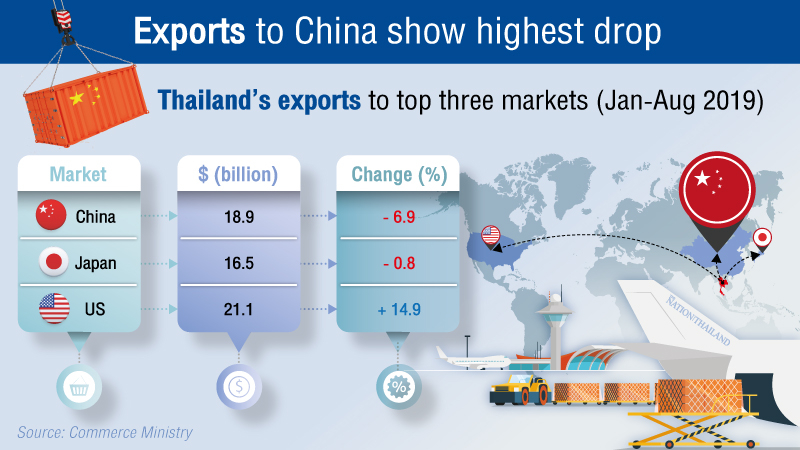
According to the Commerce Ministry, Thai exports to China from January to August this year was worth US$18.9 billion (Bt576.4 billion), down 6.92 per cent year on year, while exports to the US stood at $21.1 billion, recording a jump of 14.89 per cen. Exports to Japan were worth $16.5 billion, down 0.77 per cent.

Policy rate likely to stay at 1.5 %

ศาสตร์เกษตรดินปุ๋ย : ขอบคุณแหล่งข้อมูล : หนังสือพิมพ์ The Nation

https://www.nationthailand.com/business/30376603

Policy rate likely to stay at 1.5 %

Sep 23. 2019
937 Viewed

The Monetary Policy Committee (MPC) might decide to keep the policy rate unchanged at 1.5 per cent at its meeting on September 25 (Wednesday), pending an assessment on the impact of the previous cut, Krungthai Bank’s Chief Markets Strategist Jitipol Puksamatanan said.

However, pressure from the ongoing economic downturn, flood damages, and the slowdown in investment might lead to another reduction by the central bank this year, he added.

The MPC cut the policy rate by 0.25 of a percentage point from 1.75 to 1.5 per cent at its last meeting in August

Consumers’ rights to be protected under new MoU

ศาสตร์เกษตรดินปุ๋ย : ขอบคุณแหล่งข้อมูล : หนังสือพิมพ์ The Nation

https://www.nationthailand.com/business/30376593

Consumers’ rights to be protected under new MoU

Sep 23. 2019
By THE NATION

806 Viewed

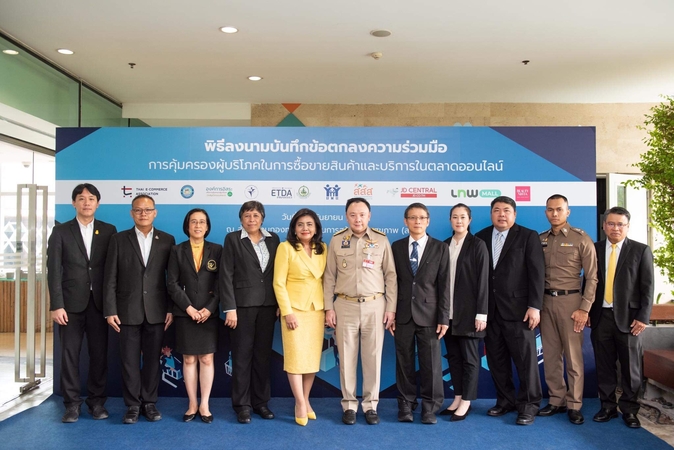
The Electronic Transactions Development Agency (ETDA) last week signed a memorandum of understanding (MoU) with major consumer organizations and private companies on a consumer protection initiative covering products and services sold online.

Consumer organizations – the Independent Committee for Consumer Protection (ICCP), the Association of Confederation of Consumer Organization, Thailand (ACCOT) and the Foundation for Consumers joined private companies Central JD Commerce Co Ltd, LNW Co Ltd, and Beautynista Co Ltd in inking the agreement at a ceremony chaired by Tewan Liptapallop, Minister to the Prime Minister’s Office.

Tewan said that the concerned organizations at both the private and public level recognized the importance of consumer protection and were determined to raise confidence among consumers buying products online.

“We have noted problems cropping again again and again when purchases are made online. The main cause is the unreliability of both sellers and online service providers. Consumers have no way of inspecting the authenticity of the system and are unable to access adequate information when a buying product. Often they do not know even the true identity of the seller or service provider with whom they are effectively entering into a contract. Nor do they have sufficient information about the product or service they are buying. This leads to many problems including deception in selling products, receiving a product that has little to do with what was advertised, a product being damaged during delivery, or problems with protection of personal information and consumer privacy. This cooperation will help create a framework for consumer protection and will raise the safety and credibility of online trading.

Surangkana Wayuparb, CEO of ETDA, said that Thailand, like other societies, has seen many changes over the last decade including a major increase in the country’s GDP, which has risen from Bt9.1 trillion to some Bt16.3 trillion anticipated this year. The number of internet users in Thailand also jumped significantly from 16.1 million about 10 years ago to 45.2 million today, which is high compared to the country’s total population of 66 million. These factors have contributed to the continuous growth of the e-commerce market in Thailand.

Surangkana added that ETDA’s survey reveals that the country’s e-commerce market increased significantly from Bt2.7 trillion in 2017 to about Bt3.2 trillion today. Thailand has the highest trading value for B2C e-commerce in Asean, with an increase of more than Bt160 billion in between 2016 and 2017. The high increase is in line with the ever-growing confidence of Thai consumers in technology and a convenient e-payment system, as well as fast home delivery.

“But as online transactions have grown, we have seen continuous problems being raised such as cheating and deception in online trading. According to our 1212 Online Complaint Center, there were about 9,987 complaints about online trading in 2017, and nearly double that number in 2018 when complaints rose to 17,558 or about 1,463 complaints per month. Major complaints are about buying but not receiving the products, products not meeting specifications as well as illegal and substandard products.

“This MoU signing will be a significant variable in our movement to resolve these online shopping problems in the future,” she said.

Saree Ongsomwang, secretary-general of the Foundation for Consumers, said that the cooperation under the MoU will cover many elements, including the inspection and data display of online retailers; the setting up of a system to provide essential information to consumers about legal online retailers and a channel for complaints against online retailers; the introduction of a financial security system with an intermediary holding payment to a seller until the shopper confirms safe, correct and complete delivery; a privacy policy to protect consumer rights; a complaint and tracking system; and a satisfaction policy for online shoppers.

Dovish wave, local uncertainty likely to drive rates lower

ศาสตร์เกษตรดินปุ๋ย : ขอบคุณแหล่งข้อมูล : หนังสือพิมพ์ The Nation

https://www.nationthailand.com/business/30376589

Dovish wave, local uncertainty likely to drive rates lower

Sep 23. 2019
By THE N ATION

621 Viewed

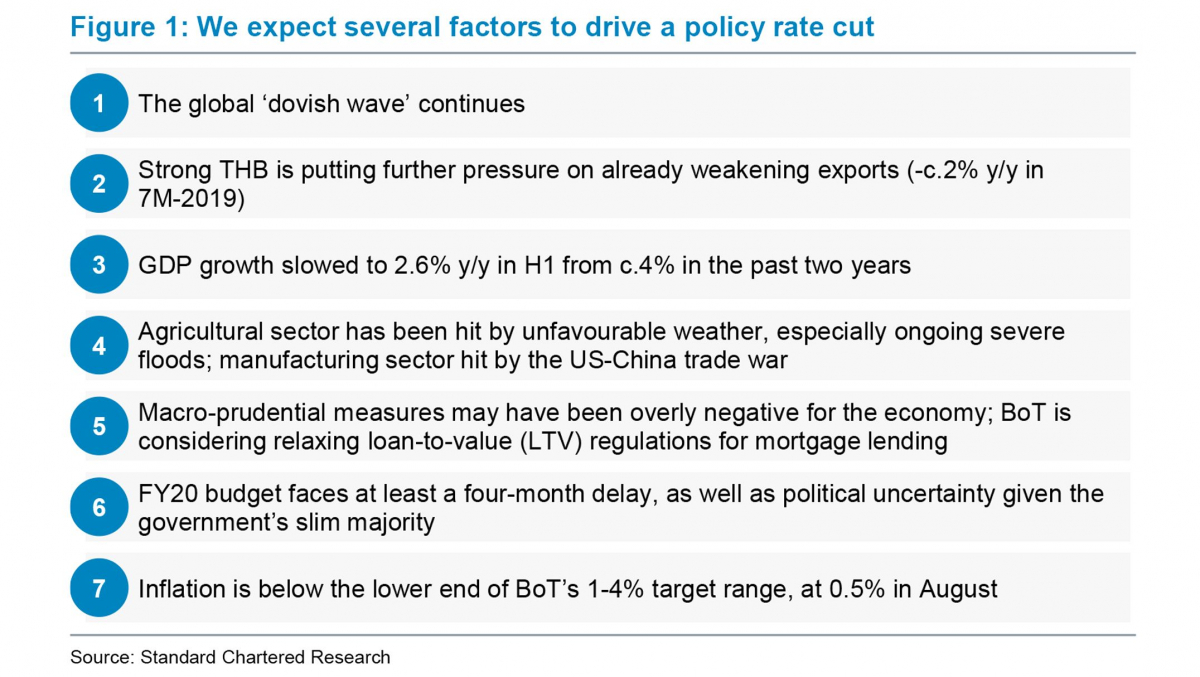
The Bank of Thailand (BoT) is expected to cut its policy rate by 25 basis point to 1.25 per cent at its Monetary Policy Committee meeting on September 25, according to Standard Chartered Bank Thailand.

This would be the second consecutive cut and take the rate to the floor, reached during the global financial crisis, Standard Chartered Bank economist Tim Leelahaphan said.

Various factors are likely to pressure the BoT to act again.

While a rate cut may not be effective in tackling the Thai baht strength, he thinks the central bank will have little choice but to deliver another cut as pressure mounts on the economy.

In addition, a dovish wave among global central banks is far from receding.

Thailand’s economic growth continues to grind lower, with no signs of improvement.

“We think BoT’s current 2019 GDP growth forecast of 3.3 per cent will be difficult to achieve, and we expect a downward revision at the September 25 meeting. We forecast a growth of 3.0 per cent,” he said.

Fiscal policy is unlikely to provide much support at this stage, putting the onus on monetary policy. The budget for fiscal year 20 (starting this October) is expected to be delayed.

The political situation and the government’s thin majority could also complicate budget implementation.

The stimulus package announced in August does not include a fresh dose of money, but taps unspent budget funds for fiscal year 19.

“We see a possibility that the policy rate could go lower than 1.25 per cent during this cycle, although this is not currently our core scenario,” he added.

Mekong nations must unite to develop as climate changes: Asia-Europe meeting

ศาสตร์เกษตรดินปุ๋ย : ขอบคุณแหล่งข้อมูล : หนังสือพิมพ์ The Nation

https://www.nationthailand.com/business/30376585

 Mekong nations must unite to develop as climate changes: Asia-Europe meeting

Sep 23. 2019
By The Nation

630 Viewed

A two-day 8th meeting between European and Asian nations concluded in Cambodia’s Siem Reap on September 20 with recommendations to enhance partnerships to promote inclusive growth and development.

The annual gathering, “Enhancing Water Partnership towards the Sustainable Development and Inclusive Growth” was hosted September 19-20 by Cambodia National Mekong Committee and discussed key challenges and opportunities around cross-border river basin management.

The 8th Asia-Europe Meeting Sustainable Development Dialogue featured discussions over cooperation in transboundary water management, food and energy security, climate change, and flood and drought issues.

The dialogue brought about 120 participants from river basin networks, academic institutions, public agencies, local and international NGOs, and inter-governmental organisations based in the EU and throughout Asia, including the Mekong region.

“Due to emerging challenges such as climate change and increasing needs for development, while protecting the people’s well-being and the environment, water availability has become a major challenge, demanding our immediate attention and action,” said Lim Kean Hor, the Minister of Water Resources and Meteorology and the CNMC chairman as he opened the Meeting on July 19. “These issues need to be addressed to ensure water resources are managed, conserved and used effectively and sustainably.”

In light of these challenges, the dialogue noted the need to increase joint policy formulation and development planning when it comes to transboundary water partnership and cooperation. This would help ensure synergies and increase opportunities for improved water resources management.

The meeting also agreed it is important for water managers to establish and promote benefit sharing mechanisms in water development and collaboration. It noted such mechanisms would help to balance benefits and costs on a water resources sector-wide scale in the lower Mekong basin in the face of rapid water developments in the region.

The participants found that though the 1995 Mekong Agreement on the Cooperation for sustainable development of the Mekong River Basin had gaps, it provided a sound legal

framework to guide cooperation and management of the Mekong River and related resources.

To increase effective partnerships for water management and development, the attendees suggested river basin organisations make the best use of both emerging and existing cooperation frameworks, including that of the 1995 Mekong Agreement.

Finally, the dialogue recommended that efforts to openly share data and information and to ensure proper coordination of developments should be strengthened because it is one of the key areas to achieving water resource development sustainability.

“A proper coordination between countries in the region and beyond is necessary to avoid or minimise potential transboundary risks and to maximise opportunities,” the chief executive officer of the MRC secretariat, An Pich Hatda, told the gathering. “The development of the shared watercourse must be judicious, fair, reasonable and equitable. It must benefit everyone sharing the river.”

Governments and partners made commitments in line with these challenges and recommendations.

Minister Lim Kean Hor told the meeting that Cambodia is committed to addressing the challenges. “On behalf of the government, I would like to emphasise our firm commitment in supporting and promoting regional and international cooperation and partnership for sustainable water management and development,” he said.

Franck Viault, head of cooperation from a delegation from the EU to Cambodia, said the EU is fully committed to promoting integrated water resources management and effective water governance for long-term stability. “This requires appropriate institutions, reliable data, capacity building, awareness-raising and funding,” he said. “It should foster sustainable water management as well as the consideration of interlinkages with, for instance, energy, food security and ecosystems.”

Zoltan Gyorgy Horvath, the charges d’affaires of the Hungarian Embassy, said, “Hungry is highly devoted to the achievement of the sustainable development goals and believes that the fulfilment of agenda 2030 requires an integrated and comprehensive approach.”

ASEM, comprising 53 partners from across Europe and Asia, is an informal platform for dialogue and cooperation between the two. Its partners represent about 65 per cent of global economy, 60 per cent of global population, 55 per cent of global trade, and 75 per cent of global tourism.

The MRC is an intergovernmental organisation for regional dialogue and cooperation in the lower Mekong river basin, established in 1995 based on the Mekong Agreement between Cambodia, Lao PDR, Thailand and Vietnam. The organisation serves as a regional platform for water diplomacy as well as a knowledge hub of water resources management for the sustainable development of the region.

Transport minister to nominate chairs of four state firm’s boards soon

ศาสตร์เกษตรดินปุ๋ย : ขอบคุณแหล่งข้อมูล : หนังสือพิมพ์ The Nation

https://www.nationthailand.com/business/30376574

Transport minister to nominate chairs of four state firm’s boards soon

Sep 23. 2019
By The Nation125 Viewed

Transport Minister Saksayam Chidchob said he will soon endorse the nominees for the chairmanship of four state enterprises’ boards of directors under this ministry.

Saksayam said once he signs the endorsement of the nominees, their names will be sent to the State Enterprise Policy Office for deliberation.

The four state enterprises are the Port Authority of Thailand (PAT), the Mass Rapid Transit Authority of Thailand (MRTAO), the Bangkok Mass Transit Authority (BMTA) and the State Railway of Thailand (SRT).

Sources said Saksayam has picked Jirut wisaljit, deputy permanent secretary for Transport Ministry, for the post of chair of the PAT board.

According to the source, Sarawut Songwilai, director general of the Railway Transport Department, is being eyed by Saksayam as chairman of the MRTA board, and Witthaya Yamuang, inspector general for the Transport Ministry, as chair of the BMTA board.

The sources said Saksayam would select either Pisak Jitwiriyasin, deputy permanent secretary for Transport, or Chayatham Promsorn, deputy director of the Office of Transport and Traffic Policy and Planning would be picked for the post of chairman of the SRT board.

VAT refunds seen as means to hike tourist spending

ศาสตร์เกษตรดินปุ๋ย : ขอบคุณแหล่งข้อมูล : หนังสือพิมพ์ The Nation

https://www.nationthailand.com/business/30376473

VAT refunds seen as means to hike tourist spending

Sep 23. 2019
By THE NATION

619 Viewed

The Revenue Department will soon open bidding for private businesses to offer tourists in certain areas of Bangkok VAT refunds.

Director-general Ekniti Nitithanprapas said a pilot “sandbox” programme involving five companies around the turn of the year was successful in boosting sales of local products.

The department is now drawing up guidelines for selecting service operators.

Applicants must be capable of digitally linking to the department and have locations in suitable places for offering refunds.

They must be founded under Thai law and have registered paid-up capital of at least Bt25 million. They can have no record of issuing unlawful tax invoices.

“And we want to see places where refunds can be issued opened in all the provincial airports,” Ekniti said.

Two million tourists per year were claiming VAT refunds before the sandbox trial, representing a combined value of Bt2 billion-Bt3 billion.

Transport minister effects shake-up at the top in state enterprises

ศาสตร์เกษตรดินปุ๋ย : ขอบคุณแหล่งข้อมูล : หนังสือพิมพ์ The Nation

https://www.nationthailand.com/business/30376560

Transport minister effects shake-up at the top in state enterprises

Sep 23. 2019
Saksayam

Saksayam
By The Nation

1,132 Viewed

In a major management shakeup at major state enterprises, the transport minister has appointed new chairmen to the boards of the Port Authority of Thailand, the State Railway of Thailand (SRT), the Mass Rapid Transit Authority of Thailand (MRTA) and the Bangkok Mass Transit Authority (BMA).

The list of new chairmen has been sent to the State Enterprise Policy Office for approval, Transport Minister Saksayam Chidchob said.

Already, new chairmen have been appointed at the Airports of Thailand and Thai Airways International although the appointments are not official yet, as the two companies are listed on the stock market. The final approval will need to wait for the meeting of shareholders, he said.

Saksayam also plans to appoint a new chairman of the Expressway Authority of Thailand, but will wait for the Cabinet to assign a new negotiator who could negotiate with the Bangkok Expressway and Metro Pcl (BEM) over dispute about the compensation demanded by the BEM.

Meanwhile, an informed source said that Chirute Visalachitra, the Transport Ministry deputy permanent secretary, is being designated as chairman of the Port Authority, Pisak Jitviriyavasin, also the ministry deputy permanent secretary, will take over as chairman of the SRT, and Sarawut Songvilai, director-general of the rail transport department, will be chairman of the MRTA. Inspector-general Withaya Yamoung will take over as new chairman of the BMA.

Bt17-billion budget to be allocated for developing EEC

ศาสตร์เกษตรดินปุ๋ย : ขอบคุณแหล่งข้อมูล : หนังสือพิมพ์ The Nation

https://www.nationthailand.com/business/30376559

Bt17-billion budget to be allocated for developing EEC

Sep 23. 2019
Credit: EEC Office

Credit: EEC Office
By The Nation

1,120 Viewed

The government plans to allocate Bt17 billion for development of the Eastern Economic Corridor (EEC) in fiscal 2020, as it wants to speed up investment in the region, especially in transport.

Kobsak Pootrakool, deputy secretary-general to Prime Minister General Prayut Chan-o-cha, said the government is applying a holistic approach to budget allocation as it needs efficient coordination between many state agencies and educational institutions.

A part of the budget would be used for investment in the high-speed rail project currently waiting for the public-private partnership contract to be signed.

The Highways Department of the Transport Ministry will get the largest share of the budget of Bt9.9 billion, followed by Bt1.3 billion for the National Science and Technology Development Agency.

The Rural Roads department will receive Bt1.2 billion, the Royal Thai Navy Bt799 million and the EEC Office Bt752 million.

Kobsak said that the budget allocation would take into account the impact on the environment and promotion of small businesses in the region.

Educational institutions will also get funding, as they will play a critical role in human resource development for the EEC where an estimated 450,000 highly skilled labour force will be needed over a year.

Burapha University will get a total of Bt1.8 billion, of which Bt 46.3 billion is part of the EEC coordinated budget, Rajamangala University of Technology Tawan-ok will get Bt629 million, Rajabhat Rajanagarindra University will receive Bt451 million and a branch of Kasetsart University will get Bt 50 million. The government will also provide funding to support the three provinces in the EEC: Bt432 million will go to Chon Buri, Bt344.9 million to Rayong and Bt259.9 million to Chachoengsao.

The budget bill for fiscal 2020 will be deliberated by the Parliament later.

Govt pushing policies to lift standard of living of 14m low-income people

ศาสตร์เกษตรดินปุ๋ย : ขอบคุณแหล่งข้อมูล : หนังสือพิมพ์ The Nation

https://www.nationthailand.com/business/30376543

Govt pushing policies to lift standard of living of 14m low-income people

Sep 21. 2019
By The Nation

926 Viewed

The government aims to raise the quality of living of some 14 million registered lower-income people by using state-owned banks to provide loans to them to create communities business, Deputy Prime Minister Somkid Jatusripitak said. 

Somkid on Saturday opened a seminar on “Join forces to drive sustainable economic development; Pracharat creates Thailand” at Impact Muang Thong Thani.

“We are holding this event to forge collaboration between the private and public sectors to find ways to improve the quality of living and income of the country’s lower-income people,” Somkid said at the seminar.

The event brought together 2,400 representatives from both the public and private sectors and communities nationwide.

Finance Minister Uttama Savanayana said at the same seminar that the Finance Ministry would announce measures to motivate the private sector to participate in communities development.

“When we talk about developing the agricultural processing industry, the private sector has to join hands with us to develop products and marketing. This means we have to forge cooperation between the public and private sectors,” he said.

He added that the ministry has continued to develop big data and integrate the data to support lower-income people. Some 14 million people are now registered with the government as low-income. The Finance Ministry’s Treasury Department is also finding vacant lands to make them available to serve as markets for the communities to sell their products.

“We also have a policy to use state-owned institutions such as Government Savings Bank, Bank for Agriculture and Agricultural Cooperatives, Tourism Authority of Thailand and others to find ways to create jobs for lower-income people in the country,” he said.

Uttama said the government’s policy was aimed at improving the quality of living of lower-income people who would be the base to improve the country’s sustainable economic growth.