Anti-corruption body to save Bt142 billion through anti-graft tools

ศาสตร์เกษตรดินปุ๋ย : ขอบคุณแหล่งข้อมูล : หนังสือพิมพ์ The Nation

https://www.nationthailand.com/business/30376012

Anti-corruption body to save Bt142 billion through anti-graft tools

Sep 10. 2019
By The Nation

111 Viewed

The Anti-Corruption Organization of Thailand has expressed confidence that the government would save up to Bt142.76 billion thanks to two anti-graft mechanisms.

Vichai Assarasakorn, vice president of the Thai Chamber of Commerce and of the anti-corruption organisation, said the two tools were initiated through cooperation between the Comptroller General’s Department and the private sector and have been in use since 2015.

By the end of this year, the two tools – the IP (Integrity Pact) and the CoST (Construction Sector Transparency Initiative) – would help the country prevent losses of Bt142.76 from corruption, Vichai said.

He said the IP tool would help the country save Bt97 billion and the CoST tool BtBt37.45 billion and added that the two tools use some 230 voluntary observers to monitor projects to prevent corruption.

The success of the two tools prompted the Anti-Corruption Organization of Thailand to plan to expand their use to other mega government projects.

Yanee Saengsrichan, an advisor to the financial system development of Comptroller General’s Department, said that since the IP and CoST projects came into effect in 2015, they have saved the government some Bt83.138 billion that might have been wasted in pay offs.

Panel to take charge of EEC Development Fund

ศาสตร์เกษตรดินปุ๋ย : ขอบคุณแหล่งข้อมูล : หนังสือพิมพ์ The Nation

https://www.nationthailand.com/business/30375996

Panel to take charge of EEC Development Fund

Sep 10. 2019
By The Nation

623 Viewed

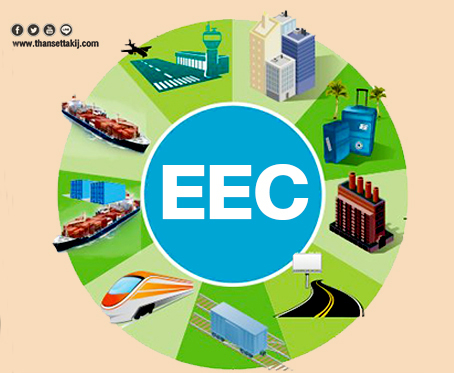
The Eastern Economic Corridor Policy Committee (EECPC) plans to set up a management committee of the EEC Development Fund, which will monitor and make compensations to local communities affected by the mega project, in line with government policy.

EECPC secretary general Kanit Sangsubhan will head the committee, to be formed within 60 days, according to a source from the EECPC.

The committee will decide how money will be collected for the fund, such as requiring contribution from companies investing in the EEC. It presently has a budget of Bt100 million, allocated by the government.

“The fund is created to compensate communities affected by the project, including granting scholarships to students in the areas ,” the source said.

“It will be similar to the Power Plant Fund which takes care of people residing near the electricity plants. However, the EEC Development Fund’s responsibility is greater than that of the Power Plant Fund, as it will also promote development in the EEC areas”.

The EECPC has recently drafted new regulations for the EEC Development Fund covering management, cash and commodity management and accounting system, evaluation and auditing.

Higher tax on sugary drinks aims to control consumption

ศาสตร์เกษตรดินปุ๋ย : ขอบคุณแหล่งข้อมูล : หนังสือพิมพ์ The Nation

https://www.nationthailand.com/business/30375992

Higher tax on sugary drinks aims to control consumption

Sep 09. 2019
By The Nation

804 Viewed

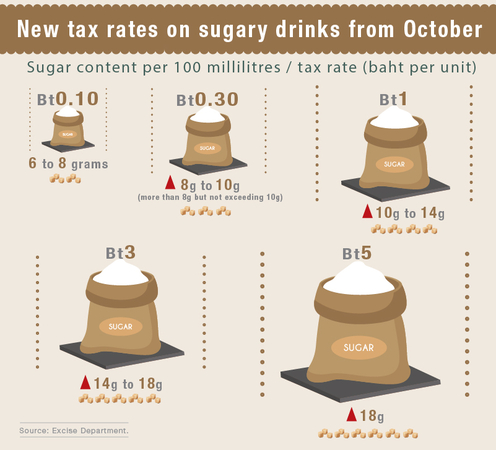
The Excise Department has announced that taxes on sugary drinks will double from October 1, with beverages containing 10 to 14 grams of sugar being taxed at Bt1 per 100 millilitres instead of Bt0.5 per 100ml, adding that this tax will not be passed on to consumers despite the higher cost of production.

Nattakorn Utensut, the department’s deputy spokesman, said most producers of sweet beverages had not reduced the sugar content out of fear of losing customers, instead many have just launched new, less-sweet versions of their drinks.

The new tax will boost the overall tax revenue to Bt3.5 billion to Bt4.5 billion from the current collection of Bt2 billion to Bt3 billion annually.

Taxes on sugary drinks will also be doubled every two years. For instance, from October 1, 2021, beverages containing 10g to 14g of sugar will be taxed Bt3 per 100ml before rising to Bt5 in 2023. This progressive increase in tax rate is expected to force manufacturers to cut down on the amount of sugar in their beverages.

Though the tax was first imposed in October 2017, only one manufacturer reduced the sugar content in its products, while others only responded by launching new, less-sweet products.

Nattakorn said most people are still not aware of the health risks associated with sugar, adding that only two groups of people – those below 30 in age and those over 60 are cautious about consuming beverages with high sugar content. People of working age still prefer sugary drinks, he said.

He added that now more producers have started specifying the sugar content and other ingredients in the labels on their products, adding that these specifications are now provided in as many as 200 to 300 items, up from just 60 to 70 items before.

Marketing report explores digital spending on ads

ศาสตร์เกษตรดินปุ๋ย : ขอบคุณแหล่งข้อมูล : หนังสือพิมพ์ The Nation

https://www.nationthailand.com/business/30375980

Marketing report explores digital spending on ads

Sep 09. 2019
By The Nation

543 Viewed

Data-driven performance marketing company, Heroleads, recently released a report on Southeast Asia and Thailand’s digital transformation that also forecast the most influential trends likely to impact local and international businesses across Thailand in the coming years.


Heroleads highlighted the growth of mobile ad spending, which accounts for over 51 per cent of the total digital ad revenue in Thailand. At present, an interesting trend in mobile advertising is the emergence of Mobile Wallet Platforms. The key objective of these digital payment solutions is to turn Thailand into a cashless society.

Another is the growing adoption of Artificial Intelligence (AI) tools, which helps businesses in engaging, personalising and optimizing ads for their customers like never before. Alongside AI, Machine Learning is also being integrated into platforms which consumers use every day, especially in chat applications or digital assistants which are becoming more and more sophisticated.

The white paper also discusses the merits of content marketing as a crucial instrument of marketing strategy, which can help brands establish their expert position. The content may come in various forms, but video and podcasts appear to be the most relevant in Thailand. Digital content market, covering games, animation and e-learning grew by almost 12 per cent in 2018 in comparison to 2017.

The white paper is divided into three chapters. The first chapter focuses on the importance of digitalisation for business in the era of continuously growing tech usage and internet adoption. Chapter two is dedicated to Southeast Asia’s Digital Marketing landscape which has become the hotbed of digital growth and continues to thrive at an impressive pace. Chapter three sums up the most important digital trends in Thailand.

“At Heroleads, we have had experience working with many businesses and brands across several industries, and we have seen a big change, especially in the Thai market. Global digitalization has continued to grow. The key strategy for winning the digital transformation is not only the capacity to handle it but also business direction and the knowledge of using social media and digital tools correctly. Heroleads wants this white paper to be another important aid that can help top entrepreneurs, seasoned marketing professionals, and small business owners. This report will help them in tapping into the key insights of the Asian market, it’s consumers and the potential segments so that they can be the first movers with their strategy for data and modern marketing” said Carlo Herold, Founder, and CEO of Heroleads Thailand.

Read the white paper at https://www.heroleadsonlineseminar.com/sea-and-thailands…/

Asean policymakers commit to investing more in people

ศาสตร์เกษตรดินปุ๋ย : ขอบคุณแหล่งข้อมูล : หนังสือพิมพ์ The Nation

https://www.nationthailand.com/business/30375976

Asean policymakers commit to investing more in people

Sep 09. 2019
By THE NATION

545 Viewed

Asean ministers and senior officials on Monday discussed how to accelerate human capital development in the region by using policy investments and reforms.

Asean countries have succeeded in achieving high levels of economic growth and have substantially reduced poverty over the last 20 years. However, education, skills development, and health indicators are on average below expectations given Asean’s income levels, and there are wide disparities in life expectancy, job productivity, and education quality across the region.

Further investment in its people, particularly children and young people, has remained a key challenge.

Organised by Thailand’s National Economic and Social Development Council (NESDC) and its Ministry of Foreign Affairs, along with the World Bank and Unicef, the Asean High Level Meeting on Human Capital Development aims to promote sharing of successful policy frameworks among member states. The talks also aim to identify new approaches to human capital development and move toward a set of common, yet context-adapted, policy directions, said a release on Monday.

“Our region is committed to developing concrete actions to ensure that we have a future-ready and competitive workforce for the global digital economy,” said Thosaporn Srisumphand, the secretary general of NESDC in the release. “It is a priority for us to design effective public policies and government programmes that put people at the centre of development.”

The World Bank’s global Human Capital Project is an accelerated effort to assess the progress countries around the world, including those in Asean, have made in building human capital. It serves as the basis for strategic support to countries that want to invest more effectively in its people. According to the World Bank, children born in the Asean region today are expected to, on average, achieve about 59 per cent of their full productivity potential compared to children born in areas with high performing education and health systems.

“Prioritising human capital development means putting people at the centre of investments, policies, and programmes,” said Mara Warwick, the World Bank country director for Thailand, Brunei, Malaysia and the Philippines. “By working towards these goals, Asean countries can directly address gaps and provide a more sustainable, equitable, and prosperous future for all its people.”

At the meeting, ministry officials for health and education discussed how closely linked policies and investments produce tangible improvements in human capital outcomes.

The issue of malnutrition was discussed during the meeting, as countries highlighted examples of progress and challenges around policy implementation. In Asean, an estimated 5 million children suffer from wasting and one in four children are stunted in growth because of chronic undernutrition. Ministers and officials shared experiences and challenges about programme design and successful implementation of initiatives to end all forms of malnutrition.

“It is important for all countries to take the Asean Leaders’ Declaration on Ending all Forms of Malnutrition to heart. The region is now facing a double burden of malnutrition. It is home to 63.7 million undernourished people and has the fastest growing prevalence of childhood obesity in the world, [and] both will negatively impact human capital and economic development,” said Unicef Regional Director, Karin Hulshof.

Representatives from planning and labour ministries spoke about concrete steps that will be needed to prepare next generations for the changing nature of jobs, and how the Asean region can seize opportunities created by a fast-growing digital era by preparing a future-ready workforce. Investments in reskilling and knowledge upgrading of today’s young people for the workplace of tomorrow are necessary, especially for countries where human capital development gaps remain wide.

At the meeting’s conclusion, participating Asean ministers and officials agreed to enhance integrated policy investments in the different sectors, including healthcare, quality education, lifelong learning and skills development, throughout the human life cycle.

Plan to issue cryptocurrency for bond trading

ศาสตร์เกษตรดินปุ๋ย : ขอบคุณแหล่งข้อมูล : หนังสือพิมพ์ The Nation

https://www.nationthailand.com/business/30375954

Plan to issue cryptocurrency for bond trading

Sep 09. 2019
Tada

Tada
By The Nation

756 Viewed

The Thailand Bond Market Association(ThaiBMA) plans to issue cryptocurrency to facilitate bond trading, making it less costly and more convenient, president Tada Phutthitada said.

There are three steps leading to cryptocurrency use in bond trading: first, the ThaiBMA will apply blockchain or distributed ledger technology ( DLT) for the registration of bonds. “It would be a hybrid kind of decentralised DLT. There is no need for consensus [among registrars] but it is a rotation system, analogous to Malaysia’s sultan monarchy system,” he said.

Currently, banks and securities firms act as bond registrars. The DLT will allow all registrars to see information realtime and it could reduce duplicated work. Moreover, bond subscribers would get their bonds within three days instead of 15 days currently, he said.

The DLT plan will be sent to the Securities and Exchange Commission soon for sandbox experiment, he said.

Next, the ThaiBMA will develop scripless bonds in order to make bond registration more efficient, he said.

Then we plan to issue cryptocurrency — stable bond coins or cryptocurrency — backed up by assets, he said.

The bond coins would be used for settlement of “gross transaction” of bond trading and it would free bond transactions from fees, he said. Traders, however, would still need to use real money to make a “net settlement”, he added.

The whole new platform is expected to make bond trading more efficient and cheaper, he said. The new platform will also be able to cope with the rapidly growing bond market with current outstanding of corporate bonds worth Bt3.5 trillion. New issuance of corporate bonds this year is estimated to reach Bt1 trillion, he said. Individual investors currently hold bonds worth Bt 1.1 trillion, while there are 10 registrars comprising banks and securities firms.

The ThaiBMA also wants to connect its system with the central bank’s cryptocurrency project, he added. The Bank of Thailand and commercial banks are currently experimenting using digital currency for interbank settlement. The coverage includes inter-bank bond trading, repurchase transactions and regulatory compliance and data reconciliation.

China’s central bank expected to release more capital

ศาสตร์เกษตรดินปุ๋ย : ขอบคุณแหล่งข้อมูล : หนังสือพิมพ์ The Nation

https://www.nationthailand.com/business/30375955

China’s central bank expected to release more capital

Sep 08. 2019
Headquarters of the People's Bank of China, the central bank, is pictured in Beijing, Oct 8, 2018. [Photo/IC]

Headquarters of the People’s Bank of China, the central bank, is pictured in Beijing, Oct 8, 2018. [Photo/IC]
By China Daily/ANN

456 Viewed

Money will be channeled especially for lending to small and micro firms 

China’s central bank is expected to release more capital into financial institutions, to ensure ample funds are lent to local governments-the key measure to strengthen investment and stabilize economic growth in the coming months, analysts said. 

The market expected an overall cut in the reserve requirement ratio (RRR) possibly as soon as this weekend. The last time when the central bank announced a full-scale RRR cut was in January. 

The money to be released from the financial institutions will support economic growth, especially for lending to small and micro enterprises, when external uncertainties remain amid trade disputes with the United States, economists said, after a meeting held by the State Council on Wednesday. 

The People’s Bank of China, the central bank, may follow the State Council’s proposal and implement the RRR cut later this month, said some analysts. 

A total RRR cut of 1 percentage point is likely before the end of this year, according to a report from Nomura Securities. 

Given a 1 percentage point blanket RRR cut, the central bank would inject 1.5 trillion yuan ($210 billion) worth of liquidity into banks, the report said. If the central bank only rolled out a targeted RRR cut of 1 percentage point for small and medium-sized banks, it estimated an injection of about 720 billion yuan of liquidity. 

More importantly, the capital injection through a broad cut of RRR will supplement liquidity in financial markets, maintain a lower interest rate level, and provide enough funds for financial institutions to purchase bonds issued by local governments, said Ming Ming, an economist with CITIC Securities. 

Local government special bond, a type of debt not on the balance sheet but is usually used for infrastructure financing, is seen as the major tool in the coming months to stabilize investment. As the total bond issuance quota will be used up by the end of this month, the State Council required pre-approval of a portion of the 2020 quota for local government special bond issuance while expanding the range of investment projects. 

Funds raised via local government special bond should be ready at the beginning of 2020, which can be investment in a broader range of projects including railway, parking lots, the natural gas pipeline network and vocational education. But some projects, such as land reserves and property development, will be prohibited, according to a statement after the State Council’s meeting. 

Besides, targeted RRR cut was also mentioned by the top-level meeting, although the basic policy tone of “prudent” had never been changed. 

The current RRR for the six largest State-owned banks stood at 13.5 percent. For the medium-sized banks, the ratio is 11.5 percent, and it is 8 percent for the rural commercial banks. 

The central bank cut the RRR for rural commercial banks in May, which has released 300 billion yuan to leverage more lending to small and private companies, according to the PBOC. 

From May to July, banks issued about 840 billion yuan in new loans to small and private companies, with a lending rate 0.3 percentage point lower than the average level in the January to April period, said Sun Guofeng, director of the PBOC’s Monetary Policy Department. 

“Given domestic and external headwinds, more policy easing is needed to convincingly stabilize economic growth,” said Louis Kuijs, Head of Asia Economics at Oxford Economics, a British think tank. 

“The macro policy stance was shifted to be more decisively pro-growth. Fiscal policy turned expansionary, with advancement of infrastructure spending and substantial cuts in value-added and personal income taxes. Monetary policy was also eased further, with additional steps to expand liquidity and spur bank lending,” he said. 

http://www.chinadaily.com.cn/a/201909/06/WS5d7190bea310cf3e35569ff3.html

China’s farm produce trade deficit expands in Jan-July

ศาสตร์เกษตรดินปุ๋ย : ขอบคุณแหล่งข้อมูล : หนังสือพิมพ์ The Nation

https://www.nationthailand.com/business/30375950

China’s farm produce trade deficit expands in Jan-July

Sep 08. 2019
Citizens in Zhengzhou buy pork at a local supermarket, Jan 27, 2019. [Photo/IC]

Citizens in Zhengzhou buy pork at a local supermarket, Jan 27, 2019. [Photo/IC]
By China Daily/ANN

635 Viewed

BEIJING – China posted a larger trade deficit in farm produce in the first seven months of 2019, official data showed.

Farm produce trade deficit increased 13.7 percent year on year to reach $41.5 billion in the January-July period, according to the Ministry of Agriculture and Rural Affairs.Imports stood at $84.8 billion, up 4.4 percent year on year, while exports dipped 3.1 percent to $43.3 billion. 

Total trade in farm produce grew 1.7 percent year on year to $128.1 billion in the period, the ministry said on its website.

http://www.chinadaily.com.cn/a/201909/08/WS5d7450e3a310cf3e3556a522.html

‘Some positive signs’ for Thailand in ICT sector

ศาสตร์เกษตรดินปุ๋ย : ขอบคุณแหล่งข้อมูล : หนังสือพิมพ์ The Nation

https://www.nationthailand.com/business/30375917

‘Some positive signs’ for Thailand in ICT sector

Sep 08. 2019
By The Nation

752 Viewed

Growth in value-addition of Thailand’s ICT sector as a share of GDP was negative, but Thailand is among the top 10 countries having high value-addition in ICT manufacturing, according to a UN agency report.

The information and telecommunications technology (ICT) sector comprises ICT manufacturing, ICT wholesale trade and ICT services as an essential part of the digital economy.

Global value-addition in the ICT sector has not kept pace with overall GDP growth, the Digital Economy Report 2019 released recently by the United Nations Conference on Trade and Development (UNCTAD) said.

Despite the increase in access to ICTs over time, the share of this sector’s value-addition in world GDP has remained stable over the past decade, averaging around 4.5 per cent, the report said.

In Asia, India had high growth in ICT sector value-addition as a share of GDP between 2010 and 2017, followed by Hong Kong and Taiwan. Thailand’s growth in ICT share of GDP, in contrast, showed a contraction.

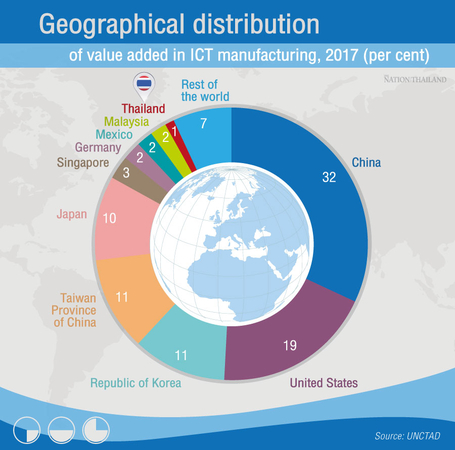
Global ICT manufacturing is highly concentrated, according to UNCTAD. Thailand, however, was among the top 10 economies that accounted for as much as 93 per cent of this subsector’s global value-addition.

Thailand was also in the top 10 countries which had high value-addition in ICT manufacturing as a share of GDP in 2017, the report said.

Looking at value-addition growth in the ICT sector by subsector, among developing countries and transition economies UNCTAD found that computer services displayed the highest average annual growth rate between 2010 and 2017, surging by an average rate of 8 per cent. In comparison, manufacturing grew by only 1 per cent, and telecommunications registered no growth. While value-addition in telecommunications rose in 12 countries including Thailand, in computer services it rose in 20 of them including Thailand. And in manufacturing it rose in 14 countries but Thailand experienced negative growth.

Bangkok and Hua Hin shine as “redefined” MICE destinations

ศาสตร์เกษตรดินปุ๋ย : ขอบคุณแหล่งข้อมูล : หนังสือพิมพ์ The Nation

https://www.nationthailand.com/business/30375926

Bangkok and Hua Hin shine as “redefined” MICE destinations

Sep 07. 2019
By THE NATION

147 Viewed

The Thailand Convention and Exhibition Bureau’s (TCEB) annual international media familiarisation trip put the strength of Bangkok and Hua Hin as a dynamic dual destination well in the spotlight as the bureau continues to create new attractions and activities at the community level.

“TCEB is redefining business experiences for MICE travellers in both destinations,” said TCEB’s Senior Vice President – Business Nichapa Yoswee. “The brand-new attraction at Iconsiam, the new venue, True Iconsiam Hall and exclusive Michelin-starred culinary experiences are helping to strengthen international MICE business in Thailand. Innovative attractions and activities in local communities, like coconut palm sugar production in Samut Songkram, and a salt spa in Phetchaburi, both in the vicinity of Hua Hin, as well as herbal products in Hua Hin, present redefined business opportunities and experiences often not previously available.”

This redefined idea of TCEB comes amidst the stronger role of MICE in Thailand’s national development. MICE is now incorporated as a new growth driving engine in the government’s 20-year national development plan and plays a role in government policy to promote more local and community attractions beyond the established destinations.

“The positive development in Thailand’s MICE policy is reflected in TCEB’s record performance in the 2019 financial year. TCEB has won bids for 11 international conferences, attracted 17 new trade shows and 12 mega-sized meeting and incentive groups of more than 100,000 delegates,” Nichapa said.

This year also sees Thailand hosting two global MICE events: the UIA Asia Pacific Round Table 2019 scheduled for September 19-20 in Pattaya and the 86th UFI Global Congress 2019 scheduled for November 6-9 in Bangkok.

In 2020, TCEB will continue to focus on key markets around Southeast Asia, Europe, USA, China and India supported by new development of MICE infrastructure and products. This includes increased function space of new hotels and expanded and upgraded transportation options in Bangkok and nationwide. The development goes hand in hand with TCEB’s “7 MICE Magnificent Themes”, BizConnect Application and the Online Request for Support (RFS) among many other initiatives designed to promote new ideas for MICE and tools to facilitate events located in Thailand.

“Another key direction of TCEB in 2020 is deepening private-public sector partnership and collaboration, such as the Thailand Incentive and Convention Association (TICA), the Thai Exhibition Association (TEA) and the Thai Hotels Association (THA), to find creative MICE solutions and new MICE experiences for clients hosting events in Thailand, which we believe will enhance redefined business experiences of our clients” Nichapa concluded.