KBank offers urgent assistance due to Podul

ศาสตร์เกษตรดินปุ๋ย : ขอบคุณแหล่งข้อมูล : หนังสือพิมพ์ The Nation

https://www.nationthailand.com/business/30375869

KBank offers urgent assistance due to Podul

Sep 05. 2019
By THE NATION

474 Viewed

Clients affected by tropical storm Podul will get a six-month grace period for paying principal, as well as financial support to rebuild their businesses and homes, Kasikornbank announced on Thursday (September 5).

Additionally, KBank has sent staff to the affected areas to provide assistance to customers.

KBank president Predee Daochai said that as part of relief support for flood victims, business customers will be granted a debt moratorium of up to six months, and access to loans for business rehabilitation with no principal payment for up to six months and a loan term of no more than five years.

For home loan, credit card and express cash card clients, assistance measures will also include a debt moratorium of up to six months.

Customers with mortgage loans with KBank can access a new loan for home repairs, plus a six-month grace period for principal payment.

Auto loan clients will be offered a 50-per-cent reduction of instalment payment for up to six months, including the waiver of fees and late payment penalties.

Flood-affected customers can apply for assistance measures from now until October 31, 2019.

Asian asset managers sets global pace in weak 2018: report

ศาสตร์เกษตรดินปุ๋ย : ขอบคุณแหล่งข้อมูล : หนังสือพิมพ์ The Nation

https://www.nationthailand.com/business/30375863

Asian asset managers sets global pace in weak 2018: report

Sep 05. 2019
By THE NATION

412 Viewed

Asia’s asset management industry last year grew at a fraction of the torrid pace of previous years, but remained the pacesetter for the global industry, according to a report by management consultant McKinsey & Co.

The region’s 5 per cent growth in assets under management for the latest year – off from an annualised 15 per cent clip for the prior six years – was still relatively strong for a year that saw AUM for the global industry finish 1 per cent lower, the report said.

According to the report, the Asia-Pacific region accounted for 77 per cent of the $1.88 trillion (Bt57.48 trillion) in global inflows for 2018. That marked an acceleration from the region’s 56 per cent share of global flows from 2013 to 2018.

Meanwhile, net profits for Asia’s asset management industry in 2018 grew 3 per cent, down sharply from an annualised pace of 14 per cent over the previous six years.

That subdued profit growth for the latest year could set the pace for the coming five years as global market uncertainties, such as the prospect of trade wars, and geopolitical volatility promise a more challenging environment for money managers, said Fumiaki Katsuki, a Tokyo-based partner with McKinsey.

Even so, with Asia’s less efficient capital markets offering more scope for active management, profit margins for asset managers in the region remained roughly double those of managers in North America and Western Europe, Katsuki said.

Within the region, China remained the prime dynamo driving global asset management inflows, accounting for more than 65 per cent of global flows in the latest year.

Growing allocations from pension funds and insurance companies, meanwhile, continue to redefine the region’s institutional landscape.

The report said while pension funds, with a 40 per cent share of institutional AUM, remain the dominant client segment, allocations from insurance companies are growing quickly – accounting for a majority of institutional flows in 2018 that boosted their share of AUM to 10 per cent from 7 per cent.

Vishal Kaushik, a Singapore-based senior expert at McKinsey, said a growing hunt for yield now has prompted insurers to boost allocations to external managers of fixed income and multi-asset strategies. That, in turn, has lifted their share of institutional flows to 70 per cent to 80 per cent from 30 per cent to 50 per cent a few years ago, he said.

To adapt to tougher conditions ahead, McKinsey’s report cited the need to add scale, potentially through acquisitions; increase focus on “digitising the value chain”; and ensure fee flexibility by focusing on solutions-oriented offerings such as multi-asset strategies.

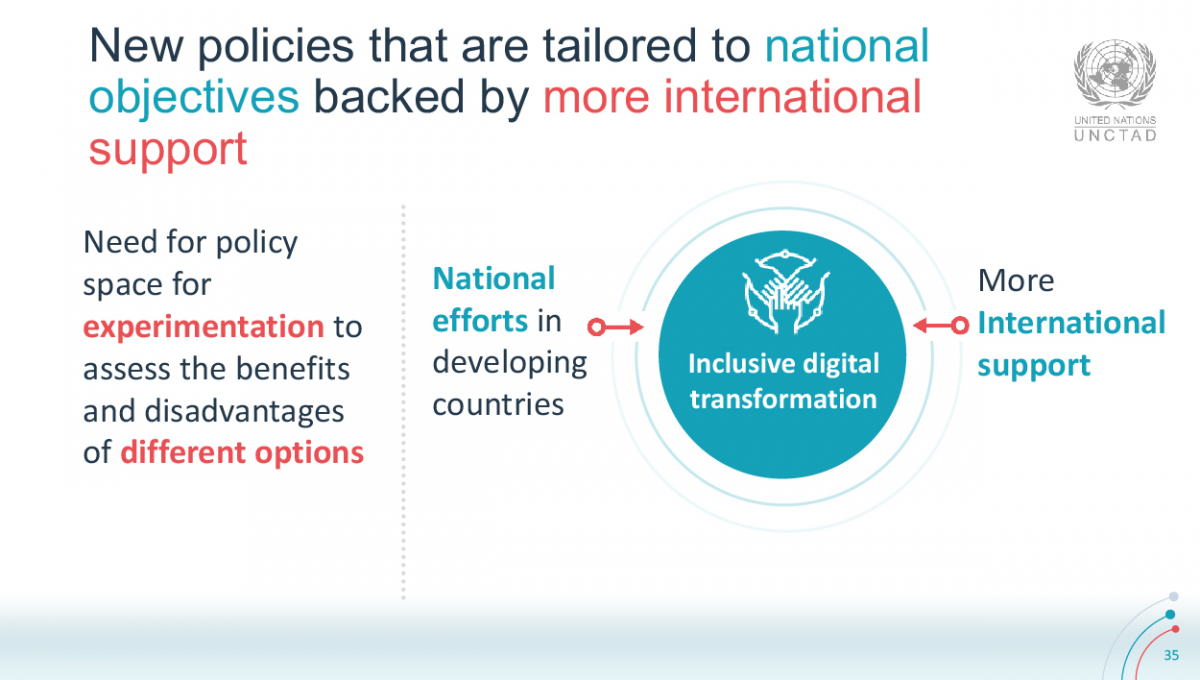
Policies: new policies at national, international levels needed to build inclusive digital economy

ศาสตร์เกษตรดินปุ๋ย : ขอบคุณแหล่งข้อมูล : หนังสือพิมพ์ The Nation

https://www.nationthailand.com/business/30375852

Policies: new policies at national, international levels needed to build inclusive digital economy

Sep 05. 2019
By The Nation

413 Viewed

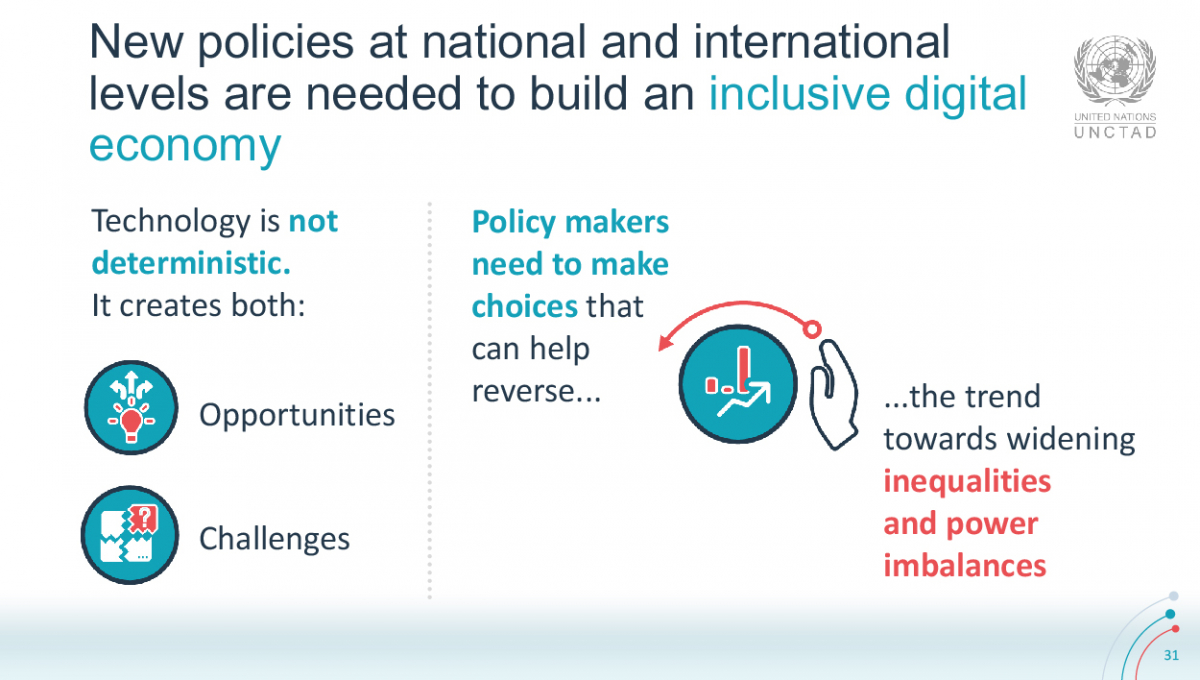
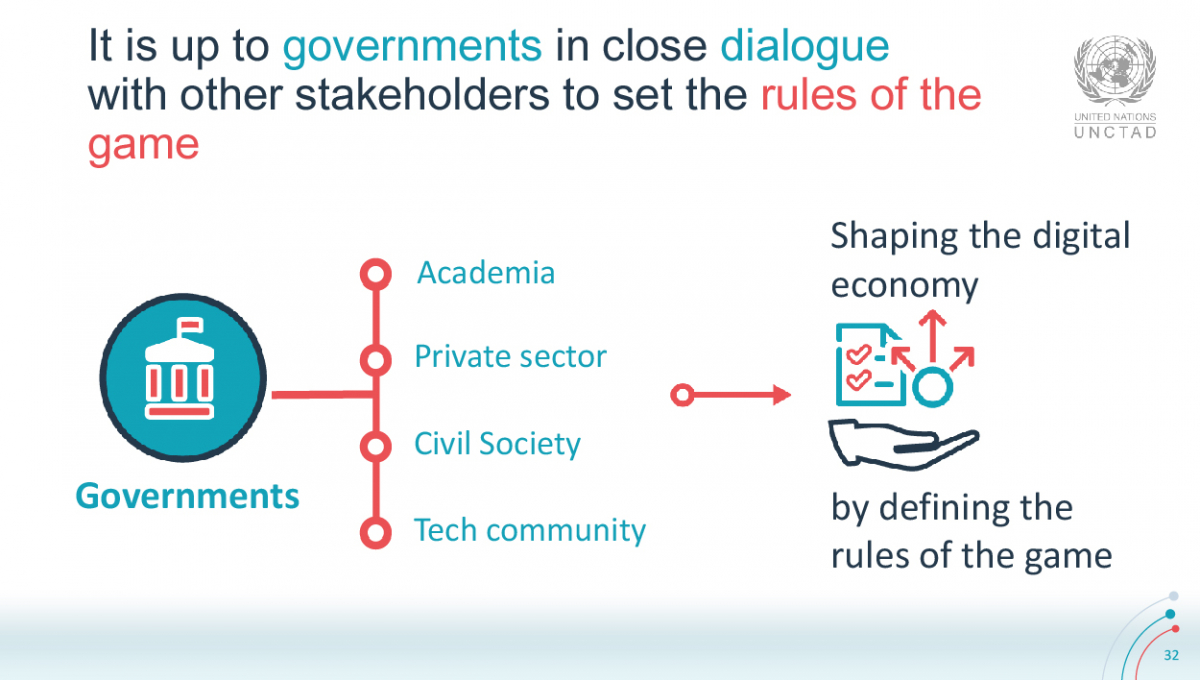
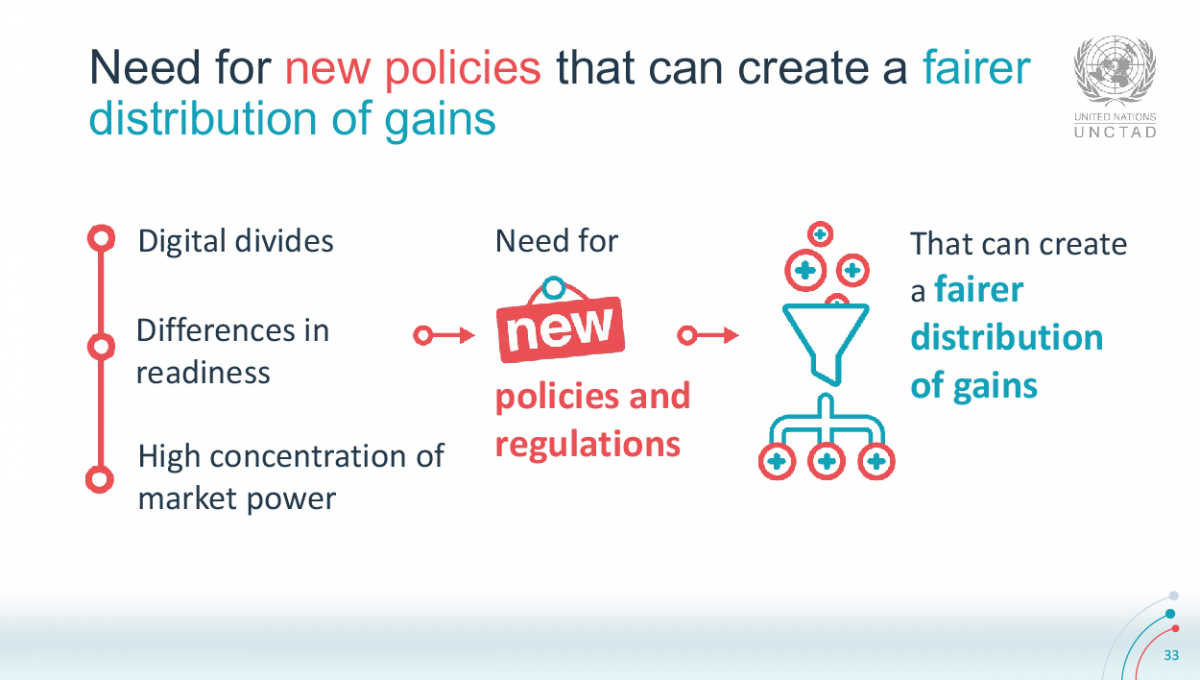
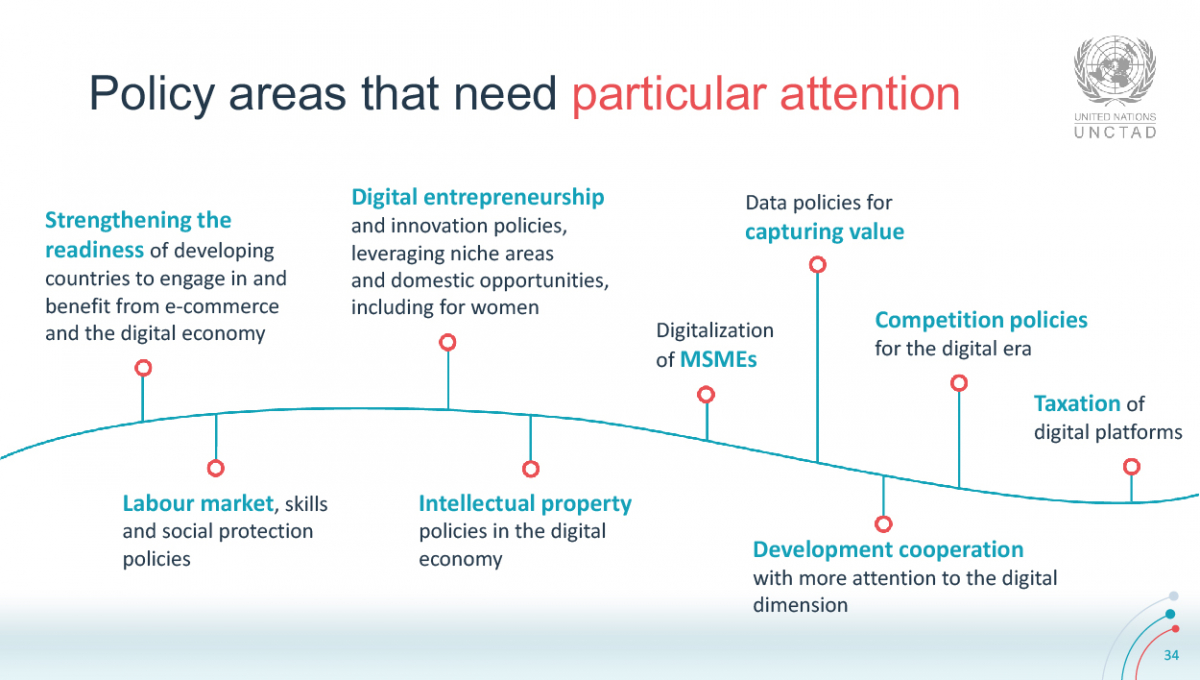
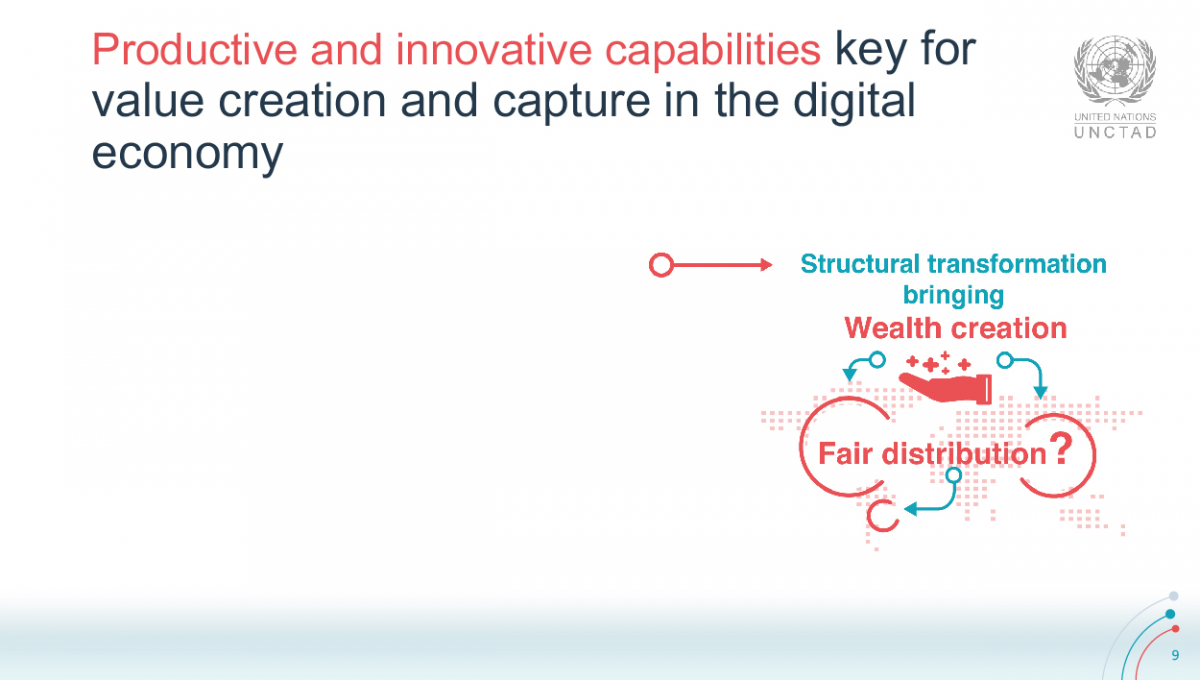
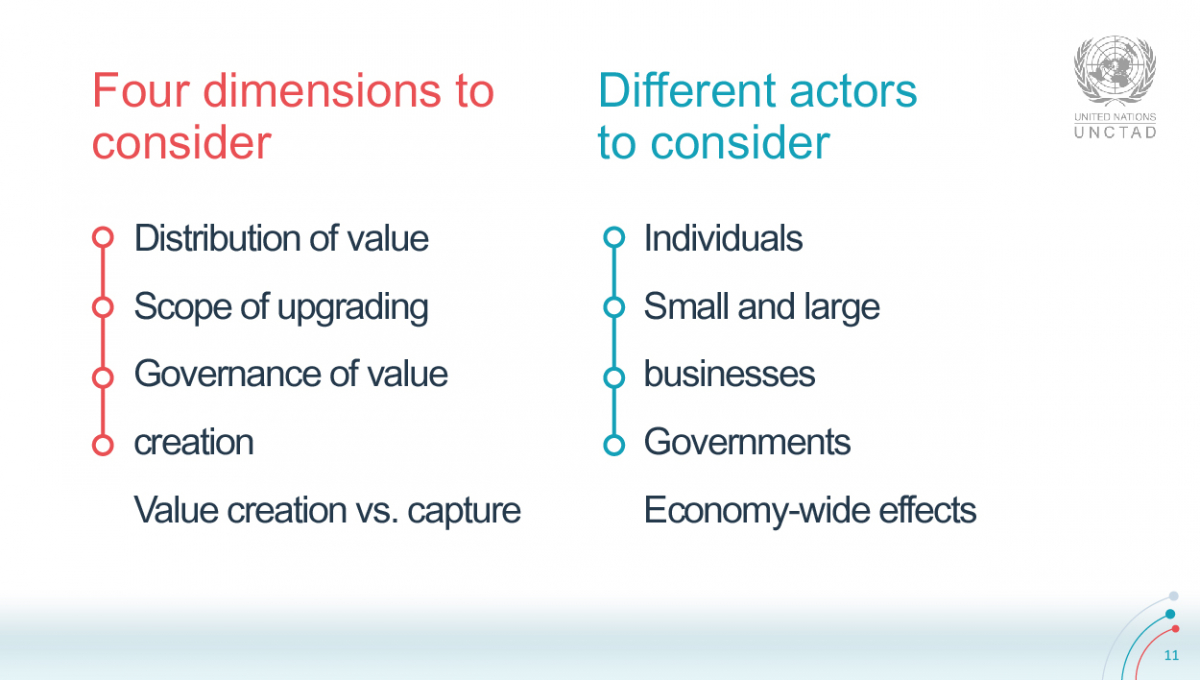
The Nation presents infographics of UNCTAD’s Digital Economy Report 2019, which highlights value creation and capture: implications for developing countries.


+++

+++

+++

+++

+++

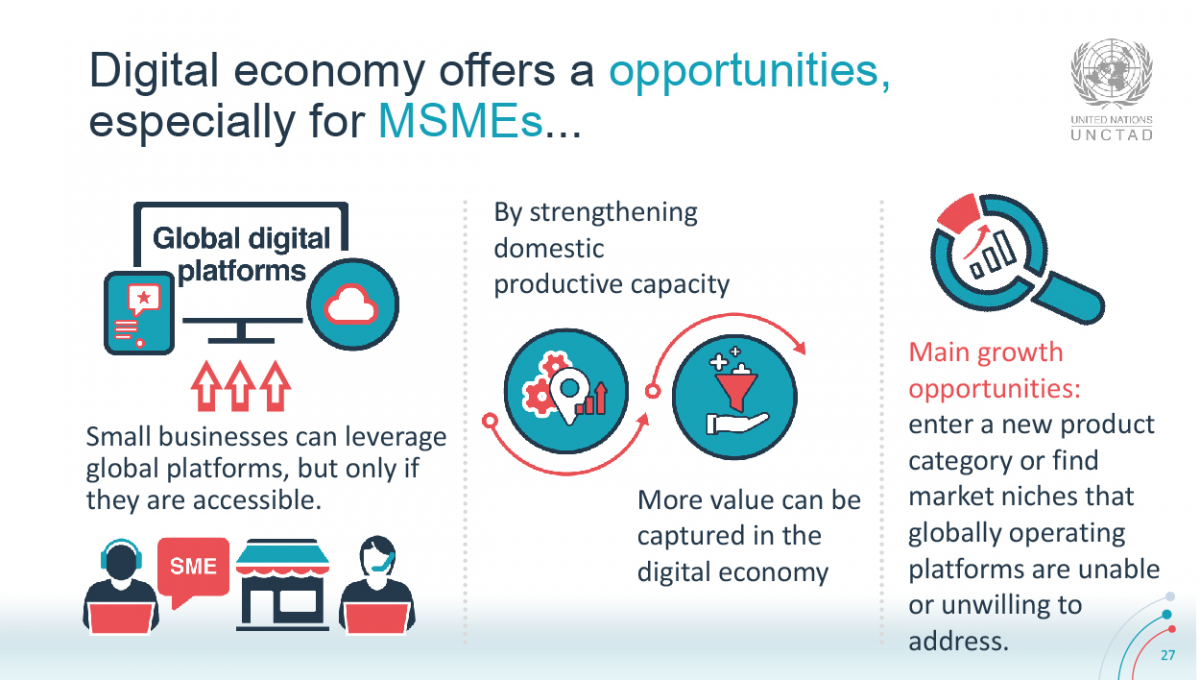
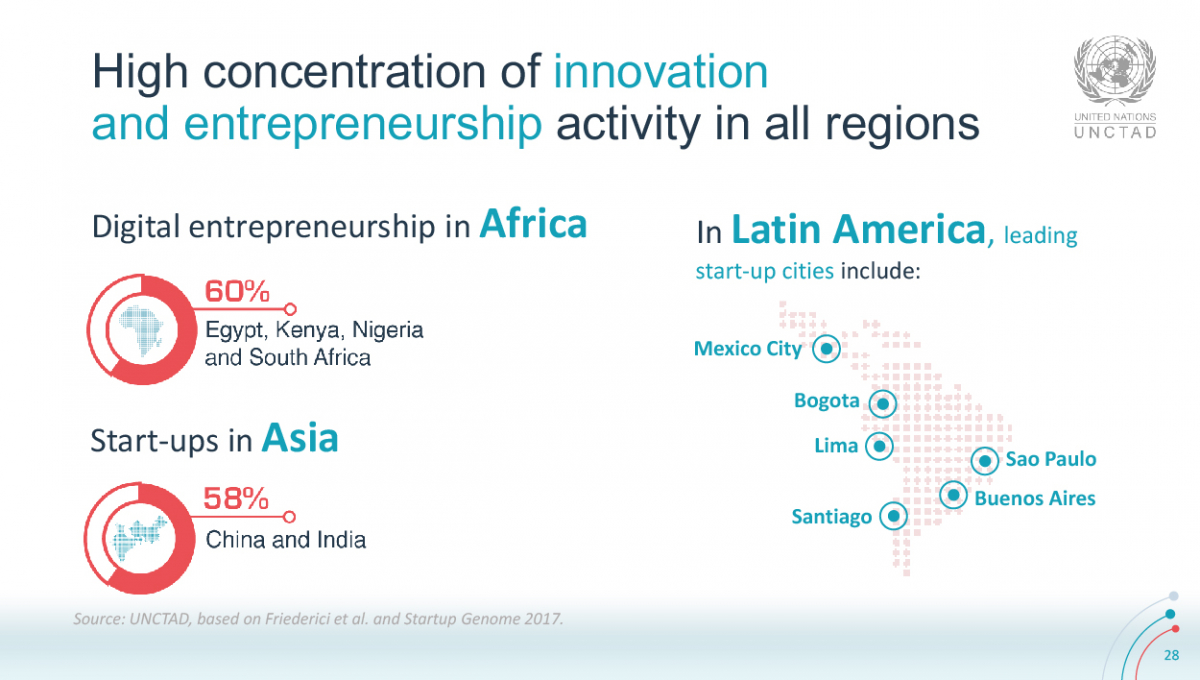
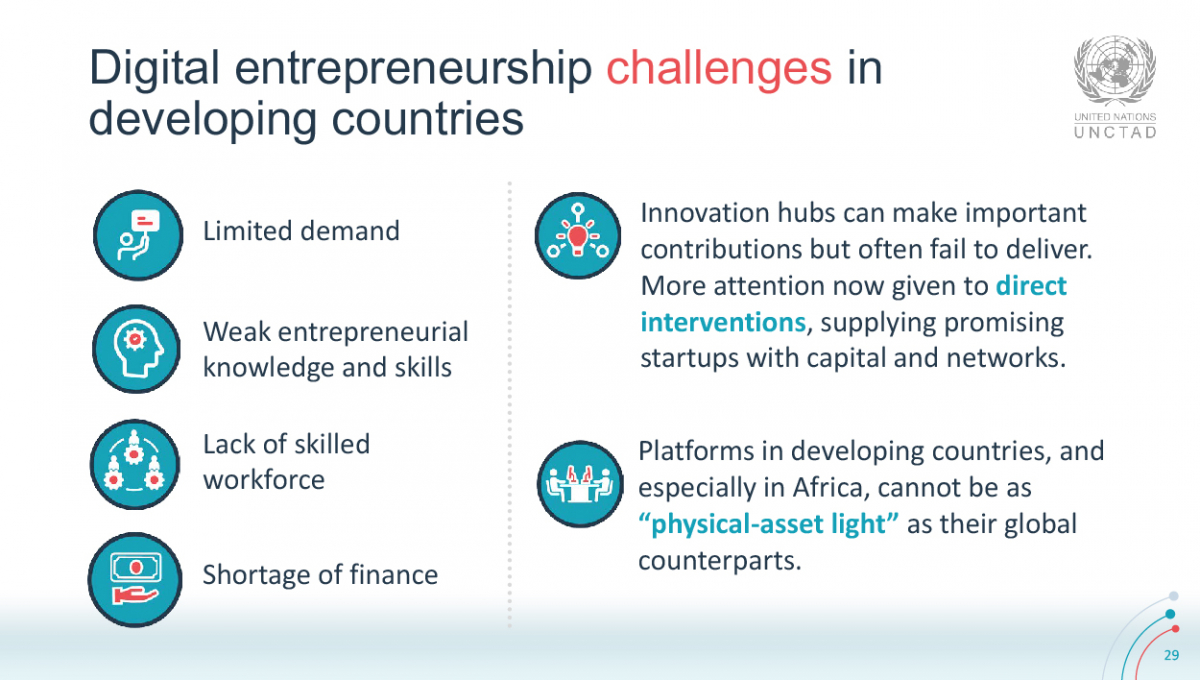
Opportunities, limitations: high concentration of innovation, digital entrepreneurship activity

ศาสตร์เกษตรดินปุ๋ย : ขอบคุณแหล่งข้อมูล : หนังสือพิมพ์ The Nation

https://www.nationthailand.com/business/30375851

Opportunities, limitations: high concentration of innovation, digital entrepreneurship activity

Sep 05. 2019
By The Nation

384 Viewed

The Nation presents infographics of UNCTAD’s Digital Economy Report 2019, which highlights value creation and capture: implications for developing countries.

MSMEs:micro small and medium-sized enterprises

MSMEs:micro small and medium-sized enterprises

+++

+++

Value creation: US$7 trillion, the combined value of large platforms

ศาสตร์เกษตรดินปุ๋ย : ขอบคุณแหล่งข้อมูล : หนังสือพิมพ์ The Nation

https://www.nationthailand.com/business/30375850

Value creation: US$7 trillion, the combined value of large platforms

Sep 05. 2019
By The Nation

489 Viewed

The Nation presents infographics of UNCTAD’s Digital Economy Report 2019, which highlights value creation and capture: implications for developing countries.

+++

+++

+++

+++

+++

Measuring value in the digital economy: size, scope

ศาสตร์เกษตรดินปุ๋ย : ขอบคุณแหล่งข้อมูล : หนังสือพิมพ์ The Nation

https://www.nationthailand.com/business/30375849

Measuring value in the digital economy: size, scope

Sep 05. 2019
By The Nation

723 Viewed

The Nation presents infographics of UNCTAD’s Digital Economy Report 2019, which highlights value creation and capture: implications for developing countries.

++++

++++

+++

Value in the digital economy: data monetised

ศาสตร์เกษตรดินปุ๋ย : ขอบคุณแหล่งข้อมูล : หนังสือพิมพ์ The Nation

https://www.nationthailand.com/business/30375848

Value in the digital economy: data monetised

Sep 05. 2019
By The Nation

563 Viewed

The Nation presents infographics of UNCTAD’s Digital Economy Report 2019, which highlights value creation and capture: implications for developing countries.

+++

+++

+++

Recent trends in the digital economy: global internet traffic has grown dramatically

ศาสตร์เกษตรดินปุ๋ย : ขอบคุณแหล่งข้อมูล : หนังสือพิมพ์ The Nation

https://www.nationthailand.com/business/30375847

Recent trends in the digital economy: global internet traffic has grown dramatically

Sep 05. 2019
By The Nation

704 Viewed

The Nation presents infographics of UNCTAD’s Digital Economy Report 2019, which highlights value creation and capture: implications for developing countries.

+++

+++

+++

+++

+++

UN calls for wider share of digital benefits dominated by US, China

ศาสตร์เกษตรดินปุ๋ย : ขอบคุณแหล่งข้อมูล : หนังสือพิมพ์ The Nation

https://www.nationthailand.com/business/30375840

UN calls for wider share of digital benefits dominated by US, China

Sep 05. 2019
By Wichit Chaitrong
The Nation

628 Viewed

A United Nations agency says concerted global effort will be required to ensure that the benefits of the rapidly expanding digital economy are shared with the millions otherwise destined to miss out.

In its first Digital Economy Report, the UN Conference on Trade and Development (Unctad) maps the global flow of data and funds and outlines the enormous potential gains and possible development costs as more people connect and make purchases online.

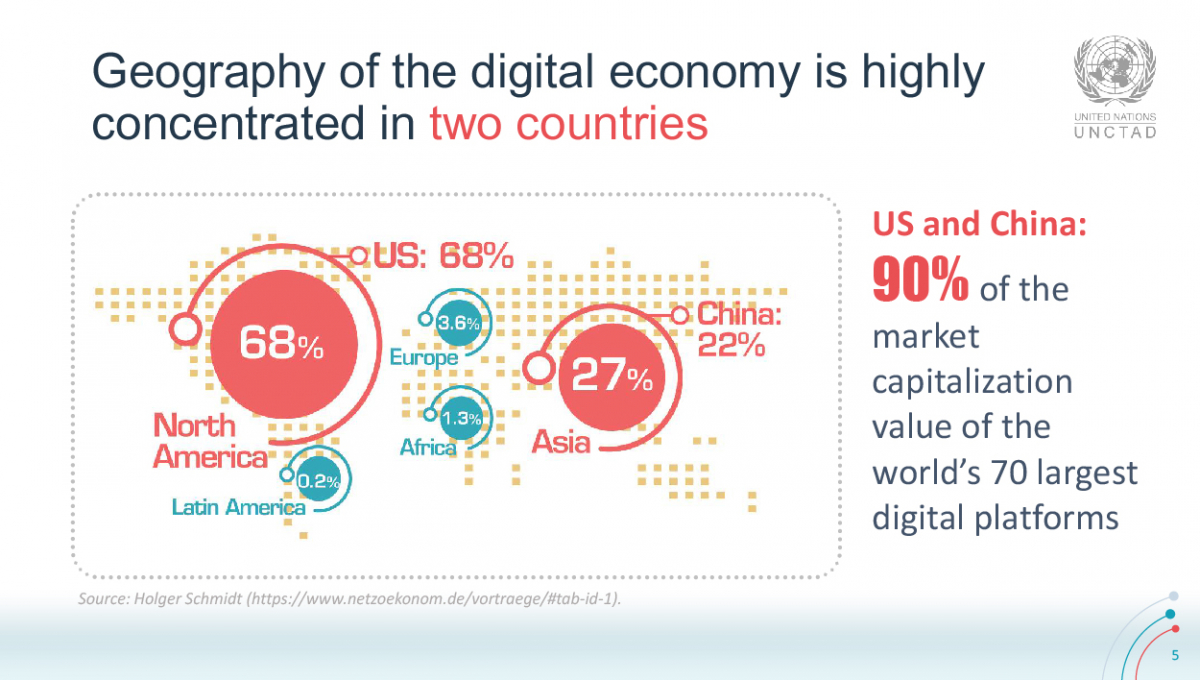
Wealth creation is highly concentrated in the United States and China, it notes, with the rest of the world trailing considerably far behind, especially countries in Africa and Latin America.
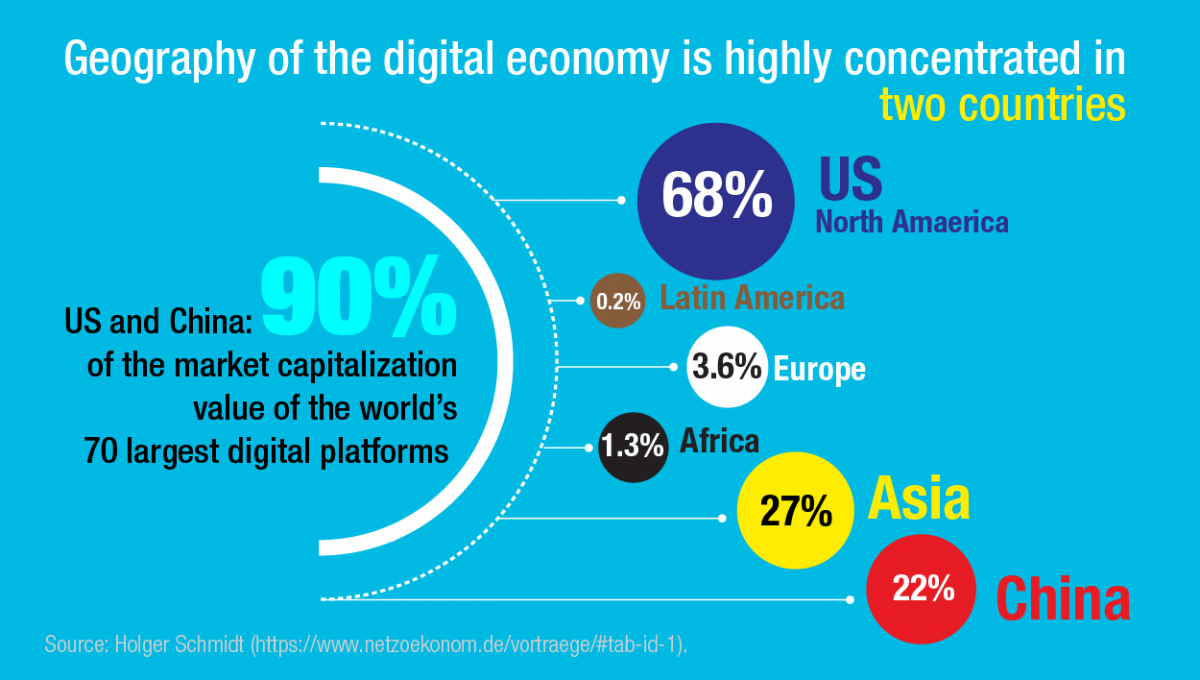
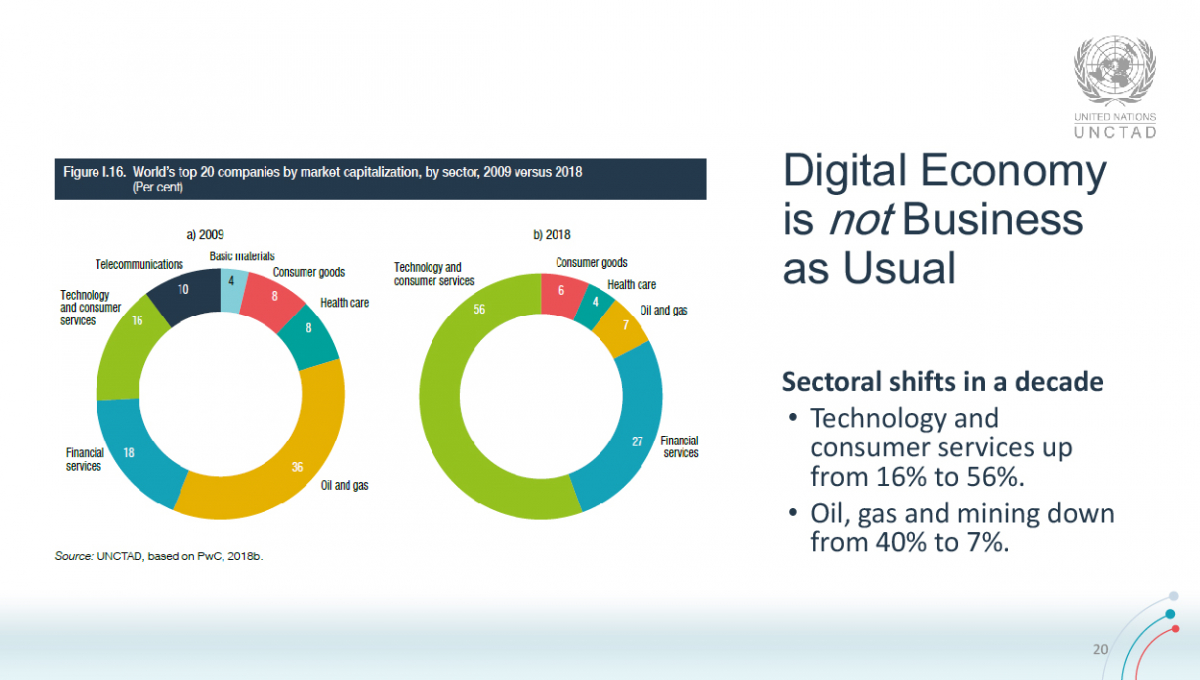
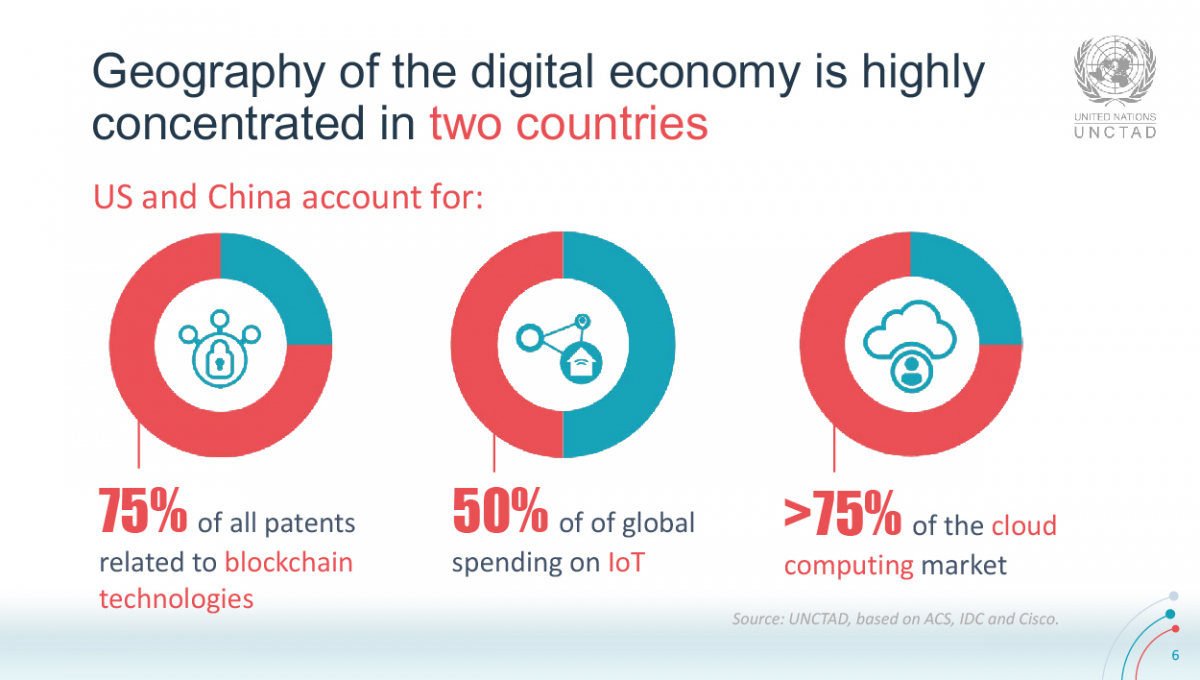
The US and China account for 75 per cent of all patents related to blockchain technologies, 50 per cent of global spending on the internet of things, more than 75 per cent of the cloud-computing market and as much as 90 per cent per cent of the market capitalisation value of the world’s 70 largest digital-platform companies.

Under current policies and regulations, this trajectory is likely to continue, further contributing to rising inequality, warned UN Secretary-General António Guterres.

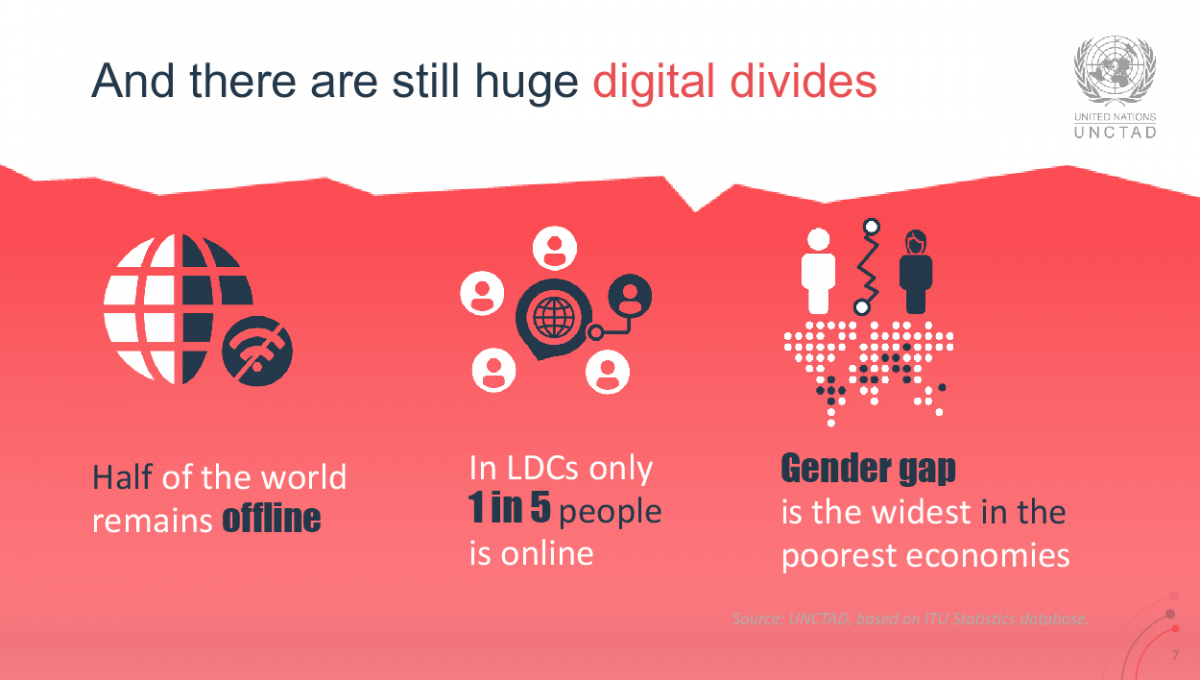
“We must work to close the digital divide, where more than half the world has limited or no access to the Internet. Inclusivity is essential to building a digital economy that delivers for all,” Guterres writes in the report.

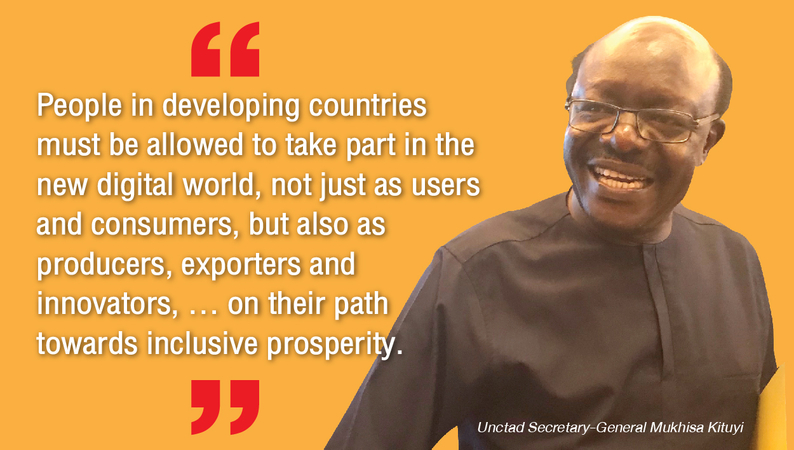
Unctad Secretary-General Mukhisa Kituyi said people in developing countries must be allowed “to take part in the new digital world, not just as users and consumers, but also as producers, exporters and innovators, … on their path towards inclusive prosperity”.

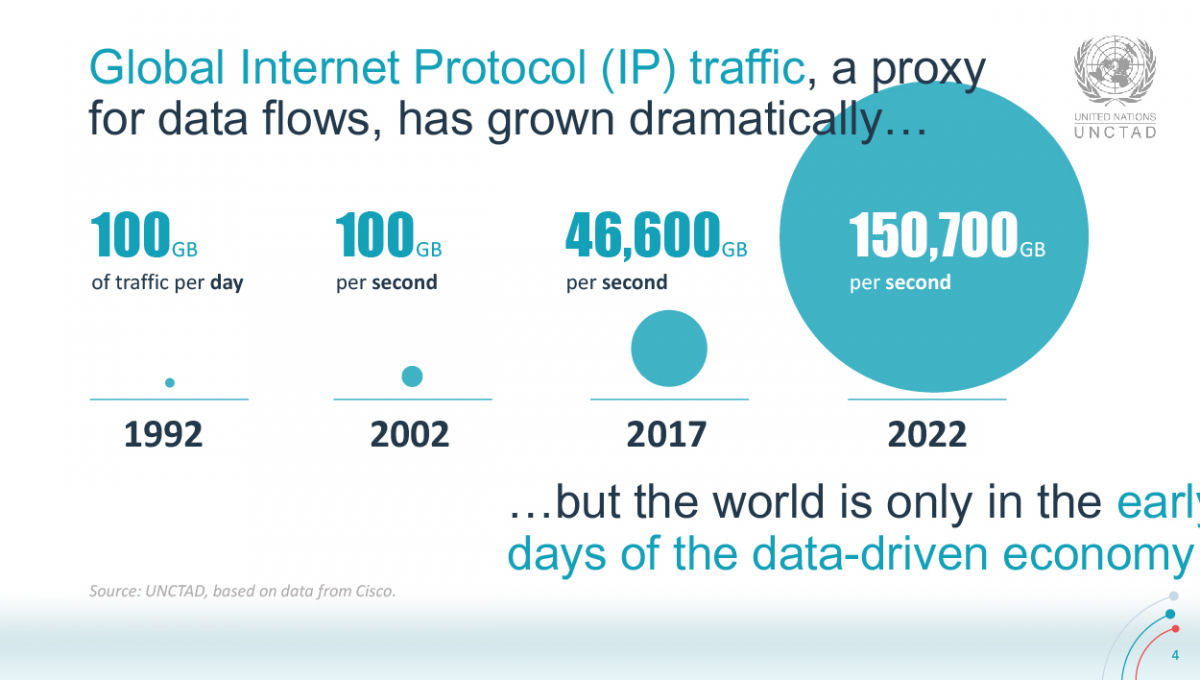
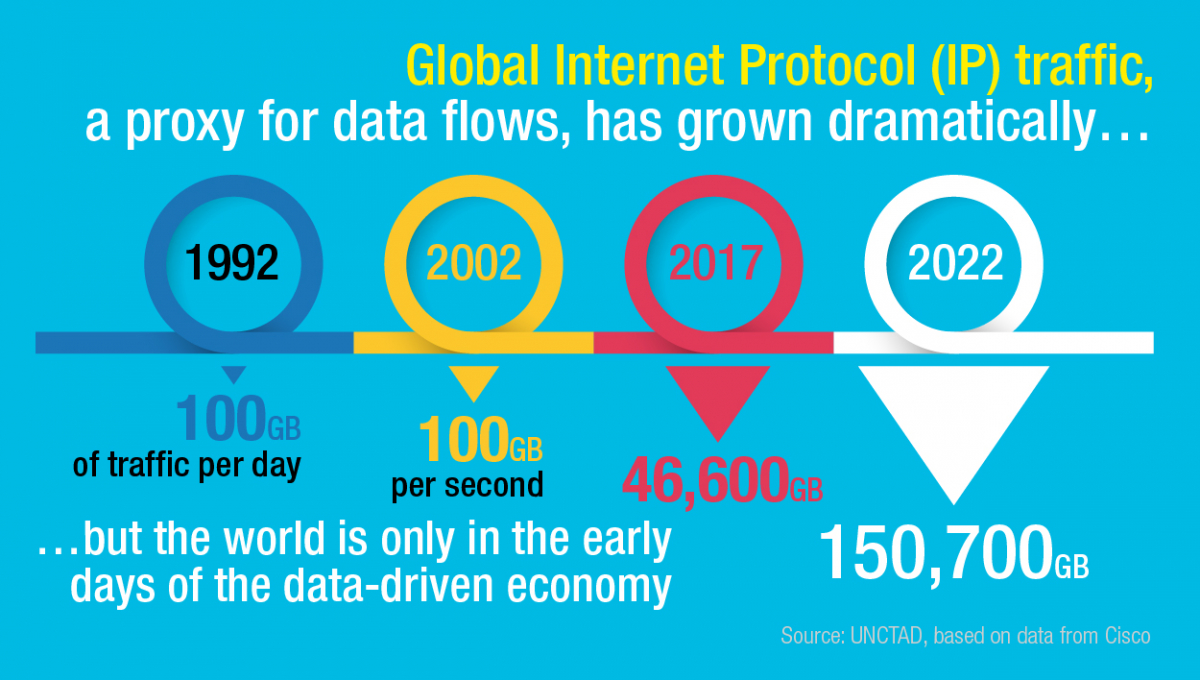
Global internet protocol (IP) traffic has seen dramatic growth, the report says, from 100 gigabytes of traffic per day in 1992 to more than 45,000 per second in 2017. And yet the world is only in the early stages of the data-driven economy. By 2022, global IP traffic is projected to reach 150,700GB per second.
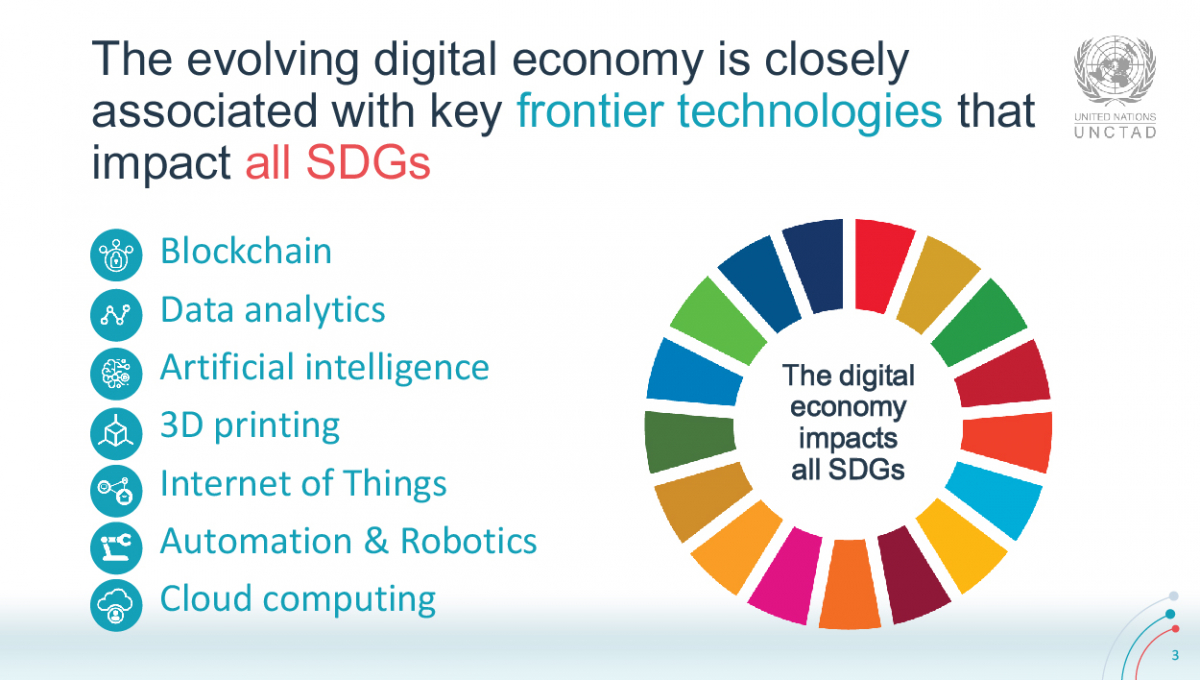
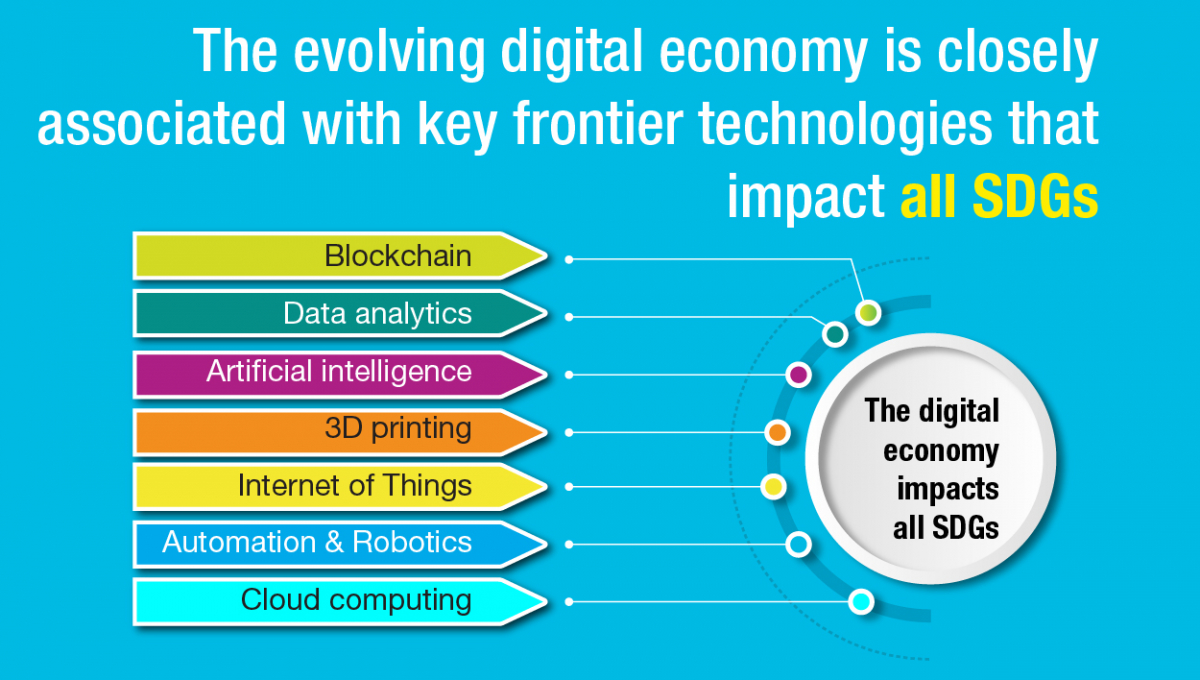
The surge reflects growth in the sheer number of people using the internet and the uptake of frontier technologies such as blockchain, data analytics, artificial intelligence, 3D printing, automation, robotics, cloud computing and the internet of things.
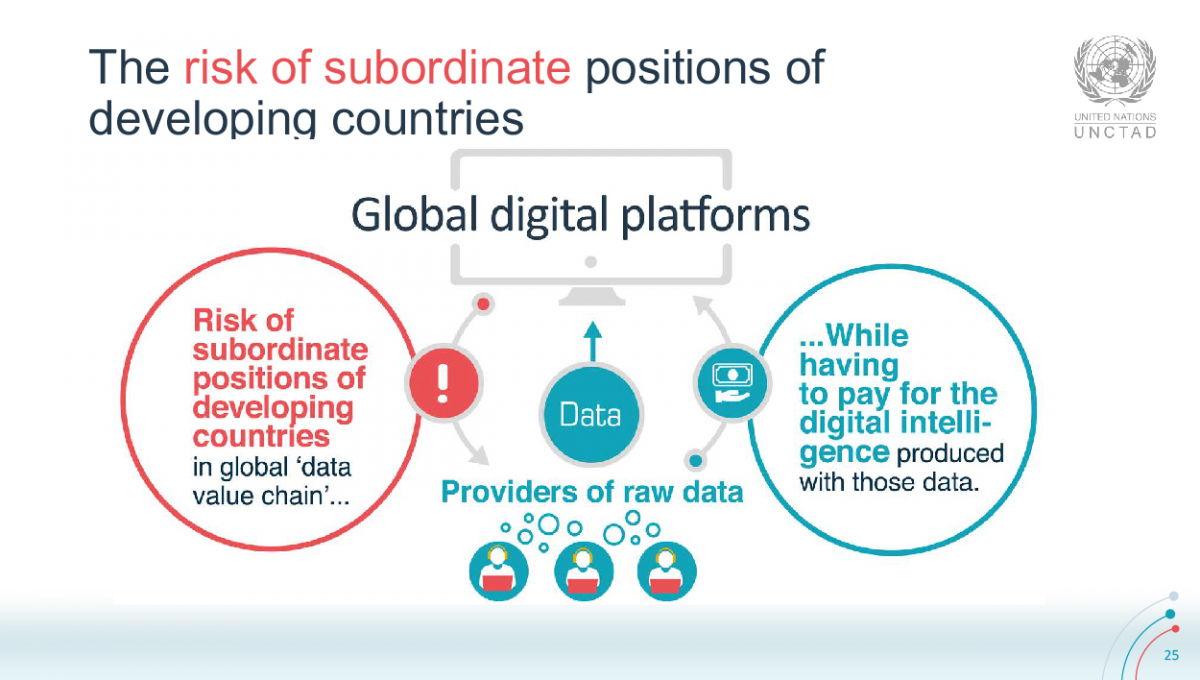
An entirely new “data value chain” has evolved among firms that support data collection, the production of insights from data and data storage.

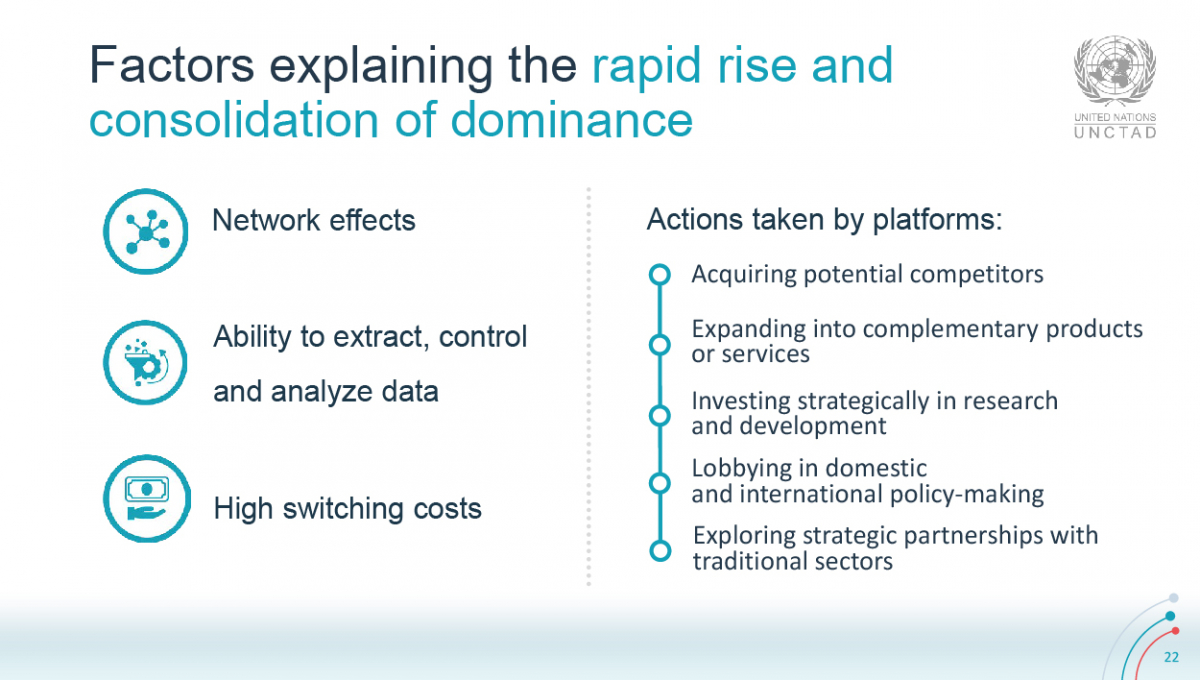
Businesses that build digital platforms have a major advantage by acting as both intermediary and infrastructure. They are positioned to record and extract data related to online interactions and transactions.

The report notes that 40 per cent of the world’s 20 largest companies by market capitalisation have a platform-based business model.

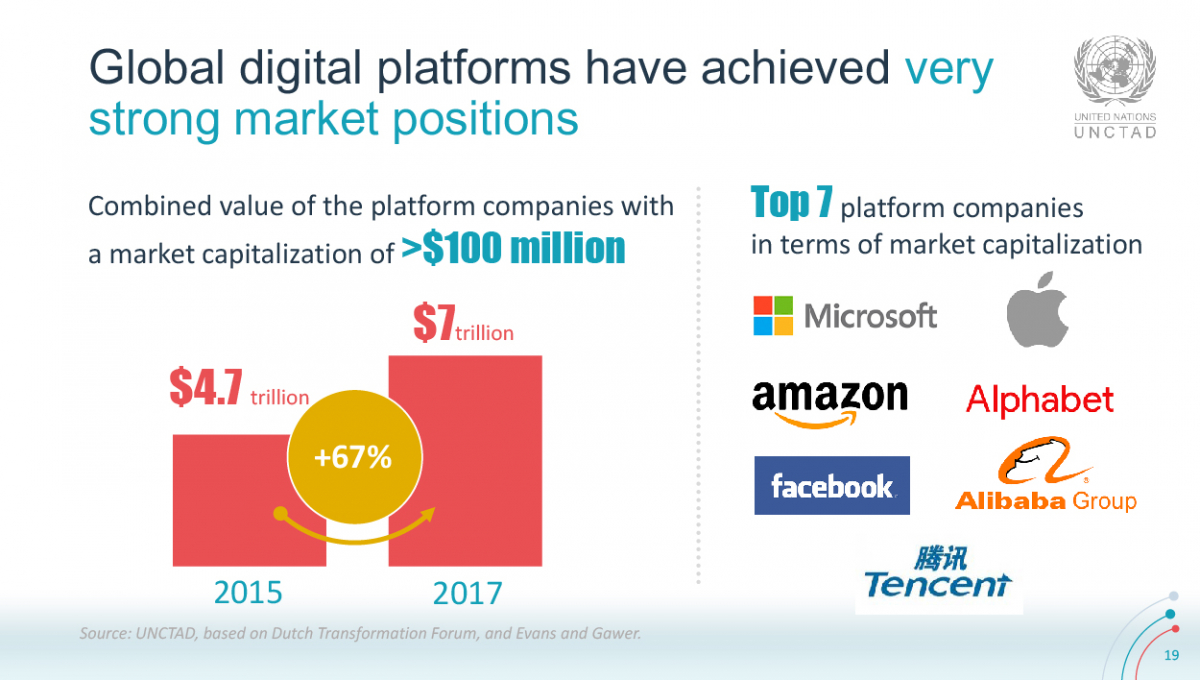
Seven “super-platforms” – Microsoft, Apple, Amazon, Google, Facebook, Tencent and Alibaba − account for two-thirds of the total market value of the top 70 platforms.

The combined value of the platform companies with market capitalisation of more than US$100 million was estimated at more than $7 trillion in 2017 – 67 per cent higher than in 2015, according to the report.

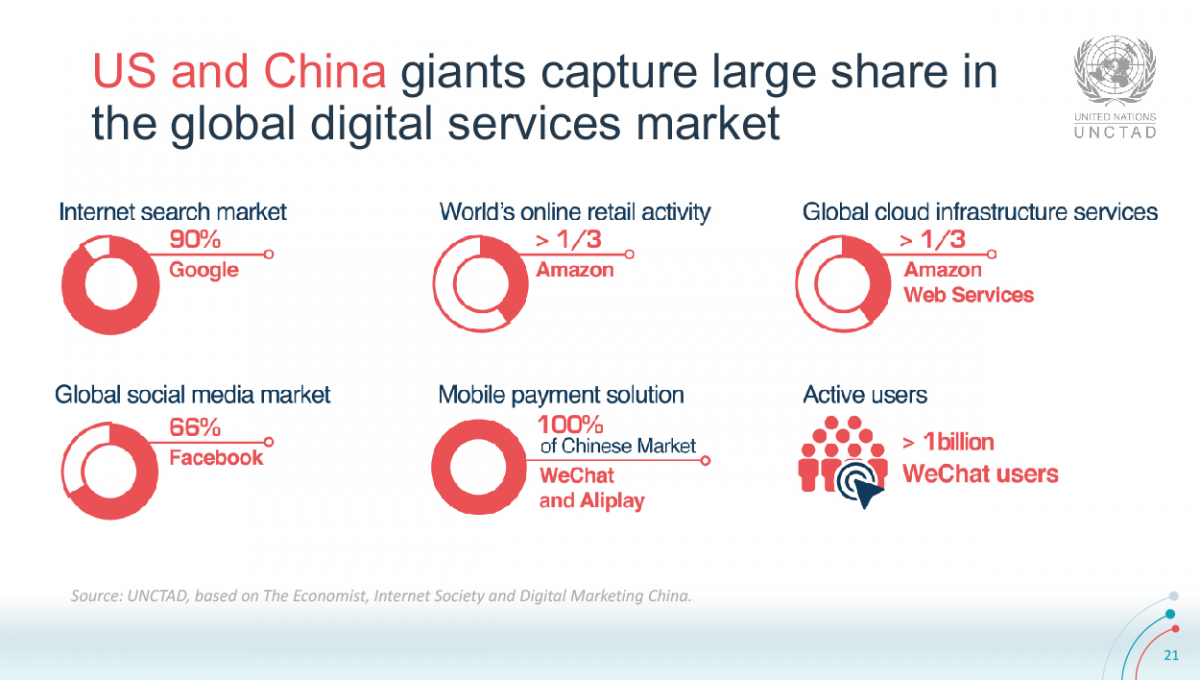
Some digital platforms have grown to dominate key niches. Google has some 90 per cent of the market for internet searches, while Facebook accounts for two-thirds of the global social-media market and is the top social network in more than 90 per cent of countries.

In China, WeChat, owned by Tencent, has more than one billion active users. Its payment solution and Alipay, owned by Alibaba, have captured virtually the entire Chinese market for mobile payments. Meanwhile, Alibaba is estimated to have close to 60 per cent of the Chinese e-commerce market.

These companies are aggressively consolidating their competitive positions, including by acquiring potential competitors and expanding into complementary products or services, lobbying in domestic and international policymaking circles and establishing strategic partnerships with leading multinationals in traditional sectors, such as automotive, semiconductor and retail industries.

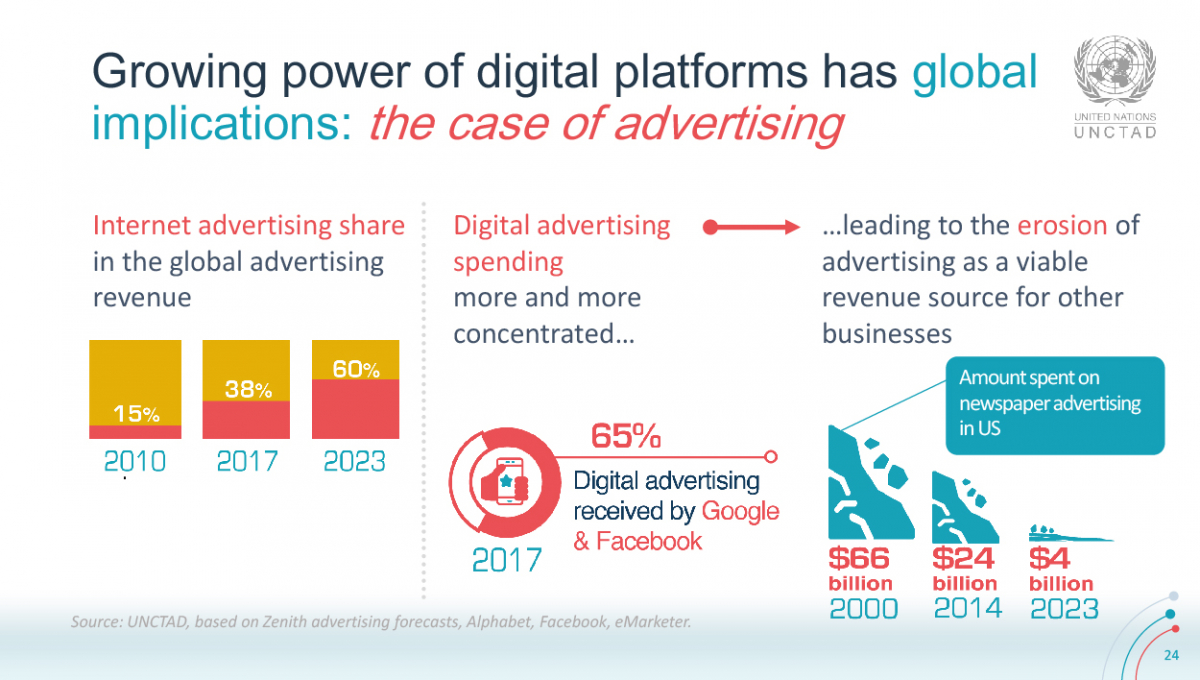
The dominance of global digital platforms and their control of data, as well as their capacity to create and capture the ensuing value, accentuates concentration and consolidation rather than reducing inequalities between and within countries, the report notes.

It warns that developing countries risk becoming mere providers of raw data, while having to pay for the digital intelligence generated using their data.

If left unaddressed, the yawning gap between the under-connected and the hyper-digitalised countries will widen, and inequalities be exacerbated.

The report suggests finding an alternative configuration of the digital economy that leads to more balanced results and a fairer distribution of the gains from data and digital intelligence.

Governments have a critical role in shaping the new economy by defining the rules, it says. This involves the adaptation of existing policies, laws and regulations, and the adoption of new ones in many areas.

“A smart embrace of new technologies, enhanced partnerships and greater intellectual leadership are needed to redefine digital development strategies and the future contours of globalisation,” Kituyi said.

Policy responses need to consider increased difficulties of enforcing national laws and regulations with respect to cross-border trade in digital services and products, the report recommends.

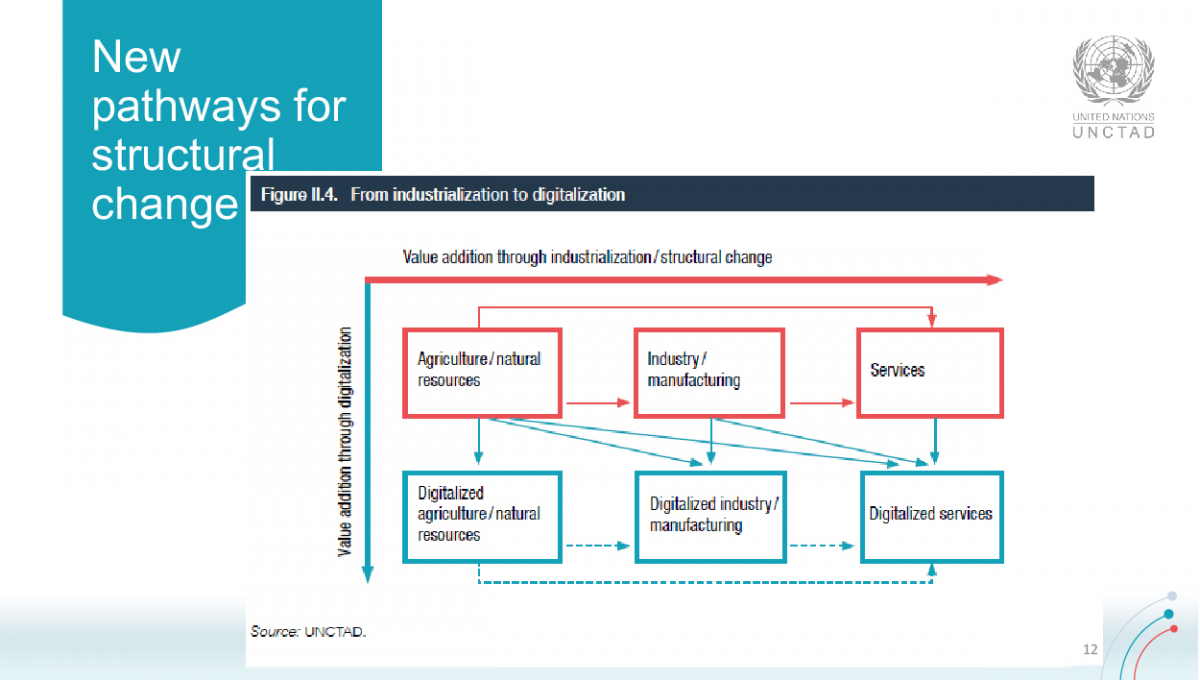
Further, they should explore new pathways for local value creation and capture, and structural transformation through digitalisation.

National development strategies should also seek to promote digital upgrading (value addition) in data value chains, and to enhance domestic capacities to “refine” the data.

“Digitalisation affects different countries in different ways, and individual governments require policy space to regulate the digital economy to meet various legitimate public policy objectives,” the report states.

At the same time, several policy challenges associated with value creation and capture in the digital economy can only be effectively addressed at the regional or international level, with the full involvement of developing countries. This includes competition, taxation, cross-border data flows, intellectual property, trade and employment policies.

To secure a digital future for the many, rather than the few, domestic and international policies should go beyond enlisting more developing-country users and consumers online; they should also enable the building of domestic capabilities to create and capture value.

According to the report, the development community needs to find more comprehensive ways to support countries that are trailing in the digital economy.

It recommends that more assistance should aim at reducing the digital divides, strengthening the enabling environment for value creation and building capacities in the private and public sectors.

Further, policy actions should seek to enhance trust by supporting the adoption and enforcement of relevant laws and regulations to promote value creation and capture in the data-driven digital economy, says the report.


Finance Ministry eases concern on household debts

ศาสตร์เกษตรดินปุ๋ย : ขอบคุณแหล่งข้อมูล : หนังสือพิมพ์ The Nation

https://www.nationthailand.com/business/30375844

Finance Ministry eases concern on household debts

Sep 04. 2019
Lavaron

Lavaron
By THE NATION

286 Viewed

The Finance Ministry on Wednesday (September 9) moved to ease public concern on high household debt in the first quarter of the year.

Lavaron Sangsnit, director-general of the Fiscal Policy Office and the ministry’s spokesperson, said the level of household debt in the first three months was still lower than the peak in 2015 when it accounted for 81.2 per cent of the gross domestic product (GDP).

The ministry said it has yet to become a pressing issue as most of the borrowings were backed by collateral and that they should be deemed as part of the process in building up one’s wealth or as investment to generate income.

Total household debt as of the end of the first quarter stood at Bt12.97 trillion or 78.7 per cent of GDP, of which 42.8 per cent were loans from commercial banks. Most of the loans were backed with assets of the borrowers, for the purpose of acquiring assets such as properties and vehicles or used as operating expenses of their businesses.

When excluding loans for businesses, total household debt in the first quarter would have fallen to Bt10.84 trillion or 65.8 per cent of GDP, Lavan said.

At the same time, the level of loans for personal consumption or personal loan remained low at 6.3 per cent of the total debt while non-performing loans among households accounted for just 3.3 per cent in the quarter.

The office, he said, will continue to monitor the situation.

Earlier this week, the National Economic and Social Development Council (NESDC) and the Bank of Thailand both raised concern on the high level of household debt.

According to the NESDC, total household debt nationwide in the first quarter amounted to Bt13 trillion, rising by 6.3 per cent year-on-year and accounting for 78.7 per cent of GDP – the highest since the first quarter of 2017.

The state think-tank warned that household debt has been rising continuously since mid-2017, adding that the debt level would likely be higher in the second quarter, given the 9.2 per cent increase in personal loans from commercial banks during the period.