BOT to revise year’s growth forecast after 2Q result

ศาสตร์เกษตรดินปุ๋ย : ขอบคุณแหล่งข้อมูล : หนังสือพิมพ์ The Nation

https://www.nationthailand.com/business/30374986

BOT to revise year’s growth forecast after 2Q result

Aug 19. 2019
Don Nakornthab/Photo by BOT

Don Nakornthab/Photo by BOT
By The Nation

195 Viewed

The Bank of Thailand (BOT) will revise the country’s economy growth forecast for 2019 in its next report in September after the National Economic and Social Development Council (NESDC) announced a 2.3 per cent growth for the second quarter, lower than the central bank’s estimate of 2.8 per cent, BOT’s senior director monetary policy group Don Nakornthab said on Monday.

He added that the BOT will revise the country’s economy growth forecast in the upcoming economy report after monitoring business risk from the trade war between China and USA, global currency fluctuation, and the government’s stimulus package that will be launched this year.

“The country now faces an unpredicted situation due to internal and external pressure. We will keep a close watch and will announce the latest estimation next month,” he said.

Falling oil prices may find some support from IMO 2020

ศาสตร์เกษตรดินปุ๋ย : ขอบคุณแหล่งข้อมูล : หนังสือพิมพ์ The Nation

https://www.nationthailand.com/business/30374985

Falling oil prices may find some support from IMO 2020

Aug 19. 2019
Mriganka Jaipuriyar,  Head of News, Asia, S&P Global Platts

Mriganka Jaipuriyar, Head of News, Asia, S&P Global Platts
By MRIGANKA JAIPURIYAR
SPECIAL TO THE NATION

207 Viewed

Overwhelmingly bearish economic sentiment has sent oil prices spiraling down and persistent cuts in demand growth forecasts are indicative of further downside risk.

The oil markets, however, could find some support in the near to medium term from a demand spike led by tighter marine fuel specifications by the International Maritime Organisation (IMO) that are set to kick in on January 1, 2020.

Front-month ICE Brent futures have fallen by 22done per cent from their 2019 high of $74.50/b seen in late April to $58/b in mid-August.

According to S&P Global Platts Analytics, Brent prices are some $10/b below where fundamentals indicate they should be.

“Fundamentals suggest Brent prices should be much stronger,” Chris Midgley, Global Director for S&P Global Platts Analytics said in a recent note, adding that healthy refining margins and strong runs are pulling crude stocks lower.

Crude stocks in the three major OECD markets of US, OECD Europe, and Japan have fallen by 700,000 b/d in June-July, he said.

“Watch for much higher global crude runs in the final months of the year as refineries pump out supplies to meet [marine fuel specification] changes for January 1. This means more substantial crude stock draws in November (900,000 b/d) and December (1.3 million b/d).”

The IMO specifications require all marine fuel to contain a maximum sulfur content of 0.5 per cent , down from 3.5 per cent, and are expected to shift global diesel/gasoil demand higher by around 1.5 million b/d in the fourth quarter of 2019 and first half of 2020, Platts Analytics estimates.

According to Platts Analytics, if Brent prices continue to stay in the $55-$60/b range, driven in large part by sentiment, it will end the year closer to $70-$75/b.

But a worsening global economic sentiment poses a key downside risk.

Although central banks have begun to aggressively cut interest rates and that should eventually support growth or lessen the drop, that will take time and possibly not be evident till later in 2020, and might be overwhelmed by market forces, Platts Analytics said in recent report.

Until then, the fading impact of the US tax stimulus, the increasing headwinds on trade, and ongoing flashpoints for conflict with India-Pakistan, China-Hong Kong, and Iranian risk are now very much part of the equation, it said.

Slowing demand, plentiful supply pose downside risk

Platts Analytics has been lowering its demand growth forecast and in late-July cut it to 1.05-1.10 million b/d from 1.5 million b/d in 2018.

In China, which accounts for a bulk of global oil demand growth, Platts Analytics expects apparent oil demand growth to run out of steam from August onward, slowing down from 906,000 b/d year-on-year growth seen in June, given a bleaker outlook for the economic growth overshadowed by increasing trade tension between China and US.

“We are now seeing the [oil demand] growth will likely slow down to 321,000 b/d year on year in the second half of 2019, bringing the annual growth to 519,000 b/d this year, while growth for 2020 will further ease to 483,000 b/d,” it said in a report.

India’s oil products demand grew 1% year on year in the first half of 2019 and demand is expected to stage only a modest recovery in the second-half.

The International Energy Agency, in its August report, also lowered oil demand growth for 2019 by 100,000 b/d to 1.1 million b/d.

“The outlook is fragile with a greater likelihood of a downward revision than an upward one,” the IEA noted.

Supply, on the other hand, looks strong despite Opec’s large production cuts and continued losses from Venezuela and Iran.

Opec and its allies have agreed to cut production by 1.2 million b/d through to the end of the first quarter of 2020.

Opec pumped its fewest barrels in more than five years in July to 29.88 million b/d, aided by a huge production decline in its largest producer, Saudi Arabia, along with falls in Iran, Nigeria, Libya and Venezuela, according to a Platts survey.

But the IEA indicated non-Opec supply was up 1.4 million b/d year on year in July and is set to grow by 1.9 million b/d in 2019 and 2.2 million b/d next year.

It’s a bleak reading for Opec, with the IEA highlighting a potential oil market glut in early-2020 when the call on Opec crude oil plunges to 28.4 million b/d.

Opec has been unsettled by the recent drop in oil prices and are eyeing a response to falling prices at the next meeting of the group’s top-level monitoring committee in September. The group’s options are limited and it appears it would need to find a way to remove another 1.5 million b/d on top next year.

Mriganka Jaipuriyar is Head of News, Asia, S&P Global Platts

Netflix pledges to build Asian digital creativity skills

ศาสตร์เกษตรดินปุ๋ย : ขอบคุณแหล่งข้อมูล : หนังสือพิมพ์ The Nation

https://www.nationthailand.com/business/30374982

Netflix pledges to build Asian digital creativity skills

Aug 19. 2019
By THE NATION

159 Viewed

Netflix has signed a pledge to partner with the World Economic Forum’s (WEF) Digital Asean working group to help people and governments in Southeast Asia develop creative and digital skills and capabilities for the fourth industrial revolution.

The pledge, made today (August 19) is part of the WEF’s Asean Digital Skills Vision 2020 programme, a private-public project involving a coalition of organisations that seeks to train up 20 million workers in digital skills by 2020.

The initiative gained further urgency when a recent WEF-commissioned survey of 56,000 Asean youths found that 52 per cent believed they needed to upgrade their skills constantly to succeed in a changing job market. On top of that, they ranked “creativity and innovation” as the most important skill for their future.

Yu-Chuang Kuek, the managing director for Netflix Asia-Pacific, said, “As Netflix grows, we are partnering with Southeast Asian governments and industry players to support the development of digital creative skills needed in a fast-developing internet entertainment landscape. We believe having the necessary skills for the creative industry; being equipped for online safety and digital literacy; as well as understanding the principles for an agile governance framework will be integral to the success of initiatives like the Asean Connectivity Master Plan.”

According to the World Economic Forum’s Justin Wood, the head of Asia Pacific and member of the executive committee, “We welcome industry partners like Netflix to this important cause. Key public-private partnerships like this play a vital role in ensuring societies and governments across the region are equipped with the necessary skills and not left behind in the wake of this technological revolution. This programme is delivering significant impact. In its first eight months, the initiative has already secured commitments to train 8.9 million workers at SMEs, as well as to provide 30,000 internships.”

As part of its pledge, Netflix will start rolling out initiatives focused on three broad areas.

The first area, creative industry 4.0 skills development, will focus on the skills required to produce content for the internet entertainment industry, including writing, production and post-production.

Second, the online safety and digital literacy initiative will be built in partnership with industry experts, consumer advocacy groups, as well as regulators, to equip consumers with the necessary knowledge and tools to enjoy online entertainment in a safe and secure way.

The third area, agile governance 4.0, will be held in partnership with key stakeholders to help regulators navigate changes in the fourth industrial revolution and to keep pace with technological advancements.

Netflix will work with various partners to hold workshops and training, which will initially be held throughout the next six months in Indonesia, Malaysia, the Philippines, Thailand and Vietnam, with more locations under consideration in the future.

Growth in Q2 slowest in 19 quarters at 2.3 per cent

ศาสตร์เกษตรดินปุ๋ย : ขอบคุณแหล่งข้อมูล : หนังสือพิมพ์ The Nation

https://www.nationthailand.com/business/30374954

Growth in Q2 slowest in 19 quarters at 2.3 per cent

Aug 19. 2019
By The Nation

126 Viewed

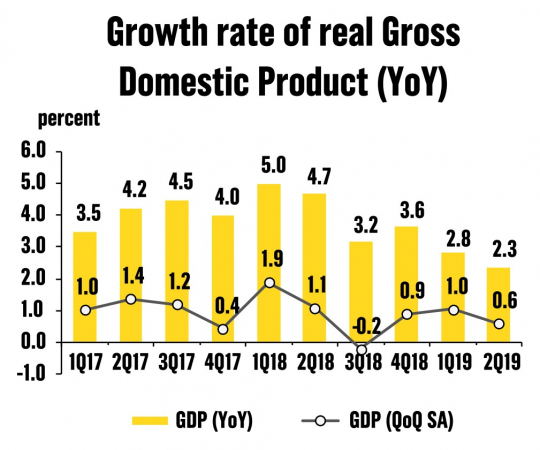
Economic growth sharply slowed in the second quarter to 2.3 per cent due to both external and domestic factors, according to a state think-tank report released today( August 19). Gross domestic product in the second quarter expanded by 2.3 per cent, a drop from the 2.8-per-cent growth rate in the first quarter, said the economic report released by National Economic and Social Development Council (NESDC), a state think tank.

The 2.3 per cent growth rate is the slowest in 19 quarters, or nearly five years.

GDP grew by 2.6 per cent overall for the first half of the year. However, the economy in the first half was affected by the trade war, a slowdown in the global economy, market volatility and the delay forming government after March’s general election, said Thosaporn Sirisumphand, the NESDC secretary general.

Unfavourable conditions have impacted on consumer and investor confidence, according to the report, with Thai exports contracting and a slowing of growth in tourist arrivals due to economic conditions in their own countries.

The think tank forecast the full year’s growth could still achieve 3 per cent, or a range between 2.7-3.2 .

“The economy is expect to recover soon,” Thosaporn said, expressing his optimism that the economic stimulus package due to for the Cabinet’s approval tomorrow would help shore up the economy.

Second-quarter GDP figures due today may impact baht, SET

ศาสตร์เกษตรดินปุ๋ย : ขอบคุณแหล่งข้อมูล : หนังสือพิมพ์ The Nation

https://www.nationthailand.com/business/30374945

Second-quarter GDP figures due today may impact baht, SET

Aug 19. 2019
By The Nation

711 Viewed

The National and Economic Social Development Council will today release the gross domestic product results for the second quarter of this year.

Most research houses predict growth would be slower at around slightly over 2 per cent, compared with 2.8 per cent in the first quarter which was the slowest growth in nearly four years. The Economic and Business Research Centre for Reform forecast growth at around 2.5 per cent for the second quarter, while Siam Commercial Bank predicted 2.2 per cent, a near five-year low.

Meanwhile, Kobsidthi Silpachai, the head of capital markets research at Kasikornbank, said that Thailand’s GDP in the second quarter may expand by 2.8 per cent while full year GDP would grow 3.1 per cent.

The new GDP figure is expected to affect the movement of the baht and the Stock Exchange of Thailand Index.

Kasikorn Research Centre said the baht would be affected when the GDP figure is released. The baht closed at Bt30.86 per dollar on Friday, weakening form Bt30.73 the previous Friday.

Foreign investors made net sales of Thai shares and government bonds as they were worried about the threat of an economic recession in the United States, leading to a weakening of the baht.

Between August 19-23, the baht is expected to move between Bt30.70 to Bt31 to the dollar. The market will focus on the GDP figure, July’s export figure and the latest developments in the trade war between the United States and China, as well as Brexit, according to Kasikorn Research.


The Thai stock market on Friday dropped 1.17 per cent from the previous week to 1,631.40. The market was in negative zone most of the week after making some gains on Friday. Investors were worried about the impact of the trade war, the recession, the protests in Hong Kong and political instability in Argentina. They, however, welcomed news reports of the Thai government’s stimulus package. The SET Index may move down to the 1,610-1,590 level while the resistance barrier is between 1,640-1,650 for this week, according to Kasikorn Research. Investors will also focus on the preliminary purchase managers’ index for July in major economies, namely the US, Japan and the euro-zone.

Investors will also keep an eye on sales of new homes and second homes in July in the US and the minutes of the US Federal Reserve meeting. The will also look at July’s inflation rate in Japan, said Kasikorn Research.

Government stimulus package not sustainable, economist warns

ศาสตร์เกษตรดินปุ๋ย : ขอบคุณแหล่งข้อมูล : หนังสือพิมพ์ The Nation

https://www.nationthailand.com/business/30374944

Government stimulus package not sustainable, economist warns

Aug 19. 2019
Uttama

Uttama
By Wichit Chaitrong
The Nation

835 Viewed

The government stimulus package will not make much difference and might not be sustainable, an economist with Rangsit University cautioned on Sunday.

The Cabinet is expected this week to approve an economic stimulus package worth Bt370 billion, covering cash handouts for farmers and low income earners, grants for children and incentives for domestic travellers as well as tax incentives to support small businesses. The government aims to boost economic growth by 3 per cent to counter both uncertain domestic conditions and the impact of trade war between the United States and China.


Finance Minister Uttama Savanayana said last week that the package would prevent economic growth sliding to below 3 per cent this year.

“Short-term spending as part of populist policies will not help much as the Thai economy is monopolised by big business,” said Anusorn Tamajai of Rangsit University’s Economic and Business Research Centre for Reform.

Most of the spending by low income groups will end up as revenue for large businesses, he noted.

He did however agree with the government plan to reduce the tax burden for small and medium-sized enterprises which could lead to more private investment. The government plans to offer generous tax reductions for those who import machinery to upgrade their production with a five-year depreciation allowance. Two state run banks; Government Savings Bank and Krung Thai Bank will also provide combined soft loans worth about Bt100 billion.

Currently, total investment in GDP is 24 per cent which is considered low compared to the peak of more than 40 per cent before the crisis of 1997. The ratio of private investment to GDP is 18 per cent GDP to government investment of 6 per cent.

Private consumption accounts for 51 per cent of GDP, and if boosted sustainably would drive the economy, he said.

The government also plans to direct other state run banks to provide soft loans to farmers and lower income groups. The Bank for Agriculture and Agricultural Cooperatives, The Government Housing Bank, and the Small and Medium Enterprise Development Bank of Thailand are expected to join the lending under the government stimulus plan. Anusorn warned that it may not be sustainable because its effectiveness depends on public confidence in the future.

Thai governments often resort to state run bank lending, quasi-fiscal measures that usually increase the burden for banks and then translate into a burden for tax players later.

Govt agrees on price guarantee for rice

ศาสตร์เกษตรดินปุ๋ย : ขอบคุณแหล่งข้อมูล : หนังสือพิมพ์ The Nation

https://www.nationthailand.com/business/30374919

Govt agrees on price guarantee for rice

Aug 17. 2019
By Somluck Srimalee

The Nation

745 Viewed

The government has agreed to guarantee price in the range of Bt10,000 to Bt15,000 per tonne for five types of rice.

The decision was reached during a meeting between Deputy Prime Minister and Commerce Minister Jurin Laksanawisit with representatives of rice farmers, rice operators and representatives from the Agriculture and Cooperatives Ministry.

The first, paddy rice with humidity at 15 per cent, will be priced at Bt10,000 per tonne with an income guarantee of not more than 30 tonnes per household or not more than 40 rai.

The next is glutinous rice, guaranteed a price of Bt12,000 per tonne, for not more than 16 tonnes per household or not over 40 rai.

Jasmine rice has been guaranteed a price of Bt15,000, not exceeding 40 rai or 14 tonnes per household.

Fragrant rice outside the area will be assured Bt14,000 per tonne, not more than 40 rai or not over 16 tonnes.

Pathumthani fragrant rice has been guaranteed a price not  exceeding Bt11,000, not more than 40 rai or not more than 25 tonnes.

“We will start the operation by attending the meeting of the National Commission on Rice Policy [National Rice Policy Committee] to determine the time,” Jurin said on Saturday.

The preliminary budget will be discussed at a meeting of the Rice Committee and will be offered to rice farmers registered with the Department of Agricultural Extension. The rice market price will be determined by a subcommittee that will set the criteria and announce the reference price every 15 days.

The parallel measures that will be implemented in production are reduction of production costs, management of fertilizers, medicines, harvest, promoting large agricultural systems or large plots, encouraging farmers to use good quality rice seeds and crop insurance, he said.

He added that the committee had also proposed cost saving measures in marketing, production, promotion of organic rice production and GAP rice or rice that has passed cultivation standards. They also proposed promotion of rice production for a specific market The long-term measure is to develop smart farms for farmers with focus on research on technology development and rice production innovation.

The meeting also proposed strategic improvements to Thai rice and expanding exports to new markets while maintaining old markets, he said.

More Thais joining the ranks of the rich

ศาสตร์เกษตรดินปุ๋ย : ขอบคุณแหล่งข้อมูล : หนังสือพิมพ์ The Nation

https://www.nationthailand.com/business/30374901

More Thais joining the ranks of the rich

Aug 17. 2019
By Wichit Chaitrong
THE NATION

684 Viewed

Despite the current economic slowdown, the number of rich people in Thailand will continue to grow at a higher rate and will boost the private banking business, according to wealth managers.

Thailand and most other Asian countries are sensitive to the volatility of global trade, as their economic growth is led by exports. The ongoing trade war between the United States and China has caused a contraction of exports and is hurting the whole economy.

Vincent Magnenat, Lombard Odier’s chief executive officer for Asia Pacific, remains optimistic about the economy and the potential for the private banking business here.

Thailand’s gross domestic product (GDP) expanded 4 per cent last year and it is forecast to expand 3.7 per cent this year. “Growth is here,” Magnenat said.

He also foresaw growth of private banking business-wealth management for high net worth individuals.

In Thailand, the number of people having assets worth over US$1 million (Bt30 million) would rise 10 per cent annually, those with assets worth more than $50 million would rise between 20-30 per cent and the number of billionaires would grow more than 30 per cent a year, said Magnenat.

He said that top private bankers in Asia manage less than 20 per cent of the assets of wealthy individuals. More than 80 per cent of their assets are onshore and are under management of major local players like KBank Private Banking.

Magnenat believes that as wealthy clients get high quality services and greater access to global assets, the number of private banking clients will rise further.

Many rich people earlier invested large amounts in local assets such as equities and bonds. They also held large amounts of cash that did not deliver much returns.

The cooperation between KBank Private Banking and Lombard Odier has changed the face of private banking business in the past four years, he said.

The new generation of Thai entrepreneurs need professionals to not only help them with investment management, but also wealth planning, family financial services and family-business governance, he noted. Meanwhile, Jirawat Supornpaibul, head of Kasikornbank’s private banking group, said that Lombard Odier has special expertise in the area of family wealth management, leading to KBank Private Banking’s philosophy that “perfect wealth comes from a combination of wealth and happiness; customers can live a worry-free lifestyle by easing their concerns in the areas of maintenance and succession of wealth”.

Thailand is expected to see a 26 per cent rise in the number of wealthy individuals during 2018-23. Jirawat said he expected customers of KBank Private Banking to rise 5 per cent annually. Currently it has more than 11,000 clients with assets under management of Bt760 billion.

On Friday it inaugurated its office in the Phrom Phong area, on the 42nd floor of Bhiraj Tower at EmQuartier. The new office location will offer greater convenience to customers, as it is close to many of the wealthy who live in the Sukhumvit area, Jirawat said.

Referring to market swings caused by the ongoing trade war, the two claimed this was the time for professionals who could make money in the highly volatile market.

They did not expect a recession next year and believed that central banks in many countries would cut their policy rates in order to shore up their economies.

Investment returns of their customers is about 8-9 per cent. In the first half of the year, the K-Alpha portfolio model one yielded 7.87 per cent and its model two delivered 9.25 per cent as of August 7.

Given the highly volatile global markets in recent weeks, investment returns could be lower in the rest of the year, Jirawat added.

No significant impact on broadcast industry from return of licences

ศาสตร์เกษตรดินปุ๋ย : ขอบคุณแหล่งข้อมูล : หนังสือพิมพ์ The Nation

https://www.nationthailand.com/business/30374899

No significant impact on broadcast industry from return of licences

Aug 16. 2019
SCB Economic Intelligence Centre's  senior analyst, Kamonmarn Jaenglom

SCB Economic Intelligence Centre’s senior analyst, Kamonmarn Jaenglom
By THE NATION

335 Viewed

The return of seven licences by six digital TV broadcasters will have only a slight positive impact on the industry in the short-term, according to Siam Commercial Bank’s Economic Intelligence Centre.

Three broadcasters – Spring 26 (Channel 26, formerly known as Now 26), Spring News Television (Springnews 19 Channel) and Bright TV (Channel 20) pulled the plugs on their channels on the midnight of August 15 after returning their licences to the National Broadcasting and Telecommunications Commission (NBTC).

Three other broadcasters returning their licences are: Voice TV (Channel 21), MCOT (Family Channel 14) and BEC Multimedia (Family Channel 13 and 3SD Channel 28). They will go off the air gradually by October.

These six commercial digital TV broadcasters had announced on on May 10 – the deadline for broadcasters intending to surrender their licences – that they would return a total of seven licences they had secured from the NBTC following an auction in 2013.

The SCB centre’s senior analyst, Kamonmarn Jaenglom, said that advertising revenue of these seven channels during the past five years accounted for less than 5 per cent of total TV advertising spending.

Corporates had also curtailed spending on TV advertising due to the volatile global and local economies this year as well the increase in digital TV operators’ airtime rates by over 4 per cent.

She added that the remaining broadcasters will still experience pressure from the decline in advertising revenue.

But in the medium term, they could generate more revenue and profit from the increasing advertising spending of direct TV companies.

Most of the broadcasters have adjusted their strategies by focusing on purchasing appealing international and local content, instead of producing their own content which entails a higher cost, she added.

Most of them have launched their own online channels, which fit well with the changing consumer behaviour, she said. The online channels will also become their new revenue source.

Ad spending on terrestrial and digital TVs dropped 3.33 per cent in July this year to about Bt5.774 billion, from Bt5.973 billion, according to a Nielsen media report.

Cable and satellite TV channels saw a 3.50 per cent drop in ad spending from Bt200 million to Bt193 million. Radio advertising was equally affected, dropping 1.44 per cent year on year from Bt418 million to Bt412 million, while outdoor media followed the same trend, dipping 0.34 per cent from Bt590 million to Bt588 million in July this year.

Related story: NBTC hands out refund cheques to 3 digital broadcasters

Traders, farmers seek exemption from ban for import of used tractors

ศาสตร์เกษตรดินปุ๋ย : ขอบคุณแหล่งข้อมูล : หนังสือพิมพ์ The Nation

https://www.nationthailand.com/business/30374897

Traders, farmers seek exemption from ban for import of used tractors

Aug 16. 2019
By THE NATION

560 Viewed

Traders and farmers on Friday called on the Commerce Ministry to revoke a ministerial order that prohibits the import of used tractors, which will seriously impact cost of production.

More than 100 used-tractor traders and farmers gathered in front of the Commerce Ministry on Friday morning, asking the authority to exempt tractors from the ministerial order that proposes a ban on the import of all used vehicles into the Kingdom. The order, which will take effect on December 10, will also prohibit the import of used tractors for any agricultural purposes.

They argued that the order would seriously impact more than 500,000 farmers and not less than 40 traders of used tractors throughout the country, who have been impacted and may have to shut down their business.

Boonchuay Sridech, a sugarcane farmer in Nakhon Sawan province, said that if the commerce minister still insisted on enforcing the order, individual farmers would be burdened by higher production cost.

Patcharin Chamnarnjak, on behalf of the used tractor traders, said that she had come on Friday to urge the Department of Foreign Trade at the Commerce Ministry to review this order. She said no stakeholder had got a chance to participate in the public hearing process.

“We would like the Commerce Ministry to listen to the opinions of all stakeholders as well as cancel or revise the ministerial order, which prohibits the import of used tractors for agriculture,” she said.

The deputy director-general of the Department of Foreign Trade, Wanchai Warawit, met the delegation and received their complaints on Friday. He said the department had also held an urgent meeting on the matter and resolved that the ministry order should be revised, indicating that used tractors have not created any negative impact on the environment. The department is preparing to approach the Cabinet to cancel the ban on the import of used tractors.

“After discussions with related authorities, including the Industry and Agriculture and Cooperatives ministries, we reached the conclusion that as far as environmental and product safety were concerned, the import of used tractors created less pollution as the vehicles are used only in the production season. They are also safe,” said Wanchai. He noted that the meeting had led to mutual agreement about granting an exemption for used tractors from the ministry order.

The total number of new and used tractors deployed in Thailand’s agricultural sector is about 15,000 each year. Many of them are imported from Japan and the prices of used tractors are two times lower than the new ones.