US businesses ready for greater engagement: Jurin

ศาสตร์เกษตรดินปุ๋ย : ขอบคุณแหล่งข้อมูล : หนังสือพิมพ์ The Nation

https://www.nationthailand.com/business/30374833

US businesses ready for greater engagement: Jurin

Aug 15. 2019
By THE NATION

156 Viewed

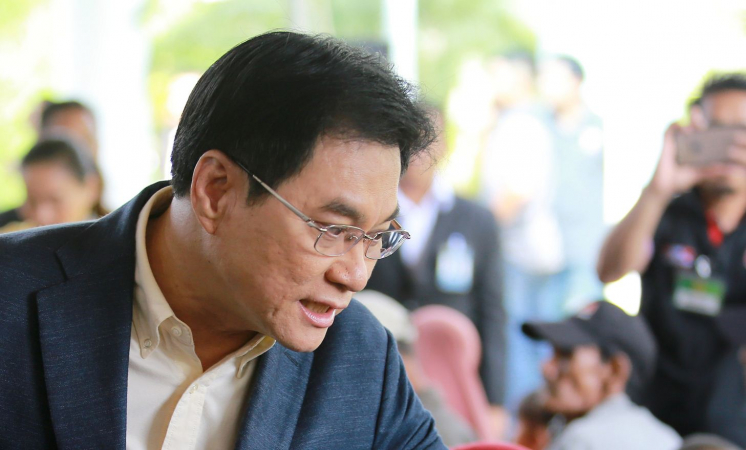
A US delegation with 108 representatives from 46 American companies on Thursday (August 15) met Commerce Minister Jurin Laksanavisith through the initiative of the Asean Business Council.

Jurin said US businesses now had more confidence in Thailand’s political stability but they wanted obstacles to bilateral business cooperation to be eliminated or the paperwork process shortened.

He added that the visitors pledged full support for future bilateral deals under the Regional Comprehensive Economic Partnership and the Comprehensive and Progressive Agreement for Trans-Pacific Partnership.

Siriporn Chaiyasut, a senior Chevron Asia-Pacific Co Ltd official, who also attended Thursday’s meeting, said that the delegation from 46 companies was the largest American business presence in the region in the last 35 years, much larger than similar recent meetings in Malaysia and Vietnam.

She said that the total American investment of around US$60 billion in Thailand was greater than in India and China combined. The executive said she and the Digital Minister have been invited by the Asean Business Council and the American Business Council to attend a technology expo in November.

Siriporn added that American investors were by nature fond of Thailand and Thai people, and Thursday’s meeting was an even more special opportunity as Thailand is the current chair of Asean.

Sliding SET ‘offers stock picks despite recession threat’

ศาสตร์เกษตรดินปุ๋ย : ขอบคุณแหล่งข้อมูล : หนังสือพิมพ์ The Nation

https://www.nationthailand.com/business/30374817

Sliding SET ‘offers stock picks despite recession threat’

Aug 15. 2019
By The Nation

231 Viewed

The threat of a global recession is real, but there is also opportunity for equity investment, Apichat Poobunjirdkul, senior strategist at Tisco Securities Co, said on Thursday (August 15).

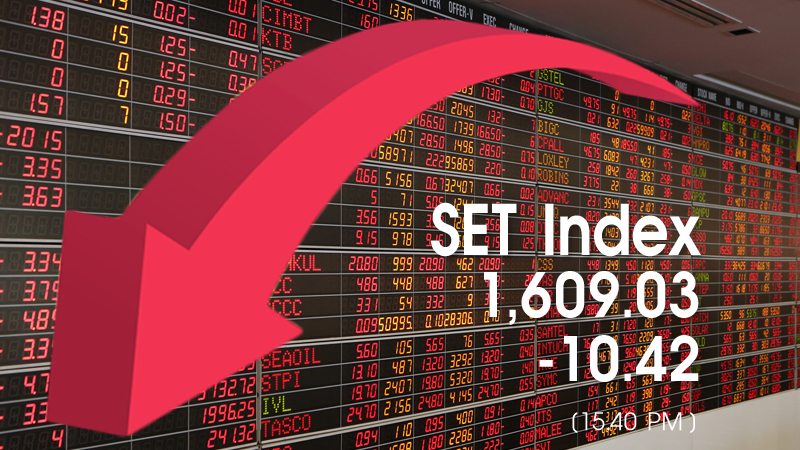
The Stock Exchange of Thailand Index followed Wall Street and major Asian markets, falling by half a percentage point in trading on Thursday afternoon after falling more than a percentage point in the morning.

Most of the large market caps hit lows, including PTT, PTTEP, PTTGC, CPALL, AVANCE , DTAC, SCB and SCC.

PTT took a hit because investors were worried about sliding oil prices, said Apichat. He advised investors to be cautious and pick stocks that largely depended on the local economy.

The bond yield inversion in the US is a warning sign of a looming recession, he said, adding, the recession could occur late next year. He said the US economy remained strong but it was affected by the trade war between the US and China.

“If President Donald Trump changes his trade policies, the US economy and the rest of the world would be better off right away,” he said, referring to the US policy if raising tariff rates on Chinese goods to reduce the trade deficit.

If Trump does not change his trade policy, a recession could happen by the end of next year, he warned

Belt and Road financiers to favour ‘greener’ and social projects

ศาสตร์เกษตรดินปุ๋ย : ขอบคุณแหล่งข้อมูล : หนังสือพิมพ์ The Nation

https://www.nationthailand.com/business/30374804

Belt and Road financiers to favour ‘greener’ and social projects

Aug 15. 2019
Developing economies around the world can expect Belt and Road projects to be “greener” in the coming years, says GFC chairman Ma Jun. [Photo Credit: Bank of Thailand's Prasiam Magazine]

Developing economies around the world can expect Belt and Road projects to be “greener” in the coming years, says GFC chairman Ma Jun. [Photo Credit: Bank of Thailand’s Prasiam Magazine]
By PHUWIT LIMVIPHUWAT
THE NATION
EXCLUSIVE INTERVIEW

342 Viewed

Financiers of China’s Belt and Road Initiative (BRI) have committed to funding environmentally and socially sustainable projects, expanding on the $100 billion worth of “green” BRI projects since 2013 when the initiative was launched.

In 2018, the Green Finance Committee (GFC) of the China Society for Finance and Banking, along with the City of London’s Green Finance Initiative (GFI), published a set of guidelines for “green” BRI projects.

“Since then, the six major Chinese banks – Industrial and Commercial Bank of China (ICBC), China Construction Bank, Agricultural Bank of China, Bank of China, Export-Import Bank of China and China Development Bank – have signed agreements to follow the proposed guidelines,” said Ma Jun, the GFC chairman, in an exclusive interview with The Nation.

These six financial institutions are responsible for 80 per cent of all financial flows going into BRI projects from China, according to Ma, who is also the director of the Centre for Finance and Development under the Tsinghua National Institute of Financial Research.

These six major banks are part of a larger group, including 30 financial institutions around the world, that have agreed to the guidelines.

Hence, going forward, the Asean region and other developing economies around the world can expect BRI projects to place more importance on environmental, social and governance (ESG) issues, Ma said.

Currently, the value of BRI projects around the world which could be considered “pure green” projects by international sustainability standards stands at around US$100 billion, Ma said.

From 2013 to 2018, $737 billion of BRI-related capital flowed into the Asean region, according to research by the CIMB Asean Research Institute (CARI) titled “China’s Belt and Road Initiative and Southeast Asia”.

Of these Asean countries, Indonesia gained the largest BRI-related capital flows at $171 billion, followed by Vietnam with $152 billion, Cambodia $104 billion, Malaysia $98 billion and Singapore $70 billion. Behind them are Laos with $47 billion, Brunei $35 billion, Myanmar $27 billion, Thailand $24 billion and the Philippines $9 billion.

Among the key BRI-related projects in the region is phase one of the Bangkok-Nakhon Ratchasima railway, which was initiated in 2017 with an expected completion in 2021. The project is worth up to Bt179 billion, the research stated.

However, BRI projects that reach international sustainability standards only made up a small fraction of total BRI investments since 2013.

Financial institutions from Malaysia and Singapore have agreed to the BRI green finance guidelines. However, Thailand has yet to join the growing pack, Ma said.

The green finance expert suggested that in order to promote more “green” projects in Asean, local governments, financiers and other stakeholders will need to work together and create an ESG-friendly ecosystem that creates incentives for the construction of more sustainable projects.

Going forward, the guidelines will be developed into specific sets of tools for each economy and financier to follow, Ma said.

Thai Airways completes evacuation of passengers from Hong Kong, resumes flights.

ศาสตร์เกษตรดินปุ๋ย : ขอบคุณแหล่งข้อมูล : หนังสือพิมพ์ The Nation

https://www.nationthailand.com/business/30374800

Thai Airways completes evacuation of passengers from Hong Kong, resumes flights.

Aug 15. 2019
By The Nation

192 Viewed

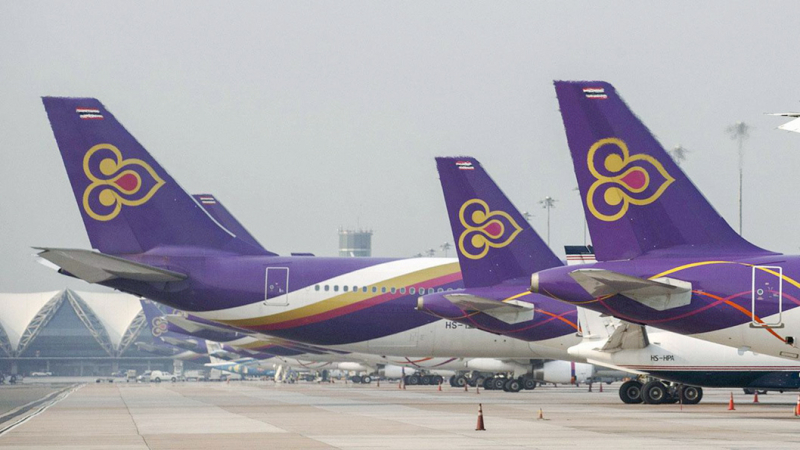
Thai Airway has now brought all passengers stranded in Hong Kong back to Thailand and normal services to Hong Kong will resume today. Sumeth Damrongchaitham, president of Thai Airways International (THAI), said that Transport Minister Saksiam Chidchob and his deputy, Thaworn Senniam, have been closely monitoring the situation and had directed the airline to ensure no passengers were left at Hong Kong international airport. With heightened security now in place and the holding of protessts in the terminal only permitted if a “Letter of No Objection” from police is granted, Thai Airways will resume normal operations.

Flights TG600, TG628, TG606, TG638, and TG602 took 1,420 passengers including 1 baby from Bangkok to Hong Kong on August 14, while 1,380 passengers including 6 babies travelled on the return legs.

Flight TG603 departed Hong Kong at 7.44am today and landed at Suvarnabhumi airport at 9.25am with 289 passengers on board.

Passengers booked to travel to and from Hong Kong but wishing to change their route can do so at no extra charge provided they purchase tickets between August 5 and 26. Such changes will be subject to the term and agreement of the company. Thai Airways will keep a close eye on the situation to ensure passenger security.

For more news and information on flights, visit thaiairways.com or call the 24-hour Contact Centre at (02) 356 1111.

GHB to cut interest rate

ศาสตร์เกษตรดินปุ๋ย : ขอบคุณแหล่งข้อมูล : หนังสือพิมพ์ The Nation

https://www.nationthailand.com/business/30374795

GHB to cut interest rate

Aug 15. 2019
Chatchai Sirilai/Photo by GHB

Chatchai Sirilai/Photo by GHB
By The Nation

209 Viewed

The Government Housing Bank (GHB) has announced a cut in its loan interest rate of 0.125 per cent effective from tomorrow (August 16, 2019), the bank’s president Chatchai Sirilai said on Wednesday.

The interest rate cut would reduce minimum loan rate (MLR) cut from 6.25 per cent to be 6.125 per cent, the minimum overdraft rate from 7 per cent to 6.875 per cent and the minimum retail rate from 6.75 per cent to 6.625 per cent.

The reduction is part of the measures the bank is taking to help its customers reduce the cost of interest rates following the Bank of Thailand’s announcement early this one of a 0.25 per cent cut in the interest rate, he added.

Markets tumble amid fear of global recession

ศาสตร์เกษตรดินปุ๋ย : ขอบคุณแหล่งข้อมูล : หนังสือพิมพ์ The Nation

https://www.nationthailand.com/business/30374791

Markets tumble amid fear of global recession

Aug 15. 2019
By The Nation

560 Viewed

Asian stock markets this morning followed Wall Street’s lead and fell sharply as investors showed their worries about economic recession and the impact of trade war between the US and China, although prominent economist Paul Krugman downplayed the fear of recession.

The Stock Exchange of Thailand Index dropped 1.6 per cent in this morning trading.

Nikkei 225 plunged almost 2 per cent, falling 1.8 per cent in Thursday’s morning trading. In China, Shenzhen Composite dropped more than 1 per cent as did the Shanghai Composite while Hong Kong’s Hang Seng shed half a per cent. Investors in South Korea showed less concern, with the Kospi rising about half a per cent.

US markets led the sharp fall on Wednesday, with the Dow Jones closing 3.05 per cent down, Nasdaq plunging 3.02 per cent and the S&P 500 falling 2.93 per cent.

Poor economic indicators from China and Germany spooked investors.

China’s industrial output grew by 4.8 per cent year-on-year in July, data from the National Bureau of Statistics showed Wednesday. The growth rate was 1.5 percentage points lower compared with June and July’s industrial output figure was the lowest in 17 years.

German GDP shrank by 0.1 per cent in the second quarter, raising fears that Europe’s biggest economy could be heading for recession. Investors interpreted poor economic conditions as a result of the trade war between the US and China.

US investors were also panicked by an inverted yield curve as yields on 10-year bond were lower than on two-year bonds, a signal of a looming recession. On Twitter, President Donald Trump blamed the Federal Reserve, calling it “clueless” and noting he has repeatedly called for larger interest rate cuts.

Howeve, prominent economist and Noble prize laureate Paul Krugman downplayed threat of recession saying on Twitter that “objectively, the economic problems are nowhere near as serious as 2008, or even 2001. But we’re being led by the gang that couldn’t think straight.” Krugman blamed Trump and his aides for poor economic policies and said that Fed is unlikely to come and rescue the markets.

Krugman was also not worried about the inverted yield curve of US bonds, saying that it means markets are begging governments to borrow. He added that the inverted yield curve was a result of the Fed earlier raising its short term rates.

There were signs of the market stabilizing as S&P 500 Futures rose half a per cent in Thursday’s morning trading.

Somkid assigns series of measures to stimulate investments and attract businesses

ศาสตร์เกษตรดินปุ๋ย : ขอบคุณแหล่งข้อมูล : หนังสือพิมพ์ The Nation

https://www.nationthailand.com/business/30374783

Somkid assigns series of measures to stimulate investments and attract businesses

Aug 15. 2019
Somkid

Somkid
By The Nation

760 Viewed

Deputy Prime Minister Somkid Jatusripitak has assigned the Industry Ministry to cooperate with the Board of Investment (BOI) to hold a roadshow to beat other nations in attracting investors to Thailand, among other new measures designed to attract investors, and particularly high technology firms.

Somkid said he has asked the ministry to work with the BOI to closely monitor companies that are considering shifting their production from China to Thailand, with a special focus on high-technology companies. The US-China trade war is reportedly having an effect on production in China, creating an opportunity to attract companies that are considering a shift to Asean countries such as Vietnam, Indonesia, Malaysia and Thailand.

“The BOI need to facilitate and apply trade measures to attract investors to Thailand, especially a Bt10 billion fund to maximise our performance in competing for investments. That fund support will be Thailand’s strong point, even though the basic wage in Thailand is much higher than in Vietnam” Somkid said.

The Industrial Estate Authority of Thailand (IEAT) must also change its focus to build a particular industrial estate to support Thai SME business, especially within the Eastern Economic Corridor (EEC), he said. The private industrial estate companies, such as WHA and Amata, have a high potential which later could evolve into a smart city construction plan. However, the land price in EEC areas is too high to attract SME businesses, and so private estate companies should bend toward the international market or large industrial companies while IEAT supports Thai SME businesses, he said.

The Industry Ministry will also cooperate with the BOI to hold roadshows in an effort to attract investors, while promotional measures need to be adapted to match every category of industrial company and to specify the area of support, such as for bioindustrial companies. The government will set targets by province for attracting companies. If there is support all around, it might attract more investors to Thailand.

Following discussions with the US Charge d’Affaires, the Consul said that Thailand has played an outstanding role in encouraging countries in the Ayeyawady – Chao Phraya – Mekong Economic Cooperation Strategy to sign a memorandum of understanding. The Consul would like to invite the Thai government to improve economic cooperation and regional investment to exercise restraint in trade with China, which has adopted the Belt and Road Initiative and with Japan which has extended The Trans-Pacific Partnership (CPTPP) and is dominating the Asean economic market. Moreover, the US supports Thailand role as a medium for CLMV (Cambodia, Laos, PDR, Myanmar, and Vietnam) countries in growing trade and investment.

Speaking at a separate event, Finance Minister Uttama Savanayana urged the listed companies in the SET 50 to increase investment to shore up the sagging economy.

He added that as they are the key engine driving the country’s economy, they should step out of their comfort zones to help the country.

Uttama said that the capital market should create new opportunities for investment to pave the way fo greater opportunities for small and medium-sized enterprises (SMEs) to raise funds.

GPF expects SET to get a boost from its return to the market

ศาสตร์เกษตรดินปุ๋ย : ขอบคุณแหล่งข้อมูล : หนังสือพิมพ์ The Nation

https://www.nationthailand.com/business/30374776

GPF expects SET to get a boost from its return to the market

Aug 15. 2019
By THE NATION

605 Viewed

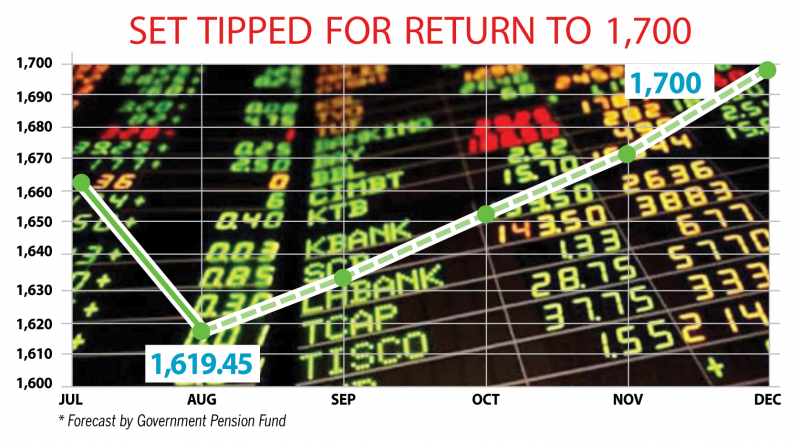
The Government Pension Fund (GPF), the largest local institutional investor, has returned to the Thai equity market and predicts the market would rebound to the 1,700 level by the end of this year.

As the Stock Exchange of Thailand Index (SET) Index has been falling currently, it is a good opportunity to buy because the market downside will be limited, GPF secretary-general Vitai Ratanakorn said.

The GPF had divested its investment in the local equity market, but we have started to buy more shares, he revealed.

The SET has been volatile largely because of external factors such as the impact of the trade war between the US and China, the violent protests in Hong Kong and the political uncertainty in Argentina. There are some negative domestic factors such as the political issue and the delay in the budget disbursement, he said.

“Looking towards the medium term, the risk factors become limited and the index could rebound to 1,700 by the end of the year,” he said. He was optimistic that once domestic conditions become conducive, investors would return to the stock market.

Despite the bond yield falling, the GPF would continue to invest in fixed-income securities and start to invest in bonds with maturity of three or four years, up from two-year maturity previously, he said.

He believed that central banks around the world, including the Bank of Thailand, might cut the interest rate again this year but it would not be much as a low interest rate would hit a limit.

Fixed-income securities dominate the GPF portfolio, accounting for 62 per cent of total investment. Thai equities represent 7.5 per cent. Foreign equities of developed and emerging markets represent the rest. The GPF has also invested in alternative assets such as property fund and infrastructure fund.

The GPF portfolio has delivered an attractive return of 4.3 per cent annually over the last five years, and it is expected to rise to 4-5 per cent by the end of the year, he assured.

The fund also gives priority to the environment, social and governance issues by setting up an environment, social and corporate governance (ESG)-focused portfolio. It will also join other institutional investors on a collaborative engagement project by investing in line with the negative list guidelines. Next year, the GPF will invest only in companies that meet ESG guidelines.

Over the last six months, the SET has dropped by 2.14 per cent, closing at 1,619.45 on Wednesday (August 14), down 0.78 points from the previous day.

Four banks cut loan interest rates in bid to lift economy

ศาสตร์เกษตรดินปุ๋ย : ขอบคุณแหล่งข้อมูล : หนังสือพิมพ์ The Nation

https://www.nationthailand.com/business/30374778

Four banks cut loan interest rates in bid to lift economy

Aug 14. 2019
 Predee

Predee
By THE NATION

708 Viewed

Four major banks on Wednesday (August 14) cut their MRR (Minimum Retail Rate) by 0.25 percentage point, effective from Thursday (August 15), to help lower the financial costs of small and medium enterprises (SMEs), increase their competitiveness and support the Thai economy.

The four banks were Kasikornbank (KBank), Krungthai Bank (KTB), Bangkok Bank (BBL) and Siam Commercial Bank (SCB).

But while KBank, KTB and BBL also cut the Minimum Overdraft Rate (MOR) by 0.25 percentage point, SCB will cut its MOR by 0.125 percentage point bringing its interest rate for MRR to 7.12 per cent and for MOR to 6.745 per cent. SCB’s Minimum Loan Rate or MLR remains unchanged at 6.025 per cent.

BBL director and senior executive vice president Suvarn Thansathit said the bank’s reduction of 0.25 per cent in its MOR and MRR was aimed at helping business operators, especially SMEs, to lower their interest rate costs which contribute to business operation costs.

“Bangkok Bank is committed to assisting business operators to improve their business efficiency and competitiveness, which will help drive the economy in line with government policies”, Suvarn said.

The move by the banks was in line with the central bank’s decision on August 7 to reduce its policy rate from 1.75 to 1.50 per cent.

As of Wednesday, the two rates at KBank stood at 7.12 per cent.

KBank president Predee Daochai confirmed that the aim was to ease the burden on SMEs and retail clients.

KTB’s move to cut its rates by 0.25 percentage point brought its overall rate down to 6.87 per cent.

Five key markets in focus to lift flagging Thai exports

ศาสตร์เกษตรดินปุ๋ย : ขอบคุณแหล่งข้อมูล : หนังสือพิมพ์ The Nation

https://www.nationthailand.com/business/30374768

Five key markets in focus to lift flagging Thai exports

Aug 14. 2019
Deputy Prime Minister and Commerce Minister Jurin Laksanawisit outlines plans to boost Thai exports by focusing on five key markets.

Deputy Prime Minister and Commerce Minister Jurin Laksanawisit outlines plans to boost Thai exports by focusing on five key markets.
By PHUWIT LIMVIPHUWAT
THE NATION

368 Viewed

The Commerce Ministry will join hands with the private sector to boost Thai exports to five major markets, expecting “tangible results” within three months.

On Wednesday (August 14), trade officials met with private sector representatives as part of the Joint Public and Private Sector Consultative Committee to discuss ways to help Thai exports cope with the negative impacts of the trade war.

Private sector representatives present at the meeting came from the Thai National Shippers’ Council, the Chamber of Commerce and Board of Trade of Thailand, the Federation of Thai Industries and the Thai Bankers’ Association.

Thai exports have been negatively affected by the ongoing US-China trade war. In the first six months of 2019, Thailand’s total exports declined by 2.91 per cent year on year, valued at US$112 billion, according to the Commerce Ministry.

Earlier on Wednesday, US President Donald Trump announced that he would defer imposition of a 10 per cent tariff hike on $160 billion worth of Chinese exports, which were originally part of the 10 per cent tariff increase on $300 billion worth of Chinese products, set to be implemented on September 1.

However, economists throughout the country have projected Thai exports to decline in 2019 largely as a result of the trade war affecting Thailand’s exports to China, which accounts for over 10 per cent of the Kingdom’s total exports.

Thailand saw its shipments to China in the first half of 2019 contract by 9.72 per cent year on year or close to $1.5 billion in value, according to the Thai Customs department.

Despite these projects, the Commerce Ministry still maintains its “working target” for exports at 3 per cent year-on-year growth, even after today’s meeting with the private sector.

“The Ministry of Commerce, along with the private sector, will form a working group to analyse how Thai exports can further penetrate key markets,” said Jurin Laksanawisit, the newly installed deputy prime minister and commerce minister, during a press conference after he held the committee meeting on Wednesday.

The minister further stated that the “high-potential-market penetration” strategy will “yield tangible results in 3 to 6 months”. However, he declined to comment on what tangible results could be expected from targeting more markets.

The five targeted markets include the CLMV (Cambodia, Laos, Myanmar and Vietnam) subregion, the rest of Asean, secondary cities in China, the Middle East, as well as India and South Asia.

These markets have shown high demand for Thai goods, giving Thai exports the potential to further penetrate these destinations and grow in value in the upcoming months, he said.

The working group, with representatives from the ministry and the private sector, will closely examine ways to increase Thai exports to these markets, as well as promote the goods that do particularly well for each destination, he explained.

For instance, Jurin continued, Thai exports of rice to Iraq have been historically strong. However, due to political reasons, Thai exports of rice to the Middle East country have reduced gradually since 2013.

Hence, the committee found that there was a good opportunity to revive Thai exports to Iraq in the upcoming months, he said.

Kitsana Vachekrilas, secretary-general of the Thai Chamber of Commerce, stated: “The private sector has been waiting for the formation of the new government for many months in the hope that a clear trade policy will emerge to boost Thai exports.”

Today’s meeting with the ministry has led to a public-private sector working group to solve trade issues in Thailand which may lead to promising results, he said.

“The private sector commends the ministry for playing an active role to boost Thai exports and looks forward to discuss further issues in the scheduled monthly Joint Public and Private Sector Consultative Committee meetings to discuss further issues,” he concluded.