Fitch lifts Thailand’s rating to BBB+ as new govt takes office

ศาสตร์เกษตรดินปุ๋ย : ขอบคุณแหล่งข้อมูล : หนังสือพิมพ์ The Nation

https://www.nationthailand.com/business/30373248

Fitch lifts Thailand’s rating to BBB+ as new govt takes office

Jul 19. 2019
By THE NATION

484 Viewed

Fitch Ratings has revised its outlook on Thailand’s Long-Term Foreign-Currency Issuer Default Rating (IDR) to positive from stable and affirmed the rating at BBB+.

The outlook revision on Thailand’s IDRs reflects increasing confidence that lingering political risks are unlikely to derail sound macroeconomic management, Fitch said.

This is demonstrated by the sustained strength of external and public finances over the past several years, which has resulted in greater resilience to macroeconomic and financial shocks.

A major political hurdle has been passed with the formation of a new civilian-led government following elections in March. Nevertheless, a degree of political uncertainty remains in the context of the stability of the new coalition government, Fitch added.

“Thailand’s robust external position is a core credit strength, exemplified by the economy’s insulation from recent bouts of global risk aversion toward emerging markets, when the country’s financial markets continued to exhibit safe-haven characteristics,” according to Fitch.

The baht has been one of the strongest performing emerging-market currencies against the US dollar in 2019, appreciating by over 4.5 per cent as equity and debt inflows have increased, particularly in June.

Fitch forecasts external finances to remain robust. It expects the current account surplus to remain high relative to peers at 5.6 per cent of GDP in 2019 and 4.9 per cent in 2020, supported by tourism inflows and a goods surplus, despite slowing exports.

Fitch estimates that the large current account surplus along with portfolio inflows will facilitate an increase in official reserves to about $216 billion (7.9 months external payments coverage) at end-2019, from $205.6 billion at end-2018. Thailand’s net external creditor position of 43 per cent of GDP in 2019, under Fitch’s forecast, would be well above the BBB median net debtor position of 7 per cent of GDP and the A median net creditor position of 9.7 per cent of GDP.

The rating agency forecasts general government debt-to-GDP to rise to 40.7 per cent by the fiscal year ending September 2023, from 36.3 per cent in FY18, as the government uses its fiscal space to boost infrastructure investment, before trending downward thereafter.

Fiscal deficits remain low relative to peers. Fitch forecasts a general government deficit (on a government finance statistics basis) of 0.2 per cent of GDP in fiscal year 2019 from a surplus of 0.1 per cent in the previous fiscal year. Fitch expects continued implementation of the economic plan under the 20-year national strategy and the focus on development of the Eastern Economic Corridor (EEC).

The broad policy contours and sustained infrastructure investment should be supportive of near- and medium-term growth prospects, according to Fitch. However, the stability of the new coalition government under Prime Minister Prayut Chan-o-cha, with its disparate 19 parties led by the Phalang Pracharath Party, is uncertain and its ability to implement its policy agenda could be constrained by its thin majority. Protracted negotiations over the formation of the new government have already led to a three-month delay in the budget process and the approval of new infrastructure projects.

The BBB+ IDR also reflects the following key rating drivers:

Fitch forecasts growth to slow, as with other trade-dependent countries in the region. It expects Thailand’s GDP growth to ease to 3.3 per cent in 2019 from 4.1 per cent in the previous year.

Merchandise export values contracted by 2.7 per cent year on year through May 2019 and Fitch forecasts full-year export growth to remain flat. It expects investment to moderate slightly in 2019 due to approval delays of new infrastructure projects and lower investment by export-oriented firms. Consumption is likely to receive some support from government transfers to low income households, but may be constrained by high household debt levels.

Fitch forecasts growth to rise to 3.5 per cent in 2020 as the drag from declining exports subsides. Investment should accelerate in 2020 as public investment ramps up and helps to crowd in private investment. A further escalation in the US-China trade war is a downside risk for the economic outlook, but could be somewhat offset by gains from trade diversion and investment flows away from China.

It expects the Bank of Thailand (BOT) to keep rates on hold at 1.75 per cent during 2019, taking into account its focus on financial stability, in the context of low inflation and slowing growth.

The divergence of the BOT’s monetary policy stance compared with other global central banks has contributed to a broad appreciation of the baht. The baht’s strength relative to regional peers could weigh on Thailand’s export competitiveness, but it is unclear that this has manifested itself yet, with recent export declines broadly in line with peers.

The BOT has voiced concerns about the strength of the currency and in July took steps to reduce short-term flows, such as a lower ceiling on non-resident local currency accounts for securities and greater non-resident reporting requirements on holdings of debt securities.

Medium-term growth prospects are dampened by structural challenges from an ageing population. The government’s economic agenda and the EEC have the potential to boost productivity by improving infrastructure and incentivising foreign investment.

Foreign direct investment has been resilient over the past several years and new FDI applications jumped sharply in the first quarter. However, it remains to be seen whether Thailand can address risks of a middle income trap associated with ageing demographics and human capital constraints.

Fitch believes financial sector risks are well contained, but there are pockets of vulnerability. Household debt as a share of GDP has begun ticking up after a couple years of moderate declines, reaching 78.7 per cent in the first quarter, due to rising mortgage and auto loan credit. Debt ratios as a share of income have risen steadily, posing risks for debt servicing if economic growth slows sharply or interest rates rise rapidly. However, banks are well-capitalised and have sound liquidity, providing a buffer against potential shocks, particularly for low income households. The BOT tightened its loan-to-value ratio measures for mortgages on April 1.

Weak structural factors relative to BBB and A rated peers constrain Thailand’s rating, Fitch said. Thailand’s World Bank Governance score stands at the 44th percentile, compared with the BBB median in the 58th percentile. GDP per capita of $8,059 in 2019 is below the BBB median of $11,595 and A median of $22,914.

Finance Ministry to push for new FinTech: finance minister

ศาสตร์เกษตรดินปุ๋ย : ขอบคุณแหล่งข้อมูล : หนังสือพิมพ์ The Nation

https://www.nationthailand.com/business/30373233

Finance Ministry to push for new FinTech: finance minister

Jul 19. 2019
By The Nation

178 Viewed

Finance Minister Uttama Savanayana says his ministry will promote the use of new cashless financial technologies or FinTech to create transparency in the government’s finances.

Posting on his Facebook wall, Uttama said Finance Ministry is ready to take up the challenge of supervising and promoting the use of FinTech to promote the new economy and to create transparency in spending by government agencies.

Uttama said the use of FinTech would benefit the country and noted that over the past two years, Thais had increasingly started using digital money to replace the use of cash.

He said the Finance Ministry of the first Prayut government has implemented a strategy to develop the infrastructure for a cashless society by launching the national electronic payment.

He added that the strategy helped speed up the pace of cashless society development, helping all agencies concerned to save both time and budget and that t e-payment could help prevent corruption because it allowed for the money to be traced back to the source.

Banks to ride on digital ID scheme with new services

ศาสตร์เกษตรดินปุ๋ย : ขอบคุณแหล่งข้อมูล : หนังสือพิมพ์ The Nation

https://www.nationthailand.com/business/30373220

Banks to ride on digital ID scheme with new services

Jul 18. 2019
By PHUWIT LIMVIPHUWAT
WICHIT CHAITRONG
THE NATION

809 Viewed

Thailand’s top commercial banks will roll out new financial service plans as they embrace the National Digital ID (NDID) scheme, which is expected to be officially launched in the fourth quarter of this year.

The NDID is a blockchain database which stores the information of its users. The database has been developed jointly between the state-run National ID company in cooperation with 10 commercial banks in the Kingdom.

The use cases in the financial sector include allowing clients to open bank accounts and make financial transactions online through digital facial identification, known in the financial sector as electronic know-your-customer (e-KYC).

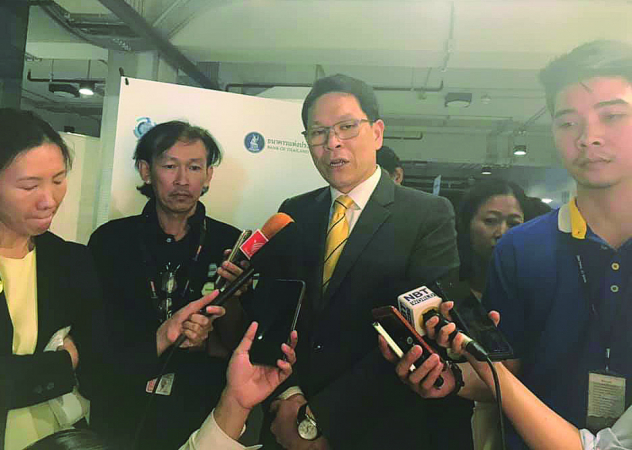
“The goal of the NDID is to increase the efficiency of financial services and making financial transactions and administrations more convenient for customers while guaranteeing the security and privacy of personal information,” Bank of Thailand (BOT) governor Veerathai Santiprabhob said when introducing the NDID scheme to the press at the Bangkok Fintech Fair 2019.

Boonsun Prasitsumrit, chief executive officer of the National Digital ID company, said: “The development of the NDID system has been completed and it is now in the final stages of the regulatory sandbox.”

He said the system should exit the sandbox and be launched to the public in the fourth quarter of this year, adding that once the implementation of the NDID on the financial sector is successful, the system can be implemented in other sectors that rely on identity verification such as insurance and retail.

Bank of Ayudhya (Krungsri), one of the 10 banks involved in the NDID testing and development stages, is confident the system will be rolled out by the end of the year and has started to do some internal testing of the new online identification system.

“Krungsri is now undergoing internal testings such as using digital facial identification systems when employees enter the headquarters building or when employees purchase food in the headquarters canteen,” said Thakorn Piyapan head of Krungsri Consumer Group.

“We believe the total bank accounts opened will increase ‪around 10 to 15‬ per cent once the NDID system is officially launched. This is because the NDID will increase the convenience of opening a bank account and allow customers to open bank accounts at night or on the weekends.”


Thanachart Bank has sought to take advantage of the digital ID infrastructure plans with an information-based lending service that it expects to launch by the end of this year. Tirachart Chiracharasporn , executive vice president of Thanachart Bank, said the bank aims to provide personal loans via its application called T-Fin. It will draw on artificial intelligence and machine learning for loan approvals. The new digital financial service will reduce the time for loan approvals and enable those who currently cannot access financial services to obtain loans. Small loans of between Bt 5,000 and Bt10,000 will be given in initial lending services, he said. The bank will apply for a sandbox trial with the central bank first before it provides the information-based lending to general public, Tirachart added.

The Stock Exchange of Thailand has also been keeping up with the NDID developments and announced that its sister company, FinNet, has developed a digital system that will connect to the NDID database and allow financial institutions to digitally verify their clients’ identities.

Silot, a Singapore-based fintech startup which is developing one-stop digital solutions for banks in Southeast Asia, announced its digital system will connect with the NDID once it is launched, according to Li Jiaming, Silot’s head of digital solutions.

The three-year-old startup has developed a QR payment solution for Krungsri and is looking expand its system’s use cases by embracing the NDID database.

New energy minister stresses sustainability

ศาสตร์เกษตรดินปุ๋ย : ขอบคุณแหล่งข้อมูล : หนังสือพิมพ์ The Nation

https://www.nationthailand.com/business/30373215

New energy minister stresses sustainability

Jul 18. 2019
 Energy Minister Sontirat Sontijirawong

Energy Minister Sontirat Sontijirawong
By THE NATION

638 Viewed

New Energy Minister Sontirat Sontijirawong has vowed to ensure the country’s sustainability in energy supply.

Speaking on the first day of taking office today (July 18) on Thursday, he said the costs of electricity and oil must be affordable to the general public, especially low income earners and small business operators.

He added that he would discuss with the ministry’s senior officials on whether the Power Development Plan ( 2018-2037) should be revised.

The ministry will also focus on the absorption of palm oil as part of the crude palm oil management policy.

He also said further study is needed on the ministry’s plan to extend government subsidy for B20 biodiesel.

Agriculture minister to tackle drought and falling prices

ศาสตร์เกษตรดินปุ๋ย : ขอบคุณแหล่งข้อมูล : หนังสือพิมพ์ The Nation

https://www.nationthailand.com/business/30373214

Agriculture minister to tackle drought and falling prices

Jul 18. 2019
From left: Mananya, Chalermchai, Praphat, and Thammanat

From left: Mananya, Chalermchai, Praphat, and Thammanat
By THE NATION

587 Viewed

The new Agriculture and Cooperatives Minister Chalermchai Sri-on has wasted no time in identifying his highest priorities.

On July 18, his first day in office, Chalermchai and his 3 deputies – Thammanat Phromphao, Mananya Thaiseth and Praphat Phothasuthon – announced they would be focusing on the drought and plummeting crop prices, especially rice and rubber.

“Drought is the most pressing issue as the whole country is suffering from lower rainfall,” he said. “We are formulating plans to tackle both drought and flood problems, mainly by providing compensation and suggesting weather-suitable crops as a substitute for the usual main crops.

“Although MOAC is not announcing any disaster zones at the moment, we are already surveying the damage caused by drought in several areas so that affected farmers can be suitably compensated without delay.”

According to the Royal Irrigation Department, this year’s rainfall is 18 per cent lower than normal, resulting in only 70 per cent of irrigated areas being viable for agriculture, mainly in the area below the Chao Phraya dam.

Praphat added that apart from the nationwide drought, rice farmers were also suffering from high production costs, now at Bt5,000 per ton.

The MOAC will devise suitable measures, he said, be it compensation or a program of price guarantees, after discussing the matter with related parties to ensure that it does not affect consumers and entrepreneurs.

Commerce minister to focus on agriculture, exports and trade deals

ศาสตร์เกษตรดินปุ๋ย : ขอบคุณแหล่งข้อมูล : หนังสือพิมพ์ The Nation

https://www.nationthailand.com/business/30373213

Commerce minister to focus on agriculture, exports and trade deals

Jul 18. 2019
By THE NATION

463 Viewed

Commerce Minister Jurin Laksanawisit revealed his top policy priorities upon arriving at the office on his first day of duties with his deputy, Weerasak Wangsuphakijkosol, on Thursday.

“The Ministry of Commerce will focus mainly on four pressing issues,” he said. “First is the revenue guarantee campaign for crucial economic crops such as rice, corn for animal feed, tapioca, rubber, and oil palm. The farmers’ revenue guarantee programme has been one of the most successful campaigns of the previous government and is therefore expected to continue following the existing procedures and regulations which have proved to be working.”

The second most important issue is exports, the new minister said. “Although many speculate that we will not be able to achieve the 3 per cent growth target, the MOC is still confident in the power of the private sector to expand the export market in the second half of the year with the help of government policies.,” Jurin said.

Third main issue is the cost of living and rises in product prices. “These will require intervention policies that are fair to both the consumers and entrepreneurs. Finally, the last issue that the MOC will focus on is to complete the pending trade negotiations with foreign partners such as those for the Regional Comprehensive Economic Partnership (RCEP) and the Thai-EU Free Trade Agreement, which were put on hold due to the national election in Thailand,” Jurin said.

New minister hopes to have medical marijuana prescribed from August

ศาสตร์เกษตรดินปุ๋ย : ขอบคุณแหล่งข้อมูล : หนังสือพิมพ์ The Nation

https://www.nationthailand.com/business/30373212

New minister hopes to have medical marijuana prescribed from August

Jul 18. 2019
By THE NATION

400 Viewed

Public Health Ministry officials welcomed the new minister on Thursday, saying they will support his policy to promote medical marijuana and work towards getting the formula prescribed at public hospitals from early August.

Public Health Minister Anutin Charnvirakul started his first day at work from 8.30am, when he showed up at the ministry with his deputy, Sathit Pitutecha. He was received by the ministry’s permanent secretary Dr Sukhum Kanchanapimai, ministry executives and officials.

A group of marijuana supporters also showed up to congratulate him and urged him to push forward the legalisation of medical marijuana.

The new minister explained that he had many items on his agenda, including implementing public health projects under Royal patronage, urgently addressing issues related to the universal healthcare scheme and the recruiting of newly graduated doctors to boost the quality of tambon-level hospitals.

Anutin said his policy can be summed up in the motto “reducing expenses, increasing incomes and promoting strength”. As for marijuana, he said it should be made accessible for everybody soon, and “if it is well implemented, it can become a cash crop for farmers”.

Dr Sukhum, meanwhile, said he was ready to respond to Anutin’s policy of allowing the prescription of medical marijuana in public hospitals by early August for patients in need. He added that the Government Pharmaceutical Organisation (GPO) should be able to produce 10,000 bottles of cannabis extract and the Chaophraya Abhaiphubejhr Hospital 5,000 bottles by then. The Phra Acharn Fan Acharo Hospital, meanwhile, will produce five formulas of marijuana-based traditional medicines made from confiscated weeds. In the first phase from July to September, there should be at least one hospital per province that provides medical marijuana, more community hospitals gain permission to prescribe the concoctions in the second phase by April 2020, he added.

Meanwhile, Deputy Minister Sathit said he aimed to propel forward three measures, namely promoting exercise as a way of maintaining health and reducing medical expenses, which he and Anutin will lead by example; developing the healthcare system in order to avoid long queues at hospitals; and using technology to link patient information with all medical service units.

Inefficient online bankers to be revealed to consumers

ศาสตร์เกษตรดินปุ๋ย : ขอบคุณแหล่งข้อมูล : หนังสือพิมพ์ The Nation

https://www.nationthailand.com/business/30373205

Inefficient online bankers to be revealed to consumers

Jul 18. 2019
By WICHIT CHAITRONG
THE NATION

413 Viewed

The Bank of Thailand (BOT) will next month start publishing details of which banks suffer the longest online downtimes so consumers can identify the most reliable ones.

“We will publicise the names of banks and their service downtimes in order to help consumers choose [the most] reliable banking,” BOT governor Veerathai Santiprabhob said on Thursday at the Bangkok FinTech Fair.

Veerathai said in response to a question on mobile banking services that consumers sometimes had poor online experiences caused by the banks’ servers being down.

The central bank had instructed banks to upgrade their online systems to handle the rising number of digital transactions, he pointed out, and while this might be a lengthy process many banks had successfully upgraded their systems and prevented old problems recurring.

As the industry regulator, the BOT had kept a close eye to make sure that banks complied with a standard of conduct required by the central bank, Veerathai added.

He also said that since the launch of electronic payment system PromptPay more than two years ago, digital financial services had one of highest commercial sector growth rates in the world.

Almost 50 million ID cards and telephone numbers were now linked to bank accounts via PromptPay and the number of merchants accepting payments via QR code scanning had reached 5 million.

The number of monthly electronic payment transactions increased from just 440 million transactions 18 months ago to almost 700 million in May 2019, he said.

Many digital payment services had also been developed to meet the needs of the new economy.

DE minister to establish anti-fake news centre

ศาสตร์เกษตรดินปุ๋ย : ขอบคุณแหล่งข้อมูล : หนังสือพิมพ์ The Nation

https://www.nationthailand.com/business/30373204

DE minister to establish anti-fake news centre

Jul 18. 2019
By JIRAPAN BOONNOON
THE NATION

553 Viewed

Digital Economy and Society Minister Buddhipongse Punakanta has set out three policy fronts to pursue the Thailand 4.0 scheme.

Buddhipongse said these fronts covered digital economy, digital society and digital security. The Digital Economy and Society Ministry will also set up a Fake News Center to combat fake news in the country.

With the digital economy, the ministry will develop an online platform to encourage companies in the private sector to use digital technology to support their businesses. It will promote initiatives such as cryptocurrencies. It will allow users to access e-government services via a single platform.

On the digital society, the ministry will encourage people to upgrade their digital skills. It will reduce the gaps in knowledge on digital technology. It will also push for government agencies to provide services via digital channels to achieve a paperless system. The ministry will develop a portal and a mobile application that will let users reach these services.

Buddhipongse said that for digital security, the ministry will help government agencies monitor reports and news that hurt national security and in this way protect people from fake news.

The minister said that he has asked executives who manage government agencies under the Digital Economy and Society Ministry to submit proposals to the ministry within 10 days.

The ministry then will set up a new budget for the 2020 fiscal year and submit the budget to the Budget Bureau by August 9.

The anti-fake news centre will monitor news reports in terms of national security. The ministry is in talks with officials from government agencies on how the centre will be run.

Industry chiefs to meet Somkid on Friday

ศาสตร์เกษตรดินปุ๋ย : ขอบคุณแหล่งข้อมูล : หนังสือพิมพ์ The Nation

https://www.nationthailand.com/business/30373203

Industry chiefs to meet Somkid on Friday

Jul 18. 2019
By The Nation

220 Viewed

The Federation of Thai Industries (FTI) will submit its recommendations for solving the country’s economic problems to Deputy Prime Minister Somkid Jatusripitak on Friday.

It will also join with the Joint Standing Committee on commerce, industry and banking to draw up a White Paper, which will be proposed to Prime Minister Prayut Chan-o-cha after the premier announces the government’s policy to parliament.

FTI chairman Supant Mongkolsuthree said on Thursday that the industries sentiment index declined to 94.5 in June from 95.9 in May, due mainly to intensifying trade wars between major economies, such as Japan-South Korea, US-India, and US-EU, which could impact on Thailand’s industrial sector.

The stronger baht has also hit exports so the Bank of Thailand should trim its interest rate to make the currency weaker, he added.