B2B buyers value offline relationships despite online tilt, survey finds

ศาสตร์เกษตรดินปุ๋ย : ขอบคุณแหล่งข้อมูล : หนังสือพิมพ์ The Nation

https://www.nationthailand.com/business/30373192

B2B buyers value offline relationships despite online tilt, survey finds

Jul 18. 2019
UPS, a prominent logistics operator, has canvassed views among B2B buyers in Asia.

UPS, a prominent logistics operator, has canvassed views among B2B buyers in Asia.
By THE NATION

165 Viewed

Business to business (B2B) buyers in Asia do much of their purchasing online and rely heavily on offline relationships while seeking out solid after-sales service, a survey by UPS has found.

The 2019 UPS Industrial Buying Dynamics Asia Pacific Study, which surveyed more than 3,400 industrial purchasers globally – including 600 from companies across China, Japan and Thailand – offers region-level insights and specific market-level traits that can help B2B businesses better connect with buyers in Asia.

“What we see in Asia is that business relationships are not one dimensional – online channels are popular, but so too are more traditional forms of buying, and this presents a real balancing act for those who want to sell in this region,” said Sylvie Van Den Kerkhof, vice president of marketing at UPS Asia Pacific region. “The data suggests that businesses wanting to work in Asian markets need to ensure that their e-commerce and bricks-and-mortar operations are both optimized and integrated, while ensuring that post-sales services, such as returns, offer a seamless experience for buyers.”

Where in other regions, shifting demographics have a much bigger role to play in purchasing behavior, to be successful here in Asia, a recommended approach is to consider buyers by job responsibility, rather than nationality or age demographic. As the study shows, Asia is a region of tremendous complexity –one where all buyers are focused on the targeted demands of service for their organizations.

The report found strong indications that online buying is set to increase, with Asian buyers saying they plan to use this channel more within the next five years. Amongst those that prefer making purchases online, Japanese buyers purchase online at a higher rate (31 per cent) than buyers in both China and

Thailand (both at 14 per cent). Meanwhile, in Thailand, companies with higher budgets report that in the next three to five years, they are more likely to move purchasing online; and in China, mobile online purchasing is seeing stronger growth than in other Asian nations.

Notwithstanding the anticipated increase in online purchases amongst Asian buyers, the report also indicates that speaking over the phone or in person happens more frequently in Asia than in the United States or Europe. Asian buyers especially value establishing a relationship in person before purchasing online – this practice is most pronounced in China, where winning trust before doing business is a key part of the deal-making process.

As a region, Asia is similar to the rest of the world in terms of how much its buyers source from domestic suppliers – 67 percent of all B2B purchases in Asia come from domestic suppliers, versus 73 per cent in the US and 64 per cent in Europe. However, there is one outlier in the region: Japan, where buyers source 90 per cent of all goods domestically. This may change in the near future, however, with the country having recently signed a series of free trade deals – most notably with the European Union. When asked what they considered to be the barriers to making international purchases, the top three factors listed by respondents in Asia were longer transit times (60 per cent), customs delays (55 per cent), and issues with returns (45 per cent).

Globally, post-sales support continues to emerge as an important component of industrial buying, consistent across different categories of buyers and industry segments. However, the research found Asian buyers, in particular, value all post-sales services more than buyers do in other regions. These include services such as general returns, pick-up services for difficult-to-ship products, and the provision of ready-made packaging and shipping materials for returns. In China and Japan, the post-sales service that matters most is on-site maintenance and repairs, and in Thailand, returns rank most highly.

“As the Thai government’s focus on developing innovation and technology has driven a shift towards a more value-based economy, we’re seeing a transition in Thailand’s manufacturing scene. The growth of high-value industries will place greater emphasis on the need for manufacturers and distributors to prioritise value-added services.” said Russell Reed, managing director of UPS Thailand. “The study highlights the importance that Thai industrial buyers place on returns. This is just one of the many areas that UPS has been able to provide strong solutions for in order our customers differentiate from competitors. These insights will enable us to provide more comprehensive and effective solutions for Thai manufacturers seeking to capture more regional or global growth opportunities.”

Second phase of Project Inthanon a success: BOT

ศาสตร์เกษตรดินปุ๋ย : ขอบคุณแหล่งข้อมูล : หนังสือพิมพ์ The Nation

https://www.nationthailand.com/business/30373172

Second phase of Project Inthanon a success: BOT

Jul 18. 2019
Photo by: BOT

Photo by: BOT
By The Nation

340 Viewed

The second phase of Project Inthanon has clearly illustrated that Distributed Ledger Technology or DLT can help enhance the efficiency of bond trading and repurchasing activities through the bonds’ life cycles, which include coupon payments, interbank outright trading and repurchase transactions, the Bank of Thailand or BOT states in its report released on Thursday.

Project Inthanon is a collaborative project between the BOT and commercial banks that aims to explore potential benefits of the technology in enhancing Thailand’s financial infrastructure as well as to develop an ecosystem that supports technological learning and advancement.

The BOT along with eight leading financial institutions and technology partner; R3, had conducted Project Inthanon Phase II from February to June. The latest phase was built upon Project Inthanon Phase I and involved collaborative designing, developing and testing a proof-of- concept (POC) of the decentralised Real-Time Gross Settlement system by using the wholesale Central Bank Digital Currency (CBDC). Project Inthanon Phase II was driven by business use cases in order to solve current business pain points and improve efficiency in the settlement system.

The scope of Phase II included 2 key areas: Delivery-versus-Payment (DvP) for interbank bond trading and repurchase transactions, and regulatory compliance and data reconciliation for third party funds transfer.

BOT reports that the outcomes and findings of Project Inthanon Phase II have shown that process automation using smart contracts has capabilities that can help improve post-trade operational efficiency as well as liquidity management.

In addition, the end-to-end third party funds transfer workflow was redesigned to prevent fraudulent transactions by allowing the senders to check beneficiary information before submitting the transactions.

The new workflow also enabled involved parties to track the status of the transactions, improving the transparency.

The outcomes and test results from Phase II will provide crucial fundamental for the development of Thailand’s financial infrastructure.

The eight financial institutions are Bangkok Bank, Krung Thai Bank, Bank of Ayudhya, Kasikornbank, Siam Commercial Bank, Thanachart Bank, Standard Chartered Bank (Thai), and the Hongkong and Shanghai Banking Corporation Ltd

For Project Inthanon Phase III, the BOT will collaborate with the Hong Kong Monetary Authority (HKMA) to explore the interoperability amongst ledgers to achieve cross-border funds transfer including business modality and implementation of relevant foreign exchange regulations, aiming to reduce associated costs and enhance efficiency.

Project Inthanon Phase III is expected to start in August and should be completed by the fourth quarter of this year, after which the BOT together with the HKMA will \publish a joint project report on the results.

Number of passengers, flights at airports in provinces drop

ศาสตร์เกษตรดินปุ๋ย : ขอบคุณแหล่งข้อมูล : หนังสือพิมพ์ The Nation

https://www.nationthailand.com/business/30373168

Number of passengers, flights at airports in provinces drop

Jul 18. 2019
(File Photo) Tourists at Chiang Mai International Airport. Photo by: The Nation

(File Photo) Tourists at Chiang Mai International Airport. Photo by: The Nation
By The Nation

685 Viewed

The number of flights and passengers at 28 airports under the Airports Department decreased by one per cent over the same period last year, the department chief said on Wednesday.

Ampawan Wannako, director general of the Airports Department, said some 14.4 million passengers were recorded at the 28 airports under the department during the first nine months of the 2019 fiscal year or from October 2018 to June 2019, adding that this represented a one-per-cent- drop compared to the first nine months of the 2018 fiscal year.

She said about 115,000 flights used the 28 airports between October 2018 to June 2019, a drop of one per cent.

The decrease was mainly caused by the cancellations of in-country flights by several domestic airlines.

Ampawan said her department was seeking to add flights to foreign cities from the 28 airports to compensate for the drop in the domestic flights.

On July 10, the low-cost airline T’way Air from South Korea launched a new route from Seoul to Krabi with seven flights per week.

In October, Blue Panorama Airlines, a low-cost airline from Italy, will launch a Warsaw-Krabi route with one flight per week, Ampawan said, adding three more European airlines are interested in introducing flights to Krabi and Surat Thani.

She expected that the number of passengers using the 28 airports would not grow much during the last three months of the 2019 fiscal year.

The anticipated number of passengers in July was 1.54 million, in Augus 1.52 million and in September at 1.37 million. The number of passengers is expected to grow by 0.69 per cent in July and by 0.47 per cent in August but fall by 0.10 per cent in September.

Her department estimates that that number of passengers using the 28 airports would stand about 18.82 per cent at the end of September, a 1.33 per cent fall compared to the 2018 fiscal year.

First task for Energy minister: Defuse electricity generation battle

ศาสตร์เกษตรดินปุ๋ย : ขอบคุณแหล่งข้อมูล : หนังสือพิมพ์ The Nation

https://www.nationthailand.com/business/30373024

First task for Energy minister: Defuse electricity generation battle

Jul 18. 2019
Sontirat

Sontirat
By THE NATION

1,207 Viewed

The Energy Ministry will on Thursday (July 18) submit a list of works for new minister Sontirat Sontijirawong to consider on taking office.

The ministry will first ask him to acknowledge a letter it will send to the Ombudsman’s Office clarifying the state’s contribution to the country’s electricity generation.

Kulit Sombatsiri, the ministry’s permanent secretary, said last Friday the letter was in response to the Ombudsman’s suggestion that the ministry revise its Power Development Plan (PDP) for 2018-2037 by boosting the state’s contribution to at least 51 per cent.

The letter explains that the state-owned Electricity Generating Authority of Thailand (Egat) owns the power lines across the country, indicating that the state has invested at least 50 per cent in the country’s electricity generation system.

If the Ombudsman finds the explanation inadequate, the ministry might consider asking the Cabinet to submit the case to the Constitution Court.

The Ombudsman told the ministry recently that the 2018 PDP allowed private companies to share the role of producing electricity, after which the state’s contribution was cut to less than 50 per cent. This contravened the second paragraph of the 2017 Constitution’s Article 56, said the Ombudsman, which has asked the ministry to take action to comply with the charter within 120 days.

Another issue Sontirat will have to consider is whether to maintain the B20 biodiesel price subsidy beyond the expiry date of July 31.

Sintirat’s policy on biodiesel and gasohol is eagerly awaited by the industrial sector, given that the 2019 Oil Fund Act set to come into effect on September 24 bans the use of the fund to subsidise renewable energy.

Sectors face downside of higher daily wage

ศาสตร์เกษตรดินปุ๋ย : ขอบคุณแหล่งข้อมูล : หนังสือพิมพ์ The Nation

https://www.nationthailand.com/business/30373142

Sectors face downside of higher daily wage

Jul 18. 2019
Gross profit of construction contractors may decrease by 2 per cent from an average of 8-10 per cent.

Gross profit of construction contractors may decrease by 2 per cent from an average of 8-10 per cent.
By The Nation

1,604 Viewed

Securities brokers expect the new government to raise the minimum daily wage to Bt400 from Bt325, shortly after formation of the new Cabinet.

Although the higher wage will boost domestic consumption, it would also lead to a spike in the production costs of some industries.

Natthachart Mekmasin, assistant MD at Trinity Securities Co Ltd, said industries relying heavily on manual labour will be most adversely affected, such as food, agriculture, automotive and electronic components. Producers in these sectors will likely see a decrease in profits. However, it will only have a marginal impact on the overall stock market as bigger industries such as energy, commercial bank and retail will not be significantly affected by the new wage rate.

Therdsak Thaweetheeratham, assistant MD at Asia Plus Securities Co Ltd, added that with the minimum daily wage going up by 23 per cent to Bt400, the gross profit of construction contractors may decrease by 2 per cent from an average of 8-10 per cent.

Companies whose profits are lower than the average, such as Italian Thai Development Plc (ITD) and Nawarat Patanakarn Plc (NWR), will inevitably face the biggest impact.

He also predicted that food and agriculture could see a whopping 25 per cent plunge in estimated profits this year , followed by electronics components (11.7 per cent) while automotive may suffer a Bt20-30 million decline.

Insurance firms brace for fluctuating stock and bond indices

ศาสตร์เกษตรดินปุ๋ย : ขอบคุณแหล่งข้อมูล : หนังสือพิมพ์ The Nation

https://www.nationthailand.com/business/30373144

Insurance firms brace for fluctuating stock and bond indices

Jul 18. 2019
By The Nation

1,169 Viewed

Insurance companies believe that the Thai stock and bond indices will continue fluctuating after the second quarter due to external pressure.

Thai Life Insurance Corporation has decided to keep cash on hand for future investment opportunities, while Tokyo Marine Life Insurance (Thailand) Corporation has decided to invest in government bonds and private stock that offers returns of 4 per cent.

Weena Chaiyawan, a member of Thai Life Insurance Corporation’s board of directors and vice president of the managing board, said the stock and bond indices were still fluctuating violently due to the US-China trade war. Hence, she said, the company’s investment strategy for this year will not focus on new assets. Instead, its plan is to hold cash on hand received from selling stocks until the time is right for investments again.

Once the interest rates drop, the stock market will improve and the total returns this year might be better than expected.

As of May, there has been a drop in bond index investment from 88.3 per cent to 87.4 per cent, while common stock and unit trust funds have risen from 11.7 per cent to 12.6 per cent compared to the same period last year. Common stock investment from foreign exchange has risen 1 per cent due to fluctuating stock prices in foreign markets in the first four months of this year.

Yuwadee Chalermsripinyorach, vice president Tokyo Marine Life Insurance’s financial board, said the investment market has shifted unpredictably, especially due to the ongoing trade war. The corporation aims to maintain total return index at 4 per cent until the end of the year

Investment plans are focusing on the over 30-year government bonds and private sector stocks that promise a return of 4 per cent, with spending focused mostly on 90 per cent of government and corporate bonds and 5 per cent on common stock.

The Office of Insurance Commission has reported investment of Bt3.3 trillion, showing a growth of 6.3 per cent, in the first quarter. Of this, 80 per cent of the investments focused on bonds and savings, while stock investment stood at 10 per cent. The other investments are funds, assets, lottery and bank loans

Joint push for ESG practice among listed companies

ศาสตร์เกษตรดินปุ๋ย : ขอบคุณแหล่งข้อมูล : หนังสือพิมพ์ The Nation

https://www.nationthailand.com/business/30373145

Joint push for ESG practice among listed companies

Jul 18. 2019
Paiboon

Paiboon
By The Nation

593 Viewed

The Federation of Thai capital market organisation, together with its members and other public and private institutes, have jointly declared that they will not be investing in companies that disregard ESG principle, in a move to foster good governance in the capital market.

Paiboon Nalinthrangkurn, board director of the organisation, revealed  that many companies in the Thai capital market will campaign for environmental, social and governance practice (ESG) among  listed firms for a better society and environment.

Institutes joining the campaign include the seven members of the organisation:  The Stock Exchange of Thailand, ATI-ASCO Training Institute, Thai Listed Companies Association, Association of Investment Management Companies , Investment Analysis Association, and The Alternative Investment Management Association. Others are the Government Pension Fund institute, Securities and Exchange commission, Association Of Provident fund, and Thai Institute of Directors.

The asset management organisation has a market capitalisation of Bt5 trillion, while other funds have a combined Bt8-9 trillions.

The campaign is to honour the coronation of His majesty the King.

They believe that a listed company should follow ESG practice by performimng good deeds for the society and the environment. For example, a company which uses a high volume of packaging materials should reduce non-environmental friendly content in its production process, whereas a financial company, such as Tisco, should share financial knowledge with the  public.

There are 700 listed companies engaged in environmental, social and governance practice (ESG).

Big organisations, such as the  PTT Public Company Limited (PTT) which is listed in the high finance enterprise group,  should invest more in  enterprises involved in  social issues, while listed institutes should  give advice on  ESG practice to small and medium-sized companies, they added.

SET closes 9.13 points lower on Wednesday

ศาสตร์เกษตรดินปุ๋ย : ขอบคุณแหล่งข้อมูล : หนังสือพิมพ์ The Nation

https://www.nationthailand.com/business/30373141

SET closes 9.13 points lower on Wednesday

Jul 17. 2019
By The Nation

312 Viewed

The Stock Exchange of Thailand (SET) closed at 1,718.85 with a trade value of Bt62.63 billion on Wednesday, recording a 9.13 point drop from Tuesday.

Net foreign, individual and proprietary purchases stood at Bt682.03 million, Bt2.13 billion and Bt532.95 million respectively.

Other markets in Asia were mixed, with the Singapore index closing 3,364.87, up 4.84 points, while Hong Kong’s Hang Seng dropping 26.45 points closing at 28,593.17. The Malaysia index also dropped 11.41 points, closing at 1,657.53.

Expect to pay less income tax, says new finance minister

ศาสตร์เกษตรดินปุ๋ย : ขอบคุณแหล่งข้อมูล : หนังสือพิมพ์ The Nation

https://www.nationthailand.com/business/30373140

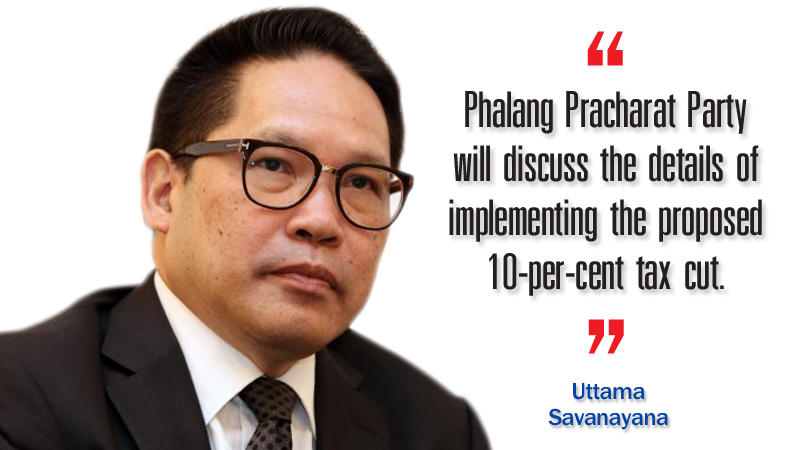
Expect to pay less income tax, says new finance minister

Jul 17. 2019
By The Nation

930 Viewed

The new finance minister is likely to bring down the rate of personal income tax, and has said that his party will discuss the implementation of tax cuts with coalition parties.

“Phalang Pracharat Party will discuss the details of implementing the proposed 10-per-cent tax cut,” Finance Minister Uttama Savanayana confirmed on Wednesday, his first day in office after the government was sworn in on Tuesday.

Uttama, who is also leader of the Phalang Pracharat Party, said the new economic package aims to support both the grassroots group as well as people living in urban areas. Details of the economic policy will be available after the new government presents its policies in Parliament on July 25-26.

While campaigning for votes, Phalang Pracharat Party promised a 10-per-cent cut in personal income tax for all seven income brackets, which is estimated to cost the country Bt50 billion to Bt60 billion annual. In comparison, coalition member Democrat Party had promised a 20-per-cent tax cut for people earning no more than Bt2 million per year.

Democrat MP and former finance minister Korn Chatikavanij had previously voiced opposition to Phalang Pracharat’s proposal, saying it would hit the tax base hard, bringing tax returns filed annually to 1 million from the current 4 million.

Meanwhile, Uttama has said that the current rates for personal and corporate income tax are not compatible because corporate tax stands at just 20 per cent.

Personal income tax is charged at a progressive rate of 5, 10, 15, 20, 25, 30 and 35 per cent. Those earning more than Bt150,000 but below Bt300,000 are subject to the lowest rate of 5 per cent, while those earning over Bt4 million a year are subject to the highest rate of 35 per cent.

Three-pronged strategy to boost industry unveiled

ศาสตร์เกษตรดินปุ๋ย : ขอบคุณแหล่งข้อมูล : หนังสือพิมพ์ The Nation

https://www.nationthailand.com/business/30373139

Three-pronged strategy to boost industry unveiled

Jul 17. 2019
Industry Minister Suriya Juangroongruangkit -
Nation Photo by Rachanon Intharagsa

Industry Minister Suriya Juangroongruangkit – Nation Photo by Rachanon Intharagsa
By THE NATION

394 Viewed

Industry Minister Suriya Juangroongruangkit has set three priorities for the strategy to boost industry inherited from the previous administration.

Easier access to bank loans for small and medium-sized enterprises (SMEs), promotion of 10 target industries, and better environmental protection would be the focus, Suriya said on Wednesday after presiding over the Thailand Industry Expo 2019 hosted by his ministry at Impact Muangthong Thani exhibition centre.

Suriya will visit the Federation of Thai Industries (FTI) early next month to gather information on challenges and problems faced by the industrial sector.

He said that his first priority was to continue pushing the promotion of 10 target industries – next-generation automotives, intelligent electronics, advanced agriculture and biotechnology, food processing, medical tourism, digital, robotics, aviation and logistics, comprehensive healthcare, and also biofuel and biochemicals.

Another priority is to seek help from the Finance Ministry and Bank of Thailand in easing access to loans for SMEs. Suriya will focus efforts on SMEs that find it difficult to obtain loans because of past debts that have already been cleared.

The third priority is to encourage factories to adopt environmentally friendly production processes, including the recycling of industrial waste.

Addressing the possibility of a rise in the minimum wage, he said that Prime Minister General Prayut Chan-o-cha had assigned a tripartite national daily wage committee to consider the issue.

Suriya said his ministry would also promote economic development zones akin to the Eastern Economic Corridor (EEC) in other regions of Thailand.

FTI chairman Supant Mongkolsuthree said that he would propose to Suriya plans supporting the use of local resources in mega projects.

He added that he would like to see the central bank launch long-term measures to curb speculation in the baht. He said the bank should trim the policy rate from the current 1.75 per cent to suppress the flow of foreign money speculating on the currency.