Asia: the global economic powerhouse

ศาสตร์เกษตรดินปุ๋ย : ขอบคุณแหล่งข้อมูล : หนังสือพิมพ์ The Nation

https://www.nationthailand.com/business/30372967

Asia: the global economic powerhouse

Jul 15. 2019
Oliver Tonby, chairman of McKinsey in Asia

Oliver Tonby, chairman of McKinsey in Asia
By THE NATION

24 Viewed

Asia is now the centre of global economic activity, according to new research by McKinsey, which makes the point that China is now competing as an economy with the US; India is poised to overtake the UK to become the world’s fifth largest economy, with a GDP about double the size of either Canada or Russia; and that sizeable growth among smaller and mid-size countries is pushing the region into a leadership position.

The rise of Asia is happening faster than expected, notes the “Future of Asia”, a new multi-channel, multi-year research effort by McKinsey & Company, in partnership with the McKinsey Global Institute, that examines, not how quickly Asia will rise, but how Asia will lead.

“If you want to understand the global economy and its future, you need to understand Asia,” said Oliver Tonby, chairman of McKinsey in Asia. “Not just its stunning economic ascendancy, but its complexity, resilience and interconnectedness through industrialisation, investment, infrastructure, trade, culture and innovation.

“The 21st-century will be characterized by a pivot toward Asia, and business and market leaders will need an accurate picture of what a future Asia will look like as they set long-term strategies,” he added.

Framing an extensive series of analysis that will follow, MGI has released a discussion paper, “Asia’s Future is Now”, which provides an overview of Asia’s role in four areas: trade flows and networks; corporations in Asia; technology; and the Asian consumer. MGI will return to each of these topics with more in-depth, stand-alone research reports over the coming 12 months.

ASIA IS TRANSFORMING TRADE

Asia’s output is accelerating. McKinsey’s research highlights that the region is on track to top 50 per cent of global GDP by 2040 and drive 40 per cent of the world’s consumption. Furthermore, as consumption rises, more of what gets made in Asia is being sold locally instead of being exported to the West.

Jonathan Woetzel, a senior partner at McKinsey and Director of MGI, said intra-regional trade is increasingly important to Asia with supply chains becoming shorter and more localized. Today, 52 per cent of Asian trade is intra-regional. “While the previous era of globalisation was marked by Western companies building supply chains that stretched halfway around the world as they sought out the lowest possible labor costs, today only 18 per cent of goods trade involves exports from low-wage countries to high-wage countries,” Woetzel said.

Asia is no longer the cheap factory of the world. As wages have risen in China, countries like Vietnam, India and Bangladesh have managed to grow their exports of labour-intensive manufactured goods by annual rates of 15 percent, 8 percent and 7 percent, respectively.

The Asian services trade is booming too. While the trade intensity of goods has declined, service flows have become the real connective tissue of the global economy – and Asia’s services trade is growing 1.7 times faster than the rest of the world’s.

ASIAN CORPORATES ARE ON THE RISE

More than 40 per cent of the world’s 5,000 largest companies are Asian. The 2018 Fortune Global 500 ranking confirmed that 210 of the world’s 500 biggest companies by revenue were Asian. Their presence is game-changing – not just in sheer numbers, but also in performance.

The region’s share of top-performing firms has grown from 19 per cent to 30 per cent the past two decades. Most of these companies are from China, India, Japan, and Korea, and the most dominant sectors within this group are computers and electronics, automotive, and banking.

Wonsik Choi, managing partner of McKinsey in South Korea and a founder of the “Future of Asia” project, said: “Our research has found that ‘superstar’ firms in the top decile of performance are generating higher economic profits than ever before, while losses are growing among the worst-performing firms, some of which are ‘zombie’ firms that actually destroy value.”

In the decade since 2005-07, the economic profit produced by top-quintile Asian firms has increased by 57 per cent (versus 33 per cent in North America). Meanwhile, the economic profit destroyed by bottom-quintile Asian firms increased sevenfold (versus 2.5 times in North America). This effect tends to squeeze the firms in the middle of the distribution. This phenomenon is global, but it is particularly pronounced in Asia.

The superstar effect in the corporate world is mirrored by widening disparities between cities, regions, and population segments. Asia may be replicating some of the patterns that have taken hold in the West.

ASIA IS SHAPING THE FUTURE OF DIGITAL INNOVATION GLOBALLY

Asia is online and booming. Today it already accounts for half (2.2 billion) of the world’s internet users; China and India alone account for one-third. The region’s enormous pools of digital consumers support a flourishing and innovative technology sector.

China has become a force to be reckoned with in digital, at home and around the world. As a major worldwide investor in digital technologies and one of the world’s leading adopters of new technologies, it is already shaping the global digital landscape and supporting and inspiring entrepreneurship far beyond its own borders.

Asia also has ample venture capital to support technology innovation and entrepreneurship. China provided 20 per cent of the world’s venture capital between 2014-2016, with India not far behind. China now ranks second only to the United States in terms of start-up investment.

Innovation hubs are starting to take root too. As of April 2019, Asia was home to more than one-third of the world’s ‘unicorns’ (start-ups valued at more than $1 billion). Ninety-one of these companies are in China, followed by India with 13, South Korea with six, and Indonesia with four.

ASIA’S CONSUMERS ARE A FORCE IN THE GLOBAL ECONOMY

By 2020, Asia’s middle class will be around three billion strong and may be home to half of the world’s middle class. Southeast Asia alone, which had 80 million households in the consuming class only a few years ago, is now expected to double to 163 million households by 2030.

These newly prosperous consumers will have income levels that allow them to make significant discretionary purchases. McKinsey projects that, over the next decade, the region may fuel half of consumption growth worldwide.

The ‘Asian consumer’ resists easy characterisation. Asia’s Generation Z has very different buying behaviours and values from the region’s seniors and will drive 15 per percent of global consumption growth, adding some $660 billion to what they already spend today. This young post-90’s generation of consumers are starting to shift their preference for foreign brands and bias against domestic brands; in fact, they are starting to choose them over foreign brands more often.

Brands will need highly targeted strategies to succeed across such a diverse and fragmented region. As companies strive to meet ever-high expectations, Asian consumers will increasingly set trends for the rest of the world.
Phuket tourism slows even as hotels, condos booming

ศาสตร์เกษตรดินปุ๋ย : ขอบคุณแหล่งข้อมูล : หนังสือพิมพ์ The Nation

https://www.nationthailand.com/business/30372948

Phuket tourism slows even as hotels, condos booming

Jul 14. 2019
By THE NATION

903 Viewed

Phuket looks set to weather a perfect storm as soaring hotel supply is forecast to be challenged by declining tourism demand.

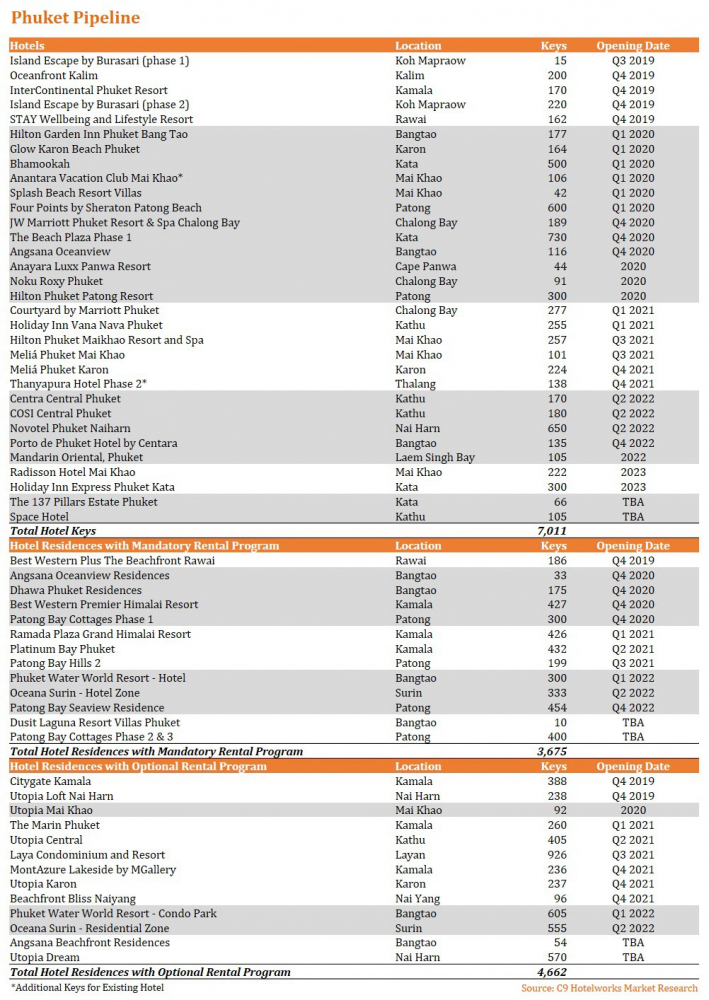
New research from consulting group C9 Hotelworks in its “Phuket Hotel Market Update Mid-Year Edition” has revealed a development pipeline of 15,348 rooms set to enter the market over the next five years, which represents an 18-per-cent push in total supply.

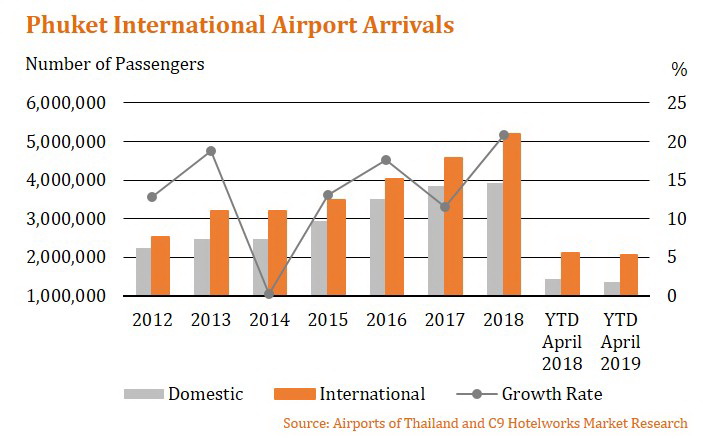
During the first four months of 2019 – high season – year-on-year international passenger arrivals at Phuket Airport slipped by 3 per cent, while the domestic segment was down 6 per cent.

The first half of 2018 had been a record-setting tourism period, with the succeeding six months experiencing a sharp decline due to the retraction of the Mainland China market.

Mainland China remains at the forefront of any discussion about Phuket and the segment remains volatile, with a 19-per-cent decrease registered this year from January through May.

Russian arrivals have yet to fully recover.

On the upside, fast-growing India tripled its tourism-arrival trajectory during the same period versus 2018.

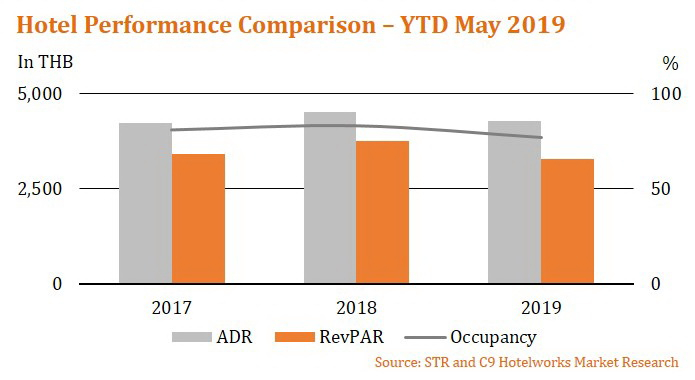
Hotel performance has mirrored the current trend. Data reflect a 12-per-cent retraction of RevPAR, driven largely by lower market-wide occupancy.

While May and September are the two lowest months for Phuket hotels, July and August are projected to experience boosts in occupancy. But the reality remains that non-high season attracts significantly lower room rates and this factor will undoubtedly suppress overall rate growth during the year.

The C9 Hotelworks report also highlights the growing influence of hotel-branded residences on the Phuket accommodation market.

More than 50 per cent of the incoming pipeline – 8,337 units – is being developed. The majority of this is condominiums, with many being affiliated with international hotel groups via management or franchise agreements.

Despite the drop in Chinese tourists, a number of Mainland real estate conglomerates have entered the island property sector.

Summarising Phuket’s forecasted tourism market conditions, C9 Hotelworks’ view is that, with the development of the new Greater Phuket airport by AoT in Southern Phang Nga, the long-term forecast remains positive.

It’s probable that the current hotel sector will experience a cycle similar to what Bali saw between 2014 and 2018 and that new supply will eventually be absorbed on a medium-term basis. But in the shorter term, demand remains a key risk factor impacting operators and owners.

Finance minister mulls bridging gap between personal and corporate tax

ศาสตร์เกษตรดินปุ๋ย : ขอบคุณแหล่งข้อมูล : หนังสือพิมพ์ The Nation

https://www.nationthailand.com/business/30372932

Finance minister mulls bridging gap between personal and corporate tax

Jul 14. 2019
By THE NATION

580 Viewed

The incoming Finance Minister Uttama Savanayana is considering the restructuring of personal income tax and bringing it in line with corporate income tax in order to bridge the gap between the two taxes.

He said this at the sidelines of the “MAI Forum 2019” co-hosted by the Market for Alternative Investment (MAI) and MAI Listed Company Association in Bangkok on Saturday.

Currently, the maximum level of personal income tax is 35 per cent, while corporate income tax is 20 per cent. The minister said he will consider the option carefully, including a possible impact this plan may have on state revenue.

He added that if the government launches any stimulus packages during this time, they will have to be customised to serve specific targeted groups.

He has also called on MAI to seek ways to have small businesses listed in the MAI index.

Vietnam plans to become leading digital economy in Asean by 2030

ศาสตร์เกษตรดินปุ๋ย : ขอบคุณแหล่งข้อมูล : หนังสือพิมพ์ The Nation

https://www.nationthailand.com/business/30372920

Vietnam plans to become leading digital economy in Asean by 2030

Jul 13. 2019
( Photo cafebiz.vn)

( Photo cafebiz.vn)
By Viet Nam News
Asia News Network
Hanoi

532 Viewed

Vietnam aims to become the leading digital country and economy in the Asean region by 2030 and allow testing of new technologies in the digital economy.

This is one of the proposals in a draft project on national digital transformation by Vietnam’s Authority of Information Technology Application (AITA) under its Ministry of Information and Communications.

The ministry has assigned AITA to develop the project and submit it for approval in November. The project aims to realise orientations and policies of the government to develop the economy based on digital technologies.

Speaking at a conference this week to review MIC’s activities in the first half of the year, AITA director Nguyen Thanh Phuc said that all people would be able to participate in the digital economy.

Phuc said the main targets would include improving the competitiveness of the economy, with the average growth rate of the digital economy reaching 20 per cent a year, and labour productivity growth of 7 to 10 per cent by 2030.

The project also aims to take Vietnam into the global top 20 and Asean top three in terms of the global competitiveness index, as well as building a transparent and effective government to be in the world’s top 50 in terms of e-government.

In addition, the project plans to have everyone using mobile payment services by 2030.

“Electronic identification will be widely recognised and used by the State to promote not only transactions between people and governmental agencies but also other transactions in the digital economy,” Phuc said.

The draft expects all Vietnamese people to be equipped with skills to be safe in cyberspace.

The AITA has proposed that the digital transformation road map in Vietnam would be implemented in three phases: the country would digitalise industrial sectors and implement digital transformation of the economy, society and State agencies from 2020-22; it would focus on digital transformation to improve labour productivity, creating new growth momentum and competitiveness from 2023-25; it would move towards the development of a comprehensive digital economy and society from 2026-30.

The AITA said Vietnam had paid attention to the application and development of information and communications technology. However, digital transformation had been ignored, thus breakthroughs in terms of models, production processes and products based on data and digital technologies had been lacking.

“For a successful digital transformation, all social components need investment, especially in resolving current shortcomings,” he added.

Network security

The Ministry of Information and Communications stated that Vietnam needed to develop a safe network security ecosystem. There would be some 100 network security businesses in the next two years while 50 network security products and services by Vietnamese firms would be widely used. The number of specialists in the sector would reach some 1,000 people and bring the market to US$1 billion to $2 billion by 2020.

Nguyen Huy Dung, director of the ministry’s Authority of Information Security, said that though Vietnam had a modest position in the world’s network security map, the country still had opportunities to develop.

To realise the target, Vietnam’s network security products and services must be widely used around the world. There should be reputable Vietnamese experts working in the world’s leading corporations on network security. Security experts should return to Viet Nam to start a business, Dung said.

Each organisation and business should allocate at least 10 per cent of total spending to IT to ensure network security. They should prioritise local products and services.

Statistics from the ministry show that the network security sector has seen strong development. In the first half of the year, there were 20 firms granted business registration on trading of network security products and services.

Baht drops slightly after central bank’s ‘warning shot’

ศาสตร์เกษตรดินปุ๋ย : ขอบคุณแหล่งข้อมูล : หนังสือพิมพ์ The Nation

https://www.nationthailand.com/business/30372913

Baht drops slightly after central bank’s ‘warning shot’

Jul 13. 2019
Pipat: “I think this was just a warning shot and it implies that the central bank doesn’t really want to lower interest rates.”

Pipat: “I think this was just a warning shot and it implies that the central bank doesn’t really want to lower interest rates.”
By Wichit Chaitrong
The Nation

189 Viewed

The central bank’s move to curb the rising baht is just a warning shot and will have little impact on the currency’s value or on the bond and stock markets, analysts said.

The Bank of Thailand (BOT) took the first step on Friday by reducing the amount of baht accounts held by foreign investors and called on financial institutions to provide reports on foreign investors holding debt securities issued in Thailand.

After BOT’s move, the Stock Exchange of Thailand closed at 1,731.59, down 8.86 points or 0.51 per cent from trading on Thursday. The baht also weakened by about 20 to 30 satang, depreciating to Bt30.90 from Bt30.60 to the US dollar.

“It is not clear whether the central bank’s action affected the stock market, as the impact on the value of the baht is very small,” said Pipat Luengnaruemitchai, assistant managing director at Phatra Securities Co. “I think this was just a warning shot and it implies that the central bank doesn’t really want to lower interest rates.”

If the US Federal Reserve cuts its policy rate later this month, then the baht is likely to move up against the dollar, Pipat said, adding that BOT’s last resort will be to cut the policy rate.

The fast-rising value of the baht has worried both exporters and policymakers as it could further impact Thai exports, which have already suffered from the global economic slowdown. Some economists have called on the central bank to lower the interest rate to prevent the baht from rising further as it could erode the competitiveness of Thai exports as goods from countries with weaker currencies will be cheaper in the global market.

Some analysts have forecast that the baht could edge up to Bt29 or Bt28 to the dollar by the end of this year should the Fed lower its interest rate twice this year.

Tada Phutthitada, president of the Thai Bond Market Association, said foreign investors sold bonds worth only Bt912 million, while their combined total holding is about Bt1 trillion. This is indicative of the fact that the central bank’s measure did not have much of an effect on the bond market. Yields of the 4.4-year bonds rose only 2 basis points, while that of the 9.4-year bond rose only 3 basis point. The year-to-date capital outflow from the bond market is only Bt1.8 billion, he added.

Details of the central bank’s measures are as follows:

1)    In order to prevent speculation in the Thai baht the BOT reduced the limit on the outstanding balance of Non-Resident Baht Account (NRBA) and Non-Resident Baht Account for Securities (NRBS) from Bt300 million to Bt200 million per non-resident with effect from July 22. For NRBA and/or NRBS with outstanding balances that are higher than Bt200 million at the end of the day, financial institutions will have to notify account holders to reduce their outstanding balance within the deadline.

NRBA holders who are non-financial corporates with underlying trade and investment in Thailand, and have opened accounts directly with Thai financial institutions, may submit requests to the BOT for a waiver on this outstanding balance limit, which will be considered on a case-by-case basis.

2)    Non-residents holdings debt securities in Thailand will be required to report the names of their end beneficiaries. This measure will help enhance the central bank’s monitoring of non-residents’ investment behaviours. This measure goes into effect as of July 2019.

“The central bank only warned foreign investors on Friday that it may take more action against them later,” Tada said.

A statement from the central bank on Friday said: “The BOT will continue to closely monitor the Thai baht’s movements as well as non-resident behaviours and stand ready to use additional measures if undesirable speculative behaviours persist.”

Energy Ministry ready to clarify the state’s contribution to power generation

ศาสตร์เกษตรดินปุ๋ย : ขอบคุณแหล่งข้อมูล : หนังสือพิมพ์ The Nation

https://www.nationthailand.com/business/30372908

Energy Ministry ready to clarify the state’s contribution to power generation

Jul 13. 2019
By THE NATION498 Viewed

The Energy Ministry has drafted a letter addressed to the Ombudsman’s Office clarifying the state’s contribution to the country’s electricity generation.

Kulit Sombatsiri, the ministry’s permanent secretary, said on Friday that the letter was in response to the Ombudsman’s suggestion that the ministry revise its Power Development Plan (PDP) for 2018-2037 by boosting the state’s contribution to at least 51 per cent.

He said once the response is ready it will be submitted for review by the new Energy Minister Sontirat Sontijirawong.

The letter explains that the Electricity Generating Authority of Thailand (Egat) exclusively owns the power lines across the country, indicating that the state has invested at least 50 per cent in the country’s electricity generation system.

If the Ombudsman still finds the explanation inadequate, the ministry might consider asking the Cabinet to see if the case should be submitted to the Constitution Court, he added.

The Ombudsman recently told the ministry that the 2018 PDP allowed private companies to share the role of producing electricity, which has resulted in reducing the state’s contribution to less than 50 per cent. It also said that this contravenes the second paragraph of the 2017 Constitution’s Article 56. The Ombudsman has asked the ministry to find a way of complying with the charter within 120 days.

Opec production cuts, trade truce may help lift oil prices

ศาสตร์เกษตรดินปุ๋ย : ขอบคุณแหล่งข้อมูล : หนังสือพิมพ์ The Nation

https://www.nationthailand.com/business/30372892

Opec production cuts, trade truce may help lift oil prices

Jul 12. 2019
By SAMBIT MOHANTY
SPECIAL TO THE NATION

262 Viewed

Oil markets are primed for a rally in the second half of this year after an easing of international trade tensions and Opec’s extended production cuts brightened the outlook for balances.

Throw in supply concerns from the thorny geopolitical picture in the Persian Gulf and prices could be about to bounce.

S&P Global Platts Analytics expects Brent crude to push higher this year, with prices expected to trade in the US$70 per barrel to $80/b range before the end of the year on greater likelihood of tighter balances, up from current levels just below $65/b.

Rising seasonal demand, anticipated crude stock draws as refineries return from maintenance, as well as the looming deadline for ship operators to comply with tighter regulations on marine fuel specifications under IMO 2020 rules will all support the market.

“Global recession fears appeared to have been allayed by the renewed dovishness by major Central Banks, spearheaded by the US Fed,” said Chris Midgley, global director at S&P Global Platts Analytics. “Beijing policymakers look determined as usual to dispel any slowdown concerns, but the latest economic indicators paint a rather worrying picture. Trade negotiations between the US and China resumed at the G20 in Osaka providing reason for optimism. Brexit impact fears subsided lately with the UK economy stabilised at a growth rate slightly above the euro zone’s.”

Opec has also played its part. The group and its allies led by Russia have agreed to extend 1.2 million barrels per day of supply cuts for nine months. Meanwhile, the prospects of renewed trade talks between China and the US following the G20 should boost the prospects for global growth.

This should help support US crude exports heading into Asia. US oil shipments to China hit an eight-month high of 189,000b/d in May. Flows into Southeast Asia and India are also expected to increase as more barrels from Iran and Venezuela disappear from the market.

Vietnam and Indonesia have snapped up US crude for the first time. India plans to increase US crude purchases to plug the gap from Iran following the imposition of sanctions.

According to Saudi energy minister Khalid al-Falih, Opec’s action in Vienna this month could help to prevent a 100-million-barrel stock build accumulating during the Northern Hemisphere winter.

“More specifically, the nine-month duration indicates that Opec-plus will remain in wait-and-see mode longer than previously assumed, and raises the odds that they will stick to their pledged volumes through March,” said Paul Sheldon, chief geopolitics adviser for S&P Global Platts Analytics. “If the countries with the most spare capacity — Saudi Arabia, Russia, and the UAE — use their quotas as a ceiling in each month through March 2020, balances could tighten more than we previously expected.”

Iran’s bickering with the US and threats to the Strait of Hormuz have also kept the market on edge. The seizure of an Iranian oil cargo near Gibraltar last week by British security forces prompted Tehran to issue threats of retaliation. Iranian statements on enrichment and storage of uranium have also added to tensions between the Islamic Republic and the international community.

These risks have added to shipment costs for vessels passing through the Strait of Hormuz, which conveys about a fifth of world supply.

However, not all forecasters are convinced a rebound in oil prices can be sustained. RBC Capital Markets expects Brent crude prices to average $69.50/b for the rest of the year.

“While we see room for crude prices to improve, underpinned by a plethora of geopolitical risk factors, we anticipate that rallies will be capped unless refined product demand improves,” wrote Michael Tan, commodity strategist at RBC Capital Markets, in a recent research note. “The market will likely oscillate within a range through the balance of the year.”

Platts Analytics expects weaker oil products demand in India and China to push down refined oil products demand growth in Asia — which accounts for some 55 per cent of global demand growth — to 700,000b/d in 2019, from 930,000b/d in 2018, marking the weakest growth since 2014.

Sambit Mohanty is senior editor, Asia Oil News & Analysis

Trump slams Facebook plan for new digital currency

ศาสตร์เกษตรดินปุ๋ย : ขอบคุณแหล่งข้อมูล : หนังสือพิมพ์ The Nation

https://www.nationthailand.com/business/30372888

Trump slams Facebook plan for new digital currency

Jul 12. 2019
By Wichit Chaitrong
The Nation

405 Viewed

US President Donald Trump has taken to his favourite social media platform, Twitter, to pour scorn on Facebook’s plan to issue its own virtual currency, Libra.

He lauded the dollar, which he described as reliable, the only real currency in the US and the most dominant currency in the world.

He also said the inherent risk with unregulated crypto assets was that they could lead to criminal activity, specifically drugs trading.

If Facebook and anyone else wanted to become a bank they must seek a new banking charter and become subject to all banking regulations just like other banks, both national and international.

He made it clear he was not a fan of Bitcoin or any other cryptocurrency.


A Thai analyst, meanwhile, says US regulators were unlikely to let Facebook launch Libra.

Such digital currencies can threaten the entire global financial system, said Boonnisead Thanyaworanan, Citibank Thailand’s investment consultant.

If Facebook and its partners wanted to press ahead with Libra they will have to demonstrate how much in assets they are prepared to put behind it. If there are no such back-up assets the digital currency could fluctuate widely and threaten the financial system, he said.

“So far there is no detail but I think it would take considerable time to launch such a currency and US regulators would not approve it easily,” said Boonnisead.

Prominent economists, including Nobel prize laureates Paul Krugman and Joseph Stiglitz, have also opposed Libra and other digital currencies.

Phuket entertainment venue operations call for delay in excise tax enforcement

ศาสตร์เกษตรดินปุ๋ย : ขอบคุณแหล่งข้อมูล : หนังสือพิมพ์ The Nation

https://www.nationthailand.com/business/30372872

Phuket entertainment venue operations call for delay in excise tax enforcement

Jul 12. 2019
By The Nation

360 Viewed

Operators of entertainment venues on the holiday island of Phuket have called on the Excise Department to indefinitely delay the levying of 11-per cent excise tax on their businesses, saying the tourism business has become sluggish.

The call was made during a meeting on Thursday evening between representatives of the Excise Area 8 Office and the entertainment venue operators at the Baumanburi Hotel in Patong.

Wasin Sitalarom, chief excise officer of Phuket, and Suree Srisuk, director of the excise office of Area 8, briefed the owners on the excise tax requirement.

The officials said the excise law, which was enacted in 1992, has a new provision that has been enforced since September 2017 that requires the Excise Department to levy excise tax on entertainment places at the rate of 11 per cent per year on their revenue.

The officials said the owners of the entertainment places must register their businesses with the department and pay the excise taxes or face a fine and additional interest of 7.5 per cent per year.

But the operators of pubs and other entertainment venues argued that they are already paying taxes at the rate of 7 per cent on their revenue. They called on the excise tax to be indefinitely delayed, saying that the tourism business in the province has become sluggish.

The meeting ended without any conclusion. The officials will inform their department of the objections before answering the operators.

Bank of Thailand introduces measures to mitigate non-resident short-term speculation

ศาสตร์เกษตรดินปุ๋ย : ขอบคุณแหล่งข้อมูล : หนังสือพิมพ์ The Nation

https://www.nationthailand.com/business/30372861

Bank of Thailand introduces measures to mitigate non-resident short-term speculation

Jul 12. 2019
By The Nation

92 Viewed

The Bank of Thailand (BOT) has decided to enhance measures to mitigate impact of short-term speculative flows and increase the reporting requirements for non-residents’ holdings of debt securities, BOT’s Assistant Governor for Financial Markets Operations Group Vachira Arromdee said on Friday.

The details of the measures are as follows.

1) Enhance “Measures to Prevent Thai Baht Speculation” by reducing the limit on the outstanding balance of Non-resident Baht Account (NRBA) and Non-resident Baht Account for Securities (NRBS) from Bt300 million per non-resident to Bt200 million per non-resident with effect from July 22. For NRBA and/or NRBS with outstanding balances at the end of the day higher than Bt200 million per non-resident, financial institutions are required to notify the corresponding non-resident account holders to comply with these changes by reducing the outstanding balances within the effective date.

NRBA holders who are non-financial corporates with underlying trade and investment in Thailand, and have opened accounts directly with Thai financial institutions, may submit requests to the BOT for waivers of this outstanding balance limit, which will be considered on a case-by-case basis.

2) Enhance the reporting requirements for non-residents’ holdings of debt securities issued in Thailand where the names of end beneficiaries shall be reported for all non-residents’ holdings of Thai debt securities. This measure will help enhance the BOT’s surveillance of non-residents’ investment behaviours and will come into effect as of the July 2019 reporting period.

The BOT will continue to closely monitor the Thai baht movements as well as non-resident behaviours, and stand ready to use additional measures if undesirable speculative behaviours persist.

Vachira added that the measures address the heightened volatility in global financial market due to various factors, such as trade tensions between the US and major trading partners, the global economic slowdown, and the shift towards a more accommodative monetary policy stance amongst major central banks. These developments have increasingly led capital flows to return to Emerging Market Economies.

With a relatively more positive outlook on the Thai baht, investors have increased their positions in Thai baht and Thai securities, in part for short-term speculative purposes.

The Bank of Thailand (BOT) has been closely monitoring the Thai baht as well as non-residents’ capital flow movements, and is concerned about the rapid appreciation of the Thai baht relative to its regional peers, as it could lead to unfavorable macroeconomic repercussions.