Credit conditions supportive for banks: report

ศาสตร์เกษตรดินปุ๋ย : ขอบคุณแหล่งข้อมูล : หนังสือพิมพ์ The Nation

https://www.nationthailand.com/business/30372850

Credit conditions supportive for banks: report

Jul 12. 2019
By The Nation

136 Viewed

Credit conditions remain supportive for banks globally going into third-quarter 2019, even if trade and geopolitical tensions are undermining confidence and economic momentum and pressure on profitability remains, S&P Global Ratings said on Friday.

The trade battle between the US and China as well as geopolitical tensions are undermining confidence and economic momentum across the globe. This has prompted the US Federal Reserve and the European Central Bank to take a more dovish stance, leading to financing conditions that remain broadly supportive for banks worldwide. That said, “low for longer” interest rates and increasing competition from non-bank players, including fintechs, are putting more pressure on bank profitability and business models.

“The low for longer monetary policy is creating a headache for banks, at a time when the profitability of many is already strained and new forms of competition are emerging,” said S&P Global Ratings credit analyst Emmanuel Volland in the report “Global Banks Midyear 2019 Outlook: Low For Longer And Digital Prompt Further Rethink”.

Credit conditions remain supportive for banks going into third-quarter 2019, even if trade and geopolitical tensions are undermining confidence and economic momentum.

The Fed’s and ECB’s responses to counter the slowdown are positive for banks’ funding conditions but continue to call into question their business models given that interest margins will remain low for longer. The pressure on profitability is higher in Europe and Japan.

The vast majority of outlooks on banks is stable globally, and the bias has become less positive in Europe.

Credit losses have likely bottomed out in many countries, while capitalisation is unlikely to improve further.

The steady push to make systemic banks resolvable continues, through a variety of approaches across the world.

Technology is disrupting retail banking across the globe. Banks’ ability to respond will depend on their digital readiness, the report said.

Emerging market equities, China in particular, seen as best buys

ศาสตร์เกษตรดินปุ๋ย : ขอบคุณแหล่งข้อมูล : หนังสือพิมพ์ The Nation

https://www.nationthailand.com/business/30372826

Emerging market equities, China in particular, seen as best buys

Jul 12. 2019
By Wichit Chaitrong
The Nation

650 Viewed

Chinese equities remain attractive despite the prolonged Sino-US trade war and the global economic slowdown, according to Citibank analysts.

The analysts gave an overweight rating to equities in emerging markets, particularly China due to the lower prices and the country’s stable economy.

Boonnisead Thanyaworanan, Citibank Thailand’s investment consultant, said the bank expects global earnings per share (EPS) to grow by 4 per cent in 2019, slightly below the consensus estimate of 5 per cent, due to different fiscal policies in each region, political uncertainties, and trade tensions between the world’s two largest economies.

The markets will be looking at the EPS prospects next year, where current consensus on global growth stands at 11 per cent.

He said Citi preferred emerging market equities, mainly due to cheaper prices than their counterparts in developed markets.

The MSCI regional trailing price-to-earnings (P/E) ratio shows that emerging market P/E was 13.5 times on average compared to 18 times in the United States while long-run median emerging markets’ P/E has climbed to 19 times.

“EM [emerging market] equities are a lot cheaper than developed market equities. EM trailing P/E is a lot lower than its long-term average while the trailing P/E in the US is somewhat higher than its long-term average,” he said.

A-shares of Chinese firms that largely depend on the domestic market are particularly attractive given their lower prices. Focus should be on consumer goods sold in the Chinese market, products that would not be adversely affected in the event of the US further raising tariffs on Chinese products, Boonnisead said, adding that companies that could sell premium products in China are competitive and have room to grow.

Equity prices in Taiwan and South Korea are above those in China but still relatively cheaper than other emerging markets, while Vietnam stocks are suitable for very long-term investment as their prices tend to be highly volatile in the short term.

The Stock Exchange of Thailand Index would rise should the US Federal Reserve cut its policy rate this month, leading to increased capital inflows, he said.

Investors should hold multi-assets in their portfolio including investment-grade bonds. The bank has been advising clients to invest in US investment grade bonds since early this year and they have enjoyed returns. Bond holders would benefit from a cut in the US rate, he said.

The Fed will likely cut its policy rate by 25 basis points this month to avert the risk of an economic slowdown. Bond holders would be the first to gain from a lower rate given the stable returns, he said. Selective US stocks are also recommended as their prices could rise further.

Meanwhile, Citibank Thailand economist Nalin Chatchotitham said the global economic growth was expected to slow down slightly to 2.9 per cent this year, from 3.2 per cent in 2018 while inflation would dip from 2.7 per cent in 2018 to 2.4 per cent.

“We expect the Thai economy to grow by 3.3 per cent, subject to downside risk. The forming of the new Cabinet on Wednesday has made Thai politics clearer and the market will respond positively to it. But any rise in the SET Index would depend on how the government implements policies. We remain worried about a delay in public spending as it would weigh down the economy,” she said.

“Decline in exports is the biggest threat for the Thai economy,” she added.

Research houses have predicted zero growth or a slight contraction for Thai shipments this year while the Commerce Ministry has revised down its export growth target to 3 per cent from the previous estimate of 8 per cent.

Thai exporters will need to rely on FTAs to survive: private sector

ศาสตร์เกษตรดินปุ๋ย : ขอบคุณแหล่งข้อมูล : หนังสือพิมพ์ The Nation

https://www.nationthailand.com/business/30372805

Thai exporters will need to rely on FTAs to survive: private sector

Jul 11. 2019
By PHUWIT LIMVIPHUWAT
THE NATION

584 Viewed

The Commerce Ministry under the new government faces tough challenges as Thai exports are expected to drop due to the ongoing US-China trade war and it is becoming a struggle to maintain the price of agricultural products due to an oversupply. In order to cope with these problems, the new government will have to encourage the private sector to rely on existing free trade agreements (FTA), seek new export markets, complete the Asean Single Window (ASW) and take a more proactive stance in supporti

In the first five months of this year, Thai exports dropped by 3 per cent compared to the same period last year, contracting in value by more than US$4 billion (Bt122.5 billion). Thailand’s economic institutions have started predicting that Thai exports will drop by around 1 per cent in 2019, compared to last year’s 6.9 per cent year-on-year growth. The Joint Standing Committee on Commerce, Industry, and Banking forecast a 1 per cent contraction recently, while Siam Commercial Bank’s Economic Intelligence Centre (EIC) estimated a 1.6 per cent decline.

In order to deal with this, private sector representatives suggested that the new government use a two-pronged approach to stimulate export growth.

“In the short and medium-term, the new government can work more closely with the private sector to ensure the FTA privileges are being utilised,” said Yunyong Thaicharoen, first executive vice president and head of the EIC.

In 2018, only 58.4 per cent of Thailand’s exports to China enjoyed FTA privileges, the Commerce Ministry said. However, from January to May this year, Thai exports to China dropped by 8.7 per cent year-on-year, reducing in value by more than $1 billion, data from the Customs Department shows.

“There are many exporters in the agriculture sector who are not aware of their FTA privileges when exporting to China. They may also not possess the knowledge on regulatory standards, intellectual property licensing and effective strategies,” said Auramon Supthaweethum, director-general of the Department of Trade Negotiations (DTN) under the Commerce Ministry.

Hence, Yunyong said, promoting the use of FTA privileges can go a long way in supporting Thai exports. However, the incoming government should continue seeking new export markets and negotiating more FTAs to support the country’s export growth prospects in the long term, he added. For instance, he said, the new government could focus on completing negotiations for the Regional Comprehensive Economic Partnership (RCEP) as soon as possible.

Prime Minister General Prayut Chan-o-cha said during the Asean Summit in June that as chair of the grouping, Thailand can be confident of completing the RCEP negotiations by the end of this year.

The mega-trade deal, which will link up the 10 Asean members and China, India, Japan, South Korea, Australia and New Zealand, has been stuck at the negotiating stage for the past seven years. Once completed, it will be the largest multilateral trade deal in history, accounting for a third of the world trade.

Thailand will benefit from lower tariffs from the 16 RCEP signatories, as it already exports 57 per cent of its goods to them. Goods exported to the 16 countries was valued at over $58 billion in the first five months of 2019.

The ASW is also on Thailand’s economic agenda this year. The regional single window aims to integrate the single-window systems of Asean countries in order to expedite cargo clearance and boost cross-border trade by enabling an electronic exchange of trade-related documents.

The new government should continue developing the ASW to improve the flow of goods within the region and boost the ease of doing business for exporters, said Kalin Sarasin, chair of the Board of Trade of Thailand.

Five Asean countries – Thailand, Vietnam, Singapore, Malaysia and Indonesia – launched the ASW in 2018, with Thailand being given the task of developing an ASW system for Cambodia, the Philippines, Brunei, Laos and Myanmar this year.

Cambodia, Philippines and Brunei have been testing the ASW option since the beginning of 2019, while Brunei recently confirmed that it can adopt the system fully, bringing the number of Asean members already using the single-window clearance system to six, DTN’s Auramon said.

The new government should also consider seeking an FTA with the European Union (EU), advised Aat Pisanwanich, director of the University of the Thai Chamber of Commerce’s Centre for International Trade Studies (CITS).

Exports to the EU account for up to 10 per cent of Thailand’s total export, though the amount has been declining at an alarming rate as Vietnam, a key competitor, has already established an FTA with the EU, he said.

Thai exports to the EU in the first five months of this year dropped by 6.9 per cent year-on-year to around $700 million and Thai-EU trade will continue declining if the Kingdom fails to swiftly negotiate a trade deal with the European bloc, Aat warned.

Vietnam’s goods that are in direct competition with Thailand, like electrical appliances, rice and fruit, will become even more competitive due to lower tariffs once the Vietnam-EU FTA is activated, Aat said. This, he added, will further reduce Thailand’s market share in the EU leading to long-term negative impacts on Thai exports.

A study conducted by the CITS suggests that once the Vietnam-EU FTA kicks in, Vietnam’s exports to the EU will rise from $50 billion per year to Bt70 billion, and reduce Thai exports by $20 billion in the second quarter of 2019 and by $40 billion in the next two years.

Meanwhile, Supant Mongkolsuthree, chair of the Thai Federation of Industries, said the new government also needs to actively support the agricultural sector.

He pointed out that the agricultural sector has been struggling on both domestic and international fronts. The price of agricultural goods has remained low locally, and those within the grassroots economy have been struggling financially due to this. Meanwhile, the export of agricultural goods has also been performing poorly due to a stronger Thai baht, which has increased the price of agricultural goods from Thailand compared to those from its competitors like Vietnam.

“We expect the new government’s agriculture-related policies to vary from controlling prices by limiting exports to offering soft loans for producers to produce less and offering price guarantees on agricultural goods,” said Mana Nimitvanich, first vice president of Krungthai Bank’s Global Business Development and Strategy Group. “While these policies are unhealthy for the economy in the long-run as they interfere with the market mechanism, they may be necessary to boost the income of those in the agricultural sector in the short-term.”

He also suggested that new government work on boosting the productivity of the agricultural sector by leveraging new technology in the long-run.

The Commerce Ministry, meanwhile, has prepared an agenda for the incoming minister to consider, such as stabilising the price of agricultural goods like rubber, cassava and rice, said Boonyarit Kalayanamit, permanent secretary of the Commerce Ministry.

Other policies the incoming commerce minister has to review include stimulating spending in the grassroots economy through the use of welfare cars and coping with the impact of the US-China trade row by negotiating more trade deals. The new minister will also have to consider joining the Comprehensive and Progressive Agreement for Trans-Pacific Partnership.

Deputy Commerce Minister Weeresak Wangsupakitkosol, however, said he still doesn’t know when his official tenure begins.

China’s Asian neighbours gain from Sino-US stand-off

ศาสตร์เกษตรดินปุ๋ย : ขอบคุณแหล่งข้อมูล : หนังสือพิมพ์ The Nation

https://www.nationthailand.com/business/30372797

China’s Asian neighbours gain from Sino-US stand-off

Jul 11. 2019
Photo by: China Daily

Photo by: China Daily
By The Nation

293 Viewed

Asian economies are benefiting from US-China Trade tensions amid an uncertain global economic outlook, according to PwC research.

The July edition of PwC’s Global Economy Watch said US imports from China fell by around 15 per cent year on year in the first quarter of 2019. This fall had, however, created opportunities for its regional trading partners, with imports to the US from a group of eight other Asian economies – Bangladesh, India, Indonesia, Malaysia, South Korea, Taiwan, Thailand and Vietnam – growing by more than 16 per cent.

Mike Jakeman, senior economist at PwC UK, says: “Economics can sometimes lag behind politics but we are now seeing hard economic data of the impact of US-China tensions.

“This has benefited other economies in the region and if this trend continues it will contribute to faster economic growth in Vietnam, South Korea and Taiwan in particular.

“Yet if your goal is to primarily tackle trade imbalances, then bilateral tariffs are an imperfect tool – import substitution can simply recreate the problem elsewhere.

“So, as a result of Vietnam becoming more competitive than China, the US’s trade deficit with Vietnam stood at $13.5bn in the first quarter, compared to $9.3bn in the same quarter a year ago.”

The July edition of Global Economy Watch also evaluates concerns about the risk of another global recession, as trade tensions impact on business sentiment and demand for exports.

Certainly, the outlook for the world’s biggest economies is less bright than it was 18 months ago.

In early 2018 the global economy witnessed the fastest and most synchronised growth since before the global financial crisis but since then, the deepening of the trade conflict between the US and China, a series of stumbles in Europe and further struggles in slow-growing emerging markets have transformed sentiment among businesses and policymakers, Jakeman added.

“However, slower growth in 2019 in each of the crucial markets of the US, China and the Eurozone is to be expected.

“The US benefited from a one-off tax cut in 2018. The Chinese government continues to cool its economy very gradually, while the Eurozone is correcting after a couple of years of above-trend growth in 2016-17. That these three economies have cooled simultaneously has been alarming but fundamentals remain strong,” Jakeman said.

Thai stocks share in Asia gains

ศาสตร์เกษตรดินปุ๋ย : ขอบคุณแหล่งข้อมูล : หนังสือพิมพ์ The Nation

https://www.nationthailand.com/business/30372791

Thai stocks share in Asia gains

Jul 11. 2019
By The Nation

288 Viewed

The Stock Exchange of Thailand (SET) Index ended the morning session on Thursday up by 6.79 points from Wednesday, at 1,746.22. The trading value was Bt34.2 billion.

The Thai benchmark index shared in the gains of stock markets across the region. Hong Kong’s Hang Seng Index closed the morning session at 28,539.74, up 335.05 points – or 1.19 per cent – from Wednesday. Tokyo’s Nikkei index began the lunch break at 21,609.08 points, up 75.6 points for a gain of 0.35 per cent from Wednesday. Singapore’s

Straits Times finished the morning session at 3,353.81 points, up 13.39 points – or 0.4 per cent – from the previous day.

The gains in Asia were attributed to the reports that US Federal Reserve, under chief Jerome Powell, is likely to cut the benchmark interest when it meets at the end of this month.

The reports have caused the US dollar to weaken, which in turn has strengthened the baht and equity markets in Asia.

The gold futures price is also rising. KGI Securities (Thailand) Plc said on Thursday it believes this will reach US$1,415.40 per ounce in August.

Govt to speed up stimulus spending as growth stagnates

ศาสตร์เกษตรดินปุ๋ย : ขอบคุณแหล่งข้อมูล : หนังสือพิมพ์ The Nation

https://www.nationthailand.com/business/30372790

Govt to speed up stimulus spending as growth stagnates

Jul 11. 2019
Somkid

Somkid
By The Nation

469 Viewed

The government will speed up its investment in infrastructure projects to boost the country’s growth rate to 3.5 per cent for the rest of this year, Somkid Jatusripitak said on Thursday after being appointed Deputy Prime Minister on Wednesday.

“I have confidence we can manage the country’s economy under the coalition government to boost its growth to 3.5 per cent, after the World Bank revised down [its forecast for] Thailand’s economic growth from 3.8 per cent to [instead] 3.5 per cent in this year,” Somkid said.

He added that the coalition government will work together to drive the country’s economic growth for the rest of this year during a period of a declining global economy. Thailand’s economy has to be driven by domestic actions such as investments in infrastructure projects and a boost to domestic consumption.

“We have already discussed this with the new Transport Minister from Bhumjaithai Party, who wanted to speed up investment to develop the country’s infrastructure in order to boost the country’s economy in the rest of this year,” he said.

Meanwhile, Somkid said, he had also held talks with the new Finance Minister over launching, perhaps soon, a stimulus package to boost domestic spending by focusing on lower-income people.

“The Finance Ministry has a sufficient budget to boost domestic consumption for the rest of this year,” he said.

Somkid said if the plan was implemented, he was confident it would boost the country’s economy for the remainder of 2019 and perhaps drive economic growth above 3.5 per cent.

UTTC urges new govt. to spend Bt100 bn. on economic boost

ศาสตร์เกษตรดินปุ๋ย : ขอบคุณแหล่งข้อมูล : หนังสือพิมพ์ The Nation

https://www.nationthailand.com/business/30372789

UTTC urges new govt. to spend Bt100 bn. on economic boost

Jul 11. 2019
By The Nation

219 Viewed

The University of the Thai Chamber of Commerce is urging the new government to boost the economy by spending Bt100 billion at the grassroots level of the population and the EEC city plan project, with the aim of raising GDP in the second half of 2019 by 3.5-4 per cent.

Thanawat Polvichai, o the Centre for Economic and Business Forecasting Director at UTTC, expects Thailand’s economy in 2019 to grow up by 3.5 per cent with 2.9-3 per cent GDP growth in the first half and 3-4 per cent in the second half, depending on the policy to be announced by the new government next month.

To secure 3.5-4 per cent GDP growth, the government will need to boost the economy in five key areas: 1) Boost budget spending by Bt50 billion or 100 billion, which will push the GDP growth by 0.2-0.3 per cent and 0.5-0.7 per cent respectively; 2) Guarantee prices for major crops to raise farmers’ income and purchasing power; 3) Provide financial subsidies to the grassroots level and local citizens by organising seminars and activities in rural areas and raising the financial amount of state welfare cards; 4) Bring the baht down to Bt31 per US dollar, as a strong baht adversely affects SMEs and the private sectors; and 5) Promote investment in the Eastern Economic Corridor (EEC) and finalise the EEC city plan to attract foreign investors.

“Apart from introducing policies that will boost the economy, the new government must implement tangible policies for both the public and private sectors, such as cannabis legalisation, boosting farmers’ income and tax and customs measures to help private entrepreneurs,” he said.

SET up almost 20 pts as Cabinet appointed

ศาสตร์เกษตรดินปุ๋ย : ขอบคุณแหล่งข้อมูล : หนังสือพิมพ์ The Nation

https://www.nationthailand.com/business/30372753

SET up almost 20 pts as Cabinet appointed

Jul 10. 2019
By THE NATION370 Viewed

Buoyed by the appointment of a new Cabinet, Thai stocks rose almost 18 points on Wednesday. The Stock Exchange of Thailand Index closed at 1,739.43, up 17.95 points, a rise of 1.04 per cent on the previous day’s figure.

The SET Index was boosted by a clearer picture of the new government, said analysts, after media reported that the launch of a new Cabinet led by Prime Minister Gen Prayut Chan-o-cha was imminent. The Royal endorsement of the Cabinet list came after the market closed, but the daily Index had already risen more than 20 points. Foreign investors maintained their bullish stance, making a net buy of Bt3.3 billion. Institutional investors and brokerage firms bought Bt861 million and Bt58.8 million respectively. But retail investors sold Bt4.2 billion. Total trade volume was Bt73.6 billion, with rise in value led by retail, communication and energy stocks.

Thai workforce must be readied for digital economy: TDRI

ศาสตร์เกษตรดินปุ๋ย : ขอบคุณแหล่งข้อมูล : หนังสือพิมพ์ The Nation

https://www.nationthailand.com/business/30372752

Thai workforce must be readied for digital economy: TDRI

Jul 10. 2019
By SOMLUCK SRIMALEE,
PHUWIT LIMVIPHUWAT
THE NATION

484 Viewed

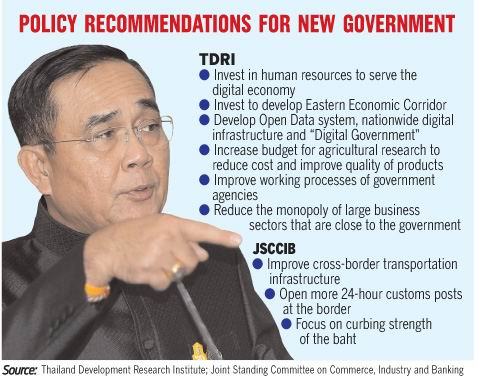
The new government will have no choice but to invest heavily in developing Thailand’s manpower, so it can survive in the fast-moving digital economy, Dr Somkiat Tangkitvanich, president of Thailand Development and Research Institute (TDRI), told the press on Wednesday.

He said the Thai workforce was facing digital disruption, and if skills are not developed in time to serve the new system, the workers will end up having to move out of the labour market. He also said that the new government needs to develop the skills of the national workforce so it is ready to serve the Eastern Economic Corridor (EEC).

From 2015 to 2018, investments in the EEC worth Bt1.014 trillion have been approved and most of them are in the sectors of petrochemical, auto, agriculture, bio technology, robotics and aviation.

Most of these industries require workers who have high expertise and the ability to learn quickly. Hence, it should be the government’s top priority to prepare manpower so it can serve the new economy and help push the country towards digital economy in line with the Thailand 4.0 strategy, he said.

Somkiat added that though the new government will continue to drive the EEC in order to boost aggressive investments from the private sector, it should also seek a way of collaborating with neighbouring communities and addressing concerns, especially those related to the environment.

Though Prime Minister General Prayut Chan-o-cha achieved some success in pushing for a digital economy over the past five years, his government also failed in several categories, such has addressing the inherent problem of corruption. He also had to rely on the special powers granted to him by Article 44.

However, as leader of the new government, Prayut will no longer have Article 44 to rely on, which means he will have to manage the country in line with law and by collaborating and communicating with the people.

“It will not be easy for the new government to run the country like it has in the past five years, but if it listens to the people and does what they want, then I believe the administration will be stable,” he said.

Meanwhile, Preedee Daochai, chairman of the Thailand Bankers’ Association, said at a press conference held by the Joint Standing Committee on Commerce, Industry and Banking (JSCCIB) on Wednesday that the new government will also have to boost the ease of doing business for Thai exporters and that the Bank of Thailand will have to bring down interest rates as soon as possible to make Thai exports more competitive.

“The Bt10-billion economic stimulus that the new government is expected to implement will not be enough to cushion the decline in Thai exports,” Preedee said.

“The government will have to be more proactive in supporting Thai exporters by implementing short-term measures to boost shipments,” added Kalin Sarasin, chairman of the Board of Trade of Thailand. The short-term measures can include things such as improving logistics infrastructure at Thailand’s borders to cut down on the transportation costs for business, he said.

Kalin also suggested that Thai authorities talk to neighbouring countries about making their customs formalities available 24 hours so the flow of goods within the region can be improved. He cited the 24-hour customs facilities already available at Songkhla’s Sadao district.

He also said Thailand should be allowed to trade in the Thai currency with other countries in order to minimise the risks associated with foreign-exchange volatility.

Another factor having a negative impact on Thai exports is the strong baht, said Supant Mongkolsuthree, chairman of the Thai Federation of Industries.

Since January, the baht has appreciated 5.7 per cent, valuing at Bt30.8 against the US dollar on July 8, which marked the highest level of currency appreciation against the greenback in the Asia-Pacific region, according to Kasikorn Research.

“The baht’s strength against the dollar compared to the currencies of its competitors such as Vietnam makes Thai exports a lot less competitive in international markets,” Supant added.

Hence, he said, it is necessary that the Bank of Thailand immediately implement measures like lowering policy interest rates by at least 0.25 per cent to slow the pace of the baht’s appreciation.

He added that the JSCCIB is looking to set up a meeting by the end of next week with the central bank to address this issue.

The committee has predicted that exports this year will contract 1 per cent from 2018. It had earlier this year projected an export growth of 3 to 5 per cent.

The committee has also brought its earlier forecast for GDP growth this year from 3 per cent to 2.9 per cent.

The US-China trade war continues being a key factor damaging exports, especially in the agriculture and manufacturing sectors, the JSCCIB said.

Thai construction and service operators secure Bt500 mn orders from the Middle East

ศาสตร์เกษตรดินปุ๋ย : ขอบคุณแหล่งข้อมูล : หนังสือพิมพ์ The Nation

https://www.nationthailand.com/business/30372750

Thai construction and service operators secure Bt500 mn orders from the Middle East

Jul 10. 2019
By THE NATION

320 Viewed

Thai business operators in the construction and service industries secured orders worth some Bt500 million as a result of the trip organised by the Commerce Ministry’s Department of International Trade Promotion to Muscat and Manama last month.

Banjongjitt Angsusingh, Director-General, revealed that 70 companies in Oman and 67 in Bahrain attended the campaign. Notable attendees included Galfar Engineering & Contracting SAOG, Oman’s largest engineering and construction company, Khimji Ramdas Group (KR), and Nass Commercial, Bahrain’s top distributor of imported products and services.

Thai business operators were able to secure immediate orders of Bt8,58 million and future orders of Bt191.73 million in Oman, while in Bahrain they secured immediate orders of Bt14.52 million and future orders of Bt296.67 million. Product groups that earned the most interest were security equipment, furniture components, building materials, and plants.

“This campaign was a huge success as Thai business operators secured more than Bt500 million in orders from both countries,” she said.