Myanmar to allow in more foreign banks

ศาสตร์เกษตรดินปุ๋ย : ขอบคุณแหล่งข้อมูล : หนังสือพิมพ์ The Nation

https://www.nationthailand.com/business/30372748

Myanmar to allow in more foreign banks

Jul 10. 2019
The Yangon branch of Bangkok Bank, the only Thai bank to be awarded a foreign banking licence in Myanmar. It is in the Yankin Township of the country’s business capital. (Photo courtesy of Thaipublica.org)

The Yangon branch of Bangkok Bank, the only Thai bank to be awarded a foreign banking licence in Myanmar. It is in the Yankin Township of the country’s business capital. (Photo courtesy of Thaipublica.org)
By KHINE KYAW
THE NATION
YANGON

363 Viewed

With Myanmar’s financial sector reforms gaining momentum, the country plans to allow more foreign banks in to provide limited services, Soe Thein, deputy governor of the Central Bank of Myanmar (CBM), said.

He told The Nation on Wednesday that the third round of issuances of licences for foreign banks would be opened by the end of this year.

On Tuesday, the CBM’s foreign banks selection committee met to approve 15 criteria for the selection of an eligible consulting firm to provide advisory services for the process of awarding licences to foreign banks that already have a representative office in Myanmar.

Soe Thein said the CBM would finalise the selection of the consultancy firm by early next month. Myanmar will select only one consultancy firm among the four finalists: Deloitte Touche Myanmar Vigour Advisory Ltd, PricewaterhouseCoopers (PWC) Myanmar Co, EY UTW Advisory Ltd and Roland Berger Co.

“In late May, we invited a total of eight consultancy services to submit proposals for providing advice on the selection of foreign banks. Half of them submitted RFP [request for proposal] on June 24,” he said.

Firms that did not apply for the CBM’s offer included big names such as KPMG Advisory (Myanmar) Ltd, Baker & Mckenzie Co, Allen & Gledhill Co and Rajah & Tann NK Legal Co.

The deputy governor said the CBM is reviewing the applications to score each of the firms depending on the selection criteria, which include consultancy fees, payment terms, professional background, experience and the academic qualifications of team members.

“The majority of the criteria largely depend on the quality and capability of the consulting firms. We will systematically assess how they’ve formed their teams and how they support us in this selection process,” he said.

“This is the very first stage of the next round of foreign banks licences that we expect to open later this year. We will choose the eligible consulting firm in the next meeting of the foreign banks selection committee, which is expected in the last week of July.”

Myanmar has yet to decide how many foreign banks will be awarded the licences in the next round, the official said.

“First, we [CBM officials] need to discuss with the selected consultancy firm. Later on, we will finalise the details,” he said.

Currently, 13 foreign banks have been awarded licences to open a branch in Myanmar. In 2014, the CBM granted a provisional licence to nine bidders from Australia, Japan, Singapore, China, Thailand and Malaysia. Two years later, four more overseas banks – from Vietnam, South Korea, Taiwan and India – were also awarded permits.

Soe Thein said Myanmar has relaxed restrictions on the licensed foreign banks to some extent. Last November, the CBM allowed the banks to provide import financing and other banking services to local businesses.

“They can provide loans to local enterprises with the same value as local banks,” he said.

“When it comes to providing credits in local currency, we apply the same conditions for both local and foreign banks. It means we ensure there is no discrimination.”

To date, Bangkok Bank is the only Thai bank that has been awarded a foreign banking licence in Myanmar. Having operated in Myanmar for more than two decades, the bank was granted the licence in 2014 and opened its Yangon branch in June 2015.

Four other Thai banks – Siam Commercial (SCB), Krung Thai, Kasikornbank and Export-Import Bank of Thailand, along with BOT Lease (Thailand) Co – are among the 53 foreign banks and finance companies that have a representative office in the country.

Three other Thai banks are likely to apply for the licence when the next round opens, while EXIM Thailand has not yet shown interest.

“In the second round, the selection committee decided to give preference to banks from the countries which were not selected in the first bidding,” said Soe Thein.

“It is still too early to finalise the conditions for the third round but there may be a chance for the banks that are well-prepared,” he added.

Pisit Serewiwattana, the president of EXIM Thailand, said in an earlier interview with The Nation that the bank prefers supporting state-owned banks that are vying for a foreign banking licence rather than establishing a branch in Myanmar.

Kamalkant Agarwal, first executive vice president at SCB, told The Nation earlier that the bank would again apply for the licence in the next round.

“Regarding the licence, we remain hopeful and will definitely keep trying … It is up to the central bank. On our side, we are very keen and whenever there is a new round, we will definitely apply for it,” he said.

Medical technology on show at Bangkok expo

ศาสตร์เกษตรดินปุ๋ย : ขอบคุณแหล่งข้อมูล : หนังสือพิมพ์ The Nation

https://www.nationthailand.com/business/30372735

Medical technology on show at Bangkok expo

Jul 10. 2019
A visitor checks out one of the display booths at Medical Devices Asean in Bangkok on Wednesday.

A visitor checks out one of the display booths at Medical Devices Asean in Bangkok on Wednesday.
By THE NATION

132 Viewed

More than 300 companies are displaying advances in medical technology and devices at Medical Devices Asean 2019 (MDA 2019), which opened in Bangkok on Wednesday.

The exhibitors – from China, Germany, Japan, South Korea, Malaysia, Pakistan, Singapore, Switzerland Taiwan and Thailand – are presenting at Hall 5-6 at the Impact Exhibition and Convention Centre. The event ends on July 12.

Running alongside the three-day trade exhibition is a range of activities, including a series of academic conferences and seminars.

Among those attending the event are Dr Opart Karnkawinpong, director general of the Department of Medical Sciences at the Ministry of Public Health; and Aditad Vasinonta, deputy director general of the Office of Industrial Economics at the Ministry of Industry. They hosted the opening ceremony, along with addresses from Winit Ritchim, chairman of the Medical and Health Device Manufacturers Industry Club; pharmacist Preecha Bhandtivej, president of the Thai Medical Device Technology; and Kanokporn Damrongkul, director of the exhibition department in the Thailand Convention & Exhibition Bureau.

Opart said MDA 2019 is a dedicated platform for medical devices and technology and is one of the channels that supports the development of the medical industry. It provides a platform for knowledge and innovation, so as to raise the local medical industry to international standards.”

Aditad said: “MDA 2019 is a crucial push to compliment the government’s new S-Curve strategy, which is to develop Thailand into Asean’s medical hub and to expand Thailand’s already strong medical industry into one that is comprehensive. A comprehensive medical industry in Thailand consists of three parts – modern service; medical devices research and production; and pharmaceutical research and production.”

Kanokporn said: “The TCEB is pleased to support MDA for the second year, which is aligned with the bureau’s policy in supporting business events involved in the S-Curve industries designated by Thailand 4.0 policy. TCEB uses conferences and trade shows as a marketing tool to drive the S-Curve industries.

“Supporting MDA affirms the position of Thailand as Asean’s medical hub, where innovation and high technology are promoted and utilised in accordance with Thailand 4.0 policy. TCEB, as a government agency, by partnering MDA, is driving to improve the country’s development.”

EEC progress highlighted among Prayut achievements

ศาสตร์เกษตรดินปุ๋ย : ขอบคุณแหล่งข้อมูล : หนังสือพิมพ์ The Nation

https://www.nationthailand.com/business/30372731

EEC progress highlighted among Prayut achievements

Jul 10. 2019
By Somluck Srimalee
The Nation

235 Viewed

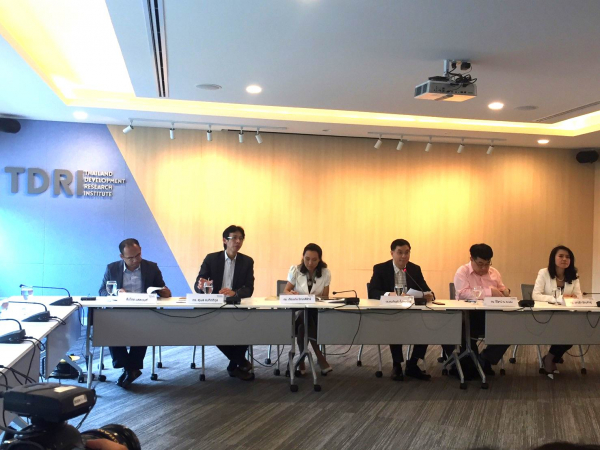
Progress on laying the groundwork for the Eastern Economic Corridor is among the key achievements of the government of Prime Minister General Prayut Chan-o-cha, the Thailand Development Research Institute (TDRI) said on Wednesday.

The leading think tank said the investment plans backing big infrastructure projects and the reforms made in the country’s fisheries make up the other two main success stories. On the latter, the country gained a yellow card, an improvement from its previous position, in relation to illegal, unreported and unregulated fishing practices.

On the downside over the past five years, the TDRI pointed to corruption allegations surrounding some members of the Cabinet and related parties when certain information was not declared to the public. It also referred to the use of Article 44 under the interim constitution to support private companies under strain from their 4G telecommunications and digital TV licences, and its failure to improve cybersecurity.

However, TDRI president Dr Somkiat Tangkitvanich said that, on balance, the government had made progress in aiding the transformation to a digital economy and in boosting foreign investment, alongside efforts to upgrade workers’ skills amid the disruptive forces of technological change.

Still, Somkiat took aim at other issues, such as the government’s focus on centralisation and its failure to consult with communities on environmental issues. In healthcare, transparency

“We do not need to give a score to the government because over the past five years there have been pros and cons. Some proposals that can help the country should be proposed to the new government, while policies that have not helped should be dropped,” he said.

Exports tipped to shrink 1% this year

ศาสตร์เกษตรดินปุ๋ย : ขอบคุณแหล่งข้อมูล : หนังสือพิมพ์ The Nation

https://www.nationthailand.com/business/30372722

Exports tipped to shrink 1% this year

Jul 10. 2019
Presenting the revised forecasts are, from left, Kalin Sarasin, chairman of the Thai Chamber of Commerce and the Board of Trade of Thailand; Preedee Daochai, chairman of the Thai Bankers' Association, and Supant Mongkolsuthree, chairman of the Federation of Thai Industries.

Presenting the revised forecasts are, from left, Kalin Sarasin, chairman of the Thai Chamber of Commerce and the Board of Trade of Thailand; Preedee Daochai, chairman of the Thai Bankers’ Association, and Supant Mongkolsuthree, chairman of the Federation of Thai Industries.
By PHUWIT LIMVIPHUWAT
THE NATION

236 Viewed

The Joint Standing Committee on Commerce, Industry and Banking (JSCCIB) on Wednesday forecast that exports this year will contract 1 per cent from the previous year.

The committee had earlier this year projected export growth of 3 to 5 per cent for 2019

It reduced its forecast for GDP growth this year to 2.9 per cent, down from the 3 per cent it estimated earlier this year.

The trade war between the US and China continues to be a key factor damaging exporters, particular for those in the agriculture and manufacturing sectors, the committee said.

The strong baht, which has appreciated by 5.7 per cent against the US dollar since January, is another key factor causing exports to drop. The JSCCIB predicts the currency will trade at around 32 to the dollar by the end of the year.

Bt20-bn economic stimulus package expected from incoming govt

ศาสตร์เกษตรดินปุ๋ย : ขอบคุณแหล่งข้อมูล : หนังสือพิมพ์ The Nation

https://www.nationthailand.com/business/30372671

Bt20-bn economic stimulus package expected from incoming govt

Jul 10. 2019
By Phuvit Limviphuwat
The Nation

684 Viewed

The incoming government should come up with a Bt20-billion package of economic stimulus measures in the second half of 2019, according to Siam Commercial Bank’s Economic Intelligence Centre (EIC).

“In the latter half of 2018, the government allocated Bt18 billion to stimulate the economy. We expect the incoming government to at least match last year’s spending amid the ongoing slowdown in economic growth and decline in exports,” Yunyong Thaicharoen, first executive vice president and head of the EIC, said on Monday.

The economist said the policies will likely include measures proposed by the Phalang Pracharat Party and the welfare card scheme to boost spending by low-income earners.

However, Yunyong said that the next government should strike a balance in its budget spending between short-term economic stimulus and long-term policies to increase the digital capabilities of companies and the workforce.

Public investment in infrastructure is expected to be one of the key drivers of economic growth in the second half. Although it has lowered year-on-year forecast of public investment growth from 4.1 per cent in January to 3.7 per cent today, the EIC still expects public investment in infrastructure to grow by 7 per cent from the same period last year.

However, the slow formation of the new government will likely delay release of the new budget. This, Yunyong said, could lead to delay in public investments in new projects towards the end of the year.

The EIC predicted that Thailand’s GDP will grow by 3.1 per cent year on year, lowering its economic growth projection of 3.3 per cent made in May. The US-China trade conflict was cited as the key cause for the decline in exports.

The unit predicted that this year’s exports will decline by 1.6 per cent year on year. A decrease of 1.6 per cent will mean a US$40-billion loss in export value compared to last year. If the EIC’s projections are correct, Thai exports in 2019 will fall to their lowest point since 2015.

Another factor affecting Thai exports is the strong baht, which has appreciated by up to 13 per cent on average against Thailand’s key trading partners in the past five years. Research by EIC has suggested that the strengthening of the baht has had a direct impact on exports as it makes Thai goods less competitive compared to its competitors.

Yunyong said the Thai currency has appreciated by 8 per cent against the Vietnamese dong this year, and by 23 per cent in the past five years. In correlation to this, when comparing Thai and Vietnamese exports of similar goods to the same destinations, Vietnam’s exports of these goods grew by 38.4 per cent in 2018 while Thai exports of these goods declined by 29 per cent.

The EIC predicts that the baht will valued at between Bt30 to Bt31 per US dollar for the rest of 2019.

To cope with this problem, Yunyong suggested that the government encourage firms to make more overseas investments to reduce the level of Thailand’s current account surplus. He added that exporters, in particular, should look to expand their production base abroad to mitigate the risks from the country’s decline in exports as a result of the US-China trade war.

The fall in exports has a wide-ranging impact on Thailand’s economy, Yunyong said. When exports decline, private investment figures will also fall as a large portion of total private investment is directed to export-oriented firms. The EIC has adjusted down its private investment growth forecast from 4.1 per cent in January to 3.7 per cent.

Furthermore, decline in domestic spending is also expected. Yunyong expects unemployment from the manufacturing and agricultural sectors to rise as a result of the downtrend in exports. The rise in unemployment in these sectors will negatively impact the level of domestic spending, he said.

The EIC expects domestic spending to grow by 3.9 per cent year on year in 2019, compared to 4.6 per cent in 2018.

Another factor that may lead to low domestic spending is the rising level of household debt, which currently accounts for 78.7 per cent of the Kingdom’s GDP, increasing by almost 1 per cent in the past six months, according to the EIC.

Yunyong added that the rising level of household debt is a key reason why the Bank of Thailand (BOT) is most likely to hold the policy rate at 1.75 per cent for the year.

The central bank, he said, is still in a hawkish stance, valuing monetary policy normalisation and the creation of policy space. Hence, unless the baht gets unexpectedly stronger and economic growth slumps at an even sharper rate, the BOT is unlikely to lower the policy rate, he said.

SRT-CP rail link contract expected to be signed this month

ศาสตร์เกษตรดินปุ๋ย : ขอบคุณแหล่งข้อมูล : หนังสือพิมพ์ The Nation

https://www.nationthailand.com/business/30372674

SRT-CP rail link contract expected to be signed this month

Jul 10. 2019
By THE NATION

807 Viewed

The State Railway of Thailand (SRT) will meet Charoen Pokphand (CP) on Friday to discuss the handing over of 8,000 rai (1,280 hectares) of land earmarked for developing the 220-kilometre high-speed train system connecting Suvarnabhumi, Don Mueang and U-tapao airports.

SRT acting governor Worawut Mala said details of the project will be discussed between SRT’s working committee and CP Holding and its partners, and the conclusion of Friday’s meeting will be attached to the contract.

“We are confident the contract will be signed within July, and if a conclusion cannot be achieved at Friday’s meeting, then we still have time to hold another discussion next week. If CP agrees with SRT’s plan for the handing over of land, we will hold another meeting to discuss further details and redo the contract before it is signed. Cabinet approval will not be required for this conclusion, because the project has already been approved,” he said.

As for whether the land earmarked for the construction is ready for takeover, Worawut said SRT will hand over 8,000 of the 10,000 rai required after the contract is signed. The remaining 20 per cent of the land cannot be handed over immediately because it is facing encroachment issues.

SRT recently earmarked Bt200 million to be used for evicting people living in the area – a job it previously thought would take two to three years to complete. SRT officials are currently surveying the actual demands of the land squatters.

Sujit Chaosirikul, SRT’s deputy governor, said two key topics will be discussed on Friday, namely the plan for handing over the 10,000 rai and details on a benchmark indicating when the high-speed trains will be in service.

“The project has made a lot of progress, and if a conclusion can be made on these two topics, SRT will be able to set a date for the signing of the contract. We expect the contract to be signed within July for sure,” he said.

SET drops 9.55 pts ahead of US Fed decision on rate cut

ศาสตร์เกษตรดินปุ๋ย : ขอบคุณแหล่งข้อมูล : หนังสือพิมพ์ The Nation

https://www.nationthailand.com/business/30372672

SET drops 9.55 pts ahead of US Fed decision on rate cut

Jul 09. 2019
By The Nation

387 Viewed

The Stock Exchange of Thailand (SET) Index closed at 1,721.48 points on Tuesday, a drop of 9.55 points on Monday’s trading.

In trading worth Bt65.33 billion, foreign and individual investors continued to show net buying of Bt1.86 billion and Bt1.55 billion respectively.

Sarawut Taechowchawalit, research manager at RHB Securities (Thailand), said that the SET index had dropped along with stock markets in the rest of Southeast Asia, Europe and the United States, as investors waited to see whether US Federal Reserve president Jerome Powell would cut the interest rate cut in his July 10-11 address to Congress on financial and economic policy.

Sarawut forecast the market would stabilise maintain a support level of 1,707 points on Wednesday.

He believed that the market would maintain or drop on Wednesday according to the support index at 1,707 points.

Chinese hunger for Thai durian drives up exports

ศาสตร์เกษตรดินปุ๋ย : ขอบคุณแหล่งข้อมูล : หนังสือพิมพ์ The Nation

https://www.nationthailand.com/business/30372664

Chinese hunger for Thai durian drives up exports

Jul 09. 2019
Auramon Supthaweethum

Auramon Supthaweethum
By The Nation

323 Viewed

China’s appetite for Thai durian drove a 31-per-cent rise in exports of fruit and vegetables under the Asean-China free-trade agreement (FTA) in the first 5 months of the year.

Durian totalled 48.51 per cent of trade under the FTA worth US$1.19 billion (Bt36.68 billion) between January and May.

Auramon Supthaweethum, Commerce Ministry director of trade negotiations, said the Thai market has benefited ever since China scrapped tariffs on Asean-grown vegetables and fruit in 2003. The value of the market increased by 1,312 per cent between 2003 and 2018, from $136.5 million to $1.92 billion.

Thailand is the largest exporter of fruit and vegetables to China. Last year, $909.6 million in Thai fruit and veg was exported to China, representing a growth rate of 784 per cent since the FTA came into effect. However, overall trade under the FTA dropped 33 per cent in the first five months of 2019, to $361.1 million.

Cassava makes up 96 per cent of vegetable exports, according to official figures, with beans and dried veg accounting for the rest. Meanwhile the fresh fruit market has grown 2,841 per cent to around US$1.01 billion, lying third behind only Hong Kong and Chile. In the first five months of 2019, a 123 per cent growth in trade was driven by exports of durian, followed by longan, mangosteen and young coconut.

Thailand has always enjoyed a positive balance of trade in fruit and veg with China. Thailand had a trade surplus of Bt100.22 million before the FTA deal, but this has been exceeded by more than eight times in just the first five months of 2019, with a trade surplus of Bt854.75 million.

“Many countries, including Thailand and China, are now paying more attention to quality control and consumer safety, Auramon noted.

“Thai exporters’ fruit and vegetables now pass universal standards such as the Good Agricultural Practice test, Pest Risk Analysis, Maximum Residue Limits test, and Good Manufacturing Practices test,” he added.

“To avoid the risk of losing opportunities to exporting fruit and veg to China, we urge Thai farmers and traders to pay close attention to said standards, including farm and packing house registration, which can be used to trace produce when any problems occur.”

Prayut II govt facing ‘four big economic challenges’

ศาสตร์เกษตรดินปุ๋ย : ขอบคุณแหล่งข้อมูล : หนังสือพิมพ์ The Nation

https://www.nationthailand.com/business/30372658

Prayut II govt facing ‘four big economic challenges’

Jul 09. 2019
Worapol

Worapol
By The Nation

249 Viewed

The incoming government will face four big economic challenges in the second half of this year, a former senior finance official has warned.

Worapol Sokatiyanirak, former chair of the National Legislative Assembly’s Finance, Banking, Financial Institute and Capital Market Sub-committee, delivered the warning during his speech on “Thailand’s Strategy to Deal with Global Economic Crisis” at the National Institute of Development Administration.

Worapol said the first challenge was the ongoing US-China trade war, which could escalate into a currency war and impact the global investment atmosphere – especially for export-reliant countries like Thailand.

The second challenge for Thailand is the economic crisis in Europe, which stems from the debts of southern European countries, problems surrounding immigration, the low employment rate, and instability of the EU after Britain leaves the Union.

The third is Thai household debt that has risen by over Bt1 trillion to Bt12.8 trillion in the last year and now accounts for 78.6 per cent of the country’s GDP.

Worapol also pinpointed migration of manufacturing to Vietnam and Indonesia due to Thailand’s slow economic growth. To counter the trend, the government may need to reduce corporate tax for international companies from 20 to 12 per cent to attract more foreign investors, he said.

He also urged the new government to curb the strong baht in the next six months. This could be achieved, he said, with a 0.25 per cent cut in the policy interest rate to accelerate economic growth, along with clarification of long-term policies on infrastructure investment, networking with neighbouring countries, boosting agricultural products’ value, and building bases for the digital, creative and health economies.

SET, baht will get stronger with lowering of policy rates worldwide: financial market expert

ศาสตร์เกษตรดินปุ๋ย : ขอบคุณแหล่งข้อมูล : หนังสือพิมพ์ The Nation

https://www.nationthailand.com/business/30372656

SET, baht will get stronger with lowering of policy rates worldwide: financial market expert

Jul 09. 2019

” Interest rates will be a key factor in determining the level of capital inflow into Thailand’s stock market,” says Passakorn Linmaneechote, deputy managing director of Kasikorn Securities.
By PHUWIT LIMVIPHUWAT
THE NATION

287 Viewed

The Stock Market of Thailand (SET) index could reach 1,775 points by the end of the year thanks to positive impacts from the lowering of interest rates by central banks across the world and their dovish sentiments, predicts Kasikorn Securities, a component of the Kasikorn Bank.

“We expect Indonesia’s central bank to lower interest rates by the end of this month, making it the third central bank in Asean to do so in the past month after the Philippines and Malaysia,” said Passakorn Linmaneechote, deputy managing director of Kasikorn Securities, adding that the US Federal Reserve is likely to do the same at least once this year.

Passakorn expects the Bank of Thailand (BOT) to maintain interest rates at 1.75 all this year because, he reckons, the Monetary Policy Committee will focus on financial stability over stimulating the economy through monetary measures.

However, the committee’s statement after their next meeting in July could signal that BOT is willing to reduce its policy rate if the Thai currency continues strengthening and the economy continues slowing down at an alarming rate. He said this statement could also generate a positive reaction in the stock market.

With dovish sentiments voiced by central banks across the world, with some lowering their policy rates, bond prices will rise and yields will drop, leading to more capital flowing into stock markets, including the SET, Passakorn added.

The financial market expert expects the baht to stay strong at around Bt31 per US dollar all this year, and is advising the government to stimulate investment in rural areas and encourage private individual banking. He is also advising large companies in Thailand to invest overseas to lower the country’s current account surplus and subsequently weaken the baht.

“A strong baht has had an overall negative impact on the Thai economy, particularly since the electronics and agricultural sectors – Thailand’s key export industries – have been seeing lower profit margins and a drop in export figures since the beginning of this year,” Passakorn said.