Leaders bullish on tech growth, fret over skill shortage: study

ศาสตร์เกษตรดินปุ๋ย : ขอบคุณแหล่งข้อมูล : หนังสือพิมพ์ The Nation

http://www.nationmultimedia.com/detail/Economy/30365180

Michael Distefano, Korn Ferry president for Asia Pacific

Leaders bullish on tech growth, fret over skill shortage: study

Economy March 05, 2019 01:00

By THE NATION

ACCORDING to a new study by Korn Ferry, business leaders in Thailand are concerned that a reduced talent supply may impact their ability to stay on track for forecast growth in the mid-term future. Some 46 per cent of leaders worried that they may have to increase salaries unsustainably to respond to the talent shortage.

Business leaders have ambitious plans to grow their revenue in the near and long term: 84 per cent reported they plan to grow an average of 36 per cent by 2020, and increasing to 47 per cent by 2030. They have similarly aggressive plans to grow headcount over the same time period: 80 per cent of organisations intend to increase headcount by an average of 37 per cent by 2020 to 48 per cent by 2030.

However, leaders in Thai organisations surveyed are more cautious about the availability of highly skilled talent than leaders in other nations: only 30 per cent of the top executives think there will be sufficient talent, or even a surplus, at 2030, as opposed to 48 per cent of leaders worldwide.

Still, they see technology as more important than talent in the future of work: 82 per cent believe technology will overtake people as their greatest value creator over the same time period, and 70 per cent ranked technology among their highest priorities when developing and executing their company’s strategy.

But the majority of leaders in Thailand do not see the future as a simple battle of man versus machine: 88 per cent also said their companies will need more highly skilled workers as a proportion of the future workforce, with the same number agreeing that technology itself will create the need for more highly skilled jobs.

To deliver their strategies, 86 per cent of leaders in Thailand have a formal forecast for their skilled talent needs – but only 9 per cent have plans that extend through to 2030. Although they are anticipating which roles will have the largest impact in the future of work, 82 per cent say they find it easier to create action plans around technology and other tangible assets, citing pressure from shareholders for quick returns and the short leadership tenures as contributing factors.

“The explosion in technology has vastly hastened the pace of business development. Flexible forecasting and business modelling are now more relevant than the traditional models, such as five-year plans,” said Michael Distefano, Korn Ferry president for Asia Pacific.

“While scenario planning is critical to business growth, this rarely extends to a ‘people plan’. As skilled workers become the lever of growth in the new economy, organisations must shift this mindset to become more agile and adopt a long-term approach when devising their talent strategy.”

High cash level could aid market recovery

ศาสตร์เกษตรดินปุ๋ย : ขอบคุณแหล่งข้อมูล : หนังสือพิมพ์ The Nation

http://www.nationmultimedia.com/detail/Economy/30365129

x

High cash level could aid market recovery

Economy March 04, 2019 01:00

By The Nation

According to the macro-strategy report by DBS Group Research, cash in Asian ex-Japan funds are still above the average level, suggesting that despite the easing Fed headwinds, positioning is yet to support the bullish view.

We believe these concerns are valid, as markets still need to climb a wall of worry over trade tensions, currencies, Brexit, European political risks, US politics, and growth downgrades.

Meanwhile, markets have been pushed to oversell above the technical levels while the Volatility Index is hovering at low levels, suggesting that short-term reversals may be imminent.

We look for growth downgrades to end in March, after the earnings season, and also details of US-China trade deal to revive sentiment.

From a half-full market perspective, high cash levels imply that there are bullets for the markets to recover after this soft patch. A trade deal, which includes a withdrawal of some past import tariffs, could be hugely positive for markets.

Meanwhile, China’s top legislature, the 13th National People’s Congress, will hold its second annual session in Beijing this month.

We expect policy guidelines to emphasise on growth-supporting measures. In our view, an outright corporate or personal tax cut will be hugely positive for the Chinese market sentiments. – Thanawat Patchimkul, Head of Research, DBS Vickers Securities (Thailand).

SET investors should seek safe havens

Next week, the SET Index is expected to swing in a range of 1,600-1,700 points. We estimate the SET Index at above 1,660 points, based on next year’s estimated earnings.

If based on this year’s earnings forecast, the market’s forward price to earnings (PE) is over 15 times. If the index is traded on next year’s market valuation, preliminarily we will set forward PE at our magic number – 14 times or 1,690 points, the level leading to our resistance of 1,700 points this month.

Stock picks: We prefer slowing down new investment and to pick three groups as safe havens.

1 Big caps with high dividend yields and laggard prices – BBL, PTTGC, BCP (KTB and SCB are cut, given risks to book higher staff expenses and SCB’s risk for a likely reduction of weight in the MSCI if the new regulation is applied.)

2 Tourism-related stocks – AOT, AAV, ERW, CENTEL, SPA, BEAUTY, DDD, TKN

3 Stocks in which negative news have already been priced in – BDMS, BPP, CK (PLANB and BJC have been out of our list due to sharp rises in prices after our picks. – Research Department, Trinity Securities.

India to deepen ties with Asean

ศาสตร์เกษตรดินปุ๋ย : ขอบคุณแหล่งข้อมูล : หนังสือพิมพ์ The Nation

http://www.nationmultimedia.com/detail/Economy/30365130

India to deepen ties with Asean

Economy March 04, 2019 01:00

By PHUWIT LIMVIPHUWAT

THE NATION

3,105 Viewed

India is expected to strengthen economic ties with Thailand and the Asean region in 2019 through joining the Regional Comprehensive Economic Partnership (RCEP) and its participation in the on-going trilateral highway project.

“Despite India’s concerns about its trade deficits with Asean countries and China, it would be missing out on a key economic opportunity to establish a presence in the fast-growing Asean region if it did not join the RCEP,” said Piyanat Soikham, lecturer in politics and international relations at Ubon Ratchathani University, during an exclusive interview with The Nation.

If negotiations succeeded, RCEP would be the largest multilateral trade pact in history – encompassing China, India, Japan, South Korea, Australia, New Zealand and the 10 Asean nations.

In 2018, Thailand posted a Bt85.571 billion trade surplus with India, with Bt243.477 billion in exports compared with a mere Bt158 billion of imports, according to the Thai Commerce Ministry.

“The Asean region, and the CLMVT (Cambodia, Laos, Myanmar, Vietnam and Thailand) subregion, in particular, is the geopolitical centre of Asia,” explained Piyanat, noting that the region connects East Asia with South Asia, a link between the two economic powers of China and India.

He commented that India’s trade strategy complements that of the Asean region, both championing multilateralism over unilateralism in trade negotiation processes.

“Furthermore, the RCEP represents the notion of ‘Asean Centrality’, and with India’s ‘Act East’ policy, it is important that India does not lose out on this opportunity to further integrate with the Asean region to reap the economic benefits of multilateral trade,” he said.

As Asean chair, Thailand has prioritised the completion of RCEP negotiations this year in its regional economic agenda.

But Piyanat has expressed concerns about Thailand’s own internal issues in regards to achieving this goal.

“Thailand’s upcoming election will have an impact on the Kingdom’s foreign affair ambitions, including the RCEP talks,” he said.  “The polls may hinder efforts of the  Commerce Ministry towards conclusion of the RCEP negotiations this year.”

However, Piyanat said the talks may indirectly hasten progress of the Bay of Bengal Initiative for Multi-Sectoral Technical and Economic Cooperation (BIMSTEC), which has been in existence since 1997.

BIMSTEC is a multinational organisation comprising Thailand, Myanmar, India, Sri Lanka, Nepal, Bhutan and Bangladesh.

“The conversation surrounding India-Asean relations through the RCEP talks may reinvigorate initiatives to increase regional cooperation in the BIMSTEC, which goes beyond trade,” Piyanat claimed.

Cooperation between BIMSTEC countries may strengthen in the areas of cross-border environment and disaster management, counterterrorism and transnational crime, as well as fisheries, he said.

Trilateral highway, a flagship project between India and the Asean region, is expected to  be completed this year connecting Moreh in India with Mae Sot in Thailand through Myanmar, Piyanat said.

“The trilateral highway, a realisation of India’s ‘Act East’ policy, represents a physical connection between India and Thailand, which lies in the centre of the Asean region,” he said, adding that up to 90 per cent of the construction process has been completed.

With the final negotiation of the trilateral highway being border regulations, the construction of the trilateral highway suggested that India is ready to open up her market to foreign goods and deepen its economic integration with the Asean region.

This gives the RCEP negotiations a positive prospect going forward, Piyanat said.

(caption) “RCEP represents the notion of ‘Asean Centrality’, and with India’s ‘Act East’ policy, it is important that India does not lose out on this opportunity to further integrate with the Asean region to reap the economic benefits of multilateral trade,” said Piyanat Soikham, lecturer in politics and international relations at Ubon Ratchathani University.

Careful what you promise

ศาสตร์เกษตรดินปุ๋ย : ขอบคุณแหล่งข้อมูล : หนังสือพิมพ์ The Nation

http://www.nationmultimedia.com/detail/Economy/30365055

  • Pheu Thai Party
    Pheu Thai Party

Careful what you promise

national March 02, 2019 01:00

By Wichit Chaitrong
The Nation Weekend

8,629 Viewed

Depleted coffers, unpopular taxes, army resistance could leave ambitious welfare proposals unfulfilled

Political parties face formidable challenges if they intend to pursue their generous welfare pledges in earnest. If they are elected to govern, they’ll have to deal with a shortfall in tax revenues, inevitable coalition horse-trading and the inherent difficulties of trimming the defence budget.

The Future Forward Party has pledged to spend Bt650 billion annually on comprehensive social welfare, tacking Bt300 billion more on top of the current outlay. The party is promising monthly cash grants for children, youth and the elderly.

The proposal echoes a scheme once suggested by independent economist Somchai Jitsuchon, who also suggested boosting cradle-to-grave social welfare expenditures by Bt300 billion.

The Democrat Party has pledged universal grants of Bt1,000 per month for children up to age eight. Its plan for free education through vocational level is equally ambitious, since so many parents currently have to borrow from the Student Loan Fund to afford tuition fees, burdening them and often resulting in loans going unpaid.

The Pheu Thai Party has promised subsidies for rice farmers of Bt5,000 per tonne per family, up to a maximum output of 15 tonnes. It also vows to boost the minimum wage to help low-income earners. The party has done won all of the most recent elections, thanks in large part to its populist policies.

The Phalang Pracharat Party has pledged to cut the personal income tax rate by 10 per cent and increase wages.

The Action Coalition for Thailand Party is proffering cash transfers for underprivileged families, 12 months’ compensation for the unemployed and free vocational education.

Shortfalls in government revenues, however, are likely to render most if not all of these promises impractical.

Thai governments have run fiscal deficits ever since the 1997 Asian financial crisis, pushing public debt to 42 per cent of gross domestic product currently. That figure is expected to rise to 48.5 per cent in 2023 due to accelerated investment in major infrastructure.

That severely limits any additional spending on social welfare.

Future Forward has proposed higher land and building taxes as one solution to overcome budget constraints, arguing that the rates set out in legislation passed recently by the National Legislative Assembly were low.

Chatu Mongol Sonakul, leader of the Action Coalition, advocates merging the Revenue, Customs and Excise departments for more efficient collection of taxes.

Pairoj Vongvipanond, former dean of economics at Chulalongkorn University, agreed that land and building taxes could be higher, but the idea could prove unpopular among partners in any coalition government.

Chatu Mongol did not endorse a tax hike on land and property, because he said some people do not generate income from their real estate.

Somchai has long urged governments to increase the value-added tax from the current 7 per cent to 8 or 10 per cent to generate more funds for welfare schemes. No major political party has as yet dared support the notion, though, fearing damage to their popularity.

Constitutional requirements are likely to result in rival parties attempting to form a governing coalition, necessitating compromises over their stated policies.

Ambitious welfare proposals by some parties could thus fail to be implemented.

“They may have different proposals, but they’ll have to compromise if they join a coalition government,” said Chatu Mongol, who is also a former finance permanent secretary.

Fiscal prudence ought to also curb government spending, which is a good outcome, said Chatu Mongol.

Current permanent secretary for finance Prasong Poontaneathas said  the government set the budget deficit for the fiscal 2019 at Bt450 billion and said the next government could have an additional deficit of Bt260 billion under fiscal-discipline law which allows a maximum deficit of Bt710 billion.

Pisit Puanpan, a senior economist at the Fiscal Policy Office specialising in macroeconomic policy, said the State Fiscal and Financial Disciplines Act 2061 (2018) set the debt ceiling at 60 per cent of GDP and restricts the budget deficit to 20 per cent of annual expenditures. It also limits fiscal obligation to 30 per cent of annual expenditures to prevent excessive off-budget spending.

Future Forward and other parties have promised to prioritise spending, for example by reallocating defence funding to social welfare.

But they are expected to face strong opposition from the Army. When parties including Pheu Thai recently proposed a 10-per-cent trim in defence spending, it drew strong protests from the military top brass. The military maintains significant political clout, so the elected government could find it hard to channel defence funding to other causes.

“How well the parties can advance their agendas depends on how strong a mandate they get from the voters,” Pairoj said.

DFT hosts event to boost Thai-Cambodia border trade

ศาสตร์เกษตรดินปุ๋ย : ขอบคุณแหล่งข้อมูล : หนังสือพิมพ์ The Nation

http://www.nationmultimedia.com/detail/Economy/30365072

DFT hosts event to boost Thai-Cambodia border trade

Economy March 01, 2019 23:10

By The Nation

6,977 Viewed

The Department of Foreign Trade (DFT) will host a Thai-Cambodia economic partnership event in which the governments of both countries and the private sector have been invited to trade and investment promotion and solutions.

The event will also feature a business matching activity for four sectors, which expects to result in immediate trade worth over Bt30 million, and a talk offering tips on how to enter the Cambodian market.

According to Adul Chotinisakorn, DFT director general, the Thailand-Cambodia Border Economic Partnership will be held on March 25 and 26, with the aim of boosting bilateral ties at the local level and expanding trade at the borders. This event follows from the Growth Strategy of Border Provinces’ Economic Cooperation, which was signed by the Thai and Cambodian commerce ministers last year.

This year, high-ranking officials from Cambodia’s Commerce Ministry as well as representatives from the government and private sectors from border provinces in both countries are expected to join the meeting. Their task is to identify the best approach in stimulating and promoting border trade and investment as well as cooperation on different aspects.

Adul listed several activities at the event, including a business-matching session between 80 Thai and Cambodian entrepreneurs from four sectors: food and beverages (including food supplements), consumer goods (including health and beauty products), agricultural machinery, and automotive (including motorcycle and automotive parts). He expects this activity to result in immediate trade deals worth Bt30 million, highlighting food and beverages and consumer goods sectors as having the greatest potential.

In addition, there will be a seminar on “How to Conduct Business to Win Cambodians’ Hearts”, in which a Cambodian marketing expert will share tips on conducting business in Cambodia and will give advice on entering the Cambodian market.

On the sidelines, the DFT will lead a group of Cambodian delegates to visit Eiamburapa Co, Ltd to check out its cassava-processing technology.

“This is the first time that high-ranking officials from the Cambodian Commerce Ministry will visit Thailand and participate in an event. The DFT is confident the event will further strengthen the longstanding Thai-Cambodian relations and our partnership with Cambodia as an important border trade partner in particular,” Adul said.

Border trade between the two countries has enjoyed robust growth over the past few years. Last year, Thai-Cambodian border trade was worth Bt145.79 billion, marking an increase of 16 pr cent. The DFT believes the Thailand-Cambodia Border Economic Partnership event will not only boost the economies of the two countries, but will also increase the value of border trade.

‘Love Hornbill Day’ celebrated

ศาสตร์เกษตรดินปุ๋ย : ขอบคุณแหล่งข้อมูล : หนังสือพิมพ์ The Nation

http://www.nationmultimedia.com/detail/Economy/30365032

‘Love Hornbill Day’ celebrated

Breaking News March 01, 2019 16:04

By The Nation

2,028 Viewed

Hornbill International, in collaboration with the Hornbill Research Foundation, Mahidol University’s Faculty of Science, recently hosted an event called “Love Hornbill Day”, under the concept “Hornbill … Soul Mates”.

At the event, held at the Hornbill Garden on Rama VI Road, Jaresak Khamsawat, Hornbill Brand Manager, and Professor Emeritus Dr Pilai Poonsawat took to the stage to accept the prototype image created by “Kru Pe Sinam” (Unnop Srisajja) for “Hornbill Sweetheart T-shirts” which were for sale at the event.

All proceeds went to support the Hornbill Research Foundation.

Also attending the event were Assoc Prof Dr Vijak Chimchom, Secretary-General of the Foundation, Niramol Medhisuwakul, Chayapol Sornsilp and Pimjai Duangnetr.

Hong Kong opens economic, trade office in Bangkok

ศาสตร์เกษตรดินปุ๋ย : ขอบคุณแหล่งข้อมูล : หนังสือพิมพ์ The Nation

http://www.nationmultimedia.com/detail/Economy/30365024

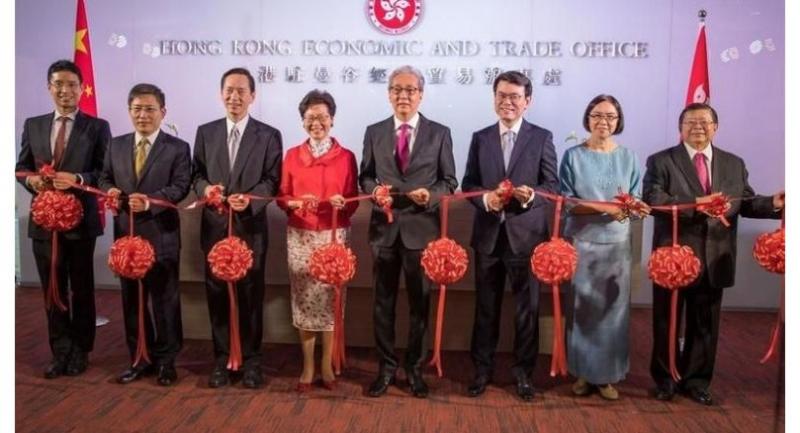
Hong Kong's Chief Executive Carrie Lam (fourth from left) and Thailand's deputy prime minister Somkid Jatusripitak (fourth from right) cut a ribbon during the opening ceremony of the Hong Kong Economic and Trade Office (ETO) in Bangkok.
Hong Kong’s Chief Executive Carrie Lam (fourth from left) and Thailand’s deputy prime minister Somkid Jatusripitak (fourth from right) cut a ribbon during the opening ceremony of the Hong Kong Economic and Trade Office (ETO) in Bangkok.

Hong Kong opens economic, trade office in Bangkok

Economy March 01, 2019 14:58

By China Daily
Asia News Network

2,193 Viewed

The Hong Kong Economic and Trade Office (ETO) was inaugurated in Bangkok on Thursday for deeper economic and trade relations.

Addressing the opening ceremony, Hong Kong’s Chief Executive Carrie Lam said the establishment of the Bangkok office is a clear and compelling statement of the importance of Asean to Hong Kong.

The Bangkok office is the third ETO established by the Hong Kong Special Administrative Region in the Asean region after Jakarta and Singapore.

Lam said she expected the office to play the role of facilitator to connect businesses and organisations between Hong Kong and Thailand, and serve as a catalyst to take the cooperation of both sides to new heights and fresh directions.

Somkid Jatusripitak, Thailand’s deputy prime minister in charge of the country’s economy affairs, said Thailand aims to use Hong Kong as a gateway to China’s Guangdong-Hong Kong-Macao Greater Bay Area.

He said Thailand expected more investment from the Greater Bay Area.

Lam also met Thai Prime Minister Prayut Chan-o-cha on Thursday and Foreign Minister Don Pramudwinai.

Domestic demand main growth driver in January

ศาสตร์เกษตรดินปุ๋ย : ขอบคุณแหล่งข้อมูล : หนังสือพิมพ์ The Nation

http://www.nationmultimedia.com/detail/Economy/30364985

x

Domestic demand main  growth driver in January

Economy March 01, 2019 01:00

By The Nation

In January 2019, the Thai economy continued to expand from the previous month, with domestic demand as the main growth driver, according to Bank of Thailand latest reports yesterday.

Private consumption indicators continued to expand in all spending categories. Private investment indicators expanded from investment in machinery and equipment and construction material sales.

Public spending rebounded from both current and capital expenditures. However, the tourism sector moderated due mainly to the decline in the number of Malaysian tourists. The value of merchandise exports contracted, consistent with the decline in manufacturing production for exports, while production for domestic market continued to expand.

On the stability front, headline inflation decelerated due to the decrease in retail petroleum prices in line with the fall in global crude oil prices. The seasonally adjusted unemployment rate slightly decreased from the previous month. The current account registered a smaller surplus attributed to lower trade balance. The overall capital and financial accounts registered a surplus.

Parties vow to get behind digital drive

ศาสตร์เกษตรดินปุ๋ย : ขอบคุณแหล่งข้อมูล : หนังสือพิมพ์ The Nation

http://www.nationmultimedia.com/detail/Economy/30364987

POLITICAL parties have vowed to leverage digital technology to boost the economy, create jobs, and upgrade people’s living standards.

Parties vow  to get behind digital drive

Economy March 01, 2019 01:00

By   SIRIVISH TOOMGUM
The Nation

POLITICAL parties have vowed to leverage digital technology to boost the economy, create jobs, and upgrade people’s living standards.

They also want to see 5G wireless technology get off the ground soon and some would amend technology-related laws that they consider affect people’s rights and freedoms.

With the national election just weeks away, they say they also plan to focus on promoting digital literacy and equal access to useful sources of open data, along with telecommunications and Internet infrastructure, for all Thais.

Representatives of five parties unveiled their visions for the country yesterday at a seminar on the digital economy, which was hosted by the Information Technology Press Club of the Thai Journalists Association.

Two of the representatives with experience in the information communication technology (ICT) field were Anudith Nakornthap, of the Pheu Thai Party, and Juti Krairiksh, of the Democrat Party; both are former ICT ministers. Joining them were Klaikong Vaidhyakarn of the Future Forward Party, Nattapong Robkob of the Thai Local Power Party, and Rupop Shinawatra of the Thai Raksa Chart Party.

Nattapong

Nattapong said that Thailand should create a single one-stop Thailand App, which would be used by all state agencies to provide public services to the people. The app would replace the disparate apps of all the state agencies.

The single app would help the state agencies to cuts costs on app development and promote greater efficiency in the delivery of public services.

Nattapong said his party is also keen to push hard on encouraging Thai startups to go global.

Juti

Juti said that some laws would be revised as they are deemed to hinder the growth of the digital economy.

He also wants to increase the number of community ICT centres in order to cover 10,000 districts. The centres’ role is to provide ICT knowledge to people in local communities.

If elected to government, Juti’s party plans to hire around 10,000 ICT experts to help local people harness knowledge in the ICT centres.

He added that his party would also further expand quality telecoms and Internet networks nationwide to ensure equal access to the networks for all.

Rupop

Rupop said that his party would focus on leveraging digital technology to upgrade people’s living standards in all aspects.

Klaikong

Klaikong said his party is keen to revise the technology laws that are seen as affecting people’s rights and freedoms, expand free Wi-Fi coverage nationwide, and promote an open-data policy and the growth of the startups.

Anudith said that he would deploy digital technology to help people improve their quality of life and their incomes as well as their own competitiveness.

He will focus on ways to create smart people under a drive for digital literacy, as such efforts are the key to ensuring the successful use of digital technology for the betterment of the country, he said.

RISE IN TRADE WITH JAPAN

ศาสตร์เกษตรดินปุ๋ย : ขอบคุณแหล่งข้อมูล : หนังสือพิมพ์ The Nation

http://www.nationmultimedia.com/detail/Economy/30364991

x

RISE IN TRADE WITH JAPAN

Economy March 01, 2019 01:00

By The Nation

Thailand’s trade with Japan under free trade agreements rose 11.2 per cent in 2018.

Auramon Supthaweethum, director-general of Department of Trade Negotiations, said trade value between Thailand and Japan under two effective FTAs amounted to US$60.2 billion, with Thai exports contributing to $24.94 billion and imports valued at $35.26 billion.

The two effective FTAs are JTEPA and Asean-Japan Comprehensive Economic Partnership (AJCEP).