‘Digital revolution’ shapes diverse and agile work cultures in Asia

ศาสตร์เกษตรดินปุ๋ย : ขอบคุณแหล่งข้อมูล : หนังสือพิมพ์ The Nation

http://www.nationmultimedia.com/detail/Economy/30365322

 Larry Chao
Larry Chao

‘Digital revolution’ shapes diverse and agile work cultures in Asia

Economy March 07, 2019 01:00

By SPECIAL TO THE NATION

3,104 Viewed

DIGITAL technologies are reshaping work cultures in Asia and that is good news for both workers and businesses, say HR professionals.

The top down, authoritative “control culture” is being supplanted by agile cultures, which promote diversity, an open mindset and empowerment. These cultures allow organisations to quickly adapt to change and capture valuable opportunities.

“Over the past few years our senior executive team in Asia has transformed,” said Lisa Butler, Manulife Insurance’s chief talent and diversity officer based in Hong Kong.“We did this intentionally because we wanted to create a more diverse workforce open to change and capable of working comfortably with digital technologies.”

Indeed, a glimpse at Manulife’s Hong Kong office today immediately shows the difference between the old and new ways of working. Men in dark grey suits, who once dominated management ranks making decisions and telling people what to do, have given way to a more diverse workforce. Open-plan office layouts have replaced closed-door offices, facilitating greater collaboration and information sharing. There is a more informal work atmosphere and fewer symbols of status and hierarchy.

“Digital gives people information and the freedom to work autonomously,” continued Butler. “They can take the initiative without waiting to be told what to do. This is especially appealing to younger executives, who feel they have more to offer and want to be more involved in decision-making.”

Several years ago, Manulife recognised that the fast-changing life insurance markets in Asia were punishing stagnant work cultures and plodding bureaucracies.

The emergence of digital technologies and diversity hastened the ability of companies to create greater agility, where local teams had the knowledge and capabilities to experiment with new ideas and challenge the status quo. It was all about discovering and implementing solutions here and now, rather than waiting to be told what to do from distant corporate headquarters.

What’s more, Manulife is not the only organisation in Asia under pressure to evolve work cultures and deliver better results. Dozens of fast-moving consumer products companies face aggressive local competitors, who are offering consumers more of what they want for less.

“Brand loyalty is dying,” lamented the CEO of one global consumer products company operating here in Thailand. “We cannot live on past successes. Consumers know more and are willing to try new things. We need to come up with better ideas faster or risk being left behind.”

To do this, companies need to use digital technologies to enable agile work cultures that harness diversity and allow people to think and make faster decisions on their own. The goal is to generate more ingenious ideas locally and to give people the leeway to take risks. The alternative is to become stuck in the slow lane and to fall behind.

But to develop agile cultures will not be easy. Old habits die hard and shaping new attitudes takes time. Bold companies like Manulife have been in the vanguard for change. It’s not yet ideal, but it is a step in the right direction.

Contributed by LARRY CHAO, managing director of Chao Group Limited, an organisational change consultancy based in New York and Bangkok since 1995.

TCEB looks to attract more international conferences

ศาสตร์เกษตรดินปุ๋ย : ขอบคุณแหล่งข้อมูล : หนังสือพิมพ์ The Nation

http://www.nationmultimedia.com/detail/Economy/30365330

TCEB looks to attract more international conferences

Economy March 06, 2019 19:21

By The Nation

2,740 Viewed

TCEB says Thailand’s conventions sector continues to grow with rising numbers of conferences in technology and startups following trends in the global business.

The bureau also said Thailand is ranked the top destination in Asean for hosting conferences, according to the ICCA. These results underscored Thailand as a leading destination for business events trusted by international associations while TCEB emphasised that the bureau will continue to prompt the Thai industries to host more international conventions.

Chiruit Isarangkun na Ayuthaya, president of the Thailand Convention and Exhibition Bureau (TCEB), said the conventions sector contributes more than 30 per cent of the revenue to Thailand’s MICE industry. This sector supports the country’s economic development by providing platforms for knowledge exchange to enhance professional capabilities, products and services development, as well as innovations which can benefit the country at the macro level.

“Thailand’s convention sector has been rising continuously. In the first quarter of the fiscal year 2019 (October to December 2018), there were 70,000 business travellers in the conventions sector, generating Bt5.5 billion in revenue to the country. Meanwhile, conferences held in Thailand trend to cover broader fields following global trends such as technologies and startups.

Chiruit said: “Currently, the average expenditure in the convention sector stood at Bt80,000 per traveller per trip. This achievement reflects TCEB’s continuous works, especially in terms of the bureau’s efforts to bid for the right to host annual conferences of professional associations at the global and regional levels.

“With the fact that each bidding takes around three to seven years in preparation, TCEB has outlined proactive strategies to enhance partnership with membership organisations such as professional associations, non-profit organisations, educational institutions and entrepreneurs.

@The focus is on key industries which comply with the Thai government’s national policy. TCEB aims to encourage these professional associations to bid for their annual conventions to take place in Thailand,” Chiruit said.

Meanwhile, according to an international ranking conducted by the International Congress and Convention Association (ICCA), in 2017, Thailand is ranked first in Asean and 25th place in the world when considering numbers of international conventions hosted in the country, followed by Singapore with 160 conventions and Malaysia with 112.

This month, there are eight international conferences taking place in Thailand, including conferences in medical, energy and electricity, financial, as well as creative and advertising industries.

Highlights of the international conferences are the Asia-Pacific Academy of Ophthalmology Congress from March 6-9 at the Queen Sirikit National Convention Centre. Co-hosted by the Royal College of Ophthalmologists of Thailand, it is expected that this year the event will attract more than 5,000 delegates and generate at least Bt440 million revenue.

From March 19-23 at Bitec, the Institute of Electrical and Electronics Engineers will host an exhibition on engineering and technological fields in power generation, transmission and distribution and renewable energy. Held in the US for the past 40 years, Thailand is the first country in Asia to host the event. It is expected to attract more than 400 exhibitors and 3,000 international delegates with Bt240 million in revenue expected to be generated.

‘Thousands’ of Thai firms monitored over illegal software

ศาสตร์เกษตรดินปุ๋ย : ขอบคุณแหล่งข้อมูล : หนังสือพิมพ์ The Nation

http://www.nationmultimedia.com/detail/Economy/30365285

x

‘Thousands’ of Thai firms monitored over illegal software

Economy March 06, 2019 12:17

By The Nation

2,543 Viewed

Unlicensed software remains common among corporations and IT sectors in Southeast Asia, whether due to indifference, intent or neglect.

BSA the Software Alliance, a global trade association of software publishers, warns that the use of unlicensed software poses serious security, business and legal risks to the users and their industries.

BSA’s “Legalise and Protect” campaign sees it working with governments and other partners to educate companies about the significant risks they face when they use software that is not genuine or not fully licensed.

BSA members’ software products are used in a wide range of industries, including manufacturing, IT, finance, professional services, construction, healthcare, consumer goods, engineering, architecture and design.

BSA is working with the Thai government, using its database of thousands of companies in Thailand under watch for possible violations.

In coming months BSA will launch public education efforts to ensure business leaders are aware of the risks of using unlicensed software.

“By legalising their software, companies can protect data security, protect competitiveness, protect their reputations – and protect against the risk of legal consequences,” said BSA senior director Tarun Sawney. “The sooner companies legalise, the sooner they can protect their operations and ultimately protect their bottom lines.”

The Asia-Pacific region has the highest rate of unlicensed software use in the world at 57 per cent. A problem of this scale is best tackled by changing minds and behaviour to encourage self-regulation and voluntary compliance, Tarun said.

BSA has thus oriented its campaign primarily to discourage companies from installing and using unlicensed or illegal software – not just for fear of enforcement, but because it is in their best interests to do so.

NBTC board gives green signal to recall 2600MHz

ศาสตร์เกษตรดินปุ๋ย : ขอบคุณแหล่งข้อมูล : หนังสือพิมพ์ The Nation

http://www.nationmultimedia.com/detail/Economy/30365240

NBTC board gives green signal to recall 2600MHz

Economy March 06, 2019 01:00

By Sirivish Toomgum
The Nation

The National Broadcasting and Telecommunications Commission (NBTC) yesterday approved the recall of the 2600MHz band for reallocation through an auction.

NBTC secretary-general Takorn Tantasith said the watchdog would recall a total of 190MHz of the band, which is aimed at providing 5G wireless broadband service.

Of the total, 154MHz will be recalled from broadcaster MCOT while a combined 12MHz will be from the Royal Thai Armed Forces Headquarters and the Royal Thai Army.

The NBTC has already taken back 24MHz of spectrum from the Public Relations Department.

The NBTC board yesterday decided that the validity of the 2600MHz spectrum for these agencies will end within 45 days of the watchdog sending letters to them to hand over the spectrum. The watchdog is expected to send the letters by Friday.

The NBTC has allowed them to hand the spectrum back to the Commission within 120 days of receiving the letter, so that they will have time to remove the related spectrum equipment.

Takorn added that these agencies have the right to decline to hand over the 2600MHz spectrum.

If things go as planned, the NBTC is expected to finish the price evaluation of the 2600MHz band within July and call bids for this band in August.

The NBTC board has also approved spending Bt7.5 million to hire three institutes to evaluate the spectrum price for the auction. They will also evaluate compensation the watchdog will pay to these state agencies after handing over their spectrum to NBTC.

Takorn said the NBTC has already proposed such deals to the Faculty of Economics of both Chiang Mai University and Chulalongkorn University and the Thailand Development Research Institute.

The NBTC board endorsed the draft regulations of the regulatory sandbox, aiming to facilitate 5G wireless technology trials by any interested parties.

Under the regulations, those who are allowed to conduct the trials in locations designated by the NBTC, will not be subject to some related normal regulations and requirements.

The board approved in principle a Bt68-million budget for Chulalongkorn University to set up a  5G demonstration centre in Chulalongkorn University and the rollout of the 5G network for testing in the campus and Siam Square area.

This funding follows NBTC’s recent signing of a memorandum of understanding with Chulalongkorn University to collaborate on a 5G wireless broadband technology-testing centre at the university.

Negative factors squeeze export numbers in January

ศาสตร์เกษตรดินปุ๋ย : ขอบคุณแหล่งข้อมูล : หนังสือพิมพ์ The Nation

http://www.nationmultimedia.com/detail/Economy/30365242

x

Negative factors squeeze export numbers in January

Economy March 06, 2019 01:00

By The Nation

Thai exports saw an unexpected 5.7 per cent slump year on year in January, pointing to impact from the baht’s appreciation, the Thai National Shippers’ Council (TNSC) said, while urging exporters to use local currencies to reduce financing costs and foreign exchange risks.

The council also urged the next government to speed up trade negotiations to boost exports.

Council chairman Ghanyapad Tantipipatpong said that though Thai exporters were surprised by the results in January, they understood that it was difficult to control negative factors.

The appreciation of the baht is not a result of local factors but the impact from the volatile US dollar, she said. If the baht appreciates by Bt1 against the US dollar, income from exports will be lower by 3 per cent.

The council urged the Bank of Thailand to ensure that exchange rates were in line with that of Thailand’s trading partners, she said.

Exports in January fell 5.7 per cent year on year to US$18.99 billion, led by a 2.9 per cent drop in agro-industry and agricultural products and a 5.9 per cent fall in manufacturing products.

Thai shipments to China saw a relatively larger decline, stemming from the US-China trade war, while shipments to the United States increased 8.27 per cent, led by a 34 per cent surge in the automobile industry.

Shipments to Asean overall decreased 7.42 per cent, but shipments to CLMV countries (Cambodia, Laos, Myanmar and Vietnam) inched up 0.6 per cent.

Despite the export contraction in January, the council said it would maintain this year’s target of 5 per cent export growth, Ghanyapad said. The export growth estimate is based on the baht trading at 33 to the US dollar.

However, risks to Thai exports remain due to global trade uncertainties from the US-China trade war, Britain’s impending exit from the European Union to escalating tensions between India and Pakistan, which have caused short-term impacts to Thai exports and air transport.

Importantly, the baht’s appreciation has affected the price competitiveness of Thai exporters, particularly those who use local content.

The council encouraged Thai exporters to use local currencies like China’s yuan, Malaysia’s ringgit, Indonesia’s rupiah and Japan’s yen for their transactions to reduce financing costs and forex risks, Ghanyapad said.

Kasikorn Research Centre (KResearch) expects the baht to move with volatility amid Thailand’s trade and political developments, the Federal Open Market Committee’s meeting on March 19-20 and the March 27 trade negotiations between the US and Chinese presidents, which need close monitoring.

The baht began depreciating in late February to early March after appreciating to a five-year high of 31.07 to the US dollar. The Thai currency weakened to close at Bt31.90 per US dollar yesterday morning before moving in a range of 31.80-31.85 per US dollar in afternoon trading.

Ghanyapad urged that delayed negotiations on free trade agreements (FTAs) with Thailand’s major trading partners, including the European Union, may need to be speeded up for finalisation by the next government as FTAs are important tools to help support Thai exporters sell products to these countries.

TAX CUT FOR E-CARS, LOW-EMISSION TRUCKS

ศาสตร์เกษตรดินปุ๋ย : ขอบคุณแหล่งข้อมูล : หนังสือพิมพ์ The Nation

http://www.nationmultimedia.com/detail/Economy/30365245

x

TAX CUT FOR E-CARS,  LOW-EMISSION TRUCKS

Economy March 06, 2019 01:00

By The Nation

The Cabinet yesterday agreed to revise the excise tax for electric cars and trucks using diesel B20 to zero per cent and 0.5 to 2 per cent respectively to lessen the problem of particulate dust pollution.

Finance Minister Apisak Tantivorawong said after the Cabinet meeting yesterday that the first measure will reduce excise tax for electricity-powered vehicles, which had been granted tax incentive by the Board of Investment, from 2 per cent currently to zero per cent, effective from January 1, 2020 till December 31, 2022. Thereafter, from January 1, 2023 to December 31, 2025, the tax rate will be set at 2 per cent, followed by 8 per cent in the year 2026.

As for trucks fitted with a diesel engine, running on B20 and with CO2 emissions not over 200 grams per kilometre, the excise tax will be cut from 2.5 per cent to 2 per cent, he said.

The tax reduction will cost the government Bt1.5 billion in tax collection a year, but it would be better for the environment, he said.

GREEN LIGHT FOR SRT PROJECT

ศาสตร์เกษตรดินปุ๋ย : ขอบคุณแหล่งข้อมูล : หนังสือพิมพ์ The Nation

http://www.nationmultimedia.com/detail/Economy/30365246

x

GREEN LIGHT FOR  SRT PROJECT

Economy March 06, 2019 01:00

By The Nation

The Cabinet yesterday approved State Railway of Thailand’s plan to develop a rail system running from Taling Chan to Siriraj with an investment budget of Bt6.6 billion.

SRT expects the project to become operational in 2022, Nattaporn Jatusripitak, spokesperson for the deputy prime minister in charge of economic affairs said after the Cabinet meeting yesterday.

The cabinet also instructed the Finance Ministry to prepare extra funding for the project. Under the existing budget, Bt2.9 billion will be spent on construction and Bt3.7 billion on the electricity system and train purchases, he said.

Thai business leaders concerned over reduced talent supply in the next decade, study finds

ศาสตร์เกษตรดินปุ๋ย : ขอบคุณแหล่งข้อมูล : หนังสือพิมพ์ The Nation

http://www.nationmultimedia.com/detail/Economy/30365204

x

Thai business leaders concerned over reduced  talent supply in the next decade, study finds

Economy March 05, 2019 07:35

By The Nation

According to a new study by Korn Ferry, the US-based executive search and management consulting firm, business leaders in Thailand are concerned that a reduced talent supply may impact their ability to stay on track for forecast growth in the mid-term future.

 Forty-six per cent of leaders said that talent shortages may force them to increase salaries unsustainably.

Leaders in Thailand have ambitious plans to grow their revenue in the near and long term.

Some 84 per cent said they plan to grow an average of 36 per cent by 2020, increasing to 47 per cent by 2030.

They have similarly aggressive plans to grow headcount over the same time period: 80 per cent of organisations intend to increase headcount by an average of 37 per cent by 2020, rising to 48 per cent by 2030.

However, leaders in Thai organisations surveyed are more cautious about the availability of highly skilled talent than those in other nations.

Only 30 per cent of the top executives think there will be enough or even surplus talent by 2030, as opposed to 48 per cent of leaders worldwide.

Still, they see technology as more important than talent in the future of work.

Around 82 per cent believe technology will overtake people as their greatest value creator over the same period, and 70 per cent rank technology among their highest priorities when developing and executing their company’s strategy.

But the majority of leaders in Thailand do not see the future as a simple battle of man versus machine.

Some 88 per cent also said their companies would need more highly skilled workers as a proportion of the future workforce, with the same number agreeing that technology itself would create the need for more highly skilled jobs.

To deliver their strategies, 86 per cent of leaders in the Kingdom have a formal forecast for their skilled talent need, but only 9 per cent have plans that extend through to 2030.

Although they are anticipating which roles will be most impactful in the future of work, 82 per cent say they find it easier to create action plans around technology and other tangible assets, citing pressure from shareholders for quick returns and short leadership tenures as contributing factors.

“The explosion in technology has vastly hastened the pace of business development. Flexible forecasting and business modelling are now more relevant than the traditional models, such as five-year plans,” said Michael Distefano, Korn Ferry president, Asia Pacific.

“While scenario planning is critical to business growth, this rarely extends to a people plan’. As skilled workers become the lever of growth in the new economy, organisations must shift this mindset to become more agile and adopt a long-term approach when devising their talent strategy,” he added.

The world is teetering on the brink of an impending skilled labour shortage, set to hit developed and developing economies alike, according to the report.

For Thailand, it is a challenge of significant proportions, and one that could constrain the country’s economic growth by 6.4 per cent in 2030.

Globally, in 2030, Korn Ferry research forecasts talent shortages of 85.2 million skilled workers, resulting in US$8.452 trillion (Bt269 trillion) in unrealised revenue across 20 of the world’s major economies.

As early as 2020, the worker deficit could hit 20.3 million people.

Investment policy here to stay: PM

ศาสตร์เกษตรดินปุ๋ย : ขอบคุณแหล่งข้อมูล : หนังสือพิมพ์ The Nation

http://www.nationmultimedia.com/detail/Economy/30365190

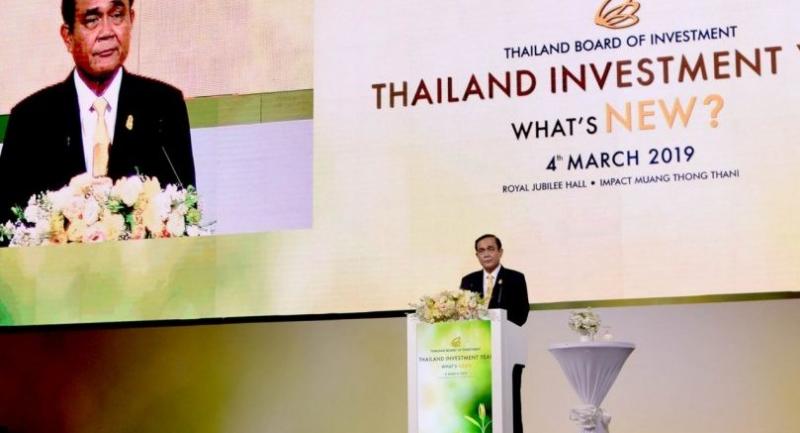
 Prime Minister Prayut Chan-o-cha  chairs the “Thailand’s Investment Year – What’s New?” forum held by the Board of Investment (BoI) yesterday.
Prime Minister Prayut Chan-o-cha chairs the “Thailand’s Investment Year – What’s New?” forum held by the Board of Investment (BoI) yesterday.

Investment policy here to stay: PM

Economy March 05, 2019 01:00

By THE NATION

2,787 Viewed

PRIME MINISTER Prayut Chan-o-cha has assured foreign and Thai investors that the government will continue to promote investments and key projects, while ensuring the Eastern Economic Corridor (EEC) goes ahead as planned.

Opening a seminar on “Thailand’s Investment Year – What’s New?”, held by the Board of Investment (BoI) with over 2,000 investors attending yesterday, Prayut said: “The government will continue with matters of investment and investment promotion for the rest of its term and the next government will certainly continue [the policy]. We hope that investors will take part in strengthening Thailand’s economy, which will benefit other countries in the region, with stability and sustainability.”

He said the country’s development was still reliant on investments from within the country and from other countries that have advanced technologies and innovation. The targeted industries have been chosen with a clear focus on promoting investments to upgrade industries with manufacturing bases in Thailand and also attracting investments in new industries.

“The government has also focused on laying the country’s foundations, while building up favourable factors for investment, improving potential industries, upgrading productivity and industrial plants’ efficiency, developing smart farmers, promoting alternative energy and renewable energy, and developing transportation infrastructure and special economic zones including the EEC,” the premier said.

In a special address to the same gathering on “The Year of Investment: Turning Challenges into Opportunities”, Deputy Prime Minister Somkid Jatusripitak said although all countries in the world have been confronting challenges and high uncertainties due to the slowing global economy and shrinking global trade and exports, Thailand’s internal factors remained strong as a result of economic stimulus, economic reforms and the new wave of domestic investment.

In 2018, the Thai economy grew 4.1 per cent with headline inflation at 1 per cent. Thailand’s current account enjoyed a surplus of over 7 per cent of the nation’s gross domestic product (GDP) while public debt was below 45 per cent of GDP.

He said winners of the bids for major infrastructure projects in the EEC are expected to be unveiled in April-May. The bid winner for the high-speed railway project that will connect the country’s three main airports – Don Mueang, Suvarnabhumi and U-tapao – is expected to be announced this month.

The third phase of the Map Ta Phut Port project is in the negotiation process with select private enterprises, while bids for the maintenance, repair and overhaul centre project and U-tapao airport project are expected to start this month with the winners announced in April.

Other infrastructure projects outside the EEC extend from four routes of heavy rail projects, six more routes of double-track railway projects, to light rail projects in Chiang Mai, Khon Kaen, Nakhon Ratchasima and Phuket provinces.

“It has never happened in the country’s history – such serious investment in both the nature and the size of investment as well as speed to drive [investment],” Somkid said.

“The election is a good thing as it will ensure certainty. I’m confident that after this election, we will have Prayut return to power and everyone will take part in building the country’s future,” he said.

BoI secretary-general Duangjai Asawachintachit said that the BoI’s two special measures in the investment year were boosting competitiveness and narrowing the gap, with the aim to increase investment in targeted industries and smart cities, and promote the grass-roots economy.

Under the grass-roots promotional measure, business operators must clearly follow the cooperative plan to support local organisations with a minimum investment of no less than Bt1 million in each project.

Also among measures to promote investment in Thailand are creating a knowledge base such as improvement of plant varieties or animal breeds, research and development of creative product design and development, electronic design, engineering design and software.

Trade barriers stall Asean integration, say experts

ศาสตร์เกษตรดินปุ๋ย : ขอบคุณแหล่งข้อมูล : หนังสือพิมพ์ The Nation

http://www.nationmultimedia.com/detail/Economy/30365191

Trade barriers stall Asean integration, say experts

Economy March 05, 2019 01:00

By PHUWIT LIMVIPHUWAT
THE NATION

2,647 Viewed

ASEAN integration is “not going anywhere” if trade regulations between Asean countries are not reformed, a recent forum heard.

“Asean has done very little beyond lowering tariffs between countries,” argued Deunden Nikomborirak, research director in economic governance at the Thailand Development Research Institute (TDRI).

Deunden was speaking during a seminar discussion at the “Chevening Annual Talk 2019: Promoting a Strong Economic Partnership Towards a Resilient and Peaceful Asean Community,” held on February 28.

“To integrate into one single economic entity, Asean countries have to put the interest of the region before their own country,” she told the forum.

She expressed doubts about the realisation of such a vision, given the seeming unwillingness between Asean countries to liberalise their markets.

“We see that each Asean country is still protecting their own interests. For example, the Asean region is not working together to attract foreign investment but instead, competing amongst one another to offer benefits for foreign investors,” she said, citing each country’s board of investments competing to offer more generous tax exemptions to foreign investors.

Thailand’s Board of Investment (BoI) last November offered a package in which investors would get a tax exemption for up to eight years if they invested in the development of smart cities under the Thailand 4.0 initiative, such as spending on infrastructure, providing a “smart environment” or developing smart technology.

“At the end of the day, it is the foreign investors that gain the benefits from investing in the Asean region, and not the Asean countries themselves,” Deunden said.

Other aspects of Asean trade which remain highly restricted are the trade in services and the flow of human capital, said Deunden, adding that there is a seeming lack of genuineness between Asean countries to tackle this issue.

“Thailand has negotiated 10 service sector liberalisation ‘packages’ with the Asean countries, and one of the service liberalisation sectors that Thailand committed to was the transportation of goods and services by man or animal,” she said. “Thailand only liberalised trade by means that are no longer used in the modern day.”

But Thailand is not alone. Deunden said other Asean countries are also choosing not to take market liberalisation in the regions as seriously as they could.

When it comes to the movement of human capital, the Asean region is again far from being integrated, Deunden contended.

“Thailand has a lot of mutual recognition agreement (MRA) laws with Asean countries to allow skilled labour – such as architects, engineers or doctors – to work in the different Asean nations. However, this does not guarantee that individuals in these professions can move freely in the Asean region,” she said. This is because the MRA is subject to the laws and regulations of each Asean country, and Thailand has made it a requirement that these individuals write exams in the Thai language.

This is just one example of how human capital flow remain highly restricted throughout the region due to the reluctance of Asean countries to open up their labour markets, she said.

Furthermore, even in the trade of goods, the Asean region faces various challenges

In 2018, 22.69 per cent of Thailand’s total trade went to Asean, valued at some Bt3.67 trillion, according to figures from the Ministry of Commerce.

Despite being Thailand’s largest trading partner, the Asean region’s share of Thailand’s total trade remains small when compared to the share of trade between countries in other trading blocs such as the European Union.

“In reality, intra-Asean trade is much smaller than 22 per cent. This is because the figures include a lot of business-to-business trade. If we look only at the trade in consumer goods, the share of Asean trade to Thailand’s total trade would be much smaller,” argued Santitarn Sathirathai, group chief economist at Sea Limited (Singapore).

“So it seems like there is a lot of economic integration in the Asean region, but a lot of that is merely supply-chain trade, such as auto-parts and electronic parts being shipped across Asean borders between foreign firms that are established in the region,” he said. Santitarn said non-tariff barriers and customs regulations have kept intra-Asean trade in consumer goods small.

“Thailand should make the lowering of non-tariff barriers in the Asean region a key economic priority as this year’s Asean chair,” concurred Prinn Panitchpakdi, managing director of CLSA Securities (Thailand) Limited.

Added Deunden: “The TDRI’s research found that the reason why intra-Asean trade remains so low is because the Asean Free Trade Agreement (Afta), is the only agreement that requires foreign products to have a rule of origin before they are imported into a country. In other free-trade agreements, goods are first imported before having their content origins verified.”

She explained that this creates a major disincentive for exporters and causes delays in goods that are moving across Asean borders, thus hindering intra-Asean trade.