
Omicron is fueling lockdowns in some countries just as others start to loosen restrictions

#SootinClaimon.Com : ขอบคุณแหล่งข้อมูล : หนังสือพิมพ์ The Nation.

https://www.nationthailand.com/international/40010168


The Netherlands imposed a snap lockdown starting Sunday. Officials in Ireland imposed a nightly curfew from Monday. France banned New Years Eve fireworks.

Omicron is fueling lockdowns in some countries just as others start to loosen restrictions

Other European countries, including France and Germany, imposed new travel restrictions. Israel has urged people to work from home when possible and is weighing tightened travel restrictions to and from the United States, among other countries.

But in Australia – once dubbed the “Hermit Kingdom” for the way it sealed its international borders against the virus – officials in the country’s most populous areas have loosened nearly all restrictions in recent days, despite case numbers soaring to fresh records.

New Zealand, too, has been loosening restrictions. The country’s prime minister, Jacinda Ardern, is set to celebrate her pandemic-delayed wedding next month with dozens of guests and a performance by the singer Lorde, the New Zealand Herald reported.

While some nations are reimposing coronavirus restrictions including lockdowns in the face of the highly transmissible omicron variant, others are loosening up – even as case numbers spike.

In Australia, which reopened its mostly shut border in November, experts have questioned the merits of ending preventive measures such as mask-wearing indoors just as case numbers are touching local records. The last time restrictions were eased, the borders were closed to international arrivals and the virus had been all but eliminated in the community.

Even as some community restrictions lift in New Zealand, its border remains mostly closed, and international arrivals spend two weeks in hotel quarantine, which has kept the number of confirmed cases of the omicron variant to about a dozen, all detected before they could spread.

Health officials in Australia’s New South Wales state, home to Sydney, lifted a raft of restrictions Dec. 15, including those around mask-wearing and proof of vaccination. Until then, unvaccinated people had effectively been in lockdown – unable to dine out, go to the gym or shop for anything other than essential goods.

That’s as at least 97 coronavirus cases were linked to a Taylor Swift-themed dance party on Dec. 10 in Sydney, and some 600 people are in isolation as close contacts. More than 200 people contracted the virus following a recent nightclub outbreak in Newcastle.

Disease modelers say Australia’s most populous state could record as many as 25,000 cases a day by the end of January – the same number recorded across Britain on Friday, where surging case numbers have seen London’s mayor declare a “major incident” to help the city’s hospitals cope. Australian officials have cited the data from researchers as a reason for people to exercise self-restraint, limiting their activities over the holiday season.

The president of the Australian Medical Association, Omar Khorshid, said Saturday that loosening restrictions such as mask-wearing while cases are rising sharply is “bizarre timing.” More than 10,000 people have contracted the virus in New South Wales in the past five days.

“Hospitalizations lag behind infections quite significantly by a week or even two weeks; it’s too late once we actually see a sharp rise in hospitalizations,” Khorshid said.

Government officials have argued that vaccinations and boosters are the way to keep cases down. About 77 percent of Australians are fully vaccinated, according to Johns Hopkins University data.

“We’re ready for this. We planned to live with the virus, we didn’t plan to remain shut in,” Australian Prime Minister Scott Morrison told reporters on Saturday.

The World Health Organization issued a grim weekend prediction that with cases rising so rapidly, hospitals in many places could “become quickly overwhelmed.” The omicron variant has been reported in 89 countries, and the number of cases is doubling in 1½ to three days in areas with community transmission, the organization said Saturday.

The United States has responded by introducing travel bans for a number of African countries, and additional pre-departure testing requirements for arrivals into the country, as well as encouraging Americans to get booster shots.

Across Europe, where omicron is poised to become the dominant variant, nations are moving to reimpose tougher measures to stem infections as the new variant spreads at lightning speed across the continent.

In the Netherlands, Prime Minister Mark Rutte said that all nonessential stores, bars and restaurants will be closed until Jan. 14, starting Sunday. Schools and universities will shut until Jan. 9.

France announced Thursday that it was banning tourists from Britain, while Germany said on Saturday that it will impose quarantine on all travelers from Britain starting at midnight on Monday and require a negative coronavirus test for entry into the country.

Britain has reimposed mask requirements indoors and ordered people to show proof of vaccination or a recent negative coronavirus test when going to nightclubs and large events. Prime Minister Boris Johnson has talked about a “tidal wave” of new cases.

Officials are reportedly preparing draft rules that, if introduced, would ban indoor gatherings in England for two weeks after Christmas, with pubs and restaurants limited to outdoor table service, according to The Times newspaper.

Ireland’s Department of Health said on Sunday that omicron had become the country’s dominant variant in just two weeks.

Israel has renewed a temporary ban on foreign visitors and is considering adding the United States, among other countries, to its “red list” of high-risk places. Israeli citizens and residents returning from countries on the red list must first enter a government-run quarantine hotel to await a negative PCR test and then undergo a seven-day home quarantine. Official permission is also required to travel to red-listed countries.

Scientists say many questions about omicron remain unanswered, including how effective existing vaccines are against it and whether it causes more or less severe illness. Their concern is that even in places like Australia or Denmark, a highly vaccinated, wealthy northern European country, the virus is about to sprint out of control.

“The right thing to do right now is try and flatten that curve a little bit, because we don’t know what proportion of people who get omicron are going to end up in hospital,” said the Australian Medical Association’s Khorshid. “It seems more mild, but if you end up with tens of thousands of people every day getting infected … even if a small proportion end up in hospital, that could still overwhelm the system.”

Published : December 20, 2021

By : The Washington Post

A Taylor Swift fan party in Australia became a coronavirus super-spreader event with nearly 100 positive

#SootinClaimon.Com : ขอบคุณแหล่งข้อมูล : หนังสือพิมพ์ The Nation.

https://www.nationthailand.com/international/40010166


At least 97 people who attended a Taylor Swift-themed party in Sydney last week have tested positive for the coronavirus, authorities said, adding that its likely some of the revelers were infected with the omicron variant.

A Taylor Swift fan party in Australia became a coronavirus super-spreader event with nearly 100 positive

The news comes as New South Wales relaxes many public health restrictions and Australia doubles down on its plan to “live with the virus” – even as omicron spreads around the world, prompting new restrictions and even lockdowns in some countries.

The event, dubbed “On Repeat: Taylor Swift Red Party,” took place Dec. 10 at the Metro Theatre in Sydney, a live music venue with a capacity of 1,100 people, according to the Sydney Morning Herald. It was billed as a celebration of the rerelease of Taylor Swift’s 2012 album “Red.”

On Thursday, public health authorities in New South Wales said in a statement that of the at least 97 confirmed cases of covid-19 that were tied to the party, “it is likely some of these cases have the Omicron variant of concern.” It advised everyone who attended, as well as their close contacts, to get tested for the coronavirus and self-isolate for a week, under the state’s public health guidelines for exposure.

NSW Health said it was reaching out to 600 people who attended the event and checked in via a contact tracing app to tell them they should test and isolate. The health department added that people who attended but did not check in with the app should do the same.

Cases in New South Wales are on the rise, with the state reporting 11,590 in the week ending Saturday evening, compared with 2,841 the week before. More than 93 percent of people in New South Wales who are 16 or older are fully vaccinated.

On a Facebook page for the event, organizers warned attendees on Tuesday that a person who tested positive for the coronavirus attended, saying they found out through “comments on our social media.”

“We know this (is) a scary time for all and we want to continue to do all that we can to create safe events for everyone as the world moves forward and learns to live with Covid in the community,” wrote the organizers, who said they were based in Adelaide and “were not on site on the night.”

Some users who attended the party reported their positive coronavirus diagnoses in the comments. “Such a fun night but soooo many positive cases from this night hope everyone is okay,” said one user.

Before the outbreak, event organizers said on Facebook that another Taylor Swift-themed event was planned for Jan. 7.

The Taylor Swift party was not the only event sparking mass isolations in New South Wales last week amid loosening restrictions. In nearby Newcastle, NSW Health said Friday that anyone present in three different hotels on Saturday “should monitor for symptoms and get tested immediately and isolate, if they (are) present.”

Even as state authorities double down on gradual reopening measures – including by scrapping a rule this week that only the fully vaccinated can attend restaurants, cafes and other venues – NSW Health announced Thursday that a music festival due to take place Saturday was ordered to shut down due to the risks from “the ongoing spread of COVID-19 in the Newcastle area, where the majority of a record number of cases are the Omicron variant of concern.”

Published : December 20, 2021

By : The Washington Post

Health officials warn omicron variant will cause record-high coronavirus cases, hospitalizations in U.S.


Top government health officials warned Sunday that the United States is likely to see record numbers of coronavirus cases and hospitalizations as the omicron variant spreads rapidly and forces Americans to once again grapple with the dangers of a pandemic that has upended life around the globe.

Health officials warn omicron variant will cause record-high coronavirus cases, hospitalizations in U.S.

“Unfortunately, I think that that is going to happen. We are going to see a significant stress in some regions of the country on the hospital system, particularly in those areas where you have a low level of vaccination,” Anthony Fauci, the nation’s leading infectious-disease specialist, said on CNN’s “State of the Union” when asked whether the United States could see record numbers of cases, hospitalizations and deaths.

Fauci described omicron as “extraordinary” in its transmissibility, with a doubling time of two to three days. The variant accounts for 50% of coronavirus cases in certain regions of the country, which meant it would almost certainly take over as the dominant variant in the United States, he added.

“It is going to be a tough few weeks, months as we get deeper into the winter,” Fauci said.

On CBS News’s “Face the Nation,” Francis Collins, director of the National Institutes of Health, said that cases will rise steeply over the next couple of weeks and that the country could soon see 1 million new cases a day of omicron, dramatically exceeding the record of about 250,000 new cases per day set in January.

“The big question is, are those million cases going to be sick enough to need health care and especially hospitalization?” Collins said. “We’re just holding our breath to see how severe this will be.”

Health officials warn omicron variant will cause record-high coronavirus cases, hospitalizations in U.S.

Fauci and Collins painted a stark but realistic picture of the winter ahead, on the heels of a week of coronavirus-related setbacks. Coronavirus cases, hospitalizations and deaths rose across much of the country last week, with officials warning of a surge just as millions of Americans – already weary after nearly two years of the pandemic – are expected to travel for Christmas and New Year’s. On Friday, Pfizer and BioNTech announced that vaccines for children under 5 would be pushed back further into 2022, as the companies modified their trials to include a third dose.

Health officials have continued to urge the unvaccinated to get their shots and those who have received only two doses of either the Pfizer or Moderna mRNA vaccines to get booster doses. Vaccines cannot be the only layer of protection against the omicron variant, Fauci said, but defeating the pandemic would not be possible without them.

There are still safe ways for vaccinated people to get together for the holidays, including wearing a mask while traveling, testing beforehand and knowing the vaccination status of everyone present at indoor celebrations, Fauci said on “Face the Nation.”

“If you do these things, I do believe that you can feel quite comfortable with a family setting,” he said. “Nothing is 100% risk-free, but I think if you do the things that I just mentioned, you’d actually mitigate that risk enough to feel comfortable about being able to enjoy the holiday.”

Collins stopped short of urging people to cancel holiday plans but said travel will be risky even for vaccinated people.

“This virus is going to be all around us,” he said. “I’m not going to say you shouldn’t travel, but you should do so very carefully … People are going ‘I’m so sick of hearing this,’ and I am, too. But the virus is not sick of us, and it is still out there looking for us, and we’ve got to double down on these things if we’re going to get through the next few months.”

Doctors, nurses and other health care workers are warning that the nation’s health system continues to strain under an unending stream of coronavirus cases. Confirmed U.S. coronavirus infections have surpassed more than 128,000 per day and confirmed virus deaths are near 1,300 per day, according to The Washington Post’s rolling seven-day average.

“For people trained to save lives, this moment is frustrating, exhausting and heartbreaking,” the American Hospital Association, the American Medical Association and the American Nurses Association said in a joint statement on Friday, urging more Americans to get booster shots.

Public health experts are bracing for a winter surge of cases driven by omicron, which can evade some protection conferred by vaccinations and prior infections, as well as cases linked to the older delta variant. Officials caution that they are still relying on preliminary data about omicron’s severity compared with earlier forms of the virus.

President Joe Biden plans to address the nation Tuesday on the status of the country’s fight against the virus, the White House said Saturday.

“We are prepared for the rising case levels,” White House press secretary Jen Psaki wrote on Twitter, adding that Biden “will detail how we will respond to this challenge. He will remind Americans that they can protect themselves from severe illness from COVID-19 by getting vaccinated and getting their booster shot when they are eligible.”

The speech, coming just before Christmas and New Year’s Day, underlines Biden’s struggle to contain the pandemic nearly a year into office. On top of the emergence of new variants and attendant challenges, the administration has at times faced criticism for what some have described as mixed signals.

Biden won high marks from the public during the first half of the year as cases declined, the country opened up from lockdown and vaccines became widely available. But the past few months have been far more difficult. After he gave a speech on July 4 saying the country was “closer than ever to declaring our independence from a deadly virus,” the situation started changing. Case rates increased as the delta variant took a foothold and many Americans refused to get vaccinated.

And despite Biden’s promise that at-home rapid tests would become a widely available tool to fight the coronavirus, the tests remain hard to find in many parts of the country, as well as more expensive than in other places across the world.

Fauci conceded Sunday that the administration needed to do better about increasing the availability of at-home coronavirus rapid tests, though he stressed that the country was in a much better place than it was a year ago, with 200 million to 500 million tests available per month, many of them free.

“We’re going in the right direction,” he said on CNN. “We really need to flood the system with testing. We need to have tests available for anyone who wants them, particularly when we’re in a situation right now where people are going to be gathering.”

Omicron also has challenged the nation’s coronavirus medicine cabinet, with evidence that the variant’s mutations will wipe out or weaken the effectiveness of treatments that can reduce the virus’s severity and keep patients out of hospitals. As a result, the Biden administration around Thanksgiving paused distribution of sotrovimab, the one monoclonal antibody that remains effective against omicron, with senior officials like David Kessler calculating that the drug should be maximally deployed when the variant becomes more prevalent.

By Thursday, administration officials decided to resume shipments of the drug, amid indicators that omicron was spreading faster in states such as New York and Washington than data published by the Centers for Disease Control and Prevention earlier in the week indicated, said two officials with knowledge of the deliberations.

“Shipment of product will begin soon, and jurisdictions will see product arrive as early as Tuesday, December 21, 2021,” the federal health department said in a statement on Friday, announcing that about 55,000 doses of sotrovimab would go out next week.

Doctors said they were desperate for treatments like sotrovimab as emergency rooms begin to crowd and case numbers soar to new heights. New York state on Saturday reported more than 21,9000 confirmed infections, breaking a record set the day before.

“Too slow! We are already seeing widespread omicron,” texted one infectious-disease doctor at a large New York City hospital, who estimated that at least 50% of patients had contracted the variant and requested confidentiality to discuss patient care. “It’s a lot of hospitalizations that could have potentially [been] averted because of slow response.”

Fauci said Sunday that he expected it to be months before antiviral drugs can be mass-produced and available to anyone who needs them. While he did not foresee the kind of lockdowns that were put in place in the early days of the pandemic, Fauci also noted that it would be difficult to keep the virus under control when there remained “about 50 million people in the country who are eligible to be vaccinated who are not vaccinated.”

Similarly, several governors on Sunday shied away from the possibility of implementing more lockdowns to fight the spread of omicron. Maryland Republican Gov. Larry Hogan said on “Fox News Sunday” that his state, which has seen a 150% increase in hospitalizations over the past two weeks, was not considering lockdowns and instead was putting more resources into testing and encouraging vaccinations and boosters. New Jersey Democratic Gov. Phil Murphy said on the same show that lockdowns remained “on the table” but that he didn’t think such a move was likely because a high percentage of the state’s population was vaccinated.

Colorado Democratic Gov. Jared Polis emphasized that people in his state should keep themselves safe with “individual freedom and local control.” He also said Colorado officials were looking to change the definition of “fully vaccinated” to include three shots, as health officials in the country and around the world have signaled in recent days they are also considering.

“That’s certainly where it’s headed,” Polis said on NBC News’s “Meet the Press.” “I wish they’d stop talking about [the third shot] as a booster. It really is a three-dose vaccine.”

Published : December 20, 2021

By : The Washington Post
Hong Kong voters stay away from patriots-only election in rejection of Beijings control

#SootinClaimon.Com : ขอบคุณแหล่งข้อมูล : หนังสือพิมพ์ The Nation.

https://www.nationthailand.com/international/40010164


HONG KONG – In a rejection of Beijings new direction in Hong Kong, voters mostly stayed away from the polls Sunday in the territorys first “patriots-only” election, which was on pace to be the lowest turnout since the territorys handover to China in 1997.

Hong Kong voters stay away from patriots-only election in rejection of Beijings control

An hour before polls closed, the turnout was just shy of 30 percent, less than half the percentage that voted in the 2019 local elections. It appeared to be a repudiation not only of the overwhelmingly pro-China candidates, but also of Beijing’s re-engineering of the territory. Ahead of the vote, Hong Kong authorities characterized casting a ballot as a vote of confidence in the political system and took unprecedented steps to boost participation after crushing the pro-democracy opposition.

“The call for a boycott as a solid form of political mobilization has taken effect, showing the will of the people [and] how angry they are at the regime,” said Ted Hui, a former elected lawmaker now living in exile in Australia.

Sunday’s vote will determine the makeup of Hong Kong’s legislature. Only a portion of the body has ever been directly elected, but until recently, it nonetheless acted as a check on the Hong Kong government. The legislative elections were scheduled for 2020 but postponed for 18 months, with authorities citing the pandemic.

During the delay, every prominent opposition leader was either jailed, under a new national security law that effectively criminalized dissent, or fled into exile. Beijing rewrote the electoral rules, reducing the number of directly elected seats from 35 to just 20. Apple Daily, the popular pro-democracy newspaper, shut down this year under government pressure.

The vote served as the first referendum on Hong Kong’s new, more authoritarian direction under Beijing’s tightened grip. Refusing to show up to vote on Sunday was one of the last ways Hong Kong residents could express their political will.

“Not participating in the government elections has already sent a strong political message in Hong Kong,” said Eric Lai, a legal and political analyst at the Georgetown Center for Asian Law.

Several registered voters said they found the exercise futile, with no candidate they wanted to vote for.

“I find no representation in the election,” said Michael, 28, who gave only his first name, fearing repercussions for boycotting the vote. His preferred candidate, Gwyneth Ho, is one of dozens in jail for participating in a primary election for the pro-democracy camp. “It is irrelevant.”

Of the more than 1 million who voted, many were seniors, traditionally a core demographic for the city’s pro-Beijing camp. Francis Mok, 81, who cast his vote in North Point Community Hall, said he supports the Democratic Alliance for the Betterment and Progress of Hong Kong, Hong Kong’s largest pro-Beijing party. He said he believes they are a force for stability.

Ginger Leung, 65, said she rejected the social unrest of 2019. She said she voted Sunday because she “realized the need to love the country in order to maintain stable lives.”

The most recent election in Hong Kong before Sunday’s vote was held at the end of 2019, after months of protests against Beijing’s increased control over the territory. More than 71 percent of registered voters cast ballots in district council races – some waited hours as lines snaked around buildings – granting the pro-democracy opposition a historic landslide win.

Opposition activists, hoping to build on that success, held a primary vote in 2020 to select the best candidates for the legislative council elections. More than 600,000 voted; the result was a slate of radical pro-democracy candidates who advocated for Hong Kong to regain more autonomy from Beijing. Most of the candidates have been detained since February and denied bail, accused of “subversion” under the security law.

Many of the district councilors who were elected in 2019 have since been disqualified or fled the territory after the security law came into force.

In an effort to boost turnout, authorities offered free public transport and allowed Hong Kong residents living in mainland China to vote at three border checkpoints – to little effect.

Passengers at bus and subway stations were instead heading out to beaches or country parks. Hiking trails, malls and restaurants were crowded. Theme parks including Hong Kong Disneyland were crammed.

A 60-year-old woman characterized hiking on Sunday as a form of protest.

“See if we the elderly will vote in unison?” she told local media. “We will only hike in unison.”

Chief Executive Carrie Lam dismissed concerns over sluggish participation as an indication that “the government is doing well.” Speaking to reporters on Sunday, Lam said that she would not be responsible for low turnout.

Chinese state media throughout the day presented a different reality. China Daily, the Chinese Communist Party’s English-language newspaper, said the city was “gripped by election enthusiasm.” Wen Wei Po, another state-owned newspaper, focused on the 90 percent turnout among a voting bloc known as the election committee subsector, a group of around 1,500 pro-Beijing elites who have the power to elect the biggest bloc in the legislature.

But Regina Ip, a pro-Beijing stalwart running for reelection, made an emergency appeal for people to vote hours before polls closed.

“A number of people have traveled to other places with free transport instead of voting. … All the public transport systems are full,” she said, according to the South China Morning Post. “Naturally I hope to be able to return with high votes but currently it’s very dicey.”

Published : December 20, 2021

By : The Washington Post
New York coronavirus cases hit record high for second straight day as omicron upends holiday plans

#SootinClaimon.Com : ขอบคุณแหล่งข้อมูล : หนังสือพิมพ์ The Nation.

https://www.nationthailand.com/international/40010161


Like many New Yorkers, college student Nadia Wilemski has felt eerily reminded this week of the early surge of the coronavirus pandemic.

New York coronavirus cases hit record high for second straight day as omicron upends holiday plans

The vaccinated and boosted 20-year-old waited in a two-hour-long line in the city to get tested Monday after coming down with some of the telltale symptoms of the virus. After learning she was positive, her plans to travel home for the holidays quickly unraveled.

The musical theater student felt exasperated, unable to find a place to isolate when her dorm closed for winter break. Her mind quickly raced back to early 2020, when she felt like “it was the end of the world.”

“It’s giving those same vibes,” Wilemski said.

On Saturday, New York state set a record for the second day in a row with more than 21,900 reported daily cases, a number not seen even during the grim waves of last winter and spring, according to data analyzed by The Washington Post, although testing was less widely available in the early days. The rapidly climbing numbers have sparked concern the state’s outbreak could be a sign of what’s to come elsewhere.

In what felt like pandemic deja vu, a steady stream of New York City sites announced they are closing their doors in anticipation of a worsening wave of coronavirus cases. “Saturday Night Live” will have no live audience attend this weekend’s show and musical guest Charli XCX will not perform. Meanwhile, the famed Rockettes dance troupe, which had just returned to the stage, called off the remaining “Christmas Spectacular” shows because of “increasing challenges from the pandemic.”

A number of restaurants and theaters in New York City that rely on big December sales also temporarily closed in recent days. Broadway shows, including the blockbuster “Hamilton” and “Tina,” about the life of Tina Turner, canceled performances this week. On a smaller scale, friends and families are canceling holiday gatherings.

New York was the first center of the pandemic in the United States, and the latest uptick for some brought back memories of March 2020, though hospitalizations and deaths remain far below what they were at previous peaks. Already, though, the surge is upending the cautious return to normality some New Yorkers had begun to embrace.

“Everybody is pretty shaken up,” said Zeba Warsi, a student at Columbia University who was trying to get tested Saturday after coming down with covid-19 symptoms following exposure to someone who tested positive. “We didn’t see it coming.”

“This has been a little bit of a rude awakening,” said Alexandra Brodsky, a lawyer who lives in Brooklyn and nixed her first post-pandemic vacation after testing positive.

Nonetheless, the latest wave of infections is much different from the early 2020′s surge, given the arsenal of tools to battle the virus, including vaccines and boosters, experts say.

“We were petrified last year in March,” recalled Mangala Narasimhan, the director of critical care services at Northwell Health, which has 22 hospitals across the state. “We didn’t know if the N95s were going to work. We didn’t even know where to put the patients we had. We had no space.”

Now, Northwell, which has about 400 covid-positive patients in its hospitals, or about half of the admissions this time last year, has therapeutics such as monoclonal antibodies. Patients who are vaccinated are also staying for shorter periods, Narasimhan said. The hospital system, which has not paused its elective surgeries, is encouraging people with health issues unrelated to the virus to get medical help if they need it.

“It’s less scary,” Narasimhan said. “It’s just annoying we’re still dealing with this and annoying that people won’t do the right things so we’re not in this situation.”

Throughout the state, infections and hospitalizations are climbing at a higher rate among the unvaccinated compared with those who are immunized, according to New York Department of Health data as of the end of November. That was also the case at Northwell, where Narasimhan said the hospital system’s covid-19 patients were predominantly from areas with lower vaccination rates such as Staten Island.

The rising coronavirus numbers are a reminder “that the pandemic is not over yet,” said New York Gov. Kathy Hochul, D, who this week reinstated a requirement for masks indoors. However, she added, the state, which has fully vaccinated over 70% of its residents, was better placed than it was 21 months ago.

“We have the tools to fight this virus,” she said.

The latest variant has only added to a winter surge in New York City in which the delta variant had been driving up cases after some summer respite.

Celine Gounder, a New York epidemiologist and infectious-diseases specialist who also advised President Joe Biden’s transition team, said that breakthrough infections will continue to happen but that vaccines are still doing their job to make most cases less severe.

“If all you have is basically a common cold with covid because you’re vaccinated and boosted, that’s a win,” Gounder said.

People who are vaccinated and boosted can still do their part to mitigate transmission, especially in the omicron-fueled wave, she said, adding that New Yorkers should continue to wear masks, gather in well-ventilated spaces and get tested before spending time with friends and family this holiday season.

There were mounting signs in much of the United States and elsewhere that omicron is on the rise. In countries with community transmission, the new variant was spreading faster than delta, with infection numbers doubling in 1½ to 3 days, the World Health Organization said Saturday. Omicron is spreading rapidly in countries with high levels of population immunity, but it remains unclear whether it evades immunity, is more transmissible or both, the health agency said, with clinical severity and vaccine efficacy also not yet known.

Given the new variant and resumption of in-person activities, public health officials have anticipated greater demand for testing. But the country has struggled with its testing supply, a problem that stifled mitigation at the start of the pandemic.

New York City, which announced this week that it would distribute 500,000 at-home tests and expand testing sites, has seen residents waiting in line for hours to get tested. Retailers have reported running low on rapid antigen tests, the rapid-result kind sold over the counter.

Warsi, a journalist who reported on the pandemic from India before arriving in New York City in the fall to attend Columbia University, said she went out to dinner with a small group of friends Tuesday. They were all vaccinated, she said, and because it was cold, they ate indoors.

She is not yet eligible for the booster; in India, she said, officials increased the amount of time between the first two doses, meaning she did not get her second shot until fall. A few days after the dinner, she came down with a fever and sore throat.

On Saturday, she was considering which testing facility might offer the shortest wait time. A friend, she said, waited more than two hours outside to get tested. Local pharmacies were out of at-home kits. And she gave up on calling the city’s covid-19 hotline after being placed on hold for 36 minutes.

“The symptoms are pretty mild,” Warsi said. “But it’s the anxiety of not being able to get access to health care in a city like New York.”

Published : December 19, 2021

By : The Washington Post

Covid hits Europe schools hard as omicron stalks New-Year return

#SootinClaimon.Com : ขอบคุณแหล่งข้อมูล : หนังสือพิมพ์ The Nation.

https://www.nationthailand.com/international/40010160


Once again parents are facing the dreaded prospect of school closures across Europe as a wave of virus infections hits the young and the omicron variant ramps up concern.

Covid hits Europe schools hard as omicron stalks New-Year return

Governments are accelerating vaccinations to try and head off more economic pain in 2022. But with cases rising faster among children, many schools have shut early for Christmas break. The question parents have is whether they’ll reopen as currently scheduled in January.

In Germany, where schools in some states have already closed, cases among the under 15s are running almost twice as high as the national average. The U.K. is seeing a similar trend, as are European Union countries including Austria and Ireland.

School closings would hit kids’ education and be a headache for workers and businesses, forcing parents to work from home, if they can, or take time off.

The latest Covid-19 surge in the U.K. and Europe is already causing havoc. It’s led to a raft of restrictions, including vaccine mandates, lockdowns and new travel rules.

Added to that is the growing evidence that omicron is the most contagious mutation yet and is better at evading vaccines. It’s put Europe on alert that even with hundreds of millions of Covid-battling shots administered, the situation could get worse before it gets better.

U.K. lawmaker Ben Spencer put the worry bluntly during a lengthy parliament debate on new Covid measures this week: “Please, please, please, will the minister confirm that there are no plans for mandatory restrictions on schools and that we will never again close our schools?”

Health Secretary Sajid Javid said there’s no certainty the government will be able to keep classrooms in England open.

In France, there were so many class closures last month that the government backtracked on a rule that classes would shut for a week as soon as one student was found to be positive, instead requiring the entire class to get tested. The rate of children under nine years old testing positive skyrocketed to 634 per 100,000 by Dec. 6, up from fewer than 100 in early November.

“Children are the biggest contamination pool at the moment,” Karine Lacombe, who heads the infectious-disease department at Saint Antoine hospital in Paris, said on RTL radio Tuesday.

Denmark’s government closed all primary schools on Tuesday, as much as a week ahead of schedule. That’s also happened in the Netherlands and parts of Switzerland.

One reason for the spread within schools is the fact that young children are among the last group in the population to get vaccinated. Shots for 5-to-11-year-olds are in the early stages of rollout in Europe, and drugmakers are still conducting trials on preschool children and babies.

While children haven’t directly suffered as much from Covid-19, often contracting the virus asymptomatically or mildly, they’ve not been completely spared.

A small number have developed multi-system inflammatory syndrome in children, or MIS-C, a sometimes deadly pediatric condition associated with Covid. A much larger number have long Covid — symptoms such as fatigue and brain fog that persist long after the infection.

But beyond the immediate fallout, children are another means of transmission to vulnerable adults and grandparents. The arrival of winter has meant more time spent indoors in classrooms with closed windows.

On the other hand, children may be at greater risk of catching Covid outside of the classroom, especially if schools adhere to strict measures including frequent testing and masks. That’s been the case in Germany, where full-year data shows that infection rates in schools stayed stable despite the circulation of increasingly infectious virus strains, according to Joerg Doetsch, president of the German Society for Pediatrics and Adolescent Medicine.

Countries are now trying to address the vaccination gap. Germany started giving shots to children aged 5-to-11 this week, although it only recommended vulnerable kids with preexisting medical conditions receive them. Greece and Italy also opened vaccinations for this age group in recent days and Belgium is set to follow.

In the U.K., vaccines for 5-to-11-year-olds may be authorized before Christmas. Britain also changed its guidance on a second dose for 12-to-15-year-olds in the face of omicron. Switzerland plans to start inoculating under-12s in January.

But if omicron takes hold, and authorities see schools as a key route for transmission, reopenings may be delayed.

For some, school closures are a last resort. Christoph Berger, the head of Switzerland’s Federal Vaccination Commission, said this week that closures are possible, but there may be other measures — more mask wearing, regular tests — that can be done first.

In Belgium, some government officials have made clear it’s the nuclear option.

Even with omicron, “schools are absolutely essential,” said Michael Devoldere, a spokesman for the Flemish ministry for education. “Schools should be closed only when there really is no other resort.”

Published : December 19, 2021

By : Bloomberg

Asean reported over 25,000 Covid-19 cases on Saturday

#SootinClaimon.Com : ขอบคุณแหล่งข้อมูล : หนังสือพิมพ์ The Nation.

https://www.nationthailand.com/international/40010143


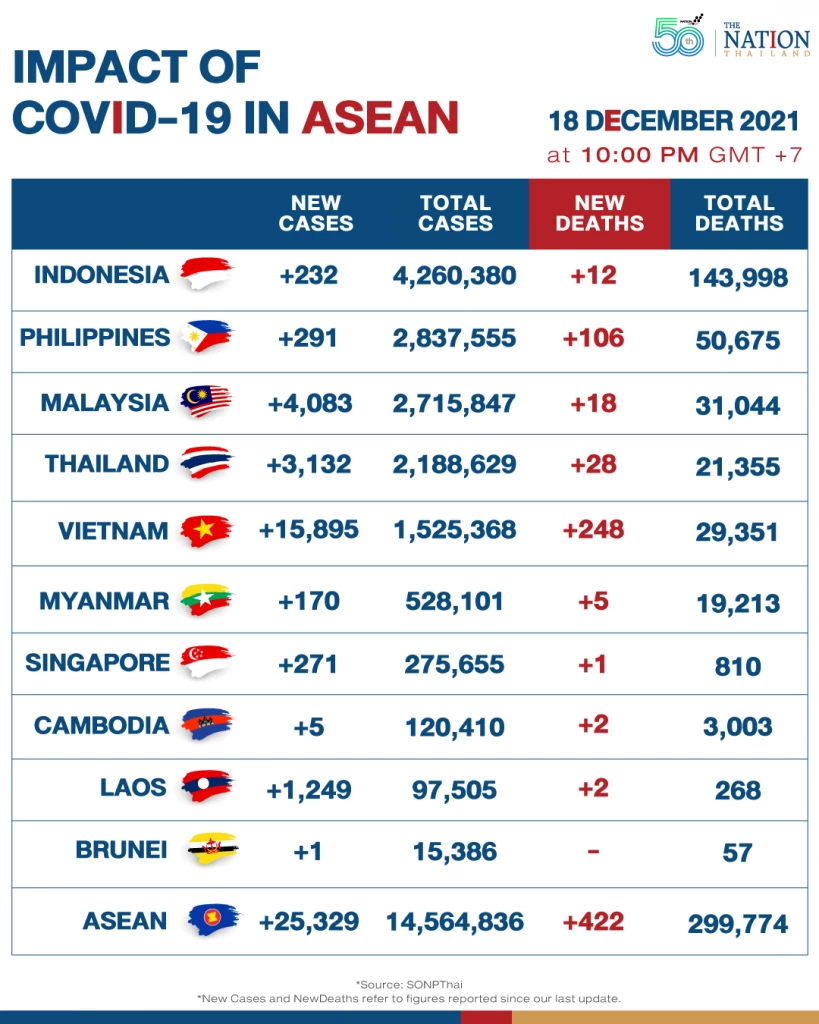
The number of Covid-19 cases crossed 14.56 million across Southeast Asia, with 25,329 new cases reported on Saturday (December 18). New deaths are at 422, bringing accumulated Covid-19 deaths in Asean to 299,774.

Asean reported over 25,000 Covid-19 cases on Saturday

Philippines President Rodrigo Duterte has assured those affected by Typhoon Odette (international name: Rai) that he is trying to look for funds for their aid, saying that government coffers have already been “immensely depleted” due to the Covid-19 pandemic.

During a briefing on the disaster situation in Visayas and Northern Mindanao on Friday, Duterte said that as soon as he gets the funding, assistance will be sent to the provinces ravaged by the super typhoon.

“We are trying to raise the money, I was also late (because) I was talking with the budget, you know our budget has been depleted immensely because of the Covid, we really spent our money,” he said.

“This Covid really emptied our coffers. So we’re trying to screen how much we can raise so that we can marshal it to the areas affected.”

Asean reported over 25,000 Covid-19 cases on Saturday

Published : December 19, 2021

By : THE NATION

Reinstating indoor mask mandate on the table as coronavirus cases surge, Bowser says

#SootinClaimon.Com : ขอบคุณแหล่งข้อมูล : หนังสือพิมพ์ The Nation.

https://www.nationthailand.com/international/40010133


WASHINGTON – Washington D.C. Mayor Muriel E. Bowser, D, on Friday said that reinstating the Districts indoor mask mandate is “on the table,” among other measures, as the city sees its highest-ever daily numbers of coronavirus cases since the pandemic began.

Reinstating indoor mask mandate on the table as coronavirus cases surge, Bowser says

On Friday morning, Bowser implored eligible residents to get vaccinated, schedule their booster shots and reconsider going to social events in the coming weeks. While the vaccine has helped stymie deaths and hospitalizations, Bowser said, the highly transmissible omicron variant – which has now been detected throughout the region – is of particular concern.

Photo Credit : Washington Post photo by Matt McClain

“What is also different is this variant, omicron, and its transmissibility,” Bowser said. “I expect that’s going to warrant some changes in course for us around our emergency response.”

D.C. on Friday reported 844 new coronavirus cases – the highest single-day total at any point in the pandemic, beating the previous day’s record of 508 new cases. The seven-day average of new cases in the city reached 360 Friday – by far the highest average since the pandemic began in March 2020. Hospitalizations in the District have increased as well, with the seven-day average at 154 on Friday, nearly double what it was at the beginning of the month.

The rise in cases can be seen throughout the region. Total cases in Virginia passed the 1 million mark earlier this week, and the seven-day average of new cases there has nearly doubled since the beginning of the month. Maryland, which has not reported cases for two weeks after a cyberattack that affected its health department, has seen hospitalizations there sharply rise, triggering potential surge capacity measures.

Area schools have also been responding to the increases, with some reducing extracurriculars or transitioning to virtual learning because of outbreaks.

Earlier this month, Bowser issued an advisory urging all people to mask up in indoor public settings, just weeks after scaling back the city’s indoor mask mandate. But some residents and local legislators have called on her to reimpose the mandate amid concerns about the latest variant; a plea that was echoed by several D.C. Council members on a weekly call with her administration Friday morning.

Among those who expressed concern was Council member Trayon White Sr., D-Ward 8, who did not appear on the call but announced on social media moments before it started that he had tested positive for the coronavirus.

“Our kids and [families] are not safe,” wrote White, who represents some of the city’s neighborhoods with the lowest rates of vaccination and is also running for mayor. “We need to shut it back down and should not be unmasking. It’s Flu season and the holiday season.”

Council members on Friday also asked about the availability of rapid antigen coronavirus tests during the holiday season and whether they could be made free to the public, particularly in high-risk communities – similar to Montgomery County and Northern Virginia, which unveiled similar programs in recent weeks.

Patrick Ashley, senior deputy director at D.C. Health, said the city had 20,000 of these tests on hand, which are mainly being used in congregate care facilities like nursing homes, jails and public shelters, and was working to secure more before they’re widely distributed.

Ashley said officials would offer more details soon about how the public can access them. In the meantime, Bowser said Friday that she would confer with her administration about possible interventions to slow the spread.

“As we have said throughout this pandemic, as it evolves, we evolve,” Bowser said. She noted that her staff is considering questions around testing, vaccine access and outbreaks in city schools, “which is probably on the top of our list.”

Schools around the region have seen an uptick in confirmed coronavirus cases on their campuses after Thanksgiving, forcing some to move to virtual classes or start an early holiday break. Prince George’s County Public Schools announced Friday they will move to virtual instruction beginning next week because of a surge in coronavirus cases. After winter break, students will continue to learn virtually until Jan. 14.

Montgomery County’s school system announced Friday it would suspend its in-person activities and events beginning Monday. While in-person instruction will go on, they will halt in-person, nonathletic extracurricular activities outside the school day through Jan. 7. Athletic practices and games can continue into next week, but during the winter break, from Dec. 23 through Jan. 2, games will be canceled, with optional practices allowed.

While Northern Virginia school systems have canceled or postponed some athletic events because of concerns about coronavirus exposure, they have yet to close schools or enact major restrictions. A spokeswoman for Fairfax County Public Schools, the state’s largest school system, said Friday that officials there “are watching our numbers closely but are holding steady at this point.”

In the District, schools have pulled grade levels out to quarantine one at a time. D.C. Public Schools told Council members in a statement Friday they’ve closely been monitoring the spread of the coronavirus. Recently, Whittier Elementary School, in Northwest Washington’s Brightwood neighborhood, moved to virtual instruction until Dec. 22, after 14 coronavirus cases were reported, dating back to Dec. 9.

“We’re just seeing right now that this a direct impact of the citywide, regional and national increases of covid-19 in our communities, likely due to the post-holiday surge that health officials warned us about,” DCPS Chancellor Lewis D. Ferebee said in an interview Wednesday.

Whittier’s temporary closure was the first time in the academic year a D.C. Public School had to shift to virtual operations because of an outbreak. Parents and Council members have been curious about how the cases at Whittier were identified and what specifically compelled D.C. Public Schools to pause in-person learning.

Two of the confirmed coronavirus cases were detected through a round of asymptomatic testing that was conducted at Whittier on Dec. 10, according to a report from the Office of the State Superintendent that was shared with D.C. Council members Friday. D.C. Public Schools further told council members in a statement that it moved Whittier to virtual instruction because the school had limited staffing availability and many of its students were in quarantine.

More than 1,000 people signed a petition Friday afternoon that requested all D.C. Public Schools move to virtual learning from Dec. 20 to Dec. 22, right before the scheduled holiday break. School officials said Friday that there are no imminent plans to move other schools to virtual operations.

Published : December 18, 2021

By : The Washington Post

In a bad sign for Boris Johnson, Britains Conservatives lose parliament seat they held for nearly 200 years

#SootinClaimon.Com : ขอบคุณแหล่งข้อมูล : หนังสือพิมพ์ The Nation.

https://www.nationthailand.com/international/40010132


LONDON – Boris Johnsons ruling Conservative Party lost a seat Friday that it had safely held for almost 200 years, in a fresh blow to the British prime minister that renewed questions about his leadership.

In a bad sign for Boris Johnson, Britains Conservatives lose parliament seat they held for nearly 200 years

The Liberal Democrats won North Shropshire in central England after the seat became vacant following a sleaze scandal that engulfed Johnson’s Conservative Party. The pro-Brexit district had sent a Conservative politician to Parliament since its formation in 1832.

The loss is certain to boost Johnson’s critics in the Conservative Party, which in particular is known for deposing leaders it sees as not winning elections.

“The people of North Shropshire have spoken on behalf of the British people. They have said loudly and clearly: ‘Boris Johnson, the party is over,'” Helen Morgan, the newly elected member of Parliament, said in her victory speech.

The shocking result – the centrist Liberal Democrats not only overturned a Conservative majority of 23,000 but won by nearly 6,000 votes – follows a massive rebellion by Johnson’s party this week over his introduction of coronavirus measures to head off a rise in infections.

It’s just one seat of 650 in a Parliament that the Conservatives handily dominate, but it has received national attention as a test for the embattled prime minister, who has endured weeks of bad headlines.

The seat became vacant after Conservative lawmaker Owen Paterson, an ally of Johnson’s, stepped down for breaking lobbying rules.

Johnson took personal responsibility for the loss and acknowledged that voters were frustrated and unaware of all his government’s recent achievements.

“I’ve got to put my hands up and say, ‘Have I failed to get that message across in the last few weeks? Has it been obscured by all this other stuff?’ Yes, I’m afraid it has,” he told broadcasters.

Analysts said the North Shropshire vote concentrated minds on Johnson’s ability – or not – to win elections. “His whole premiership is based on, ‘he’s good at winning elections,'” said Rob Ford, a professor of politics at the University of Manchester. “If it becomes a settled view that, far from being an electoral Gandalf, he is an electoral Voldemort, he’s not long for Number 10,” he added, referring to the prime minister’s address at 10 Downing Street in London.

Paula Surridge, a senior lecturer at the University of Bristol, said some members of the Conservative Party were “never fans” of Johnson’s but were willing to “put up with him” because he was an electoral asset, not a liability. In December 2019, Johnson led the Conservatives to a whopping 80-seat majority, winning seats in traditional Labour Party heartlands in the north of England.

But the latest election shows the “the shine was coming off with voters,” Surridge said.

The Conservative Party is known to be quicker than most at toppling leaders perceived as unable to bring in the voters. Most famously, in 1990 Margaret Thatcher was booted out by her own party with a sudden ruthlessness that surprised Britons.

But Johnson is no stranger to controversy and has bounced back, repeatedly, from scandals and setbacks. And while talk of regicide is easy, there are no reports of a deluge of letters of no confidence flooding in.

Daniel Wincott, a politics expert at Cardiff University, said Johnson has long had a reputation as a “Teflon politician on whom things seem to slide.” But lately, less has been sliding.

Johnson is battling fires on many fronts: a surging omicron variant, rebellious lawmakers, tanking approval ratings.

Arguably most damaging, said Wincott, is the drip, drip, drip of allegations about government staff flouting rules and attending Christmas parties last year at a time when such gatherings were banned. The “sense of hypocrisy does start to stick,” Wincott said.

Johnson denied that any rules were broken and ordered an internal inquiry by Britain’s top civil servant, Simon Case. In a surreal development on Friday evening, Case recused himself from the probe following reports that a gathering was held in his own office around the same time.

Johnson is in trouble, said Ben Page, chief executive of Ipsos MORI, a pollster. “He’s made a series of self-inflicted wounds, and if he continues on the same track, then all bets are off.”

But he added that things were “not yet terminal” and that “assuming he can get his act together, he can recover.” The next general election is due in 2024. While the Labour Party is currently polling slightly ahead of the Conservatives for the first time in years, it would still lose if an election were held today because of boundary changes and demographics.

Surridge, the lecturer, said she did not think Johnson was in “immediate trouble” but allowed that the tide has turned against him. The “events of the last few weeks have damaged him enough that it’s sort of the beginning of the end,” she said. “I don’t think the end will be soon, but I think it will be difficult to recover from completely.”

Published : December 18, 2021

By : The Washington Post

U.S. airstrikes on Taliban surged in wars final month amid failed bid to prevent Afghan armys collapse

#SootinClaimon.Com : ขอบคุณแหล่งข้อมูล : หนังสือพิมพ์ The Nation.

https://www.nationthailand.com/international/40010130


U.S. airstrikes against the Taliban surged in August, rising to levels not seen in nearly a year as part of the final, failed attempt to prevent the Afghan armys collapse as militants rapidly took over the country, according to data disclosed Friday.

U.S. airstrikes on Taliban surged in wars final month amid failed bid to prevent Afghan armys collapse

The burst of attacks came as Taliban fighters encircled numerous provincial capitals and ultimately seized control of Kabul, Afghanistan’s capital, on Aug. 15. About 153 U.S. bombs or missiles were dropped by U.S. war planes and drones that month, up from 18 in July, the data showed.

Until Friday, the U.S. Air Force had not released such a report for nearly two years.

The data does not include strikes launched by the Afghan air force, which routinely carried out bombing until disbanding along with the central government. Nonetheless, the numbers offer a fresh look at how the American military scrambled in the waning days of its longest war, as the situation on the ground grew increasingly desperate for U.S.-trained Afghan forces being overpowered by the Taliban’s assault.

For many years, the U.S. Air Force released “air power summaries” monthly in a demonstration of transparency to American taxpayers, congressional oversight committees and U.S. allies. But publication was suspended after the Trump administration signed a deal with the Taliban in February 2020 that promised to withdraw U.S. troops by this year in exchange for a handful of concessions, including that militants stop attacking U.S. troops. U.S. forces remaining in Afghanistan would retain the ability to defend themselves, U.S. officials said, but they continued to carry out limited airstrikes in support of their Afghan allies.

Pentagon spokesman John Kirby said Friday before the reports’ distribution that Defense Secretary Lloyd Austin directed that the data again be released in an effort to improve transparency. The withheld monthly reports date back to February 2020, he said.

Kirby said there have been no U.S. military airstrikes in Afghanistan since the withdrawal was completed Aug. 30. The Pentagon will continue to provide air power summaries, he said, with publication by Air Forces Central Command, which oversees operations in the region.

The airstrikes occurred as hundreds of civilians were killed per month in 2021, mostly in roadside bomb explosions or fighting between Afghan forces and the Taliban, according to U.N. mission reports. The U.S. military did kill some civilians, however, including in an Aug. 28 strike in Kabul in which commanders thought they were striking an Islamic State bomber but killed an aid worker and nine other civilians.

At the height of its air campaign against the Taliban, the U.S. military conducted thousands of strikes annually, reaching a high of 7,423 in 2019, as commanders attempted to force the Taliban to negotiate an end to the war.

The bombing campaign remained busy early in 2020, with 415 weapons dropped in January and 360 in February of last year. But it plummeted after the withdrawal deal was signed, with 116 weapons dropped in March, 27 in April, 15 in May and 18 that June, the newly released data show.

The numbers climbed again from there, as the Taliban mostly held true to not attacking U.S. troops but waged a bloody campaign against Afghan police and soldiers. The U.S. military dropped 246 weapons in October 2020, and then more than 100 per month for the first third of 2021, the reports show. The numbers tailed off again beginning in May, before the last spike as the Taliban asserted control of the country.

Published : December 18, 2021

By : The Washington Post