Irans chief negotiator in the Vienna talks announced on Thursday that two draft texts containing Irans proposals on sanctions removal and nuclear restrictions have been presented to the parties to the 2015 nuclear agreement, formally known as the Joint Comprehensive Plan of Action (JCPOA).
“Logically, the other side should now examine these documents in order to get ready to enter into serious talks with Iran on the texts,” Ali Bagheri Kani told Iranian media in the Austrian capital.
He voiced hope that the JCPOA parties will be able to review Iran’s drafts and reach their conclusions about them “in the shortest time possible.”
Bagheri also warned about efforts by non-parties to the agreement to derail current diplomatic work to revive the deal.
Earlier in the day, Israeli Primer Minister Naftali Bennett urged an “immediate halt to negotiations” with Iran and “the implementation of tough steps by the world powers” against Iran in a phone call with U.S. Secretary of State Antony Blinken, Bennett’s office said in a press release.
Photo taken on Nov 29, 2021 shows a meeting of the Joint Commission on the Joint Comprehensive Plan of Action (JCPOA) in Vienna, Austria. (EU Delegation Vienna/Handout via Xinhua)
Israeli media reported on Monday that the Israeli government has been contacting U.S. and European officials over the past two weeks to provide its alleged intelligence that Iran would be taking steps to enrich uranium at a weapons-grade degree of purity.
Rafael Grossi, head of the International Atomic Energy Agency (IAEA), dismissed on Wednesday the claim that Iran would be enriching uranium at a 90-percent degree of purity, noting that the IAEA is the only monitoring institution with a presence at Iranian nuclear sites.
“There is no 90-percent enrichment at the moment in Iran. You have enrichment at five percent, you have enrichment at 20 percent, you have enrichment of 60 percent … but we don’t have any information about 90-percent enrichment,” Grossi said in an interview with French state TV.
In his remarks to the press on Thursday, Bagheri said he warned his JCPOA counterparts on Wednesday about “the outlook and approach of actors outside the talks to negatively affect the negotiation process.”
The current round of JCPOA talks resumed this week in Vienna after a nearly six-month pause, about three months after the current Iranian government took office in late August.
Representatives from Iran and the P4+1 group, namely Britain, China, France, Russia plus Germany, as well as the European Union, are seeking an agreement on the way to remove U.S. sanctions on Iran, in exchange for the reimposition of restrictions and enhanced international monitoring on Iran’s nuclear program.
The new actions include increasing vaccine outreach across the United States, tightening pre-departure COVID-testing protocol for all inbound international travelers, and requiring a negative test within one day of departure for the country.
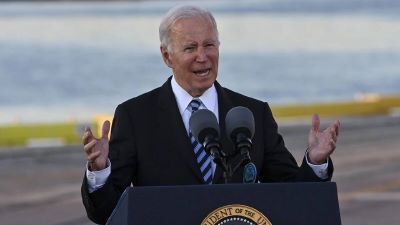
U.S. President Joe Biden on Thursday announced an array of new measures in fighting COVID-19 as two confirmed cases of Omicron have been reported in the country.
“It’s the combined advice from all of you that we developed this plan, and it doesn’t involve shutdowns or lockdowns but widespread vaccinations, and boosters, and testing and a lot more,” Biden said in a speech at the National Institutes of Health.
Biden said the measures would allow schools and businesses to stay open while keeping Americans safe. “We’re going to fight this variant with science and speed, not chaos and confusion,” he said.
The new actions include increasing vaccine outreach across the United States, tightening pre-departure COVID-testing protocol for all inbound international travelers, and requiring a negative test within one day of departure for the United States.
Earlier, the Biden administration has announced restrictions of travel from South Africa and seven other southern African countries where the Omicron variant was identified.
It also announced a plan to extend a mask requirement for domestic travel, originally slated to expire in January, until mid-March.
The second U.S. case of the Omicron COVID-19 variant was found in the midwestern state of Minnesota on Thursday, a day after the first case was confirmed in California.
Germany imposed stringent nationwide restrictions on people who arent vaccinated against Covid-19 and limited attendance at soccer games and other public events to check a brutal surge in infections.
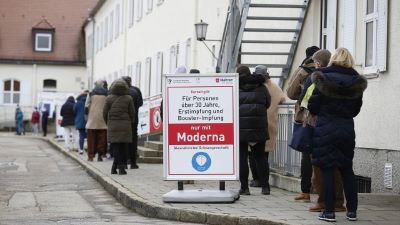
In one of her final acts as chancellor, Angela Merkel held talks with her incoming successor, Olaf Scholz, and Germany’s 16 regional premiers on Thursday, where they agreed on new curbs including allowing only people who are vaccinated or recovered into restaurants, theaters and non-essential stores.
The officials also backed a plan to make Covid shots compulsory, saying that the lower house of parliament would vote on it soon. Scholz said he expects the measure to pass, and Merkel said she would vote for it if she was in the Bundestag.
“We’re in a very, very difficult situation,” said the Social Democrat, who is due to be sworn in on Wednesday. “We have very many citizens who are vaccinated but not enough to prevent another wave of infections. Those who have not been vaccinated must do so, and that’s my very urgent personal appeal.”
A vaccine mandate would be a major departure after Merkel and other officials insisted shots would be a personal choice. The soft tone may have contributed to Germany’s relatively tepid uptake, with less than 70% of the population fully inoculated. The step will be controversial, and further protests from vaccine opponents are all but assured.
Germany’s change in power after the Sept. 26 election has slowed the government’s response to a resurgence in the pandemic. Despite the growing urgency as hospitals fill up, authorities were keen to avoid blanket curbs and close schools.
The new measures include tighter contact restrictions for non-vaccinated people, shutting nightclubs in places with high infection rates and strict limits on the number of spectators at large public events.
The agreement makes the guidelines national. Some regions with high infection rates like Bavaria and Saxony had already tightened restrictions, and states continue to have the authority to clamp down harder locally.
While there has been some recent good news, with Germany’s infection rate slipping for a third straight day, medical officials have warned that the situation remains serious.
“We are seeing something of an easing but at a level that’s far too high,” Merkel said in what could be her final press conference as chancellor. “That’s why we needed to agree these measures today.”
The head of the DIVI intensive-care lobby predicted on Wednesday that the number of Covid patients in ICUs will reach 6,000 by Christmas, exceeding the previous record. Thursday’s level of 439.2 cases per 100,000 people over the past seven days is still more than double the peak in the spring.
To protect more people, authorities want to administer as many as 30 million vaccine doses by the end of the year, including boosters. Officials also want to significantly expand the pool of people who can give shots, including using qualified workers in drug stores and care facilities.
While the U.S. braces for the unknown of omicron, which has now been detected in Minnesota, St. Cloud Hospital in the central part of the state is still deep in battle with the delta variant of the coronavirus.
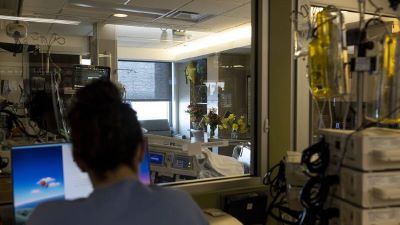
Beds have been full for seven weeks with a flood of mostly unvaccinated patients, a hospital official said. The hospital routinely turns down other overwhelmed facilities trying to transfer covid patients – sometimes saying no as many as 15 to 20 times a day.
The first U.S. cases of omicron have been detected in California and Minnesota – about 60 miles southeast of St. Cloud in Hennepin County, in a man who traveled to New York City last month. He was vaccinated and has recovered, health officials said.
But public health experts in Minnesota and nationwide are urging Americans not to lose sight of the fact that the overwhelming majority of the nation’s coronavirus cases – and those in Minnesota – are caused by the highly transmissible delta variant. Over the past six months delta has been responsible for some of the worst spikes of the entire pandemic. It is so contagious that even states with above-average vaccination rates have seen surges – and many are bracing for cases to increase again.
George Morris, covid-19 response incident commander for CentraCare, St. Cloud Hospital’s parent organization, described delta as a train going off the tracks. “We just continue to see rail car after rail car pile onto this derailment,” he said.
“Omicron is potentially another train coming,” Morris said. “It’s a whole other train coming right behind a wreck.”
Doctors and others on the front lines warn delta strikes rapidly, filling up hospitals so quickly some started rationing care for the first time in the pandemic. Vaccinated people end up infected in higher numbers when transmission is out of control. While they are unlikely to fall seriously ill, they can still spread the virus, end up with a nasty but clinically mild case they’d rather avoid or end up hospitalized if they are elderly or immunocompromised.
Even if omicron turns out to be less worrisome than feared, epidemiologists warn the U.S., particularly the Northeast and Upper Midwest, is still headed toward a winter surge fueled by the delta variant as people travel for the holidays and gather indoors in cold weather. While officials are urging Americans to get booster shots to protect themselves as much of the country heads indoors, just over one in five Americans have received them as immunity from initial shots starts to wane.
“Forget about omicron right now. We are not even handling delta well, no matter what happens to omicron,” said Eric Topol, director of the Scripps Research Translational Institute. “We have the combination of elapsed time, a hyper contagious variant and relaxed mitigation. It’s the perfect storm to have a surge.”
Scientists expect clearer data by the end of the next week that would explain whether omicron is even more contagious than delta and more resistance to vaccines or therapeutics.
But in the meantime, they are reminding Americans that it wasn’t long ago that delta was the frightening variant identified abroad during India’s spring surge. Now delta is the dominant strain in the U.S. And it has remained the top threat because it is so contagious even as other variants have come and gone.
Unlike omicron, scientists have answered crucial questions about delta, including that it can be spread by the vaccinated who contract breakthrough infections and that it is 50 percent more contagious than the predominant strain last spring. While there are still outstanding questions about whether it makes people more sick, doctors have anecdotally reported having younger patients showing up to the hospital faster compared to 2020 and the Centers for Disease Control and Prevention has cited some studies suggesting delta cases are more likely to require hospitalization.
New Jersey Health Commissioner Judy Persichilli stressed delta was driving the state’s uptick in hospitalizations during a Monday press briefing addressing omicron.
“I encourage everyone not to be hysterical about what we don’t know about omicron, but to be really proactive in controlling what we do know, which is the delta variant is here, it’s with us, it’s causing increasing trends,” Persichilli said.
The same protective measures that officials have long been urging still apply now: Getting vaccinated and boosted, wearing masks in crowded indoor settings and getting tested before big family gatherings.
After announcing the first known omicron case, Minnesota health officials stressed the persistent delta surge is reason enough to take precautions.
“Even without omicron, there was plenty of reason for people to take full advantage of those prevention tools,” Minnesota Health Commissioner Jan Malcolm told reporters Thursday. “Omicron again is just another kind of wake-up call if we needed one.”
St. Cloud Hospital is experiencing how delta can stretch hospitals to their limits. And that’s before an expected spike linked to Thanksgiving travel and gatherings.
“We’re at the point where we are borderline saying nobody is going to get in,” Morris said of transfer patients. “And that’s going to be real hard, because we’re going to have people backed up in the emergency room, backed up in all of our regions, backed up at home because we’re full.”
The surge at the University of Michigan Health-West is stretching into a third month – the longest one of the pandemic – with no immediate end in sight.
Chief medical officer Ronald Grifka says the hospital is under strain, with health care workers testing positive and having to miss work. Many procedures have been delayed. And even though some of those procedures are considered elective, Grifka noted that deferrals can have a major impact. He gave the example of a patient falling after a hip surgery was canceled and landing in the hospital for emergency surgery.
Test positivity rates have been hovering around 20 percent, he said, suggesting the virus is still rampant and cases will continue rising after Thanksgiving gatherings. And state surveillance data suggests delta accounts for nearly every Michigan infection.
“It’s here. It’s still wreaking havoc in the community,” said Grifka. “We can’t take our eyes off delta, that’s for sure.”
Unlike with omicron, the U.S. has the benefit of hindsight with delta.
Delta fueled India’s devastating early 2021 coronavirus surge, marked by harrowing scenes of people dying on the streets gasping for air because hospitals ran out of beds and oxygen.
That wave arrived during an optimistic time in the U.S. as Americans emerged from a dark winter surge and vaccines were becoming widely available.
“It’s always not us until it is us,” said Ashish K. Jha, the dean of the Brown University School of Public Health who urged Americans to treat India’s crisis as an American problem. “At the very beginning it was China, but not us. Then it was Italy, but not us. Then it was us. Then it was New York, but not the rest of the country. It baffles the mind how we manage to delude ourselves into thinking it’s always over there, and it’s not going to hit us in our own home.”
The Ozarks became one of the first delta hotspots in the U.S. last June and July. Hospitals in Springfield, Mo., warned they were treating more patients than at any point during the pandemic – a harbinger for the record shattering hospitalizations throughout the Southeast and rural West in the months ahead.
“When delta overwhelms southwest Missouri, which is not very densely populated, it’s very foreboding what it can do to highly densely populated areas like the Northeast,” said Steve Edwards, chief executive of CoxHealth, which operates a Springfield hospital that was battered in the summer and recently reopened a covid ward as admissions rise again.
Edwards watched in dismay as much of the country failed to heed the lessons from southern Missouri before delta tore through the Sun Belt and rest of the Midwest.
“Half the country listened and the other half listened to an ideology based on politics, religion and their sense of culture which overrode their understanding of science,” Edwards said. “It kind of breaks your spirit because it’s an open-book test and the answers are there.”
Instead of the country uniting behind the common threat of the delta variant, it became more sharply divided as Republican governors and state legislatures focused on reining in public health measures rather than the virus itself.
Florida Gov. Ron DeSantis, a Republican, waged a war against local governments and businesses attempting to require masks and vaccines even as his state reported nearly 20,000 fatalities since the delta surge started in July. Hospitalizations soared past 17,000, an all-time peak. Texas banned vaccine mandates as the state health department reported unvaccinated Texans were 40 times more likely to die of covid-19. Overwhelmed hospitals in Alaska, Montana and Idaho were forced to ration care.
Idaho’s largest health system, St. Luke’s, came “very close” to having to ration care during a delta surge earlier this fall, said chief physician executive Jim Souza. He described a herculean effort to avoid that crisis: treating patients for septic shock in emergency department waiting rooms, expanding nurse-patient ratios, converting hospital spaces to fit additional beds.
Still, patient care was affected. The safety net was there, he said, but it “got a little bit threadbare.”
For parts of the country that have not yet experienced a delta surge, Souza said, “do not underestimate this virus’s ability to move into exponential growth. Do not underestimate what that will mean for your teams.”
Perhaps one of the most important lessons from the delta surges is that highly vaccinated areas are not spared. By August, counties with above average vaccination rates still short of herd immunity were igniting as covid-19 hotspots. But places with higher vaccination rates also saw lower hospitalization rates as the vaccine succeeded at its core job of keeping people from becoming seriously ill.
New Orleans was an early test of how a highly vaccinated community can manage new waves of the surge. Officials believe breakthrough infections were a major driver of the surge, but noted hospitalization rates were much lower among city residents than residents of poorly vaccinated rural parts of Louisiana.
“It’s just a numbers game: When you have a population that was 75 percent vaccinated, if everyone is exposed to delta as we probably were in some form or fashion, that’s a lot of people who are going to get a breakthrough infection,” said Jennifer Avegno, the city’s top public health official.
The city ended up imposing an indoor mask mandate, regardless of vaccination status, and required restaurants and bars to require proof of vaccine for entry. Avegno said people in highly vaccinated communities should ignore the threat of delta at their own peril. Even if young adults with breakthrough infections are comfortable with their low risk of severe cases, they can spread it to the unvaccinated or vaccinated people who will have a harder time mounting an immune response.
“I hope our example is not unheeded,” Avegno said in an interview. “Sometimes there’s a tendency to cast aspersions on a particular region that got the outbreak first and say that’s them, rather than saying how can we learn from their lessons so we don’t have to go through the same thing.”
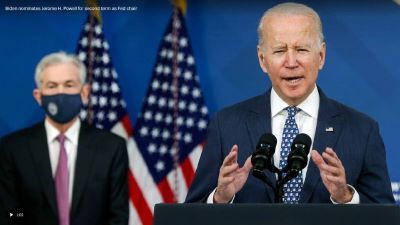
WASHINGTON – President Joe Biden announced an array of measures Thursday to protect Americans from a potential winter surge of coronavirus infections, as three states confirmed cases linked to the omicron variant and international researchers shared data that the still-mysterious variant may lead to more reinfections.
“We’re going to fight this variant with science and speed, not chaos and confusion,” Biden said in a speech at the National Institutes of Health, appealing to Americans to put aside partisan differences and continue to get vaccinated, wear masks and take other precautions. “This is a moment we can put the divisiveness behind us, I hope.”
The president’s plan includes campaigns to increase vaccinations and booster shots, more stringent testing requirements for international travelers and plans to make rapid at-home coronavirus testing free for more people. While some of the measures are new – notably a plan to launch “family mobile vaccination clinics,” where all eligible members of a family could simultaneously get shots and boosters – others build on existing tactics, such as rallying businesses to mandate vaccination-or-testing requirements for employees.
Public health experts praised aspects of Biden’s plan but called for further investments in testing, screening and combating misinformation about the vaccines. They also said that Biden’s vow that the nation will ward off omicron after it “beat back” the delta variant doesn’t reflect a reality where the virus continues to circulate at high levels, with more than 140,000 coronavirus-linked deaths in the United States since the start of September.
It’s the “most aggressive pandemic plan yet for the United States, but still falls short of all that’s needed now,” said Eric Topol, director of the Scripps Research Translational Institute.
Biden’s package of coronavirus strategies comes as officials confirmed omicron-linked infections in California, Minnesota and Colorado, and South African researchers reported that the new variant appeared to significantly increase coronavirus reinfections among those who had previous cases, although the symptoms were mild. Scientists caution that it will take days, if not weeks, to fully understand if the new variant can evade current vaccines and treatments, or cause more severe symptoms in infected people.
In his remarks, Biden stressed that the vaccines remain the best protection against existing and new variants, and that all adults should get a booster shot as soon as they are eligible,given that immunity appears to wane over time – a position increasingly echoed by public health experts.
“Starting today, we’re making it easier than ever to get a booster shot,” the president said, touting a plan for pharmacies to send text messages and emails to remind Americans when they are due for the additional shots. The federal health department also will launch new booster-shot ad campaigns and partnerships with organizations like AARP, the advocacy group for older Americans.
Medicaid, the safety net health insurance program, also will reimburse participating health-care providers for “COVID-19 counseling visits,” where health workers answer families’ questions about vaccines and stress the importance of getting children immunized.
But as the White House confronts a slowdown in new vaccinations, it was unclear whether such plans would spur significant movement in a country where attitudes appear to have hardened over the last year. Fifty-eight percent of Americans were considered “fully vaccinated” against the coronavirus as of Nov. 1 – a figure that climbed to only 59.4% as of Dec. 1, according to The Washington Post’s vaccination tracker.
There is also emerging evidence of a widening partisan gap among Americans choosing to get a booster shot. The Kaiser Family Foundation on Thursday reported that 32% of vaccinated Democrats have received a booster shot, compared to 21% of independents and 18% of Republicans. Meanwhile, 31% of vaccinated Republicans said they definitely or probably would not get a booster shot.
“We saw partisanship play out as the biggest predictor of whether people would get a first shot,” said Liz Hamel, a Kaiser Family Foundation vice president. “Now we’re seeing that even among the fully vaccinated, Republicans are less eager to get boosters.”
Biden also touted a plan to make rapid at-home tests more available by requiring private insurance companies to reimburse consumers for the cost of the tests, beginning in January, while community health centers and some rural clinics offer them for free. “Private insurers already cover the expensive PCR test that you get at a doctor’s office, and now they will cover at home tests as well,” the president said, although the plan will not apply retroactively to already purchased tests.
Some public health experts said they had questions about how the model – which calls for the departments of Health and Human Services, Labor and Treasury to issue federal guidance by Jan. 15 – would be implemented.
Nirav D. Shah, president of the Association of State and Territorial Health Officials and director of Maine’s Center for Disease Control and Prevention, said that state officials are hoping the reimbursement would be approved in real time when someone bought the test – in the same way such claims are processed when people get flu shots and prescription medications.
“Lumping in the covid test under that model would greatly expand access,” he said during a news conference Thursday.
Others argued it would be better for the government to buy the tests and distribute them widely at no charge.
Using private health insurance is “a sucker strategy,” added Tinglong Dai, professor of operations management and business analytics at the Johns Hopkins University Carey Business School. “You have to buy this test and then get reimbursed; it’s a lot of hassle.” In addition, he said, insurance companies eventually raise premiums to recoup their costs. “Nothing is really free,” he said.
Public health experts have spent months clamoring for more access to rapid coronavirus testing, warning that the lack of real-time data on infections has had disastrous consequences for containing the virus’s spread.
“Free and highly available rapid tests would be a game-changer,” said Charity Dean, a former California health official and the CEO of the Public Health Company. “If we had rapid tests at every door for every school, every movie theater, any person can go and get them – just like they can in many other countries – it would enable people to have personal responsibility and know when they’re infectious.”
Shah, head of Maine’s CDC, stressed the continued difficulty that states have had in obtaining rapid at-home tests from manufacturers, as well as getting funding to pay for them. State health departments buy tests in bulk for schools, nursing homes, prisons and other places experiencing local outbreaks.
In Maine, officials have ordered tens of thousands of Abbott’s BinaxNOW rapid at-home antigen tests for delivery, but Abbott has not delivered in a timely fashion, Shah said. While there are other authorized rapid tests on the market, state officials need to send the same test to institutions because “that’s what they know how to use,” Shah said.
Biden also announced that inbound international travelers must be tested for the coronavirus within one day of global departure, regardless of nationality or vaccination status, beginning early next week. That toughens protocols for vaccinated travelers, who had been able to get tested as long as three days before departure. The move, which federal officials had weighed earlier this week, comes after the White House imposed travel restrictions on eight nations in southern Africa following warnings from scientists about the emergence of the omicron variant.
Celine Gounder, an epidemiologist and infectious-disease specialist who advised Biden’s transition team on covid-19 response, said she was unhappy the White House prioritized restrictions and testing for international travelers, while overlooking domestic flights.
“When you think about Texas, it’s the size of France – and it operates as its own country in many respects,” Gounder said, calling for a renewed focus on how state policies contribute to the virus’s spread. “If you’re really trying to prevent spread of dangerous variants, you should be providing similar standards across the board,” she said.
Asked about additional restrictions on domestic and international flights, White House press secretary Jen Psaki said Thursday that “nothing is off the table” when it comes to controlling the virus’s spread. Psaki said the administration is considering what is “most implementable” but noted that “our most important factor is what is going to be most effective.”
Biden also extended requirements that travelers wear masks on airplanes, public transportation and trains, as well as in transportation hubs such as airports and bus stations. The measures, which were set to expire in January, will run through at least March 18, and the minimum fine for noncompliance will be doubled to $500. But the administration’s plan does not include new masking or vaccination mandates – a move that White House officials characterized as unnecessary and that public health experts said would be difficult to implement.
“I feel like they’ve kind of maxed out what they can do with mandates, from a political perspective,” Gounder said.
Some experts said that renewed shutdowns in the wake of omicron would likely be unnecessary.
“The reason why we had to do broad shutdowns and broad stay-at-home orders in March 2020 was because we were flying blind” and lacked information on the virus or how to fight it, Dean added. “Today . . . we can use the tools at our disposal to execute containment and mitigation with surgical precision.”
Biden’s plan arrives as White House officials are in constant communication with their counterparts overseas and vaccine manufacturers about the potential impact of the omicron variant.
Biden and his aides have long said his political fortunes are tied to the pandemic response. And after a difficult summer highlighted by climbing covid cases, a chaotic withdrawal from Afghanistan and supply chain disruptions, White House officials were optimistic about shifting the focus to the president’s economic agenda as the ravages of the delta variant subsided. But the emergence of a new and potentially more dangerous variant has complicated the president’s messaging efforts.
“I expect this not to be the new normal,” Biden said Monday when asked if the country should get used to the idea of new variants and occasional rounds of travel restrictions.
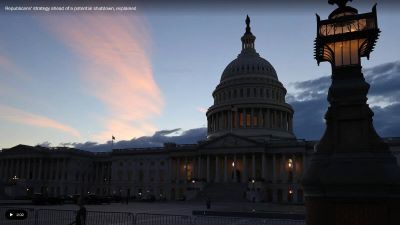
WASHINGTON – House lawmakers on Thursday adopted a bipartisan bill to fund the government into early next year, but a Republican revolt in the Senate against President Joe Bidens vaccine policies still threatened to grind key federal agencies and programs to a halt.
The 221-to-212 nearly party-line vote in the House marked an important development if lawmakers hope to stave off a shutdown that is set to occur at midnight Friday. But its fate in the Senate seemed in great doubt, as Republicans doubled down in opposition to its swift passage with just over 24 hours before the crucial fiscal deadline.
For the second day in a row, a group of Republicans led by Sen. Roger Marshall of Kansas threatened to hold up the government funding measure in protest of a presidential directive that orders large employers to require coronavirus vaccines for workers or implement comprehensive testing programs. Even though many public health experts see such policies as critical to combating the pandemic, the GOP lawmakers charged that Biden’s mandates are unconstitutional and threaten Americans’ rights and jobs.
“We have seen in the course of this pandemic Democrats being very comfortable with being petty tyrants and decreeing that you must obey their medical mandates,” said Republican Sen. Ted Cruz of Texas, who has played a lead role in prompting at least one shutdown in the past.
The GOP blockade created significant political headaches for Senate Majority Leader Charles Schumer, D-N.Y., and Senate Minority Leader Mitch McConnell, R-Ky., who endorsed the bipartisan funding deal earlier in the day. Only with the support of every chamber lawmaker can the Senate advance the spending resolution before midnight Friday – otherwise a shutdown into early next week is all but guaranteed.
Republicans including Marshall and Cruz did signal Thursday they might be open to an agreement to speed up the clock. Seeking to wield their influence ahead of a critical fiscal deadline, they each said they would be open to allowing the funding bill to proceed expediently in exchange for a vote on an amendment that would defund federal enforcement of Biden’s vaccine and testing policies.
Yet Democratic and Republican leaders by Thursday evening declined to say whether they are willing to permit such an amendment, which conservatives have said they want to be set at a 51-vote threshold for passage. Adding to the political uncertainty, Sen. Joe Manchin, D-W.Va., unexpectedly expressed an openness to supporting such a GOP-led amendment on vaccines, even though he opposed a similar effort offered by Republicans earlier this fall. That vote had occurred before the president announced his vaccine-and-testing policy targeting private businesses.
“I’ve been very supportive of a mandate for federal government, for military, for all the people who work on a government payroll,” Manchin said. “I’ve been less enthused about it in the private sector. So we’re working through all that.”
The Senate jostling only raised the odds that the country could barrel into a short-term shutdown this weekend, an outcome that both parties have insisted for days they do not actually want. The growing possibility even prompted Biden to engage Senate leaders directly Thursday, after which he told reporters he thinks a shutdown will not occur.
“We have everything in place to be able to make sure there is not a shutdown,” Biden said.
On Capitol Hill, meanwhile, some Republicans appeared frustrated by the political predicament created by members of their own party – especially since the funding bill has the votes necessary to pass.
“We know ultimately we’re going to fund the government,” said Sen. Richard Shelby of Alabama, the top Republican on the chamber’s appropriations panel and one of the architects of the new funding deal.
In the process, Shelby said lawmakers faced an urgent political choice: “Do we do it before midnight [Friday]? Or do we stretch it out a few days and get the same result.”
Washington is no stranger to government shutdowns, though each one is different in its scope, duration and the number of Americans it affects. For the most part, many federal operations continue during a funding lapse: Social Security and Medicare benefits do not halt, the Postal Service continues delivering mail, and military functions can proceed.
At times, though, the disruptions can prove significant. National parks often close, though the Trump administration tried to keep them open during a lengthy shutdown two years ago in manner that some budget experts said violated federal law. Passport applications can be delayed, and foreign embassies can curtail services. Federal agencies shutter many services deemed nonessential, sometimes delaying things such as tax filings and passport applications.
For many workers, meanwhile, the implications can be severe. Hundreds of thousands of federal employees are often sent home or forced to work without pay. Those furloughs and other consequences may not rear their heads in the event the shutdown only occurs into a weekend, but the disruptions could prove more troublesome for families and businesses in the event that it drags on for an extended period of time.
With these consequences in mind, Democrats and Republicans began Thursday on a positive political note, brandishing a new funding deal. Known as a continuing resolution, it is set to cover federal operations into Feb. 18 – at which point lawmakers either must adopt another short-term deal or complete their work on roughly a dozen longer-term appropriations bills that fund the government for the remainder of fiscal 2022.
Lawmakers also included as part of the stopgap an additional $7 billion to assist Afghan evacuees. But they generally did not address a slew of unresolved policy issued that they had hoped to tackle as part of the continuing resolution, a reflection of the tense talks that delayed a vote on government funding for days.
“While I wish it were earlier, this agreement allows the appropriations process to move forward toward a final funding agreement which addresses the needs of the American people,” said Rep. Rosa DeLauro, D-Conn., the leader of the House Appropriations Committee.
Shelby later offered his own blessings: “I’m pleased that we have finally reached an agreement on the continuing resolution. Now we must get serious about completing [fiscal 2022] bills.”
Those fights entering February are likely to be fierce, as Democrats hope to deliver on Biden’s budgetary goals, spending greater sums in areas including health and education, while Republicans hope to whittle down those amounts and devote more resources to the Pentagon. Democrats and Republicans also have squared off on a host of policy items, including the fate of the Hyde Amendment, which blocks federal funding for abortion – a provision Democrats hope to scrap despite unwavering GOP objections.
For now, though, House leaders on Thursday adopted the short-term resolution after a brief debate. Taking to the chamber floor, House Majority Leader Steny Hoyer, D-Md., blasted the GOP for failing to provide “any help” toward funding the government until the fiscal year that ends in September.
“This is a result of the inability of the Congress to work,” he said.
House Republican leaders, meanwhile, encouraged their members to oppose the spending stopgap in a move that threatened to inch the country closer to a shutdown. In doing so, they argued that Democrats had failed to negotiate because they spent too much time trying to advance Biden’s broader economic agenda. All but one – Rep. Adam Kinzinger, R-Ill., – later opposed the bill.
“This government should be shut down,” said Rep. Marjorie Taylor Greene, R-Ga., citing a need to control the deficit only days after she said denying federal funding would thwart the president’s vaccine policy and stall Democrats’ agenda. “You want to know why it should be shut down? Because the people in here. The people in here cannot control themselves.”
While the House ultimately muscled through GOP objections, the Senate soon found itself staring down a lengthier, more treacherous fight – chiefly as conservatives raised new objections around vaccines.
Speaking from the well of the chamber, Sen. Mike Lee, R-Utah, blasted Biden’s vaccine-and-testing policies targeting companies as unconstitutional. He slammed Schumer specifically, stressing that conservatives for weeks had made clear to the majority leader that they planned to push an effort to defund the mandates as part of the debate over federal funding.
“I don’t want to shut down the government,” Lee said. “The only thing I want to shut down is Congress funding enforcement of an immoral, unconstitutional vaccine mandate.”
Schumer, for his part, expressed his hope earlier Thursday that “cooler heads will prevail on the other side.” He touted the bipartisan work that had yielded the new deal to fund the government until February, adding of the potential for obstruction: “If there is a shutdown, it will be a Republican, anti-vaccine shutdown.”
McConnell, meanwhile, insisted that dissenting lawmakers would eventually fall into line. “We’re not going to shut the government down,” he told Fox News. “That makes no sense for anyone. Almost no one on either side thinks that’s a good idea.”
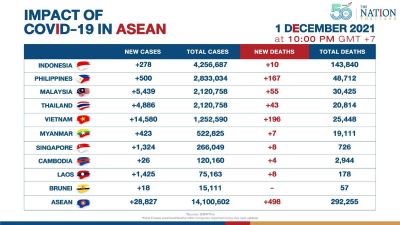
The number of Covid-19 cases crossed 14.1 million across Southeast Asia, with 28,827 new cases reported on Wednesday (December 1), higher than Tuesday’s tally at 26,937. New deaths are at 498, decreasing from Tuesday’s number of 370. Total Covid-19 deaths in Asean are now at 292,255.
Vietnam’s National Institute of Hygiene and Epidemiology announced that the third phase trial of a Vietnamese Covid-19 vaccine “Covivac” has been suspended over difficulties in finding volunteers. The trial needed around 4,000 volunteers, but with no district having thousands of unvaccinated residents who qualify for clinical trials, finding the needed volunteers has proved difficult.
Meanwhile, Malaysia has temporarily banned the entry of travellers from countries that have reported the Omicron Covid-19 variant or are considered high-risk. Malaysia will also delay plans to set up Vaccinated Travel Lanes (VTL) with the affected countries, and reimpose quarantine requirements for Malaysian citizens and long-term residents returning from those nations, regardless of their vaccination status.
Less than a week after the new omicron variant of the coronavirus was reported to the World Health Organization, global leaders on Wednesday agreed to start negotiations to create an international agreement to prevent and deal with future pandemics – which some have dubbed a “pandemic treaty.”
The special session of the World Health Assembly, only the second ever held by the WHO’s governing body, pledged by consensus to begin work on an agreement, amid a round of applause, after three days of talks.
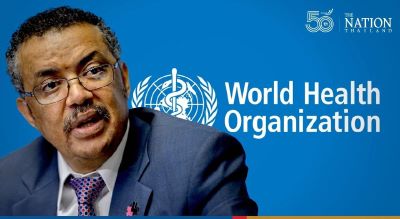
“I welcome the decision you have adopted today, to establish an intergovernmental negotiating body to draft and negotiate a WHO convention, agreement or other international instrument on pandemic prevention, preparedness and response,” WHO Director General Tedros Adhanom Ghebreyesus said.
The commitment by countries to negotiate a “global accord” would “help to keep future generations safer from the impacts of pandemics,” he added.
However, agreeing to agree is a slow process, and any final treaty could take years and is likely to come well after the end of the coronavirus pandemic. “Of course, there is still a long road ahead,” Tedros acknowledged.
The news was generally welcomed by advocates for a global system more equipped to address the inequity and supply constraints that have emerged during the pandemic. “The timetable for action is realistic,” said James Love, director of the nonprofit watchdog group Knowledge Ecology International. “All of that said, the ambitions are high in terms of both the legal status and the subjects to be addressed, and it will be difficult to keep this up.”
But some experts said the proposal wasn’t ambitious enough. “I think we need a ‘public health treaty’ that is broader and covers all big diseases,” said Srividhya Ragavan, an expert in global health at Texas A&M University’s School of Law, adding that a “pandemic treaty” would be a “self-center approach” for the West.
“Fact is, too many people are lost from lack of access to available medications for diseases such as cancer,” Ragavan said.
The assembly’s decision will see the creation of an “intergovernmental negotiating body” to draft and negotiate the final convention, which would then need to be adopted by member states. The negotiating body will hold its first meeting by March 1, the WHO said. It will also hold public hearings to inform its deliberations and deliver progress reports.
As the session got underway Monday, the WHO warned of a “very high” global risk from the omicron variant. Tedros said it “demonstrates just why the world needs a new accord on pandemics,” and called for a “legally binding” agreement.
The decision adopted by the assembly on Wednesday, however, stops short of calling for a legally binding instrument, but aims to beef up global action plans toward preventing, preparing and responding to future pandemics. The recent arrival of a fast-spreading variant from an under-vaccinated country should bolster those who favor a treaty. For over a year, experts have warned that “no one is safe until everyone is safe.”
Supporters say a “pandemic treaty” or other international instrument could address some of the failures of the coronavirus pandemic. For example, it could put in place a global structure to identify threats earlier; better share data or genome sequences of emerging viruses; and ensure the equitable distribution of vaccines or other drugs.
But some nations, including major players China and Russia, have reacted with apprehension to any calls for a treaty. The pandemic has shown that often, when threatened, governments don’t tend to think globally, choosing instead to look out for themselves.
The United States has said it is largely in favor of such an accord.
“The United States is committed to working with member states to take forward the recent recommendations of the working group on preparedness and response. That includes developing a new WHO convention, agreement or other international instrument and making agreements to improve the effectiveness and agility of international health regulations,” White House press secretary Jen Psaki said Tuesday. “Of course, that’s in all of our interests.”
Britain and European Union states have also championed an agreement. Outgoing German Chancellor Angela Merkel called this week for “reliable financing” for the WHO and greater contributions from its member states – while alluding to the E.U. position of supporting a binding agreement.
“Viruses know no national borders,” Merkel said by video message. “That’s precisely why we should lay down measures to be taken to improve prevention, early detection and response in internationally binding fashion.”
DAKAR, Senegal — Nigeria has confirmed its first cases of the omicron coronavirus variant after three travelers arriving from South Africa tested positive, the Nigeria Center for Disease Control said Wednesday.
The travelers all landed in Africa’s most populous country over the past week, Ifedayo Adetifa, the NCDC’s director general, said in a statement. The infections are “widespread globally,” he added.
“Therefore,” he said, “it is a matter of when, not if, we will identify more cases.”
Confusion abounded, however, after the nation’s top health agency initially reported that omicron was found in samples collected in October, which would have made Nigeria the first place the variant was known to have existed. The wording of the statement was subsequently changed.
A medical official who works with the NCDC, speaking on the condition of anonymity because of the sensitivity of the subject, told The Washington Post that the information was a mistake, saying the passengers were actually swabbed in the last days of November.
Nigeria was the first West African nation to record an omicron infection since scientists in southern Africa flagged the variant last week. Ghana also confirmed cases Wednesday, saying the variant was detected in people entering the country from Nigeria and South Africa.
Thus far, around two dozen countries have reported detecting omicron.
The United States and other nations responded to the announcements with travel bans targeting southern African countries – against the advice of the World Health Organization – igniting outrage across the continent. Scientists condemned the move, saying it could discourage nations from sharing lifesaving information as the pandemic evolves.
“Instead of vilifying South Africans, we should be praising them,” said Christian Happi, director of the African Center of Excellence for Genomics of Infectious Diseases in Ede, Nigeria.
Dutch officials reported Tuesday that omicron was in the Netherlands and other European countries before South Africa rang the alarm, though the first samples of the new variant were in people who came from southern Africa. Scientists caution that little is known about the variant, which has been linked to a surge of cases in South Africa. Information on how speedily it spreads or if it resists vaccines isn’t expected to be available for weeks.
“It’s very possible that it has been here way before,” said Happi, who runs a sequencing laboratory in southwestern Nigeria, “but it’s too early to say.”
South Korea announced its first five cases of omicron on Wednesday – all with links to Nigeria – and earlier this week, Canada reported that its first two cases of the variant were detected in people returning from a trip to the West African nation. A case in Hong Kong was also in someone who had traveled to Nigeria.
Since the pandemic began two years ago, most African nations have recorded comparatively fewer coronavirus cases. Health officials caution that testing remains limited in many areas and that travelers tend to make up a significant share of those being swabbed.
The continent also has the slowest regional vaccination rate. Less than 2 percent of Nigerians are fully vaccinated. The nation of 213 million has counted about 214,000 coronavirus cases and 2,977 deaths.
The European Union recommended Wednesday that member states review essential travel restrictions on a daily basis and coordinate their actions in response to the omicron variant.
The daily assessment is needed to determine whether the temporary restrictions need to be applied to additional countries, as well as what kind of testing or quarantine of essential travelers is required, according to an EU official. The aim is to adapt the measures, or lift them as more evidence becomes available, the official added.
A group representing the airline industry said it hoped the European Commission’s approach would counter the divergent response it’s seen so far from European governments when it comes to travel rules and the omicron variant.
“We welcome the commission’s continued efforts to coordinate member states’ strategy to limit the spread of the omicron variant,” Agnes Leroux, the policy director for Airlines for Europe (A4E) said in a statement. “With further scientific updates expected in the coming days on the severity of infection linked to omicron, reviewing measures on a daily basis is a good approach in order to amend travel restrictions as needed.”
EU nations have implemented restrictions on travel to southern Africa and some have added in additional testing requirements.
The bloc’s executive arm also called on national governments to rapidly deploy booster shots and quickly implement proposals to limit the validity of the EU’s digital vaccine certificate to nine months without a booster.
European Commission President Ursula von der Leyen said Wednesday that she believed EU nations should also discuss whether mandatory vaccinations are needed to help fight the ongoing spike in Covid-19 cases, as well as the new omicron variant.
“I think it is understandable and appropriate to lead this discussion now — how we can encourage and potentially think about mandatory vaccination within the European Union,” she said during a news conference. “This needs discussion. This needs a common approach. But it is a discussion that I think has to be led.”
The EU decided against holding an emergency virtual leaders’ summit, according to an EU official. Instead, health ministers will meet Tuesday to discuss the Covid situation and EU leaders will address it at their next scheduled summit on Dec. 16, the official added.
European governments should put in place targeted and proportionate precautions and restrictions to limit the spread of the virus, the EU said.
The bloc also pledged to accelerate its efforts to share vaccines worldwide in order to achieve the global vaccination target of 70% in 2022, which was agreed at the Group of 20 summit in October.
As of Tuesday, 11 EU members have recorded at least 59 cases of the omicron variant, including in the Netherlands, Sweden and Spain. EU agencies are currently collecting and analyzing data on the variant. The European Medicines Agency said on Tuesday that the approval of vaccines to address the new variant, if needed, could take three to four months.


 Photo taken on Nov 29, 2021 shows a meeting of the Joint Commission on the Joint Comprehensive Plan of Action (JCPOA) in Vienna, Austria. (EU Delegation Vienna/Handout via Xinhua)