Dozens of coronavirus patients die in Indonesian hospital amid oxygen shortages
Dozens of patients died when a public hospital on the island of Java nearly ran out of oxygen over the weekend, underscoring dire oxygen shortages in parts of Indonesia as the island nation suffers from a major coronavirus outbreak.
Sixty-three patients died between Saturday and early Sunday at the Dr. Sardjito General Hospital in Yogyakarta city, CNN reported, citing a statement released by the hospital.
The hospital’s oxygen supply was replenished as of early Sunday morning. But the episode highlighted the strain Indonesia’s hospitals are experiencing amid a variant-driven surge of infections and a sluggish vaccination campaign. Indonesia’s geography – consisting of a string of islands between the Pacific and Indian oceans – has also complicated the distribution of critical medical supplies, including oxygen.
“Due to an increase of three to four times in the amount [of oxygen] needed, the distribution has been hampered,” said Luhut Binsar Pandjaitan, the coordinating minister for maritime affairs and investment, according to the Associated Press.
The deadly shortage in Yogyakarta came after Health Minister Budi Gunadi Sadikin said last week that the government had guaranteed oxygen for covid-19 patients. He also told CNBC that Indonesia had “learned from our neighbors” about the threat of oxygen scarcity and that the country had capacity to ramp up oxygen production.
However, oxygen “is not well spread,” he said, “because the factories are mostly located in west Java and east Java, not in central Java. That is where . . . we see the lack of oxygen, because of distribution issues rather than supply issues.”
Scenes of overwhelmed hospitals and desperate struggles to procure oxygen in nearby India in the spring served as a warning to neighboring countries that are now experiencing their own severe outbreaks.
The Sardjito hospital said in a statement that it had sought more oxygen for days before its supplies almost ran out, but that the number of virus patients over the weekend had overwhelmed the hospital, CNN reported.
The Red Cross warned last week that Indonesia was “on the edge of a COVID-19 catastrophe” and that its health system was headed toward collapse. By the end of June, hospitals were turning away critically ill patients and oxygen prices had more than doubled as residents sought out scarce oxygen canisters for sick relatives, Al Jazeera reported.
Officials said Monday that the government has asked oxygen producers to dedicate their full supply to medical use and that Indonesia would import oxygen if necessary, according to the AP. Sadikin also told lawmakers Monday that the health ministry had established a special unit dedicated to addressing oxygen supplies in hospitals as cases spike on Java and the island of Bali.
Sadikin said the government is encouraging people with mild symptoms to be treated at home “because hospitals are full,” Bloomberg News reported. New restrictions on mobility took effect over the weekend, and CNN reported that additional limits on the entry of foreign travelers will start Tuesday.
Indonesia, the world’s fourth most populous country, recorded 27,333 new coronavirus cases and 555 deaths on Sunday. Officials said travel for the Eid al-Fitr holiday in May and the spread of the highly infectious delta variant contributed to the surge in recent weeks. The country’s vaccination program is also struggling: Indonesia has fully inoculated only about 5% of the population of more than 270 million so far, mostly using the Chinese Sinovac vaccine.
White House national security adviser Jake Sullivan said Friday that the United States would ship 4 million doses of the Moderna vaccine to Indonesia through the Covax program “as soon as possible.”
Infections among children in Indonesia have spiked, worrying advocacy organizations. Children account for around 12% of total cases, according to Save the Children – a rate that is among the world’s highest.
“We desperately need more vaccines – that’s the bottom line,” Dino Satria, chief of the Humanitarian and Resilience Program at Save the Children in Indonesia, said in a statement Monday. “We hope the international community is listening. Without urgent action, many more children and adults will die.
About 140 students missing and presumed kidnapped after gunmen storm another school in northwest Nigeria
At least 140 Nigerian schoolchildren are missing after gunmen stormed a school Monday in Nigerias northwest Kaduna state, where an epidemic of kidnappings for ransom has increasingly ensnared students in Africas most populous nation.
Armed assailants on Sunday also abducted eight people, including two nurses and a 12-month-old child, from residential quarters at the National Tuberculosis and Leprosy Training Center in Zaria, about 50 miles from Kaduna, according to the BBC. A nearby police station was simultaneously targeted, perhaps as a distraction, Reuters reported.
The alleged kidnappings were the fourth armed attack on an educational institute in Kaduna state in the past five months and the third on the Zaria hospital.
Kaduna police said in a statement carried by the BBC that the gunmen on Monday “overpowered the school’s security guards and made their way into the students’ hostel where they abducted an unspecified number of students into the forest.”
The statement said that 26 people, including one female teacher, have since returned, while the status of the rest of those missing from the Bethel Baptist School remained unknown.
Since December, more than 1,000 students have been abducted, at least nine killed, and more than 200 are still missing from similar raids, according to the BBC.
Nigerian police said they had not yet received any ransom demands from Sunday’s alleged kidnapping.
“So far, [there was] no ransom demand,” hospital spokesperson Maryam Abdulrazaq told Reuters. “We have not heard from the bandits since they took them away.”
Since the militant group Boko Haram abducted 276 schoolgirls from Chibok secondary school in Nigeria’s Borno state in 2014, in a widely reported incident, kidnappings for ransom by armed groups have been on the rise in parts of Nigeria where poverty, unemployment, and the proliferation of criminal and armed groups is rampant.
Kidnappers initially focused on wealthier Nigerians or foreigners. But in the past few years, “bandits,” as criminal gangs are broadly called, have increasingly targeted poorer communities, including students at boarding schools where security is known to be unreliable.
“Bandits have realized that the authorities cannot protect the people,” Isa Sanusi, spokesman for Amnesty International in the Nigerian capital, Abuja, previously told The Washington Post. “That is lucrative. Ordinary people will give up all they have to save their families.”
The proliferation of kidnappings of schoolchildren has led many parents to see schools as unsafe.
“Many parents decided to withdraw their kids from school after the kidnappings,” Sanusi told The Post. “This is a devastating setback for education – worst of all for girls.”
Britain prepares to live with the virus and remove nearly all covid restrictions
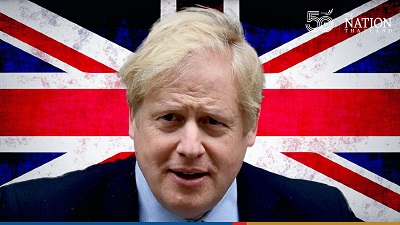
LONDON – Boris Johnson announced Monday that England was set to soon end virtually all government mandates to control the spread of the coronavirus, telling people that in two weeks it likely will be completely up to them whether to wear a mask or socially distance.
At an evening news conference from 10 Downing Street, the British prime minister said the country was ready to move beyond one of the longest, most restrictive series of lockdowns on the planet, turning away from a public health strategy that relied on “government legal diktat” to one based on “personal responsibility.”
He cautioned that the pandemic was not over, but it was time for restrictions to end soon. He said this was only possible because the vaccines were doing their job and protecting the population from infection and serious illness.
If the current trends hold, and Johnson suggested they would, then he expected the full reopening on July 19, dubbed “Freedom Day” by the media. At that time, Johnson foresaw all night clubs, museums, concert halls, theaters and sports arena to be allowed to operate without capacity limits or distancing measures.
After the reopening, the government will no longer press people to work from home if they can. Customers will no longer be required to “check in” at pubs and restaurants or use government test-and-trace apps.
If you want to crowd into a packed bar in Soho and fight the scrum for a pint at the counter, the government says it is up to you to decide whether to mask.
Though some buses, subways and taxis may ask riders to wear face coverings, the government said it would not legally enforce the measures.
One newspaper called it “the big bang” of reopenings.
Scientific advisers said that after July 19, the government will essentially be treating covid-19 like seasonal flu, with a few exceptions. The government will still legally mandate that those who test positive for the virus self-isolate. New rules regarding international travel and schools are expected later this week.
During the long arc of the pandemic, Johnson and the British government have loved to deploy snappy slogans. The latest is “Hands, Face, Space.” Before that, “Stay alert, control the virus, save lives.” And quite a few more before that.
Ministers are now repeating the line that the public must now “learn to live with the virus,” which does raise the question of what people have been doing for the past 16 months, through three national lockdowns and 128,000 deaths.
In his remarks, Johnson urged the people to “act responsibly” and “exercise judgment” and “carefully manage” their risks.
Johnson said, “I will obviously wear a mask in crowded places where you meet people you do not know . . . to protect others and as a matter of simple courtesy.”
As an example of allowing people to weigh their own risks, Johnson said, it would make sense to wear a mask on a crowded car in the London Underground, but a passenger might feel safe without a covering on an empty train out in the countryside.
Ministers concede that infections will likely rise when mandates are eased, but the government hopes that the number of hospitalizations and deaths will be limited by the ongoing vaccination campaign, one of the most successful in the world. Some 45 million people have had a first vaccine dose in Britain – about 85 percent of the adult population – and another 33 million have had their second.
Johnson’s plan to lift all restrictions applies only to England. Scotland, Wales and Northern Ireland are in charge of their own public health rules. Scotland may keep mask-wearing in place, for example, until a review in August.
Johnson’s decision to fully open for commerce, domestic travel and summer fun comes with risks. The prime minister has lifted lockdowns and eased measures in the past, only to see the virus come roaring back.
ADVERTISEMENT
Britain may arguably be in the middle a third wave of infections now, with new cases soaring to 25,000 a day, twice the numbers seen in the much larger United States.
At Monday’s news conference, England’s chief medical officer, Chris Whitty, warned that the country could see 50,000 new coronavirus cases a day in two weeks’ time.
The rising cases, doubling every eight days, are driven by the delta variant, which was first detected in India. The new strain is now dominant in Britain and scientists estimate it may be 40 to 60 percent more transmissible than the alpha variant that was earlier predominant.
In sign of how widespread the new surge is, Kensington Palace said Monday that Kate, the Duchess of Cambridge, is in isolation after last week coming into contact with someone who has subsequently tested positive for the coronavirus.
“Her Royal Highness is not experiencing any symptoms, but is following all relevant government guidelines and is self-isolating at home,” said the palace. Her last public event was a visit to Wimbledon on Friday.
ADVERTISEMENT
Johnson’s move to make mask-wearing voluntary has been met with criticism by some scientists, who fear a surge in cases, hospitalizations and deaths.
One researcher, Susan Michie, a psychologist at University College London, and a member of the government’s SAGE committee of scientific advisers, tweeted, “Allowing community transmission to surge is like building new ‘variant factories’ at a very fast rate.”
Peter English, an expert in communicable disease and former editor of the journal Vaccines in Practice, told science reporters that “government ministers who have declared that they will not show consideration to vulnerable people by wearing a mask – and thereby encouraged others in this approach – have been hugely irresponsible, and shown a gross failure of leadership.”
The British Medical Association was urging the government to continue to advise the public to wear masks in public areas such as shops and public transport, and to stress the importance of good ventilation.
Britain now has a new health secretary, Sajid Javid, replacing Matt Hancock, who resigned in late June after a tabloid newspaper obtained footage of the married minister passionately kissing a top aide inside his office – violating the very social distancing rules he had written.
In contrast with Hancock’s more cautious approach, Javid is gung-ho to move forward and open the country fully. He acknowledged that some people will become sick and some will die, but said the pandemic is under control and it is time to move on.
“No date we choose comes with zero-risk for covid,” Javid told the House of Commons. “We cannot eliminate it, instead we have to learn to live with it.”
In a piece for the Mail on Sunday, Javid wrote that the months of restrictions have come at great cost: “Rules that we have had to put in place have caused a shocking rise in domestic violence and a terrible impact on so many people’s mental health.”
Rescuers seek 80 missing people after deadly landslide in Japanese seaside town
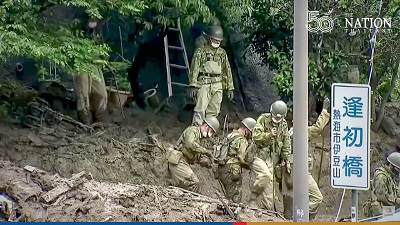
TOKYO – Rescuers used heavy machinery, shovels and dogs on Monday as they searched desperately for survivors from a landslide in the seaside city of Atami that has left at least four people dead and 80 missing.
Two people were found alive and unharmed on Monday, public broadcaster NHK reported, two days after a “tsunami” of mud swept away scores of buildings in the city, following torrential downpours.
Atami, a city of 36,000 people, lies 60 miles southwest of Tokyo. It is set on a steep slope leading down to a bay and is famous for a hot springs resort.
Mayor Sakae Saito said the city has yet to confirm the location of 80 people, with officials checking residence records and visiting evacuation shelters, according to Japanese media.
“It was a matter of a few minutes,” the woman who posted a video of the mudslide told the Mainichi newspaper, explaining that the entire family had escaped out of a window. “My only thought at seeing the mudslide was fear and I felt like I was just going to die.”
Eiji Suzuki said he had rushed out of his house on hearing a sudden noise, only to see the mudslide approaching. He tried to go back home to help his 82-year-old mother but police told him to evacuate the area and they would rescue her.
They did, but she died later in hospital.
“The police urged me to evacuate but now I regret leaving my mother behind,” he told Mainichi. “She was a truly kind person. Thinking of all of our memories together I am devastated. “
Some areas had received more rain in 24 hours than they normally receive in the whole of July, but nature may not have been entirely to blame.
Shizuoka Gov. Heita Kawakatsu said the prefecture was looking into whether local development projects had also played a role, by leaving a large mound of dirt that appears to have collapsed into the river, while also deforesting the area and reducing the capacity of mountain soils to retain water, according to Japanese media reports.
Chief Cabinet Secretary Katsunobu Kato called for vigilance, with the ground so saturated and weakened that even light rain could prove dangerous, but Prime Minister Yoshihide Suga vowed an all-out effort to rescue any survivors.
“Police, Self-Defense Forces, firefighters, the Japan Coast Guard and others are dedicating all their strength to rescue every person who has been left in the debris who needs help as soon as possible,” he told reporters.
A 75-year-old man had a lucky escape when the house across from his was swept away. The couple living there are missing.
“This is hell,” the man told the Reuters news agency from an emergency shelter.
China sent a new meteorological satellite into planned orbit from the Jiuquan Satellite Launch Center in northwest China on Monday morning.
The satellite, Fengyun-3E (FY-3E), was launched by a Long March-4C rocket at 7:28 a.m. (Beijing Time), and this was the 377th flight mission of the Long March rocket series, according to the China National Space Administration.
Equipped with 11 remote sensing payloads, FY-3E will be the world’s first meteorological satellite in early morning orbit for civil service.
It is designed with a lifespan of eight years and will mainly obtain the atmospheric temperature, humidity, and other meteorological parameters for numerical prediction applications, improving China’s weather forecast capacity.
It will also monitor the global snow and ice coverage, sea surface temperature, natural disasters, and ecology to better respond to climate change and prevent and mitigate meteorological disasters.
In addition, the satellite will monitor solar and space environments and their effects, as well as ionospheric data to meet the needs of space weather forecasts and supporting services.
The satellite and rocket were developed by the Shanghai Academy of Spaceflight Technology. It operates under the China Aerospace Science and Technology Corporation.
Laos on alert for Delta variant as Asean reports over 49,400 Covid cases
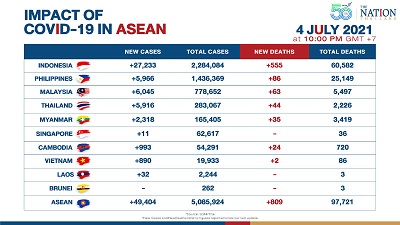
Southeast Asia reported 49,404 new cases on Sunday, lower than Saturday’s 50,501, but deaths were higher at 809, compared to 707 the previous day.
The number of Covid-19 cases in Asean crossed 5.08 million, while the death toll increased to 97,721.
Philippines reported 5,966 new cases and 86 deaths on Sunday, bringing cumulative cases in the country to 1,436,369 with 25,149 deaths. The National Covid-19 Committee announced the relaxation of disease control measures for those who have received the required vaccine doses. Fully vaccinated elders can now travel to other provinces.
Laos reported 32 new cases on Sunday, bringing cumulative cases in the country to 2,244. Of these, 2,031 people have been cured and discharged.
The government has extended disease control measures for another 15 days, until July 19, due to the ongoing spread of the Delta variant of the virus in neighbouring countries.
On July 4th, thousands gather in D.C. to celebrate a nearly normal Independence Day
WASHINGTON – Thousands of Americans gathered in the nations capital Sunday, welcomed beneath a bright blue sky by a city eager to host an Independence Day that resembled some version of a normal one.
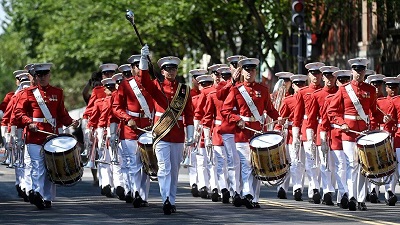
The United States Marine Drum and Bugle Corps marches as spectators enjoy the Barracks Row Parade celebrating Independence Day in Washington, D.C., on July 4. MUST CREDIT: Washington Post photo by Marvin Joseph
In a moment when the pandemic is finally easing, the day began with maskless actors dressed as George and Martha Washington welcoming maskless tourists to Constitution Avenue and was scheduled to end with rockets glaring red over adoring citizens no longer required to stand six feet apart – the way that July Fourths in D.C. are meant to. In between, children waved flags along parade routes, house-partiers chugged bottles of light beer, immigrants became citizens at Mount Vernon and a man took a knee in front of Abraham Lincoln’s marble statue to ask his girlfriend to marry him.
“We can feel it,” Jeff Litten said. “The city is reawakening.”
He was one of about 10 congressional staffers and National Institutes of Health employees who’d planted four American flags in the ground near the Washington Monument, where they’d decided to throw a “dad party”: Hawaiian shirts, corn hole, a mini portable grill.
They’d stayed connected during the pandemic over Zoom and were elated to finally celebrate something together, in person, along with thousands of other revelers.
There was perhaps no more symbolic sign of D.C.’s inching toward the ordinary than the 6:30 a.m. reopening of the long-shuttered plaza in front of America’s most important home.
“Mama, that’s the White House?” said 10-year-old Zoey Gaines, as she turned around to her trailing mom, Sara. “Oh my God!”
Zoey – and hundreds of other people crowded along the new high black fence around 1600 Pennsylvania Avenue – were getting a closer look at the executive mansion than any members of the public have had in more than a year.
“Go up to the fence so I can take your picture,” Sara said, motioning for her 11-year-old son , Jalen, and 8-year-old daughter, Samiyah, to join Zoey in front of the White House.
Her children couldn’t believe how big it was.
“How many bathrooms are in there?” asked Samiyah.
Zoey, sitting atop the ledge of the base of the fence, with one leg swaying, answered confidently: “Um, definitely 35.”
The family hadn’t come from New Jersey to the District because of who now lived behind the black fence, Gaines said, but instead because she and her kids finally felt safe to travel – and what better place to celebrate America’s birthday than in its capital?
Late morning, Karlan Jankowski biked to the Archives with two friends, all of them wearing tricorn hats. They stopped to add their name to the reprinted Declaration of Independence.
The three had just come from the Barracks Row parade on Capitol Hill and planned to bike down later to Lady Bird Johnson Park, where they usually watch the fireworks.
Jankowski typically stays in D.C. on the Fourth, but it was the first time since 2017 that Dennis and Lindsey Gucciardo had joined her. Their disdain for the man in the White House had kept them away, but this year’s celebration, Dennis hoped, would return to what it “should be.”
“It’s a focus on the celebration of America’s independence and not one – ” he started.
“- person,” Lindsey finished.
But it was that same person, Donald Trump, that made the holiday visit special for the Gulino family, who stopped by the former president’s Trump International Hotel to take pictures of the gold letters emblazoned on the building’s front.
“We just think it’s cool to, kinda, see his name,” said Tom Gulino. He and his wife and two teenage sons had flown more than 700 miles from Plainfield, Ill., to meet their 24-year-old son, a Marine who drove up from North Carolina, where he’s stationed.
They had already visited many of the area’s most famous tourist destinations, including the Ford’s Theatre, the Supreme Court and Arlington National Cemetery. The Trump International Hotel was a must-see for the family, though its exact location was a bit of surprise.
“It’s kind of ironic,” Gulino observed, “it’s in front of the IRS building.”
They weren’t the only Trump supporters out celebrating. Outside the White House, Mamadou Sako, a Black immigrant from central Africa, wearing a “Team Trump” cowboy hat and all-red shoes inscribed with “TRUMP,” lamented the ouster of his beloved leader but was still delighted to see D.C. looking the way it’s supposed to.
“To have this all open and see so many faces, it’s just a joy,” said Sako, who’d moved from Gabon to the District in 1987 and now works as a chef.
Spectators enjoy the Barracks Row Parade celebrating Independence Day in Washington, D.C., on July 4. MUST CREDIT: Washington Post photo by Marvin Joseph
At about that same time, three miles west, D.C. Mayor Muriel Bowser strolled down MacArthur Boulevard NW, enjoying the crowd lined up for nearly 10 blocks along the Palisades parade route. Her daughter, Miranda, who wore a striped dress and a blue bow in her curly hair, perched on Bowser’s hip as the mayor tossed green stress balls – “We Are Washington,” they read – into a crowd in desperate need of some relief.
“Happy Fourth!” she shouted between hugs and high fives for onlookers.
For 8-year-old Carter Goldberg and his family – four generations sprawled on the grass near the Washington Monument – this Fourth was the happiest they could remember.
In May, the boy was admitted into an intensive care in Pittsburgh with a severe case of covid-19 after developing multisystem inflammatory syndrome, known as MIS-C.
ADVERTISEMENT
He spent more than two weeks in the hospital, his family said, as his blood pressure plummeted.
“We almost lost him,” said 71-year-old Diane Stumph, Carter’s great-grandmother.
Even after his release, he suffered from so much pain, and weight gain because of the steroids, that he struggled to finish the school year. His legs still hurt and he tires easily, his family said, though it was hard to tell as he chased a bird Sunday afternoon.
“I was this far away from catching it!” he called back, sporting a red, white and blue hat. “This far!”
Then he began to recount their recent itinerary. They’d been to the Washington Monument and the National Museum of African American History and Culture, he said, pointing to each. They’d eaten ice cream, too.
ADVERTISEMENT
Listening, Stumph understood how remarkable it was for them to be there after what Carter had endured.
“After all that, it just feels like freedom,” Diane said.
The country’s 245th birthday follows a pair that were like none other in modern U.S. history, and in its capital, the wait for a dose of ordinary patriotic revelry has felt particularly long.
In 2019, Trump commandeered the holiday for what he dubbed “A Salute to America.” In a ceremony that loosely resembled those thrown by authoritarian regimes, Coast Guard helicopters, an Air Force B-2 stealth bomber and Navy Blue Angels flew overhead before the president addressed a select group of VIP supporters in front of the Lincoln Memorial.
The next year’s celebration, in 2020, proved no less unusual. Amid a still-raging pandemic, and just weeks after violent protests over George Floyd’s death, the number of visitors to D.C. plummeted, with just one-tenth of the number of people riding in on Metro compared with the year before.
At Black Lives Matter Plaza, flags were burned and trampled. Elsewhere, Trump supporters scuffled with protesters. The president fanned those divisions in a speech from the White House’s South Lawn, declaring that he would soon defeat “the radical left.”
Now, almost exactly six months after Trump’s supporters stormed the U.S. Capitol to stop Congress from certifying his electoral defeat, his successor, President Biden, sought to return July Fourth to its bipartisan traditions, hosting 1,000 military personnel and essential workers at an “America’s Back Together” White House celebration.
Much of the Mall, and beyond, has begun to look just the way it did pre-pandemic, pre-protests, pre-insurrection. The plywood on downtown buildings has disappeared, and the battalions of sweaty, disinterested high-schoolers have returned. The melodic, sometimes mind-numbing soundtrack of Constitution Avenue – those ice cream truck chimes – is back, as are the half-full Big Bus Tours that rumble by them. The Smithsonian museums have reopened, and in Lafayette Square, across from the White House, Segway tours pass by office workers eating their lunches on park benches.
But even as office workers and tourists return, D.C. won’t be entirely what it was before, perhaps ever. Physical reminders of the city’s long period of chaos persist.
Kyle Chung, center, snaps a photo of Anna Lech at the Capitol Reflecting Pool in Washington, DC, on Independence Day, July 4, 2021. MUST CREDIT: Photo for The Washington Post by Craig Hudson
In Lafayette Square, a public bathroom that last summer’s protesters set ablaze has yet to be repaired. With its walls charred, the building is enclosed behind chain-link fence, like a museum piece on display for curious, or confused, passersby.
Across the road are the now iconic giant yellow letters declaring “BLACK LIVES MATTER,” a permanent nod to what thousands of activists marched for on the city’s streets.
And less than two miles away, just beyond the Peace Monument, black metal fencing still guards the Capitol. “AREA CLOSED,” the red-lettered signs read, the result of an assault on American democracy that, among other things, forced the annual Capitol Fourth concert to be prerecorded and aired on television.
On Sunday afternoon, perched on the steps of the nearby reflecting pool, Alexander Foley set up a small easel and a 8.5-by-11-inch canvas. He sprayed it with a protectant and used the plastic wrap of a canvas as a palette.
With a thin brush, the Baltimore artist mixed globs of blue and red. Squinting on a lawn chair beneath an umbrella, Foley reimagined the building in front of him – without a fence. He wanted his canvas to reflect the normalcy and liveliness of the beloved holiday.
“I see the fences as a cage to the people’s house,” said Foley, who was joined by his rescue poodle, Amadeus. He had come to D.C. with a stack of canvases not to portray the capital exactly as it is, but as it used to be and the way he hopes it will be again soon.
For Nicolas Picard, none of the recent upheaval in D.C. or across the country mattered much on Sunday. He woke up Sunday feeling excited, but also nervous. He’d picked out his red chino-style pants the night before, but had to stop over at a friend’s house to iron his blue pinstriped button down shirt because it was wrinkled.
By mid-morning, Picard had made his way to an open field overlooking the Potomac River at Mount Vernon, where the Frenchman joined 38 other immigrants – from Lebanon to Liberia, Mauritania to Moldova – who were about to become U.S. citizens.
He lived in the United States two decades ago before coming back to attend graduate school at Carnegie Mellon in 2011.
Picard, 32, began the process of becoming a citizen at almost the exact same time the pandemic swept the country. He watched a furious racial reckoning and the divisive presidential election that soon followed. It was a hard period to navigate, he said.
“There were many feelings,” Picard recalled. “How do I make sense of the system of government and the protests and the civic activism that’s taking place around me, as I become a citizen and I assert my patriotism?”
On Sunday, he stood for the national anthem and took the oath, and when the ceremony ended and onlookers applauded and cheered, a woman in front of him began to weep.
Picard understood why. America is deeply flawed, he knew, but now it was his home, and he had a say, a right to vote, a chance to help make it better.
Published : July 05, 2021
By : The Washington Post · John Woodrow Cox, Dan Rosenzweig-Ziff, Karina Elwood, , Nicole Asbury, Brittany Renee Mayes, Jasmine Hilton, Stephanie Lai, Josh Woodrow Cox
Lobsters feelings loom large as British Parliament debates animal welfare bill
LONDON – How does a lobster feel when its dropped into the boiling pot? The British Parliament wants to know.
Is an octopus sad, sometimes? Does the squid learn its lessons? The bee feel joy? The earthworm anxiety? The peers in the House of Lords are currently debating the matter.
These questions arise because Prime Minister Boris Johnson is trying to make good on his electoral pledge to enshrine into law the idea that animals are “sentient beings,” meaning the government would be obligated to not only safeguard creatures’ physical well-being but also take into account their feelings – of pleasure, pain and more.
The Animal Welfare (Sentience) Bill is a potentially sweeping piece of legislation that could require all arms of government – not just the agriculture ministry – to consider animal sentience when forming policy and writing regulations.
The implications could be moral and profound, supporters hope – or cumbersome and bureaucratic, say critics, with some seeing a power play by vegan activists and animal rights radicals.
The bill does appear to go further than European Union protections, once seen as the most comprehensive on Earth, and far, far beyond the relatively lax laws in the United States.
What is sentience? As Charles Darwin suggested 150 years ago, it may be the ability to feel “pleasure and pain, happiness and misery.”
In the House of Lords, the peers wondered aloud whether they were not touching on questions of the soul.
“The big picture has changed,” said Donald Broom, a Cambridge University authority on animal welfare.
“I think of the new idea as ‘one biology.’ That human animals and other animals are extraordinarily similar,” he said, “and that sentient animals are individuals who feel pain and suffering, and all sorts of other things, and that should be taken into account.”
Broom said he was “not against eating or exploiting animals, but we should think about them as individuals.”
He said the scientific study of animal cognition, consciousness and sentience has galloped forward in recent years and that abilities once thought unique to humans have also been discovered in nonhuman animals, including tool use, language, a sense of time and the future, deception, empathy and altruism.
The bill now being debated is unprecedented in scope because it seeks to protect wildlife as well as domesticated and companion animals such as cows and chickens, dogs and cats.
Meaning? The government could soon be responsible not only for the welfare of a species at the population level – the threatened puffin, say – but also for the possible effects of policy on individual puffins.
New questions might arise: Are those popular tour boats filled with birdwatchers too close to the breeding cliffs at Skomer Island? Does an especially photogenic puffin seem perturbed by them?
Does a rare wild bird have a right to be left alone?
A centerpiece of the proposed legislation is the creation of an independent body of experts – the Animal Sentience Committee – who will scrutinize government decisions to ensure that ministers have paid “all due regard” to the welfare of animals as sentient beings, or explain why not.
Which animals, you ask? Are all animals equal but some more equal than others, as George Orwell wrote? It appears so.
Perhaps to speed its passage, the bill as introduced applies only to vertebrates – animals with backbones – meaning mammals, birds, reptiles, amphibians and fish, both wild and domestic.
ADVERTISEMENT
That may well extend animal protections further than we humans have gone before. But activists are pushing for the bill to include some invertebrates, and based on the early debate in the House of Lords, many lawmakers agree.
You wonder: Is there a lobby for lobsters? Yes, there is. It’s called Crustacean Compassion.
“I have been shocked by some of the treatment of animals such as lobsters, crabs and squid, in the way they have been stored and very often killed,” said Janet Fookes, a baroness in the House of Lords from the Conservative Party.
Fookes told the chamber of “one horrible example of a supermarket tightly wrapping a live crab in single-use plastic – a double abomination so far as I am concerned – and lobsters are still plunged alive into boiling water.”
Fookes said she wanted to see “perfectly good, stunning machines” deployed before the crabs and shrimp go on the boil, “which could do this job humanely.”
ADVERTISEMENT
A colleague, Labour Party member Barbara Young, the baroness of Old Scone, argued the case for including certain invertebrates.
“There is already sufficient evidence of sentience among cephalopods and decapod crustaceans,” Young said, urging the lords to watch “the award-winning documentary ‘My Octopus Teacher,’ which explores the rather bizarre and strange but nevertheless emotional relationship between a man and an octopus.”
The film won the Best Documentary category at the Academy Awards this year.
When the Conservative Lord Richard Benyon introduced the bill in June, he began by noting Britain’s global reputation as a nation of animal lovers.
The country’s first national animal protection law, the Cruel Treatment of Cattle Act, was enacted in 1822, when Londoners were sickened by the sight of emaciated cows driven to market through the city. That was followed by legislation to improve conditions in slaughterhouses in 1875; then the Protection of Animals Act in 1911; and a world-leading system for regulating scientific experiments on animals in 1986.
The idea of animal sentience was incorporated into foundational E.U. law in 2009 in the Lisbon Treaty. But with the U.K.’s exit from the bloc, Johnson’s government came under pressure from voters to establish similar – or even greater – protections.
Mike Radford, an authority on animal welfare law at the University of Aberdeen in Scotland, said that the sentience bill may be a bold stroke but that its vague language, concepts and definitions are problematic. “Politically, it’s a helluva mess,” he said, adding that it really doesn’t define “animal” or “sentience.”
Radford, though, thought it was “very, very likely” the legislation would be amended to include octopus, crabs and kin, saying that opposition to live boiling has become mainstream.
“Chucking live lobsters into pots to turn them red is a major issue,” he said.
To gauge the power of the animal welfare lobby, note that there are now more than 1.1 million members of the Royal Society for the Protection of Birds, more members than the top five political parties in Britain combined.
The beloved protector of British pets, the Royal Society for the Prevention of Cruelty to Animals, is now backing crabs and cuttlefish. “It wasn’t long ago that there was a widely-held view that fish don’t feel pain, but ground-breaking research found they can,” the society observed.
Jonathan Birch, leader of the Foundations of Animal Sentience project at the London School of Economics, who is studying the issue for Parliament, said a growing body of evidence points to feeling and emotion in all sorts of invertebrates.
Though he worries that the new oversight committee might prove toothless and that little might change, he’s hopeful. “It’s a good starting point,” he said, “and it’s better than nothing.”
The sentience bill has had its second reading in the House of Lords. Next it goes to committee, where line-by-line discussion of amendments takes place, it may be reprinted and more changes debated, and eventually it may be sent to the House of Commons, where a similar but more detailed examination and debate occur, with more committee work, changes and votes.
It’s a long haul – and skeptics line the road.
In the initial House of Lords debate, Daniel Moylan, a baron, voiced his fears: “The logical consequence is that we are driven in the direction of veganism and the consumption solely of non-sentient plants.”
Not only that. The bill, he said, might give the government “the unfettered power to declare … that an earthworm is a sentient being. This is a power greater than that given by God to Adam in the Garden of Eden, which, as I recall, was restricted to the power to naming animals.”
Matt Ridley, a viscount and popular science writer, remarked, “The sentient animals that concern me in relation to the Bill are the living, sensing, voluntarily moving creatures called bureaucrats. The Bill does little or nothing to change the way we treat animals, but it does create a wonderful feeding opportunity for Homo bureaucratius to do what it is best at: to build a nest and raise a lot of workers.”
Iran, facing another virus surge, reimposes restrictions and focuses on homegrown vaccines
Iran on Sunday reimposed coronavirus restrictions amid fears that a fifth wave of the virus driven by the delta variant could overrun the countrys health-care system, already battered by U.S. sanctions and the regions worst cycle of outbreaks.
The latest surge comes as Iran has struggled to import vaccines, prompting the country’s leaders to double down on researching and developing its homegrown vaccines.
On Sunday, the government ordered the closure of all nonessential businesses in the capital, Tehran, and 274 other cities with high numbers of covid-19 cases. It also issued a ban on travel between cities with elevated infection risks.
Iranian Health Ministry spokeswoman Sima Sadat Lari said Sunday that confirmed cases of covid-19 had increased by 13.2 percent over the last week, while hospitalizations rose by 11 percent and the number of related deaths by 7.2 percent, the state-run IRNA news agency reported.
On Saturday, outgoing Iranian President Hassan Rouhani warned that the country was on the verge of a fifth wave of the virus, driven by the influx of the delta variant and a decline in public adherence to infection control measures, Iranian media reported.
“If we’re not careful enough, there is concern that the country will face a fifth wave,” Rouhani told a televised session of Iran’s coronavirus task force.
Rouhani warned that the virus was spreading particularly fast in Iran’s southeastern and southern provinces and blamed it on the delta variant entering through those border regions. Authorities in Sistan and Balochistan province, which has the worst rate of infection in the country, closed the province’s porous border with Pakistan to all but vehicles transporting goods on Wednesday.
The delta variant, first identified in India, has been detected in nearly 100 countries, according to the World Health Organization.
Iran, a country of 85 million, has recorded around 3.2 million cases of covid-19 and nearly 85,000 related deaths – rates that are the region’s highest but also considered an undercount given flaws in official counting methods and the government’s lack of transparency.
Only around 5 percent of Iranians have received at least one shot of the coronavirus vaccine.
While the country has received doses from Covax, China, Russia and India, Iran has faced difficulties in building up a supply of vaccines, in part because of U.S. economic sanctions that make it difficult for the government and private sector to access foreign bank accounts and conduct many basic international transactions.
Further complicating the situation, the office of Ayatollah Ali Khamenei, Iran’s supreme leader, in January banned the import of vaccines manufactured in the United Kingdom and United States, citing his distrust of the countries that Iran has been at odds with since its 1979 revolution.
Instead, Iran has focused on its locally made vaccines.
Iran has several vaccines in the works, one of which – COVIran Barekat, produced by the state-controlled Shifa Pharmed Industrial Group – was the first to be approved for local emergency use in mid-June. Iran later issued emergency authorization for Soberana 2, a Cuban vaccine it has partnered up with the communist country to produce.
Late last month, 82-year-old Khamenei got his first shot of the two-dose Barekat vaccine in front of television cameras. Khamenei said he waited until an Iran-made vaccine was approved for his age group.
“I was not willing to use a non-Iranian vaccine,” he said in a statement released by his office. “Therefore, I said I would wait for the Iranian vaccine because we should appreciate this national honor and as long as there is the opportunity for prevention and cure inside the country, why shouldn’t we use it?”
Iranian authorities, however, have not publicly released data about the efficacy of Barekat, which means “blessing” and is based on the deactivated virus. In February, Shifa said, without providing scientific evidence, that the first phase of human trials showed that Barekat was 90 percent effective in preventing infections.
Asean records over 50,000 new Covid-19 cases as total crosses 5 million
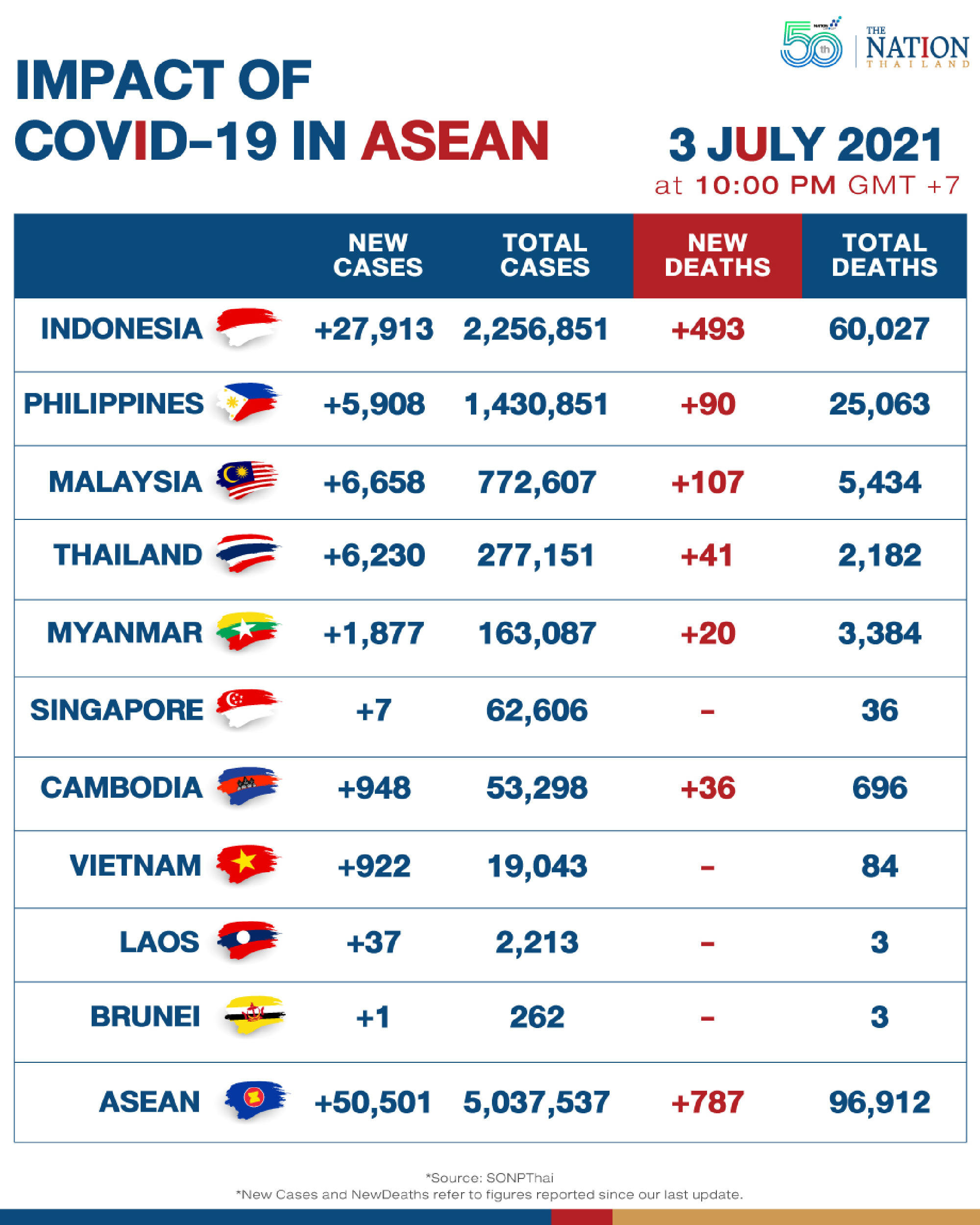
The number of new Covid-19 cases in Southeast Asia hit a record 50,501 on Saturday, but the death toll was lower at 787 compared to 902 the previous day, collated data showed.
Saturday’s figure of new cases was higher than the previous day’s 48,507, with Indonesia reporting 27,913 cases, over 2,000 higher than on Friday.
Total Covid-19 cases in the Asean region totalled 5,037,537 and the death toll rose to 96,912.
Malaysia reported 6,658 new cases and 107 deaths on Saturday, bringing cumulative cases in the country to 772,607 and the death toll to 5,434.
The Malaysian government will ease some Covid-19 restrictions in five states — Kelantan, Pahang, Perak, Terengganu and Perlis — under the second phase of the plan to restore normalcy in the country from Monday onwards.
Meanwhile, Cambodia reported 948 new cases and 36 deaths on Saturday, bringing cumulative cases in the country to 53,298 and the death toll to 696.
The Cambodian Ministry of Posts and Telecommunications aimed to import Covid-19 rapid antigen self-test kits for selling to private organisations. However, test kits will not be sold to the general public.
Asean records over 50,000 new Covid-19 cases as total crosses 5 million




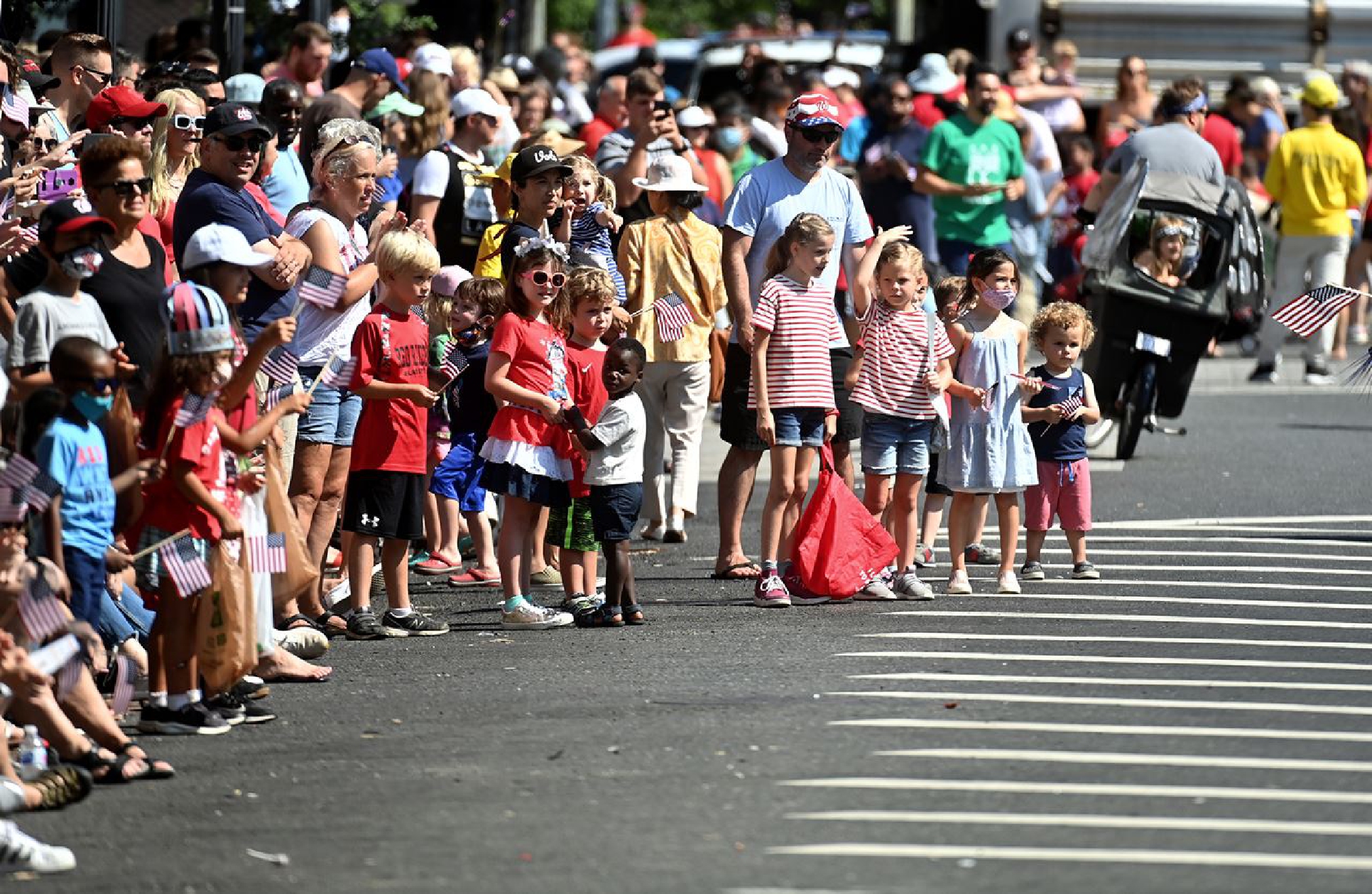 Spectators enjoy the Barracks Row Parade celebrating Independence Day in Washington, D.C., on July 4. MUST CREDIT: Washington Post photo by Marvin Joseph
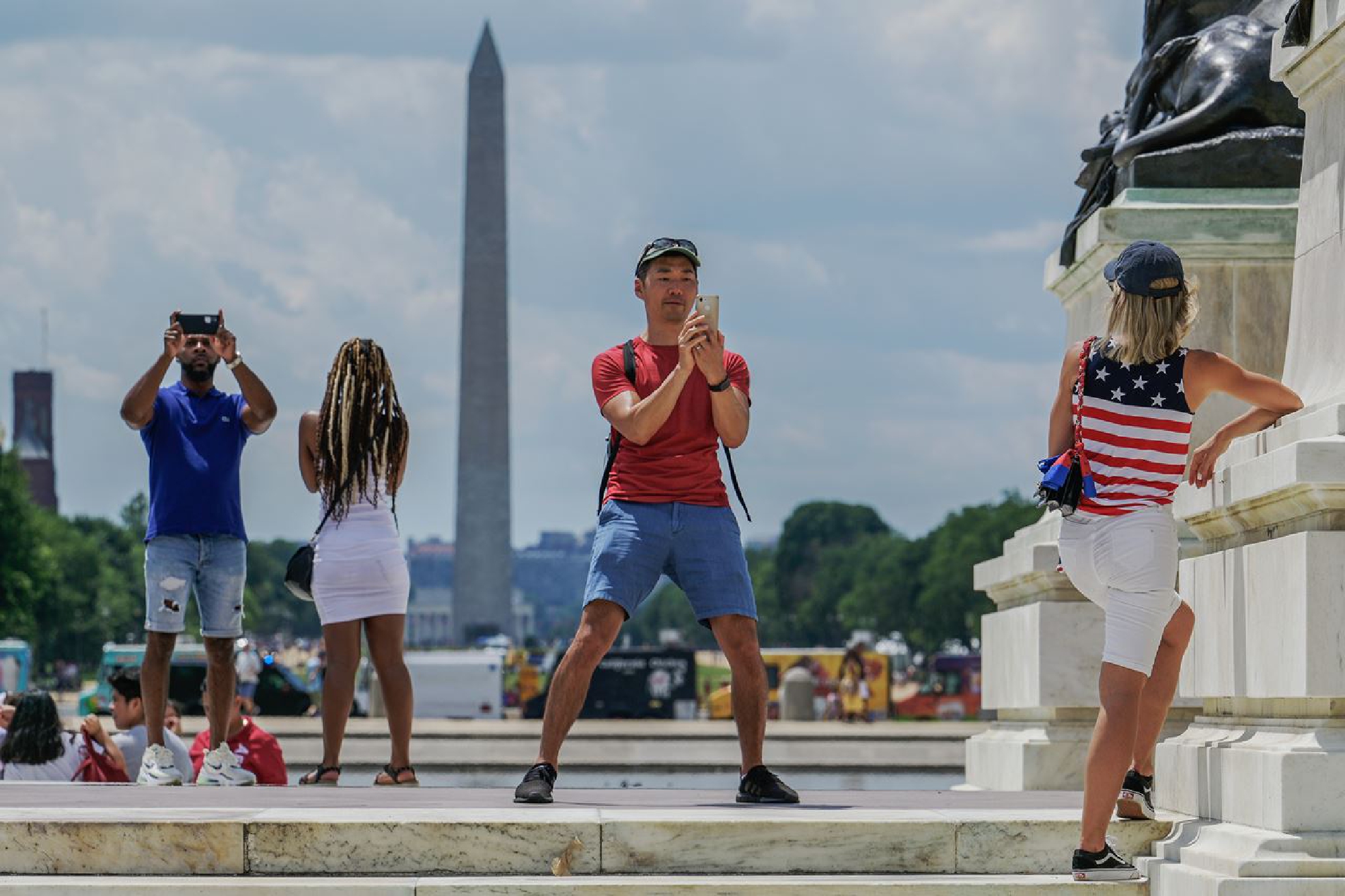 Kyle Chung, center, snaps a photo of Anna Lech at the Capitol Reflecting Pool in Washington, DC, on Independence Day, July 4, 2021. MUST CREDIT: Photo for The Washington Post by Craig Hudson

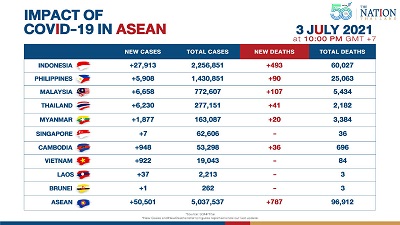
 Asean records over 50,000 new Covid-19 cases as total crosses 5 million
