Ugandan Olympian tests positive for virus upon arrival in Japan, the first detection as athletes head to Tokyo
The 2020 Tokyo Games hit another snag after a vaccinated member of Ugandas team tested positive for the coronavirus upon arrival in Japan on Saturday.
It marked the first detection of the coronavirus among incoming athletes five weeks ahead of the competition at a time when cases are surging in many countries, including Japan.
Uganda’s team had all been vaccinated with AstraZeneca shots and tested negative for the virus before departure, Japanese media reported, according to the Associated Press. Japan requires a two-week quarantine for international travelers, though it is waiving the rule for many Olympic athletes and support staffers.
Upon arrival Saturday night at Tokyo’s Narita International Airport, one member of Uganda’s team tested positive. That person was denied entry into Japan and sent to a government-run facility. The team’s remaining eight members continued as planned Sunday to the host town of Osaka.
The International Olympic Committee, and the Japanese government and organizers, have insisted that the Games can be held safely with the health protocols in place. But critics say it’s too risky to bring thousands of participants from all over the world together while new waves of infections hit many countries with low vaccination rates.
Under Japan’s rules, Olympians are not required to be vaccinated against the coronavirus but will need to remain in designated social bubbles and test daily.
Public health experts are particularly concerned about highly contagious variants of the virus, such as the delta variant first detected in India, that appear to be driving many of the recent surges.
While no vaccine is 100 percent effective for everyone, cases of fully vaccinated people contracting the coronavirus have raised alarm. There are particular concerns that the Chinese-made Sinopharm and Sinovac versions offer less protection than other vaccines available.
Japan has fully vaccinated less than 6 percent of its 7.1 million residents, the slowest rate among developed countries, according to the AP. At the same time, cases are rising in many cities, including Osaka and the capital, Tokyo.
On Sunday, Japan lifted its pandemic-related state of emergency in most areas, despite concerns that the move could spark another surge. Japan has not imposed lockdowns, but it has used the state of emergency to issue limits on gatherings and order restaurants and shops to close early, among other restrictions.
Uganda is facing an alarming rise in coronavirus cases, leading to surges in hospitalizations and shortages of oxygen for treatment. Just 2 percent of the country has been vaccinated. This month, Uganda hit records for daily infections, which are considered severe undercounts because of limited resources.
ADVERTISEMENT
“We have no way to know how far the virus has spread in Uganda because of the low testing capacity in the country,” Mercy Corps, a Seattle-based humanitarian NGO, said in a statement. “The health systems are overwhelmed, and sooner or later, there will be no space or adequate health care staff to admit severely ill patients who need emergency and critical care services. It’s a ticking time bomb.”
Asean sees another major spike in new Covid cases and deaths
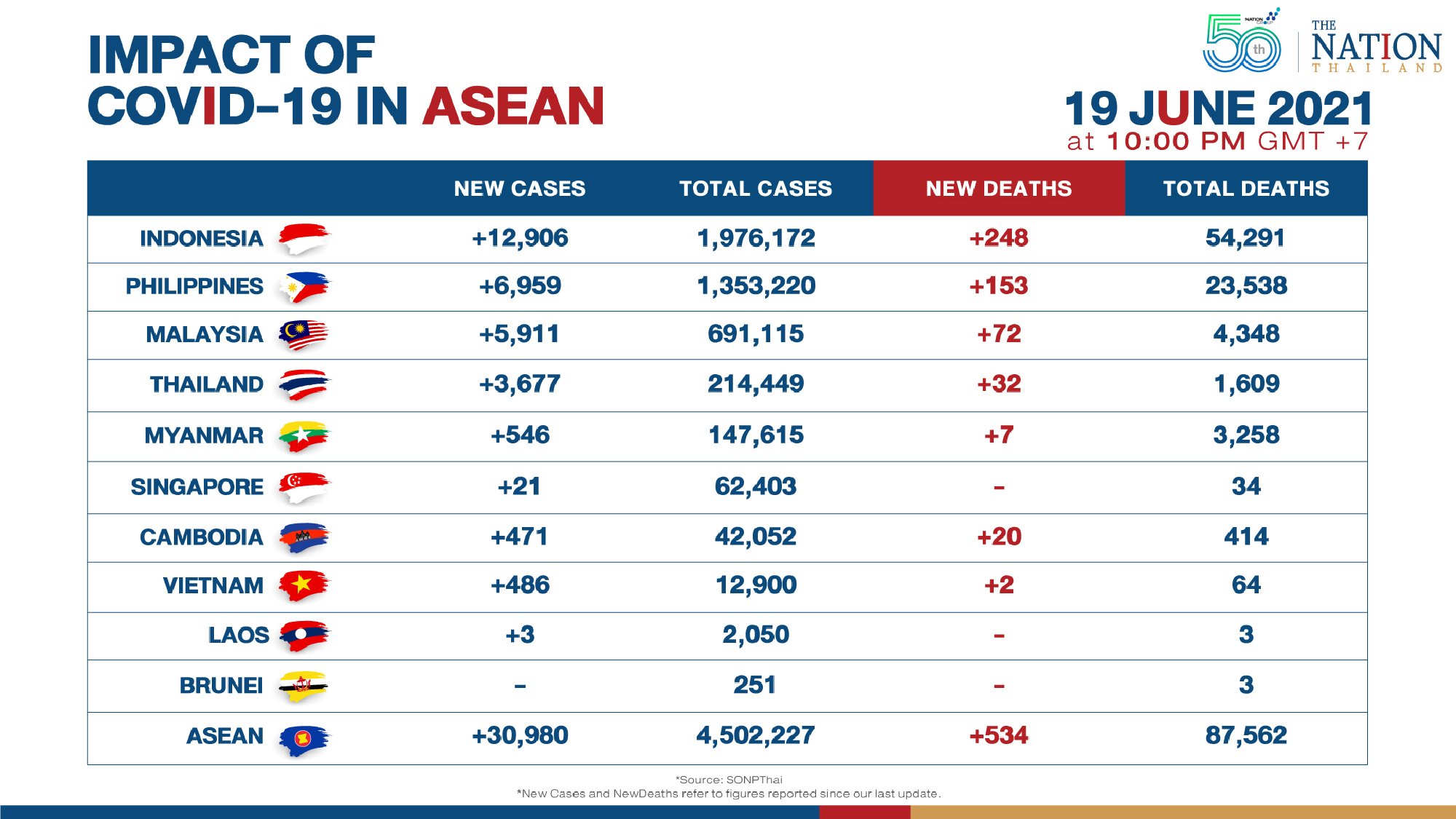
Southeast Asia on Saturday saw over 30,000 new Covid-19 cases for the second successive day, and also a higher number of deaths, collated data showed.
There were 30,980 new cases on Saturday, the highest on a single day in over a month, compared to 30,715 on Friday, and 534 deaths, against 512 the previous day.
Total Covid-19 cases are now at 4,502,227 and 87,562 have died.
Singapore reported 21 cases on Saturday, bringing cumulative cases in the country to 62,403 with 34 deaths.
On Saturday, 24 private hospitals chosen by Singapore’s Health Ministry administered Sinovac Covid-19 vaccines to people after the country’s government approved it as an alternative vaccine.
The price of a Sinovac vaccine jab is 10-25 Singapore dollars (THB234-285), while about 34,000 people who have allergy due to this mRNA vaccine can bring evidence to the Health Ministry to claim refund.
Singapore has approved the Pfizer-BioNTech and Moderna vaccines as the main vaccines.
Cambodia reported 471 new cases and 20 deaths on Saturday, bringing cumulative cases in the country to 42,052 with 414 deaths.
Of the new patients, at least seven, who have returned from Thailand, have been infected with the Delta variant.
Asean sees another major spike in new Covid cases and deaths
Palestinians cancel vaccine deal with Israel, saying doses are too close to expiration date
JERUSALEM – Just hours after a vaccine-sharing agreement was announced with Israel on Friday, the Palestinian Authority announced that the deal was off because the doses donated by Israel were too close to their expiration date and did not meet its standards.
Israel had sent more than 1 million doses of coronavirus vaccines near their expiration date to the Palestinian Authority in the West Bank in exchange for a similar quantity of fresh vaccine to be returned by the Palestinians later in the year, officials said Friday.
The arrangement to cooperatively manage their vaccine stocks would have allowed the Palestinian Ministry of Health to accelerate its vaccine campaign while keeping unneeded doses in Israel from going to waste. Israel – which has already reached a significant majority of its residents with vaccines – will get its stocks replenished in time for booster shots later in the year, experts said.
However, Palestinian Health Minister Mai Alkaila told reporters Friday that they had expected the doses to have expiration dates for July or August. After they received them, Alkaila said, they saw that the doses would in fact expire in June.
“That’s not enough time to use them, so we rejected them,” Alkaila said, according to Reuters.
The vaccine deal, announced by the office of new Israeli Prime Minister Naftali Bennett, had followed criticism from Palestinian activists and human rights groups that say Israel has not done enough to help fight the pandemic in Palestinian populations it largely controls.
Israel donated several thousand doses of vaccine for Palestinian health workers early in the year, and the Israeli army inoculated more than 100,000 Palestinian workers who have permits to work in Israel. But then-Prime Minister Benjamin Netanyahu declined to make vaccines available on a wider scale, contending that the Palestinian Authority was responsible for public health under terms of the Oslo accords.
Members of the new government touted their announcement Friday as a means to aid Palestinians while keeping the virus at bay across borders.
The statement, issued jointly by the prime minister and the Health and Defense ministries, said the transfer of up to 1.4 million doses would be paid back from a Pfizer order scheduled to be delivered to the Palestinians in September or October.
“We will continue to find effective ways to cooperate for the benefit of people in the region,” new Israeli Foreign Minister Yair Lapid said in a tweet.
The Israeli military unit responsible for coordination with the Palestinian Authority said it delivered 100,000 doses of vaccine on Friday, before the deal was scrapped.
It was not immediately clear if some of the shared vaccine would have been passed on to the Gaza Strip, where vaccine levels are lower. Last month’s 11-day war threatened to create a new surge of infections after thousands of Gazans were forced to shelter in crowded schools and community centers during Israel’s bombardment of the enclave.
Israel has seen a dramatic drop in its need for vaccine inventories as its fastest-in-the-world vaccine program has delivered shots to a significant majority of its population and the country has largely returned to pre-pandemic life.
The virus continues to spread in the West Bank, although the number of positive cases has declined as more people are vaccinated. Officials have mostly depended on doses donated by third countries or the Covax program aimed at inoculating the world’s poorest populations.
ADVERTISEMENT
“You are beginning to see people have more weddings and parties,” said Salwa Najjab, a West Bank physician who has served on one of the Palestinian Authority’s coronavirus advisory panels. “The situation is getting better.”
A boost in supply would extend the reach of the vaccine campaign in time to help communities weather an expected jump in outside visitors from Europe, other Arab countries and the United States as global travel restrictions are lifted, Najjab said.
“It will make a difference if they get it out to the villages,” she said.
The U.S. may be ready to see cicadas gone, but this French village has a statue, a song and ceramics in their honor
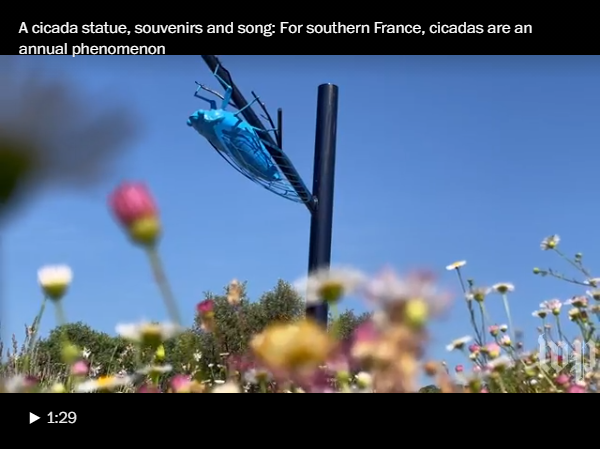
LE BEAUSSET, France – The five-foot blue iron cicada dangles upside-down from a metal branch, bulging eyes staring at the sky. It appears ready to launch itself at any moment at cars moving through the traffic circle below.
The $34,000 statue was inaugurated last year as a proud defense of the seasonal insect, after complaints from tourists who had dared to ask if the din emanating from the trees could be stopped with an application of insecticide.
The chorus of cicadas, or “cigales,” as they are called here, is an annual and generally beloved phenomenon in southern France, especially in the region of Provence. And the village of Le Beausset, with a population of about 10,000 people and an unknown number of cicadas, is the self-proclaimed cicada capital.
Across the region, visitors can buy cicada postcards and cicada tablecloths and ceramic cicadas in more than three dozen colors. For the biggest fans, shops in Le Beausset’s neighboring town of Le Castellet sell versions that release their deafening sounds whenever anyone comes close.
And so as residents of Le Beausset and across France’s south await the annual chirping of the insects – expected later this month – many here have watched reaction to the U.S. “zombie cicada invasion” with a mix of bewilderment and surprise.
They understand that the cicada species dominant in southern France emerge in lower density than the 17-year periodical cicadas that have roiled the East Coast this summer. But few here would think of the insect as an edible snack. Or something worthy of 911 noise complaints.
“In Provence, cicadas are culturally omnipresent,” said Stéphane Puissant, a cicada expert who works for the city of Dijon’s Science and Biodiversity Garden.
According to a Provincial legend, cicadas were sent from heaven to keep people from dozing off in the midday heat of summer. But the people of Provence found the sound calming, and it lulled them to sleep all the same.
One of France’s most famous poems, “The Cicada and the Ant” – published in 1668 by Jean de La Fontaine and inspired by an Aesop fable – portrays the cicada as improvident, singing the summer through and having to beg for provisions in the winter.
La Fontaine’s cicada may have been a reference to the predicament of artists. And so in the 19th century, a group of Provence-based writers, the Félibrige, adopted a golden cicada as a symbol, along with the phrase, “The sun makes me sing.”
The insect was linked to warmth and light, Puissant said, and that reputation soon spread to the north of France.
Cicadas in France are “really associated with holidays and sunny places, and it’s a really positive image,” said François Dusoulier, head curator at France’s National Museum of Natural History.
French TV ads, for example, feature the sound of cicadas to evoke the joys of summer months.
As an indication of French reverence for cicadas, the country’s Senate voted this year to classify cicada chirping – along with cow smells, rooster crowing and other elements of everyday life in France’s countryside – as national heritage, protected from litigation and elimination.
To the extent that cicadas are the subject of complaints, Dusoulier blamed a growing disconnect between “urban societies, especially maybe in northern countries, and the real life cycle of nature that occurs in the Mediterranean areas.”
Yves Pujol, a singer who lives in Provence, agreed that in his experience, the people registering their disgust primarily come from big cities.
“They don’t mind the noise of ambulances all day and night, but the sound of cicadas bothers them,” he remarked.
“It’s like saying: There’s too much sun. Can we do something against it, can we hide the sun?” he said. “It’s impossible.”
Following the tourist complaints in Le Beausset in 2018, Pujol wrote a song staunchly supportive of cicadas. The refrain – “Don’t touch, don’t touch the cicadas, don’t touch, or you get slapped” – may strike some as aggressive, but it is meant as a symbolic message and reflects how strongly the region feels about the insect, he told The Washington Post.
The song seemed to strike a chord with locals. It has been viewed 250,000 times on YouTube. It’s typically the first song his group plays at concerts in the region, even three years after the controversy. As Pujol stood in the center of Le Beausset’s cicada roundabout earlier this month, talking to The Post, locals asked to take photos with him, and a man cheered from his car.
“The cicada won’t be exterminated – no matter what happens – it won’t be killed, and it won’t be poisoned with pesticides,” said Philippe Marco, Le Beausset’s former deputy mayor for culture, festivities and heritage.
On the national stage, the cross-party support for France’s roosters and cicadas this year was seen as a sign of how all major parties will fight for the votes of rural residents in the presidential elections next year.
But in Le Beausset, there is some distaste for what locals see as the politicization of cicadas.
It was the village’s then-mayor who was the driving force behind the cicada statue, and some residents complain about his conservative group’s reliance on the insect as a symbol in its most recent election campaign.
Other residents have questioned why their iron cicada had to be blue and not look more like the actual insect.
But there are no doubts about how the residents feel about the animal in nature.
In a small tourist shop in the village center, where cicada replicas are available for $2.40, owner Marie-Christine Fenot has been growing more impatient by the day.
ADVERTISEMENT
As soon as the first cicadas sing, village residents will post videos on Facebook, she said.
“It’s important for us,” she said. “It really is.”
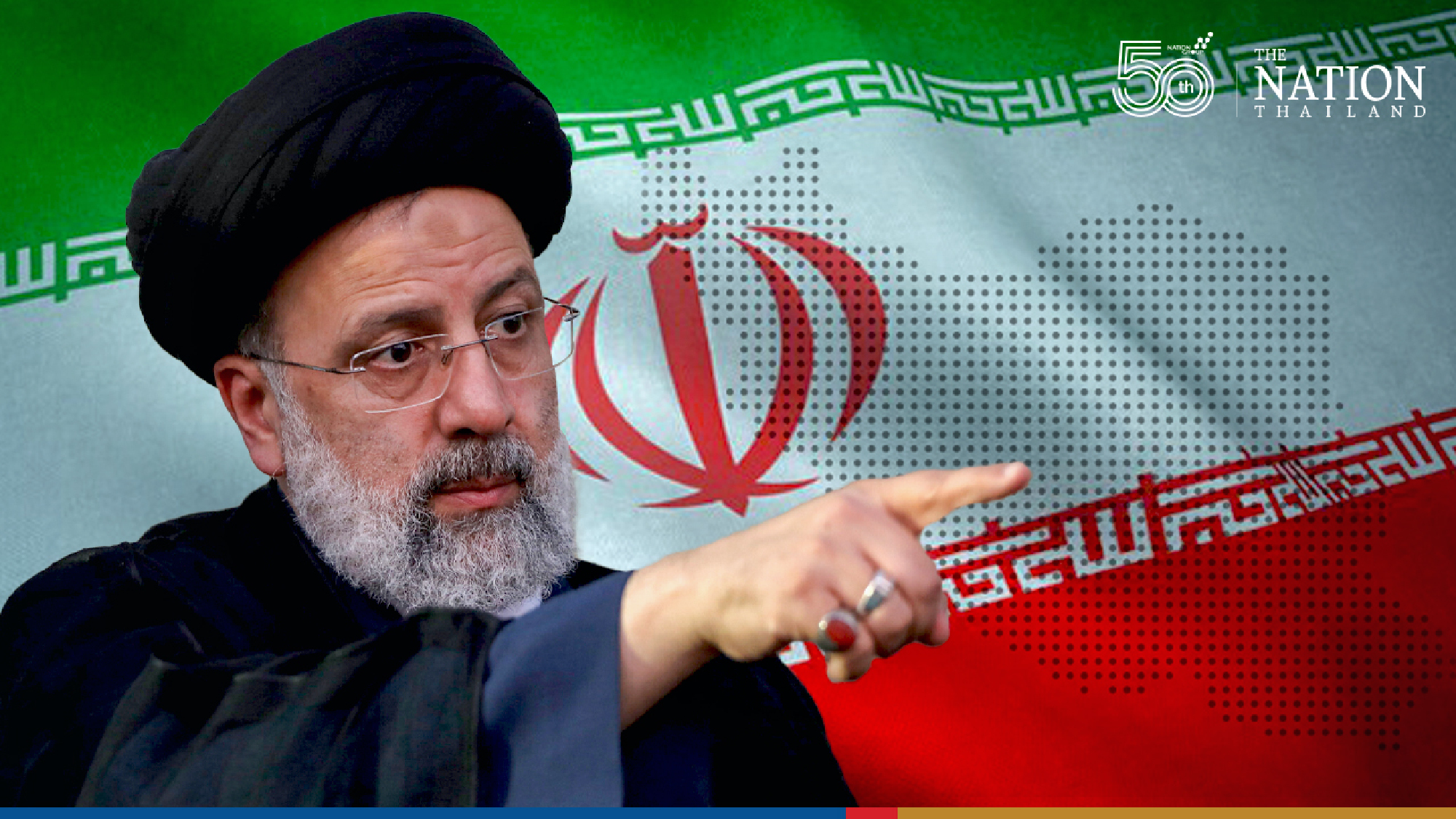
Irans new president Ebrahim Raisi consolidates hard-line grip as reformers pushed aside
Irans announcement Saturday of a resounding election victory by Ebrahim Raisi, the ultraconservative judiciary chief, signaled a stunning consolidation of power, handing the elected leadership back to hard-liners and sidelining reformists who negotiated a nuclear deal with global powers and advocated greater engagement with the West.
The victory by Raisi also showed the determination of Iran’s conservative establishment, including its security and intelligence agencies, to eliminate any political challenge at a critical moment, analysts said.
Among the potential landmark moments ahead: reckoning with who would succeed the 82-year-old supreme leader, Ayatollah Ali Khamenei, who is seen as a mentor to Raisi.
Some experts speculated about whether the return to unity at the top – Khamenei’s ruling clerics and the political structure around Raisi – could become a permanent fixture in Iran and the country’s relatively vibrant election contests could be a thing of the past. For Friday’s election, most moderates were barred by the ruling establishment, leaving many voters frustrated and turnout apparently low.
Raisi’s win, however, was not expected to derail negotiations currently underway in Vienna between Tehran and world powers to revive the 2015 nuclear deal. Khamenei has allowed Iran to reopen the dialogue and appears ready to keep it going in efforts to lift international sanctions.
But the longer-term impact on Iran’s relationships with Europe and the United States was far less clear.
Raisi, 60, a fixture of Iran’s hard-line establishment since his 20s, is viewed as an acolyte of the supreme leader and has been floated in the past as a possible successor. Human rights groups have linked him to numerous episodes of repression over decades and said he played a central role in mass killings of dissidents in the late 1980s.
Raisi, who unsuccessfully ran for president in 2017, has cast himself as an anti-corruption crusader, while critics have accused him of using corruption as a fig leaf to eliminate rivals.
“At this stage, when the supreme leader is very likely to pass away, Raisi represents a man who the entire security establishment trusts,” said Hadi Ghaemi, executive director of the Center for Human Rights in Iran. “He has been on the side of the security and intelligence agencies – that use the judiciary for repression – his entire life.”
In a statement Saturday, Raisi called the election that brought him to power “a great epic of the rising nation that opened a new page of contemporary history,” according to state-run IRNA news agency.
He will replace President Hassan Rouhani, a relative moderate whose government signed the 2015 nuclear accord with the United States and other world powers. Later, Rouhani was left facing the Trump administration’s “maximum pressure campaign” aimed at crippling Iran’s economy using sanctions and other measures. Trump withdrew the United States from the nuclear accord in 2018.
Raisi has expressed a willingness to revive the deal, known as the Joint Comprehensive Plan of Action, or JCPOA, in line with Khamenei’s wishes. But his presidency seemed certain to mark a radical departure from the Rouhani era, with little prospect of liberalizing domestic reforms or any broadening of Tehran’s relationship with the West, analysts said.
Polls in the days leading up to the election predicted low turnout amid voter fatigue and calls to boycott the election after accusations that the contest was rigged to favor hard-line candidates. The balloting was held as Iran struggles to bring its coronavirus cases under control after experiencing one of the world’s worst outbreaks early in the pandemic.
The Interior Ministry said Raisi received nearly 18 million votes out of more than 28 million cast. His nearest rival, Mohsen Rezaei, received about 3 million votes. Fewer than 50 percent of eligible voters cast ballots in the election, a historic low.
The result was no surprise.
Iran’s Guardian Council, which approves candidates seeking office, last month disqualified several prominent politicians who might have challenged Raisi. (Rouhani was term-limited from running again.) Critics called it an unusually brazen effort by the clerical establishment to engineer the election results.
Half of the council’s members are clerics appointed by the supreme leader, and the other half are jurists nominated by the head of the judiciary. Raisi nominated three of the council’s members.
Rouhani, who soundly defeated Raisi in the 2017 presidential election to secure a second term, congratulated the judiciary chief.
“I hope that with your efforts and with more cooperation by all the pillars and forces of the country, in these critical times, we will see effective actions for the progress and development of the country,” he said in a statement.
In the run-up to the election, Iran’s reformists vigorously debated whether to vote or boycott it, given the widespread perception that the contest was fixed in Raisi’s favor. As the balloting got underway, some fervent boycotters harassed Iranians who decided to vote, by posting their pictures online.
There were also ugly scenes at some overseas polling stations. A video shared on social media showed a small crowd in Birmingham, England, attacking at least one female voter with fists and flagpoles at one of 11 polling stations in Britain.
Others allowed to compete in the election included Rezaei, a former Revolutionary Guard Corps commander who had previously run for president; Saeed Jalili, a hard-liner and a former nuclear negotiator; Abdolnaser Hemmati, the centrist governor of Iran’s central bank and Mohsen Mehralizadeh, a reformist politician and former governor of Isfahan province.
In a short campaign season, the candidates tried to energize an electorate frustrated by the dismal state of Iran’s economy, government mismanagement, widening repression and the layers of sanctions imposed by Trump. Raisi, for his part, remained vague about his plans to repair the country and generally sought to avoid controversy.
During debates and other appearances, Raisi “was very cautious not to use the radical rhetoric that his hard-line supporters are using,” while also trying to convince swing voters that hard-liners would not necessarily be part of his administration, said Ali Reza Eshraghi, a visiting scholar at the Center for Middle East and Islamic Studies at the University of North Carolina.
Raisi’s reticence to lay out specific plans, along with his lack of charisma, left many Iranians with more questions than answers about the incoming president. “Beyond speculation, no one knows what he is going to do,” Eshraghi said.
Two days before the election, Hemmati, the former central bank governor, pleaded with potential voters in an online discussion not to boycott the election, saying it would cede political ground to Iran’s hard-liners. “Why should we surrender all the power in our country to one camp?” he said.
Early Saturday, in an Instagram post, he congratulated Raisi. “The decent and proud people of Iran righteously expect a life full of hope, peace and welfare. I hope your government will bring about honor together with better welfare and peace for the great nation of Iran,” he wrote.
Anahita, a 45-year old travel agent from the northern city of Tabriz, who lost her job during the pandemic, said she argued with friends over whether to vote in the election. She decided not to, while her friends went to the polls and voted for Hemmati.
ADVERTISEMENT
“Now I see that both groups have lost,” she said. “The ultimate winner is the Khamenei camp again, because they successfully divided the opposite and made us fight each other,” she said.
Published : June 20, 2021
By : The Washington Post · Kareem Fahim, Sarah Dadouch
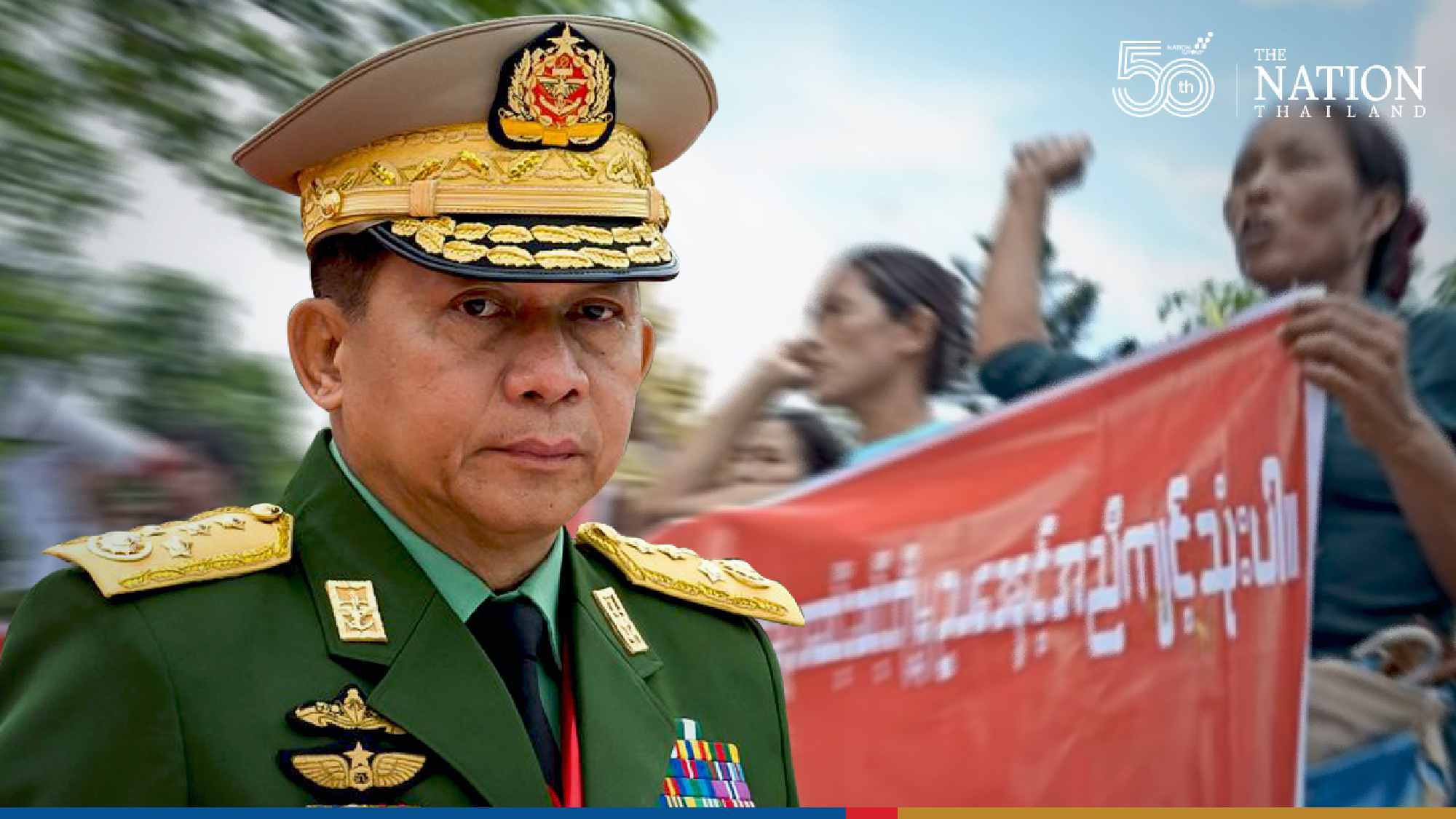
U.N. set to adopt resolution condemning Myanmars military junta
The United Nations General Assembly adopted a resolution Friday condemning Myanmars military leaders and calling for a halt in arms sales to the country.
The move comes after calls for more aggressive action on the part of diplomat Kyaw Moe Tun, who is still recognized by the U.N. as Myanmar’s ambassador, although he was pushed out and charged with treason by Myanmar’s military leaders for refusing to side with the junta that took power in a coup this year.
Tun was present Friday, casting Myanmar’s vote in favor of the resolution condemning the coup leaders.
The resolution calls on the Myanmar military to respect democratic election results and release political detainees.
The resolution was introduced by Liechtenstein, whose representative warned that there is a “real and present danger of a full-fledged civil war” in Myanmar.
The resolution was adopted after a vote of 119 in favor and 36 abstentions. One country, Belarus, voted against the resolution, citing its “politicized” nature.
Though Myanmar might typically be expected to vote against such a measure, Kyaw Moe Tun’s ongoing role as a representative of the elected civilian government means Myanmar’s recognized diplomats are calling for sanctions against their own country.
After the vote, Tun reemphasized his desire for the United Nations and the international community to take the “strongest and most decisive action against the military.”
The ambassador expressed his gratitude for the adoption of the resolution, but also his disappointment in how it took “almost three months to adopt this watered-down resolution.” He said that the resolution did not include arms embargoes, adding that the military is killing civilians with heavy artillery, most of which is imported.
“Selling weapons to the murderous military can be construed . . . to aid and abet the military to commit serious crimes such as crimes against humanity, ethnic cleansing, war crimes and genocide,” Tun said.
Several representatives – including from Bangladesh, Egypt and Iran – said that the resolution did not go far enough in comprehensively addressing the root causes of the Rohingya crisis, and abstained.
But others, including Russia, Belarus and China, condemned the “country-specific” nature the resolution. The representative from Russia said that the General Assembly vote blurs lines between the United Nations organs.
“Myanmar’s current issues represent a twist and turn in its political transition process. Essentially, it is a domestic issue,” the representative of China said. “History has shown that external blind pressurization or imposition of sanctions on Myanmar is not only ineffective but, quite on the contrary, may aggravate the issue.”
The Security Council was also set to hold informal talks on the situation in Myanmar on Friday.
At a meeting of the U.N. Security Council in April, Kyaw Moe Tun proposed not only an arms embargo, but targeting of bank accounts held by military leaders and a no-fly zone over the country.
While any resolution that passes the U.N. General Assembly is nonbinding, it can serve as a politically significant indication of global disapproval.
Though the 15-member U.N. Security Council has more power than the General Assembly, China, a permanent member and one of the Myanmar military’s few international allies, can exercise veto power there.
Published : June 20, 2021
By : The Washington Post · Adam Taylor, Sammy Westfall
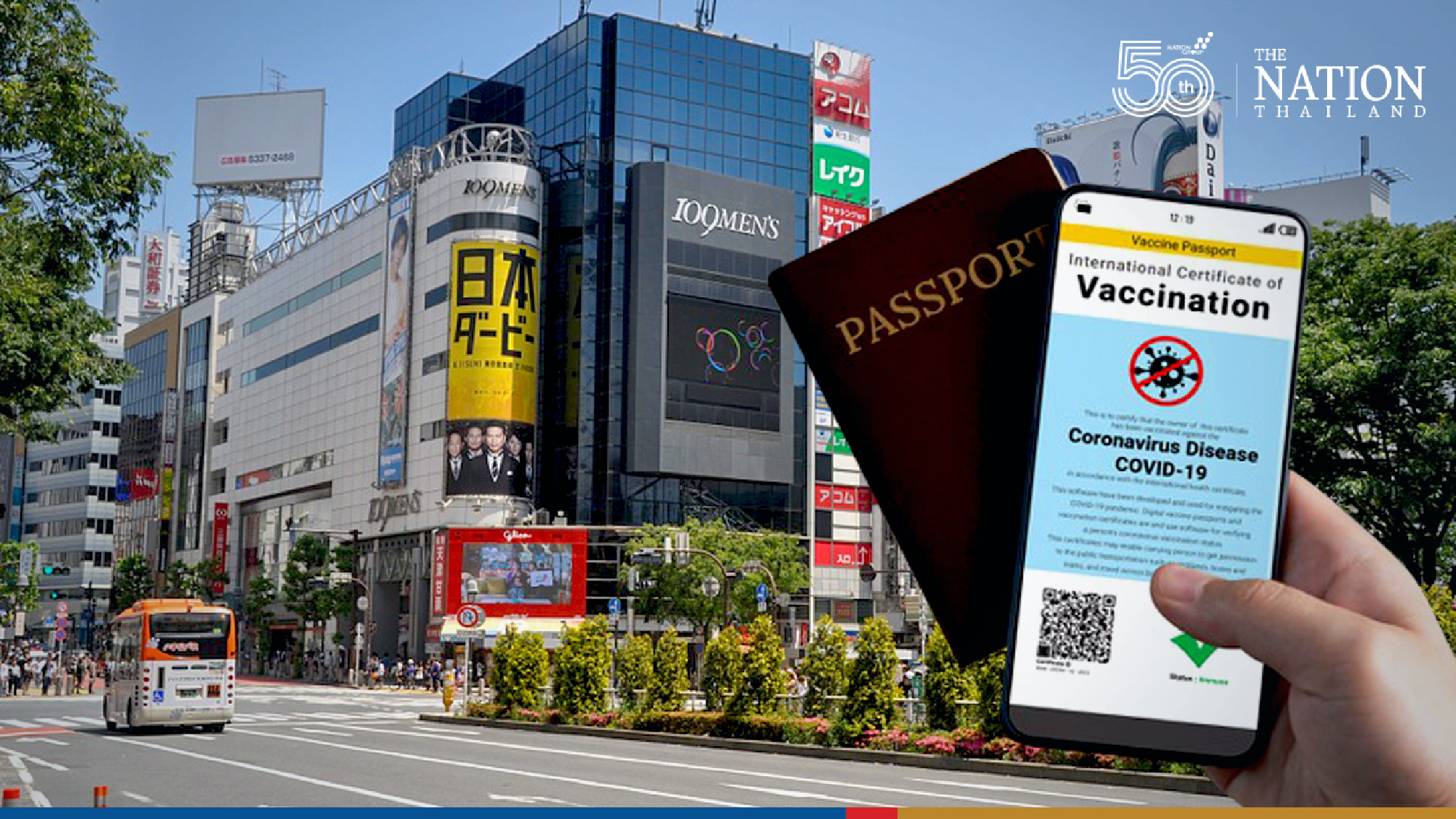
TOKYO – Japan will start issuing vaccination certificates to people traveling overseas who have been inoculated against COVID-19 as early as the middle of July.
For the time being, the government will issue such certificates — dubbed “vaccine passports” — on paper. It is considering issuing them in digital form in the future, which would allow people to apply for them online.
The government is preparing to create certificates of vaccination now so that paper-based documents can be issued by the middle or end of July, Chief Cabinet Secretary Katsunobu Kato said at a press conference Thursday.
“We’ll accelerate coordination by holding a briefing session for local governments as early as next week,” he said.
The vaccine passports will show the traveler’s name, nationality, passport number and date of vaccination, as well as the manufacturer of the vaccine used and other details. It will be issued by the municipalities responsible for vaccinations on behalf of the central government. No fees are expected to be charged for issuance.
The government’s Vaccination Record System will be used for the issuance process. As the system does not currently support English notations, the government is considering making improvements to the system.
In the European Union and other countries, there is a growing movement to introduce vaccination certificates as a measure to prevent unvaccinated people from entering.
In Japan as well, there have been calls — mainly from the business community — for the early introduction of this system in a bid to restart travel between Japan and other countries.
Federal judge strikes down CDC cruise rules in major victory for DeSantis
A federal judge said Friday that the Centers for Disease Control and Prevention cant enforce its rules for coronavirus-era sailing against cruise ships in Florida starting July 18.
The decision was hailed by Florida Gov. Ron DeSantis, a Republican – who filed suit against the public health agency in April – as a “major victory.”
“The CDC has been wrong all along, and they knew it,” DeSantis said in a statement, alleging that the agency was trying to “sink” the industry. “Today, we are securing this victory for Florida families, for the cruise industry, and for every state that wants to preserve its rights in the face of unprecedented federal overreach.”
Under the 124-page ruling from U.S. District Judge Steven Merryday, the CDC’s conditional sail order will become a ” ‘nonbinding ‘consideration,’ ‘recommendation’ or ‘guideline’ ” when applied to Florida sailings on July 18.
As part of its conditional sailing order, the CDC says operators can sail quickly if 95% of crew and passengers are vaccinated. If not, the agency requires cruise lines to take volunteers on “test” cruises to show they can mitigate the risks of covid.
Cruise ships have not been allowed to carry passengers from the United States since March of 2020, after high-profile outbreaks on ships around the world. As ports closed to ships with infected people on board, some sick passengers died en route to land.
The agency can propose “a narrower injunction” by July 2 “to further safeguard the public’s health while this action pends,” the ruling said. CDC spokeswoman Caitlin Shockey declined to comment Friday afternoon.
In a statement, DeSantis said the industry would soon be allowed to sail again thanks to the lawsuit that he and Florida Attorney General Ashley Moody filed. In reality, some cruise ships are preparing to sail as soon as next week with the CDC’s blessing after meeting their requirements.
“Today’s ruling is a victory for the hardworking Floridians whose livelihoods depend on the cruise industry,” Moody said in a statement. “The federal government does not, nor should it ever, have the authority to single out and lock down an entire industry indefinitely.”
It wasn’t clear if cruise operators would change anything about their plans after July 18 given the ruling. Roger Frizzell, spokesman for industry giant Carnival Corp., said the company was in the process of reviewing the decision.
It was also unclear how the ruling would affect the decision by some cruise lines to require passengers to be vaccinated in cruises that leave Florida – a requirement that is not allowed under state law.
DeSantis spokeswoman Christina Pushaw said in an email that the ruling “essentially frees the cruise industry from the CDC’s arbitrary and burdensome requirement of 95% vaccination among passengers.”
She said the governor’s office was not aware of any cruise line that would be requiring “vaccine passports” on sailings from Florida. Some have said, however, they will require either everyone on board or those over 16 to be vaccinated.
Florida argued in the suit that the CDC overstepped its authority with the conditional sailing order; in the decision, Merryday found that the state was “highly likely to prevail on the merits” of that claim.
“Viewed with the benefit of history, CDC’s assertion of a formidable and unprecedented authority warrants a healthy dose of skepticism,” he wrote.
He pointed out that the CDC had never before prohibited an industry-wide fleet from operating or imposed restrictions that “halted for an extended time an entire multi-billion dollar industry nationwide.”
“In a word, never has CDC implemented measures as extensive, disabling, and exclusive as those under review in this action,” Merryday wrote.
In recent weeks, the CDC has been lifting restrictions for vaccinated passengers on cruises. Just this week, the agency lowered its warning level from a 4 to a 3 for cruises and changed its recommendation to say that people who are not fully vaccinated should avoid cruise travel.
“Since the virus spreads more easily between people in close quarters aboard ships, the chance of getting covid-19 on cruise ships is high,” the agency wrote. “It is especially important that people who are not fully vaccinated with an increased risk of severe illness avoid travel on cruise ships, including river cruises.”
The difficulty of keeping covid off ships was made clear in recent days, when Royal Caribbean International postponed one of its first U.S. cruises after eight crew members tested positive for the virus before they were fully vaccinated. Last week, two passengers sharing a room on a cruise out of St. Maarten tested positive despite a requirement that all adults be fully vaccinated.
ADVERTISEMENT
Mike Winkleman, a maritime personal injury attorney, said he expects the CDC to come back to the judge with a new set of rules for cruise lines to follow. And, he said, cruise lines can still follow the plans they have been working on in conjunction with the agency.
“It’s not just the CDC and it’s not just Gov. DeSantis,” he said. “The cruise lines have been working for a year-plus, hiring their own teams of scientists and people with practical knowledge of this to figure out how they can cruise safely.”
As July 4 vaccination goal grows unlikely, Biden touts another milestone
WASHINGTON – President Joe Biden on Friday touted a new milestone in the fight against the coronavirus but sidestepped how he is likely to fall short of his goal of ensuring that 70% of American adults receive a vaccination shot by July 4 – a rare setback in his five-month crusade against the virus, which he has made his highest priority.
In a speech at the White House, Biden said that 300 million coronavirus vaccine doses had been administered since he took office 150 days ago, an achievement he said would propel the nation into a “very different summer compared to last year, a bright summer,” as virus infections and deaths have fallen sharply.
But Biden acknowledged that daunting challenges remain in the fight against the coronavirus – most significantly, the millions of people in the United States who are eligible for vaccines but have not gotten them. The president warned about the dangers they could face from the more contagious and potentially more lethal Delta variant, now circulating in the United States, as well as the risks unvaccinated younger people might assume.
“As I promised you from the beginning, I will always give it to you straight – the good, the bad and the truth,” he said. “And the truth is that deaths and hospitalizations are drastically down in places where people are getting vaccinated. But unfortunately, cases and hospitalizations are not going down in many places in the lower vaccination rate states. They’re actually going up in some places.”
Biden said Americans will “celebrate our independence from the virus” on the July 4 holiday but made no mention of the vaccination goal he pegged to that date. In early May, Biden said he was aiming for 70% of adults to have at least one vaccine dose by then, and for 60% to be fully vaccinated.
Projections suggest the nation may fall closer to 68% of adults receiving at least one shot of the vaccine by July 4. Some experts caution that the United States may not cross Biden’s threshold until late July or even August.
White House officials and outside advisers dismissed the significance of that target, saying they are more concerned about regional variations in vaccination rates that could allow a resurgence of the virus.
Fifteen mostly East and West Coast states, plus the District of Columbia, have already vaccinated 70% of adult residents, led by Vermont, which has administered shots to 84% of adults. Five more states are over 68% and will likely reach Biden’s goal.
But other states are lagging far behind and are likely to miss the target; Arkansas has vaccinated just 51% of adults, for instance.
“68 percent versus 70 percent doesn’t matter,” said Andy Slavitt, who served as a senior adviser to the White House coronavirus response before stepping down last week. “What matters is 50 percent in Arkansas versus 90 percent in Vermont.”
Still, Biden has made the pandemic his most urgent focus, and falling short of the July 4 target would be the first time his administration has failed to reach a self-imposed benchmark. The president’s advisers have long felt that his political fate will be determined in large measure by how the public assesses his stewardship of the crisis.
Biden has portrayed the Independence Day as a symbolic milepost – a moment for many Americans to return to the small celebrations they were forced to forego last year. Although many vaccinated people will be in position to do that, a sizable portion of the country has not gotten a shot.
As of June 18, about 64% of adults had received at least one shot of coronavirus vaccine, according to tracking by The Washington Post, but the pace has dramatically slowed since mid-April, when more than 3 million shots per day were being administered. The seven-day average dipped below 1 million shots per day in early June before a subsequent uptick to about 1.3 million shots per day in the past week.
White House officials have said their “month of action” ahead of July 4 is helping drive those new vaccinations, as volunteers encourage shots through door-to-door canvassing, phone banks and other local events. An array of organizations like Planned Parenthood and the SEIU have mobilized their own networks in support of the White House push.
But multiple surveys continue to find that about one-third of Americans have no immediate plans to get vaccinated, citing objections that range from a belief the threat has been exaggerated to evidence that previously infected people retain protection against it. Public health experts say the nation needs widespread immunity to prevent a resurgence of cases later this year in the face of increasingly transmissible variants like Delta linked to a spike in hospitalizations overseas.
ADVERTISEMENT
“It’s a variant that is more easily transmissible, potentially deadlier and particularly dangerous for young people,” Biden warned Friday.
Limited supply and slow delivery were the early challenges Biden faced with the vaccine rollout, when appointments filled up as quickly as state and local officials could post them and many anxious Americans counted down the days until they could sign up. But in recent months, the challenge of vaccinating the country has become more about weak demand.
The administration has sought to address that in different ways. It called on employers to give workers paid time off to get vaccinated and to recover as needed and set aside money to offset some of those costs. It partnered with dating apps to try to spur younger people to get vaccinated and encouraged Black-owned barbershops to invite in health providers to get more shots in arms in African-American communities.
But disparities persist. The percentage of White people who received at least one dose of vaccine was about 1.4 times as high as the rate for Black people and 1.2 times as high as the rate for Hispanics, according to a Kaiser Family Foundation analysis of 40 states released this week.
As Biden’s goal goes unrealized, some liberal groups have blamed Republicans, arguing GOP officials have consistently played down the threat of the virus and failed to encourage their constituents to get shots.
“As our nation pushes hard to get shots in arms and meet President Biden’s goal of 70 percent vaccinated by July 4, we need all hands on deck – and if we don’t reach that goal we’ll all know where to point the finger of blame,” Brad Woodhouse, executive director of Protect Our Care, said last week.
Published : June 19, 2021
By : The Washington Post · Sean Sullivan, Dan Diamond
Biden finds himself caught in politics of Catholic Church
WASHINGTON – There was a time when President Joe Biden could have been Father Joe.
For long stretches of his childhood, as he was educated by nuns in Catholic schools, Biden considered entering the priesthood, eventually convinced by his mother to try college first. After his wife and daughter were killed in a car accident in 1972, he later recounted, the newly elected senator met with a local bishop to discuss a dispensation that would have allowed him to become a priest.
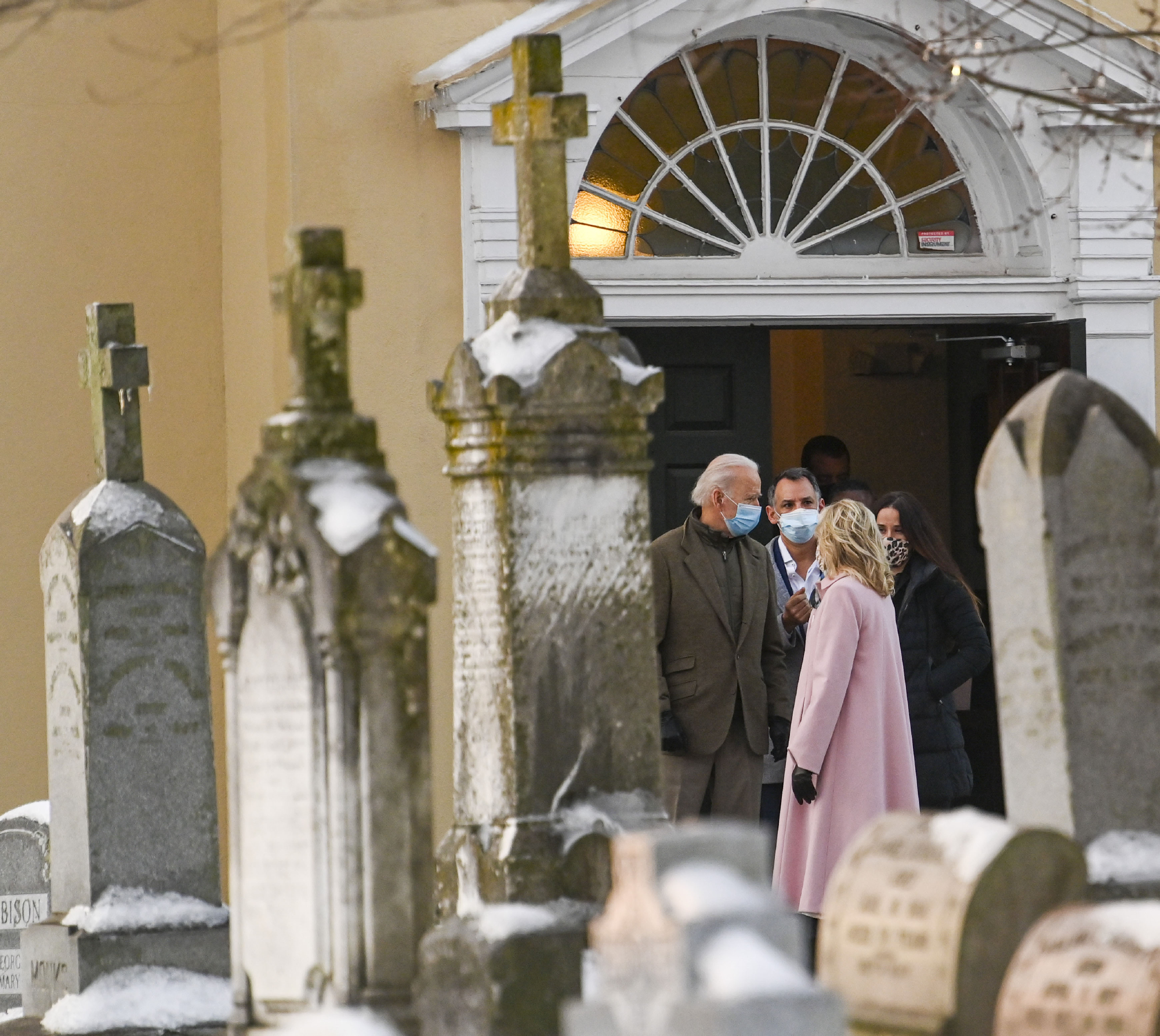
President Biden and first lady Jill Biden attend Mass in Delaware with daughter Ashley and her husband, Howard Krein, on Dec. 18, the anniversary of the car accident that killed the president’s first wife and daughter. Biden considered becoming a priest after their deaths. Washington Post photo by Jonathan Newton
Biden is arguably the most observant president in decades, and his faith is a core part of his identity. He rarely misses Mass. He crosses himself in public. He quotes scripture, he cites hymns, and he clutches rosary beads ahead of key decisions.
But now, the nation’s most prominent Catholic is at odds with many of the American bishops of his church. He has been the catalyst for an explosive disagreement that had been playing out for years, over whether Communion should be granted to politicians whose public stances go against church doctrine, and on Friday they took a step toward barring Biden and others from the Eucharist.
The move puts Biden, who rarely discusses his Catholicism, at the center not only of a political fight between conservatives and liberals, but also a church battle between traditionalists and reformers. In that sense he is aligned with Pope Francis as world-renowned liberal Catholics, a phenomenon that presents a challenge to traditionalists.
“If there are Catholic icons in this world and this country, they are Pope Francis and Joe Biden,” said Massimo Faggioli, a Villanova University theology professor and author of “Joe Biden and Catholicism in the United States.” “That is seen by some bishops as a threat, because their position is much more marginal now.”
Biden has long looked up to Francis, whom traditional Catholic priests consider too liberal and who discouraged the bishops from moving forward on restricting Communion.
The two men – an Argentine Jesuit and a Scranton-born pol – in some ways share similar philosophies, aligned on climate change, social change and economic disparities. Each is attempting to break with a more rigid predecessor in ways they believe are more inclusive, but which anger those who view the changes as too permissive.
“The convergence of a relatively progressive pope and a moderately progressive United States president causes some alarms for some of the so-called traditional or conservative Catholics, who feel their positioning in the faith community is under some threat,” said Mark Rozell, who co-edited the book “Catholics and U.S. Politics After the 2016 Elections: Understanding the ‘Swing Vote.’ “
“How does Biden respond to it?” added Rozell, dean of the Schar School of Policy and Government at George Mason University. “I have no idea. It puts the president in a very difficult spot.”
For now he’s responding by not saying much about it. Asked on Friday afternoon about the decision by the U.S. Conference of Catholic Bishops and the possibility he could be denied Communion, Biden paused.
“That’s a private matter,” he said. “And I don’t think that’s going to happen.”
Biden spent his early childhood in Scranton, Pa., where it was not unusual to see crucifixes in stores, nuns on the street and priests in the neighborhood. Sundays always started with the entire family trooping to St. Paul’s for Mass. The future president memorized the Lord’s Prayer and Apostles’ Creed, and could recite almost the entire Baltimore Catechism.
ADVERTISEMENT
His grandfather taught him to say the Rosary, and would kiss him good night while reminding him to say three Hail Marys for purity. He played Catholic Youth Organization football and attended Catholic schools.
“Wherever there were nuns, there was home,” Biden wrote in his book “Promises to Keep.” “I’m as much as a cultural Catholic as I am a theological Catholic. My idea of self, of family, of community, of the wider world comes straight from my religion.”
That did not necessarily mean unwavering fealty to Catholic doctrine – an approach that is now putting him at odds with the bishops. “It’s not as much the Bible, the Beatitudes, the Ten Commandments, the sacraments, or the prayers I learned,” Biden wrote. “It’s the culture. The nuns are one of the reasons I’m still a practicing Catholic.”
The nuns, he said, stood up for him when his classmates made fun of his stutter, or called him “Dash” not because he was a fast athlete but because he struggled to speak with clarity.
When he met his first wife, Neilia, her parents wanted them to break up because he was Catholic. Eventually, they dropped their objections and agreed not only to the marriage, but for it to be officiated by a Catholic priest.
Biden talks less about the social doctrines of his church and more about broad philosophies – helping those less fortunate, being a decent person. Despite his habit of quoting scripture (marking Juneteenth on Thursday, he recited, “Weeping may endure for a night, but joy cometh in the morning”) and his casual asides about the nuns of his childhood, he has been reluctant to discuss his faith in detail.
The contrast with former president Donald Trump is striking. Trump was not known as a churchgoer or religious individual, saying he could not remember ever asking God for forgiveness and downplaying the importance of Communion. But he aggressively courted conservative Christians, winning their praise for his antiabortion stance and his nomination of conservative judges.
At times Trump made especially dramatic gestures, like leaving the White House during a Black Lives Matter protest to hold up a Bible in front of St. John’s Church. During the 2020 campaign, Trump warned that Biden would “hurt the Bible, hurt God” if elected. At the Republican National Convention, former Notre Dame football coach Lou Holtz called Biden “a Catholic in name only.”
Biden, in contrast, sometimes seem to downplay his own piety.
“I am not suggesting to you that I am a deeply religious man, but I deeply believe in my religion,” Biden told Irish America magazine in 1987. He added, “I believe that some real wisdom has accrued over 1,987 continuous years of Catholicism – as long as you take it in a way that understands that there are significant mistakes that my church has made, but that it has an amazing resilience which I admire.”
Biden said at that time that he never missed Mass, though he could not explain exactly why. One of the first questions that his mother would ask when he called her, he later recounted, was whether he’d been to church.
“At any rate, I practice my religion,” he said. “It’s no big deal.”
Perhaps at the time, when he was only a young senator, it was no big deal. But now, as the second Catholic president in American history after John F. Kennedy, it is clearly a much bigger deal.
The debate among the U.S. bishops often views Biden’s faith through the lens of abortion rights, a topic that has been divisive for the church and problematic for Biden. During the 2012 vice-presidential debate with Republican nominee Paul Ryan, also a Catholic, Biden said he personally accepts the church’s position on abortion, “but I refuse to impose it on equally devout Christians and Muslims and Jews.”
At the same time, many Democrats have long said that Biden is not supportive enough of abortion rights, and it was only during his 2020 presidential campaign that he came out in support of federal funding for abortions.
In the past, Biden’s pro-choice position has caused some bishops to deny him Communion. Catholic schools have not allowed him to speak, and when he was selected in 2016 to receive one of the highest honors that Notre Dame can confer, it triggered an uproar among some on the campus.
One member of a group opposing the honor, University Faculty for Life, was future Supreme Court Justice Amy Coney Barrett.
But Biden’s stance also reflects a change among many of those who now attend America’s Catholic churches. A 2019 Pew Research Center survey found that 56% of Catholics support the right to abortion in all or most cases.
Catholics who are registered to vote are almost evenly divided between Republicans and Democrats, according to Pew. Although the growing segment of Hispanic Catholics overwhelmingly lean toward Democrats, there has been a steady erosion of the number of White Catholics who support the party.
In 2008, when Biden was Barack Obama’s running mate, the Democratic ticket won Catholics 54 to 45%, according to exit polls. But during their 2012 reelection campaign, Catholics were evenly split.
The numbers worsened for Democrats in 2016, when 52% of Catholics supported Trump, compared with 45% for Hillary Clinton, according to a Pew Research Center survey. In the November election, Catholic voters were about evenly split between Biden and Trump.
If Biden’s Catholicism is not entirely about adherence to doctrine, he is not alone. In a 2019 Pew poll, for example, almost 70% of Catholics said they do not believe in transubstantiation, the ideas that the bread and wine used for Communion becomes the body and blood of Jesus.
“My religion is just an enormous sense of solace,” Biden told Stephen Colbert during a 2015 interview. “What my faith has done is it sort of takes everything about my life – with my parents and my siblings and all the comforting things. . . . All the good things that have happened, have happened around the culture of my religion and the theology of my religion. And I don’t know how to explain it more than that.”
Faggioli said that less-traditional approach to religion has likely inflamed church leaders in part because Biden is so visibly Catholic and churchgoing, in essence providing an alternative view of what it means to be Catholic.
“What is remarkable is the archbishops in the last seven months since he was elected are really trying to find a way to discipline him,” Faggioli said. “And Joe Biden has totally ignored them.”
 Asean sees another major spike in new Covid cases and deaths