U.S. to boost vaccine donations, but critics say far more is needed #SootinClaimon.Com

#SootinClaimon.Com : ขอบคุณแหล่งข้อมูล : หนังสือพิมพ์ The Nation.

https://www.nationthailand.com/international/40000994

U.S. to boost vaccine donations, but critics say far more is needed


WASHINGTON – President Joe Biden announced Monday that his administration will send at least 20 million doses of U.S.-authorized coronavirus vaccines abroad by the end of June, a decision that comes amid criticism that the United States has hoarded vaccines and done too little to fight the pandemic beyond its borders.

U.S. to boost vaccine donations, but critics say far more is needed

The announcement marks the first time the United States has said it will share vaccines authorized for domestic use. The shipments will include doses from Pfizer-BioNTech, Moderna and Johnson & Johnson. Biden had previously committed to share up to 60 million doses of the AstraZeneca vaccine overseas, though the United States has not authorized that vaccine for domestic use and the doses remain under review by the Food and Drug Administration.

“There’s a lot of talk about Russia and China influencing the world with vaccines. We want to lead the world with our values, with this demonstration of our innovation, ingenuity and the fundamental decency of the American people,” Biden said Monday afternoon in a speech from the East Room of the White House.

Biden also announced that Jeff Zients, the nation’s domestic coronavirus coordinator, will lead the effort to share vaccines globally. Zients will work in coordination with the National Security Council and other agency partners, including Gayle Smith, who is coordinating global diplomatic outreach at the State Department.

“We’re going to bring the same whole-of-government response to the global effort that made us so successful here at home,” Biden said.

Kevin Munoz, a White House spokesman, said Zients was tapped for the role because of his success in overseeing the domestic effort, which has required working across federal agencies and in collaboration with state governments.

In recent weeks, Biden has been pressed to share more vaccines with the world and to develop a strategy to better distribute them as supply in the United States outstrips demand, even as deaths surge abroad. Nearly half of Americans have received at least one dose of a coronavirus vaccine, according to data compiled by The Washington Post, compared with less than 5% of people in Asia and about 1% in Africa.

“It’s great to share, but redistributing 20 million existing doses has little impact on the global demand for the 10-to-15 billion doses needed,” said Lori Wallach, who oversees global trade work for advocacy organization Public Citizen. “Obviously, it’s better to share than not, but it’s like offering 20 million bites from our existing slice of pizza when . . . we need to be getting a bunch of new pizza production lines going as fast as possible.”

Across the administration, officials acknowledged that the donation of 20 million doses would not substantively affect the effort to vaccinate the world but stressed that Biden’s announcement was just the “next step” of a larger effort.

The appointment of Zients to oversee the effort signals to some the increasing recognition of the central role that U.S. manufacturing will play in producing the worldwide supply, particularly given Zients’s efforts to work with Pfizer and Moderna to bulk up the country’s domestic supplies.

Amanda Glassman, executive vice president at the Center for Global Development, a nonprofit think tank, framed Biden’s announcement as “a step in the right direction” but said the pledged donations remained incremental. She also warned that Zients, a longtime business executive and domestic policy expert, would face new challenges trying to oversee global health policy decisions.

Glassman called on the United States to push its global allies to follow through on their commitments to support Covax, the World Health Organization-backed initiative to distribute vaccine doses equitably around the globe. The head of UNICEF on Monday warned that the surging coronavirus outbreak in India and other factors had led to a shortfall of tens of millions of doses that Covax hoped to use to help vaccinate low- and middle-income countries.

Meanwhile, China and Russia have worked out deals to sell or donate their vaccines to dozens of countries, sparking bipartisan concern that the United States is ceding ground to international rivals.

“We’re all here listening and frankly wondering why can’t we move as quickly as Russia and China to decide precisely what we want to do [and] where we want to do it and communicate that to the world?” said Sen. Mitt Romney, R-Utah, at a Senate hearing last week on the Biden administration’s global coronavirus strategy.

Some observers said Biden’s recent pledges – such as his decision to support waiving intellectual property protections on coronavirus vaccines – did not add up to a comprehensive plan and might even create new complications. For instance, drug companies have warned that passing the waiver at the World Trade Organization would impede their efforts to increase manufacturing, and German leaders have raised concerns about its effects on production.

“What remains lacking is a cohesive strategy,” said Krishna Udayakumar, director of Duke University’s Global Health Innovation Center. “For example, how do IP waivers fit with today’s announcement? What about increasing global manufacturing capacity? Will the U.S. ease export restrictions to facilitate more effective global manufacturing? Still many unanswered questions.”

Published : May 18, 2021

By : The Washington Post · Tyler Pager, Dan Diamond

Tech leads stocks down; crude oil jumps #SootinClaimon.Com

#SootinClaimon.Com : ขอบคุณแหล่งข้อมูล : หนังสือพิมพ์ The Nation.

https://www.nationthailand.com/international/40000993

Tech leads stocks down; crude oil jumps


U.S. stocks fell and the dollar weakened as investors considered risks to the economic outlook including inflation and a spike in coronavirus cases in parts of the world.

Tech leads stocks down; crude oil jumps

Technology and communication services led the benchmark S&P 500 into the red for the first time in three sessions. Apple and Microsoft weighed down the tech-heavy Nasdaq 100. Semiconductor stocks continued to be under pressure, with the Philadelphia Semiconductor Index dropping about 10% from a peak in early April.

“Investors should brace for further bouts of volatility, driven by inflation data along with other risks, such as setbacks in curbing the pandemic,” wrote Mark Haefele, UBS Global Wealth Management’s chief investment officer. “But we don’t see inflation concerns ending the rally in stocks, which we expect to be led by cyclical parts of the market as the global economic reopening broadens.”

Oil edged up as rising optimism around a demand recovery in regions such as the United States offset coronavirus flare-ups in parts of Asia.

Bitcoin tumbled to as low as $42,133 after a volatile weekend that saw Tesla CEO Elon Musk whipsaw prices with tweets that touched on the energy usage of the cryptocurrency and whether he was selling. Coinbase Global fell to a record low and below the reference price used in its April direct listing. Gold climbed to the highest in more than three months.

Federal Reserve Vice Chair Richard Clarida said during a webinar that weaker-than-expected April payroll report shows that “we have not made substantial further progress” on the central bank’s goals for employment and inflation laid out as thresholds to begin scaling back the central bank’s massive monthly bond purchases.

Concerns that policymakers may have to pull back support sooner than expected to quell rising inflation have weighed on global equities. Investors this week will parse the minutes from the Federal Open Market Committee’s latest meeting for any discussion about accelerating price pressures, and for hints of a timeline for reducing asset purchases.

“Expect this volatility to continue as the market searches for direction,” said Mike Loukas, CEO at TrueMark Investments. “The release of the Fed minutes on Wednesday will be interesting. With earnings season almost over, inflation will continue to hold center stage.”

Elsewhere, the Stoxx Europe 600 index edged lower and stocks in Asia were mixed.

– – –

Here are some key events this week:

– Reserve Bank of Australia publishes minutes of its latest meeting Tuesday

– The Fed publishes minutes from its April meeting Wednesday, which may provide clues to officials’ views on the recovery and how they define “transitory” when it comes to inflation

These are some of the main moves in markets:

Stocks

– The S&P 500 fell 0.3% as of 4 p.m. New York time

– The Nasdaq 100 fell 0.6%

– The Dow Jones industrial average fell 0.2%

– The MSCI World index was little changed

Currencies

– The Bloomberg Dollar Spot index fell 0.2%, down for the third straight day, the longest losing streak since May 10

– The euro rose 0.1%, to $1.2158

– The British pound rose 0.3%, to $1.4142

– The Japanese yen rose 0.2%, to 109.17 per dollar

Bonds

– The yield on 10-year Treasurys advanced one basis point, to 1.64%

– Germany’s 10-year yield advanced one basis point to the highest in about two years

– Britain’s 10-year yield was little changed at 0.86%

Commodities

– West Texas Intermediate crude rose 1.5%, to $66 a barrel

– Gold futures rose 1.6%, the most since May 7

Published : May 18, 2021

By : Syndication Washington Post, Bloomberg · Vildana Hajric, Kamaron Leach

CEO behind 5,300% stock gain says secret is raising salaries #SootinClaimon.Com

#SootinClaimon.Com : ขอบคุณแหล่งข้อมูล : หนังสือพิมพ์ The Nation.

https://www.nationthailand.com/international/40000992

CEO behind 5,300% stock gain says secret is raising salaries


Masaru Tange says the strategy that turned his company into one of Japans best-performing stocks may be surprising: He buys smaller firms and boosts their workers pay.

CEO behind 5,300% stock gain says secret is raising salaries

Tange’s Shift, a software tester, acquires other businesses near the bottom of the industry supply chain and raises their engineers’ salaries. He says he’s able to do this and still charge competitive prices by cutting out layers of companies that serve as middlemen in the outsourcing process. And having more workers leads to higher sales.

Shift’s shares have risen more than 5,300% since it went public in 2014, the second-best performance on Tokyo’s benchmark stock index. The company’s market capitalization has surged to about $2.3 billion, pushing the value of Tange’s 33% stake to about $745 million.

Tange, 46, says his business model is an attempt to remove inefficiencies in Japan’s software industry, where layers of subcontractors take cuts on orders before passing the work to another company below. It’s also, he says, a break from the M&A strategy of buying a business and looking to reduce costs.

“I have a strong urge to rescue these young employees,” Tange, Shift’s founder, president and CEO, said in an interview. “I want to create a fair working environment through M&A.”

Tange grew up in what he describes as an ordinary family in Hiroshima in southwestern Japan, where both his parents were civil servants. He established Shift in 2005 after majoring in mechanical engineering and spending more than five years working for a consulting firm.

Shift started out advising companies on how to improve profits. In 2009, it entered the software testing business.

Tange said he wanted to change engineers’ perception that software testing was a second-rate job, including by paying them more money.

For example, for a service where the market price was $18,000 (2 million yen), Shift would charge $14,000 (1.5 million yen). This would enable it to win customers. At the same time, it would raise the amount paid to the engineer to about $7,300 (800,000 yen) from $4,600 (500,000 yen). It could do so, Tange said, by getting rid of middlemen.

Shift acquired Yusuke Sato’s company in 2016. Since then, the software developer says his salary has jumped by more than 70%.

“Joining Shift was a huge turning point in my career,” Sato said.

Shift has 3,308 engineers as permanent employees as of the end of February, up more than 14-fold from 228 at the end of November 2015. The company acquired at least 14 firms during that period.

Increasing engineers leads directly to revenue growth because it enables the company to do more business, according to Go Saito, an analyst at Credit Suisse who initiated coverage on the stock in February with an outperform rating.

“Sales can be derived by multiplying the number of engineers and the unit price for engineers,” Saito wrote in a report that month. “The company has already created a framework for the skills development of engineers, enabling it to cultivate high-quality human resources.”

Revenue rose to $262.4 million (28.7 billion yen) in the 12 months ended August 2020, more than triple the level three years earlier. Profit increased to $14.6 million (1.6 billion yen), compared to $1.9 million (208 million yen) three years before. Shift forecasts that sales will jump to a record $411.5 million (45 billion) yen this fiscal year.

Software engineers are underpaid in Japan compared to the U.S. and there’s a shortage of them, according to Saito. That’s one reason why Shift’s model of outsourcing software testing works, he said.

“We’re the biggest in Japan in this area,” Tange said. “I do see revenue reaching 100 billion yen,” he said, referring to the company’s goal for the fiscal year ending August 2025.

Shift’s soaring shares haven’t been immune to pullbacks. They’ve fallen about 22% from a record in October as investors sold high-growth technology stocks. Even after the drop, the company trades at about 87 times estimated earnings.

For veteran investor Mitsushige Akino, the stock may see more volatility in coming months and could fall in market downturns. But its “fundamentals are solid and Shift is making progress on the vision it laid out,” the senior executive officer at Ichiyoshi Asset Management said. “It won’t be strange to see more buying of these types of shares if investors focus once more on growth stocks.”

Credit Suisse’s Saito says the key will be whether Shift is able to continue to increase its number of engineers.

Whether that will happen remains to be seen, but Tange, at least, isn’t short of confidence.

“We’re just getting started,” he said.

Published : May 18, 2021

By : Syndication Washington Post, Bloomberg · Min Jeong Lee, Toshiro Hasegawa

Scientists say Covid is airborne. Now authorities think so, too #SootinClaimon.Com

#SootinClaimon.Com : ขอบคุณแหล่งข้อมูล : หนังสือพิมพ์ The Nation.

https://www.nationthailand.com/international/40000991

Scientists say Covid is airborne. Now authorities think so, too


A quiet revolution has permeated global health circles. Authorities have come to accept what many researchers have argued for over a year: The coronavirus can spread through the air.

Scientists say Covid is airborne. Now authorities think so, too

That new acceptance, by the World Health Organization and the U.S. Centers for Disease Control and Prevention, comes with concrete implications: Scientists are calling for ventilation systems to be overhauled like public water supplies were in the 1800s after fetid pipes were found to harbor cholera.

Cleaner indoor air won’t just fight the pandemic, it will minimize the risk of catching flu and other respiratory infections that cost the U.S. more than $50 billion a year, researchers said in a study in the journal Science on Friday. Avoiding these germs and their associated sickness and productivity losses would, therefore, offset the cost of upgrading ventilation and filtration in buildings.

“We are used to the fact that we have clean water coming from our taps,” said Lidia Morawska, a distinguished professor in the school of earth and atmospheric sciences at the Queensland University of Technology in Brisbane, Australia, who led the study. Likewise, “we should expect clean, pollutant- and pathogen-free air” from indoor spaces, she said over Zoom.

The study’s authors, comprising 39 scientists from 14 countries, are demanding universal recognition that infections can be prevented by improving indoor ventilation systems. They want the WHO to extend its indoor air quality guidelines to cover airborne pathogens, and for building ventilation standards to include higher airflow, filtration and disinfection rates, and monitors that enable the public to gauge the quality of the air they’re breathing.

A “paradigm shift is needed on the scale that occurred when Chadwick’s Sanitary Report in 1842 led the British government to encourage cities to organize clean water supplies and centralized sewage systems,” they wrote.

“No one takes responsibility for the air,” Morawska said. “It’s kind of accepted that the air could be of whatever quality — containing viruses and pathogens.”

SARS-CoV-2 multiplies in the respiratory tract, enabling it to spread in particles of varying sizes emitted from an infected person’s nose and throat during breathing, speaking, singing, coughing and sneezing.

The biggest particles, including visible spatters of spittle, fall fast, settling on the ground or nearby surfaces, whereas the tiniest — aerosols invisible to the naked eye — can be carried farther and stay aloft longer, depending on humidity, temperature and airflow.

It’s these aerosol particles, which can linger for hours and travel indoors, that have have stoked controversy.

Although airborne infections, like tuberculosis, measles and chickenpox are harder to trace than pathogens transmitted in tainted food and water, research over the past 16 months supports the role aerosols play in spreading the pandemic virus.

That’s led to official recommendations for public mask-wearing and other infection-control strategies. But, even those came after aerosol scientists lobbied for more-stringent measures to minimize risk.

Morawska and a colleague published an open letter backed by 239 scientists last July requesting authorities endorse additional precautions, such as increasing ventilation and avoiding recirculating potentially virus-laden air in buildings.

WHO guidance has been amended at least twice since, though the Geneva-based organization maintains that the coronavirus spreads “mainly between people who are in close contact with each other, typically within 1 meter,” or about 3 feet.

Morawska, who heads a WHO collaborating center on air quality and health, says that’s an oversimplification.

“There’s nothing magic about this 1 meter,” Morawska said. The closer to an infected person, the higher the concentration of infectious particles and the shorter the exposure time needed for infection to occur. “As you are moving away, the concentration decreases,” she said.

Infectious aerosols remain concentrated in the air longer in poorly ventilated, confined indoor spaces, according to Morawska.

Although a high density of people in such settings increases the number of people potentially exposed to an airborne infection, enclosed indoor areas that aren’t crowded may also be hazardous — a distinction Morawska says the WHO should make clearer.

“The WHO, step by step, is modifying the language,” she said.

Morawska, a Polish-born physicist who was previously a fellow of the International Atomic Energy Agency, can take credit for the WHO’s changing stance, said Raina MacIntyre, professor of global biosecurity at the University of New South Wales in Sydney.

“Professor Morawska’s contribution, on the background of world-leading expertise in aerosol science, made a real impact by forcing WHO’s hand,” MacIntyre said in an email.

The role of airborne transmission “has been denied for so long, partly because expert groups that advise government have not included engineers, aerosol scientists, occupational hygienists and multidisciplinary environmental health experts,” MacIntyre wrote in The Conversation last week.

“A false narrative dominated public discussion for over a year,” she said. “This resulted in hygiene theater — scrubbing of hands and surfaces for little gain — while the pandemic wreaked mass destruction on the world.”

Some people working in infection prevention and control and related fields have stuck rigidly to beliefs that minimized aerosol transmission, despite evidence challenging their views because “they do not want to lose face,” said Julian Tang, a clinical virologist and honorary associate professor in the department of respiratory sciences at England’s University of Leicester.

“We all have to adapt and progress as new data become available,” Tang said. That’s especially true in public health, where official policies and guidance based on “outdated and unsupported thinking and attitudes can cost lives,” he said.

Morawska said she hopes the attention that the pandemic has drawn to face masks and the risks associated with inhaling someone else’s exhaled breath will be a catalyst for cleaner indoor air.

“If we don’t do the things we are saying now, next time a pandemic comes, especially one caused by a respiratory pathogen, it will be the same,” she said.

Published : May 18, 2021

By : Syndication Washington Post, Bloomberg · Jason Gale

China seeks red tourism boost from Communist Partys 100-year milestone #SootinClaimon.Com

#SootinClaimon.Com : ขอบคุณแหล่งข้อมูล : หนังสือพิมพ์ The Nation.

https://www.nationthailand.com/international/40000990

China seeks red tourism boost from Communist Partys 100-year milestone


Two Chinese provinces are taking a lead in promoting “red tourism” ahead of the Communist Partys centennial, as President Xi Jinping seeks to boost domestic consumption while consolidating power.

China seeks red tourism boost from Communist Partys 100-year milestone

Jiangxi party chief Liu Qi announced at a news conference in Beijing last week that his province would host a China Red Tourism Expo with neighboring Hunan in October. The party is trying to improve coordination between the different red tourism sites that attracted an estimated 1.4 billion visits in 2019 before the pandemic stymied travel, according to the tourism ministry, roughly equal to China’s population.

Eastern Jiangxi province is home to Jinggangshan — the so-called cradle of the Chinese revolution — while Hunan has Shaoshan, the hometown of late party patriarch Mao Zedong. Other key red tourism sites around the country include Yanan in Shaanxi province and Zunyi in Guizhou province.

The party will celebrate 100 years since its founding later this summer, an occasion which Xi is also using to showcase his own grip over the ruling party. In the lead-up, the government has been pushing study of party history by all sectors of society including the business community, promoting lectures and gala events and encouraging people to visit key historic sites that commemorate important events.

One person answering the call is 70-year-old Qingdao resident Zhao Fangan, who with her husband and a group of friends planned to visit several such red tourism sites including Ruijin, the former residence of Mao, also in Jiangxi as well as Yanan, near the end point of the Long March.

“We all want to see these places where the Chinese Red Army has gone,” the former teacher told Bloomberg News last month on the steps of the Jinggangshan Revolution Museum. “This year is a very special year — the 100th anniversary of the founding of the Communist Party of China — we want to commemorate it in this way.”

While many of the visitors observed during a government-led reporting trip to Jiangxi and Guizhou province in April were senior citizens, there was also a push to kindle interest in history among other groups including teenagers. They will be offered interactive experiences such as “taste the red rice” of the revolutionaries or to sing Red Army ballads, Liu said. He added that the May Day holiday saw tourism traffic at “red heritage” sites in his province grow by 300% compared to the previous year. While he didn’t provide specific numbers on the provincial level, he did cite the Nanchang Aug. 1 Memorial in the provincial capital as an example, saying the 5,000 tickets to the venue were “sold out” every day during the period.

“You can see tourists flooding all of the red tourists sites such as the ones in Jinggangshan,” Liu said. “As we mark the centenary of the CPC this year, we should seize the opportunity of party history, learning and education, and try to improve Jiangxi’s red tourism in terms of format, content and services.”

Published : May 18, 2021

By : Syndication Washington Post, Bloomberg

Biden calls for cease-fire in Israel-Hamas fighting as pressure mounts to halt violence #SootinClaimon.Com

#SootinClaimon.Com : ขอบคุณแหล่งข้อมูล : หนังสือพิมพ์ The Nation.

https://www.nationthailand.com/international/40000989

Biden calls for cease-fire in Israel-Hamas fighting as pressure mounts to halt violence


WASHINGTON – President Joe Biden on Monday called for a cease-fire to end a week of fierce fighting between Israel and Hamas militants, urging both sides to “protect innocent civilians” in a statement that amounted to a subtle rebuke of the Israeli government, a close ally of the United States.

Biden calls for cease-fire in Israel-Hamas fighting as pressure mounts to halt violence

Biden “reiterated his firm support for Israel’s right to defend itself against indiscriminate rocket attacks” during a call with Israeli Prime Minister Benjamin Netanyahu, the White House said. But in adding that Biden “expressed support for a cease-fire,” the administration went further than previous accounts of U.S. interactions with Israeli officials in describing the closed-door diplomacy and suggesting a private push.

Even as pressure mounted from fellow Democrats and others urging a cease-fire, Biden administration officials had stopped short of joining their calls until Biden spoke to Netanyahu and then issued a carefully worded statement afterward.

On the whole, the comments from Biden and his top advisers reflected their determination to cautiously navigate the ongoing conflict. The administration had declined to weigh in earlier Monday on whether Israel’s military assault against Hamas militants in the Gaza Strip is proportionate to the risk posed by Hamas rocket fire, as behind-the-scenes efforts to bring conflict to a close continued.

Biden’s conversation with Netanyahu was their third since the deadly exchanges began, amid rising political pressure in the United States to do more to rein in Israeli airstrikes that have killed more than 200 Palestinians in Gaza.

The death toll among Israelis from rocket fire and rising Israeli-Palestinian violence stood at 10, and at least 15 Palestinians have died in clashes in the West Bank.

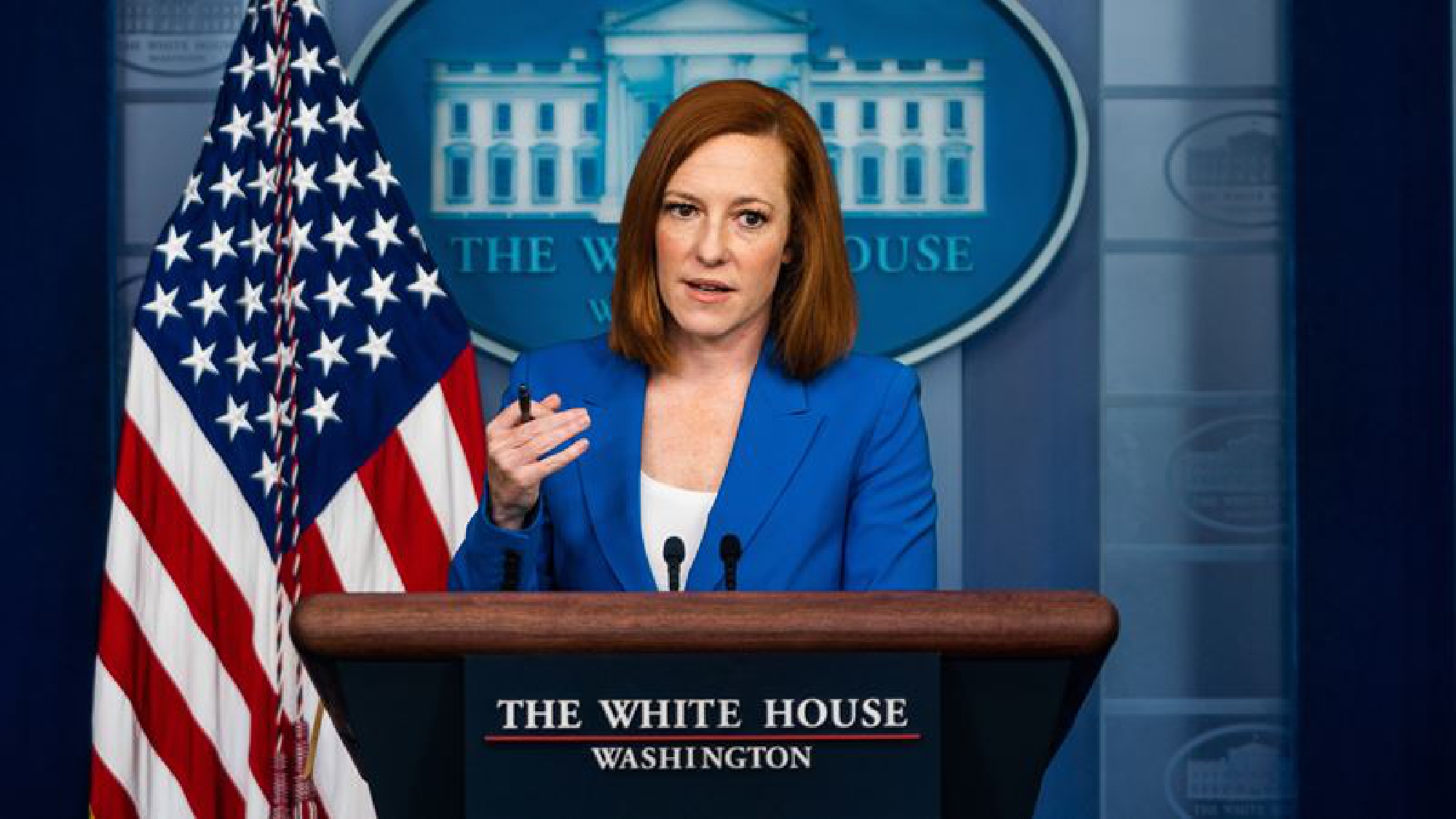
Pressed during her daily press briefing on whether Biden still believes Israel’s military response has been proportionate, White House press secretary Jen Psaki declined to answer directly.

“We’re not going to give a day-by-day evaluation,” said Psaki, who stressed the concerns that Biden communicated in weekend phone calls to Israeli and Palestinian leaders about lives lost on both sides of the conflict.

Biden and other U.S. officials have repeatedly endorsed Israel’s right to defend itself from Hamas rocket attacks, which target Israeli towns and cities indiscriminately.

“The role we are playing, the action, the prism we are making all of our decisions through is how can we help bring an end to the violence and bring an end to de-escalate the situation on the ground,” Psaki said. “And our calculation at this point is that having those conversations behind the scenes, weighing in with our important strategic partnership we have with Israel, also with other countries in the region, is the most constructive approach we can take. So our approach is through quiet, intensive diplomacy, and that’s where we feel we can be most effective.”

The muted tone reflects a decision by the Biden administration that heavy public pressure on Israel is likely to backfire. Multiple U.S. officials are applying some pressure and advice behind the scenes, with the goal of winding down the conflict, ideally within days.

It is not clear whether either Israel or Hamas would agree to a formal cease-fire, but U.S. and some Arab officials have signaled that a de facto agreement to end hostilities may suffice.

Egypt is a key go-between and had achieved some success last week in persuading Hamas to temporarily cease firing long-range rockets into Israel. The conflict has since escalated, however, and Israel appears to be following a pattern from past conflicts with Hamas, in which Israel attempts to quickly run down a list of Hamas targets before agreeing to pull back.

“The Israelis have a list of Hamas targets they want to hit, so they’re not open to a cease-fire” now, said one State Department official, who spoke on the condition of anonymity to describe sensitive discussions.

One Western diplomat familiar with discussions said there is a “race-the-clock” aspect to the Israeli actions, with the clock being the buildup of international pressure to end active hostilities because of civilian loss of life. Israel maintains that Hamas intentionally endangers civilians by locating military targets among homes, schools and ordinary commercial buildings.

Pressure from the United States is often most persuasive, both from administration officials and from members of Congress.

Senate Majority Leader Chuck Schumer, D-N.Y., said Monday that he agrees with colleagues who put their names to a letter Sunday calling for an immediate cease-fire.

“I want to see a cease-fire reached quickly and mourn the loss of life,” Schumer told reporters.

Sen. Todd Young, R-Ind., and 28 Senate Democrats had called for a cease-fire, broadening the previous notes of criticism of Israel and the Biden administration’s response that came largely from liberal Democrats.

Young, a member of the Senate Foreign Relations Committee, and Sen. Chris Murphy, D-Conn., joined a statement saying: “Israel has the right to defend itself from Hamas’ rocket attacks, in a manner proportionate with the threat its citizens are facing. . . . Both sides must recognize that too many lives have been lost and must not escalate the conflict further.”

Asked for her response to growing calls inside the Democratic Party for the United States to take a harder line against Israel, Psaki said political considerations must not be the primary focus.

“Our message is sometimes you have to step back from politics for a moment. It’s not easy to do,” Psaki said. “And we recognize and agree that watching the lives lost of these Palestinian children, of these families – the fear you see in the eyes of the Israeli people, it is heartbreaking.”

Secretary of State Antony Blinken drew short of calling for a cease-fire or a statement at the U.N. Security Council on Monday.

“We are ready to lend support if the parties seek a cease-fire,” Blinken said at a news conference in Copenhagen as part of an unrelated tour of Nordic countries.

When asked why the United States would not sign on to efforts at the United Nations to advance a cease-fire, Blinken said, “We are not standing in the way of diplomacy.”

“The question is, will any given action, or any given statement, as a practical matter, end the violence?” he said. “If we think there’s something, including at the United Nations, that would advance that, we’d be for it.”

Blinken and national security adviser Jake Sullivan both spoke with their Israeli counterparts on Monday.

Blinken “expressed deep concern at the inter-communal violence,” State Department spokesman Ned Price said in a statement.

“The two discussed the path forward, and the Secretary noted that the United States would remain engaged with Israel, the Palestinian Authority, and other regional stakeholders as part of our diplomacy to ease tensions and put an end to the hostilities.”

For days, the United States, a staunch protector of Israel at the United Nations, has blocked efforts by China, Tunisia and Norway to move the Security Council forward on a statement, including a call for a cessation of hostilities.

Blinken’s qualified support for a cease-fire – only if the parties themselves agree – has been interpreted as an accommodation of Israel’s goal to hit more Hamas targets. Israel also dislikes the term cease-fire because it could imply that Hamas is a legitimate government able to negotiate a formal agreement.

“It’s a pretty clear signal to Israel that it has time to finish the job on its terms,” said Richard Gowan, U.N. director at the International Crisis Group.

Aaron David Miller, a former U.S. official who has advised both Republican and Democratic administrations on Middle East issues, said waiting on Hamas or Israel to endorse a cease-fire is a recipe for further violence.

“The longer this goes on the greater danger of a mass casualty event either by errant Hamas rockets or Israeli air/artillery,” he said. “Biden is clearly giving Netanyahu the time and space and political support.”

“Clearly, Biden et. al. have had conversations with Netanyahu about his timeline for ending this. And the IDF isn’t done yet,” he said, using the acronym for the Israel Defense Forces.

Turkish President Recep Tayyip Erdogan, who has been a leading voice in the region criticizing Israel’s conduct during the current conflict, on Monday condemned the Biden administration’s decision to approve new weapons sales to the Netanyahu government.

“You are writing history with your bloody hands in this incident, which seriously, disproportionately attacked Gaza and caused the martyrdom of hundreds of thousands of people,” he said after a cabinet meeting in Ankara, in comments that wildly inflated the death toll from Israel’s airstrikes in Gaza.

Published : May 18, 2021

By : The Washington Post · Anne Gearan, John Hudson, Sean Sullivan

Miss Mexico named universe’s most beautiful woman for 2020 #SootinClaimon.Com

#SootinClaimon.Com : ขอบคุณแหล่งข้อมูล : หนังสือพิมพ์ The Nation.

https://www.nationthailand.com/international/40000967

Miss Mexico named universe’s most beautiful woman for 2020


Mexico’s Alma “Andrea Meza” Carmona beat contestants from 74 countries and territories to be crowned Miss Universe 2020 by her predecessor Zozibini Tunzi from South Africa.

Miss Mexico named universe’s most beautiful woman for 2020

In the final round, held on Sunday night at Seminole Hard Rock Hotel and Casino in Hollywood, Miss Mexico beat the other finalists – India, Brazil, Peru and the Dominican Republic – to be named the 69th Miss Universe.

Carmona, 26, is the third Mexican woman to win the Miss Universe title. She had been crowned Miss Mexicana Universal 2020 and Miss Mexico 2017 before winning the Miss Universe crown.

Published : May 17, 2021

By : The Nation

Israeli airstrikes kill 42 in Gaza as Biden, regional partners push for cease-fire #SootinClaimon.Com

#SootinClaimon.Com : ขอบคุณแหล่งข้อมูล : หนังสือพิมพ์ The Nation.

https://www.nationthailand.com/international/40000952

Israeli airstrikes kill 42 in Gaza as Biden, regional partners push for cease-fire


TEL AVIV, Israel – Predawn Israeli airstrikes Sunday on several homes along a main road leading to Shifa Hospital in Gaza City killed 42 people, including 10 children, according to Gazas Health Ministry, and the number was expected to rise. It is believed to be the single deadliest attack since the bout of violence began last week.

Israeli airstrikes kill 42 in Gaza as Biden, regional partners push for cease-fire

Diplomatic efforts by President Biden and U.S. regional allies to reach a cease-fire have not stopped the escalation between Israel and Hamas, which on Sunday trudged into its seventh day and has spilled over into mass protests in Israeli towns and in the West Bank.

From Saturday night into early Sunday, the Israeli military said it dropped 100 bombs on Hamas’s underground tunnel system, known as the “Metro,” and destroyed the homes of Hamas leader Yehiya Sinwar, his brother and several other prominent military commanders. A Doctors Without Borders clinic in Gaza City that served as a trauma and burn treatment center was also hit, according to a statement by the organization.

Hamas on Saturday fired continuously into cities and towns across southern Israel, as well as toward the West Bank and the Tel Aviv metropolitan area, which had experienced two days of relative calm. On Saturday night alone, Tel Aviv was targeted with more rockets than during all of the 2014 Israel-Gaza war, according to Maj. Gen. Uri Gordin, commander of Israel’s Home Front Command.

The Palestinian death toll climbed to 192, including 58 children; the numbers were expected to rise as more bodies were discovered from the overnight attacks. An Israeli man whose family described him as disabled was killed in a direct rocket hit to his building in a Tel Aviv suburb on Saturday, raising the death toll in Israel to 10.

On Sunday morning, Egypt opened the Rafah border crossing, which had been closed for the Eid al-Fitr holiday, a day earlier than scheduled, to allow for the passage of students, people in need of medical care and other humanitarian cases from Gaza into Egypt, according to Gaza’s Interior Ministry.

Egypt has sent 16 ambulances into Gaza to pick up injured people seeking treatment in Egyptian hospitals, a medical source told Reuters. He added that a bus carrying 95 people had arrived from Gaza on Sunday morning.

Biden, speaking to Netanyahu on Saturday, said he supported Israel’s right to defend itself against rocket attacks from Hamas, the Islamist militant group that rules the Gaza Strip, and other Gaza-based terrorist groups, according to the White House. He voiced concern for the loss of civilians, including children, on both sides, and the Israeli targeting of journalists in Gaza.

Israel launched airstrikes Saturday that obliterated several high-rises, including a 12-story tower that contained the offices of the Associated Press and Al Jazeera. The military claimed it also housed Hamas military assets but offered no evidence.

Biden said he had “grave concern” over the clashes between Arabs and Jews that continued Saturday during Nakba Day, which marks the displacement of hundreds of thousands of Palestinians in Israel’s founding in 1948. The event drew thousands of Palestinians to the streets in the West Bank and Israel in the largest turnout in years.

Israeli police arrested two Jordanian residents carrying knives in the northern Gilboa region after they crossed the border, police spokesman Micky Rosenfeld said. They were suspected of planning to go to Jerusalem. Six Israeli police officers were injured in an apparent car ramming attack Sunday evening in the Sheikh Jarrah neighborhood of East Jerusalem, Rosenfeld said. The current round of violence was sparked by a dispute over evictions in the mostly Palestinian neighborhood.

After multiple rocket sirens sounded in the area of Ben Gurion International Airport near Tel Aviv in recent days, most foreign airlines have suspended incoming and outgoing flights.

In a separate call, Palestinian Authority President Mahmoud Abbas told Biden he had made “extensive contacts in order to reach a truce in Gaza,” according to Wafa, the official Palestinian news agency. Netanyahu has said repeatedly the Gaza campaign is expected to last at least several more days.

“We will continue to act, as much as is required, to restore peace and security to you, the citizens of Israel. It will take time,” Netanyahu said in a televised statement Sunday evening. “There is always pressure on us, but we are receiving support from the United States and from many other nations.”

Amr, the U.S. deputy assistant secretary of state for Israel-Palestinian affairs, and Jonathan Shrier, chargé d’affaires at the U.S. Embassy in Jerusalem, met with Gantz Sunday to discuss a potential cease-fire with Hamas.

Mediators from the United States, Egypt, Qatar and Jordan have been working in recent days to de-escalate the crisis.

On Sunday, Saudi Arabia convened the 57-nation Organization of Islamic Cooperation in an emergency virtual meeting “to discuss the Israeli aggression in the Palestinian territory,” the organization said.

Saudi Foreign Minister Prince Faisal bin Farhan al-Saud called for an “immediate stop to military operations, and for the entry of aid and treatment for the injured,” in some of his sharpest language against Israel to date. He condemned “forced displacement” in East Jerusalem.

The U.N. Security Council met in open session to discuss de-escalation Sunday. The body met behind closed doors twice in the past week to discuss the crisis. Secretary General António Guterres declared the hostilities in Israel and Gaza “utterly appalling” and called for an immediate end to the violence.

U.S. Ambassador Linda Thomas-Greenfield said “the human toll of this past week has been devastating.” She said the Biden administration was “working tirelessly through diplomatic channels to try and bring an end to this conflict.”

Hamas has fired some 3,000 rockets since the violence exploded on Monday, according to Lt. Col. Jonathan Conricus, spokesman for the Israeli Defense Forces. Hundreds of rockets have misfired and landed within the Gaza Strip, he said.

Nearly 90 percent of the rockets that enter Israeli airspace are intercepted by the country’s Iron Dome defense system, according to Gordin, the commander of Israel’s Home Front Command.

Conricus said Israel has struck some 700 military targets in Gaza in the past week. He said the Israeli operation would end by “Hamas stopping the fire toward Israel … the most basic of preconditions. After that happens, there might be room for talks.” But he also said military instructions were to “carry on” until all “current and future capabilities” of Hamas and other militant groups in Gaza were destroyed.

Published : May 17, 2021

By : The Washington Post · Shira Rubin

CDC chief says any vaccine mandates in U.S. will be set locally #SootinClaimon.Com

#SootinClaimon.Com : ขอบคุณแหล่งข้อมูล : หนังสือพิมพ์ The Nation.

https://www.nationthailand.com/international/40000951

CDC chief says any vaccine mandates in U.S. will be set locally


Any mandates in the U.S. to require people to be vaccinated against covid-19 will be set locally, not federally, the head of the Centers for Disease Control and Prevention said.

CDC chief says any vaccine mandates in U.S. will be set locally

“It may very well be that local businesses, local jurisdictions, will work towards vaccine mandates,” CDC Director Rochelle Walensky said on NBC’s “Meet the Press.” “That is going to be locally driven and not federally driven.”

Walensky spoke in four Sunday-morning interviews, days after the CDC announced that Americans vaccinated against covid-19 were clear to shed their face masks at most times.

The decision was kept under wraps among a small circle of top White House aides last week as they began making arrangements for the president to address the watershed moment on Thursday.

The move has created confusion, though, about who should continue to wear masks and who should be responsible for checking on peoples’ vaccination status if they’re unmasked in certain settings, like retail stores.

Walmart Inc. announced Friday that fully vaccinated staff and customers can leave their masks at home, and Starbucks Corp. also dropped mask requirements for vaccinated customers.

“This was not permission to shed masks for everybody, everywhere,” Walensky said on NBC. “This was really science-driven individual assessment of your risk.”

Governors in many states moved quickly late last week to drop mask mandates for vaccinated people. Others lifted the mandates completely, issuing strong recommendations to those not vaccinated to continue to wear masks and get immunized.

In President Joe Biden’s home state of Delaware, Gov. John Carney said Friday that effective May 21 the state will embrace CDC guidelines so that fully vaccinated people can stop wearing masks in most indoor and outdoor settings.

Maryland Gov. Larry Hogan announced the end of the statewide mask mandate starting Saturday, aligning Maryland with the new CDC guidance.

Hogan said on CNN’s “State of the Union” that he doesn’t think businesses will ask people to show vaccination cards.

“We’re giving the businesses the flexibility to do what they think is right,” he said. “They have the right to take actions, just like telling people, no shirt, no shoes, no service.”

On “Fox News Sunday” Walensky said the decision to shed a face mask was based on “the honor system.” She didn’t, though, rule out the need for proof of vaccination at the local level at some point.

“If you are not vaccinated, you are not safe. Please go get vaccinated or continue to wear your mask,” she said. “The vaccine is now available to over 90% of Americans within five miles.”

Published : May 17, 2021

By : Syndication Washington Post, Bloomberg · Craig Torres, Yueqi Yang

U.K. restaurants hit with chef shortage as indoor dining resumes #SootinClaimon.Com

#SootinClaimon.Com : ขอบคุณแหล่งข้อมูล : หนังสือพิมพ์ The Nation.

https://www.nationthailand.com/international/40000950

U.K. restaurants hit with chef shortage as indoor dining resumes


Britains restaurants and bars can serve indoors again for the first time in five months on Monday. Many of them are struggling to find enough staff after Brexit and three lockdowns in a year drove workers out of the industry.

U.K. restaurants hit with chef shortage as indoor dining resumes

Chefs, waiters and bartenders needed for everything from fast-food restaurants to fine dining are in short supply, with industry executives and recruiters saying that many of their most experienced people have left for other jobs.

“The people just aren’t there anymore,” said David Moore, owner of Pied à Terre, London’s longest-standing independent Michelin-starred restaurant. The industry is facing a “fairly massive, very serious skills shortage.”

It’s a sign of scars on the U.K. economy that may hold back a rebound from the worst recession in three centuries – or a spark for inflation that’s already starting to concern investors. It’s a trend that already hit the U.S., prompting McDonald’s Corp. and Chipolte Mexican Grill Inc. to raise wages for staff.

In Britain, hospitality companies were among the hardest hit by rules that closed leisure venues and pushed workers onto the government’s furlough wage subsidy program.

Despite that lifeline, the industry shed 330,000 staff through the pandemic, said Kate Nicholls, chief executive officer of the lobby group UKHospitality. About 20% of all restaurants and 10% of hotels closed shut for good, and many workers are looking at the long hours, low pay and shaky prospects of hospitality and looking elsewhere for work.

“People people are still nervous about committing to hospitality, fearful that the government may still impose restrictions, businesses unable to offer full-time posts,” Nicholls said. “The single biggest driver is uncertainty.”

Pub and restaurant stocks have rallied hard this year, with Restaurant Group more than doubling to the top performance of the FTSE 350 Index. But despite the U.K.’s speedy vaccination rollout, most hospitality companies are still trading below pre-covid levels and hope to get a lift from the return of consumers ready to spend their savings.

Staffing is one of the industry’s biggest uncertainties. Online job advertisements for “catering and hospitality” rose above pre-pandemic levels in the first week of May, the jobs search engine Adzuna said. A survey of 1,000 companies published Monday by the CIPD, a group representing human resources workers, showed two thirds of hospitality companies plan to recruit in the second quarter, up from 36% in the first.

Pizza Express in April set out plans to recruit more than 1,000 new roles, reversing cuts made over the past year. D&D, with more than 40 high-end restaurants based primarily in London, is seeking to fill 400 jobs but so far managed to recruit just half that number.

“We’re having people working much longer hours to be able to run the restaurants,” D&D CEO Des Gunewardena said. “We’re going to be fine, but it is a challenge.”

Thomas Faulkner, a former chef who now recruits for the trade, sees a “critical shortage” of staff likely to linger for some time unless restaurants deliver more incentives.

High turnover due to tough working conditions, high pressure, low pay and a “culture of machismo” meant that London was losing skilled chefs faster than they could be trained even before covid struck, according to a report published by the Centre for London.

“Being a chef is generally not healthy,” said Faulkner.

“What’s happened in this pandemic is they have gone to do other roles, realizing they can earn the same or more money standing in a car park or delivering for Amazon or Ocado. It’s a much more pleasant experience. They do fewer hours. They do sociable hours,” he said.

Britain’s exit from the European Union, which was completed in January, dried up a big pool of labor. More than 50,000 migrants left the U.K. in the second quarter of 2020, according to government estimates, with many more expected to have followed over the rest of the year. Immigration rules makes it difficult for them to return.

Before Brexit, up to a quarter of the hospitality workforce nationwide and 38% in London was made up by EU nationals, according to KPMG.

Gunewardena said the D&D is doing more to train staff, both internally and through government programs. In the short-term, its upmarket restaurants have “been a bit more liberal” with whom they take on board, offering higher pay than what was on offer before and training people to work in fine dining, he said.

“We’re hearing elsewhere within the sector of other restaurants throwing money at people,” Gunewardenza said. “We’re paying the same but bringing people up.”

Some big changes are inevitable in the sector including many moving from other industries, he said. “Longer term, it will be a higher skilled, higher wage sector.”

Published : May 17, 2021

By : Syndication Washington Post, Bloomberg · Marc Daniel Davies