India sets pandemic record with more than 400,000 new cases; Fauci says crisis is like a war
NEW DELHI – In sheer numbers, it is the worst surge since the pandemic began – and it is still gathering speed.
After a devastating week of soaring infections, India reported more than 400,000 new cases Saturday, a global record. Experts believe that number will climb even higher in the coming days, an unimaginable burden for a health system already under siege with hospitals issuing pleas for oxygen.
India’s experience underscores a sobering paradox: Even as the United States and Europe move away from the darkest days of the pandemic, other countries are engaged in a desperate struggle against the virus.
The powerful resurgence of infections in India – a country where cases had ebbed just months earlier – is also a reminder that the coronavirus is far from controlled around the world, even with vaccination rates climbing in many countries.
It remains unclear how large a role coronavirus variants are playing in the pandemic’s grip on India. But the staggering numbers themselves are leaving the country increasingly isolated. On Friday, the United States said it would restrict travel from India. Dozens of countries have begun sending aid to bolster hospitals overwhelmed by patients and short on crucial supplies.
In India’s capital, New Delhi, a hospital treating coronavirus patients ran out of oxygen on Saturday. It took an hour for fresh supplies to arrive. In the meantime, at least eight patients died, among them one of the hospital’s own doctors, said S.C.L. Gupta, the medical director of Batra Hospital.
The incident marks the second time in recent days in which an oxygen shortage at a Delhi hospital proved fatal. On April 23, a different hospital ran out of oxygen and 26 critically ill coronavirus patients died.
In New Delhi, people are waiting for hours at crematoriums to perform funeral rites for their loved ones. Dozens of pyres are being packed closely together in scenes that are without precedent. Every day people are dying outside hospitals, unable to access care.
Anthony Fauci, the Biden administration’s chief medical adviser, urged India to explore ways its military could help alleviate the calamity, saying the situation is “like a war” in an interview with the Indian Express newspaper.
He also strongly advised India to implement a nationwide shutdown. “No one likes to lock down the country,” he said. But a temporary lockdown “could have a significant impact on the dynamics of the outbreak.”
India had announced that it would open its vaccination program to all adults over the age of 18 starting Saturday, but in many parts of the country there were not enough doses available to expand the program. Several state governments said they did not know when they would obtain the necessary supplies.
The oxygen shortages and the chaotic rollout of the latest phase of the vaccine drive are adding to a deepening sense of crisis. Epidemiologists have said that the number of daily cases in India could reach 500,000 within weeks.
India has reported more than 300,000 new cases each of the past 10 days, bringing its total number of infections in the pandemic to 19 million. More than 3,500 people died in the most recent 24-hour period, according to data from the Health Ministry on Saturday.
The figure is an undercount, experts say. Recent reports from crematoriums and cemeteries in different cities and states indicate that a significant number of covid-19 deaths are missing from official statistics.
Several hard-hit areas of the country – including Delhi and the state of Maharashtra – have already announced lockdowns. On Saturday, the Delhi government said it would extend its shutdown for a third week. In a nationwide address on April 20, Indian Prime Minister Narendra Modi said that such measures were “a last option” that should be avoided.
On Friday, Modi met with his cabinet of ministers, which released a statement saying that the situation was a “once in a century crisis.” The cabinet reviewed measures to ramp up hospital beds, oxygen supply and stocks of essential medicines.
Two military transport planes carrying oxygen cylinders, rapid diagnostic tests and medical-grade masks from the United States arrived in Delhi on Friday. More aid is on its way, both governments said.
In a sign of the desperation in India’s capital, a lawyer named Amit Sharma submitted a petition to the Delhi High Court pleading for help finding a bed in an intensive care unit for his severely ill brother-in-law.
In the middle of the hearing on Friday, Sharma told the judges that his brother-in-law had died and no more efforts would be required. “I have completely failed,” Sharma said, according to media reports.
“No, the state has failed,” one of the judges replied, after a moment of stunned silence. “We all have failed.”
Volunteers are attempting to do what they can. Srinivas BV, president of the youth wing of the opposition Congress party, is leading an effort to answer distress calls on social media and the messaging platform WhatsApp. A couple of weeks ago, his group was still managing to help patients get beds in government hospitals. Now that, too, is proving nearly impossible.
“People are dying not because of [the virus] but because they’re not getting basic treatment in time,” he said.
One of them was Raja Ram Tiwari, a 64-year old retiree who used to work for India’s state broadcaster. His condition worsened on April 25. His son Shantanu spent hours the next day running around the city trying to secure an oxygen cylinder on the black market, where he was told it would cost $800 or more.
That evening, after calling dozens of hospitals, the family found a facility willing to admit Tiwari in a neighboring state, 60 miles away. Shantanu withdrew his father’s life savings to pay for the treatment and took his mother’s gold jewelry to sell in case more was needed.
He got his father into a taxi but five minutes into the ride Tiwari started to have trouble breathing. They went directly to the nearest hospital. It was too late: Doctors came outside to see Tiwari and told Shantanu his father was dead.
At the first crematorium Shantanu tried, there were already 11 bodies in line before it opened early in the morning. He went to another larger one, hoping it would have more capacity. When he arrived there at 3 a.m., it was conducting a mass cremation of dozens of bodies that had arrived earlier that day.
Shantanu watched for hours as he waited for his father’s turn. “I have never seen a night so silent and the sky lit with so many pyres,” he said.
As Israel buries the dead, questions grow over responsibility for deadly stampede
JERUSALEM – One day after a deadly stampede killed dozens of religious pilgrims, Israelis came out by the thousands to bury the dead, keep vigil in their honor and protest the lack of government oversight that may have cost them their lives.
At funerals, candlelight vigils and raucous demonstrations immediately after the end of the Jewish sabbath, citizens of all political stripes mourned and demanded to know how political and religious leaders let Friday’s overcrowded ultra-Orthodox festival take place with little oversight after years of safety warnings.
More than a dozen funerals began just after sundown, at least nine in Jerusalem, where many of the ultra-Orthodox victims lived. Grieving families managed to conduct 22 funerals before sunset Friday in keeping with religious rules to bury the dead within 48 hours.
But authorities were still identifying victims, leaving some families in agonizing limbo. By Saturday night, at least 42 bodies had been identified, according to media reports. At least four of the dead were U.S. citizens. Officials said 16 of the more than 150 injured remained hospitalized Saturday.
Some of the funerals drew hundreds of mourners. Pini Rozovsky, a 23-year-old yeshiva student, was among the crowd of men in traditional black hats and coats outside of Jerusalem’s Shamgar funeral home, where as many as six of the victims were being readied for burial.
Rozovksy’s own bus to the ill-fated festival was turned back after the stampede occurred. His friend Moshe Ben Shalom had arrived earlier, and was among those killed.
“This tragedy must be remembered for generations to come,” Rozovsky said. “There was never any like it.”
As families across Israel and in other countries began to sit Shiva, the seven-day Jewish mourning period, Neora Yaari, 36, led a candle-lighting vigil in Zion Square, a popular gathering place in the center of West Jerusalem.
As pedestrians stopped to light votives bearing the Hebrew words “Mourning Together,” the scene of the stampede in northern Israel, Yaari said she wanted to gather in “a neutral place, not connected to politics to say that we are all together and to put the disagreements aside.”
Not far away, a larger and angrier crowd swelled near the entrance to the residence of Prime Minister Benjamin Netanyahu, who has been the target of anger and blame since the tragedy that he characterized as one of the worst in Israel’s history.
The Balfour Street protests have been a weekly occurrence on Saturday’s for more than a year as Netanyahu’s opponents have called for the resignation of a prime minister who is being tried on corruption charges.
Demonstrators here – who say that Netanyahu allows the ultra-Orthodox to flout the law because they are a key part of his governing right-wing coalition – see the Mount Meron disaster as another reason for the prime minister to go.
“They dealt with Meron from a political point of view, not a safety point of view,” Avital Livny, a Tel Aviv actor. She held a sign in Hebrew: “The heart is broken. Criminals of the Meron Tragedy to court!”
It named Netanyahu and two of his close allies, Interior Minister Aryeh Deri and Public Security Minister Amir Ohana.
Ohana wrote in a lengthy Facebook post Saturday that he takes responsibility, “but responsibility does not mean blame.”
“I am ready to face any probe and answer any question,” he added. “This disaster happened this year, but it could have happened any other year.”
Demonstrator Giora Ehrlich, 64, a librarian from Herzliya, near Tel Aviv, was heartened by the anger he heard from some of the ultra-Orthodox community.
“The religious are looking for who is responsible and they are coming to the same conclusion we are,” Ehrlich said, pointing his finger toward the prime minister’s residence.
Ehrlich cited a familiar complaint from Netanyhu’s critics: The prime minister relies on ultra-Orthodox communities as a core of his political support base and in return he allows the highly insular and conservative religious communities to often operate outside the state’s control.
He has been criticized by opponents throughout the pandemic for not enforcing public health restrictions in ultra-Orthodox enclaves, which often resisted the measures and saw some of the largest outbreaks.
Earlier this month, Netanyahu told representatives from United Torah Judaism, an ultra-Orthodox political party that pushed for free worship at the Mount Meron site, that there would be no limit on the number of participants at this year’s gathering, according to accounts widely reported in Israeli media at the time.
The stampede in at the packed event occurred after some 100,000 mainly ultra-Orthodox Jewish men and children had gathered at the annual commemoration at the tomb of a revered 2nd-century rabbi on Mount Meron. The night of singing and dancing and bonfires turned suddenly to tragedy as the huge crowed surged toward the exits. Some reportedly slipped on slippery steps causing crushing pileups and panic in the confined setting.
The annual event, typically Israel’s largest pilgrimage, was canceled last year because of the coronavirus. This year, it was permitted as the country reopened following a widespread vaccination program.
But various Israeli authorities had reportedly been at odds for weeks ahead of the event over whether to severely limit attendance, according to Israeli media.
Israel’s ultra-Orthodox have largely opposed coronavirus restrictions.
Israeli authorities, however, have recently imposed limits on other religious gatherings. On Saturday, just 2,500 people were permitted at the annual Orthodox Christian Holy Fire celebration at the Church of the Holy Sepulcher, which is believed to contain the tomb of Jesus. Normally, tens of thousands of people attend the pre-Easter event.
Israeli security forces in recent weeks have also prevented Palestinians from gathering in the evening outside Damascus Gate in Jerusalem’s Old City, a popular pastime during the Muslim holy month of Ramadan. Police said the restrictions were to prevent crowds from blocking access to the al-Aqsa Mosque compound, a claim Palestinians rejected.
Published : May 02, 2021
By : The Washington Post · Steve Hendrix, Miriam Berger, Shira Rubin
As the U.S. departs Afghanistan, will the old Taliban reemerge?
After the Talibans hard-line government collapsed in 2001, American leaders dismissed some senior militants attempts to join the new Afghan political order, shunning a group that had isolated itself from the outside world, harbored al-Qaida and relegated women out of sight.
James Dobbins, who was leading diplomatic efforts to forge a new Afghan government after the Sept. 11, 2001, attacks, describes the refusal to entertain the Taliban leaders’ overtures to cooperate or surrender as “a major blind spot.”
“It was clearly a failure to recognize that the Taliban were an important element of Afghan society that could not be completely ignored or completely exterminated,” he said.
Twenty years later, as the United States begins withdrawing its remaining military force and experts predict a Taliban return to power via force or political pact, officials caution that it is still unknown whether the group has moderated its rigid beliefs.
Whether a renewed Taliban regime, should one emerge, proves more humane and inclusive than it was in the past would be a crucial test of President Biden’s decision last month to withdraw troops from Afghanistan and end the United States’ long military endeavor there.
A May 1 deadline for a U.S. withdrawal, which was negotiated under President Donald Trump in 2020 but was extended unilaterally by Biden to allow for more time to withdraw, has focused attention on the nature of the militant group, which now appears to be on the cusp of seizing a renewed share of political power.
Experts say the group, while unwavering in its desire to make Afghanistan an “Islamic society,” has not defined a clear stance on how it would approach many issues, including freedom of expression, the rights of women and minorities, and a future political structure – either out of strategic ambiguity or because the group has not reached an internal consensus on those topics.
Thomas Ruttig, co-director of the Afghanistan Analysts Network, said he believes the Taliban is waiting to gauge its strength relative to other parties, including elements of the current Afghan government or warlords, who might contend for power after the September deadline that Biden has set for the U.S. exit.
“We will start to know when the last soldier has left,” Ruttig said of whether the Taliban has changed.
In a recent research paper, Ruttig laid out the mixed evidence of whether the Taliban’s ideology and probable governing stance had evolved since 2001. The group, which previously banned TV and most music, has, for example, embraced the Internet and social media. It appears more open to facilitating foreign aid. But in other areas, such as political freedoms, it has shown little intent to embrace major change.
For many Americans, the Taliban’s stance toward women will be a key litmus test. After taking over in the 1990s, the Taliban largely banned women from public life, and girls were kept home from school. Over the past two decades, women have slowly claimed a greater role in economic and political life.
According to a recently declassified assessment from the National Intelligence Council, slim turnover in the Taliban’s leadership and the group’s inflexible negotiating positions are among the factors that suggest it will “roll back much of the past two decades’ progress” if it regains power.
“The Taliban’s desires for foreign aid and legitimacy might marginally moderate its conduct over time,” the assessment said. “However, in the early days of reestablishing its Emirate, the Taliban probably would focus on extending control on its own terms.”
Suhail Shaheen, a spokesman for the Taliban’s political leadership, said the group was “committed to women’s rights, whether they are in terms of [access to] education or work. So no need to worry about their basic rights.”
But experts said the Taliban’s administration of areas it now controls – which represent at least half of the country – may be the best indicator of its future actions. Even today, women are largely banned from working outside the home, except in the fields of education or medicine. Some provinces in the Taliban’s territory don’t have a single school for girls, while others allow girls to study only through primary school.
The group also represses free speech among Afghans living under its rule and regularly uses beatings and imprisonment as punishment for minor infractions.
When asked whether this kind of rule would be implemented nationwide under a Taliban government, the Taliban spokesman said he expects “there will be a review by experts to cater to essential aspects of human rights,” but any ruling would not deviate from Islamic law.
He appeared to acknowledge an expansion of access to education for women, saying “there will be need to adapt a decent uniform for girls at school and university level.” There are no universities in Taliban-controlled Afghanistan.
Sen. Jeanne Shaheen,D-N.H., citing a wave of assassinations of female activists and journalists, said the United States must do everything in its power to support the rights of women and girls in Afghanistan.
“Afghan girls should have the opportunity to grow up in a world with the freedoms their mothers fought to secure,” she said in a statement. “They are watching. We are watching.”
As the Biden administration seeks to keep a faltering peace process alive, also unknown is what sort of future Afghan government the Taliban would accept. While officials say the group appears more willing to share power, it’s not yet clear if it would seek to restore some form of its pre-2001 Islamic emirate, led by unelected clerics, or if it would accept a democratic system with elections and greater political freedoms.
Ashley Jackson, a researcher at the Overseas Development Institute, said Taliban leaders had made vague references to democracy but also expressed their goal of a “truly Islamic” form of government that would include Sharia law and would probably prioritize their religious norms.
“I would think they would be opposed to democracy, but they won’t say that publicly,” she said. “It’s hard to tell if they’re just buying time and hiding their objective, or if they have a different vision of representation and governance.”
Speaking before lawmakers this past week, U.S. envoy Zalmay Khalilzad said the promise of external funding and international recognition could act as an incentive for the Taliban to moderate its aims. The group’s previous government was recognized by only a handful of nations.
“The Talibs say they are interested in not being a pariah and being welcomed,” he said. “. . . All I can say is that we have made it clear that if they do, they can end their prior status, there can be progress in relationship with us and with others. But if they don’t, the very thing that they say they do not want to happen will be inevitable.”
While Taliban military leaders may see the benefits of global legitimacy and aid, fighters on the ground may not share those priorities.
As officials seek clues about the Taliban’s intentions, the group continues a wave of violence, which has intensified speculation that it may attempt a military takeover once local forces no longer have foreign air support. According to a new report from a U.S. watchdog, Taliban attacks were nearly 37% higher in the first quarter of the year than they were during the same period of 2020.
Yasin Zia, Afghanistan’s acting defense minister, said he believes the country’s Air Force will be able to “fill the gap,” adding that once the United States hands over military equipment, Afghan ground forces will “completely change the game.”
Still, as the original May 1 deadlines passes for the withdrawal of U.S. troops, many Afghans fear that Taliban forces will return to large-scale bombings in urban areas, a tactic the militants largely halted following the signing of the withdrawal deal last year.
On Friday, a car bomb exploded in the provincial capital of Logar, killing at least 21 people and wounding at least 91, according to the Interior Ministry. The attack, which the government blamed on the Taliban, occurred as Afghans were breaking their fast during the Muslim holy month of Ramadan.
U.S. officials are also concerned about the Taliban’s willingness – and ability – to ensure that groups such as the Islamic State and al-Qaida don’t attempt to strike the West, as al-Qaida did on 9/11. While the Taliban’s leadership committed in the 2020 deal to sever ties with al-Qaida, which maintains a small presence in Afghanistan, it did not make significant moves to do so for over a year.
Khalilzad, who was born in Afghanistan and served as U.S. ambassador in Kabul after 9/11, said the United States would seek to prevent the Taliban from resuscitating its earlier harsh governance but acknowledged that its ability to do so may be limited.
“We want our investments and sacrifices to have been worthwhile. And if we navigate the coming months appropriately, I believe that this can happen,” he said. “In the end, however, it will be up to the Afghans to seize their opportunities.”
Published : May 02, 2021
By : The Washington Post · Missy Ryan, Susannah George
GOP launches cultural attack on Bidens plan for day care, education and employee leave
WASHINGTON – Its not just the price tag.
Days after President Joe Biden rolled out his American Families Plan – a sprawling $1.8 trillion proposal to expand federal investment in child care, higher education, employee leave and more – Republicans have, alongside their deep fiscal misgivings, launched a broad social critique of the plan.
Key GOP voices are accusing Biden of engaging in a stealth attempt to reshape American life, trying to reframe their opposition to the plan away from dollars and cents toward the culture-war terrain on which they have recently been much more politically successful.
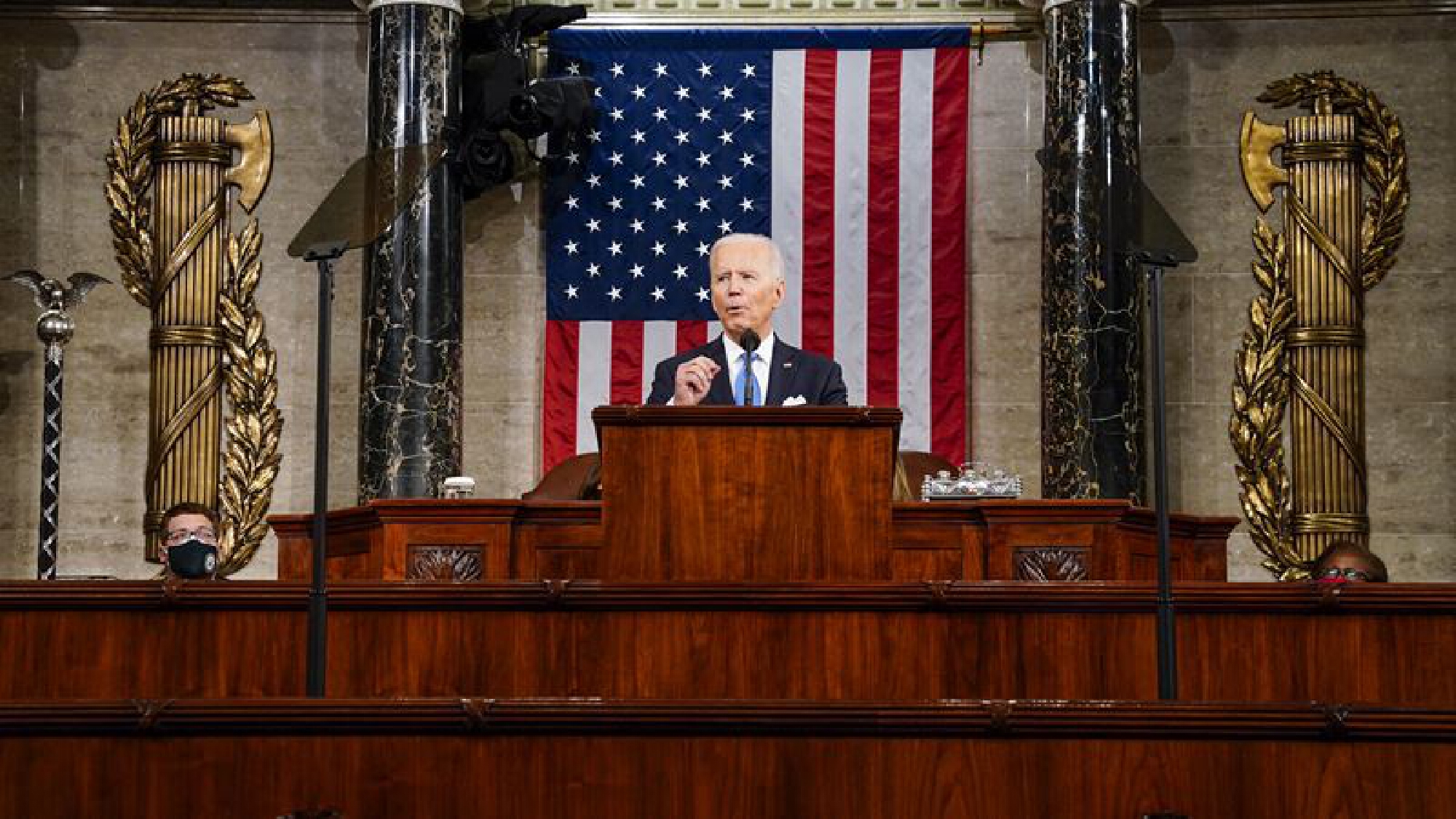
Senate Minority Leader Mitch McConnell, R-Ky., on Thursday responded to Biden’s pitch, made in a joint address to Congress, by declaring that the new administration “wants to jack up taxes in order to nudge families toward the kinds of jobs Democrats want them to have, in the kinds of industries Democrats want to exist, with the kinds of cars Democrats want them to drive, using the kinds of child-care arrangements that Democrats want them to pursue.”
That echoed a message sketched out immediately after Biden’s speech by Sen. Tim Scott, R-S.C., who gave the nationally televised GOP response and accused Democrats of wanting “to put Washington even more in the middle of your life, from the cradle to college,” and other Republicans followed suit.
“I think there’s a lot of lefty social engineering paid for by mortgaging the future of my children and my grandchildren,” said Sen. Josh Hawley, R-Mo. “It’s doubling down on the same old solutions on the left and just throwing more money at it.”
No legislation has been written to implement Biden’s proposals, and congressional Democrats are likely to finesse and amend them as they work through the legislative process in the coming months. But nothing in Biden’s blueprint would mandate that Americans attend free community college, drive electric cars or put their children in prekindergarten.
That has made the early GOP attacks especially mind-boggling for Democrats, who responded this week by arguing that they show Republicans are out of touch with the needs of most American families, especially as the country emerges from the ravages of the covid pandemic.
“I think they’re just flailing,” said Sen. Ron Wyden, D-Ore., who will play a key role in refining Biden’s proposals as chairman of the Senate Finance Committee and said his party’s aim was “to create options for families that will help us be more productive and create more high-skill, high-wage jobs.”
Sen. Bernie Sanders, I-Vt., the Budget Committee chairman, called the Republican attacks “way out of touch with common sense and where the American people are at.”
“No one is going to be coerced into anything,” he said. “But a mom or a dad who is going to work in order to provide for the family wants to know that their kids are in quality, affordable child care that exists in almost every other major country on Earth. We’ve got to do the same here.”
The Biden child-care proposal – which would establish universal pre-K for 3- and 4-year-olds and also subsidize child care for low- and middle-income families – emerged as a special lightning rod for conservatives.
Sen. Marsha Blackburn, R-Tenn., set the tone in a Fox Business Network interview Wednesday, hours after Biden released his plan, where she argued the proposals would “incentivize women to rely on the federal government to organize their lives.”
“Three-year-old pre-K, they’re going to mandate this. Two years of college, whether you like it or not. These are the things that take away choices from the American people,” she said. “It favors those who want power and control over every single minute of your day. It is disgusting.”
Later, as Biden gave his address, Blackburn tweeted a link to a 1974 New York Times story about the prevalence of affordable child care in the Soviet Union, adding: “You know who else liked universal day care.”
Some of the critiques on the right have been even more biting. J.D. Vance, a best-selling author and investor who is considering a Senate run in Ohio, said in a Thursday appearance on Tucker Carlson’s Fox News Channel program that Biden’s universal pre-K proposal was about favoring the “preferences of our ruling-class elites” over those of average Americans.
“They want strangers to raise their kids, but middle-class Americans, whatever their station in life, they want more time with their children,” he said.
Carlson interjected with further mockery of the plan, which Biden has billed as helping to improve children’s lives: “I love how they call it preschool like it’s an education initiative. It’s day care, let’s just say it out loud.”
Numerous studies, however, support Biden’s claims about the benefits of early-childhood education. Lenore Palladino, an economics professor at the University of Massachusetts Amherst, said the emerging Republican case against subsidizing child care ignores the economic realities of modern America: Not only do both parents want to work in many households, but for many more it is simply not a choice.
“I think sometimes policymakers, or people like myself who have more economic stability and are in professional settings, forget the deep reality that most families in this country need at this point two working partners to make a go of it, to be able to have a little bit of breathing room,” Palladino said. “We need a system that enables us to not be individually trying to scramble and figure out the best circumstances for child care.”
An April Yahoo News/YouGov survey found 58% of Americans in favor of providing universal pre-K for all American children, as Biden proposes, and 60% in favor of creating subsidies that would reduce the cost of child care for working parents. A majority of Democrats and independents favor child-care subsidies, while Republicans were roughly split. The poll also found most Democrats and independents in favor of universal pre-K, while slightly more Republicans were opposed than they were for child-care subsidies.
While many Republicans have made clear that they see no role for the federal government in further supporting child care, community college or employer leave, a small group of GOP lawmakers have floated alternative plans that would put cash directly into the bank accounts of American parents to spend as they wish – on child care or simply to allow a parent to stay home and provide care themselves.
“If you’re providing the service instead of the cash, what you’re saying is, we are providing you a benefit, but only if you use it in the way that we want,” said Oren Cass, executive director of the conservative think tank American Compass and an advocate for more federal support for families. “If your concern is that families are having trouble making ends meet . . . then the way that you should address that is with a program that provides more resources to families.”
Cass points to his group’s own survey research in claiming that most households prefer cash assistance to child-care subsidies, particularly down the income ladder. That argument has underpinned many of the early attacks on Biden’s plan.
Democrats, he said, “don’t just get to say, ‘We have this massive child-care plan, and you have no alternative.’ You actually do have an alternative. And, gosh, it looks like it may actually be more aligned with what middle- to working-class households would find most appealing.”
Still, the scale of the GOP plans appear to fall short of what Biden is proposing in combined child-care subsidies, universal pre-K funding and other family supports – including a $3,000-per-year child tax credit. And it is unclear how much support any of the conservative alternatives have inside the GOP congressional ranks.
The plan put forth by Hawley, for instance, would give families a refundable tax credit up to $12,000 per year, no strings attached, calculated based on earnings to encourage parents to hold jobs.
“It doesn’t pick for them the child-care solution – they have to pick. What Joe Biden wants to do is pick commercial day care,” Hawley said in an interview. “I think that’s a mistake.”
Sens. Marco Rubio, R-Fla., and Mike Lee, R-Utah, have proposed a more modest system of tax credits that would not be fully refundable, while Sen. Mitt Romney, R-Utah, has proposed a more sweeping plan that would issue monthly Social Security-like checks of up to $350 per child to most families.
Romney was among the Republicans who pooh-poohed Biden’s approach to child care this week, calling it “an incursion of the long hand of the federal government in areas where it doesn’t belong.”
“Building a national child-care enterprise of some kind, run by the federal government, is not my idea of the best way to give families the options that they would like to have,” he told reporters.
Park Service removes National Christmas Tree near White House after it develops fungal disease
WASHINGTON – The National Park Service says it will plant a new National Christmas Tree near the White House on the Ellipse in Presidents Park after the old tree developed a fungal disease and was removed Saturday morning.
The new tree will be planted in the fall ahead of the 99th National Christmas Tree Lighting, the park agency said in a news release.
The federal government has had a living National Christmas Tree, which can be viewed year-round by the public, on the Ellipse since 1973.
The tree that was removed Saturday was a 30-foot Colorado blue spruce from Palmyra, Pa., that was planted in 2019 with the help of a crane. Officials said the tree developed needle cast, a fungal disease that causes spruce tree needles to turn brown and fall off.
Before that, officials planted a Colorado blue spruce from Virginia in Oct. 2012.
That tree sustained damaged during a 2014 windstorm and then again in 2018 when someone attempted to climb it.
The National Park Service has said that October is an ideal time to plant the tree, though there is still the risk of “transplant shock.” The park service did not say where it would get the new tree from.
A baby was born midflight over the Pacific. A viral TikTok video captured the scene and first cries.
It was already an eventful day for friends Julia Hansen, 23, and Siearra Rowlan, also 23, before they boarded their flight from Salt Lake City to Honolulu. After arriving at the airport, they were informed their flight was delayed four hours, plus TSA confiscated a sealed jar of mayonnaise they had packed in their carry-on bag.
But nothing topped what happened halfway through their Delta flight to Hawaii.
Somewhere over the Pacific Ocean, a passenger gave birth to a baby boy – although it wasn’t known to Hansen and Rowlan immediately.
Hansen was dozing off when Rowlan first heard flight attendants calmly asking if someone on board was a doctor.
“Everybody’s kind of turning back to see what’s happening, and then there’s a lot of shuffling between flight attendants,” Rowlan says. “The speaker goes on and off like they’re about to announce something but they don’t. Then there’s a little baby crying.”
In her now-viral TikTok video, Hansen captured parts of the commotion – from the overhead announcement informing passengers of the birth; to an eruption of applause for the mother; to a crew of EMTs boarding to provide medical assistance to the mother upon landing.
Passengers applaud once again as the mother makes her way off the plane in a wheelchair, crying newborn in tow. (Hansen omitted footage of the family’s faces to respect their privacy.)
Delta confirmed that a baby was born on the flight from Salt Lake City to Honolulu on Wednesday. A doctor and nurses on the flight responded to a call for medical professionals. No other information about the birth or the baby’s family was available Friday.
Several commenters wondered why the passenger was allowed to board if she was anywhere near her due date. Delta does not prohibit pregnant travelers.
“At Delta, we don’t impose restrictions on flying if you’re pregnant and don’t require a medical certificate for you to travel,” the airline says on its website. “If you’re traveling after your eighth month, it’s a good idea to check with your doctor to be sure travel is not restricted.”
Aside from comments such as, “She just saved $20k in hospital bills,” and “The only time it’s okay to clap when the plane lands,” many viewers wondered about what such a unique delivery would mean for the baby’s birth certificate.
According to the State Department’s Foreign Affairs Manual, “a U.S.-registered aircraft outside U.S. airspace is not considered to be part of U.S. territory,” and “a child born on such an aircraft outside U.S. airspace does not acquire U.S. citizenship by reason of the place of birth.” But if a child is born over U.S. airspace, they would be granted U.S. citizenship.
A representative from the Los Angeles County Department of Health Vital Records Office says the parents would need to register for the baby’s birth certificate in the county where the plane was passing. Other experts have said families should take birth certificate issues up in the state where they land.
“If a birth occurred en route, that is in a moving conveyance (e.g., an airplane) the place of birth becomes where the newborn was first removed from the conveyance, or in this instance, the airplane,” said Centers for Disease Control and Prevention spokesman Scott Pauley in an email.
Once the plane landed, passengers waited for the mother to be escorted off by wheelchair first, then resumed disembarking normally like the miracle of life didn’t just unfold in their midst.
“It really didn’t take much time at all,” Hansen says. “After she had gotten out, everyone just kind of got up, got their carry-on and left.”
Rowlan adds, “It was so casual . . . but one kid was like, ‘This is like from a movie scene!”
Published : May 01, 2021
By : The Washington Post · Natalie B. Compton, Hannah Sampson
Indias coronavirus surge creates vaccine supply turmoil far beyond its borders
As coronavirus cases surged this month in India, the country that houses the worlds largest vaccine manufacturer, the government began to pause vaccine exports.
Shipments ground to a halt by mid-April. Now, with domestic need for vaccine in India overwhelming capacity and program extending to adults over 18 this weekend, it is not clear when India will begin exporting doses again.
The suspension of exports in April has contributed to a 90 million-dose shortfall for Covax, an international vaccine distribution effort, one of the group’s key backers said Friday. That number will only grow in May if restrictions are not lifted.
The limited supply would be a particularly big blow for low-income nations, many of which not only sought India-produced AstraZeneca through Covax but also pursued bilateral deals with Serum Institute of India, the Pune-based vaccine giant.
Arindam Bagchi, a spokesman for India’s Foreign Ministry, said Friday there was “no update” on when vaccine exports would resume.
Andrea Taylor, a researcher at Duke University’s Global Health Innovation Center who leads a team tracking vaccine deals and distribution, said continuing delays in Indian exports would be “devastating” for the poorer nations, adding that Covax would probably meet only a fraction of its distribution goals for May.
“There is no contingency plan or alternate supplier for the next few months,” Taylor said.
The Indian government has faced criticism for exporting millions of doses abroad before it secured enough doses for its population of 1.36 billion. Despite new case numbers that set global records and a death toll of over 200,000, less than 1 in 10 Indians have received a dose.
Even with export controls, vaccination sites in India have complained of severe problems with supply. On Thursday, Mumbai announced it would close vaccination sites in the city center until Sunday after running out of doses.
Outside India, the profound impact of the export ban suggests other manufacturing options are needed, said Thomas Bollyky, a senior fellow at the Council of Foreign Relations.
“The Serum Institute of India is a terrific contract manufacturer of vaccines,” he said. “It is not sufficient to meet global needs.”
In a statement, Gavi, a vaccine alliance that backs Covax, said further delays in May would be a “significant short-term challenge” for Covax.
In total, 49 million doses had been distributed through Covax, of which 29 million were from Serum, the statement said.
Officials from the African Union, which also arranged supplies from Serum, have expressed alarm, with top health official John Nkengasong saying this month that the export controls could be “catastrophic” for the continent.
Nkengasong, who heads the Africa Centers for Disease Control and Prevention, said this week that what was happening in India could eventually happen in Africa. “We are living in a world that is extremely uncertain now,” he told reporters in Nairobi on Thursday.
According to data collected by the Indian government, exports of vaccine have slowed to a stop. India exported over 28 million doses in March, up from 17 million in February, with most doses coming from Serum.
That number declined steeply in April to less than 1.9 million. No vaccine has been exported since April 16, according to the Indian data.
India initially portrayed the export restrictions as a temporary measure. V.K. Paul, a top health official and co-chair of India’s vaccine distribution group, said in an interview in early April that the restrictions were not a “scaling down” but a “slowing down” that would be resolved within weeks.
But with new cases in India still soaring – reaching another global record of 386,452 on Friday, with the total death toll over 200,000 – it was not clear when exports would resume.
In a bid to beat back infection rates, anyone over 18 will be eligible for vaccinations across India starting Saturday. Several Indian states have said they do not have enough supplies for the large expansion of eligibility.
Serum has said it is able to produce between 60 million and 70 million doses per month. Bharat Biotech, another Indian company that has developed a vaccine called Covaxin, is producing 10 million per month.
Adar Poonawalla, Serum’s chief executive, has blamed the slow pace of vaccine production in India on U.S. export controls on raw materials, calling on President Biden to “truly unite in beating this virus” in a tweet this month.
International organizations, including Gavi and others, have also called on countries to lift restrictions on exports and release excess doses.
The United States has pledged to share its supplies of AstraZeneca, not yet approved domestically, with foreign nations. Twenty million doses are expected to go to India. The Indian government has also reached an agreement to obtain 5 million doses of Sputnik V, a Russian-backed vaccine.
Such deals will be too little, too late to stop the immediate spread of the virus. It will take weeks, if not longer, to obtain and distribute the doses. AstraZeneca, like Sputnik and Covaxin, does not confer immunity immediately and requires two doses.
“There’s no way to vaccinate your way out of this surge,” Bollyky said. In the short term, he added, treatment and social distancing policies may be more important.
There are concerns that other countries may be on the same path as India. Nepal, India’s smaller neighbor facing its own surge, received only half of its order from Serum before India’s export restriction. Less than one-tenth of its population has received a dose, and it is now seeking more supplies from Russia and China.
“For the next India, we need to be ahead of it, not behind it,” Bollyky said.
He mentored decades of Army Rangers. At 94, hell receive the Medal of Honor.
WASHINGTON – Shivering in freezing temperatures, about 50 U.S. soldiers braced for the worst. Hundreds of Chinese soldiers were about to launch a series of bloody attacks on the hill the Americans had just taken under fire, and no reinforcements were within a mile.
Retired U.S. Army Col. Ralph Puckett stands alongside troops as they prepare to start a foot march during the 2021 David E. Grange Jr. Best Ranger Competition at Fort Benning, Ga., on April 16.
CREDIT: U.S. Army photo by Sgt. Henry Villarama
The clash that then-1st Lt. Ralph Puckett and his soldiers experienced that night on “Hill 205” came at the outset of the Battle of the Chongchon River, a pivotal moment in which senior U.S. commanders were surprised by China’s full-scale entry into the Korean War.
Thousands of U.S. soldiers died in following days as they withdrew hundreds of miles back into South Korea in what the Army now describes as the longest retreat in U.S. military history.
Puckett, who commanded the Eighth Army Ranger Company, was wounded by a hand grenade in the first attack on the hill on Nov. 25, 1950, but stayed in command. American and South Korean soldiers absorbed five more chaotic, armed assaults through the night before Puckett ordered his soldiers to withdraw the following morning as the Chinese threatened to overrun them.
“I had been wounded three times by then, and I was lying there in my foxhole unable to do anything,” Puckett would later recall for an oral history project. “I could see three Chinese about 15 yards away from me, and they were bayoneting or shooting some of my wounded Rangers who were in the foxholes.”
More than 70 years later, Puckett, 94, will receive the Medal of Honor, the nation’s highest award for valor in combat, for his actions. President Joe Biden called Puckett at home in Columbus, Ga., on Friday to inform him of his decision to approve the award, said John Lock, a retired Army officer who began petitioning the Army for reconsideration of Puckett’s actions in 2003.
The Army credits Puckett with leading his soldiers across an open field to take the hill under intense fire, braving enemy fire repeatedly to check on his soldiers after he was wounded the first time, and directing “danger close” artillery strikes near his own position to ward off advancing Chinese soldiers.
Puckett has said he told his soldiers to leave him behind after he was incapacitated, but two privates first class, Billy Walls and David Pollock, carried him to safety.
Puckett would go on to earn the Distinguished Service Cross, the nation’s second-highest award for valor in combat, for his actions in the battle. The recognition came near the outset of a 22-year career that also included a second Distinguished Service Cross and two Silver Stars for valor in Vietnam. Puckett was awarded five Purple Hearts for injuries suffered in combat and two Bronze Star Medals with the V device for valor.
With an upgrade to the Medal of Honor, Puckett will be one of the most highly decorated service members for valor in U.S. military history, Lock said.
Among those who assisted in Puckett’s case were Sen. John McCain, R-Ariz., who contacted the Army on Puckett’s behalf a few months before dying of cancer in 2018, and retired Gens. Joseph Votel and Stanley McChrystal, who know Puckett through their mutual service as Rangers, according to documents that Lock provided to The Washington Post.
“Then First Lieutenant Puckett’s actions on Hill 205 in 1950 exemplified personal bravery beyond the call of duty, risking his own life as he drew enemy fire so his men could locate, engage, and destroy an enemy machine-gun nest and kill a sniper,” Votel wrote in a 2018 letter to Army officials in support of Puckett’s nomination.
Puckett’s wife, Jean, said in a phone interview that the family hopes to visit the White House for a ceremony. Considering her husband’s advancing age and some health problems, she expressed concern about how long it was taking.
“He is not the one who has been pushing it. It has been John and our immediate family, who want him to be able to receive it personally if he is going to be awarded that medal,” she said, referring to Lock. “He felt the Distinguished Service Cross was honor enough.”
For years, Puckett has been a spiritual and cultural leader of sorts for the 75th Ranger Regiment, the elite fighting force that specializes in raids, airfield seizures and other difficult missions in combat. As an “honorary colonel” for the regiment, he traveled overseas in his 80s with U.S. commanders, including to Iraq and Afghanistan, and regularly met with soldiers at Fort Benning, Ga., the home of both the Ranger Regiment and much of Ranger School.
Votel, who retired as chief of U.S. Central Command in 2019, was commander of 1st Ranger Battalion when he got to know Puckett during an exercise in South Korea. Puckett shared details about his experiences fighting in the Korean War, connecting to the soldiers with his “down-to-earthiness,” he said.
“He’s a very noble individual He adds a level of dignity, a level of stalwartness, to everything that he is a part of,” Votel said in an interview. “He’s just really a revered figure in the Ranger Regiment.”
Puckett, who was born in Tifton, Ga., retired from the Army in 1971 and settled near Fort Benning after retiring as a civilian in the 1990s. His wife said they met there in a hospital decades earlier as Puckett was healing from the wounds he suffered in North Korea.
More recently, Puckett said he supported women serving in combat units. He said during an interview with The Washington Post in 2015 that he believed some could meet the standards and wanted to see them do it. His granddaughter, an Army captain, is now preparing to become an artillery officer, Jean Puckett said.
Puckett recently made an appearance this month at the Best Ranger Competition, in which two-person teams of soldiers compete in an event stretching over 2.5 days.
“Thank you for being what you are and doing what you’re doing,” Puckett said in remarks captured and posted online by the Army. “You set the standard for the Army. You set the standard for the Rangers. You set the standard for all of us.”
Johnny Crawford, who became a child star as the son of The Rifleman, dies at 75
Johnny Crawford, who reigned as one of televisions most popular young actors while starring as Chuck Connorss sensitive son on “The Rifleman,” then parlayed his screen success into a string of Top 40 hits as a teenage crooner in the early 1960s, died April 29 at an assisted-living home in the Sun Valley section of Los Angeles. He was 75.
He had Alzheimer’s disease, said his wife, Charlotte McKenna-Crawford, and was in declining health after being hospitalized last year for covid-19 and pneumonia.
Crawford was 9 when he began performing on national television, appearing on “The Mickey Mouse Club” in 1955 as one of two dozen original Mouseketeers. Wearing mouse ears and matching white shirts, he and his castmates charmed an audience of adolescent baby boomers while singing and dancing between serials and educational segments. Episodes began with a roll call and ended with a farewell song: “Now it’s time to say goodbye / to all our company.”
After the first season ended, Crawford was cut from the show. He suspected it was because he kept getting distracted while learning his dance steps, focusing instead on fellow Mouseketeer Annette Funicello. “That really broke my heart. . . . I was a has-been at nine,” he told an interviewer in 1982. “I told my agent that I would have worked at Disney’s for nothing. That’s when she told me that I was working for them for nothing.”
Yet he soon began appearing on episodes of “The Lone Ranger” and other shows, paving the way for his work on “The Rifleman.” Running from 1958 to 1963 on ABC and then for decades in syndication, the western starred Connors as Lucas McCain, a sharpshooting Civil War veteran and widower looking after his son, Mark, who shouts for “Pa” whenever trouble appears at their New Mexico ranch.
The two actors maintained a close relationship off-screen, with Connors sharing stories from his short career as a pro baseball player and teaching Crawford how to hold a bat and run the bases. “He tried to be a good influence for me, even off-camera,” Crawford recalled. “And he treated me like an adult when we were working. He made it much easier than it might have been.”
Crawford was 13 when he earned an Emmy nomination in 1959, losing in the best supporting actor (drama) category to Dennis Weaver of “Gunsmoke.” That same year, two of his family members received nominations as well: his older brother, fellow child actor Robert Crawford Jr., for an episode of “Playhouse 90”; and his father, Robert Crawford, for editing “The Bob Cummings Show.”
Crawford had grown up in a musical family, with one grandfather who worked as a music publisher and another, from Belgium, who played the violin and rose to become concertmaster of the New York and Los Angeles philharmonics. Nursing musical ambitions of his own, he signed with Del-Fi Records in 1961 and recorded Top 40 hits such as “Rumors,” “Proud” and the Pinocchio-inspired “Your Nose Is Gonna Grow,” about asking a girl why she was “holding another boy tight.”
In 1962, his song “Cindy’s Birthday” reached No. 8 on the Billboard Hot 100.
Crawford promoted his music career by occasionally singing on “The Rifleman,” even as he started learning rodeo techniques from cast and crew members. “Some of those extras were really good ropers,” his wife said in a phone interview. For about a decade, he competed in rodeo events such as calf roping, steer wrestling and bull and bronc riding, while appearing in film, television and stage roles.
He later traded his Stetson and blue jeans for a top hat and tuxedo, reinventing himself as the leader of the Johnny Crawford Dance Orchestra, which performed music from the 1920s and ’30s in period style. Formed in 1992, the group played at weddings, parties and charity balls across Southern California, including for a group of Hollywood A-listers at the Cicada swing-dance club in 2000.
“There were only about 50 people there, and they were all enjoying the band, and almost all were dancing,” Crawford later told the Wall Street Journal. “One fellow was standing off to the side watching for the longest time; it was Dustin Hoffman. He loved it. He said it reminded him of when he was a little boy and his parents took him to see Ted Lewis. Martin Short was a riot. He said, ‘I wanna sing with Johnny Crawford!’ “
John Ernest Crawford was born in Los Angeles on March 26, 1946. Both parents were occasional actors, and his mother was also a concert pianist. The family’s home was filled with old records, and by the time Crawford auditioned for “The Mickey Mouse Club” he had learned 1920s songs such as “Charley, My Boy” and “Mean to Me.”
Rather than sing a popular standard, he auditioned by performing a tap-dance routine and fencing with his brother. He said he secured a spot as a Mouseketeer by imitating singer Johnnie Ray, performing the song “Cry.”
Crawford later played a Native American in the adventure film “Indian Paint” (1965), appeared with Kim Darby in “The Restless Ones” (1965) and was shot by John Wayne in the western “El Dorado” (1966). He served two years in the Army and starred in the Oscar-winning short film “The Resurrection of Broncho Billy” (1970).
He also appeared on shows including “Hawaii Five-O,” “Little House on the Prairie” and “Murder, She Wrote” and starred opposite Victoria Principal in “The Naked Ape” (1973), a comedy from executive producer Hugh Hefner. The two men became close friends – Crawford “was a regular at the Playboy Mansion for 30 years,” his wife said – and bonded over their shared love of music.
Crawford said he had been trying to write folk music when Hefner played him an album of Bing Crosby songs from the ’20s. “That was it,” he recalled in a 2000 interview with the Journal. “I decided to start singing folk songs from Tin Pan Alley instead of from Oklahoma.”
In 1995, he married Charlotte McKenna, his high school sweetheart. In addition to his wife, of Los Angeles, survivors include two stepdaughters, Brenda Westenhaver of Denison, Texas, and Jamie Pierce of Rapid City, S.D.; a brother; and a sister.
Crawford sang with Vince Giordano’s dance orchestra in New York before starting his own group in Los Angeles, and sometimes drew on his rodeo experience to perform rope tricks onstage. Leading the orchestra was his “favorite role,” he said. “These songs have wonderful dialogue. It’s like getting to do Shakespeare. It’s the best acting assignment I’ve ever had.”
And, he added, “I pay myself better than any other producer I’ve ever worked for.”
Teens death ignites call for changes in foster system
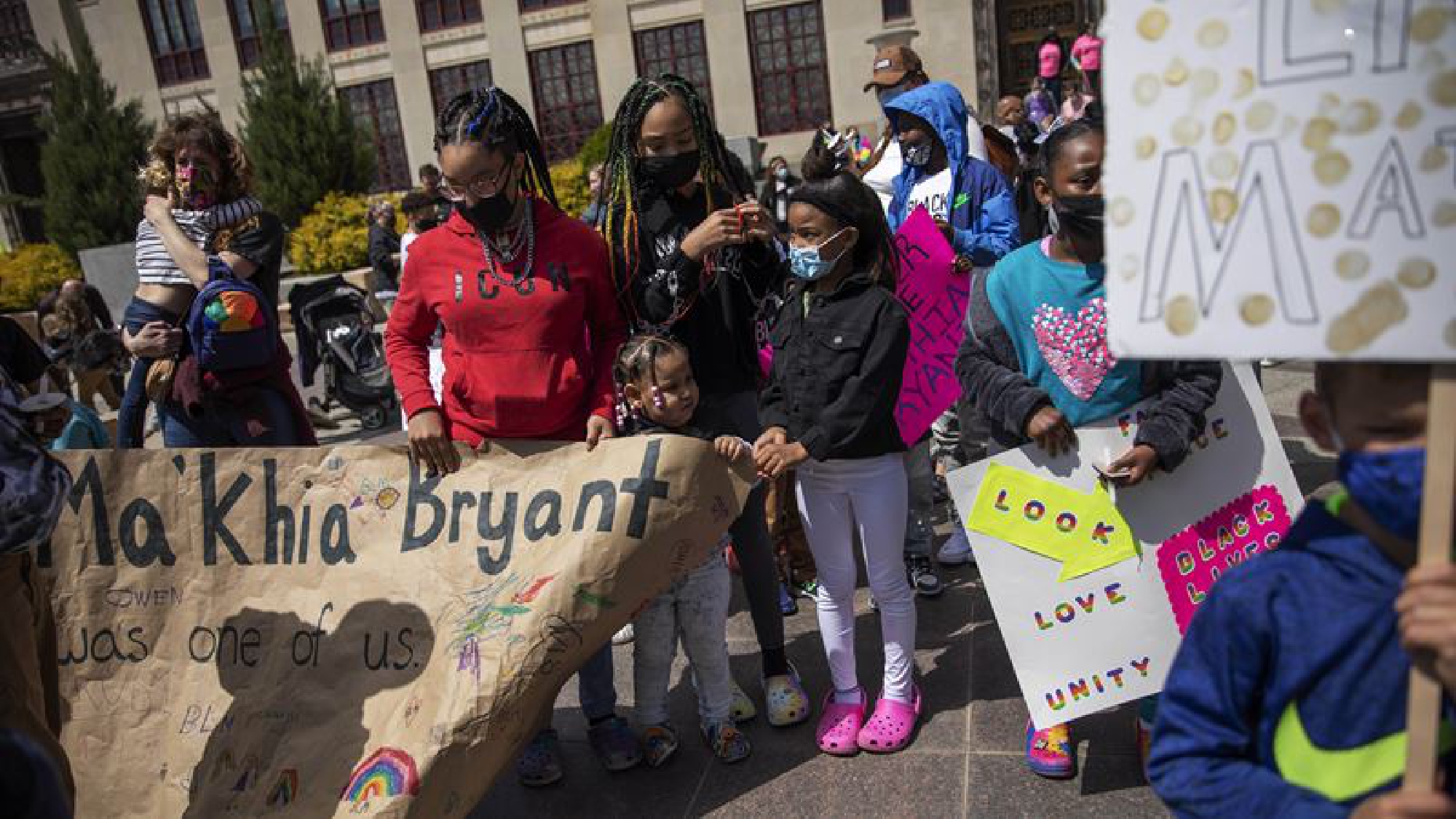
COLUMBUS, Ohio – MaKhia Bryant and her sister lived with their foster mother in a two-story house in a middle-class neighborhood, next to a cornfield along the edge of the city limits here.
Residents described the neighborhood as quiet and most of those interviewed said they did not even know that the sisters were foster children until April 20, when Bryant, 16, was shot and killed by a Columbus police officer when he saw her swinging a knife at a woman during a disturbance in front of the foster home.
Bryant’s grandmother, Jeanene Hammonds, said Ma’Khia called her that afternoon asking for help. She told her grandmother that there was trouble at the foster home involving a former foster child who had previously lived at the residence. The young woman had returned for a visit and was upset over the condition of the house, sparking an argument, Hammonds said.
The Ohio Bureau of Criminal Investigation is investigating the case, which has raised questions about police officers’ use of deadly force. But the disturbance at the house and Bryant’s death also are indicative of deeper problems in the state’s foster care system, said foster parents and child welfare advocates, many of whom are now calling for reforms to the overwhelmed and disjointed system caring for abused and vulnerable children. With Bryant’s funeral scheduled for Friday, her death has become a call to action.
At a somber news conference Wednesday, Bryant’s birthparents and their attorney called on the U.S. Department of Health and Human Services to investigate Ohio’s foster care system and asked for a Justice Department probe of the Columbus Division of Police, whose officers have fatally shot 38 people since 2015, including five under the age of 18, according to the department.
“We are going to investigate every agency that had a time and an opportunity to prevent Ma’Khia’s death,” attorney Michelle Martin said. “All systems failed her . . . and we have to protect our children.”
Foster parents, some of whom gathered with their children at a protest to honor Bryant on Sunday, say they need more training on how to de-escalate conflicts, more funding for social workers and more resources devoted to helping children remain with their birthparents. They are also demanding that armed police officers no longer be the first responders for most incidents involving foster children, nearly all of whom are traumatized in some way by being relocated away from birthparents.
And to many foster parents, Bryant’s death only reinforces their own concerns about the system. Morgan Wade had been a foster parent for just a couple of years when her 3-year-old foster son began having an episode that is probably familiar to many parents.
She was driving down a highway when the toddler crawled out of his car seat and began hitting his younger sister. Wade called the agency that licensed her for guidance.
“They told me to call the police,” Wade said. “I was just wanting advice, but they told me to call police on a 3-year-old.”
Wade disregarded the advice, quickly determining she could handle the child’s outburst on her own. But her story resonated with many of the foster parents at Sunday’s protest.
“It’s a really tough choice for foster parents,” said Laura Flynn, 27, who has been a foster parent for five years. “We are all aware of how unsafe it is to call law enforcement on our kids, but who else do you call for support? And how do you protect your kids from being moved [to a new home] if you are not following what the current systems say you should and you lose your license?”
– – –
Over the past decade, Ohio has been hit hard by the nationwide opioid crisis, leading to a surge in the number of foster children, officials said. The number of children in the state’s care has grown from 12,000 in 2012 to about 15,000 today.
More recently, the system has been battered by a lack of funding and a shortage of foster families – about 8,000, a sizable percentage of whom do not take teenagers.
Earlier this year, Gov. Mike DeWine, a Republican, said an ongoing overhaul of the system was his top priority, and he proposed spending $415 million to help children in need. DeWine has also pledged to make changes to the system through executive actions.
“This is going to remain an issue that Governor DeWine will be focused on throughout his tenure as governor,” said Dan Tierney, a DeWine spokesman, who added that the governor is also a former U.S. senator and state attorney general who has been pushing to reform the system for decades.
But the state’s foster care system continues to face setbacks and criticisms, including accusations that it is especially debilitating for non-White children.
A March report commissioned by the Ohio Department of Job and Family Services found that Black youths make up 36 percent of Ohio’s foster care population, despite making up just 14 percent of the state’s population of children.
Black youths also stay in the system longer than White children and often feel as if they cannot speak up about the quality of their care, the report said. Many White foster parents don’t believe they have adequate training on how to best raise children in multiracial environments, the report concluded. Advocates say about 80 percent of Ohio foster parents are White.
Ma’Khia Bryant’s biological mother, Paula Bryant, declined Wednesday to discuss why her children were placed in foster care or how long they have been in the system.
But as she sobbed, she told reporters that her daughter “had a full life in front of her that ended in a tragedy.”
“I loved my baby. She was a good little girl,” Paula Bryant said. “Words can’t even explain how I feel right now that I have to bury my beautiful daughter.”
Hammonds, the grandmother, said Paula Bryant lost custody of her four children several years ago. Hammonds said she cared for the children until mid-2019, when Franklin County Children Services removed them amid a dispute with a landlord and disagreement over adequate housing.
Hammonds said Ma’Khia Bryant initially ended up in a group home near Dayton but in February was placed with a foster parent who was already caring for her younger sister in southeast Columbus.
A spokeswoman for Franklin County Children Services confirmed that Bryant was in foster care but declined additional comment, citing confidentiality laws.
– – –
Hammonds said Bryant called her on the afternoon of April 20 asking for help. A former foster child, now a woman in her 20s, had returned for a visit and was upset over the condition of the house, sparking an argument, Hammonds said.
The woman then left the house but returned with at least two other women to continue the argument, Hammonds said. Hammonds said it was her other granddaughter – Bryant’s younger sister – who called 911 at 4:32 p.m.
“We’ve got these grown girls over here trying to fight us, trying to stab us, trying to put their hands on our grandma,” the girl told an operator, according to a recording of the call that police released after a public records request. “Get here now.”
Officer Nicholas Reardon arrived 12 minutes later to the scene of a physical altercation involving several people, including Bryant swinging a knife while pinning a 22-year-old woman against a car.
Reardon fired four shots, striking Bryant, who died a short time later after being transported to a hospital.
Gerry Slocum, who lives three doors down from the house where Bryant and her sister lived, said the foster parent was not home during the incident. But the woman, who Slocum thought had been at work, returned a short time later and huddled with other neighbors in Slocum’s driveway.
“She was distraught, and she was very confused about what was happening,” said Slocum, 50, adding that she believes the woman was a single foster parent. “She was trying to piece together what possibly could have been going on.”
Martin, the attorney for Bryant’s biological parents, said she does not believe that Ma’Khia and her sister were receiving adequate care.
“It doesn’t sound like the children were being properly supervised, even within the moment,” said Martin, who also works as a court-appointed attorney in foster care cases. “Who were those girls at the house? How did they get there? What trauma was not being addressed in the home?”
A Washington Post reporter visited the foster home Tuesday evening. A woman who answered the Ring doorbell audio system said the foster mother was not at the home. The woman then asked for privacy to “allow her time to mourn.” Attempts to reach her by phone on Wednesday were also unsuccessful.
Slocum and several other neighbors interviewed by The Post said the April 20 shooting was the first time they had seen or heard any sort of disturbance at the home.
“It’s like all of this just came out of the blue,” said Shonnell Kelly, 38, who has lived on the block for four years. “I didn’t even find out it was a foster home until that day . . . and you don’t know what goes on behind closed doors, but I had never seen any conflict of any kind outside.”
But police records, obtained by The Post after a public records request, show that the April 20 incident wasn’t the first time Columbus police had been dispatched to the home.
Since mid-2018, police have been called to the house 11 times to investigate suspicions that a teenager who lived at the home had run away; the most recent of those calls occurred April 7 and involved a 13-year-old.
In December, the foster parent called police to report that a 10-year-old was “knocking things off the Christmas tree, yelling,” according to the police records.
In March, a 15-year-old girl – identified as Bryant’s younger sister – called 911 and told an operator she no longer wanted to live in the home, according to police records. Officers responded and learned that the girl had a fight with her sister and foster mother, and threatened to “kill someone” unless she was placed in a different foster home.
A caller from the residence also called police on April 15 to report that someone had fired two gunshots into a neighboring residence.
“Why were any children still in the house at this point with those types of calls coming into police?” said Martin. “That is one of my questions.”
Glenn McEntyre, a spokesman for the Columbus Department of Public Safety, said the police department’s “computer-aided dispatch” system includes a flagging mechanism that can alert officers to properties with a history of problems or other issues that could require a modified response. But McEntyre said he does not know whether Bryant’s foster home had also been designated a “special-situation premise address.”
“We won’t know until the conclusion of the investigation what information [officers] had access to,” McEntyre said. “The information that the [officers] had will fall under the purview of the state investigation into the response.”
– – –
For foster families in Columbus, the experiences in the foster home where Bryant and her sister lived sound all too familiar, and are among the reasons many are urging the public not to make sweeping judgments about the care and the oversight she may or may not have received from her foster mother.
Nicole Hernandez, 24, who has been a foster mother for about two years, said Ohio foster families struggle to navigate a bureaucratic system that does not provide enough financial or mental health support for parents or children.
Although the Ohio Department of Job and Family Services sets statewide standards for foster care, state officials stress that the system is designed to be “state-supervised” but is administered by 88 counties.
In Franklin County, which includes Columbus, the county department of child services has opted to contract out the placement and supervision of foster children, employing 21 private agencies. Statewide, Ohio counties are contracted with about 100 private agencies involved in the placement and care of foster children.
The guidance foster parents receive depends on which agency they are licensed under, said Flynn,the foster parent with five years’ experience.
When a child is having an outburst or conflict erupts in a home, some agencies urge foster parents never to physically restrain or try to break up the commotion. Others offer some form of physical de-escalation for small children but not after they become teenagers, Flynn said.
“A lot of foster parents are not really trained to de-escalate situations,” Flynn said. “I think most agencies say, ‘Just call police.’ . . . And police arrive, they just take them to [Nationwide Children’s Hospital], and just adds to the child’s trauma.”
The burden on families is especially intense for those who are willing to care for teenagers. Foster parents say many families do not take teenagers, meaning those who can are at times expected to care for up to five teenagers at the same time.
“When you have a lot of teens, all suffering trauma, stuck in a home together, conflict is bound to happen,” Hernandez said.
Ajmeri Hoque, who works as a court-appointed advocate for foster children in several central Ohio counties, said the state simply isn’t requiring “enough supervision” of children that it decides to remove from their biological parents.
“The bar is very low for what is considered to be a safe home, in terms of cleanliness and number of people in the home, and the number of children that one foster parent has to take care of,” Hoque said. “When you have multiple children . . . and you have one parent taking care of all of them, there is going to be issues, and there is going to be conflict.
“If the state is taking these children, the state needs to care for these children,” Hoque added.
Foster parents in Ohio are reimbursed by the state and county between $10 and $200 a day per child, depending on the age of the child, their health and a few other factors, including the location of the placement.
Dot Erickson-Anderson, coordinator of the all-volunteer Ohio Family Care Association, said most foster parents simply do not receive enough money to avoid having to work primary jobs, meaning many foster children are also “latchkey kids.”
“The system places a kid with an individual family and expects them to be able to deal with that child, and sometimes a sibling group of three or four, and then the parent then has to leave those children for some time or leave them with someone else,” said Erickson-Anderson, who has been a foster parent for 35 years.
Erickson-Anderson said state and national leaders should be working on developing a more coordinated approach to foster care, including a robust network of trained social workers who are capable of responding to foster homes “within 10 minutes” when problems arise. Foster families should also be encouraged to create their own support pods, in which they work together to try to respond to and de-escalate trouble even when it involves a child not under their direct supervision, Erickson-Anderson said.
“Child welfare is now built so much on the confidentiality of the system, you might have two foster parents on the same block, and they may not even know they are both foster parents,” Erickson-Anderson said.
Scott Britton, assistant director of the Public Children Services Association of Ohio, an advocacy group for county children services agencies, said some help is coming for foster families. He said that in January, the Ohio Department of Medicaid will launch “mobile response teams” to help children with “complex behavioral health needs.”
“These are programs that Ohio should have had for a long time,” said Britton, adding that 99 percent of the state’s foster children qualify for Medicaid.
Lily Cunningham, a clinical mental health counselor in Franklin County, added that Bryant’s death shows why social workers have been pushing for police to embrace a “wraparound” approach to public safety.
“The question always is: Why is this child or family in foster care?” Cunningham said. “But the right question should be: What can we be doing right now to enhance the lives of children in foster care?”
McEntyre, the Columbus public safety spokesman, said it’s up to Franklin County Children Services and state lawmakers to make such policy decisions.
Hana Abdur-Rahim, an organizer with the Black Abolitionist Collective of Ohio, which is affiliated with the Black Lives Matter movement, said Bryant’s death only reinforces her group’s belief that the Ohio foster care system should be abolished. The state should instead spend its money supporting families so children are not removed from their homes, she said.
“A lot of times people’s children get taken away because they can’t afford to take care of them, or they don’t have proper housing,” Abdur-Rahim said. “So if we had more resources, children would not get taken away from their families.”
Many foster parents also say they, too, would like to see the day when their services are not needed. But in Ohio and elsewhere, they know it’s only a matter of time before they get another call from their agency pleading for them to take in another child.
“There is literally nowhere else for these kids to go,” Flynn said. “So for people who want to criticize [foster parents], you instead should think whether you can take in a teenager.”
Published : April 30, 2021
By : The Washington Post · Tim Craig, Randy Ludlow