NYC mayor sets goal to fully reopen July 1 as virus eases
New York City is moving to fully reopen July 1 with arenas, gyms, stores, restaurants and hair salons returning, Mayor Bill de Blasio said.
“This is going to be the summer of New York City,” de Blasio said Thursday during a press briefing. “We’re all going to get to enjoy this city again, and people are going to flock here from all over the country to be a part of this amazing moment.”
New York locked down almost completely as the pandemic descended upon the most populous U.S. city last March, with schools closing and non-essential businesses forced to shut. The city has been embarking on a slow step-by-step comeback as infection rates have eased, accelerated by the advent of vaccinations. The city is about halfway toward the mayor’s goal of having 5 million people fully vaccinated by the end of June, state data show.
De Blasio’s goal of a complete re-opening leaves some key sectors until later, such as schools and Broadway. City officials say they intend to offer in-class summer school programs for more than 100,000 students, with school buildings open for full enrollment in September. Shows at Broadway theaters also aren’t slated to resume until that month.
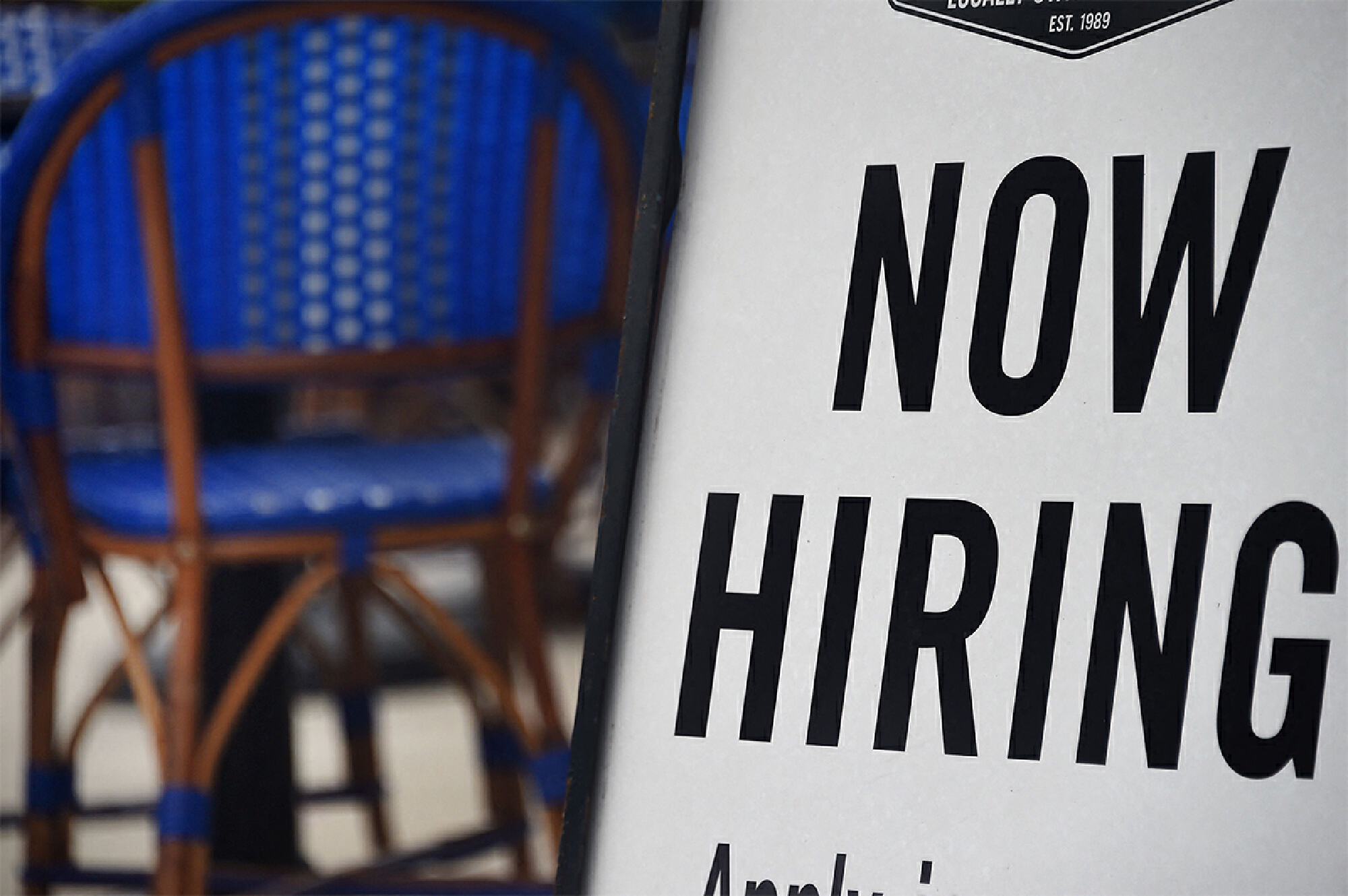
To help lead the recovery, de Blasio appointed New York restaurant mogul Danny Meyer, creator of Union Square Café, Gramercy Tavern and Shake Shack, to chair the city’s Economic Development board. As the city reopens, it will need to hire a lot of people very quickly, Meyer said. At least 400,000 jobs will return in the city this year, de Blasio said.
“One of my hopes is that the city will be an agent that will connect job seekers with employers,” Meyer said.
The mayor may need to get state officials on board for his July 1 reopening plan. Ultimate authority still resides with orders already issued by Governor Andrew Cuomo, according to a vote taken by the state legislature last month. That vote stopped Cuomo from issuing any new directives without lawmakers’ approval, while also allowing the governor’s existing directives to be extended, and he’s frequently clashed with de Blasio on measures to fight the pandemic.
“The federal government, state government always have a say, but I’m saying as leader in New York City, we’re ready to come back and come back strong,” de Blasio, who is term-limited and in his final year in office, said Thursday during an interview on MSNBC.
Cuomo reopened New York City indoor dining in February at 25% capacity and then increased that limit to 35%. On March 19, he boosted it again to 50%.
New York’s all-important tourism industry has begun to show signs of slowly recovering. Since January, the hotel occupancy rate has ticked up six percentage points, to about 35%, according to hospitality data company STR. The industry reported its fifth straight monthly increase in average daily room rates, which have risen 12% since December.
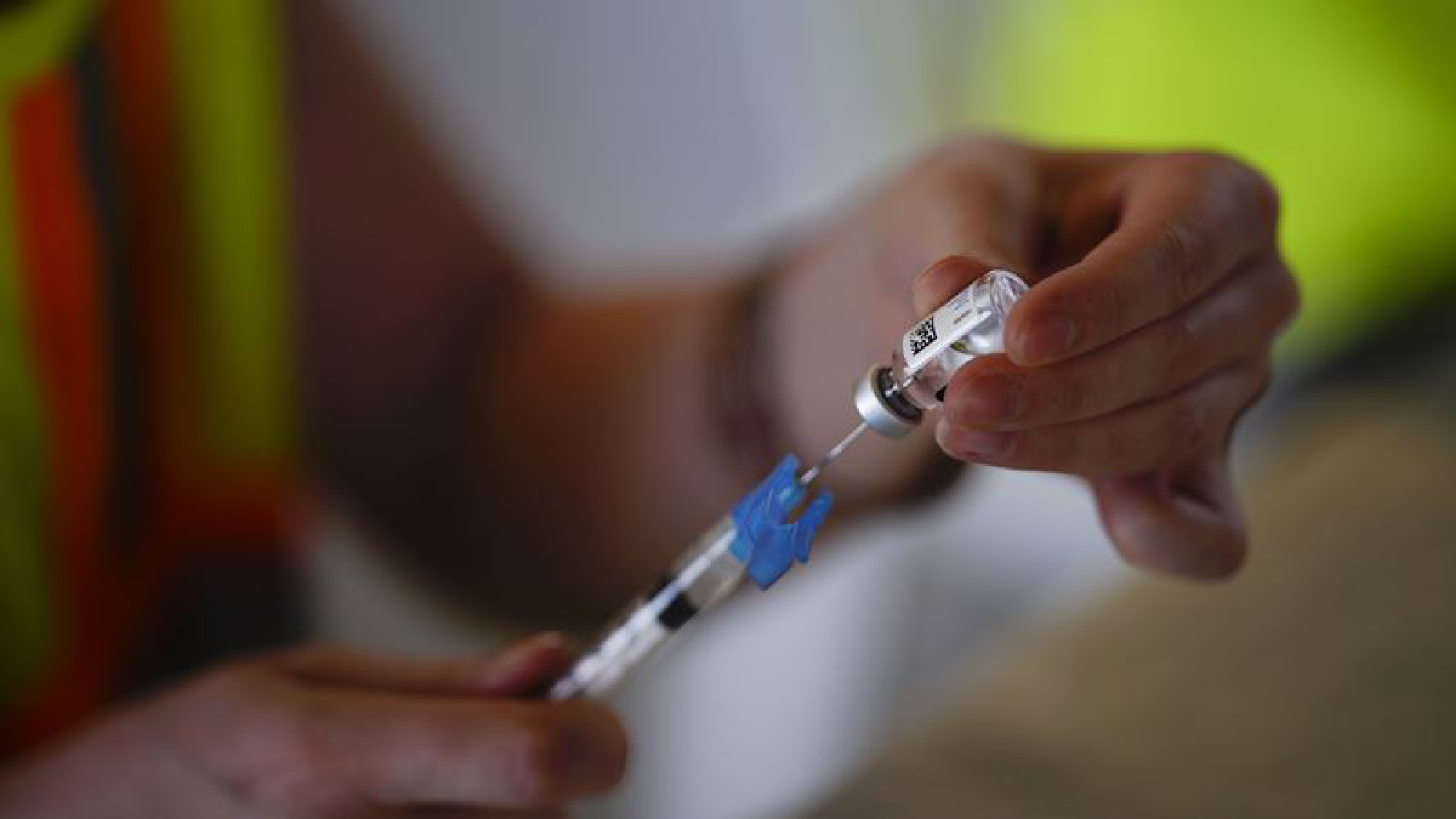
New York City has administered more than 6.4 million vaccine doses, according to the mayor. Daily Covid-19 related hospitalizations dipped below 100 Tuesday for the first time since mid-November. New confirmed and probably cases on a seven-day average stood at 1,354 as of April 27, down more than 50% from two weeks earlier. The city’s seven-day average rate of positive tests for the virus also fell to 3.18%, from 5.43% on April 14.
Published : April 30, 2021
By : Syndication Washington Post, Bloomberg · Henry Goldman
INDIANAPOLIS – A blue card sat on the windshield of Josh Woolvins black Hyundai Tucson on Tuesday, a spot of color in the sunshine at Indianapolis Motor Speedway. It signaled to nurses at this drive-by immunization clinic that Woolvin and his mother, Debbie Shipp, wanted Johnson & Johnsons single-dose coronavirus vaccine, not their other choice, Pfizer-BioNTechs two-shot regimen.
Both selected Johnson & Johnson for its one-and-done convenience, a preference that outweighed their concerns about the extremely rare blood clots that prompted a 10-day pause in use of the vaccine.
“I’d rather deal with the side effects than die” of covid-19, Woolvin said.
There is no government data yet on whether health authorities’ 10-day halt in administration of the Johnson & Johnson vaccine soured people on the product, and the company declined to discuss the matter. But in spot checks across the country, people seeking vaccines and officials dispensing them appear eager to resume using the vaccine, which is also easier to store and transport.
On Tuesday, for example, 1,355 people at the racetrack chose Johnson & Johnson at the clinic run by Indiana University Health, while 407 took the Pfizer vaccine, according to spokesman Jonathon Hosea. At a homeless program in San Francisco, drugstores in Maine and universities across the country, the same sentiment is largely true.
“For most people experiencing homelessness, it was their preference,” said Margot Kushel, director of the UC San Francisco Benioff Homelessness and Housing Initiative, who hopes her county health department reauthorizes use of the Johnson & Johnson vaccine in time for another outreach Thursday. “They wanted it to be one and done. They didn’t want to worry about coming back.”
More than 7 million doses of Johnson & Johnson’s vaccine – a small fraction of the national total – had been dispensed when health authorities halted use of the product April 13 to allow review of a handful of cases of cerebral venous sinus thrombosis, the clotting disorder that has affected at least 15 people, killing one. Ten days later, federal health officials authorized resumption of the use of the vaccine with a warning about the rare side effect.
Another 9 million doses had been shipped and were available, according to Ian Sams, a spokesman for the U.S. Department of Health and Human Services.
But there appears to be little Johnson & Johnson vaccine in the pipeline at the moment. Federal data released Tuesday shows that just 765,000 doses were allocated this week.
A recent Washington Post-ABC News poll suggested that fewer than one in four unvaccinated people would be willing to get the J & J vaccine. But the survey was taken during the pause, while health authorities were reviewing the safety data.
Company spokesman Jake Sargent said Johnson & Johnson would not comment. He pointed to a statement released April 23 by the company’s chief scientific officer, Paul Stoffels, who said that “as the global pandemic continues to devastate communities around the world, we believe a single-shot, easily transportable COVID-19 vaccine with demonstrated protection against multiple variants can help protect the health and safety of people everywhere.”
Near the Canadian border in rural Van Buren, Maine, pharmacist John Hebert started giving vaccinations in December. He initially had an allocation of Moderna that he took to nursing homes across the state.That sometimes took Hebert on day-long drives to elderly populations asfar as Portland, more than 300 miles away.
After the J & J vaccine was authorized in February, Hebert, the head pharmacist at Hebert Rexall Pharmacy, said the one-dose shot was the “ideal offering for that kind of activity” because he doesn’t have to return for second shots weeks later, a requirement for the Pfizer and Moderna vaccines.
Hebert had about 100 doses of the J & J vaccine in the refrigerator when the pause was imposed. He believes they will be used as he continues to trek to homebound residents of the state.
“It’s going to go fairly quickly,” Hebert said. “We have a list that only want J & J.”
Hebert believes the pause may have contributed slightly to vaccine hesitancy – but that it won’t take long to reverse. “We can get those people back,” he said.
At a town hall event for evangelicals hosted Tuesday by Wheaton College, National Institutes of Health Director Francis Collins said his two young adult grandchildren chose J & J – a decision he supported. Collins described the single shot’s practical benefits and extremely rare clotting risk, but worried that concerns about the company’s vaccine may extend to the other two “in a way that would not be justified by the data we have seen.”
Eric Norberg, the pharmacist and owner of Carroll Drug Store in Southwest Harbor, Maine, said the CDC allocated Moderna to his small operation a couple of weeks ago but uptake has been slow. He doesn’t know whether that is because people in the area already traveled to get vaccinated in other places or whether there is hesitancy about vaccination in general.
“There’s not as much traction as I was hoping,” said Norberg, whose store administered about 70 doses last week and 30 so far this week. The store has called many homebound people and found they already have been helped by friends and neighbors.
The Moderna vaccine is packaged in 10-dose vials, all of which need to be used within hours. Johnson and Johnson’s vaccine comes in five-dose vials and can be stored in a regular refrigerator, presenting less of a logistical challenge, Norberg said. Looking ahead, he said, the J & J vaccine would be useful for seasonal workers who power the town’s summer tourist economy.
At the University of Arizona, the vaccination campaign has relied heavily on the Pfizer shots because the school has the substantial special freezer capacity required to store those doses. But President Robert Robbins said he expects the Johnson & Johnson vaccine will continue to be a useful tool for many colleges and universities.
“The best vaccine is the one you can get tomorrow,” he said. The paramount goal, he added, is to “vaccinate as many people as you can as fast as you can.”
At the University System of Maryland, Joann Boughman, senior vice chancellor for academic and student affairs, said the J & J vaccine was convenient because of its single dose and its storage capabilities.
The system is determined to continue its effort to vaccinate students, regardless of the vaccines it receives from the federal and state governments.
Before the pause, the Johnson & Johnson vaccine wasn’t in wide use at Maryland schools because the supply was limited. “Would it be nice to offer individuals a choice on the vaccine they receive – for example, Pfizer over J & J? Sure it would – but that will be up to state health authorities to decide. In the meantime, we will continue moving forward assuming use of the Pfizer and Moderna vaccines,” she said.
At the racetrack, Shipp arrived with a clear evaluation of her options. She said her husband had experienced side effects after his Johnson & Johnson shot, including headaches and restless legs syndrome.
She was nervous about similar problems, but added: “I think it’s just a roll of the dice. It could happen with any of the vaccinations.”
Kushel, director of the San Francisco program trying that is trying to reach 30,000 to 40,000 people on the street, in single-room occupancy hotels and in supported housing, recalled a moment on April 8, when a pop-up effort ran out of Johnson & Johnson vaccine. Workers quickly made arrangements to transport people waiting in line to a hospital for their shots.
“People’s first question was ‘What vaccine is it?’ It was really amazing,” she said. Upon learning they would receive the two-shot Moderna vaccine, they all had the same reaction, she said: “Yeah, no, we’ll wait.”
Kushel said her task force will have another vaccine on hand for those reluctant to accept Johnson & Johnson, and will explain the risks to women of childbearing age, the group most affected by the blood clotting found so far. She said she has spoken to one group that will not accept Johsnon & Johnson because of the fear of the rare blood clots.
But avoiding the effort of chasing down sometimes mobile and hard-to-find homeless people for their second shots is a major advantage, she said.
“The J & J vaccine is easier. The dose vials are smaller. We have not wasted one dose,” she said. “I would be thrilled to have it back.”
Published : April 30, 2021
By : The Washington Post · Mary Claire Molloy, Lenny Bernstein, Frances Stead Sellers, Nick Anderson
Jobless claims hit new pandemic low for third straight week as labor market picks up
WASHINGTON – Weekly jobless claims fell to a pandemic low for the third consecutive week, the Labor Department reported Thursday, with 553,000 Americans filing for initial unemployment benefits for the week that ended April 24.
This marks a decrease of 13,000 compared with the previous week, putting the insured unemployment rate around 2.6%, the Labor Department said.
While claims remain elevated, the trajectory signals that growing vaccination numbers, loosening business restrictions and warmer weather are helping to heal the jobs market. The streak of declining claims started in mid-April, with a surprise drop of more than 175,000. Now, economists say they think the trend will continue.
“With more news of cities set to fully reopen in the coming months and vaccinations picking up speed, we’re starting to see some real firepower behind an economic comeback,” Chris Larkin, managing director of trading at E-Trade, said Thursday in comments emailed to The Washington Post.
States reported 121,749 initial claims for Pandemic Unemployment Assistance, for gig and self-employed workers, for the week ended April 24. There were nearly 7 million continued PUA claims, for benefits that are set to expire in September.
There are myriad signs of a brightening outlook. The U.S. economic recovery picked up speed in early 2021, the Commerce Department reported Thursday, with economic growth hitting 1.6% in the first three months of the year. The January-to-March period saw some of fastest economic growth in more than four decades, behind only the initial 7.5% surge last year, when businesses first reopened from pandemic-related shutdowns.
The promising economic data, plus strong corporate earnings, helped lift the S&P 500 to another record close. It added 28.29 points, or 0.7%, to close at 4,211.47. The benchmark index has risen more than 10% since Biden’s inauguration, putting him on track to have the best first-term markets kickoff of any president since Franklin D. Roosevelt, according to the Wall Street Journal.
The tech-heavy Nasdaq jumped 31.52 points, or 0.2%, to close at 14,082.55, while the Dow Jones industrial average climbed 239.98, or 0.7%, to settle at 34,060.36.
“The U.S. economy is going to enjoy a few more months of tremendous data releases on vaccinations, stimulus checks and pent-up consumer demand,” Ed Moya, a financial analyst with OANDA, said Thursday in comments emailed to The Post. “The second half outlook is up in the air, but for now everyone wants to ride this last big wave of growth.”
Consumer confidence rebounded to pre-pandemic levels in April, according to the Conference Board, as stimulus and improving labor market conditions left households feeling better about their incomes.
This time last year, more than 3.4 million Americans were applying for initial unemployment benefits, and the national unemployment rate was between 15 and 20%.
“How do I file for unemployment” was the most Googled question across the nation the past year, according to research from CenturyLinkQuote.com.
But there’s still a long way to go. More than 17 million Americans were drawing unemployment benefits across all programs this month. In 2019, average weekly initial claims hovered around 218,000.
Meanwhile, poverty rose to 11.7% in March, the highest level of the pandemic, according to research from the University of Chicago and University of Notre Dame, as Americans awaited the next round of stimulus relief. Children and women were hit the hardest by the spike, researchers said.
Many economists describe the recovery as “K-shaped” because of its diverging prospects for the rich and poor. But the divide is also splintering across gender lines. The U.S. economy added back 916,000 positions in March, but only about a third of these were regained by women. Women would need nearly 15 straight months of job gains at last month’s level to recover the more than 4.6 million net jobs they have lost since February 2020, according to the National Women’s Law Center.
Biden’s March $1.9 trillion coronavirus relief package broadened unemployment eligibility and extended some unemployment benefits through September, including the weekly $300 benefit offered by states.
Biden, in speech to Congress, offers sweeping agenda and touts democracy
WASHINGTON – President Joe Biden on Wednesday night used his first speech to a joint session of Congress to argue for a dramatic expansion of government services, making a plea for sweeping plans to provide universal preschool, free community college and expanded health care and new tax breaks for families – much of it funded for by higher taxes on the wealthiest Americans.
While he also renewed calls for an array of priorities – including immigration changes, gun control and police reform – Biden more broadly portrayed a country that is rapidly emerging from the depths of a global pandemic and has survived events that, in his view, tested American democracy as rarely before.
“We have stared into an abyss of insurrection and autocracy – of pandemic and pain – and ‘we the people’ did not flinch,” he said toward the end of a 65-minute speech.
Biden delivered his address in a Capitol that had faced a lethal assault from a mob less than four months ago. He walked through the House chamber’s wooden doors just after 9 p.m., passing through the same entryway that had been battered by insurrectionists on Jan. 6 in an attempt to prevent his presidency.
Biden’s remarks juxtaposed a more traditional presidential cheerleading for America – a country he declared was “on the move again” – with far more unusual warnings about existential threats to American democracy and references to a country that repeatedly flies flags at half-staff because of mass shootings.
“I took the oath of office – lifted my hand off our family Bible – and inherited a nation in crisis,” Biden said. “The worst pandemic in a century. The worst economic crisis since the Great Depression. The worst attack on our democracy since the Civil War.”
“Now, after just 100 days, I can report to the nation: America is on the move again,” he added. “Turning peril into possibility. Crisis into opportunity. Setback into strength.”
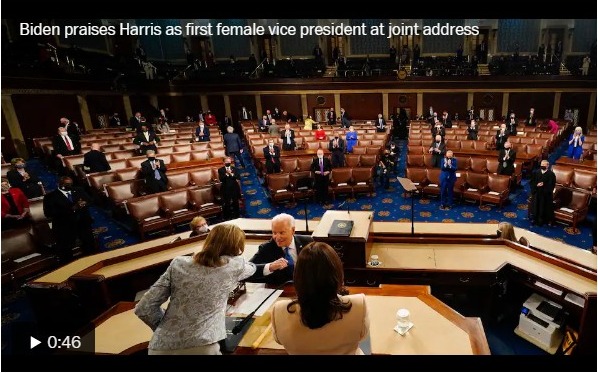
Biden delivered the remarks with a historic backdrop, as two women – House Speaker Nancy Pelosi and Vice President Kamala Harris – sat within the camera’s frame for the first time during such an address. The two women greeted each other at the front of the chamber, grabbing hands and then bumping elbows.
Biden went out of his way to highlight the moment. After acknowledging “Madam vice president,” he added, “No president has ever said those words from this podium; no president has ever said those words. And it’s about time.”
In a historic marker of a different sort, only about 200 people were invited to a speech that is normally heard by a crowd of 1,600. Members were spread out, with many in the gallery above the floor, nearly everyone wearing masks.
“While the setting tonight is familiar,” Biden said at the start of his speech, “this gathering is a little bit different.”
Chief Justice John G. Roberts Jr. was the only one representing the Supreme Court. Just two members of Biden’s Cabinet – Secretary of State Antony Blinken and Defense Secretary Lloyd Austin – were in attendance, and Gen. Mark A. Milley, chairman of the Joint Chiefs of Staff, represented the military. Jill Biden was in attendance, but without the first lady’s box that typically includes guests to be mentioned by the president during the speech.
For Biden, a president who has mostly communicated through brief appearances and limited remarks, partly because of the pandemic, the address was the first opportunity to make his case on a grander stage.
New to the office but an old hand in Washington, the president took that opportunity to present himself as a leader who wants to deliver an array of benefits to ordinary Americans, from green jobs to elder care. The message was intended to resonate both with the populist moment and Biden’s guy-next-door political identity.
Biden has been a frequent attendee of such addresses over the past half-century, but this was his first time giving the prime-time address himself. Biden’s tone was calm, his language simple and his style at times notably casual and devoid of rhetorical flights.
“It’s not right,” he said of the corporate tax rate. “It’s long past time,” he said of pay equity for women. “I want to be very blunt about it,” he said about climate change.
And as a man who served in the Senate for more than three decades, he displayed a deep familiarity with the elected officials in the room. “It’s good to be back!” he said at the start.
The address came at a pivotal moment in his presidency, following three months of intense focus on the coronavirus and as Biden begins pitching ambitious new items on his agenda that face fierce resistance from Republicans.
It fell on the eve of his 100th day in office, a symbolic marker that many presidents have used to gauge early success and that Biden has highlighted more than most. He has used his first 100 days as a timetable for various efforts, from mask-wearing guidelines to vaccination goals to reopening schools.
His remarks touting the viability of democracy were particularly striking and not a message presidents would typically feel the need to deliver. “The question of whether our democracy will long endure is both ancient and urgent – as old as our Republic, still vital today,” he said.
Biden also spoke forcefully of the need for racial equity, and he made a point of embracing LGBTQ rights. “To all the transgender Americans watching at home – especially the young people who are so brave – I want you to know that your president has your back,” Biden said in another striking moment.
Earlier in the day, the administration unveiled a $1.8 trillion proposal that would expand child care, provide universal preschool, cover two years of free community college and expand paid family and medical leave.
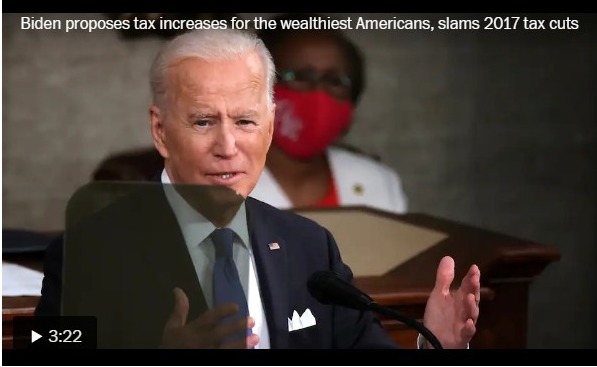
Biden, adopting lines that could have been ripped from a Sen. Bernie Sanders, I-Vt., campaign speech, chastised the country’s biggest corporations for not paying federal income taxes and called on America’s wealthiest to “pay their fair share.”
Biden’s new proposal comes on top of a $2.3 trillion plan announced last month to rehabilitate the country’s physical infrastructure – bridges, roads, airports – as well as to improve the water system and expand broadband access, particularly in rural areas. Some of the spending would be offset by raising the corporate tax rate from 21% to 28%.
Biden focused on the first part of the plan Wednesday as a way to rebuild the middle class, saying that 90% of the jobs created would not require a college degree.
“The American Jobs Plan is a blue-collar blueprint to build America,” he said, adding, “Wall Street did not build this country. The middle class built this country, and unions built the middle class.”
Biden also touted parts of his plan that include an infusion of money for clean energy, saying Democrats have often failed to connect fighting climate change with potential economic benefits.
“There’s no reason the blades for wind turbines can’t be built in Pittsburgh instead of Beijing,” he added. “No reason. None.”
Biden’s plans are facing significant opposition in Congress, however.
Sen. Tim Scott (R-S.C.), who was tapped to give the GOP response to Biden’s speech, touted the successes of the Trump administration, attempting to counter Biden’s effort to take credit for the economy and progress on the fight against covid.
“Our best future won’t come from Washington schemes or socialist dreams,” he said. “It will come from you – the American people.”
Biden has sought to redefine bipartisanship as winning support from GOP voters, and in some cases local officials, rather than Republican lawmakers.
As he gears up for his next big legislative push, Biden has invited the top four congressional leaders – two Democrats, two Republicans – to meet at the White House on May 12.
He framed the challenges the country faces as existential threats to the survival of democracy, invoking the United States’ growing competition with autocratic countries, especially China, saying they doubted the ability of American democracy to survive.
“They believe we’re too full of anger and division and rage,” he said of autocratic leaders. “They look at the images of the mob that assaulted this Capitol as proof that the sun is setting on American democracy. But they are wrong. You know it. I know it. But we have to prove them wrong. We have to prove democracy still works.”
Biden also returned to many of the vexing problems that have confronted Washington for years.
He urged Congress to overhaul the country’s immigration system, pushing for the passage of the immigration bill he sent to the body on his first day as president, while also saying that he was open to compromise. Notably absent, however, was any mention of the current surge of migrants at the border – an omission that received swift criticism from Sen. Mark Kelly (D-Ariz.).
He pressed for police reform, pointing to the recent conviction of Derek Chauvin, the White former police officer found guilty last week of killing George Floyd, a Black man who was in custody. Biden called on lawmakers to pass legislation named for Floyd by the end of next month to mark the first anniversary of his death.
“We have all seen the knee of injustice on the neck of Black America,” he said. “Now is our opportunity to make real progress.”
And he pressed lawmakers to take action on gun control in light of a spate of recent mass shootings.
Presidential addresses to Congress have sometimes been the scene of partisan theatrics. A year ago, Pelosi dramatically tore up President Donald Trump’s speech when he was done. In 2009, Rep. Joe Wilson (R-S.C.) shouted “You lie!” during President Barack Obama’s speech on health care, an outburst for which the congressman later apologized.
This speech, for all its unusual atmospherics, was devoid of such drama, making it the latest institution Biden has returned to a more traditional style. At the end, he appeared to thank lawmakers for sitting through it.
“Thank you,” he said in closing, “for your patience.”
Published : April 30, 2021
By : The Washington Post · Matt Viser, Tyler Pager
White House urged to address surge in ransomware attacks
Cybersecurity experts, law enforcement agencies and governments urged the White House to root out safe havens for criminals engaging in ransomware and step up regulation of cryptocurrencies, the lifeblood of hackers, in the hopes of controlling a growing wave of attacks.
These are two of 48 recommendations made by a task force in a report Thursday to the Biden administration aimed at fighting the continuing ransomware episodes that plague major corporations, local governments and health-care providers across the world. The task force, organized by the Institute for Security and Technology, said the cyber-attacks have become a $350 million criminal industry — a four-fold increase from the previous year. Last week, the U.S. Justice Department created its own, independent ransomware task force, signaling growing awareness inside the U.S. government of the now decade-old threat.
Ransomware is a type of malicious code that typically encrypts a victim’s data or network of computers. The hackers then demand a ransom to decrypt the information. More recently, ransomware gangs have also stolen data and threatened to make it public unless the victim pays a fee.
The FBI encourages organizations to refuse to pay hackers, but many victims end up doing so because the costs of the attacks can outweigh the ransom demand. Ransomware attacks have forced hospitals to postpone critical treatment, energy providers to cut off power supplies and schools to stop teaching. In some instances, lives are at stake, said Kemba Walden, an attorney in the Digital Security Unit at Microsoft.
The report was born from months of consultations among cybersecurity experts at Palo Alto Networks Inc., researchers at Chainalysis Inc. and law enforcement agencies in the U.S., U.K. and Canada, among others. The recommendations include five priorities deemed to be ”foundational and urgent,” including a push to use diplomatic channels and law enforcement across the world to dissuade countries from becoming “safe havens to ransomware criminals.”
“Most ransomware criminals are based in nation-states that are unwilling or unable to prosecute this cyber crime, and because ransoms are paid through cryptocurrency, they are difficult to trace,” according to the report. “This global challenge demands an ‘all hands on deck’ approach, with support form the highest levels of government.”
John Demers, U.S. assistant attorney general for national security, told reporters this week that ransomware as a cybercrime is no longer limited to independent cartels seeking to hold victims hostage for profit. Instead, nation-states may be using the attacks as a tool to disrupt government or private operations.
Earlier this month, for instance, the U.S. Treasury Department sanctioned Russian entities for helping to facilitate cyber-attacks and tied a Russian intelligence agency to a notorious ransomware group known as Evil Corp.
The report also outlines methods to regulate and control the economic backbone of the ransomware business: cryptocurrencies. Such payments between hackers and their victims occur in the largely unregulated realm of digital currency, which is harder for experts to track in hopes of identifying the criminals. The task force calls for governments to require cryptocurrency exchanges and trading desks to enforce basic “know your customer,” anti-money laundering and financial terrorism laws.
These rules could help law enforcement identify the nexus of ransomware cartels and the individuals getting rich from ransom payments, said Don Spies, director of market development for Chainalysis.
“I firmly believe cryptocurrencies are a new asset class. They’re now part of the overall financial system,” Spies said. “So, too, is ransomware, and it’s not going away. But I believe these recommendations can go a long way to combating a problem that’s out of control.”
Published : April 30, 2021
By : Syndication Washington Post, Bloomberg · Kartikay Mehrotra
U.S. tells citizens to leave India as covid crisis deepens
The U.S. told its citizens to get out of India as soon as possible as the countrys covid-19 crisis worsens at an astonishing pace.
In a Level 4 travel advisory — the highest of its kind issued by the State Department — U.S. citizens were told “not to travel to India or to leave as soon as it is safe to do so.” There are 14 direct daily flights between India and the U.S. and other services that connect through Europe, the department said.Indian authorities and hospitals are struggling to cope with unprecedented covid infections and deaths. Official data on Thursday showed new cases rose by a staggering 379,257 over the prior 24 hours, another record, while 3,645 additional lives were lost. More than 204,800 people have died.
“U.S. citizens are reporting being denied admittance to hospitals in some cities due to a lack of space,” the website of the U.S. Embassy and Consulates in India said in a health alert. “U.S. citizens who wish to depart India should take advantage of available commercial transportation options now.” All routine U.S. citizen services and visa services at the U.S. Consulate General Chennai have been canceled.
According to the U.S. Centers for Disease Control and Prevention, anyone returning to the U.S. from overseas must have a viral Covid-19 test between three and five days after travel. Individuals who haven’t been vaccinated should also stay at home and self-quarantine for a week.
The South Asian nation now has the world’s fastest-growing caseload with 18.4 million confirmed instances. The virus has gripped India’s populace with a severity not seen in its first wave. Mass funeral pyres, lines of ambulances outside overcrowded hospitals and desperate pleas on social media for oxygen underscore how unprepared India’s federal and state governments are to tackle the latest outbreak.
The unfolding tragedy is prompting some of the world’s biggest corporations to organize aid. Amazon.com is harnessing its global logistics supply chain to airlift 100 ICU ventilator units from the U.S., and the equipment will reach India in the next two weeks. Microsoft Chief Executive Officer Satya Nadella said he was “heartbroken” by the situation and the tech behemoth is using its voice, resources and technology to aid relief efforts and help buy oxygen concentrators.
Blackstone Group Chairman Stephen Schwarzman said his private equity firm is committing $5 million to support India’s covid relief and vaccination services to “marginalized communities.” Local companies, too, are wading in, with the philanthropic arm of India’s most valuable company — Reliance Industries Ltd., controlled by Asia’s richest man Mukesh Ambani — pledging to create, commission and manage 100 ICU beds that will become operational mid next month.
As thousands of doctors, nurses and non-medical professionals work around-the-clock to save what patients they can, countries around the rest of the world are drawing up their bridges.
Within Asia, Hong Kong banned flights from India, as well as Pakistan and the Philippines, for 14 days from April 20. Singapore has barred long-term pass holders and short-term visitors who have recently been in India from entering. Indonesia is also denying entry to people traveling from India.
Further afield, the U.K. has added India to its travel ban list, and the United Arab Emirates and Kuwait have halted passenger flights from India. Canada last week banned flights from India and Pakistan for 30 days. Australia banned flights from India this week.
Published : April 30, 2021
By : Syndication Washington Post, Bloomberg · Angus Whitley
Stocks climb in volatile trading amid news of GDP, earnings
U.S. stocks rose to a record as investors digested the latest batch of corporate earnings and data that showed that the American economy gained steam in the first three months of the year.
Apple wiped out its gains amid concern that the iPhone maker may not sustain growth after a blockbuster quarter as it faces a tightening supply of chips. Weak earnings dented Ford and eBay. Facebook held its post-earning gains, surging to a record after its sales dwarfed estimates.
The S&P 500 briefly turned negative in afternoon trading. The tech-heavy Nasdaq 100 broke a two-day losing streak. The volatility came as investors continued to assess major corporate results that overshadowed signs of a resurgence in the economy. Data released Thursday showed U.S. gross domestic product expanded at a 6.4% annualized rate in the first quarter, while applications for U.S. state unemployment insurance fell last week to a fresh pandemic low.
“It looks like it’s a tug of war between those that think the good earnings results we’ve seen are just the beginning of a longer economic and corporate earnings boom and those that believe we are at peak growth and markets are unlikely to go higher from here,” said Chris Zaccarelli, chief investment officer at Independent Advisor Alliance.
While the GDP figures may support the Federal Reserve’s strong assessment of the economy, the central bank is in no mood to halt aggressive support as it looks for even further progress in employment and inflation. Chair Jerome Powell on Wednesday dismissed worries about price surges or anecdotes of labor shortage, implying that policymakers are prepared to run the economy hot for a while. President Joe Biden unveiled a $1.8 trillion spending plan targeted at American families, adding to the economic optimism.
With their plans, the Fed and Biden have delivered a boost to investor sentiment that has seesawed in recent days between optimism over a string of robust economic data and caution amid high valuations and speculation about stimulus tapering by year’s end.
“All evidence still points to continued support from both fiscal and monetary policy against a backdrop of accelerating corporate earnings,” said Mark Haefele, UBS Global Wealth Management’s chief investment officer. “This reinforces our view that markets can advance further, with cyclical parts of the market – such as financials, energy, and value stocks – likely to benefit most from the global upswing.”
Crude oil rose on a confident outlook on demand from OPEC and its allies, despite the threat from India’s flaring coronavirus crisis.
– – –
These are some of the main moves in markets:
Stocks
– The S&P 500 rose 0.7% as of 4 p.m. New York time
– The Nasdaq 100 rose 0.5%
– The Dow Jones industrial average rose 0.7%
– The MSCI World index rose 0.4%
Currencies
– The Bloomberg Dollar Spot index was little changed
– The euro was little changed at $1.2128
– The British pound rose 0.1% to $1.395
– The Japanese yen fell 0.3% to 108.89 per dollar
Bonds
– The yield on 10-year Treasurys advanced two basis points, to 1.63%
– Germany’s 10-year yield advanced four basis points, to -0.19%
– Britain’s 10-year yield advanced five basis points, to 0.84%
Commodities
– West Texas Intermediate crude rose 1.7%, to $65 a barrel
– Gold futures were little changed
Published : April 30, 2021
By : Syndication Washington Post, Bloomberg · Vildana Hajric, Kamaron Leach
Economy grew by 1.6% in first quarter, showing potential for boom
WASHINGTON – The U.S. economy grew 1.6% in the first three months of the year because of rising coronavirus vaccinations and massive federal stimulus spending. It is on the verge of regaining all of its pandemic losses in coming months.
The GDP report, released by the Bureau of Economic Analysis on Thursday, showed that consumers are spending more on things such as cars and homes. A record boost in household after-tax income suggests there’s more consumer spending power waiting in the wings.
The rosy economic news came the same day as news of the third straight week of reduction in jobless claims, according to the Labor Department. A range of companies across different sectors – including Caterpillar, Comcast, Mastercard, McDonald’s and Microsoft – reported strong revenue in recent days.
“Virtually all key economic indicators are flashing a green light suggesting there’s a lot of economic momentum for growth,” said Bernard Baumohl, chief economist at the Economic Outlook Group. He likened the country’s prospects to a bursting firework: spectacular while it lasts, with an afterglow that may linger for some time.
The recovery has been good for small businesses including Chesapeake Light Craft, which has seen surging sales of its flat-pack building kits for kayaks, 31-foot outrigger sailboats and more. The company is hiring new staffers for its 10,000-square-foot warehouse in Annapolis, Md., to handle a 20% increase in orders.
“Everyone I’ve talked to, they’re just ready to get out,” Chesapeake Light Craft CEO John Staub said. “They’re ready for life to resume to normal.”
Even when the economy reverses its pandemic losses, signs of trouble will linger. While the unemployment rate has fallen, about 8.4 million jobs lost during the pandemic have yet to return. The GDP report noted inflation is picking up: prices grew at a 3.5% annualized rate in the first quarter and are up 1.7% from a year earlier. Economists, including those at the Fed, expect prices to continue to pick up in the near term, reflecting ongoing supply-chain problems that are expected to ease as the global economy reopens.
The optimistic picture could make it more politically difficult for the Biden administration, which is making the case that the economy needs an ambitious $2 trillion infrastructure plan and an equally sweeping $1.8 trillion plan that directs money toward child care, education and paid family leave. Republicans in Congress oppose such large proposals and could point to the strengthening recovery and say there is not sufficient need, said Joe Brusuelas, chief economist at RSM.
“On infrastructure, maybe that’s an easier case to make, because of the productivity lift that would follow,” Brusuelas said. “I could make a very strong case for the social programs. But it becomes much more difficult when you’re back to pre-pandemic levels of economic activity, and one can reasonably expect the economy will be back to full employment.”
Harvard University economist Jason Furman, chair of the White House Council of Economic Advisers under President Barack Obama, said the data make a strong case that the novel coronavirus remains the biggest factor holding the economy back. People are spending in areas where it’s safe to do so – buying goods such as boat kits or fire pits – but avoiding spending on face-to-face services such as restaurants and bars.
“It was an extraordinary quarter for people going out and buying stuff, particularly cars – I myself bought a car in Q1 – but the services part of the economy was still well below where it was before the pandemic,” Furman said.
And customers have money to spend. Thursday’s report showed that Americans received a record amount of after-tax income in the first three months of the year as the bulk of the $600 checks for the December stimulus and $1,400 American Rescue Plan checks were distributed. The record would not have been reached without more than $1.6 trillion in federal stimulus spending reaching household balance sheets since the crisis began, with $0.6 trillion of that coming in the past quarter, according to the BEA.
That includes stimulus measures that President Donald Trump signed in the final days of 2020, and the coronavirus relief package President Joe Biden signed in March. Economists say the first-quarter numbers will not reflect the full thrust of Biden’s $1.9 trillion bill, which probably will charge the economy and year-long growth.
In Annapolis, Staub recently surveyed his employees about their willingness to reopen their small retail space to in-person traffic. Based on their input, he plans to open for retail and restart in-person boatbuilding classes in the very near future.
Customers flocked to the company when stay-home orders proliferated last spring and people were looking for socially distanced activities. Boatbuilding demand has not subsided, and Staub said 2021 is on track to at least match the record sales he saw in 2020. The company is shipping about 2,000 kits a year.
“I think there’s going to be a ripple effect through the economy for a long time,” Staub said. “The economy is just not the same as it was 12 to 16 months ago.”
As people find that they have enough furniture and recreational vehicles, economists are watching for the service sector to spring back. If people start booking travel and dining out once again, jobs that vanished a year ago at hotels and restaurants may return.
Constance Hunter, chief economist at KPMG, said she’ll be looking for complications of a strong rebound: supply constraints. Also telling will be the extent to which demand for services picks back up after peoples’ quarantine spending fixated on goods.
Hunter noted auto sales – and an accompanying semiconductor chip shortage – as one example. In a tweet Thursday morning, Hunter said she did not expect that auto sales would keep growing at their roaring pace. But if people shift away from buying cars and spend more on services, that could ease pressure on demand for chips, giving supply chains time to recalibrate.
The aluminum trailers and specialty imported metal boat parts needed at Chesapeake Light Craft are often sold out months ahead of time. Nationally, demand for new homes has triggered a lumber shortage, sending prices soaring.
As Daryl Fairweather, chief economist at the national real estate brokerage Redfin, ticked off all the ways in which this housing market had set records – price growth, time on market, homes sold over list price, homes selling in less than a week – she said all that housing activity had an outsize effect on economic growth in the first three months of the year.
New construction, agent fees and remodels propelled residential real estate to its biggest share of the economy since the housing bubble of the mid-2000s, Fairweather said. Although those forces should remain strong through the summer, she expects that housing’s role in the economy will recede as price growth slows and other sectors catch up.
As recently as early January, economists surveyed by Wolters Kluwer’s Blue Chip Economic Indicators thought the first quarter would see 0.6% growth (2.3% annualized) as the pandemic peaked, but they raised their forecasts as stimulus money flooded the country and 94 million Americans were at least partly vaccinated in a three-month period, according to data compiled by The Washington Post.
The first quarter’s growth, 1.6%, would be 6.4% at an annualized rate, but annualized rates can be misleading amid an unprecedented crisis because they imply that a quarter’s trend will continue for an entire year. The Washington Post is focusing on quarterly rates until the economy recovers.
In the first half of 2020, as the United States shut down over fears of the fast-spreading novel coronavirus, the U.S. economy shrank more than 10%. After nine months of growth, it is more than nine-tenths of the way back. It remains further behind after accounting for population growth and the economy’s estimated potential.
For much of corporate America, the boom is underway. Amid the rosy reports from firms including McDonald’s and Northrop Grumman are ample signs companies believe that the boom will continue. Caterpillar’s profits rose as the nation’s mines and factors gear up for rising demand. Microsoft reported that the nation’s coronavirus-era digital transformation continued apace.
If the current pace of economic growth is to be sustained, it will require increased productivity driven by new technologies such as those that proliferated during the pandemic, said the Economic Outlook Group’s Baumohl. This week, Microsoft reported a 19% jump in revenue. On a call with analysts, CEO Satya Nadella noted the work-from-home world in which white-collar workers have been living played to the Seattle tech titan’s strengths.
“Over a year into the pandemic, digital adoption curves aren’t slowing down. In fact, they’re accelerating and it’s just the beginning,” Nadella said.
Economists expect inflation to rise this year as vaccines become more widespread and people unleash pent-up desire to spend. But there’s much debate about how high it will climb, and when the increase will trigger a response from the Federal Reserve or the White House.
On Wednesday, Fed Chair Jerome Powell warned that increases in inflation this year will be temporary and will reflect mismatches in supply and demand as the economy reopens. That’s different from persistent or widespread price increases that weigh on the whole economy, he said.
“The supply will take a little bit of time to adapt,” Powell said. “New restaurants will have to be opened. The supply of various inputs into the goods part of the economy will have to be brought back up to speed. And you’re seeing some of that.”
Published : April 30, 2021
By : The Washington Post · Andrew Van Dam, Rachel Siegel
Biden bets that he can remake economy without negative side effects
WASHINGTON – President Joe Biden, fresh off a victory on a large stimulus package, is pitching another $4 trillion in spending to make bold investments in the nations physical infrastructure and human capital in what he says will spur growth, create a more equitable economy and make the United States more competitive with China – without any negative side effects.
It’s a bold experiment that hasn’t been tested in the modern U.S. economy. This year and next, forecasters are predicting a burst in hiring and growth that will rapidly heal most financial wounds from the pandemic. But how Biden’s big tax and spending proposals would impact the economic recovery for years to come is much debated.
The latest proposal in Biden’s economic agenda would spend another $1.8 trillion, mostly on education, child care and family and medical leave programs, but that would be on top of $2.3 trillion in proposed infrastructure investment and the $1.9 trillion that Congress passed in March as an emergency response to the pandemic.
The biggest concern is that the economy will overheat from so much stimulus, triggering rapidly rising prices that would make it difficult for middle-class families to afford goods and force policymakers to slow growth to contain inflation. Already there are pockets of concern with used car prices up nearly 10% and meat, including beef and pork chops, up almost 6% over the past year.
To pay for this new spending, Biden wants significant tax increases on the wealthy and corporations, but some economists and business leaders warn this has the potential to backfire. Higher taxes can stymie new investment in the private sector, curb enthusiasm for starting new businesses, and even push existing U.S. companies to move overseas.
Separately, some economists worry that spending so much to strengthen the government safety net has the potential to dissuade some lower-income workers from working, especially in lower-paying jobs that continue to dominate much of the service sector.
“The philosophy behind the Biden administration is everyone can have more. We can have the cake and eat it, too. There is no price to pay in terms of inflation, higher interest rates or slower growth,” said Sung Won Sohn, a professor of finance and economics at Loyola Marymount University and a former bank executive. “If they are wrong, the price tag will be pretty high.”
The White House argues there’s minimal risk of these negative consequences coming to pass and that the benefits for the economy – and people’s well-being – far outweigh any costs. Biden’s team also wants to see tangible improvements in reducing inequality and climate change, not just faster growth. But this debate about how big to go and what the trade-offs are will play out in the coming months, and the arguments will shape the thinking of key senate votes like those from Sen. Joe Manchin, D-W.Va.
“The is not a stimulus package,” said Heather Boushey, a top Biden economic adviser. “These are long-term investments spread out over the next couple of years, depending on the program. I think that tempers the inflation risk.”
Boushey also stressed that expanding child care, paid leave and pre-K schooling should lead to more parents working, which also reduces the inflation risk.
The tab to repair damage from the pandemic is nearly $6 trillion, making Republicans and some Democrats queasy about spending another $4 trillion so soon. While the White House proposes raising some taxes to pay for the latest initiatives, there is nothing in the package to address the existing debt, which is already at the highest level since World War II, and widened by the recovery efforts.
“The big sea-change is the Democrats have very much let go of the worries about the size of the federal deficit or inflation that’s associated with it,” said Tim Duy, a professor at the University of Oregon and chief U.S. economist at SGH Macro Advisors. “There’s room for Biden to turn this into a 21st Century New Deal. Whether he can follow through on that remains to be seen.”
The American Families Plan that Biden unveiled Wednesday is Biden’s most liberal yet in many ways. It dramatically expands education in the United States, offering two years of free community college and preschool for all three and four-year-olds. It would eventually make 12 weeks of paid family leave available to all, along with reducing child-care costs for most and increasing government payments to low- and middle-income families with kids.
At heart, the Biden economic team’s rationale is that more Americans are likely to work if affordable child-care is more widely available, and it’s easier to obtain education beyond high school. Men without college degrees have been dropping out of the labor force for three decades as muscle jobs in factories declined in the increasingly digital economy. More recently, the pandemic wiped out a generation of women’s gains in the working world as many mothers had to scale back their jobs to care for children during the pandemic. The White House believes it can reverse these trends, which should boost growth in addition to making people’s lives easier.
“These investments are the kinds of investments that will boost labor supply, particularly for women and caregivers,” said Boushey, the White House economist.
Over the past decade, there has been a major push, especially on the left, to address the untapped potential of getting more women into the workforce and raising incomes for those at the bottom through a higher minimum wage and direct government payments to workers.
“We have ignored the whole human capital side of the economy too long,” said Diane Lim, an economist who writes the Economist Mom blog. “Republicans say these programs are just social welfare spending and that’s wasteful. The way to push back on that is to explain that there’s a lot of supply side human capital that will be freed up if caregiving is subsidized.”
Many of the policies in this latest Biden plan have public support. Some economists worry they will not be fully paid for. New spending programs would balloon the yearly deficit further, causing more government borrowing and potentially less private sector investment.
According to White House estimates, the latest plan would raise $1.5 trillion over the next 10 years from tax increases and tighter tax enforcement, which does not quite cover the $1.8 trillion cost. The White House says the plan would be fully paid over 15 years.
“This is very strange budgeting from my perspective. It is fuzzy. It is definitely fuzzy,” said William Hoagland, senior vice president at the Bipartisan Policy Center and a former Senate Budget Committee staff member. “They’re going to spend $1.8 trillion in this package over 10 years but pay for it over 15 years.”
The White House argues a 10-year budget “window” is arbitrary and the changes the president is proposing will likely bring in enough revenue over time to more than pay for the new programs.
“The way we budget for these plans is responsible,” said David Kamin, deputy director of the National Economic Council. “These are investments with long-term benefits for the economy. Using conservative assumptions, the plans are fully paid for over a 15-year period and would, in fact, produce deficit reduction over the long term.”
The White House is also hoping to raise $700 billion in new revenue over the next decade from the Internal Revenue Service scrutinizing big companies and rich households. While there is a lot of support for doing this, some say it’s highly unlikely to raise that much revenue.
“I’m sure they’ll raise a great deal of money, but $700 billion is a tall order,” said Mark Everson, the former IRS Commissioner from 2003 to 2007 who is now vice chairman at alliantgroup, a tax consulting firm.
Another budget oddity is the American Families Plan only extends a key payment for families with children for a few years. Biden’s signature plan to reduce child poverty is a $3,000 per child payment (it would be $3,600 per child under age 6) to low- and moderate-income parents. Biden wants to make this a permanent new program, but his plan only calls for funding it through 2025.
Other economists are skeptical that anything outside of perhaps large-scale immigration can increase U.S. labor force participation, especially with so many baby boomers retiring from work. The latest U.S. Census from 2020 also shows the slowest population growth in 90 years as the nation’s birthrate continues to decline.
“I am not convinced any policies will change the long-term trend of declining labor force participation,” said economist Sohn.
Taken together, Biden’s three major economic policies ― the emergency spending bill, the infrastructure plan and this latest family plan ― represent a massive boost in government investment in the economy and a significant increase in the incomes of lower-income Americans who stand to gain the most from the various programs and tax changes.
“It is not enough to restore where we were before the pandemic. We need to build a stronger economy that does not leave anyone behind – we need to build back better,” wrote the White House in its announcement of the American Families Plan.
Economists, even on the Democratic side, say Biden is taking a gamble. If his team’s assumptions are correct that inflation can be kept under control while job options expand for many lower and middle-class Americans, it will be a significant policy win. But there’s also a chance his strategy leads to unwanted side effects like higher inflation that former Clinton and Obama adviser Larry Summers and others have warned about.
Inflation is the economic equivalent of a termite problem, it can often go under the radar for years and by the time it surfaces as a major red flag, it takes dramatic action to reverse its effects, such as having to send the U.S. economy into a recession to end the 1970s inflation problem.
For now, Federal Reserve Chair Jerome H. Powell pledges he can keep inflation under control and that the economy can afford to have inflation a little high for a while since it has been so low for so long. But any sign that is changing will cause a quick reaction in markets, dinging confidence in the recovery.
“If there’s a unifying theme from both [Powell and Biden], it’s a desire to move quickly and impose massive medicine in a bold experiment to drive the economy – and employment – much higher despite the obvious inflation risks,” wrote Greg Valliere of AGF asset management in a note to clients. “At what point could the Biden and Powell medicine become an overdose? We may find out this summer.”
A more nuanced debate is taking shape over whether Biden’s policies might dissuade some lower-income Americans from returning to work, especially parents who are slated to begin receiving monthly child payments in July on top of stimulus payments and, for some, an extra $300 a week in unemployment. Fast food companies and other restaurants are complaining that they cannot find enough workers. Many liberal economists argue that if low-wage jobs paid more and did not have such harsh conditions, people would be more eager to return to work.
For many in Congress, the tax debate is likely to be the most fraught. The higher income tax on the wealthy would impact individuals and families earning over $400,000. And tax changes on corporations, while popular, often end up getting passed on to consumers in the form of higher prices or lower wages. And it can hurt long-run growth if businesses scale back on investments in new products and technologies.
But the Biden team is betting that Americans are ready to embrace bigger government that delivers more services and benefits to them, especially after two deep recessions and years of lackluster middle-class income growth.
Polling indicates that support for smaller government is at the lowest level since 1984. A recent Washington Post-ABC news poll found high support for larger government among people under 40 and minorities, suggesting a generational shift in what people want from government economic policy.
“Everybody was running around in 2008 trying to save the banking system. Now there’s a very different effort this time to save the day-care centers,” said Betsey Stevenson, a University of Michigan economist who served in the Obama administration. “We shouldn’t just be asking what policies will do for long-run growth. We should also be asking what they will do for our well-being.”
Biden will pledge to tackle immigration in address to Congress
WASHINGTON – President Joe Biden will recommit himself to overhauling the immigration system Wednesday during his first address to Congress, while signaling openness to Congress passing smaller parts of his agenda that have bipartisan support, including guaranteeing a pathway to citizenship for undocumented immigrants brought to the United States as children.
Biden will call on Congress to pass his immigration proposal, which includes a pathway to citizenship for the 11 million undocumented immigrants and funding for security upgrades at the border and ports of entry, according to an administration official who spoke on the condition of anonymity to discuss the address ahead of its public release. The move marks an attempt by Biden to show his seriousness on immigration policy at a time when he is under attack from Republicans over the migrant surge at the border and from Democrats over his handling of how many refugees should be allowed into the country.
Biden fulfilled his campaign promise to send an immigration bill to Congress on the first day of his administration, but the legislation has taken a back seat to more pressing issues for the White House, such as the recently enacted coronavirus relief bill and his infrastructure proposal.
Even without the political fallout from the administration’s handling of a surge of Central American migrants at the border, a comprehensive immigration bill would be difficult to get through Congress given the need to secure at least 10 Senate Republican votes for its passage.
Given this political reality, according to the official, Biden will also use his address to a joint session of Congress to push for more targeted legislation that would guarantee a pathway to citizenship for undocumented immigrants brought to the United States as children, known as “dreamers,” allow farmworkers already in the country to earn legal status and ease restrictions on visas for seasonal agricultural workers. Both bills passed the House with bipartisan support: The dreamers bill passed with nine Republican votes, while the farmworkers legislation had the support of 30 Republicans.
To make his sell, especially to skeptical Republicans, Biden will outline how immigrants play a crucial role in maintaining a healthy and competitive economy, the official said.
Former president Donald Trump made restricting immigration a signature issue during his time in office and often used harsh rhetoric, which was at times called racist, to describe foreigners seeking to come to the United States. Many Republicans rallied behind this agenda, including Trump’s campaign to build a wall along the U.S.-Mexico border, making any bipartisan deals a nonstarter.
But with Trump out of office, there have been some signs that there could be agreement between the parties on some immigration issues.
A bipartisan group of 14 senators – five Republicans and nine Democrats – are meeting in hopes of striking a deal on a narrower immigration compromise that would marry border security priorities important to Republicans with a pathway to citizenship for farmworkers and dreamers. Senators are discussing all bills that have been introduced, including a bipartisan measure recently proposed by Sens. John Cornyn, R-Texas, and Kyrsten Sinema, D-Ariz., on border security. These talks, however, are not very far along and a deal would be difficult to strike.
Biden is also expected to applaud Vice President Kamala Harris for her work on engaging with El Salvador, Honduras and Guatemala – the Northern Triangle countries many migrants are leaving to escape violence and poverty. Republicans have criticized Harris for not traveling to the southern U.S. border to assess the situation there, but the White House has dismissed these attacks, noting that her assignment is to deal with the cause of the migration as other administration officials focus on problems at the border.
Members of the Congressional Hispanic Caucus are continuing to push Biden to include parts of proposed immigration legislation into the second plank of his infrastructure package, the “American Families Plan,” which he plans to announce on Wednesday. Although it is not expected to be included, caucus members may be pleased with the president’s attention to immigration during his first speech before Congress.
The handful of caucus members who met with Biden last week urged him to mention his support of the bills already proposed in Congress.
In June 2012, President Barack Obama issued an executive order that allowed dreamers to stay in the country and work without the threat of being deported. Democrats have been seeking to codify that program ever since, particularly after it survived Trump’s attempt to end Deferred Action for Childhood Arrivals (DACA), the policy’s official name.
Many Republicans have expressed support for permanently addressing the fate of dreamers, and it remains at the center of any potential immigration deal.
“I have always said that I’m open to finding – it doesn’t necessarily have to be the U.S. Citizenship Act, but it has to be more robust than dreamers,” said Sen. Robert Menendez, D-N.J., the chairman of the Senate Foreign Relations Committee. “If dreamers is all that happens, the community won’t be happy and I won’t be.”
As for Republicans, several strategists responsible for political messaging said that striking a deal on immigration may dampen efforts to pressure Biden on the migrant surge at the border, which Republicans have grabbed onto as a political issue.
“What we really need is for [Biden] to admit that his policies and rhetoric caused the crisis. The results of this crisis are as predictable as they are disastrous – for both migrants and American citizens,” House Minority Leader Kevin McCarthy, R-Calif., said on the House floor last week while the chamber debated legislation that would bar future presidents from implementing countrywide travel bans – a bill introduced in response to Trump’s attempt early in his administration to ban travelers from several majority-Muslim countries.
Biden rescinded Trump’s travel ban on Muslim countries during his first day as president, completing a campaign promise.
Republicans blame Biden policies – such as his decision to halt the construction of Trump’s border wall and an order clarifying that only undocumented immigrants who pose a national, border or public security risk should be deported – as reasons there are currently problems dealing with the number of migrants at the border.
“These priorities are almost a parody of left-wing governance,” Senate Minority Leader Mitch McConnell, R-Ky., said last week. “Not securing the border. Not a better plan for these children. Just ‘woke’ proofreading. This is not going to get the job done.”
Biden has defended his approach, saying many of Trump’s policies were inhumane and that the flow of migrants at the border is, in part, seasonal.
The president has faced the fiercest backlash from his party for breaking his promise to raise the cap on the number of refugees that can be admitted to the United States each year. The White House quickly reversed course and said it will have a new proposal out soon.
Biden faced sharp criticism from activists early on in his campaign for not paying enough attention to the Hispanic community, a mistake he tried to reverse by pledging to send Congress an immigration bill on his first day as president.
Since taking office, Biden has taken several actions on immigration to fulfill promises he made on the campaign trail, such as signing an executive order that created a task force to unite 600 children separated from their parents during the Trump administration. He has partially completed some promises, like preventing undocumented military veterans from deportation and streamlining the naturalization process. He also attempted to pause deportations for his first 100 days, a move that was blocked by a judge in Texas.