White House announces it’s keeping Trump-era refugee caps, then backtracks amid furor #SootinClaimon.Com

#SootinClaimon.Com : ขอบคุณแหล่งข้อมูล : หนังสือพิมพ์ The Nation.

https://www.nationthailand.com/news/30404981

White House announces it’s keeping Trump-era refugee caps, then backtracks amid furor

InternationalApr 17. 2021

By The Washington Post · Sean Sullivan, Seung Min Kim, Tyler Pager

WASHINGTON – President Joe Biden on Friday all but abandoned a pledge to enable tens of thousands of refugees fleeing danger abroad to come to the United States this year, then abruptly backtracked after drawing a furious response from human rights advocates and fellow Democrats.

In a directive issued early Friday, the administration announced it would leave the cap on refugees at 15,000, the record-low ceiling set by President Donald Trump. But after hours of blistering criticism from allies, White House press secretary Jen Psaki reversed the announcement, issuing an unusual statement saying the order had been “the subject of some confusion.”

Psaki said that Biden would actually set the final cap – which sets the refugee allotment through the end of September – by May 15, and that while the White House expects it will be higher than Trump’s ceiling, it was “unlikely” to rise to the 62,500 that Biden had put forward with some fanfare in February.

Psaki said Biden could not keep that promise because the Trump administration had “decimated” the refugee program. But advocates dismissed that explanation as unpersuasive, saying the Biden team was more likely seeking to abandon the pledge amid concerns about the political criticism surrounding the current surge of migrants to the southern border.

“It’s deeply disappointing that the administration elected to leave in the place the shameful record low of its predecessor,” said Krish O’Mara Vignarajah, president and chief executive of Lutheran Immigration and Refugee Service, a resettlement agency working with the government.

Biden’s new decree – known formally as an emergency presidential determination – did move away from Trump-era policies by changing the regional allocation of refugees. Under Trump’s directive, strict restrictions were placed on accepting refugees from certain African and majority-Muslim countries.

The tortuous maneuvering reflected growing concern about immigration inside the White House, according to people with knowledge of the decision-making process, who cited worries about expanding the refugee program at a moment when critics are pummeling Biden with claims that he is too soft in his policies and rhetoric. The president is struggling to contain the soaring number of migrants arriving at the southern border, which has caused significant anxiety inside the West Wing, according to people with knowledge of the situation.

Some of those people pointed to Ron Klain, Biden’s chief of staff, as a driving force behind the president’s announcement that he would keep the Trump-era caps. A senior administration official denied that Klain engineered the initial decision and said instead that the chief of staff was a driving force behind Psaki’s clarification. All of these officials spoke on the condition of anonymity to discuss private deliberations.

Biden’s long-delayed decision-making has resulted in hundreds of canceled flights for refugees, including a pregnant mother who missed the window to travel, and it has cast many people into limbo who had organized their lives around coming to the United States after Biden signaled a new direction, according to advocates and Democratic lawmakers.

Biden’s directive Friday was greeted with anger from Democrats and leaders of the resettlement agencies that work with the government, some of whom equated his approach to Trump’s. The decision prompted the most forceful denunciations from his own party that Biden has experienced as president.

“This Biden Administration refugee admissions target is unacceptable. These refugees can wait years for their chance and go through extensive vetting. Thirty-five thousand are ready. Facing the greatest refugee crisis in our time there is no reason to limit the number to 15,000,” Sen. Richard Durbin of Illinois, the second-ranking Senate Democrat and a close Biden ally, said in a statement. “Say it ain’t so, President Joe.”

For all the furor, the political effect of Biden’s move was unclear. While he met a torrent of outrage from Democrats, some conservatives suggested that the impulse to hold off on a dramatic increase in refugees showed sensitivity to the politics of immigration.

“This reflects Team Biden’s awareness that the border flood will cause record midterm losses *if* GOP keeps issue front & center,” tweeted Stephen Miller, a chief architect of Trump’s hard-line immigration platform.

Republicans who have struggled to dent Biden’s popularity when it comes to his handling of the coronavirus pandemic and the economy have increasingly focused on immigration, suggesting that the president has botched the situation on the border and is responsible for an influx of migrants that is hard to control.

Biden did make some changes to Trump’s order. His revised regional allocations include 7,000 spots for refugees from Africa and 3,000 from Latin America. While those moves garnered some praise, they were drowned out by the chorus of Democrats from across the political spectrum who lambasted the president’s decision and raised concerns about whether Biden would fulfill his prior commitment to lift the cap on refugees to 125,000 beginning in October.

Underlying the stormy reaction was the feeling among Democrats that harshness toward migrants and refugees was central to what they disliked about Trump. Biden was expected to usher in a return to a more welcoming United States, one that provided a haven for suffering and persecuted people from around the world.

Biden’s initial decision Friday, to some Democrats, seemed to contradict that promise as well as the president’s rhetoric promising a more tolerant country.

Before Friday’s announcement, Senate Foreign Relations Committee Chairman Robert Menendez, D-N.J., prepared a letter to Biden, urging him to lift Trump’s refugee cap expeditiously and warning that the delay had already had “serious repercussions.” Menendez called the 15,000 limit that Biden has retained for now “appallingly low.”

Menendez was joined by prominent liberal lawmakers. “There are simply no excuses for today’s disgraceful decision,” tweeted Rep. Ilhan Omar, D-Minn., who lived in a refugee camp in Kenya as a child after her family fled civil war in Somalia.

“Completely and utterly unacceptable,” added Rep. Alexandria Ocasio-Cortez, D-N.Y.

Rep. Pramila Jayapal, D-Wash., a naturalized U.S. citizen who was born in India, issued a blistering statement calling Biden’s move “unconscionable.”

The White House acknowledged that the turbulent situation on the border played a role its decision-making process, citing the demands it has placed on the Office of Refugee Resettlement.

“We have to ensure that there is capacity and ability to manage both,” said Psaki under questioning during a briefing, referring to the border surge and the refugee pressures. White House officials said the pandemic and the challenge of rebuilding a system the previous administration shredded were also factors.

But representatives of resettlement agencies working with the government were not convinced by these explanations, pointing out that the refugee system is entirely distinct from the arrangement used to process would-be migrants at the border. Jenny Yang, vice president for advocacy and policy at World Relief, said the White House’s reasons amounted to a “completely faulty excuse.”

The U.S. refugee program is aimed at people displaced from their countries because of severe conditions such as genocide, civil war, and other political, religious or racial persecution. Admission is a multistep process that begins outside the United States. That is in contrast to the asylum program, which allows migrants to apply upon arriving at the border.

Refugees go through a vetting process that can take years. Once approved, they are often paired with organizations that work to arrange transport and resettlement in the United States. Until the Trump era, the United States regularly resettled tens of thousands of refugees annually and led the world in accepting refugees.

Presidents have broad leeway in administering the program. While they must notify congressional leaders of their plans, they do not need their approval to set annual caps on how many refugees can come. Biden delivered a speech at the State Department on Feb. 4 in which he announced his intention to move sharply away from Trump’s strict policies.

“It’s going to take time to rebuild what has been so badly damaged,” he said in the address. He announced that he would raise the annual cap on refugee admissions to 125,000 for the next fiscal year and move swiftly toward a “down payment” soon.

On Feb. 12, the State Department submitted a report to Congress on the president’s proposal for the rest of the fiscal year, which would override Trump’s directive. The report, the culmination of an interagency process including the State Department, the Department of Homeland Security and the Department of Health and Human Services, outlined how the Biden administration wanted to raise the refugee cap to 62,500 people.

In the past, signing the emergency declaration has been viewed as a formality, as the report reflects the consensus of the three agencies responsible for refugees. But Biden never signed the declaration, and people familiar with the process said they could not recall a time when a president enacted a presidential determination that was different than the report to Congress.

In early March, the State Department had to cancel flights it had booked to bring approved refugees to the country because Biden had not yet signed the presidential determination. The flights, people with knowledge of the situation said, reflected the department’s expectation that Biden would quickly sign the order to lift the cap.

The United States has accepted more than 3 million refugees since 1980, according to the State Department. That system has a history that defies political labels. Many resettlement agencies are religiously based, including some sponsored by evangelical Christians and mainstream denominations, alongside nonpartisan charitable groups.

Refugee resettlement has been a bipartisan priority for decades and at times has included strong ideological overtones, such as a Republican-backed program to resettle large numbers of Soviet Jews during the Cold War.

According to a report released recently by the International Rescue Committee, the Biden administration has admitted only 2,050 refugees at the halfway point of this fiscal year and is on pace to accept the lowest annual number of refugees of any modern president.

Biden’s backtrack is in contrast to many other areas of foreign policy and national security where the new president has pointedly reversed Trump, arguing that the United States should be a moral and humanitarian leader for the world.

“This is incredibly disappointing. The U.S. is the most powerful nation in the world and we can’t do better?” said Ali Noorani, executive director of the National Immigration Forum.
Police shooting of 13-year-old in Chicago leads to calls in the city for radical police reform #SootinClaimon.Com

#SootinClaimon.Com : ขอบคุณแหล่งข้อมูล : หนังสือพิมพ์ The Nation.

https://www.nationthailand.com/news/30404979

Police shooting of 13-year-old in Chicago leads to calls in the city for radical police reform

InternationalApr 17. 2021

By The Washington Post · Kim Bellware, Mark Guarino, Robert Klemko

CHICAGO – The fatal police shooting of a 13-year-old Adam Toledo has the city bracing for protests as a mayor who campaigned on police accountability searches for answers and progressives renew their call for “radical” police reforms.

A protest began Friday evening in Little Village, a predominantly Mexican American community on the West Side of the city where Toledo grew up, posing an earlier-than-expected challenge for a police department and a city gearing up for a potential violent reaction to the conclusion of the Minneapolis trial of Derek Chauvin, whose killing of George Floyd last year ignited nationwide protests.

On Thursday, Chicago authorities released police body camera and surveillance footage of Officer Eric Stillman chasing Toledo on March 29 then firing a bullet into his chest. Toledo died at the scene despite the efforts of Stillman and other responding officers to revive him.

The video shows Toledo, who is Latino, carrying an object police say was a firearm during the chase, but tossing it behind a fence and raising his hands in the split-second before he is fatally wounded. Police spokesman Tom Ahern described the shooting as an “armed confrontation” in a tweet on the day of the killing.

“At the time Adam was shot, he did not have a gun. OK?” said Toledo’s family’s attorney, Adeena Weiss-Ortiz, at a news conference Thursday. “If he had a gun, he tossed it.”

In early April, in the wake of Toledo’s killing but before release of the videos, Chicago Mayor Lori Lightfoot, a Democrat, had called for reform of the department’s foot chase policy.

Lightfoot said she found the video incredibly difficult to watch. “I say that not only as a mother of a 13-year-old myself but as a mother who is deeply passionate about protecting our young people,” she said Thursday. “We all must proceed with deep empathy and calm and importantly, peace.

“This is an important moment for us to take stock, to listen, and then to reinvest in strategic ways that will really improve the quality of young people’s lives,” she said.

Illinois state Rep. La Shawn Ford, a Democrat whose district includes the far West Side of Chicago, said Lightfoot must embrace radical police reform now.

“This was bound to happen,” said Ford, “because we have not been strong enough in fighting for and implementing reforms in the city of Chicago. And it will happen again.

“We’re going to need a mayor to understand that we need radical changes in . . . policing in Chicago. She has to make sure she puts policies in place that control behaviors . . . or people will lose their children. This is like a war on the family and the community.”

Ford has been calling for critical race theory education for law enforcement officers, many of whom have “never ever lived around Black people or Brown people, yet they spend most of their day overseeing them in their eyes.” Critical race theory, in part, says that institutions such police departments are inherently racist.

Ford along with Illinois’ House Black Caucus of 30 legislators have pushed for an end to qualified immunity for police with a bill that opens up individual officers to civil litigation if they violate individual rights. The measure also would require local municipalities to disclose information about settlements resulting from law enforcement violations. The bill passed the House Restorative Justice Committee in late March.

Others are skeptical of what they see as incremental efforts to change the police.

“We are in a position where we’re trying to move the discussion toward real systemic change, not more reform,” said Chicago activist Ja’Mal Green, who participated in a protest outside the Chicago police headquarters on the South Side on Friday. “Policing in America doesn’t work. The system of policing must be taken down and we must start over.”

The Invisible Institute, a journalism nonprofit which tracks officer complaints and other police data in Chicago, said Stillman, who is White, has had three complaints filed against him since 2017 and four use-of-force reports in that span.

Stillman, who joined the department in 2015, is assigned to the 10th district on the city’s predominantly Black and Latino West Side. The complaints against him were for search-related conduct, according to the records. One complaint was determined “unfounded,” one was closed with no finding and a third is pending investigation. In the use-of-force reports, all four subjects were Black men in their late 20s or older.

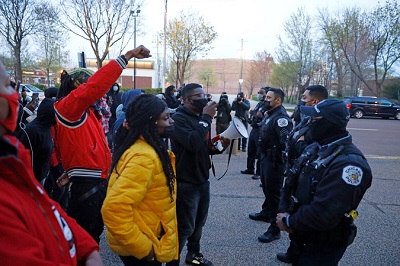
Several hundred protesters who rallied in Little Village Friday evening carried signs and banners calling for ‘Justice for Adam,’ Lightfoot’s resignation and the abolition of the police department. Families of people who were killed by the department shared their stories and rallied support for continued pressure on police and city officials.

Sandra Nevarez, whose son of Marc Nevarez was fatally shot by police in October, pleaded for officials to let young people suspected of wrongdoing have their day in court. “Illinois doesn’t have the death penalty. Is [the Chicago Police Department] now the death penalty?” Nevarez asked the crowd. “Let these kids go to court. Let them defend themselves. Let them bury their parents, not the parents bury their kids.”

According to a public opinion survey by the Chicago Index taken in March before Toledo’s shooting, 73% of respondents indicated they thought the city is on the “wrong track” while just 16% of respondents rated Lightfoot’s performance as “excellent or good.”

The Chicago Police Department fared slightly better in the survey, with 37% of respondents saying they were “satisfied or very satisfied” with the police force.

India Jackson, 20, said people in the Chicago’s youth activist community are struggling ahead of Friday night’s protests.

“Everyone is drained that this keeps happening,” said Jackson, who leads communications for GoodKids MadCity, a youth-organized group on the city’s South and West Sides that is among the organizers of Friday evening’s protest. “But this is a different type of heartbreak because Adam Toledo was a child.”

Groups like GoodKids MadCity are pushing for the defunding and eventual disbandment of the Chicago Police Department.

Jackson said she was “floored” when news emerged in February that Lightfoot had spent $281.5 million in federal covid-19 relief money on personnel costs for CPD, a move that angered not only activists but progressive members of the Chicago City Council. The city’s budget department said money went to officers who staffed airport coronavirus screenings, a virus field hospital at McCormick Place, virus testing sites across the city and resident wellness checks.

“Criticism comes with the job of mayor but this one’s just dumb,” Lightfoot told reporters at the time.

Jackson said, “We want [city leaders] to invest those funds into our community: schools, housing, food banks, medical centers. People are suffering from poverty and the CPD is sitting on a billion dollars.”

There has not been a critical mass of calls for Lightfoot to resign in the same way former mayor Rahm Emanuel faced widespread condemnation over his handling of the video release in the 2014 police shooting of Laquan McDonald, a landmark shooting in the rise of the Black Lives Matter movement.

American, Georgetown universities join growing list of campuses to require coronavirus vaccines #SootinClaimon.Com

#SootinClaimon.Com : ขอบคุณแหล่งข้อมูล : หนังสือพิมพ์ The Nation.

https://www.nationthailand.com/news/30404978

American, Georgetown universities join growing list of campuses to require coronavirus vaccines

InternationalApr 17. 2021

By The Washington Post · Lauren Lumpkin

WASHINGTON – American and Georgetown universities joined a growing list of universities this week in requiring students who return in the fall to get a coronavirus vaccine.

As vaccine eligibility expands and schools come closer to reopening for the fall, at least a dozen campuses have shared plans to mandate vaccines. Some, including Georgetown and AU, are also considering requirements for faculty and staff.

But the announcements have raised questions over the validity of such requirements, as well as access. International students, particularly in countries where coronavirus vaccines are not widely available, could run into challenges securing inoculations, college leaders acknowledge.

Despite the potential obstacles, the announcement at American was met with excitement, said Eric Brock, a junior and student body president. He said students have encouraged the university to enact a mandate.

“Personally, I feel safe coming back to campus knowing that those vaccines are going to be required,” said Brock, who has been taking classes remotely from his home in Phoenix. “I couldn’t be happier.”

AU president Sylvia Burwell, who served as health and human services secretary under President Barack Obama, said Wednesday that vaccines will be an important piece of the school’s plan to reopen campus in the fall.

“While public health measures like face coverings and physical distancing will likely be part of our fall operations, robust vaccination in our community will enable us to expand activities and interactions that enrich the educational, research, and social experiences that are fundamental to AU,” Matthews wrote in a statement.

Like other schools that have unveiled vaccine requirements, AU will make exceptions for students with medical or religious reasons, Burwell said.

While schools are expecting students to be inoculated for the fall, many students in other countries do not have access to vaccines that have been authorized in the U.S., Burwell said. Officials are determining how to handle those cases, she said.

International students who have not yet received vaccines will be directed toward clinics in the U.S. when they arrive in the fall, according to Burwell.

Georgetown shared similar guidance with international students, according to a message sent to the community this week.

Vaccine requirements have gained popularity in recent weeks as access in the United States has widened. Every adult is expected to be eligible for a shot by Monday.

Universities are hopeful that students will secure their doses by the time school starts in late summer.

Eric Feldman, a law professor at the University of Pennsylvania’s Carey Law School, said he believes schools have legal standing should their mandates be challenged.

“It may not be unambiguous in the legal text that universities can require the vaccination of students, but I think we have many, many years of precedent,” Feldman said.

A student sued the University of California in 1925, claiming he met all the school’s attendance requirements, except for the smallpox vaccination mandate. A judge sided with the university. A 2015 California law that required vaccines for schoolchildren withstood legal challenges as well.

Feldman called the pushback about the coronavirus vaccines’ emergency authorization “overblown.”

“The FDA didn’t provide emergency-use authorization at the last minute without having a very robust set of data that demonstrates the safety and efficacy of the vaccine,” Feldman said. “In terms of emergency-use authorization, the universities are on pretty safe ground.”

More schools are expected to join AU and Georgetown. Maryland’s attorney general recently advised that the state’s university system can legally mandate vaccinations, according to a letter sent to state Sen. James Rosapepe, D-Prince George’s, whose district includes the University of Maryland at College Park.

A decision has yet to be announced but Jay Perman, the system’s chancellor, told the Board of Regentson Fridaythat he supports the notion of requiring returning students to have vaccines.

He cited difficulties enforcing social distancing in residence halls, and said students risk spreading the virus through their interactions in classes, during extracurricular activities and at gatherings.

“I’ve already said that widespread vaccination is the way to resume some semblance of normal operations this fall,” Perman said.

NIH cuts fetal tissue research restrictions #SootinClaimon.Com

#SootinClaimon.Com : ขอบคุณแหล่งข้อมูล : หนังสือพิมพ์ The Nation.

https://www.nationthailand.com/news/30404977

NIH cuts fetal tissue research restrictions

InternationalApr 17. 2021

By The Washington Post · Amy Goldstein

WASHINGTON – The National Institutes of Health on Friday removed restrictions that the Trump administration imposed on research using fetal tissue, allowing university researchers and government scientists freer rein to use material from elective abortions when studying diseases and possible treatments.

A brief update for outside scientists from the NIH director’s office said the Department of Health and Human Services was reversing a 2019 decision that had required applicants for federal grants and contracts involving fetal tissue to undergo an extra layer of review by an ethics advisory board.

In a separate notice emailed Friday, NIH told its internal scientific and clinical directors that it was lifting a Trump-era ban on using federal money to buy human fetal tissue for biomedical studies by government employees.

The announcement, foreshadowed the day before by HHS Secretary Xavier Becerra, marks a profound shift in science policy and social values from former president Donald Trump to the three-month-old Biden administration.

The White House remained silent Friday about NIH’s move. Yet rescinding the restrictions on federal support for fetal tissue research conforms to the oft-stated pledge by President Joe Biden and his top health advisers – largely in the context of trying to defeat the coronavirus pandemic – that they will place primacy on science.

Two years ago, the question of whether government money should continue to be invested in studies relying on cells from aborted fetuses became a major collision point between social conservatives and the nation’s scientific community.

In 2019, Trump overrode the advice of his HHS secretary, Alex Azar, by blocking the use of NIH funds to purchase fetal tissue for use in government research labs. For outside researchers, the ban was less explicit, saying any application for a NIH grant or contract involving fetal tissue would need to be screened by a new ethics advisory board, if the application was deemed worthy on its scientific merits.

The Trump administration did not form the panel for about a year. When it did, most of its members strongly identified with opposition to abortion. The board convened once last summer before disbanding. It reviewed 14 proposals and recommended rejecting all but one.

Behind the scenes, senior figures at NIH were known to disagree with the two-part restrictions, though they did not speak against them publicly.

NIH’s actions Friday rescind the central parts of the Trump-era policy but do not entirely restore rules to the way they had been. The 2019 rules compelled academic and other outside scientists applying for grants or contracts to start including extensive justification of why human fetal tissue was needed for the work and why other research methods were inadequate. Scientists complained the justification took up too much space in grant proposals and contract applications with a length limit.

Friday’s changes leave in place the requirement for that extensive justification, according to proponents and opponents of the rewritten rules.

The policy change immediately flipped the politics surrounding federal fetal tissue policy. Scientists and their representatives who decried the Trump administration rules are celebrating their demise. Meanwhile, abortion opponents who advocated the last administration’s policy Friday are bemoaning that it is now abandoned.

“The scientific community appreciates that the Biden administration is lifting the arbitrary restrictions on promising biomedical research using human fetal tissue,” Christine Mummery, president of the International Society for Stem Cell Research, said in a statement. Saying that NIH should be “insulated from political interference,” Mummery said Friday’s actions were a “return to evidence-based policymaking.”

Lawrence S.B. Goldstein, a senior researcher at the University of California at San Diego and the only member of the Trump administration’s ethics advisory board who has used fetal tissue in his work, said, “It’s an unqualified win. . . . Hopefully, all those great research projects will come back that were killed by the ethics advisory board.”

Goldstein said, “I hope we are not going to enter an era of policy yo-yo as we change administrations,” but he added, “For the moment, I am happy.”

On the other hand, Tom McClusky, president of March for Life Action, an antiabortion advocacy group, said the research that the new rules will help permit “is a gross violation of human dignity. . . . The government has no business creating a marketplace for aborted baby body parts.”

Tony Perkins, president of the like-mindedFamily Research Council, condemned Becerra as “a fanatical advocate for abortion.”

David Prentice, another member of the ethics advisory board and research director of the antiabortion Charlotte Lozier Institute, said, “It’s a sad turn of events. . . . Now, taxpayer funds will be used for research that is poor ethics and poor science. We’ve just backed away from any sort of ethical consideration around this issue.”

Prentice said that under Friday’s turnabout, “We’re trafficking in aborted fetal tissue for antiquated experiments.” He contended that fetal tissue is less effective in research than adult stem cells, artificially grown groups of cells known as organoids and other material not derived from aborted fetuses.

Asked whether Lozier or other organizations opposed to fetal tissue research might legally challenge the Biden rules, Prentice said, “At this point, we are reviewing all possible avenues.”

The role of fetal tissue in biomedical research extends to the 1950s, when Swedish researchers developed a polio vaccine by using fetal cells. In the late 1980s, scientists developed the technique of breeding mice with deficient immune systems and transplanting into them small amounts of immune system tissue from aborted fetuses.

These “humanized” mice grow the equivalent of a human immune system. They have become crucial lab animals in studying several major diseases, including therapies for HIV, cancers, neurological problems, sickle cell disease and eye disorders. NIH, by far the largest funding source for biomedical research in the United States, has paid for most of this work. Last year, a federal researcher was blocked from using fetal tissue to try to develop treatment for covid-19, the disease caused by the coronavirus.

Friday’s updated NIH guidance for outside researchers said HHS and NIH “will not convene another NIH Human Fetal Tissue Research Ethics Advisory Board.” It said researchers applying for federal grants or contracts involving work with fetal tissue still must obtain consent from the tissue’s donor, may not pay for such tissue and must follow all other federal, state or university requirements.

For scientific studies undertaken by government employees, a one-paragraph email from Michael M. Gottesman, NIH’s deputy director for “intramural” – or internal – research said guidelines “will return to their previous state.” Human fetal tissue, the email said, “may again be used” in NIH’s laboratories.

Work that requires new purchase of fetal tissue “from all previously-approved sources may be conducted,” the notice said. Projects approved for use of fetal tissue before June 2019, when Trump changed the rules “will be reinstated without further review.”

The Biden administration has been making piecemeal changes to conservative health-related policies of its predecessors.

In February, federal health officials rescinded a Trump administration policy allowing states to ask for permission to require some low-income residents to work or prepare for jobs to qualify for Medicaid. Instead of cutting back on efforts to urge Americans to enroll in Affordable Care Act health plans, the current administration created an unprecedented extended sign-up period, then lengthened it from three months to six months.

Biden officials had not publicly discussed a pending change in the rules for fetal tissue research until Thursday. Testifying at a budget hearing on Capitol Hill, Becerra said an announcement from NIH was imminent, and he made clear the direction it would take, thought not the details.

“We believe that we have to do the research it takes to make sure that we are incorporating innovation and getting all of those types of treatments and therapies out there to the American people,” Becerra said.

Hong Kong schools devote a day to China’s national security #SootinClaimon.Com

#SootinClaimon.Com : ขอบคุณแหล่งข้อมูล : หนังสือพิมพ์ The Nation.

https://www.nationthailand.com/news/30404940

Hong Kong schools devote a day to China’s national security

InternationalApr 16. 2021Students raise the Chinese national flag during a ceremony marking the National Security Education Day at a school in Hong Kong on April 15. MUST CREDIT: Bloomberg photo by Chan Long Hei.Students raise the Chinese national flag during a ceremony marking the National Security Education Day at a school in Hong Kong on April 15. MUST CREDIT: Bloomberg photo by Chan Long Hei.
By Syndication Washington Post, Bloomberg · Kari Lindberg, Iain Marlow, Chloe Lo

Hong Kong marked its first National Security Education Day since last year’s imposition of sweeping national security legislation by Beijing, as the government ramps up efforts to overhaul the school system and instill patriotism in the city’s populace following the protests of 2019.

Schools across the city were mandated to hold events including singing the Chinese national anthem and raising flags. In addition, giant billboards promoting the event have been plastered across the city, while the police held an open day where they displayed professional drills, anti-terrorism exercises and displayed armored vehicles.

While mainland China has celebrated such a day since 2016, this is the first time the semi-autonomous financial hub is marking the occasion. The city’s government is required, under the national security law that was drafted in Beijing and forced on the city with no meaningful local debate, to “promote national security education in schools and universities.”

The shift to a forceful inculcation of national security issues, even among young children, comes as Beijing increases its control over almost all sectors and institutions in Hong Kong. In its most recent move to stifle political dissent, China’s top legislative body approved an overhaul of the city’s already limited elections to give authorities an effective veto over any potential opposition candidate.

Carol Chan, an events manager who has children aged three and five, said of the new curriculum, “Would you teach a kindergarten kid how much money to put into the bank? They are only counting coins. It’s insane.”

Beijing believes that Hong Kong’s insufficiently patriotic youth were responsible for the sometimes violent protests throughout 2019 and the national security education day is one way of trying to shape nationalistic students, said Ivan Choy, a senior lecturer at the Chinese University of Hong Kong.

“They think that one of the major sources of instability is from the students, the young people, so they will put more efforts on this aspect,” said Choy, who studies Hong Kong politics. “They have put more patriotic education in, and they have tried to punish or discipline teachers in secondary schools.”

As the city prepared to mark the occasion, China’s state media also published several articles about citizens who had allegedly compromised national security. These include a Shanghai real estate tycoon who allegedly financed “anti-China” activists in Hong Kong, a mainland student who became supportive of the city’s protests and a migrant worker who allegedly photographed a military port in the southern city of Shantou for foreign spies.

The day began with a formal ceremony featuring top officials of the Hong Kong government. Also in attendance were Zheng Yanxiong, head of the secretive agency China created to implement the controversial security law that was condemned by major Western governments, and Major General Chen Daoxiang, head of the People’s Liberation Army garrison in the city.

In a speech, Luo Huining, Beijing’s top official in Hong Kong, said, “Any attempt by foreign countries and external forces to flagrantly interfere in the affairs of Hong Kong, and to exploit Hong Kong as a pawn will be met with impactful countermeasures.”

Schools held a number of events, including what the government called a national security themed bulletin board design competition at a primary school.

“To support the theme and objectives of the National Security Education Day, the school has arranged flags to be raised,” one local secondary school said in an email to parents that was seen by Bloomberg. “In addition, there is a set of displays near the school office with details on National Security and some Q&A posted for information.”

Hong Kong students also took part in what a government press release called “Together We Safeguard Our Nation and Homeland – Community Mosaic Wall,” where students put stickers with “smiling faces” onto a display board — reminiscent of the Lennon Walls which protesters built around the city during the 2019 protests exhibiting protest slogans and artwork.

Bookmarks distributed to students days before the event list a host of topics linked to national security, including “polar security,” “deep sea security” and “ecological security.”

There were limited public displays of opposition in a city where social-distancing restrictions and the national security law have made once raucous protests almost disappear entirely. Four activists led a small protest in the city’s Wan Chai neighborhood, according to local broadcaster RTHK.

The city has identified education, along with media and the judiciary, as key sectors that need to be brought to heel, after students played a key role in the city’s protest movement. Beijing has urged Hong Kong to eliminate the alleged “black hands” influencing its schools, intimating that foreign forces have helped foment societal unrest.

International schools seem to be exempt from participating in National Security Education Day. According to the South China Morning Post, the English Schools Foundation, which operates a group of international schools in Hong Kong, told parents in February that it would still have autonomy over its curriculum.

However, the city’s Education Bureau stressed that international schools still need to prevent “teaching or other school activities” that breach the security law, as well as ensure students “acquire a correct and objective understanding and apprehension of the concept of national security and the National Security Law.”

The government’s website promoting national security day has only been made available in Chinese.

Representatives of multiple of the city’s international schools didn’t immediately respond to requests for comment about how they would handle the day’s events. A spokeswoman for the ESF declined to comment.

Hong Kong told schools in February to start using a more patriotic curriculum and advised teachers to report breaches of the national security law. Children starting from around kindergarten age will be taught to memorize offenses under the law, including subversion, secession, terrorism and collusion with foreign powers.

Loha Tse, who works as a hotel manager and is parent to a four-and-a-half year old, said her child received a sticker last week promoting the event.

“It makes no sense to force these things on to kids so young,” said Tse.

German institutes cut 2021 GDP forecast on longer lockdowns #SootinClaimon.Com

#SootinClaimon.Com : ขอบคุณแหล่งข้อมูล : หนังสือพิมพ์ The Nation.

https://www.nationthailand.com/news/30404939

German institutes cut 2021 GDP forecast on longer lockdowns

InternationalApr 16. 2021

By Syndication Washington Post, Bloomberg · Birgit Jennen, Carolynn Look

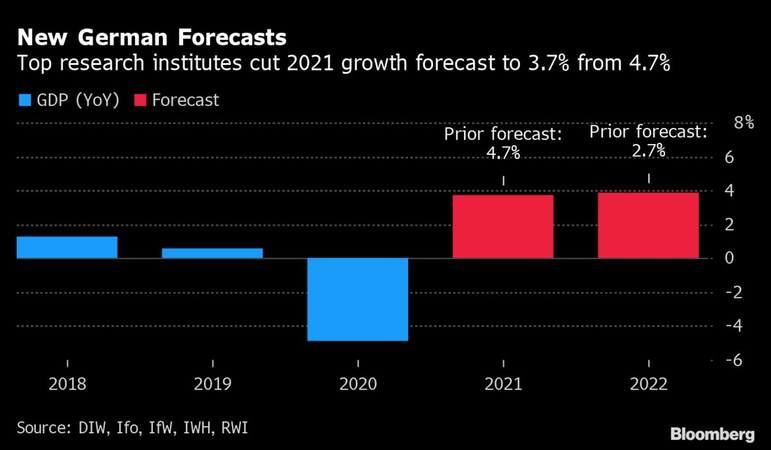
Germany’s leading research institutes cut their joint 2021 growth forecast for Europe’s biggest economy as prolonged lockdowns hold back the nation’s recovery.

The downgrade to a 3.7% expansion in gross domestic product, from 4.7% previously, reflects a sluggish vaccination campaign which has forced the government to extend virus restrictions. The outlook for 2022 was upgraded to 3.9% from 2.7%.

The economy likely shrank by 1.8% in the first quarter of this year, Torsten Schmidt, Economic Director of RWI Leibniz Institute for Economic Research, said in the report.

Germany has struggled to control a third wave of infections, and Chancellor Angela Merkel is seeking to impose even harsher curbs in virus hot spots. The institutes said they don’t expect rules to be loosened again until the middle of the second quarter, and that restrictions will likely remain in place until the end of the third quarter.

The twice-yearly outlook is prepared for the economy ministry by the DIW, Ifo, IfW, IWH and RWI institutes, and helps guide the government’s own forecasts and budget planning.

The government’s forecast is for growth of 3% this year, after a contraction of around 5% in 2020, and it expects a return to pre-pandemic levels of output in mid-2022. The economy ministry has said the signs point to a recovery over the rest of this year, and that a pickup in the pace of inoculations is fostering confidence.

Economy Minister Peter Altmaier said Thursday that he’ll publish an update to the government’s forecasts on April 27, and the prediction for this year would likely be “well above the previous forecast.”

“In particular, manufacturing is currently robust,” he said in an emailed statement. “However, we still have major problems in the area of retail and services,” he said.

Merkel’s ruling coalition has made tens of billions of euros available to offset the economic impact of the pandemic, and Finance Minister Olaf Scholz said Thursday it’ll continue to help businesses and households for as long as necessary.

“We must ensure that we can support companies and jobs with financial aid until the end of the crisis,” Scholz said during a lower house of parliament debate on the his supplementary budget for this year.

“We can afford to finance everything that is needed,” he said, adding that Germany’s budget will be in better shape than other countries after the crisis thanks to sensible policies in the past that laid a solid foundation.

U.S. could have 300 million extra vaccine doses by end of July, raising concerns over hoarding #SootinClaimon.Com

#SootinClaimon.Com : ขอบคุณแหล่งข้อมูล : หนังสือพิมพ์ The Nation.

https://www.nationthailand.com/news/30404938

U.S. could have 300 million extra vaccine doses by end of July, raising concerns over hoarding

InternationalApr 16. 2021

By The Washington Post · Adam Taylor, Emily Rauhala

The United States is on track to have gathered an oversupply of hundreds of millions of coronavirus vaccine doses as soon as July, even while many countries in the developing world will have to wait years to vaccinate a majority of their populations, according to a report by the Duke Global Health Innovation Center.

https://www.washingtonpost.com/video/c/embed/3cadc601-82a1-44fc-b2e7-c164d2799130?ptvads=block&playthrough=false

The new estimates, included in the paper alongside recommendations, come as the Biden administration faces mounting pressure to facilitate equitable vaccine distribution around the world. The United States has pledged money to the global immunization effort, but has resisted calls to share vaccine technology or donate surplus doses.

On Thursday, Secretary of State Antony Blinken held a fundraising event for Covax, a World Health Organization-backed push to distribute coronavirus vaccines, particularly to low- and middle-income countries, and called on other nations to do more.

Covax aims to secure and distribute enough vaccine to reach up to 20% of the population in 92 participating target countries by the end of 2021. In February, the Biden White House pledged up to $4 billion in support, reversing a Trump administration decision to opt out.

At a virtual event on Thursday, Blinken urged countries to give more, saying an additional $2 billion could help Covax reach 30%, rather than 20%, of target populations this year. “Just think for a moment of all the people whose lives would be impacted by hitting that higher target.” he said.

The secretary of state said countries must support vaccine manufacturing, but stopped short of announcing any specific policies or plans. He did not address the issue of surplus U.S. doses.

On Wednesday, Oxfam released a letter signed by more than 100 former heads of state and Nobel laureates calling on President Joe Biden to waive intellectual property rules for coronavirus vaccines and “put the collective right to safety for all ahead of the commercial monopolies of the few.”

“Leadership from the US on safe, effective, and equitable global access to Covid-19 vaccines is imperative,” the Duke paper argues, pushing for Washington to increase funding for vaccine-sharing programs, and to donate excess doses and use its clout to open up vaccine manufacturing.

Another proposal, put forward in a letter backed by the Center for Strategic and International Studies (CSIS), calls for the United States to donate 10% of its excess doses over the summer, moving to 50% by the end of the year, and argues that Biden should deliver a speech this spring to make the case to the American people.

Under the leadership of Gayle Smith, Blinken’s new coordinator for global coronavirus response and health security, the ONE Campaign, a nonprofit organization, called on wealthy countries to donate 5% of their surplus doses once they’ve vaccinated 20% of their populations.

The proposals come just after the United States surpassed that 20% target -and as the virus spreads uncontrolled in much of the world and more-virulent variants continue to take hold.

The United States will probably have “at least 300 million excess doses or more” by the end of July, the Duke paper’s authors estimate, even as vaccination programs are extended to the vast majority of U.S. children.

The estimate is based on the assumption that the vaccine developed by AstraZeneca receives emergency-use authorization and the Johnson & Johnson vaccine is used widely, despite rare side effects.

The oversupply in the United States forms a stark contrast with the situation in many poorer parts of the world, where vaccination programs have been slow to begin amid problems with supply and distribution, and could ultimately prolong the pandemic and hamper a U.S. recovery.

The Biden administration has pledged to donate doses. “If we have a surplus, we’re going to share it with the rest of the world,” Biden said last month, when pressed on the issue. “We’re going to start off making sure Americans are taken care of first, but we’re then going to try to help the rest of the world.” And Blinken has made the case that protecting Americans requires international action. “This pandemic won’t end at home until it ends worldwide,” he said at a news conference on April 5. But no global plan to donate doses has been specified.

The world’s poorest 92 countries will not be able to reach a vaccination rate of 60% of their populations until 2023 “or beyond” if current distribution trends continue, the Duke paper estimates.

The authors include former U.S. officials such as Mark McClellan, who served as commissioner of the Food and Drug Administration under President George W. Bush, as well as Krishna Udayakumar, founding director of the Duke Global Health Innovation Center.

Their recommendations echo the concerns from other public health experts worldwide, including World Health Organization Director General Tedros Adhanom Ghebreyesus, who called vaccine-distribution plans that focus only on domestic issues a “self-defeating strategy [that] will cost lives and livelihoods.”

French President Emmanuel Macron in February pushed for the United States and Europe to donate up to 5% of secured vaccine doses, although the idea has not gained significant momentum.

Covax is just one part of the broader Access to COVID-19 Tools (ACT) Accelerator, a broader plan that has a funding gap of more than $22 billion.

Even if Covax were fully funded this year, it would be able to vaccinate only a quarter of the populations in the world’s 92 poorest nations, according to the Duke paper.

Although many experts think the United States needs to do more to ensure that the developing world can vaccine faster, they differ on approach.

While the letter spearheaded by Oxfam called on the United States to back a temporary waiver of World Trade Organization intellectual property rules, breaking vaccine monopolies, the Duke experts argued that such a measure is unnecessary and could prove chaotic.

Instead, they propose that the United States should back the use of cooperative licensing arrangements to increase manufacturing capacity, so that production can be scaled up quickly but safely.

The Duke authors also state that although U.S. contracts with drug manufacturers may restrict donations of excess doses, the Biden administration could modify its contracts and could provide “loans” of currently available vaccine doses (as it has done with Mexico and Canada). It also could shift the timing of vaccine deliveries so more-needy countries receive their doses first.

Both the Duke and CSIS proposals noted that although the AstraZeneca vaccine does not have emergency-use approval in the United States, it could be used in other countries. The United States has purchased 300 million doses of the AstraZeneca vaccine alone.

Spring wave of coronavirus crashes across 38 states as hospitalizations increase #SootinClaimon.Com

#SootinClaimon.Com : ขอบคุณแหล่งข้อมูล : หนังสือพิมพ์ The Nation.

https://www.nationthailand.com/news/30404937

Spring wave of coronavirus crashes across 38 states as hospitalizations increase

InternationalApr 16. 2021A heart emblazoned with a hopeful message appears at American Coney Island in Detroit. The popular tourist site is closed during Michigan's stay-at-home order during a coronavirus surge. MUST CREDIT: Photo by Nick Hagen for The Washington Post.A heart emblazoned with a hopeful message appears at American Coney Island in Detroit. The popular tourist site is closed during Michigan’s stay-at-home order during a coronavirus surge. MUST CREDIT: Photo by Nick Hagen for The Washington Post.

By The Washington Post · Joel Achenbach, Jacqueline Dupree

The coronavirus pandemic in America has turned into a patchwork of regional hotspots, with some states hammered by a surge of infections and hospitalizations even as others have seen the crisis begin to ease. The spring wave of the pandemic has driven hospitalizations above 47,000, the highest since March 4.

Thirty-eight states have reported an increase during the past week in the number of people hospitalized with covid-19, the illness caused by the virus, according to a Washington Post analysis of data provided by the Department of Health and Human Services.

But the national statistics fail to capture the intensity of the coronavirus emergency in the hotspots. Michigan reported more than 10,000 new infections on Tuesday alone. The state on Wednesday reported an average of 46 deaths a day, up from 16 a month earlier.

“We’re still climbing, unfortunately,” said Nicholas Gilpin, system medical director for infection prevention at Beaumont Health, which runs eight hospitals in the Detroit area and has more than 800 patients hospitalized.

Michigan officials have pleaded with the White House for more vaccine doses, but the Biden administration has said it will stick to allocations based on state populations. Administration officials stressed that vaccines aren’t rapid-response tools for outbreaks.

“What we need to do in those situations is shut things down,” Rochelle Walensky, director of the Centers for Disease Control and Prevention, said Monday. “We need that vaccine in other places. If we vaccinate today, we will have, you know, impact in six weeks, and we don’t know where the next place is going to be that is going to surge.”

Along with Michigan, 32 other states have also registered increases in infections in the past two weeks, including all the states along the Great Lakes from Wisconsin to Pennsylvania. Minnesota and South Dakota are also up, making the Upper Midwest the major regional center of the spring wave. If there’s a single broad trend, it’s that the northern tier of the country is generally faring worse than the southern – for the moment.

Other regional hotspots include Maine and New Hampshire in northern New England; Delaware and Maryland in the mid-Atlantic; Colorado, Arizona and Nevada in the Mountain West; and Oregon and Washington in the Pacific Northwest.

By contrast, much of the Deep South, with the exception of Florida and Georgia in recent days, has reported sharp decreases. Since the winter wave ended, West Texas and the Great Plains have seen improving numbers.

“The spring wave has not had a huge amplitude nationally, but has been very regional,” said David Rubin, director of PolicyLab at Children’s Hospital of Philadelphia.

He and his colleagues have pointed to weather and seasonality as a factor in infection rates, with warmer and lengthening days supporting less virus transmission.

“There’s a clear latitude effect. If you go up into Canada, they’ve been having a really hard time,” he said.

The vaccination campaign appears to have altered the demographics of hospitalizations: With a large majority of elderly people now inoculated, the average age of patients has dropped. Gilpin, of Beaumont Health, said patients are generally less ill than in previous phases of the pandemic.

As of Thursday, more than 76 million people in the United States had been fully vaccinated. The vaccines are not foolproof, however – something known since the first results emerged from clinical trials. The CDC said Thursday that 5,800 cases of post-vaccination “breakthrough infections” have been reported nationwide. That’s fewer than 1 in every 13,000 vaccinations.

Of those breakthrough cases, 29% were asymptomatic and 7% required hospitalizations. CDC spokeswoman Kristen Nordlund said 74 of those vaccine recipients who had breakthrough infections died.

Separately, officials in the state of Washington reported Wednesday that 217 people among the 1.7 million fully vaccinated there had suffered breakthrough infections. Five deaths among patients ranging in age from 67 to 94, all with multiple underlying conditions, are under investigation, the state department of health said.

Anthony Fauci, President Joe Biden’s chief medical adviser on the pandemic, said during Monday’s White House task force news conference that there are two distinct types of vaccine failure.

“Primary vaccine failure” is when the body doesn’t mount a robust immune response. That could be caused by poor health, age, medication or something wrong with the vaccine. “Secondary vaccine failure” is when immunity fades over time, or if the person is exposed to a different virus strain.

“However, even if a vaccine fails to protect against infection, it often protects against serious disease,” Fauci said.

The CDC said these breakthrough infections were seen in all age groups. Women accounted for 65% of reported breakthrough cases. The CDC did not break down the cases by vaccine type.

“To date, no unexpected patterns have been identified in case demographics or vaccine characteristics,” Nordlund said. She added that the CDC continues to advise vaccinated people to take precautions in public places, such as wearing masks, maintaining social distancing, and avoiding crowds and poorly ventilated places.

The nation appears to be moving forward, if not always smoothly, toward its goal of crushing the pandemic. By the end of the week, the United States is poised to reach the milestone of 200 million vaccine shots into arms, and the now-rapid pace of inoculations among the most vulnerable populations is driving down mortality rates from covid-19.

But vaccine hesitancy is much on the mind of public health officials. In coming weeks, the supply of doses may outstrip demand. Biden administration officials said Wednesday the country is averaging 3.3 million vaccine doses a day. On Wednesday, the government reported only 2.5 million vaccine doses administered – even though that included pre-pause Johnson & Johnson vaccinations.

That pause is because of a rare blood-clotting condition seen in six women, one of whom died. That number is small compared with the 7.5 million doses delivered, but the similarity of the cases to blood clotting seen in Europe in the rollout of the AstraZeneca vaccine – which uses a similar vector for introducing the vaccine into the body – has grabbed the attention of the scientific community.

This country’s vaccination efforts have relied far more heavily on the Pfizer-BioNTech and Moderna vaccines. But Johnson & Johnson has been ramping up in recent weeks, with 344,000 vaccinations reported Monday before the pause.

Any attempt to forecast the future of the pandemic has been hampered by unknowns about the virus and the human immune response to it, the unpredictability of human behavior, the successes or failures in persuading people to get vaccinated, and many other crosscurrents that can push infection and hospitalization numbers in opposite directions. Changing metaphors: There are many dials controlling this situation, manipulated simultaneously, clockwise and counterclockwise.

One dial involves the speed of vaccination. That took a setback this week. Inoculations with the Johnson & Johnson vaccine were paused nationwide amid reports of six women between the ages of 18 and 48 who suffered a rare blood clotting disorder.

That is not a showstopper given that Johnson & Johnson so far has represented only about 5% of vaccinations. But the news was unwelcome in Michigan. The worries about this one vaccine could erode confidence in the broader vaccination campaign and the assurances of public health experts, at a moment when vaccines are the most powerful tool for ending the pandemic, Gilpin said.

“You’ve already got a pretty concerned chunk of the population that are already skeptical of the vaccine. This is not going to help,” Gilpin said. “This has become a race, a race to get the vaccine into people as quickly as possible before the virus can continue to spread, or continue to mutate. And so this will slow us down.”

Rubin, of Children’s Hospital, said human behavior is the biggest cause of recent infection upticks. Fatigued by the pandemic, people are lowering their guard, traveling more readily, socializing indoors with unvaccinated people. Governors and mayors are easing restrictions on gatherings.

“The biggest driving force of the spring resurgence has been how quickly the American people have abandoned social distancing,” Rubin said.

One of the big unknowns is the number of people who have already been infected with the virus and may have at least partial immunity. The official count is 31 million, but some experts believe the true number is many times that. Some states hammered by high numbers of infections earlier in the pandemic, such as Iowa, have recorded more modest spring numbers, while states such as Maine and New Hampshire, largely spared until now, are seeing sharp spikes in cases.

On Tuesday, the country’s seven-day daily average for new infections topped 71,000 for the first time since Feb. 18.

Federal coronavirus data released Wednesday showed 1,414 counties color-coded as red, with “high transmission” rates, a rise from 1,317 on March 14. There was a mirror image to that increase: The number of counties color-coded blue, “low transmission,” also rose in the same time period, from 186 to 249.

Within states, the trends are not uniform. In Georgia, which has seen its average of new cases increase more than 17% in the past week, 38 of its counties – many in the north and west of the state – have registered case average increases, while 52 have experienced decreases and the other 67 counties reported no change.

The northern states such as Michigan and Minnesota may have reached a peak in cases, as the upward trend of new infections has flattened in recent days. Rubin said modeling by Children’s Hospital of Philadelphia suggests those states, as well as the New York City area, could soon experience declining infections. The forecasts are based in part on widespread drops in test positivity percentages that have consistently foreshadowed declines in caseloads and hospitalizations, Rubin said.

Highly contagious, mutation-laden variants of the virus are circulating. A variant first seen in the United Kingdom, known as B.1.1.7, and believed to be at least 50% more transmissible, is now the dominant strain in the United States, according to the CDC. Several other less-common variants are in the mix. The vaccines work against the variants for now, but evolution of the virus could necessitate changes in the vaccines similar to the reformulation of seasonal flu shots.

“There are these variants that are wild cards. But one thing we know for sure is if a virus can’t circulate, if it can’t replicate, it can’t create new variants,” said Ellen Foxman, an immunologist at Yale School of Medicine.

That points to the need for mass vaccination, she said, and the Johnson & Johnson vaccine pause shouldn’t derail the campaign.

“You want normal life? That’s your ticket, is mass vaccination. We don’t want to let this one little bump of this very rare complication of this one vaccine to interrupt the progress that we’ve been making,” she said.

U.S. imposes economic sanctions on Russia over cyberspying, efforts to influence presidential election #SootinClaimon.Com

#SootinClaimon.Com : ขอบคุณแหล่งข้อมูล : หนังสือพิมพ์ The Nation.

https://www.nationthailand.com/news/30404936

U.S. imposes economic sanctions on Russia over cyberspying, efforts to influence presidential election

InternationalApr 16. 2021

By The Washington Post · Ellen Nakashima

WASHINGTON – The Biden administration on Thursday imposed sanctions targeting the Russian economy to punish the Kremlin for a cyberespionage campaign against the United States and to influence the presidential election, according to senior U.S. officials.

The administration also sanctioned six Russian companies that support Russian spy services’ cyberhacking operations and will expel 10 intelligence officers working under diplomatic cover in the United States. It formally named the Russian intelligence service SVR as responsible for the hacking operation commonly known as SolarWinds.

The measures were taken under a new executive order and are an effort to make good on President Joe Biden’s vow to hold Moscow accountable for a series of operations, including election influence and the cyberhacks that compromised nine federal agencies and about 100 private firms.

“Our view is that no single action that we will take or could take . . . could directly alter Russia’s malign behavior,” said Jonathan Finer, principal deputy national security adviser. “But this is going to be a process that is going to take place over time, and it will involve a mix of significant pressure and finding ways to work together.”

The announcement of a U.S. response had been repeatedly pushed back, in part because Biden has wanted his team to develop more effective measures, said senior administration officials who spoke on the condition of anonymity to discuss a sensitive matter.

Biden told Russian President Vladimir Putin in a call on Tuesday that Washington would be taking actions “in the coming days” to defend U.S. national interests, without specifying the exact timing or measures, a senior administration official said. Biden also raised the possibility of a summit in a third country with Putin in the coming months.

As president-elect, Biden had told Putin in January that his administration would be “compelled to respond” to these activities, the official said. “So it should not come as a surprise to the government of Russia that we’re taking these actions.”

The package includes sanctions on all debt Russia issues after June 14, barring U.S. financial institutions from buying government bonds directly from the Russian Central Bank, the Russian National Wealth Fund and the Ministry of Finance. The action, experts said, will complicate Moscow’s ability to raise money in the international capital markets.

Some Russian officials discounted the move, saying it is easy for investors to work around the restriction by investing in bonds on the secondary market through an intermediary.

But under the new order signed by Biden, the United States is reserving the right to broaden the scope of the sovereign debt sanctions to include secondary markets if Moscow’s malign activities persist, officials said.

“This action signals that the Biden administration is not going to hold back,” said Edward Fishman, a nonresident senior fellow at the Atlantic Council. “They’re taking significant actions against the Russian economy and putting global markets on notice that Russian sanctions will increase if Russia’s aggressive behavior continues.”

At the same time, said a second senior administration official, “we’re not looking for escalation. We’re providing a proportionate and tailored response.”

Kremlin spokesman Dmitry Peskov said Thursday that Russia viewed any U.S. sanctions as illegal and would retaliate in kind. Moscow summoned U.S. Ambassador to Russia John Sullivan for what a Foreign Ministry spokeswoman said would be “a difficult talk.”

Peskov said sanctions would not be helpful in the lead-up to the proposed summit.

“We condemn any sanction aspirations,” Peskov said. “We believe they are illegal. In any case, the principle of reciprocity applies in this case. Reciprocity will meet our interests in the best possible way.”

The SVR, Russia’s foreign intelligence agency, dismissed the accusations that it was involved in cyberattacks as “nonsense.”

The European Union, Australia and Canada issued statements of support after the White House’s actions on SolarWinds, noting that European countries were also affected but they did not join in sanctions targeting Russia’s sovereign debt.

The measures will be accompanied by what the White House hopes will be a strong message to Moscow to convey U.S. displeasure, but without cutting off diplomacy, said a second official. The message, the official said, is: “We are willing to talk about certain things, but we can’t have a strong relationship while you continue to take these malign steps.”

One action that will not be tied to the sanctions is Russia’s reported effort to put bounties on the heads of U.S. troops in Afghanistan in 2019, officials said. U.S. intelligence agencies had low to moderate confidence that officers with the Russian military spy agency, the GRU, sought to encourage Taliban attacks against U.S. and coalition personnel – not strong enough to justify the imposition of sanctions, officials said.

“But we do believe that this information puts the burden on the Russian government to explain its action and takes steps to address this disturbing pattern of behavior,” the senior administration official said. “We expressed those concerns directly to the government of Russia.”

The new executive order focuses on Russian activities outside its borders and “is intended to signal to the Russian government that its destabilizing behavior is unacceptable and that the United States will impose economically impactful costs if it continues or escalates,” the senior official said.

The executive order covers a range of actions that can be sanctioned, from cyberattacks to election interference to transnational corruption. Creating such an umbrella order streamlines the messaging, allowing the administration to sanction one nation – Russia – for a diverse set of activities under one authority, experts said.

“It’s good to clearly message our priorities to Russia,” said Andrea Kendall-Taylor, a senior fellow at the Center for a New American Security. “By packaging a response to several things at once, the administration can get off the back foot and move on its agenda. What we don’t want is to always be in response mode to Russia.”

The sanctions and expulsions come four months after revelations that Russian cyberspies had compromised major federal agencies, including the Treasury and State departments and a number of private-sector companies. The hacks were enabled by corrupted software updates from the Texas-based company SolarWinds. The Washington Post first reported that the SVR was believed to be behind the intrusions. The SolarWinds link was first disclosed by a private cyber firm, FireEye.

Biden’s repeated vows to punish the party responsible raised expectations the administration would take action – despite the fact that the intrusions apparently fell into the category of political espionage. All developed countries engage in such espionage.

But senior administration officials have said that Russia’s presence in federal networks could give it a toehold to undertake more disruptive actions. And some policy experts have said that should be grounds for punishment. Others disagreed, saying the operation did not reach disruptive levels.

The six cyber firms to be sanctioned have facilitated Russian government hacking in some way, from providing expertise to developing tools that allow the spy agencies to gain access to targeted networks, the officials said. Some, but not all, are linked to the SolarWinds campaign, they said.

The U.S. intelligence community last month issued a report concluding that Putin sought to sway the 2020 election in President Donald Trump’s favor by spreading misleading information about Biden.

In response, the Treasury Department is sanctioning 32 entities and individuals involved in the influence campaign and other acts of disinformation. They include Konstantin Kilimnik, a Ukrainian-Russian who worked in Ukraine with Trump’s 2016 presidential campaign chairman Paul Manafort. A Senate panel last year concluded that Kilimnik was a Russian intelligence officer, and the Treasury on Thursday offered new details, saying that during the 2016 campaign, Kilimnik “provided Russian intelligence services” with sensitive information on polling and campaign strategy.

The Treasury also sanctioned Russian disinformation sites including InfoRos, which calls itself a news agency but is primarily run by the GRU; and the Strategic Culture Foundation, an online journal controlled by the SVR that the Treasury said promoted false narratives in the 2020 election and tried to obscure its Russian origins.

The United States is expelling the 10 operatives from Russia’s embassy in Washington. Russian spies have been sent home before. The Obama administration expelled 35 intelligence operatives in December 2016 in retaliation for Kremlin interference in that year’s presidential election. The Trump administration in 2018 ordered out 60 Russian officers, including a dozen identified as spies, in response to the poisoning of former Russian spy Sergei Skripal in Britain. That action was taken in coordination with European allies.

Officials in Moscow expressed anger that the Biden administration expelled diplomats and slapped on new sanctions two days after Putin’s call with Biden. “Such aggressive behavior will doubtless be decisively rebuffed,” said Russian Foreign Ministry spokeswoman Maria Zakharova, saying Russia would inevitably respond. “Washington must realize that the degradation of bilateral relations will come at a cost. Responsibility for what is happening lies entirely with the U.S.,” she said.

The new sovereign debt sanctions, affecting ruble and nonruble bonds, are noteworthy, officials said. Before this action, U.S. sanctions barred Americans from buying only nonruble denominated debt – about 20% of Russia’s sovereign debt. Now, said the second senior administration official, the other 80%, or the full amount, will be covered.

Police order to hold back riot-control weapons compromised Capitol, inspector general tells House panel #SootinClaimon.Com

#SootinClaimon.Com : ขอบคุณแหล่งข้อมูล : หนังสือพิมพ์ The Nation.

https://www.nationthailand.com/news/30404935

Police order to hold back riot-control weapons compromised Capitol, inspector general tells House panel

InternationalApr 16. 2021

By The Washington Post · Karoun Demirjian

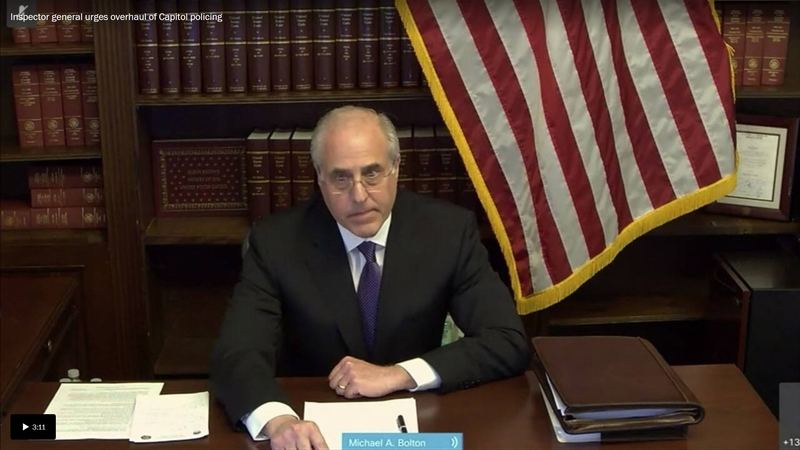
WASHINGTON – An order to hold back heavy riot-control weapons left Capitol Police at a grave disadvantage as front-line officers, vastly outnumbered, fought to protect Congress from a violent mob Jan. 6, the force’s inspector general told lawmakers Thursday, as he urged an overhaul of campus security.

Inspector General Michael Bolton told the House Administration Committee that a deputy assistant chief of police instructed officers not to use the weapons – including stingballs and 40mm launchers – out of concern that “they could potentially cause life-altering injury and/or death, if they were misused in any way.” Bolton did not identify the chief, but he said that had officers employed such measures, “it certainly would have helped us that day to enhance our ability to protect the Capitol.”

“The takeaway from that is, let’s provide the training to our officers so they are used appropriately,” Bolton said, later adding: “Training deficiencies put officers. . . in a position not to succeed.”

More than a half-dozen congressional committees and one task force appointed by House Speaker Nancy Pelosi, D-Calif., have opened inquiries into how law enforcement missed warning signals and failed to hold back the insurrection, during which thousands of President Donald Trump’s supporters invaded the Capitol campus in a deadly but failed bid to prevent Congress from certifying President Biden’s election win. But Bolton’s investigation, projected to continue for several more months, is expected to produce the most comprehensive analysis of how inadequate training and intelligence-gathering and operational “deficiencies” allowed the Capitol’s first line of defense to be overrun.

To date, the inspector general has produced two interim reports for Congress detailing investigators’ preliminary findings, including that the force lacked the security clearances needed to properly assess warnings that the Capitol might come under attack. He also determined that the Capitol Police had incomplete records of the personnel and equipment on hand to respond to civil disturbances – and that many of the officers did not know how to use the crowd-control weapons at their disposal.

During Thursday’s hearing, Bolton was emphatic that the Capitol Police would have to undertake sweeping procedural changes in order to be prepared for future threats to the Capitol and Congress. He also called for a “cultural change,” arguing that the force must move away from the “traditional posture of a police department,” and start acting instead like “a protection agency” focused not on responding to disturbances, but on preventing events like the Jan. 6 riot.

The hearing came as lawmakers are readying a supplemental spending package to pay for reforms and enhancements to campus security. Many are based on recommendations from former Army Lt. Gen. Russel Honore, whom Pelosi tasked earlier this year to conduct an evaluation. His team’s draft report, released last month, recommended an expansion of the campus police force, and construction of mobile and retractable fencing around the Capitol to be deployed in emergencies.

Pelosi told reporters during a Thursday news conference that she had received a draft of the House Appropriations Committee’s proposal to apportion funds for stepped-up security measures, including plans “to harden the windows, the doors and the rest.”

But when the inspector general was asked Thursday where Congress should be spending its money, Bolton focused on a different answer: training.

“If you want to invest dollars, that’s the place to invest it: training,” he said, lamenting that for too long, police training had been treated as an afterthought to other measures.

Bolton specifically raised lapses in the department’s Civil Disturbance Unit, or CDU, to highlight how a lack of training directly affected the Jan. 6 response. The Capitol Police CDUfunctions as “an ad hoc unit,” he said, instead of a permanent force with specialized skills.

He called for Congress to adopt incentives to attract officers to the high-risk job, and to build a force that is prepared to respond to potentially riotous crowds and threats to the Capitol.

“To be truly effective, you have to have that continuous training,” he testified. “They need to have a stand-alone unit, whatever size the department deems appropriate, and that’s their full-time job.”

Bolton also emphasized that improving the Capitol Police’s capacity to gather, analyze and assess intelligence is vital for responding to future threats.

“We need an intelligence bureau, . . . a full-service, comprehensive bureau,” he said. Bolton has also called for ensuring that civilians and officers tasked to intelligence-gathering operations obtain top-secret clearances, which not all employees currently have.

Bolton is not the first official to call for an overhaul of training, staffing, communications and intelligence operations. In recent weeks, Congress has heard about law enforcement failures and errors from the Capitol Police’s former chief, Steven A. Sund, the current acting chief, Yogananda D. Pittman, and the former Senate and House sergeants at arms who resigned after the riot, Michael Stenger and Paul Irving, respectively.

None of those officials has yet spoken with the House Administration Committee – a fact Republicans criticized in their remarks Thursday.

“This is the first hearing that the chair has called on January 6, more than three months after the attack,” said Rep. Rodney Davis, R-Ill., the panel’s ranking member, complaining that they had “skipped a step” by not having first called in officials who made the decisions leading up to Jan. 6.

Sund, the former police chief, has accused the two sergeants at arms of refusing his requests to call in the National Guard as a backup force before the riot. Under current rules, the police chief must seek permission from the Capitol Police Board, composed of the sergeants at arms and the Architect of the Capitol, before deploying additional resources in response to emergencies.

Davis insisted that any review of the Capitol Police that sidestepped scrutiny of the Board would be incomplete. Bolton answers to the Capitol Police board and does not have jurisdiction over them.

“I’ve said for a long time that an overhaul of the Board is needed,” Davis said, complaining that the committee’s probe was not satisfactorily bipartisan. He promised to release “a series of short reports” of his own.

The Administration Committee, made up of six Democrats and three Republicans, is one of at least five House panels that have launched probes into aspects of the Capitol riot, with still others examining questions surrounding forms of domestic extremism that were highlighted by the attack. But most of those inquiries have been slow to get underway.

Many lawmakers expected that such committee-level inquiries would quickly be overshadowed by an independent, 9/11-style commission, a concept that had seemed to have strong bipartisan support in the attack’s immediate aftermath but now has stalled in the face of political disputes over the scope of its authority.

In the Senate, a joint investigation between the committees on Rules and Homeland Security and Governmental Affairs has made more headway, with a report documenting the failures that led to the mayhem on Jan. 6 expected to be completed next month, according to various aides familiar with its progress.