
Texas blackout scare renews call to rein in unruly power market #SootinClaimon.Com

#SootinClaimon.Com : ขอบคุณแหล่งข้อมูล : หนังสือพิมพ์ The Nation.

https://www.nationthailand.com/news/30404934

Texas blackout scare renews call to rein in unruly power market

InternationalApr 16. 2021A worker repairs a power line in Austin, Texas, on Feb. 18, 2021. MUST CREDIT: Bloomberg photo by Thomas Ryan Allison.A worker repairs a power line in Austin, Texas, on Feb. 18, 2021. MUST CREDIT: Bloomberg photo by Thomas Ryan Allison.

By Syndication Washington Post, Bloomberg · Josh Saul, Mark Chediak

It didn’t take a heat wave or freak winter storm this time to raise the specter of rolling blackouts in Texas. All it took was a mild spring day.

The fact that the state’s power system, serving nearly 30 million people, made an urgent plea for conservation with temperatures in the 80s Fahrenheit is prompting fresh questions about the need for reform less than two months after February’s deadly blackouts.

“It’s a disgrace for a power grid in modern times to struggle to keep the lights on during a mild day,” said Daniel Cohan, an associate professor of environmental engineering at Rice University. “We’ll be in trouble when a summer heat wave comes in and demand is one-and-a-half times as much as it was yesterday.”

Texas has long taken a laissez-faire approach to its power grid, allowing market forces — rather than regulations — ensure there’s enough power on hand to satisfy demand. State lawmakers have been reluctant to buck that philosophy as they consider legislation to address the problems that led to February’s crisis. Yet without changes, unpredictable weather will continue to beget chaos, experts warn.

“The reality is the market is designed to operate with very thin reserve margins,” said Katie Bays, an analyst at FiscalNote Markets. “And weather unpredictability combined with a white-knuckle approach is going to produce volatility.”

This week’s brush with outages stemmed largely from human error: grid operators misjudged the weather.

The Electric Reliability Council of Texas, which manages most of the state’s grid, had counted on a mild cold front sweeping the state to lower demand for power. It didn’t happen. As a result, demand on the grid was about 3,000 megawatts higher than anticipated — or the equivalent of 600,000 homes.

Normally, additional power plants would kick in to make up the shortfall. But about 25% were off line for repairs to gear up for summer, when plant owners make the bulk of their money selling electricity to satisfy Texas’s insatiable demand for air conditioning.

Unlike other U.S. grid operators, Texas doesn’t have a capacity market that pays generators to be available in order to meet expected demand. Instead, the Texas market is designed for wholesale prices to spike when supplies get tight in order to encourage power producers to come online. That approach allowed prices to surge to $9,000 a megawatt-hour during the last crisis, which pushed many companies into default and has left the power market in ongoing financial distress.

“It further highlights the need for Ercot reform and it’ll put a fire under legislators’ butts,” said Josh Price, an analyst for Height Capital Markets.

Lawmakers are considering a series of measures in response to February’s blackouts. One bill would require power plants to prepare better for cold weather. Another would ban retail electricity providers from exposing customers to the volatility of wholesale power prices. And other measures would require renewable generators to buy reliability services, increasing their financial burden. But a bill that would create a capacity market hasn’t budged.

“The legislature has been trying to take a hands-off approach to Ercot and assume that the fundamentals of the market will solve the underlying issue,” Bays said.

Texas lawmakers advanced several power bills on Wednesday. The Senate passed a measure that would force renewable generators to shore up their ability to deliver supplies, while a House committee approved a proposal that would permit co-operatives, municipal utilities and power companies to sell debt to cover huge obligations racked up during the crisis, according to a note sent out by Price. Any bills would have to be passed by both chambers to become law.

Texas ranks last among U.S. regional power networks when it comes to reserve capacity, according to the North American Reliability Corporation, which oversees grids in the U.S., Canada and parts of northern Mexico. Ercot has failed to meet its own target reserve of 13.75% for the past three years, according to the agency.

An Ercot spokeswoman said it was speculative to say whether or not a higher reserve margin would have resulted in different outcomes from the winter storm.

Weather doesn’t usually have a big impact on electricity demand in spring and fall. Those are the so-called shoulder seasons when customers are neither cranking their heaters nor blasting their air conditioners.

On Tuesday, temperatures in Dallas, Brownsville and Houston were moderately higher than normal, reaching or exceeding 80 degrees Fahrenheit (27 Celsius). That, combined with a dearth of generation, prompted Ercot to ask for conservation for almost four hours.

The real test could come this summer. While Ercot said last month it expects to have adequate supplies for the season despite anticipated record peak demand, almost 75% of Texas is gripped by drought, and more than 91% is abnormally dry. Drought makes heat worse because the sun’s energy goes into warming the air rather than evaporating ground moisture.

“This doesn’t bode well for summer when they are already issuing these kind of alerts,” said Jim Rouiller, lead meteorologist at the Energy Weather Group. “The cold killed people. The heat will kill a lot more people.”

Recovery quickens as U.S. retail sales soar, jobless claims ease #SootinClaimon.Com

#SootinClaimon.Com : ขอบคุณแหล่งข้อมูล : หนังสือพิมพ์ The Nation.

https://www.nationthailand.com/news/30404932

Recovery quickens as U.S. retail sales soar, jobless claims ease

InternationalApr 16. 2021Shoppers wearing protective masks carry bags across Post Street in San Francisco on April 14, 2021. MUST CREDIT: Bloomberg photo by David Paul Morris.Shoppers wearing protective masks carry bags across Post Street in San Francisco on April 14, 2021. MUST CREDIT: Bloomberg photo by David Paul Morris.

By Syndication Washington Post, Bloomberg · Olivia Rockeman

The U.S. economy’s comeback is firing on all cylinders with employment, retail spending and manufacturing exhibiting strong gains.

Thursday’s barrage of economic data showed that some parts of the economy, like retail sales, have returned to or exceeded pre-pandemic levels. Applications for unemployment benefits, while still elevated, hit the lowest in 13 months.

The rebound reflected a wave of business reopenings last month, increased vaccination rates and a fresh round of stimulus checks to households. In addition, the bounce back follows a harsh winter and surge in Covid-19 cases in many parts of the U.S. that curbed activity.

U.S. retail sales accelerated in March by the most in 10 months, increasing 9.8% after declining in February. A separate report showed initial state jobless claims fell by almost 200,000 last week, partly reflecting a significant drop in California.

Other reports Thursday showed strength in manufacturing too. A Federal Reserve Bank of New York index of factory activity in the state jumped to the highest level since 2017. A Philadelphia Fed manufacturing gauge improved to the strongest reading since 1973.

Additionally, production at U.S. factories increased in March by the most in eight months following the weather-related setback in February.

U.S. stocks rose to record highs and Treasury yields fell as investors cheered the data and earnings reports.

While the economy has shown signs of roaring back, Fed officials have cautioned in recent days that the U.S. has a long road to recovery — with many Americans still out of work and the virus still percolating.

Initial jobless claims are more than double pre-pandemic levels and there are an estimated 8 million fewer jobs than in February 2020. The recovery has also been uneven, with the service industry hit the hardest, leaving many lower-income and minority Americans out of work.

The government’s retail sales report — which was better than expected — showed all 13 categories posting gains in March. The total value of sales in each category, with the exception of restaurants, are above where they were in February of last year.

Receipts at restaurants rose 13.4% in March, while sales at apparel retailers jumped 18.3% — both the strongest advances since June of last year.

“With consumers still sitting on a pile of accumulated savings combined with the expected reopening of the service economy this summer, our forecast looks for a consumer spending boom this year that will rival any in living memory for most Americans,” Tim Quinlan and Shannon Seery, economists at Wells Fargo Securities, said in a note.

Businesses that have been strong throughout the pandemic, including furniture outlets and building material merchants, experienced solid March sales. E-commerce sales also rebounded.

Ray Blanchette, chief executive officer of restaurant chain TGI Friday’s, said comparable sales, a key indicator in the restaurant industry, turned positive in March and April over 2019 figures.”Stimulus checks helped,” Blanchette said. “There’s a lot of pent-up demand. And when folks get out they want to enjoy themselves. In many cases, it’s the first time they’ve done it in some time.”

While federal stimulus payments provided a temporary spending boost in the month, their impact in the longer term remains to be seen. Reports in the coming months will show whether job growth and overall consumer confidence will be enough to allow for such huge monthly sales gains.

Further, as the economy continues to reopen, consumers may steer their spending away from merchandise and more toward travel and other services, which could lead to more moderate retail sales.

Gas station receipts rose 10.9%, at least in part reflecting higher fuel prices, which averaged $2.88 per gallon at the end of March, compared with $2.72 at the end of February. The retail figures aren’t adjusted for price changes.

Sales at car and motor vehicle parts dealers advanced 15.1% in March, even as automakers faced production constraints due to the global semiconductor shortage.

Baghdad’s streets and squares are largely abandoned a year after youth revolution #SootinClaimon.Com

#SootinClaimon.Com : ขอบคุณแหล่งข้อมูล : หนังสือพิมพ์ The Nation.

https://www.nationthailand.com/news/30404918

Baghdad’s streets and squares are largely abandoned a year after youth revolution

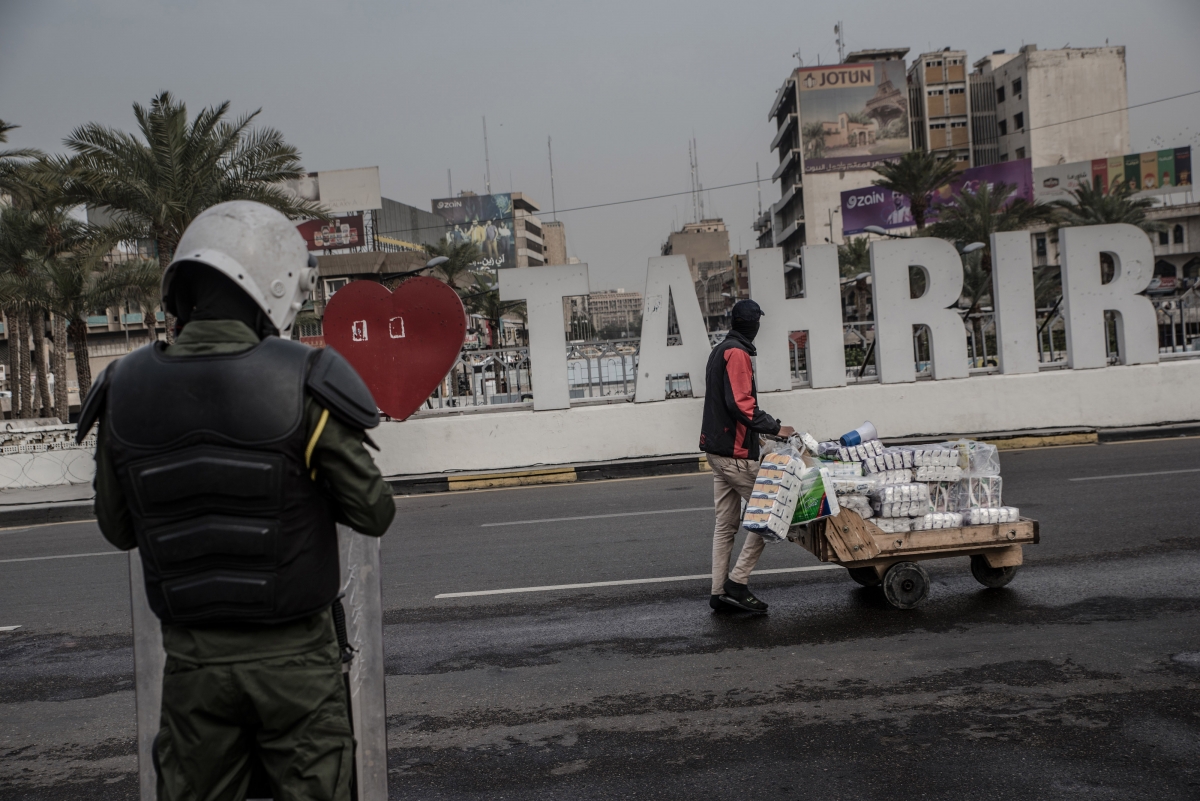
InternationalApr 15. 2021The The “I Love Tahrir” sign in Baghdad’s Tahrir square in January 2020. Photo for The Washington Post by Emilienne Malfatto

By Louisa Loveluck, Emilienne Malfatto
The Washington Post

BAGHDAD – It’s been more than a year since Iraqi protesters brought down their prime minister as part of the largest uprising in generations. Born in the shadow of the 2003 U.S.-led invasion, the young demonstrators who protested from Baghdad to Iraq’s southern cities had called for an end to the political system that the U.S. occupation installed. They wanted an end to corruption and sectarian politics that have left them with little hope of a future in their own country, they said. Their sloga

That dream was quashed with deadly force. More than 600 protesters were killed by Iraq’s security forces and militia groups. Thousands more were injured and still live with the scars. In May 2020, a new prime minister, Mustafa al-Kadhimi, came to power vowing justice for the dead. But not a single member of Iraq’s security forces has been prosecuted, and most of the hardships that inspired Iraq’s protest movement have been worsened by an economic crisis that accompanied the country’s coronavirus epidemic.

Squares rarely fill with protesters these days, but public discontent rumbles on. Scattered demonstrations occur weekly outside government buildings, with people demanding jobs and services that a cash-strapped and inefficient Iraqi state cannot provide.

The "I Love Tahrir" sign in Baghdad's Tahrir square in January 2020. Photo for The Washington Post by Emilienne Malfatto

The “I Love Tahrir” sign in Baghdad’s Tahrir square in January 2020. Photo for The Washington Post by Emilienne Malfatto

Dozens of protesters have been shot dead by security forces over the past year. Activists have been disappeared by Iran-backed militia groups they dare to challenge, according to human rights monitors. Fearing for their lives, other young demonstrators have fled to Iraq’s semiautonomous Kurdish region, or abroad and to exile.

As spring temperatures start to climb, Iraqi officials worry in private that the country’s power grid will be unable to meet public demands during the sweltering summer months, bringing more protesters out to the streets. That could set the stage for another deadly confrontation.

Freelance photographer Emilienne Malfatto visited Baghdad’s protest sites in 2020, the height of the movement, and a year later. Here is her recounting.

– – –

The "I Love Tahrir" sign in Baghdad's Tahrir square in January 2020. Photo for The Washington Post by Emilienne Malfatto

The “I Love Tahrir” sign in Baghdad’s Tahrir square in January 2020. Photo for The Washington Post by Emilienne Malfatto

I glanced through the window as we drove by Tahrir Square. It felt terribly empty. The tents were gone. The tables with sweets, fruits and tea, also gone. And, above all, the joyful, naive effervescence – this belief that a “revolution” was happening for a “better Iraq” – that’s gone, too.

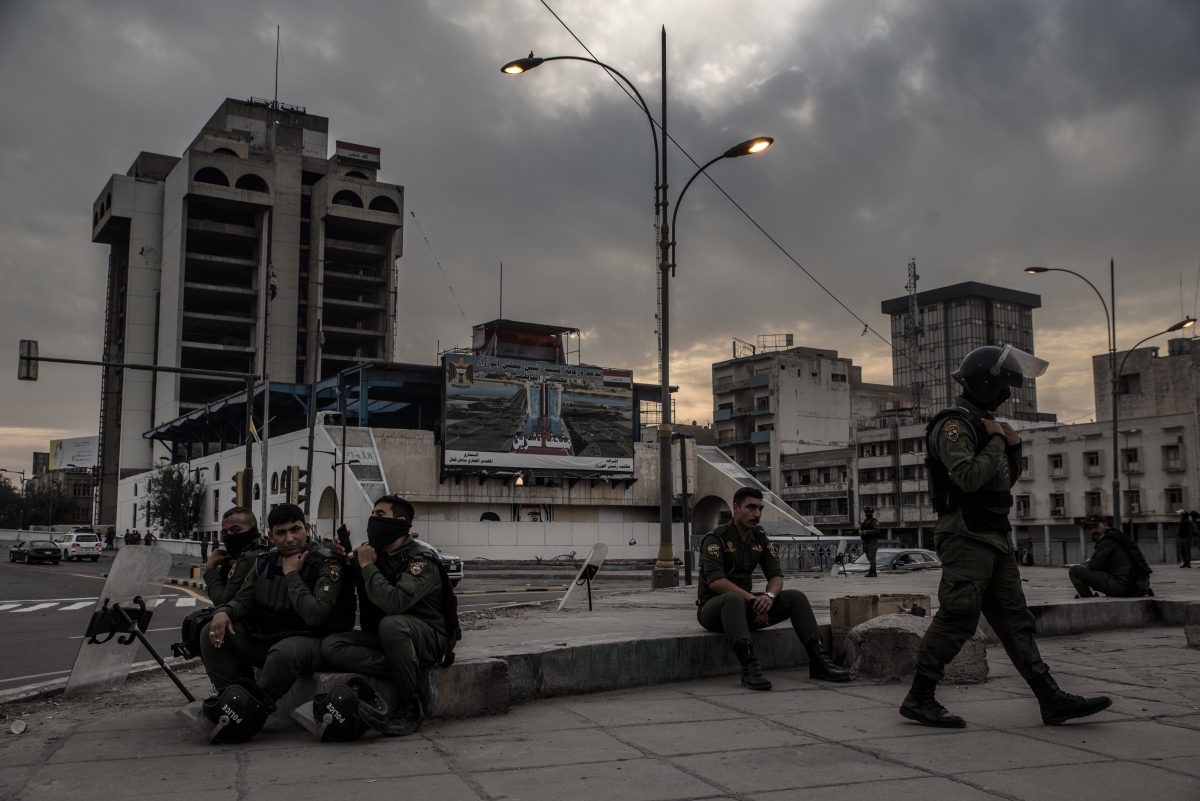
Replacing all of that was a sea of uniforms, olive green and dark blue, sometimes black. Young men standing on guard in what felt like a show of force. The message was clear: We’re here, we’re holding the place, and protesters are not coming back.

It was just a little over a year ago when I had last visited Tahrir Square. At that time, protests against the government and clashes with the police were a daily occurrence, with the square occupied by demonstrators calling for a change in governing policies. In another part of the city, at a pedestrian bridge near Muhammad Qassem highway, I had photographed a procession for a fallen protester as well as an intense confrontation between youths and police, the sky dark with the smoke of burning barricades.

The "I Love Tahrir" sign in Baghdad's Tahrir square in January 2020. Photo for The Washington Post by Emilienne Malfatto

The “I Love Tahrir” sign in Baghdad’s Tahrir square in January 2020. Photo for The Washington Post by Emilienne Malfatto

A year later, all I had seen has disappeared. It’s as if nothing ever happened there. The sky was gray, but from a sandstorm. The barricades and tents were replaced with plastic chairs on which soldiers rested their weapons. The place felt sad, like a missed opportunity, like the dream was over.

I could also see this transformation in the faces of the soldiers and policemen guarding these forgotten places of protest. A year ago, I had photographed the exhausted men and boys who led that revolution, their eyes reddened by tear gas, black stains covering their hands and faces as heavy smoke rose from burning tires. All of them said they had a reason to fight, a cause they believed in. A year later, the faces on Tahrir Square looked different. They were still young, but, with their uniforms and their shields, they represented the end of a movement, of hope.

Public health experts increase vaccine education during Johnson & Johnson pause #SootinClaimon.Com

#SootinClaimon.Com : ขอบคุณแหล่งข้อมูล : หนังสือพิมพ์ The Nation.

https://www.nationthailand.com/news/30404916

Public health experts increase vaccine education during Johnson & Johnson pause

InternationalApr 15. 2021

By Jenna Portnoy
The Washington Post

A day after federal agencies recommended a pause in administration of the Johnson & Johnson coronavirus vaccine while they investigate potential rare side effects, public health experts and providers in the Washington region on Wednesday said they are increasing education and transparency to allay potential worries among people about coronavirus vaccines.

Community leaders and those in charge of vaccinating vulnerable populations said that the pause does not appear to have immediately deterred people who want to be vaccinated or have upcoming vaccine appointments.

“My concern is the people who were already not planning to get the vaccine will latch on to this as further justification just for why they shouldn’t get it,” said Leana Wen, a former Baltimore health commissioner, emergency physician and Washington Post contributing columnists.

Federal officials recommended the nationwide pause in administering the Johnson & Johnson vaccine while they review a rare type of blood clot known as cerebral venous sinus thrombosis in conjunction with thrombocytopenia, or low blood platelets, developed in six women who had received that vaccine. One such woman from Virginia died.

Public health officials say the pause is proof that the adverse effect reporting system is working properly and that the Centers for Disease Control and Prevention and Food and Drug Administration are taking even extremely rare side effects seriously.

The District of Columbia, Maryland and Virginia stopped administering the Johnson & Johnson vaccine within hours of the federal recommendation, as clinics that were prepared to give that vaccine quickly switched to the two-dose Pfizer-BioNTech or Moderna versions. The one-dose Johnson & Johnson vaccine was particularly useful for people experiencing homelessness and for transient populations who may have trouble returning for a second dose.

Mark Whitlock, senior pastor at Reid Temple AME, which partnered with Luminis Health Doctors Community Medical Center to host vaccine clinics for Prince George’s County, Md., residents, said one congregant contacted him Tuesday with concerns about the Johnson & Johnson pause.

“She and I had prayed, and I assured her that we had Pfizer and Moderna,” he said. “I am very concerned about the safety of the membership of Reid Temple. I am celebrating the fact that they did take it off the market.”

Vaccine supply and access – not hesitancy – remains his biggest concern in Prince George’s, one of the region’s communities hit hardest by the coronavirus, which can cause the illness covid-19.

The long-term impact of the pause will depend on what investigators discover and how they communicate findings to the public, experts said.

“If we can’t confidently have the American public believe and trust in the safety and efficacy of vaccines, that could undermine the entire effort,” Danny Avula, Virginia’s vaccine coordinator, told reporters Tuesday.

But he said the incidence of six cases among the millions of doses administrated is “exceedingly rare for a serious side effect.”

About 31 million people, or 10% of the American, population has contracted the novel coronavirus; of that number, one out of 585 people died of the disease, he said.

“In relative terms, these are really low rates of incidence,” he said of the six cases. “All of this is like a big risk-benefit calculation,” he said.

– – –

The Washington Post’s Erin Cox contributed to this report.

Target, Netflix, Bank of America join companies, executives in opposing limits to voting rights #SootinClaimon.Com

#SootinClaimon.Com : ขอบคุณแหล่งข้อมูล : หนังสือพิมพ์ The Nation.

https://www.nationthailand.com/news/30404915

Target, Netflix, Bank of America join companies, executives in opposing limits to voting rights

InternationalApr 15. 2021Florida Gov. Ron DeSantisFlorida Gov. Ron DeSantis

By Todd C. Frankel, Josh Dawsey, Jena McGregor
The Washington Post

WASHINGTON – Top Republican officials continue to push back against a surge of major companies and corporate leaders who oppose new voting laws being pursued by Republicans in dozens of states, with fresh signs that some in the GOP are waiting to see how far companies are willing to go on this issue.

Even as executives representing a wide swath of Corporate America discussed via Zoom last weekend potentially withholding political donations and business investments over the issue, speakers at the Republican National Committee retreat in Palm Beach were pledging to continue the fight. Florida Gov. Ron DeSantis was applauded at the RNC meeting for attacking Major League Baseball, among others, according to a recording obtained by The Washington Post.

“Major businesses who are getting in bed with the left, the corporate media and big tech … these corporate executives have no backbone, they don’t want to be criticized by the corporate partisan media – they cave, they virtue signal in one direction,” DeSantis said.

“You have these woke corporations who are colluding with all those folks,” he continued. “We have to stand up for ourselves, we’ve got to fight back.”

On Wednesday, hundreds of major companies and corporate leaders released a joint statement that said voting is “the lifeblood of our democracy” and “we must ensure the right to vote for all of us” – a seeming rebuke of the hostile tone coming from Republicans who insist the laws are needed for election security and companies should stay out of politics.

The developments could possibly reshape political giving and potentially fracture a long-held alliance between the GOP and corporate business giants, who are increasingly under pressure to take political stands – and can feel the backlash for doing it. “I think what is happening is new,” said Steven Law, who runs the Senate Leadership PAC, the major fundraising arm for Senate Minority Leader Mitch McConnell, R-Ky. Political groups say corporate PAC giving is down this year across the board.

Still, it remains to be seen whether the mounting rhetorical attacks will lead to an actual rupture between corporations and the GOP.

Wednesday’s statement by corporate leaders – which cast the issue as nonpartisan – included support from recognizable corporate names such as Target, Netflix, Bank of America, Facebook, Cisco, Twitter, Microsoft, Starbucks, Amazon, Mastercard, American Airlines, United Airlines and Vanguard, as well as prominent people such as investor Warren Buffett, law firms and nonprofit organizations.

The statement was also notable for the names that were missing, including Delta Air Lines and Coca-Cola – two companies that earlier this month were among the first to oppose new voting rules in their home state of Georgia.

The statement was discussed during the Zoom meeting of corporate leaders last weekend and published Wednesday as an ad in The Washington Post, the New York Times and other major newspapers.

The current crop of voting measures being debated in statehouses nationwide is fueled by lingering animosity over the last presidential election, when baseless accusations of voter fraud resulted in Republican officials pushing for restrictive new laws.

“The legislation is so egregious and so targeted as to keep certain types of people from voting – I think it’s wonderful that Corporate America is taking a stand,” said one of the signers, Debra Lee, the former chief executive of Black Entertainment Television, who sits on four corporate boards.

But it remains unclear how far companies are willing to go to address concerns about voting rights.

Some GOP operatives believe the tensions will die down once the business community realizes it needs the GOP as it faces a Democratic White House proposing major new spending and potentially higher corporate tax rates.

“I am curious to see how corporations are going to feel once they start feeling the wrath of this administration, which is going to raise their taxes,” said Lisa Spies, a prominent GOP fundraiser.

Spies said she suspected much of the controversy churned was for “public display” and “a lot of these people are still donating and very active.”

Law said he didn’t think Major League Baseball thought through its decision this month to move the All-Star Game from Georgia to Colorado over a voting rights bill.

“There can be an astonishing cost as to what they might always think is virtue signaling,” Law said.

“This is happening at the same time the new Biden administration is planning very aggressive moves that will be largely hostile to the business interests of these companies,” Law said.

He also pointed out the absence of Coca-Cola and Delta from Wednesday’s statement. “That could suggest that these companies learned the hard way, that when you go out relying on fake talking points supplied by (leading Georgia Democrats) Stacey Abrams and Raphael Warnoc​k, you do so at your own risk,” Law said.

A Delta Air Lines spokeswoman declined to comment further about why it did not sign Wednesday’s statement, pointing to a statement made by the carrier’s CEO March 31. Coca-Cola said it did not receive the statement or a request to sign it and that its “focus has been on meeting and collaborating with local groups, and we have spoken up in support of the foundational right to vote.”

Several company officials said their decision to sign Wednesday’s statement was not a partisan one.

“We believe that is a false talking point that is being mounted by the individuals who are trying to restrict voting access to large segments of Americans,” said Neil Blumenthal, co-CEO of Warby Parker.

The statement came after Kenneth Chenault, the former chief executive of American Express, and Kenneth Frazier, the chief executive of Merck, pushed companies to take a stand on what they viewed as discriminatory laws on voting.

Chenault and Frazier coordinated a letter signed last month by 72 Black business executives that made a similar point – a letter that first drew attention to the voting bills in executive suites across the country.

Dozens of law firms also signed the statement, representing a growing effort to fight restrictive voting laws in court. Among the firms listed were Squire, Patton, Boggs; Cravath, Swaine and Moore; Akin Gump Strauss Hauer and Feld; and Paul, Weiss, Rifkind, Wharton and Garrison.

There was also a smattering of celebrities – some with their own companies – included on the statement, such as Naomi Campbell, Tracee Ellis Ross, Katy Perry and Gwyneth Paltrow.

The fight has left some business leaders torn.

Kathryn Wylde, who leads the Partnership for New York City, which calls much of the elite business community its members, said Republicans tend to see the voting rights issue as a partisan effort to shore up the chances of a continued Democratic majority.

“The Black executives don’t see it as a partisan issue. They see it as a civil rights issue,” Wylde said. “But a lot of the businesses can’t afford to alienate the Republicans who have defined this as a partisan issue. The reason people didn’t sign is that.”

But it is not a fight either side seemed ready to back away from.

Reid Hoffman, the co-founder and former chairman of Linkedin, said he expects the business community to keep fighting.

“My hope would be a willingness to go all the way on this issue,” he said.

NATO unanimously backs U.S. exit from Afghanistan #SootinClaimon.Com

#SootinClaimon.Com : ขอบคุณแหล่งข้อมูล : หนังสือพิมพ์ The Nation.

https://www.nationthailand.com/news/30404914

NATO unanimously backs U.S. exit from Afghanistan

InternationalApr 15. 2021

By John Hudson
The Washington Post

BRUSSELS – The 30-member NATO alliance on Wednesday unanimously backed the United States’ decision to withdraw all forces from Afghanistan by Sept. 11 after President Joe Biden’s top diplomat and defense official made the cause for the move in a joint visit to Brussels.

In a closed-door meeting of alliance foreign ministers, followed by a news conference with NATO Secretary General Jens Stoltenberg, Secretary of State Antony Blinken sought to put a positive spin on the conclusion of the long-grinding conflict, which has lost the confidence of the general public in much of Western Europe and North America. He said the alliance had ensured that Afghanistan would never again become a platform or haven for global terrorists.

“The threat from al-Qaida in Afghanistan is significantly degraded; Osama bin Laden has been brought to justice,” Blinken said. “We have achieved our objective.” Remaining in Afghanistan, he said, is not “in our interest. Not for the United States, not for NATO and our allies.”

The military alliance went into Afghanistan after invoking its collective defense clause, Article 5, for the first time in its history following the 9/11 attacks. About 7,000 non-U.S. foreign troops remain in Afghanistan, mostly from NATO countries such as Germany, Italy and Britain, but also non-NATO countries including Georgia and New Zealand.

Those troops outnumber the 2,500 troops the United States maintains in Afghanistan, but they rely heavily on U.S. air and logistical support. That reliance caused many NATO allies to express concern in recent years when President Donald Trump would tweet sporadically about a full U.S. withdrawal from Afghanistan without coordinating with allies.

Blinken on Wednesday assured foreign partners that there would be no such surprises in the Biden era.

“I am here to work closely with our allies, with the [NATO] secretary general, on the principle that we have established from the start: ‘In together, adapt together and out together,’ ” Blinken said before an earlier meeting with Stoltenberg.

Blinken was joined in Brussels by Defense Secretary Lloyd Austin, who is also meeting with NATO counterparts on the plan to begin a U.S. troop withdrawal and complete it by Sept. 11.

In a closed-door meeting among all 30 NATO members, Austin set the tone for the discussion with a strong endorsement of the withdrawal, said a European official familiar with the matter who spoke on the condition of anonymity to discuss alliance deliberations. Austin referenced his military service and intimate knowledge of the sacrifices made in the conflict, but underscored that the time to leave the country was upon us, the official said.

Following Austin’s remarks, the official said, those in the room who spoke for their countries broadly supported the withdrawal plan, with the exception of some grumbling from the representatives of the Czech Republic and Belgium, who spoke about the speed of Biden’s decision and the investments European countries had made in the conflict.

British and German officials have indicated that they will accompany the United States with their own departure from Afghanistan. For some countries, however, the exit is more difficult to swallow.

“We have had dozens of soldiers die there,” said one Western European official who spoke on the condition of anonymity to discuss his reaction to the U.S. plan. The diplomat noted, however, that the terrorism threat from Afghanistan has been significantly reduced, which was always the main objective.

“Our first and foremost goal is just not to have in Afghanistan a future place for international terrorism,” the diplomat said.

At the news conference, Stoltenberg said the alliance decision was “unanimous,” adding that “this is not an easy decision and it entails risks. . . . We’ve said for many months we face a dilemma, because the alternative to leaving in an orderly fashion is to be prepared for a long-term, open-ended military commitment with potentially more NATO troops.”

Like Blinken, he said that the alliance and other partners would continue to support Afghanistan. “This is not the end of our relationship with Afghanistan, but rather the start of a new chapter,” Stoltenberg said.

But in making that pledge, he also referred to the problems Afghanistan will face, and the belief of many officials and experts that the Taliban is likely to increase its campaign to take over the country.

“It is now for the Afghan people to build a sustainable peace” that “puts an end to violence, safeguards the rights of all Afghans – particularly women and children – and assures that Afghanistan never again serves as a safe haven for terrorists,” Stoltenberg said.

He made clear that the U.S. withdrawal was a primary factor in the NATO decision. “In light of the U.S. decision to withdraw, we discussed the way forward today,” he said, adding that any Taliban attack on departing troops “will be met with a forceful response.”

For years, many NATO members, especially Germany, indicated that any withdrawal must be based on the conditions on the ground in Afghanistan. But the Biden administration made clear on Tuesday that this would not be the standard.

Austin did not respond to a question at the news conference about his own recent statements that withdrawal would be “conditions-based.”

“I fully support his decision,” Austin said of Biden. “Our troops have accomplished the mission they were sent to achieve.” Asked if U.S. military leaders agreed on the departure, Austin said he would not speak for them. “What I can tell you is this was an inclusive process,” he said of internal administration decision-making, “and their voices were heard, their concerns taken into consideration as the president made his decision.”

Strong reservations about the fate of Afghanistan remain, but European diplomats acknowledged that staying in the country indefinitely was unsustainable, logistically and politically.

“As long as the U.S. consults, gives at least a veneer of co-decision, and withdraws responsibly enough that it doesn’t leave the Europeans high and dry, then the Europeans won’t be hard to deal with on this issue,” said Jeremy Shapiro, research director at the European Council on Foreign Relations. “In the end, the Europeans went into Afghanistan for America and NATO; they’ll accept to leave for the same reasons.”

CDC advisers seek more data on rare blood clots before deciding whether to resume Johnson & Johnson shots #SootinClaimon.Com

#SootinClaimon.Com : ขอบคุณแหล่งข้อมูล : หนังสือพิมพ์ The Nation.

https://www.nationthailand.com/news/30404913

CDC advisers seek more data on rare blood clots before deciding whether to resume Johnson & Johnson shots

InternationalApr 15. 2021

By Lena H. Sun, Carolyn Y. Johnson
The Washington Post

WASHINGTON – A federal vaccine advisory committee said Wednesday it wanted more data before deciding whether to resume use of Johnson & Johnson’s coronavirus vaccine, leaving in place a pause that federal officials had recommended because of a rare and severe type of blood clot identified so far among six of the 7.5 million people who received the shot.

The move means the single-shot Johnson & Johnson product will remain on the shelf for at least a week.

At a hastily arranged emergency meeting a day after federal officials recommended a pause in use of the vaccine, advisers to the Centers for Disease Control and Prevention agreed to reconvene within 10 days, acknowledging the urgency of making a decision about a vaccine that is a key part of the strategy to end the pandemic in the United States and globally.

The Advisory Committee on Immunization Practices reviewed details about six cases of blood clots in women who were between the ages of 18 and 48. The women developed symptoms, most often headaches, six to 13 days after vaccination. One vaccine recipient, a Virginia woman, died in March, and another is in critical condition, health officials have said. Two have been discharged and three remain in the hospital.

Instead of voting on a recommendation about whether and how the vaccination campaign could be restarted, panel members said they wanted more information on the risks, cause and frequency of the rare brain blood clots. When the panel reconvenes, members could vote at that time to recommend the vaccine for people 18 and older, continue an overall pause or pause use for certain age groups.

“We are very fortunate, because we have multiple other alternatives in the U.S. to help stop this pandemic. We have very good, well-proven alternatives where we are not seeing safety signals,” said Helen Keipp Talbot, an associate professor of medicine at Vanderbilt University and committee member. “I think that puts us in a little bit of a different position, and we can be much more cautious and thoughtful and use the old model of, ‘First, do no harm.'”

Beth Bell, a global health expert at the University of Washington who leads the panel’s coronavirus vaccine work group, said she did not want to take a vote Wednesday for fear of undermining support for the easier-to-use vaccine.

A national Economist-YouGov poll found that public confidence in the Johnson & Johnson vaccine might already be declining. The share of people who thought the vaccine was “very or somewhat unsafe” increased in a matter of days, from 26% of people during the past weekend and Monday to 39% on Tuesday after federal officials recommended a pause.

The vaccine has been viewed as a powerful tool for building immunity among vulnerable communities, such as homebound people or homeless populations who might not be able to return for a second shot. The decision will also almost certainly reverberate around the globe.

The vaccine was a large part of the U.S. vaccination strategy, and the drugmaker has delayed the rollout of its vaccine in Europe as the investigation continues. South Africa suspended use of the shot.

But some public health officials said Wednesday’s lack of a recommendation is a decision that will have consequences.

“The extension of the pause will invariably result in the fact that the most vulnerable individuals in the United States who were prime candidates for the Johnson & Johnson vaccine will remain vulnerable. The most at risk will remain at risk, and those who would benefit immediately from vaccination will remain unvaccinated for an unknown period of time,” said Nirav Shah, director of the Maine Center for Disease Control and Prevention. “That would come at a period where the United States is still logging 5,000 deaths in the past seven days across the country.”

A CDC official and a Johnson & Johnson executive described the six cases in the greatest detail yet. All of the women were White, and only one was taking hormonal contraceptives that can cause blood clots, suggesting that was not the reason for the clots.

Tom Shimabukuro, of the vaccine safety team at the CDC, explained that the rare, severe clots were especially alarming because they were accompanied by low levels of blood cells involved in clotting – a combination virtually unheard of among healthy, young people.

“We have a picture where we have clots forming in large [blood] vessels in the presence of low platelets, so it’s kind of a paradox here,” Shimabukuro said. “This is unusual – it usually doesn’t happen.”

The combination has also been seen, rarely, among people who received vaccine developed by AstraZeneca and the University of Oxford. Four of those vaccine recipients were treated initially with heparin, an anticoagulant that is not recommended because the events closely resemble an immune-triggered reaction to the drug that could worsen the clots.

Some of the women had blood clots in other parts of their body, and Shimabukuro said the agency would cast a wider net, looking for clotting accompanied by low levels of platelets.

In a company presentation, Aran Maree, chief medical officer for Janssen, the division of Johnson & Johnson that developed the vaccine, also presented data on two cases of clots in people who received the vaccine in the clinical trial, one of whom was a 25-year-old man with a hallmark of the symptoms.

“I’d like to reiterate that, based on the current data, Johnson & Johnson believes the overall benefit-risk profile for a vaccine is positive across the population for which it is authorized,” Maree said.

The blood clots are similar to those reported by several European countries after the use of AstraZeneca’s coronavirus vaccine, which uses a similar technology. Several experts said it is necessary to understand whether the risks of the vaccines outweigh the benefits for certain groups of people. But they also said the risk of developing a clot after receiving the vaccine appears far lower than the chance of a clotting issue caused by a severe covid-19 infection or from using hormonal birth control, such as oral contraceptives.

The immediate practical effect of the recommended pause was limited because the overwhelming majority of the 192 million shots administered in the United States have been made by Pfizer-BioNTech and Moderna using a different technology.

Of the Johnson & Johnson doses administered to date, nearly 1.5 million have been given to women 18 to 50 years old, said Sara Oliver, a CDC medical officer and member of the committee’s covid-19 work group. The Johnson & Johnson vaccine makes up fewer than 5% of the inoculations that have been administered, Oliver said.

Food and Drug Administration and CDC officials said they decided to recommend pausing the use of Johnson & Johnson’s vaccine because they were worried about the possible harm if clinicians did not know how to detect, manage and treat the complication. They want to make sure medical professionals are aware that blood clots potentially associated with a vaccine should not be treated with the conventional drug heparin, which could exacerbate the clots.

Officials also want to encourage reporting from clinicians in the event there are additional cases that could help clarify the syndrome or risk factors, officials have said.

In many ways, the scenario playing out in the United States echoes what happened in Europe as rare clotting events began to be recognized in early March among younger adults, predominantly women, who had recently received the AstraZeneca vaccine.

The rare but alarming clotting cases in Europe caused some countries to suspend vaccination altogether, and scientists began to study whether the clots were connected to vaccination. A societal debate about the risk tolerance of regulators and the possible effect of vaccination suspensions on hesitancy erupted as countries halted inoculations in the middle of a pandemic. As time went on, more cases were recognized and studied.

Out of 34 million people given vaccinations in Europe, regulators there have identified 169 cases of brain blood clots and 53 cases of abdominal clots that raised suspicion.

After weeks of scientific work and meetings, European scientists and regulators concluded that the clotting events were possibly linked to the vaccine – and determined a diagnostic test and a treatment. Many countries have restricted use of the AstraZeneca-Oxford vaccine to older adults as a result.

The type of brain blood clots identified in the six U.S. cases result in a condition called cerebral venous sinus thrombosis. The normal rate of those blood clots in the general population is 2 to 14 per million people in a year. What stood out to scientists and physicians was that these clots were accompanied by very low levels of platelets, the blood cells involved in clotting. That combination of symptoms – a risk of bleeding and clotting at the same time – sounds counterintuitive but occurs in rare immune responses, when the body creates antibodies that bind to platelets, causing them to be activated and also consumed.

A similar syndrome occurs in some patients after exposure to the anticoagulant heparin, which triggered the warnings not to use that drug when treating these patients.

Since the U.S. vaccination program began Dec. 14, safety experts from the CDC vaccine advisory committee have been monitoring data weekly.

Initial information about the six cases was detected in a vaccine-monitoring system run by the CDC and the FDA. That three-decade-old system, known as the Vaccine Adverse Event Reporting System, or VAERS, is an early warning platform that also collects information about possible side effects or health problems after vaccination. It monitors unusual or unexpected patterns that require a closer look. Anyone can report a reaction or injury, including health-care providers, patients and patients’ representatives, such as caregivers or attorneys.

The recommendation to pause the Johnson & Johnson rollout resulted in swift action, with the U.S. military and many states announcing they were suspending the use of the single-shot vaccine. About 7.5 million doses of Johnson & Johnson’s vaccine had been administered nationwide as of Wednesday. About 16 million doses have been delivered to states and territories, and through federal channels, since the beginning of March.

– – –

The Washington Post’s Scott Clement contributed to this report.

U.S. Capitol Police officer cleared of wrongdoing in fatal shooting of woman during Capitol attack #SootinClaimon.Com

#SootinClaimon.Com : ขอบคุณแหล่งข้อมูล : หนังสือพิมพ์ The Nation.

https://www.nationthailand.com/news/30404912

U.S. Capitol Police officer cleared of wrongdoing in fatal shooting of woman during Capitol attack

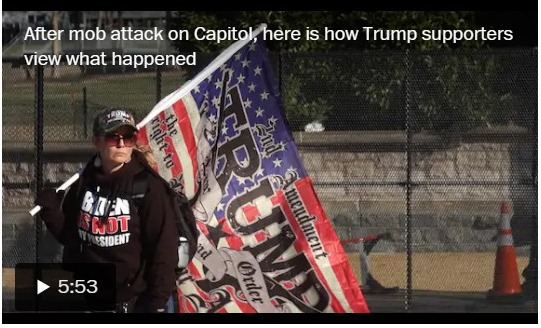
InternationalApr 15. 2021Pro-Trump protesters clash with police during the tally of electoral votes on Jan. 6. Photo by Amanda Andrade-Rhoades for The Washington Post.Pro-Trump protesters clash with police during the tally of electoral votes on Jan. 6. Photo by Amanda Andrade-Rhoades for The Washington Post.
By Keith L. Alexander, Justin Jouvenal, Spencer S. Hsu
The Washington Post

WASHINGTON – A U.S. Capitol Police officer has been cleared of criminal wrongdoing for fatally shooting Air Force veteran Ashli Babbitt as she attempted to breach a set of doors deep in the Capitol during the January siege, federal prosecutors in the District of Columbia announced Wednesday.

Authorities determined that there was insufficient evidence to prove Babbitt’s civil rights were violated, and that it was reasonable for the officer to believe he was firing in self-defense or in defense of members of Congress and aides who were fleeing the House chamber. Prosecutors did not identify the officer.

The killing of the 35-year-old California native became one of the defining moments of the riot, after graphic videos of her shooting spread across social media and were replayed by news outlets.

Prosecutors notified a representative of Babbitt’s family of its findings Wednesday, the office of acting U.S. attorney Channing Phillips of the District said in a statement. The statement said the U.S. attorney’s office and the Justice Department have closed the investigation, “acknowledging the tragic loss of life and offering condolences” to Babbitt’s family.

Roger Witthoeft, Babbitt’s brother, said he was not happy that prosecutors decided not to charge the officer.

“In my eyes, everyone should stand before a jury to face justice. That decision shouldn’t be made behind the scenes. I think he should at least stand trial,” Witthoeft said.

“I love my sister and I’ll always remember her as a decent woman and patriot,” he said.

Mark Schamel, the Capitol Police officer’s attorney, credited his client with showing great restraint.

“His bravery on January 6 was nothing short of heroic,” Schamel said in a statement. “He stopped the rioters from gaining entry into the Speaker’s Lobby and saved the lives of countless members of Congress and the rioters. His heroism should be no surprise to those who know him.”

To convict law enforcement officers of civil rights violations, including shootings resulting in death, prosecutors must be able to prove that an officer used “objectively unreasonable” force and “willfully” used more force than he thought was necessary. The high bar of willfulness makes bringing charges against an officer difficult, and Wednesday’s outcome was not unexpected by legal observers under the circumstances.

Multiple cellphone videos captured the shooting as it unfolded on the afternoon of Jan. 6. Babbitt and a group of other rioters made their way inside the Capitol to barricaded doors leading to the Speaker’s Lobby, which is the hallway outside the House chamber where some lawmakers were sheltering during the siege.

Videos show the group pummeling the wood-and-glass doors with a helmet, feet and a flagpole. A Capitol Police officer in a suit and a surgical mask is seen standing in a doorway on the far side of the doors with his gun drawn.

The officer opened fire as Babbitt, who was wearing a Trump flag like a cape, attempted to crawl through one of the broken panes of the Speaker’s Lobby doors, video shows. Babbitt, who was hit in the shoulder, tumbled backward onto the floor.

The attorney for the officer, a lieutenant, said in a statement that the officer clearly identified himself and ordered rioters not to pass a barricade at the doors of the Speaker’s Lobby before firing. Other officers had also ordered Babbitt to stop and she broke multiple laws in attempting to enter the Speaker’s Lobby, according to the statement.

A group that included officers, rioters and a Hill staffer rushed to her aide, video shows. Two law enforcement officials familiar with the investigation have said that Babbitt was unarmed. She later died.

Babbitt was one of five people who authorities said died amid the chaos of the Capitol siege, including Capitol Police officer Brian Sicknick, whose remains lay in honor in the Capitol Rotunda in early February.

In death, Babbitt has become a martyr to many on the far right. Some even fashioned a flag that features a silhouette of a woman in front of a Capitol that is aflame. Below, it reads “Vengeance.”

Federal prosecutors have charged at least eight people who were in the crowd around Babbitt in the moments before she was shot. They include Christopher Ray Grider, a Texas winery owner who is accused of trying to kick in the Speaker’s Lobby doors; Zachary Jordan Alam, of Pennsylvania, who is accused of smashing the glass pane Babbitt attempted to crawl through; and Chad Barrett Jones, of Kentucky, who is accused of smashing another pane with a wood stick that had a Trump flag attached.

Authorities had suggested the possibility of bringing felony murder charges against rioters if Babbitt’s death was a foreseeable consequence of felony conduct by others, according to a person familiar with the matter. But they have since ruled out that possibility, given case law that allows such charges only in instances when an accomplice is responsible for a victim’s death, not a law enforcement officer.

District police are required by law to identify officers involved in serious uses of force within five business days of an incident. They are also required to release video from body cameras of the officers directly involved. The law only applies to District police. Capitol Police are not equipped with body cameras.

The law firm said it was keeping the officer’s name confidential because he has faced death threats.

Witthoeft, Babbitt’s brother, said it was “appalling” that the officer’s name had not been released “in this age when everything is public record.”

The three-month investigation was conducted by prosecutors in the U.S. attorney’s office’s public corruption and civil rights section. The Justice Department’s Civil Rights Division and the District police internal affairs bureau reviewed social media video footage, statements by witnesses including the shooter and other officers, physical evidence, and autopsy results, prosecutors said.

Criminal charges against police officers involved in on-duty fatalities are rare in the District. City records show that prosecutors in the U.S. attorney’s office have never filed criminal charges against a District police officer involved in a fatal on-duty shooting. Such historical data was not available regarding officers from other agencies.

Babbitt hailed from the San Diego area and became an ardent supporter of QAnon, an extremist ideology that the FBI has deemed a domestic terrorism threat, and a backer of President Donald Trump, her since-deleted Twitter account showed. She often echoed Trump’s baseless claims that November’s presidential election was stolen.

“Nothing will stop us . . . they can try and try and try but the storm is here and it is descending upon DC in less than 24 hours . . . dark to light!” Babbitt tweeted the day before she died.

Babbitt spent more than a decade in the military, first in the Air Force and then in the Air National Guard, but she had discipline problems and didn’t advance far. Her ex-husband, Timothy McEntee, has said she served in Afghanistan and Iraq.

After leaving the military in 2016, Babbitt started a pool business with family members that struggled financially, and her Twitter account shows she became more interested in online misinformation and conservative causes.

In one video posted to social media, Babbitt rants loudly about the effects of immigrants on the U.S. economy. In a tweet, she called for then-Vice President Mike Pence to be arrested and charged with treason, presumably for not being supportive enough of Trump’s baseless claims of electoral fraud.

“She was never afraid to speak her mind,” McEntee told The Washington Post in a January text message.

Babbitt seemed to derive a sense of mission from the Jan. 6 protest. In the days leading up to it, she retweeted messages from other demonstrators who were traveling to Washington.

One read: “It will be 1776 all over again . . . only bigger and better.”

– – –

The Washington Post’s Tom Jackman contributed to this report.

John Williamson, economist who devised ‘Washington Consensus’ model of reform, dies at 83 #SootinClaimon.Com

#SootinClaimon.Com : ขอบคุณแหล่งข้อมูล : หนังสือพิมพ์ The Nation.

https://www.nationthailand.com/news/30404910

John Williamson, economist who devised ‘Washington Consensus’ model of reform, dies at 83

InternationalApr 15. 2021John WilliamsonJohn Williamson

By Matt Schudel
The Washington Post

John Williamson, a British-born economist for the World Bank and other institutions and think tanks, who was best known for coining the term “Washington Consensus” to describe a set of reforms aimed at reinvigorating struggling economies in Latin America and other countries, died April 11 at his home in Chevy Chase, Md. He was 83.

He had multiple system atrophy, said his daughter, Theresa Williamson.

Dr. Williamson began his career as a college professor and had stints working for the British government, the International Monetary Fund and the World Bank, developing policies to help bolster economies of countries around the globe.

After teaching in Brazil, he joined the Washington-based Institute for International Economics – later renamed the Peterson Institute for International Economics (PIIE)- in 1981, where he developed ideas to strengthen global economies and markets.

In 1989, after consulting economists at the IMF, World Bank, Treasury Department and Federal Reserve, Williamson suggested a list of 10 ideas to spur and safeguard economic development. His prescription became known as the Washington Consensus, which was subject to mistrust and misinterpretation from the beginning.

In its original form, the Washington Consensus presented several basic macroeconomic ideas to restore stability in countries with shaky economies. The first and perhaps most important requisite was fiscal discipline. Others included directing public expenditures toward health care, education and infrastructure; lowering tax rates; privatizing state-run businesses to improve efficiency and reduce corruption; and securing private property rights.

“The three big ideas here are macroeconomic discipline, a market economy and openness to the world,” Williamson said at the time.

The policy goals were meant to be applied to Latin America, but quickly became seen as a template for global economic reform in the wake of the collapse of communism across Eastern Europe.

“Initially there was a lot of criticism from Latin America calling it the ‘Washington Consensus,’ ” Williamson said in a 2006 oral history interview with the World Bank, “because this suggested that there were some people sitting in Washington deciding what Latin America needed to do. And the critics thought that these reforms were being imposed, which wasn’t my perception of how things were in fact happening, and certainly not how they should have happened.”

His ideas, however well-intentioned, immediately ran into the roadblocks of reality. Left-wing populists such as Hugo Chávez in Venezuela centralized many aspects of the national economy, and other reforms ran aground because of labor opposition, corruption and other deep-rooted institutional problems.

“The Washington Consensus had escaped my control and it had become whatever people meant by it,” Williamson said in a 2018 interview with the Center for Financial Stability.

Nobel Prize-winning economist Joseph Stiglitz wrote in his 2002 book “Globalization and Its Discontents” that fiscal conservatism, privatization and higher interest simply weren’t effective in economically underdeveloped countries. The Washington Consensus, he concluded, had left some countries worse off than they were before, with stagnant economic growth and weakened social safety nets.

But later studies by economists Kevin Grier and Robin Grier showed that countries that had maintained their long-term policies of economic reform had increased growth, income and other economic conditions.

“There’s no question that Latin America is doing much better than East Europe,” Williamson said in 2009 during another worldwide economic downturn. “There’s been much more restraint this time around in most of the countries. That’s what Latin America is benefiting from.”

John Williamson was born June 7, 1937, in Hereford, England. His father ran a plant nursery business, and his mother was a homemaker.

Williamson graduated from the London School of Economics in 1958, served two years in the British air force, then received a doctorate in economics from Princeton University in 1963. While teaching at the University of York in England in the mid-1960s, he developed the “crawling peg” theory, an economic model to maintain currency stability by limiting volatility in exchange rates.

Williamson worked for the British treasury department in the late 1960s, taught at the University of Warwick in England and had a two-year assignment with the IMF in Washington in the early 1970s. He taught at the Pontifical Catholic University from 1978 to 1981. During the 1990s, he spent three years working for the World Bank. He published more than a dozen books and wrote scores of scholarly articles before his retirement in 2012. His most recent books, “Growth-Linked Securities,” appeared in 2017.

Survivors include his wife of 47 years, the former Denise de Souza of Chevy Chase; three children, Andre Williamson of Silver Spring, Md., Daniel Williamson of Chevy Chase and Theresa Williamson of Rio de Janeiro; two sisters; and seven grandchildren.

DWilliamson was a dedicated conservationist and birdwatcher who had sightings of more than 4,000 species of birds in the 104 countries he had visited.

Partly for environmental reasons, he believed governments should impose stiff taxes on carbon emissions. He also saw another industry that he thought should be heavily taxed for the public good: advertising.

“One could easily envisage a 20 or 30 percent tax on advertising,” he said in a PIIE publication in 2012, “which would bring in a lot of money and would have beneficial effects in limiting the extent to which we are bombarded with these unnecessary things at the present time.”

Biden selects Asian American outreach director #SootinClaimon.Com

#SootinClaimon.Com : ขอบคุณแหล่งข้อมูล : หนังสือพิมพ์ The Nation.

https://www.nationthailand.com/news/30404908

Biden selects Asian American outreach director

InternationalApr 15. 2021Sen. Tammy Duckworth (D-Ill.) at one point threatened to block future Biden nominees because of the lack of Asian American representation in the administration. (Reuters)Sen. Tammy Duckworth (D-Ill.) at one point threatened to block future Biden nominees because of the lack of Asian American representation in the administration. (Reuters)

By Tyler Pager, Seung Min Kim
The Washington Post

WASHINGTON – President Joe Biden has selected Erika Moritsugu, vice president of the National Partnership for Women and Families, to serve as a senior adviser overseeing outreach to Asian American and Pacific Islander communities, the White House announced Wednesday.

The move comes after weeks of pressure from Asian American leaders to diversify the upper ranks of the White House.

Moritsugu is expected to report to Bruce Reed, Biden’s deputy chief of staff, with the rank of deputy assistant to the president, a person familiar with the announcement, who spoke on the condition of anonymity because they were not authorized to speak publicly, said.

Moritsugu did not respond to a request for comment. Biden is scheduled to meet with the leadership team of the Congressional Asian Pacific American Caucus in the Oval Office on Thursday.

Moritsugu previously worked at the Anti-Defamation League and served on the staffs of Sen. Tammy Duckworth, D-Ill., and former Sen. Daniel Akaka, D-Hawaii.

She has also held various policy roles at the Democratic Policy Committee, worked at the Department of Housing and Urban Development during the Obama administration and oversaw Senate legislative affairs at the Consumer Financial Protection Bureau.

After the March 16 spa shootings in the Atlanta area, in which six Asian women were killed, Duckworth and Sen. Mazie Hirono, D-Hawaii, threatened to block future Biden nominees because of the dearth of representation in the administration. They withdrew that threat after receiving assurances that Biden would appoint a senior Asian American White House official.

As Biden started to roll out his Cabinet and senior staff during the presidential transition, Asian American leaders raised concerns about the lack of representation of people of Asian descent.

Other than Vice President Kamala Harris, Biden only has one other person of Asian descent in his Cabinet, Trade Representative Katherine Tai. Biden nominated Neera Tanden to serve as director of the Office of Management and Budget, but she withdrew her nomination after bipartisan pushback from senators concerned about her sometimes hard-hitting Twitter feed.

Asian American leaders are now pushing Biden to nominate Nani Coloretti, a former Obama official, for the OMB spot.