A battle resumes over Japan’s bizarre school rules #SootinClaimon.Com

#SootinClaimon.Com : ขอบคุณแหล่งข้อมูล : หนังสือพิมพ์ The Nation.

https://www.nationthailand.com/news/30403691

A battle resumes over Japan’s bizarre school rules

InternationalMar 15. 2021
By The Washington Post · Simon Denyer, Julia Mio Inuma

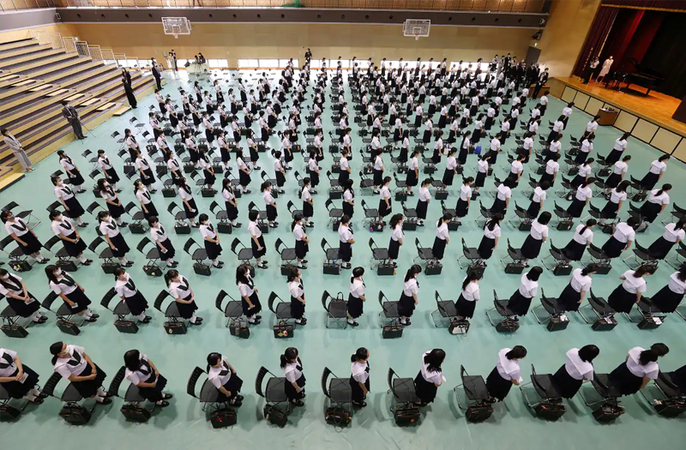
TOKYO – There is a saying in Japan: “When rules exist, they have to be obeyed.”

But there are surely few rules as pointless, divisive and cruel as the widely enforced regulation that Japanese schoolchildren must have straight jet-black hair, sociologists and activists say.

It is supposed to prevent rebellious students – girls and boys alike – from dyeing or perming their hair and encourage them to concentrate on their studies. But as with other rules here, including a ban on dating and a requirement that students wear white underwear, the result oftenfuels discrimination, crushes individuality and enforces a rigid conformity that holds Japan back, according to critics.

The battle to change the rules has been reignited by a court ruling in the western city of Osaka last month that awarded a former student $3,000 for “emotional distress” incurred after she was hounded out of high school because her hair wasn’t black enough. But the court controversially backed the school’s legal right to impose the rule.

The young woman’s lawyer, Yoshiyuki Hayashi, said his client, now 21, intends to appeal, saying her childhood was destroyed when she entered the Prefectural Kaifukan High School. By her second semester, she was ordered to dye her hair black every four days but was banned from classes and even excluded from a school trip because teachers decided it still “wasn’t black enough,” Hayashi says.

When she refused to keep dyeing her hair, she was told not to bother coming to school. Later, her parents tried to negotiate a way for her to return, only to find her desk had been removed from the classroom and another pupil assigned her school ID number.

“She was hit very hard psychologically,” Hayashi said. “At one point, it was so bad that just seeing herself in the mirror or seeing her hair caused her to hyperventilate.”

The woman, who declined to comment herself, had always wanted to attend university, he said, “but she became extremely mistrustful of people” to the extent she does not interact with many people outside her family. “She has now started a part-time job, but she is still struggling,” he said.

In a news conference after the ruling, principal Masahiko Takahashi said the school would not change its black hair policy but would “take more care.” Osaka’s prefectural government noted the court upheld the school’s rules but said the girl’s name shouldn’t have been removed from the school’s directory.

Nearly half of Tokyo’s public high schools require students whose hair is not black and straight to submit certification to prove it’s natural and not dyed or permed, according to a report by NHK, while the Mainichi newspaper found the proportion even higher in Osaka.

Miyuki Nozu, a 32-year-old woman now working with refugees, went to a private school that demanded students with brown or curly hair carry certification with them at all times. Eyebrows were regularly checked to make sure students had not plucked them, while socks had to be white and folded three times.

She says the rules make it much harder for immigrant and mixed-race children to feel they belong.

“Schools just assume without any thought that all Japanese people have black straight hair and girls should act a certain way,” she said. “But Japan is not a single-ethnicity nation anymore. Schools don’t realize society has changed and that they are forcing an outdated ideal on students. This proves they have no intention or ability to teach about diversity.”

Nozu said one of her classmates was labeled a “troublemaker” because she struggled to follow the rules, but went on to graduate top of her class at the prestigious Tokyo University of the Arts. Still, she said, “there are plenty of people who are repressed and lose their creativity.”

Kayoko Oshima, a law professor at Doshisha University who focuses on the issue, says some students are “emotionally damaged and lose their self-esteem” and can also be isolated and bullied by classmates who absorb the underlying ethos – that those who don’t conform don’t belong in Japanese society.

“In Japan, people have an impression that when someone stands out, they will be targeted or bullied,” she said. “So people learn not to stand out, and young people see this as a survival method. Teachers talk about individuality, and yet people’s uniqueness is crushed.”

In corporate Japan, that in turn creates an atmosphere in which people are often scared to speak out, particularly in meetings, and especially if they are women, Oshima and Nozu said.

In schools, it doesn’t stop at hair color. In the city of Nagasaki, nearly 60 percent of 238 public schools demand that pupils wear white underwear, NHK reported, with one student telling the broadcaster teachers regularly check their underwear when they change for gym class.

In Fukuoka, 57 out of 69 schools surveyed by the lawyers’ association had rules about underwear color, the Asahi newspaper reported. Some schools even reportedly asked pupils to remove their underwear if they broke the rules.

Yet pressure is growing for change.

A young Japanese woman has taken her Tokyo high school to court for abusing its power by asking her to “voluntarily withdraw” after she broke the rules by dating a boy in her class Even though she was just a few months from graduation, she felt obliged to drop out, Japan Today reported.

In 2018, when the Osaka case first came to court, Yuji Sunaga was so outraged that he helped start a campaign to “Stop Extreme School Rules” and collected 60,000 signatures for a petition demanding the government take action.

He says the rules not only entail discrimination but can also lead to sexual harassment. Strict uniform policies impose financial burdens on poor parents; rules requiring children to take all their textbooks home can cause back problems; and rules banning winter clothing or scarves can also damage children’s health. Some children may be driven to suicide, he says.

“Because of the rules, the children themselves exert peer pressure that everyone needs to conform, and this continues into adulthood like an obsession,” he said.

“Children’s self-esteem is plummeting, in some cases so low they are losing their will to live,” he said.
Myanmar junta imposes martial law in part of Yangon #SootinClaimon.Com

#SootinClaimon.Com : ขอบคุณแหล่งข้อมูล : หนังสือพิมพ์ The Nation.

https://www.nationthailand.com/news/30403690

Myanmar junta imposes martial law in part of Yangon

InternationalMar 15. 2021

By Syndication Washington Post, Bloomberg

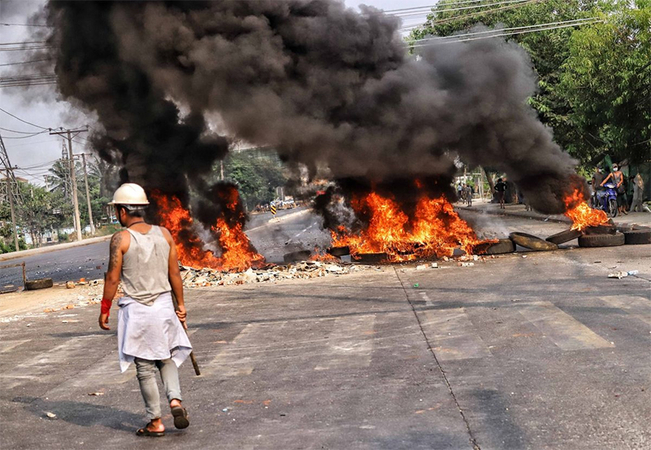
Myanmar’s junta declared “full martial law” late Sunday in parts of the commercial capital Yangon after clashes led to more deaths and Chinese-owned businesses were set on fire.

Coup leaders imposed the measure after the Chinese Embassy asked authorities to guarantee the safety of its investments and citizens. Military-run broadcaster Myawady announced that more than 2,000 protesters blocked roads over the weekend to prevent firefighters from putting out fires at several factories in industrial zones, which included Chinese businesses.

The martial law order applies to two densely populated townships in Yangon: Hlaing Thar Yar and Shwe Pyi Thar. It gave the head of the military’s Yangon command power “to endure safety, the rule of law and peace more effectively.”

“We urge Myanmar authorities to impose effective measures to end all acts of violence and to investigate and punish the perpetrators in accordance with the law,” the Chinese Embassy said in a statement late Sunday. The Global Times, a tabloid run by the Communist Party, said in an editorial on Monday that “those who maliciously defame China and instigate attacks against Chinese factories” must be “severely punished.”

The death toll continued to rise over the weekend as Myanmar authorities continue using force to quell persistent nationwide protests against the military coup of Feb. 1. At least seven people were confirmed dead Saturday, according to the United Nations Human Rights Office, bringing the total to 88 since the coup. Local media outlets reported that more than 50 protesters were killed in Yangon during crackdowns Sunday, mostly in the townships, though the figures could not be immediately corroborated.

The Special Advisory Council for Myanmar, a group of international experts consisting of former UN officials, said it has “grave concerns that a major military crackdown may be imminent, with fatal consequences.” The group called for “immediate international political intervention.”

“So far, the international response to the attempted coup has been weak,” the council said. “It is sending a dangerous message that the generals will continue to suffer no meaningful repercussions for their violent attacks on the Myanmar people.”

While the U.N. Security Council has condemned the violence, countries including China and Russia have opposed stronger language and sanctions against the Myanmar military leaders. China has said it maintains good relations with all parties in Myanmar and called for dialogue to prevent the situation from deteriorating.

The junta’s lead spokesman, Zaw Min Tun, reiterated on Thursday that minimal force was used to disperse protesters, even as witnesses say live bullets continued to be fired. He said security forces will continue to enter some properties to search for protest instigators in some townships, which he added was “to ensure safety and the rule of law.”

In Mandalay on Saturday, demonstrators took to the streets after deadly violence earlier in the day. Tens of thousands of engineers and engineering students chanted for an end to military dictatorship and the release of detained leaders including Aung San Suu Kyi, the deposed elected leader.

“Security forces are trying to scare us from joining street protests in the coming days,” said Aung Myo Nyunt, a 20-year-old student protester in Mandalay. “Their efforts will be in vain.”

Myanmar’s police detained 36 protesters in Mandalay on Saturday, according to state broadcaster MRTV. The television station accused Suu Kyi’s National League for Democracy of instigating protests and spurring unrest. On March 3, 21 protesters were killed, while 12 died in crackdowns Thursday.

Soldiers and riot police have forced striking public servants and employees in certain sectors to return to work as the civil disobedience movement threatens a collapse in services including banking, health care, education and transportation. The junta asked all banks to reopen on Monday, and it said actions would be taken if lenders do not obey.

Japan’s green future requires returning to its nuclear past #SootinClaimon.Com

#SootinClaimon.Com : ขอบคุณแหล่งข้อมูล : หนังสือพิมพ์ The Nation.

https://www.nationthailand.com/news/30403667

Japan’s green future requires returning to its nuclear past

InternationalMar 14. 2021Tokyo Electric Power Co.'s (Tepco) Fukushima Dai-Ichi nuclear power plant seen from Namie, Fukushima Prefecture, Japan, on March 8, 2021. MUST CREDIT: Bloomberg photo by Toru Hanai.Tokyo Electric Power Co.’s (Tepco) Fukushima Dai-Ichi nuclear power plant seen from Namie, Fukushima Prefecture, Japan, on March 8, 2021. MUST CREDIT: Bloomberg photo by Toru Hanai.
By Syndication Washington Post, Bloomberg · Tsuyoshi Inajima, Stephen Stapczynski, Shoko Oda

About once a month, the same group of two dozen Japanese government officials, company executives and professors file into a bland white and beige conference room at the nation’s economy, trade and industry ministry to plot its long-term energy future.

Each has a printed agenda, tablet computer and carton of green tea neatly laid out before them, and politely flips over a rectangular name card to request a turn to speak. Beneath the rigid formality, there’s an increasingly divisive debate: what’s the role of nuclear energy a decade after the Fukushima disaster.

Since Japan pledged in October to become carbon neutral by 2050, many among the advisory group have reached the same conclusion. To meet its global climate commitments, the country will need to restart almost every nuclear reactor it shuttered in the aftermath of the 2011 meltdowns, and then build more.

That’s a daunting technical challenge that will require the nation to rapidly accelerate the resumption of idled operations and find a permanent solution to the meddlesome problem of storing radioactive waste. Equally difficult for Prime Minister Yoshihide Suga’s government will be persuading wary regulators and a wide sweep of Japan’s public who harbor deep concerns over safety.

“We had better hurry and rebuild trust in nuclear power,” said Masakazu Toyoda, a member of the 24-strong government panel that’s devising new policies. “This is a matter of energy security.”

Japan must have 27 of its remaining 36 reactors online by 2030 to hit its obligations under the Paris climate accord, according to Toyoda. Other estimates put that figure at closer to 30. So far, only 9 units have been fired back up since a program of restarts began in 2015.

Nuclear now accounts for about 6% of Japan’s energy mix, down from roughly 30% of the Fukushima disaster. In the immediate aftermath, Japan closed all its 54 reactors, around a third of which were permanently scrapped.

More than 160,000 people were evacuated from the region surrounding the Fukushima Dai-Ichi plant after a magnitude 9 earthquake in March 2011, the biggest ever recorded to hit Japan, caused a massive tsunami that overwhelmed the facility, shut off power to cooling systems and led to meltdowns of three reactor cores.

The incident convinced some governments that nuclear power’s risks far outweighed its benefits, and prompted some including Germany and Taiwan to set deadlines to close down their fleets of plants. Mammoth costs of building new facilities, and frequent delays, have since served as other deterrents to the fuel’s revival.

Still, China plans to have 70 gigawatts of nuclear generation capacity by 2025 as it aims to zero out emissions by 2060. That’s the equivalent of adding about 20 new reactors.

Nuclear energy produces about 10% of the world’s electricity, down from a peak of 18% in the mid-1990s, and the construction of new plants lags far behind the pace of closures, according to the International Energy Agency.

On many fronts, nuclear power remains an almost perfect solution for a resource-poor island nation like Japan: it requires minimal overseas fuel, takes up little land-unlike solar and onshore wind-and produces carbon-free power around the clock. In fact, the government was targeting atomic energy to eventually be its main source of electricity right up until the Fukushima disaster.

Yet some 39% of Japanese people want all nuclear plants closed, according to a February survey. Many local, prefecture-level governments-which must sign off on reactor restart plans-have been reluctant to wave through approvals, while courts have supported requests to temporarily shut some operating reactors.

That opposition is problematic for a Japanese government that’s promised to lower emissions 26% by 2030 from 2013 levels under its Paris commitments, and is slated to review those targets this year and potentially make them stricter. “Japan will change its attitude toward nuclear builds somewhere on the road toward net-zero emissions,” said Frank Yu, an analyst at Wood Mackenzie.

Carbon dioxide intensity in Japan’s power sector surged in the years after the Fukushima incident as the nation turned to more polluting alternatives, according to IEA data. Today, fossil fuels such as liquefied natural gas and coal are used to generate most of Japan’s electricity.

Meeting the Paris goals alone will need Japan, the world’s fifth-largest greenhouse gas emitter, to hit an existing target for nuclear power to make up 20% to 22% of its energy mix by 2030. The more ambitious pledge for 2050 may require atomic power to claim an even greater share.

“Utilizing a certain amount of nuclear will be necessary for Japan to become carbon neutral,” Tomoaki Kobayakawa, president of Tokyo Electric Power Co. Holdings Inc., owner of the crippled Fukushima plant, said in an interview.

How far Japan should go in building out a large nuclear sector, and how feasible that would be, is a current source of disagreement among the government’s advisory group. It will recommend new targets this year.

“No one believes the 2030 goal is attainable,” said Takeo Kikkawa, a professor at International University of Japan and a member of the panel who’s skeptical on the prospects for nuclear energy. “The industry doesn’t believe it is possible, but they won’t admit it.” Nuclear is likely to account for 15% of Japan’s energy, at most, in 2030, he says.

So far, utilities have applied to restart 27 reactors-25 of which are operable, while 2 are currently under construction. Toyoda says that, at the very least, those 27 units must be online if there is a chance to hit the 2030 goal.

In December, the economy ministry said nuclear energy and thermal facilities with carbon capture and storage technology may represent 30% to 40% of combined power generation in 2050, without offering specific details.

It means that Japan should already be preparing to build new reactors over the next three decades, Akio Mimura, chairman of the Japan Chamber of Commerce and Industry, told the government panel last month. Based on a 60-year lifespan, Japan will have 23 reactors in 2050 and 8 by 2060, according to a government presentation in December.

“The government must clarify its position,” Mimura told the advisory group. “If we don’t start planning this now, we won’t have enough nuclear power capacity by 2050.”

At least 10 killed as Myanmar anti-coup protests escalate #SootinClaimon.Com

#SootinClaimon.Com : ขอบคุณแหล่งข้อมูล : หนังสือพิมพ์ The Nation.

https://www.nationthailand.com/news/30403666

At least 10 killed as Myanmar anti-coup protests escalate

InternationalMar 14. 2021

By Syndication Washington Post, Bloomberg

At least 10 people were killed in Myanmar after violent crackdowns on anti-coup protesters on Saturday, making it one of the deadliest days since the military regime took power last month.

Four protesters were killed, and 19 others were injured with nearly half of them in critical condition in Sein Pan ward of Mandalay, the nation’s second largest city, according to the Byamaso Emergency Clinic. Witnesses and local media outlets said three protesters were killed in Yangon overnight, two died in the Bago region and one protester was shot dead in the Magway region.

The death toll was 81 as of Friday, according to the UN Human Rights Office, with the latest fatalities yet to be tallied. On March 3, 21 protesters were killed, while 12 died in crackdowns on March 11.

Demonstrators continued to take to the streets in Mandalay on Saturday evening, with tens of thousands of engineers and engineering students chanting for an end to military dictatorship and the release of detained leaders including democracy icon Aung San Suu Kyi.

“Security forces are trying to scare us from joining street protests in the coming days,” said Aung Myo Nyunt, a 20-year-old student protester in Mandalay. “Their efforts will be in vain.”

Myanmar’s police detained 36 protesters in Mandalay on Saturday, according to state broadcaster MRTV. The television station accused Suu Kyi’s National League for Democracy of instigating protests and spurring unrest.

Soldiers and riot police have forced striking public servants and employees in certain sectors to return to work as the civil disobedience movement threatens a collapse in services including banking, healthcare, education and transportation. The junta asked all banks to reopen on Monday, and said actions would be taken if lenders fail to obey.

The junta’s lead spokesman, Zaw Min Tun, reiterated on Thursday that minimal force was used to disperse protesters, even as witnesses say live bullets continued to be utilized.

Zaw Min Tun said security forces will continue to enter some properties to search for protest instigators in some townships, which he added was “to ensure safety and the rule of law.”

Exporters take unusual steps to ease container shortage #SootinClaimon.Com

#SootinClaimon.Com : ขอบคุณแหล่งข้อมูล : หนังสือพิมพ์ The Nation.

https://www.nationthailand.com/news/30403665

Exporters take unusual steps to ease container shortage

InternationalMar 14. 2021Shipping containers next to gantry cranes at the Yangshan Deepwater Port in Shanghai on Jan, 11, 2021. MUST CREDIT: Bloomberg photo by Qilai Shen.Shipping containers next to gantry cranes at the Yangshan Deepwater Port in Shanghai on Jan, 11, 2021. MUST CREDIT: Bloomberg photo by Qilai Shen.

By Syndication Washington Post, Bloomberg · Ann Koh, Rajesh Kumar Singh

Some of the world’s biggest exporters in Asia are intervening to alleviate a shipping container shortage that jeopardizes their overseas trading.

Government-owned Indian Railways has moved empty boxes to inland depots like Delhi from seaports for free. South Korea has deployed an extra nine vessels on the Trans-Pacific route to help local manufacturers while China’s state-owned shipyard, Cosco Shipping Heavy Industry, has converted at least one freshly built paper-and-pulp carrier to transport the containers.

The state-backed companies and governments are working quickly to smooth disruptions on the supply side of global trade to avoid losing business, even as clogged ports like Los Angeles trigger import delays and freight costs remain high. Asian economies remain deeply reliant on exports to Europe and North America to line government coffers.

“The state has a far bigger role within shipping in Asia, with equity stakes in numerous shipping lines, shipyards and terminals,” said Simon Heaney, senior manager of container research at Drewry Shipping Consultants Ltd. “That influence is much less prevalent elsewhere in the world.”

Indian Railways is discussing if its current 25% discount for moving empty containers inland along some routes needs to be extended beyond March, according to Manoj Singh, executive director for freight traffic and transportation. The carrier offered free carriage at least twice last year and hasn’t ruled out waiving all charges again when it reviews the situation at the end of the month, he said.

Container Corp. of India Ltd., on whose board Singh sits, is also moving containers to neighboring countries such as Sri Lanka and Bangladesh to help ease the shortage, he said. Typically the company would only move the boxes to facilitate domestic shipments.

That coincided with a turnaround in India’s trade, with both exports and imports witnessing two consecutive months of growth since December after record declines last year due to the pandemic.

“Exporters and their industry groups are noisier and more active lobbyists on these types of issues,” said Daniel Richards, a senior analyst at Maritime Strategies International Ltd., a shipping consultancy. “When you add to that the importance of the export sector to most Asian economies you can see why these governments have at least made efforts to be seen to be proactive.”

But even countries less reliant on exports than powerhouses like China or South Korea are looking at ways to unclog global trade arteries.

The UTLC Eurasian Rail Alliance reduced tariffs last April for transporting empty containers via its Europe-China link. The company jointly formed by the state railways of Russia, Kazakhstan and Belarus said that this would help “avert the shortage of containers for loading in China.”

“There’s a lot of stress with container availability, costs, schedule reliability” in the market, said Ng Baoying, global managing editor for container shipping at S&P Global Platts. “This could persist through the first half of this year.”

To some extent, state intervention can run counter to steps corporations have taken in response to disruptions driven by the pandemic. For instance, Hapag-Lloyd is raising freight rates next month to ship boxes from Europe to India’s Nhava Sheva port, the company said this month.

Government role is limited and market forces will ultimately determine how things pan out, said Ajay Sahai, director general at the Federation of Indian Export Organisations.

“The best thing governments can do is ensure rapid and effective vaccination of their populations so that landside logistics labor capacity and productivity can be restored to pre-pandemic levels,” said Heaney. “That will do a lot to improve the circulation of containers.”

U.S. push for peace in Afghanistan has new ‘urgency.’ Some Afghans fear it could backfire. #SootinClaimon.Com

#SootinClaimon.Com : ขอบคุณแหล่งข้อมูล : หนังสือพิมพ์ The Nation.

https://www.nationthailand.com/news/30403664

U.S. push for peace in Afghanistan has new ‘urgency.’ Some Afghans fear it could backfire.

InternationalMar 14. 2021Forward Operating Base Lightning was a U.S. Army base in eastern Afghanistan. The base is now abandoned. MUST CREDIT: photo for The Washington Post by Lorenzo Tugnoli.Forward Operating Base Lightning was a U.S. Army base in eastern Afghanistan. The base is now abandoned. MUST CREDIT: photo for The Washington Post by Lorenzo Tugnoli.

By The Washington Post · Susannah George

DOHA, Qatar – The United States has launched its most aggressive push yet for a political settlement to end two decades of conflict in Afghanistan, but some Afghan officials are warning the campaign could backfire: deadlocking talks, undermining theelectedgovernment and plunging the country deeper into violence.

The approach – nicknamed “moonshot” by some U.S. officials referring to its lofty ambitions – is an attempt to reach a peace deal within weeks by applying unprecedented pressure to negotiating teams on both sides of the conflict, the Taliban and the Kabul government.

After the two sides met in Qatar’s capital, Doha, to begin historic peace talks last year, little progress has been made at the negotiating table. Meetings stalled for months while Afghanistan violence began to soar with the Taliban expanding its territorial influence and control.

The Trump administration’s focus was on the withdrawal of U.S. forces from Afghanistan. The Biden team is applying greater pressure on the diplomatic front. U.S.-Afghanistan policy is under review, and the U.S. special envoy, Zalmay Khalilzad, embarked on a regional tour last month to spearhead the new approach.

But Afghan officials fear the tight timeline and the threat of withdrawing all U.S. troops without a political settlement risks repeating the mistakes of the 1990s, when Afghanistan descended into civil war on the heels of the Soviet withdrawal. The sweeping battles for power helped giverise to the Taliban movement, which was driven from power by the U.S.-led invasion after the Sept. 11, 2001, attacks.

The Afghan officials, like others interviewed for this story, spoke on the condition of anonymity because they were not authorized to discuss the matter with journalists. The Afghan officials acknowledged that current levels of violence and the political stalemate in Doha are unacceptable, but disagreed with the Biden administration’s attempted reset.

“The consequences for us are the collapse of the state, sudden destruction and a very long and intense civil war,” said one Afghan official with knowledge of the talks, referring to the increased U.S. pressure.

“The fact that it has happened in the past once shows it could happen again,” he said.

A second official said “pushing the peace now with this new initiative very rapidly” risks undermining the country’s military. He said he fears “bringing back the old mujahideen at the expense of the Afghan security forces,” referring to the militia factions and irregular fighters who fought the Soviet forces, then turned on each other during the civil war.

The accelerated push is occurring amid growing indications that the United States is considering postponing the withdrawal of U.S. troops – a move aimed at pressuring the Taliban to reduce violence and comply with the terms of the deal it signed with the United States last year. But Biden administration officials have also said a final decision of the future of U.S. troops in Afghanistan has not yet been made.

During a regional tour involving meetings in Kabul; Doha; and Islamabad, Pakistan, Khalilzad delivered a draft peace plan to the Afghan government and Taliban leadership. Along with the draft proposal, Afghan President Ashraf Ghani received a letter from Secretary of State Antony Blinken pressing him to accelerate peace talks and reach an agreement with the militants.

“The United States has not ruled out any option,” the letter warned. “I am making this clear to you so that you understand the urgency of my tone.”

A spokesman for Ghani’s office rejected the suggestion that the president is under greater pressure now from Washington to reach a peace deal. ” If there is any pressure that we feel, it is the pressure from the Afghan people who have been terrorized” since the Soviet pullout in 1979, said Fatima Murchal, Ghani’s deputy spokesperson.

Taliban representatives in Doha also dismissed that the change in approach would have an effect on long-stalled talks.

“Pressure from the United States never works,” said Mohammad Naeem, the spokesman for the Taliban’s political office. “We know this because they have already tried all forms of pressure for 20 years.”

Naeem said the group does not expect the United States to walk away from the 2020 deal, but if it does, “there will be problems, and they will be responsible for that.”

U.S. officials say the potential risks of inaction outweigh an opportunity to accelerate the process.

The new approach of “moving at a faster pace toward a political agreement,” said one U.S. official, is “the best option for moving forward.”

“Given where we are, the alternative is more dangerous,” he said.

But for many officials in Kabul, the letter and the draft peace proposal – first made public by Afghanistan’s ToloNews network – came as a shock.

“It’s not what we have been promised,” said the Afghan official with knowledge of the talks, who described the tone of the leaked letter as “upsetting” and contrary to the more consultative approach Kabul was expecting from the Biden administration.

The Afghan government had called on the Biden administration to conduct a “full review” of the peace process and to apply more pressure on the Taliban before committing to the withdrawal of U.S. forces.

“They were hoping for a miracle,” said Fatima Gailani, referring to the members of Ghani’s government. Gailani, one of the lead negotiators, said Afghan leaders should not have been surprised by the U.S. pressure campaign, given President Biden’s past comments on his desire to end the war in Afghanistan.

Now, she said, the leaked document “brought reality out into the open” and could act as a wake-up call to unify Afghanistan’s political parties.

Rustam Shah Mohmand, a former Pakistani ambassador to Afghanistan, also supports the new approach from the United States, but warned that some of the specifics outlined in the U.S. draft peace deal – such as detailing the structure of the interim government – were a potential “distraction” that “could make matters more complicated.”

Reaction in Kabul already appears to be exposing widening political fault lines, rather than signaling moves toward consensus. Ghani’s main rival, Abdullah Abdullah, the chairman of the High Council for National Reconciliation, welcomed the new U.S. proposal.

“It is a positive starting point to boost the peace process and the peace talks,” said Abdullah spokesperson Mujib Rahman Rahimi. Abdullah and other political rivals of Ghani’s administration have the most to gain from the establishment of an interim government, one of the draft’s key elements.

“We do not consider the proposal a setback or a step to destabilize the country. Rather, it is a step forward,” Rahimi said.

Afghanistan is in one of the deadliest conflicts in the world. Last year, violence killed more than 3,000 civilians and wounded nearly 5,800, according to a United Nations annual report. Those numbers represented a drop in overall civilian casualties compared with the year prior, but U.N. data showed that, as the year wore on, deaths began reaching record levels.

“Ask anyone, and they will tell you a story about losing a son or a husband or a father,” said Ihsanullah Sediq, a peace activist in Ghazni province, one of the country’s most volatile. Sediq, also a member of a conservative, religious Afghan political party, said “from a humanitarian view, it’s not acceptable for this war to continue.”

“The only way to find an end to this war is to create a new political environment, whatever you want to call it,” he said. “And it must come with international pressure. Because without it, the leaders in Kabul will not tolerate each other for even just a single week.”

British police clash with mourners honoring slain London woman despite covid restrictions #SootinClaimon.Com

#SootinClaimon.Com : ขอบคุณแหล่งข้อมูล : หนังสือพิมพ์ The Nation.

https://www.nationthailand.com/news/30403663

British police clash with mourners honoring slain London woman despite covid restrictions

InternationalMar 14. 2021Sarah EverardSarah Everard

By The Washington Post · Karla Adam, Miriam Berger

LONDON – London police clashed with mourners attending a vigil on Saturday to honor the memory of Sarah Everard, a young British woman whose kidnapping and killing shocked a nation.

“Shame on you” and “Arrest your own,” some in the crowd shouted, referring to police officer Wayne Couzens, 48, who earlier Saturday was charged with kidnapping and murdering Everard.

Gatherings for Everard in London were officially canceled after talks between organizers and the police broke down over disagreements about legality and the safety of groups of people meeting amid covid-19 restrictions. But people came to the memorial in Clapham Common anyway. By nightfall, police said the gathering was “unsafe” and called on people to leave as tensions rose. A number of people were arrested.

As scenes of tussles circulated online, some female politicians criticized the Metropolitan police’s handling.

If police had put the same resources into holding “the covid-secure vigil originally planned that they put into stopping any collective show of grief and solidarity (both through the courts and a heavy-handed physical response), we’d all be in a better place,” tweeted Charlotte Nichols, the shadow minister for women and equalities.

London Mayor Sadiq Khan echoed the calls. “The scenes from Clapham Common are unacceptable,” he wrote on Twitter. “The police have a responsibility to enforce Covid laws but from images I’ve seen it’s clear the response was at times neither appropriate nor proportionate.”

Throughout the day, hundreds of people poured into Clapham Common, a large urban park, to pay their respects, lay flowers and pause for a moment of silence. Everard, a 33-year-old marketing executive, was last seen March 3 and is thought to have been abducted nearby. Her body was formally identified Friday.

People gathered in socially distanced fashion around a bandstand in the center of the park. Catherine, Duchess of Cambridge, briefly joined the crowd and was among those who stood silently before a sea of floral tributes and handwritten notes.

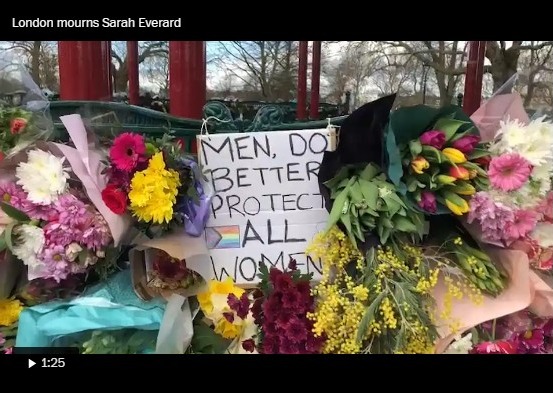
One read: “It could have been any one of us – I’m so sorry it was you.” Another read: “Men, do better, protect all women.”

Yet another: “How can we feel safe when the police are to blame?”

Reclaim These Streets, the organizers of the canceled vigil, encouraged people to shine a light, candle, torch or phone at 9:30 p.m., the last time Everard was seen alive. Other vigils took place around the country.

Scottish First Minister Nicola Sturgeon was among the first politicians to share a picture of a candle in Everard’s honor on Twitter.

Prime Minister Boris Johnson said in a tweet that he’d be taking part along with his fiancee. “Tonight Carrie and I will be lighting a candle for Sarah Everard and thinking of her family and friends. I cannot imagine how unbearable their pain and grief is. We must work fast to find all the answers to this horrifying crime.”

The case has stunned the nation, not least because the man charged with killing Everard is a serving police officer. Couzens appeared before Westminster Magistrates’ Court on Saturday to hear his charges of kidnapping and murder.

The case has also caused a national reckoning over women’s safety and prompted a discussion among women about what it’s like to walk alone, particularly at night. Many have demanded change and called for an end to victim blaming.

For residents of Clapham, it feels especially personal: They have walked along the same streets Everard did, through the same park that’s popular with exercisers, past the bandstand, the largest in London, that hosts open-air concerts in the summer. It could have been them.

“It touched a nerve, really, that it really could have just been me,” said Lucy Davies, 24, who once lived on the road where Everard was last seen. Davies said she takes precautions when traveling alone at night: She texts friends when she’s leaving and uses “Find My Friends” on her phone. But now she wonders whether more can be done.

“Today is important for all the days following to stop girls from feeling unsafe in areas, and maybe what men can do to help us feel a bit safer,” she said.

Another local resident, Emily Ramsey, 28, said she’s now rethinking how she travels at night. “You go for dinner, after work, get on the tube, it’s 10 p.m. and you walk home for 10, 15 minutes. You don’t think anything of it. Now, I’d probably ask my boyfriend to meet me and walk with me.”

She said the suggestion floated by some commentators that men should have a curfew was wrong. “I don’t think that’s the right solution. It’s no one’s fault, but maybe some men don’t appreciate we’re always glancing over our shoulder, you just have to hear footsteps a bit close and you automatically freeze. Hopefully this has made men a bit more aware,” she said.

Sophie Johnson, 28, who lives nearby, said that since Everard’s disappearance, she hasn’t walked outside at night by herself. She added that it wasn’t fair to place the onus on women. “We’re already doing all the right things. We walk in sensible shoes, have our keys out, don’t listen to music with both earphones, we’re already doing all those things.”

She said that the case has prompted a larger discussion among her male friends about what more they can do, like “cross the street or fake a phone call to seem noisy and you’re not sneaking up – it’s prompted a lot more conversation.”

Ryan Salisbury, 29, an art director, traveled 40 minutes in from Hampshire to pay his respects. He said it was “important that there is a visual presence of people today to show that this kind of thing is not acceptable.”

“My heart goes out to every women who has experienced that, even on a daily basis, that misogyny and discrimination,” he said. “I want to be here to represent that’s not okay, that’s not 2021.”

U.S. joins Asian countries in pledging up to 1 billion doses to other nations #SootinClaimon.Com

#SootinClaimon.Com : ขอบคุณแหล่งข้อมูล : หนังสือพิมพ์ The Nation.

https://www.nationthailand.com/news/30403647

U.S. joins Asian countries in pledging up to 1 billion doses to other nations

InternationalMar 13. 2021

By The Washington Post, Anne Gearan

The United States, India, Japan and Australia pledged Friday to jointly manufacture and distribute up to 1 billion doses of coronavirus vaccine before the end of next year, as the Biden administration comes under increased pressure to provide more vaccine help to poorer nations.

The vaccine would be supplied to Southeast Asian nations and potentially elsewhere as act of charity that represents a workaround for President Joe Biden, who has said he cannot yet divert any U.S. supply despite a projected surplus, given that many Americans are still urgently awaiting their immunizations.

The announcement, which came out of the first summit among leaders of the four democracies informally called “the Quad,” also hints at the Biden administration’s larger aim of linking like-minded governments to counter Chinese expansionism, including using pandemic aid as a springboard.

“At this moment, it’s a purpose that I think we all are concerned about,” Biden said as he welcomed the three leaders via video call. “A free and open Indo-Pacific is essential to each of our futures, our countries.”

They leaders also pledged to meet in person by the end of the year.

The vaccine would be produced by India, with additional funding provided by the United States and Japan and distributed with logistical help from Australia, the White House said.

China, however, has a head start, since it is already passing out free vaccine doses in Southeast Asia and elsewhere. Its initiative amounts to a campaign of “vaccine diplomacy” that experts say is part of its broader effort to bind poorer nations to China through trade or dependency.

America’s union with the three Asian democracies is a priority for the Biden administration, which sees it as a bulwark against China on several fronts.

“We strive for a region that is free, open, inclusive, healthy, anchored by democratic values, and unconstrained by coercion,” said a joint statement issued after the meeting by Biden and prime ministers Narenrda Modi of India, Scott Morrison of Australia and Yoshihide Suga of Japan.

The grouping first formed following the 2004 Indian Ocean tsunami, but Friday marked the first gathering of heads of state, albeit a virtual one, a sign of Biden’s concern with Asia generally and China more specifically.

“That’s on purpose,” White House national security adviser Jake Sullivan said Friday. “It reflects his view that we have to rally Democratic allies and partners in common cause and his belief in the centrality of the Indo-Pacific to the national security of the United States.”

The Biden administration has set a near-term goal of repairing European alliances ruptured by President Donald Trump and a longer-term aim of repositioning U.S. engagement toward Asia.

Trump regularly challenged traditional alliances, including the European Union and NATO, while taking a relatively friendly approach to such longtime U.S. adversaries such as Russia and North Korea. His relations with China were uneven, initially praising Chinese President Xi Jinping but later referring to the coronavirus as “the China virus” and blaming the country for its spread.

Trump in the end failed to get the massive trade agreement that he sought with China. Xi emerged from the Trump era stronger at home – having secured an indefinite hold on power – and emboldened abroad with a $1 trillion international development project known as the Belt and Road Initiative.

Friday’s agreement was an early effort by Biden to push back against those efforts by Beijing to expand its international influence.

The president “believes that we are going to end up in a stiff competition with China, and we intend to prevail in that competition,” Sullivan told reporters. “He is amassing the sources of strength we need to be able to prevail.” Biden is better positioned now than when he took office, Sullivan said.

President Barack Obama had also attempted a “pivot to Asia,” as it was called at the time, only to see much of the effort subsumed by conflict in the Middle East.

Biden’s version of the pivot includes military, economic and diplomatic actions meant to blunt Chinese influence. Defense Secretary Lloyd Austin and Secretary of State Antony Blinken are both traveling to Asia in coming days to visit Japan and South Korea in their first foreign trips as Cabinet secretaries.

China is involved in territorial and other disputes with both of those U.S. allies, and it helps to prop up the nuclear-armed regime in North Korea. North Korean leader Kim Jong-Un has threatened military action against both South Korea and Japan.

Austin is also visiting India, which last year skirmished with Chinese soldiers along the Himalayan border.

Japan’s Suga will be the first foreign leader to visit Biden in person sometime this year, the White House announced. Next week, Blinken and Sullivan will meet their Chinese counterparts in Alaska.

In the brief portion of Friday’s meeting viewed by reporters, neither Biden nor the other leaders directly discussed an array of other challenges presented by China, including threats to maritime movement, aggressive economic expansion and violation of intellectual property rights. Each of the four nations has a complicated relationship with China, and those tensions formed the subtext of the gathering.

“The Quad has come of age,” Modi said.

The group also agreed to increase cooperation on climate change and technology issues, as officials sought to portray the meeting’s aims as broader than just countering Beijing.

“The four leaders did discuss the challenge posed by China, and they have made clear that none of them have any illusions about China,” Sullivan said. “But today was not fundamentally about China.”

Sports broadcaster caught on hot mic directing racial slur at girls’ basketball team #SootinClaimon.Com

#SootinClaimon.Com : ขอบคุณแหล่งข้อมูล : หนังสือพิมพ์ The Nation.

https://www.nationthailand.com/news/30403645

Sports broadcaster caught on hot mic directing racial slur at girls’ basketball team

InternationalMar 13. 2021

By The Washington Post, Glynn A. Hill

An Oklahoma sports commentator is under investigation after he was heard on a live microphone Thursday night directing a racial slur at a girls’ high school basketball team.

Norman High girls’ basketball coach Frankie Parks tweeted a clip Friday where the broadcaster from the National Federation of High School Networks, can be heard berating players and using a racist slur as they knelt for the playing of the national anthem before a state playoff game.

The broadcaster, identified by The Frontier as Matt Rowan, owns OSPN, the live-streaming platform that broadcast Thursday’s game.

“I hope Norman gets their ass kicked,” he said before launching into a tirade that involved several profanities and the racist comment.

The broadcaster’s remarks drew condemnation from school officials, Norman Mayor Breea Clark, a Democrat, and former University of Oklahoma football stars Kenny Stills and Gerald McCoy. Norman High players also received broad support on social media, with some rallying around the Twitter hashtag #ThisIsWhyWeKneel.

Norman guard Myka Perry, a Florida recruit, called the comments “disrespectful and disgusting” in a social media post, adding, “This is why we kneel. I love my sisters, and this makes us that much stronger. You are part of the problem.”

The Oklahoma Secondary School Activities Association (OSSAA), the state athletic organization which contracted the announcers through NFHS for the state tournament, said it was “made aware that some very offensive, inappropriate comments were made during the NFHS livestream broadcast” and that it had pulled the broadcast team.

“On behalf of the NFHS Network and the OSSAA, we sincerely apologize that this happened at one of our events. While we are currently investigating the incident, this crew will not be doing any more games for the remainder of our championships,” executive director David Jackson said in a statement. “This kind of behavior will never be tolerated by anyone representing the NFHS or OSSAA. State tournament playoffs are a special time for our schools, their students, and their communities [sic], and anything that is counter-productive to education-based activities will be addressed immediately and appropriately. We will make further comments as we finish our investigation.”

The NFHS Network said it is “aggressively investigating the incident and will ensure that any individuals responsible will have no relationship with the NFHS Network moving forward.” In response to questions regarding the identity of the broadcaster who made the comments, it referred The Washington Post to its earlier statement.

In a statement, Rowan blamed his comments in part on having diabetes.

“I made inappropriate and racist comments believing that the microphone was off; however, let me state immediately that is no excuse, such comments should have never been uttered,” Rowan said in the statement.

“I will state that I suffer Type 1 Diabetes and during the game my sugar was spiking. While not excusing my remarks, it is not unusual when my sugar spikes that I become disoriented and often say things that are not appropriate as well as hurtful.

“I offer my most sincere apologies for the inappropriate comments made and hope that I can obtain forgiveness. I specifically apologize to the Norman High School girls basketball team, their families, their coaches and their entire school system.”

Norman High went on to defeat Midwest City in Thursday’s quarterfinal. Its semifinal against Tulsa Union will be live-streamed through Norman Sports TV.

Rick Cobb, the superintendent of Mid-Del Public Schools, which includes Midwest City, said in a statement he is hopeful OSSAA will review “any future contracts [NFHS] have for broadcasting school activities” in Oklahoma.

Clark said she has been in contact with players’ parents and is planning a town hall with “the youth of Norman, so we can learn how this incident has impacted them and hear directly from our kids how we can improve our community going forward.”

Norman Public Schools superintendent Nick Migliorino reiterated support for players in a statement on Friday.

“We condemn and will not tolerate the disgusting words and attitudes of these announcers. This type of hate speech has no place in our society and we are outraged that it would be directed at any human being, and particularly at our students,” he said.

“We fully support our students’ right to freedom of expression and our immediate focus is to support these girls and their coaches and families, particularly our Black students and coaching staff. It is tragic that the hard work and skill of this team is being overshadowed by the vile, malignant words of these individuals. We will do everything in our power to support and uplift our team and everyone affected by this incident.”

ICE has no clear plan to vaccinate thousands of detainees #SootinClaimon.Com

#SootinClaimon.Com : ขอบคุณแหล่งข้อมูล : หนังสือพิมพ์ The Nation.

https://www.nationthailand.com/news/30403644

ICE has no clear plan to vaccinate thousands of detainees

InternationalMar 13. 2021

By The Washington Post, Maria Sacchetti

The coronavirus has been running rampant for months through Immigration and Customs Enforcement’s network of jails holding civil immigration detainees fighting deportation – but the agency has no vaccination program and, unlike the Bureau of Prisons, is relying on state and local health departments to procure vaccine doses. Nobody can say how many detainees have been vaccinated.

The Biden administration says it wants to make every adult in the United States eligible for vaccination by May – and immigration agents have said they would not interfere with efforts to vaccinate undocumented immigrants outside of detention. But lawyers for immigrants who are detained say there is no urgency to vaccinate those in federal custody against a deadly pathogen that can spread fast in confined spaces.

“ICE has no plan to provide vaccines on a systemwide basis,” said Melissa Riess, a staff attorney for Disability Rights Advocates in California, one of several nonprofits that filed a federal lawsuit in California seeking the release of detainees with high-risk health conditions. “That’s having horrendous consequences. It seems like they’re doing nothing.”

The California case is one of dozens of legal battles riveted on the immigration agency’s treatment of civil immigration detainees during the pandemic. The coronavirus has ripped through many of ICE’s detention facilities, infecting nearly 10,000 detainees and killing nine. At least 370 detainees are currently positive for the virus, according to agency records.

Prisons and detention centers – like nursing homes, college dorms and other communal living settings – are places where the virus has spread rapidly because their shared spaces can make it difficult to stay apart. The Centers for Disease Control and Prevention has recommended vaccinations for people in prisons and jails, but the limited supply so far has led to debates at the state and local levels over who should get them first.

Unlike ICE, the Bureau of Prisons has a program to vaccinate federal inmates imprisoned for criminal cases, and vaccine doses are shipped directly from manufacturers to the prisons. Since staffers come and go, they get the shots first, followed by prisoners. Approximately 14,700 of the 152,000 inmates have gotten the injections so far – a small but growing share that the BOP updates each weekday online.

No similar system exists at ICE, and a Business Insider investigation last monthfound that the agency had no vaccination plan.

Dr. Ada Rivera, a top medical official at ICE, said in the federal lawsuit in California last month that officials told the Department of Homeland Security earlier in the pandemic that they needed thousands of vaccine doses for detainees, and DHS officials relayed that information to those running Operation Warp Speed. But ICE has not received any vaccine doses directly and is relying on state and local health departments to deliver them, an ICE spokeswoman said. Most have not provided any doses.

“Immigration and Customs Enforcement is firmly committed to the health and welfare of all those in its custody,” spokeswoman Danielle Bennett said. “A limited number of ICE detainees have begun to receive the coronavirus vaccine based on availability and priorities for vaccinating individuals in the state where they are currently detained.”

DHS declined to comment, and the Department of Health and Human Services did not respond to requests for comment.

ICE runs a network of more than 200 public and privately run facilities and county jails, which at one point during the Trump administration held an average of more than 50,000 people a day, a record high. The agency is now detaining fewer than 14,000 people a day, its lowest average in decades, in keeping with CDC recommendations and court orders. Unlike convicted criminals in federal BOP prisons, immigrants are held for the civil purpose of attempting to carry out their deportations.

Records show that the virus has spread through ICE facilities over the last year, with hundreds infected in states such as Texas, Georgia, Arizona and Virginia.

Eloy Detention Center, in the Arizona desert, is monitoring 47 active coronavirus infections, according to ICE. The South Texas ICE Processing Center outside San Antonio has 38 active cases, while a facility in Batavia, N.Y., has 51 cases.

In Batavia, a small federal detention facility near the Canadian border, detainees said in interviews that they can hear sick immigrants coughing in their bunks. Some moan with headaches.

“I’m trying to stay alive. Right now this place is infested with the virus,” Aldwin Brathwaite, 59, a grandfather from Trinidad and Tobago who came to the United States in 1979 with a green card, said in a phone interview this week.

Brathwaite said he has cancer and has been detained since January 2019, longer than he spent in state prison for felony identity theft and other nonviolent crimes. ICE did not respond to his claims. He remains negative for the virus, his lawyer said.

“Honestly, I’m scared,” he added. “I don’t want to be the first one to die here.”

Elvin Minaya Rodriguez, 38, said he is facing deportation to the Dominican Republic because he has a state drug conviction, which he is appealing. He said he is married to a U.S. citizen, has a green card, and has spent two years in detention trying to keep it.

Rodriguez said he wears a mask and tried to stay away from others to avoid becoming infected, though he has a low-paid prison job serving food to other detainees. In late February, his head and limbs throbbed with pain. Phlegm filled his lungs. His pale skin turned red.

“The virus got me,” he said in Spanish from detention, where he recovered. “I thought I was going to die.”

Without a vaccination, he fears he will catch the virus again. He said he has high blood pressure.

ICE officials say they are taking precautions inside the centers, testing immigrants for the coronavirus and quarantining them upon arrival, and isolating and caring for those who test positive.

“Detainees who test positive for COVID-19 receive appropriate medical care to manage the disease,” ICE said in a statement.

But lawyers say immigration officials are still holding too many immigrants at high risk of the disease, making the lack of vaccinations even more pressing.

U.S. District Judge Jesus Bernal ruled Wednesday that he would appoint a special monitor to oversee ICE’s compliance with his order last year to consider releasing detainees with serious medical conditions or disabilities, calling ICE’s latest efforts “exceedingly slow.”

“This is particularly concerning as the public health emergency rages on,” he wrote.

Other lawsuits are fighting for detainees’ health in county jails or federal facilities.

In western New York, lawyers have begged a federal judge for weeks to make sure 85 detainees with medical conditions at the Batavia detention center get vaccinated.

Judge Lawrence J. Vilardo in New York has warned officials that “this is life-threatening stuff,” and he told lawyers at a hearing Thursday to vaccinate detainees.

“Guys, this is not rocket science,” said Vilardo, who criticized the agency last week for doing “zero” to get vaccine doses. “We can get this done.”

Government lawyers said they would abide the court’s orders, but in court filings they suggested that the immigrants sue the New York state government to secure vaccine doses instead.

“If we had unlimited resources, we would vaccinate everybody,” Justice Department lawyer Adam Khalil said during the hearing Thursday. “Unfortunately, that’s not the case.”

He said detainees were also spreading the virus by not wearing masks or social distancing.

“You have to take some self-responsibility,” Khalil said.

John Peng, a lawyer with Prisoners’ Legal Services of New York who is representing the immigrants at the Batavia facility with the New York American Civil Liberties Union, said ICE should ensure that the detainees are protected.

“This is ICE’s responsibility,” he said in an interview. “The government is choosing to detain someone.”