Biden’s dogs to return to White House after younger pet causes a ‘minor injury’ to an ‘unfamiliar person’ #SootinClaimon.Com

#SootinClaimon.Com : ขอบคุณแหล่งข้อมูล : หนังสือพิมพ์ The Nation.

https://www.nationthailand.com/news/30403507

Biden’s dogs to return to White House after younger pet causes a ‘minor injury’ to an ‘unfamiliar person’

InternationalMar 10. 2021Major, a dog of President Joe Biden and first lady Jill Biden, explores the White House grounds in January 2021. MUST CREDIT: White House photo by Adam SchultzMajor, a dog of President Joe Biden and first lady Jill Biden, explores the White House grounds in January 2021. MUST CREDIT: White House photo by Adam Schultz

By The Washington Post · Sean Sullivan, John Wagner

WASHINGTON – President Joe Biden and first lady Jill Biden’s two dogs will return to the White House from Delaware, the White House press secretary said Tuesday after confirming that the younger dog, Major, had caused a “minor injury” to an “unfamiliar person.”

“Champ and Major, the president and first lady’s dogs, are members of the family and still getting acclimated and accustomed to their new surroundings and new people,” Jen Psaki said during a briefing for reporters. “And on Monday, the first family’s younger dog, Major, was surprised by an unfamiliar person and reacted in a way that resulted in a minor injury to the individual, which was handled by the White House medical unit with no further treatment needed.”

She added that plans had already been in place for the dogs to be cared for by family friends as the first lady travels to the West Coast this week.

“She has a three-day trip this week, and the dogs will return to the White House soon,” Psaki said.

Asked by a reporter whether Major could be euthanized as a result of the episode, Psaki said that would not be the case.

“Major Biden is a member of the family, so I can assure you of that,” she said.

Earlier Tuesday, the White House released a statement saying the dogs had been sent to Delaware that made no mention of a report about the aggressive behavior of the younger dog.

“With the First Lady traveling for three days, Champ and Major went to Delaware to stay with family friends,” Michael LaRosa, a spokesman for Jill Biden, said in a statement.

CNN reported that Major had a “biting incident” with a member of the White House security staff and has been known to display agitated behavior, including jumping, barking and “charging” at staffers.

The CNN report was attributed to “two sources with knowledge” and did not include on-the-record comments from the White House.

The dogs made their debut on the White House grounds in late January.

Jill Biden is visiting military bases this week as part of her initiative to hear from military families about the challenges they face, particularly during the pandemic.

On Tuesday, she was scheduled to visit Joint Base Lewis-McChord in Washington state. Her travels will also take her to Naval Air Station Whidbey Island in Washington state and Marine Corps Air Ground Combat Center in California, according to the White House.

Online funerals, Zen apps keep Japan’s Buddhist temples afloat #SootinClaimon.Com

#SootinClaimon.Com : ขอบคุณแหล่งข้อมูล : หนังสือพิมพ์ The Nation.

https://www.nationthailand.com/news/30403465

Online funerals, Zen apps keep Japan’s Buddhist temples afloat

InternationalMar 09. 2021Tsukiji Hongwanji is a four-century-old temple near Tokyo's old fish market. MUST CREDIT: Bloomberg photo by Noriko HayashiTsukiji Hongwanji is a four-century-old temple near Tokyo’s old fish market. MUST CREDIT: Bloomberg photo by Noriko Hayashi

By Syndication Washington Post, Bloomberg · Ayai Tomisawa

Memorial services held online. Zen meditation apps. Buddhist temple-led matchmaking services.

Staff operate computers during a live broadcast of an online memorial service at Tsukiji Hongwanji temple in Tokyo. MUST CREDIT: Bloomberg photo by Noriko Hayashi

Staff operate computers during a live broadcast of an online memorial service at Tsukiji Hongwanji temple in Tokyo. MUST CREDIT: Bloomberg photo by Noriko Hayashi

As the coronavirus pandemic forces institutions around the world to change the way they do things, those new endeavors are some of the ways that Buddhist groups in Japan are trying to survive. Their temples are part of the landscape: there are about 77,000, more than the number of Japan’s ubiquitous convenience stores.

covid-19 has caused further pain for Buddhist organizations already struggling in recent years due to Japan’s shrinking population and sagging interest in religion among the young. One estimate is that temples’ total income has halved in the five years to 2020. And now the virus has kept believers at home, reducing donations they make for services such as memorials for the deceased.

Buddhist temples have thrived in Japan for more than a millennium. But they need money to operate, and the pandemic has prompted some priests and monks to think of new ways to generate income. It’s a reflection of the way that industries worldwide from travel to dining and retail are having to improvise as covid-19 restrictions batter their usual business.

Ryosokuin, a Zen temple with more than 660 years of history in Kyoto, is one such innovator. Faced with a drop-off in services such as memorials and a plunge in tourism, the organization boosted its online operations. It developed a meditation app that’s been downloaded more than 15,000 times that it expects to eventually monetize, and it’s organized an online Zen meditation community called UnXe, meaning “cloud-sitting.”

“When we lost visitors and donations fell, we realized that our conventional way of supporting our operations no longer works,” said Toryo Ito, deputy chief priest at the temple. “We need to adapt to a management style which meets with the times.”

Tsukiji Hongwanji in Tokyo is venturing into areas that staid temples aren't traditionally known for, like a cafe, matchmaking services and yoga classes. MUST CREDIT: Bloomberg photo by Noriko Hayashi

Tsukiji Hongwanji in Tokyo is venturing into areas that staid temples aren’t traditionally known for, like a cafe, matchmaking services and yoga classes. MUST CREDIT: Bloomberg photo by Noriko Hayashi

Buddhism has a history stretching back to the sixth century in Japan, but few periods have brought such challenges. Over a third of temples may disappear by 2040 as the population ages, according to Kenji Ishii, a religious studies professor at Kokugakuin University in Tokyo.

Temple income is falling, too. The total figure likely dropped about 51% since 2015 to $2.4 billion (263 billion yen) in 2020, according to estimates by Hidenori Ukai, the chief priest at the Shokakuji temple in Kyoto and a freelance journalist.

The pandemic is adding to financial troubles across a broad swath of Japanese society. While the economy is recovering, a state of emergency in major cities has continued to weigh on consumer spending. And businesses that serve customers face-to-face such as retailers have been hit especially hard, resulting in a spate of bankruptcies for restaurants and hotels.

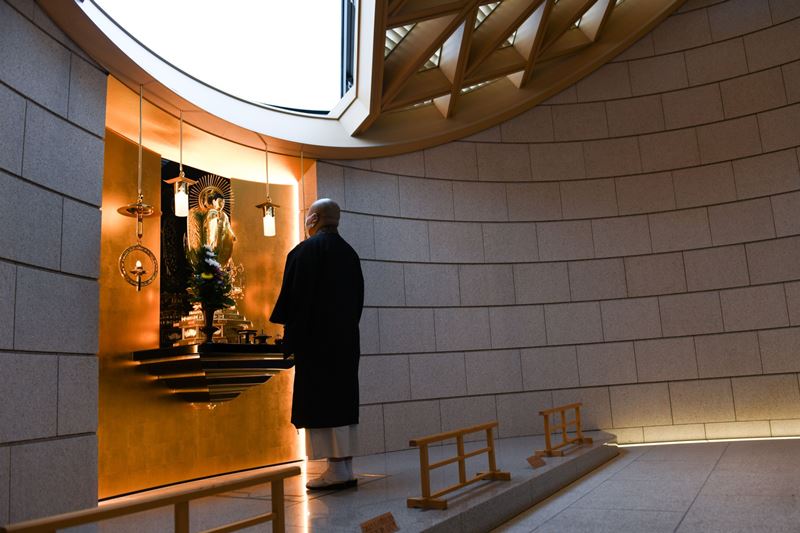
A priest offers a prayer at Tsukiji Hongwanji temple in Tokyo. MUST CREDIT: Bloomberg photo by Noriko Hayashi

A priest offers a prayer at Tsukiji Hongwanji temple in Tokyo. MUST CREDIT: Bloomberg photo by Noriko Hayashi

Tsukiji Hongwanji, a four-century-old temple near Tokyo’s old fish market, is another organization trying to make the best of the virus period. It started online memorial services last May for families that don’t want gatherings for the deceased, and has done about 70 such events, according to Yugen Yasunaga, a representative director and priest at the temple.

The organization is also venturing into areas that staid temples aren’t traditionally known for, like matchmaking services, a cafe and yoga classes, said Yasunaga, who worked in a major Japanese bank for more than two decades before starting his career at Tsukiji Hongwanji.

“Just like Amazon.com responds to the various needs of customers online, a temple can do the same,” he said.

Another area that Japanese religious institutions are increasingly exploring is environmental, social and governance investing. Tokuunin, a Zen Buddhist temple in central Tokyo, bought 40-year social bonds sold by the University of Tokyo.

“At a time when we can barely get any returns from long-term savings, we’re happy that we can contribute to helping society while earning enough returns to cover inflation,” said Yuzan Yamamoto, its chief priest.

Meghan and Harry’s interview with Oprah stunned. But it’s unlikely to change the British monarchy. #SootinClaimon.Com

#SootinClaimon.Com : ขอบคุณแหล่งข้อมูล : หนังสือพิมพ์ The Nation.

https://www.nationthailand.com/news/30403464

Meghan and Harry’s interview with Oprah stunned. But it’s unlikely to change the British monarchy.

InternationalMar 09. 2021

By The Washington Post · William Booth

LONDON – Harry and Meghan, the Duke and Duchess of Sussex, described the British royal family in their sensational interview with Oprah Winfrey as frozen, distant, enfeebled and dysfunctional – in other words, everything the monarchy is portrayed to be on Netflix’s “The Crown.”

But perhaps what made the interview so surprising was the suggestion that the monarchy hasn’t learned from its mistakes, and that it remains especially out-of-touch on issues such as mental health and racism.

There had been hope in Britain that Meg and Haz would be change agents – that the addition of an American, biracial, self-proclaimed feminist to the royal family would shake things up in a good way. And when the couple announced last year that they were giving up their roles as “senior royals,” there was disappointment among fans of a more modern monarchy that they had given up on that mission.

Yet in the interview that aired Sunday night in the United States and Monday night in Britain, the couple suggested that the palace and the royal family just didn’t get it – the depth of the racism in the British press and on social media, or the potential for Meghan to connect with the multiracial British Commonwealth.

The televised conversation had echoes of the famous 1995 BBC interview with Harry’s mother, Princess Diana. In that exchange, Diana told journalist Martin Bashir about her bulimia and not getting support from the palace or her husband, Prince Charles, who was having an affair. Nearly two years later, Diana died in a car crash, chased by paparazzi.

Meghan suggested she had Harry’s full support. But she told Winfrey she felt abandoned by the palace while she was hounded by tabloids and death threats, to the point where life in the gilded bubble felt “unsurvivable” and she considered suicide as the best way out.

Meghan claimed she was rebuffed each time she begged for help – for the palace’s PR apparatus to come to her defense, for professional psychological support, for a continued security detail.

The runaway royals mostly blamed the press and the palace operators – a kind of royal “deep state” of flacks and spinners – for their decision to flee to America.

Though they also pointed fingers at family members. Meghan said a female royal relative advised she lay low because she was oversaturated in the media, though she’d only been out twice in four months. Harry revealed that his father, heir-to-the-throne Prince Charles, at one point stopped taking his calls and played a role in cutting off Harry’s financial support and security protection. There is “a lot of hurt that happened,” said the son.

And then there was the biggest headline grabber: Meghan’s account that, when she was pregnant with her first child, a family member prompted “concerns and conversations about how dark his skin might be when he’s born.”

That claim may be particularly difficult for the royal family’s reputation, both in America and in Britain, which has its own version of a Black Lives Matter movement.

Meghan declined to identify the family member, saying, “I think that would be very damaging to them.” Harry wouldn’t say, either.

On Monday, Oprah relayed that the prince would only tell her that it is not his grandmother, Queen Elizabeth II, or his grandfather, Prince Philip – which turned eyes toward Charles or Harry’s brother, William, as the culprit.

As of Monday night, the palace had not responded to the interview. Meghan’s estranged father, Thomas Markle, is scheduled to give an interview to ITV’s “Good Morning Britain” with Piers Morgan on Tuesday.

In shielding the popular queen and her husband, who is currently hospitalized, Harry and Meghan may have been shielding themselves from criticism, too.

“If they had dared attack the Queen, they would have forfeited an enormous amount of sympathy,” royal historian Robert Lacey told the Guardian newspaper.

Charles, however, is relatively unpopular, and Lacey said the interview could have implications for his eventual kingship.

The interview represented “an enormous clash of cultures and values, a clash of generations, a psychological clash between the stiff upper lip and the wobbly lower chin,” Lacey told the Guardian. “Will young Australians, or Canadians, for example, want a King Charles III who refused to take calls from his son when he was in emotional distress?”

Meghan said the reality of being a royal isn’t like the fairy tales she grew up with as an American. But later in the interview, she compared herself to a fairy-tale character, Ariel, the rebellious little mermaid who falls in love with a human prince but must give up her voice for a chance to be with him.

Meghan said she was not silent, but silenced by the crown.

“I just wish that we would all learn from the past,” Harry said, suggesting a parallel between his wife and his mother, in their ability to connect with people around the world – and the resentment that caused within the family.

Harry suggested that Meghan would have been an especially potent implement of soft power in British Commonwealth countries – some of which have majority-Black, Brown and Asian populations, from the centuries when England ruled the waves and was a dominant slave-trading empire.

“Here you have one the greatest assets to the Commonwealth the family could have ever wished for,” he said. But the palace never learned how to use her.

Among their fans and in some media accounts, Harry and Meghan had gotten credit for doing things their own way – for orchestrating a more private birth for their son, for declining titles for him, for staking out their own financial independence.

But in their Winfrey interview, the couple suggested that those and most other decisions were imposed on them. Archie wasn’t offered the title of prince, and the family cut them off financially.

The couple stressed they mostly just wanted to get along, to do their job, to be protected from negative press and to cut ribbons and endorse charities in peace. Perhaps it was us on the outside that saw them as crusaders and outliers, when the couple wanted more ordinary roles, as they said to Winfrey.

Meghan said when the couple smiled at events, they were just being “good at their jobs,” playing for the cameras, even as they were hurting inside.

Early reaction in Britain focused on Meghan’s confession that she felt suicidal – though the tabloids themselves were not accepting any blame.

Criticizing the press is usually a good play by politicians and celebrities, and the couple excoriated the tabloids. But there was a tricky bit here.

The British popular press give British readers what they want, which is saucy, catty, royal news – and a lot of it. Their readers are seen as patriotic, nationalist, flag-waving and pro-monarch. The very same people who lined up and wept at Princess Diana’s funeral procession were the very same people who bought the Daily Mail every day – and bathed in the salacious palace travails.

Harry tried to make a distinction. In an outtake that aired Monday morning, the prince told Winfrey, “The U.K. is not bigoted, the U.K. press is very bigoted.”

But it is hard to decouple the two: Could a racist tabloid press exist without a willing readership?

Harry said the royal family – even his father and brother – live in constant fear of the British tabloids and newspapers, some owned by powerful media moguls such as Rupert Murdoch.

And although he has been able to escape the confines of the monarchy, his father and brother don’t have that luxury.

“They are trapped, they don’t get to leave,” Harry said. “And I have huge compassion for that.”

Microsoft attack blamed on China morphs into global crisis #SootinClaimon.Com

#SootinClaimon.Com : ขอบคุณแหล่งข้อมูล : หนังสือพิมพ์ The Nation.

https://www.nationthailand.com/news/30403462

Microsoft attack blamed on China morphs into global crisis

InternationalMar 09. 2021A Microsoft office in Mountain View, Calif., on Jan. 22, 2021. MUST CREDIT: Bloomberg photo by David Paul Morris.A Microsoft office in Mountain View, Calif., on Jan. 22, 2021. MUST CREDIT: Bloomberg photo by David Paul Morris.

By Syndication Washington Post, Bloomberg · William Turton, Jordan Robertson

A sophisticated attack on Microsoft’s widely used business email software is morphing into a global cybersecurity crisis, as hackers race to infect as many victims as possible before companies can secure their computer systems. The attack, which Microsoft has said started with a Chinese government-backed hacking group, has so far claimed at least 60,000 known victims globally, according to a former senior U.S. official with knowledge of the investigation. Many of them appear to be businesses caught in a wide net the attackers cast as Microsoft worked to shut down the hack.

The European Banking Authority became one of the latest victims as it said Sunday that access to personal data through emails held on the Microsoft server may have been compromised. Others identified so far include banks and electricity providers, as well as senior citizen homes and an ice cream company, according to Huntress, a Ellicott City, Maryland-based firm that monitors the security of customers, in a blog post Friday. One U.S. cybersecurity company which asked not to be named said its experts alone were working with at least 50 victims, trying to quickly determine what data the hackers may have taken while also trying to eject them. The rapidly escalating attack came months after the SolarWinds breaches by suspected Russian cyberattackers, and drew the concern of U.S. national security officials in part because the latest hackers were able to hit so many victims so quickly. Researchers say in the final phases of the attack, the perpetrators appeared to have automated the process, scooping up tens of thousands of new victims around the world in a matter of days.

Washington is preparing its first major moves in retaliation against foreign intrusions over the next three weeks, the New York Times reported, citing unidentified officials. It plans a series of clandestine actions across Russian networks — intended to send a message to Vladimir Putin and his intelligence services — combined with economic sanctions. President Joe Biden could issue an executive order to shore up federal agencies against Russian hacking, the newspaper reported. “We are undertaking a whole of government response to assess and address the impact,” a White House official wrote in an email on Saturday. “This is an active threat still developing and we urge network operators to take it very seriously.”

The Chinese hacking group, which Microsoft calls Hafnium, appears to have been breaking into private and government computer networks through the company’s popular Exchange email software for a number of months, initially targeting only a small number of victims, according to Steven Adair, head of the northern Virginia-based Volexity. The cybersecurity company helped Microsoft identify the flaws being used by the hackers for which the software giant issued a fix on Tuesday.

The result is a second cybersecurity crisis coming just months after suspected Russian hackers breached nine federal agencies and at least 100 companies through tampered updates from IT management software maker SolarWinds. Cybersecurity experts that defend the world’s computer systems expressed a growing sense of frustration and exhaustion.

“The good guys are getting tired,” said Charles Carmakal, a senior vice president at FireEye, the Milpitas, California-based cybersecurity company.

Asked about Microsoft’s attribution of the attack to China, a Chinese foreign ministry spokesman said Wednesday that the country “firmly opposes and combats cyber attacks and cyber theft in all forms” and suggested that blaming a particular nation was a “highly sensitive political issue.”

Both the most recent incident and the SolarWinds attack show the fragility of modern networks and sophistication of state-sponsored hackers to identify hard-to-find vulnerabilities or even create them to conduct espionage. They also involve complex cyberattacks, with an initial blast radius of large numbers of computers which is then narrowed as the attackers focus their efforts, which can take affected organizations weeks or months to resolve.

In the case of the Microsoft bugs, simply applying the company-provided updates won’t remove the attackers from a network. A review of affected systems is required, Carmakal said. And the White House emphasized the same thing, including tweets from the National Security Council urging the growing list of victims to carefully comb through their computers for signs of the attackers. Initially, the Chinese hackers appeared to be targeting high value intelligence targets in the U.S., Adair said. About a week ago, everything changed. Other unidentified hacking groups began hitting thousands of victims over a short period, inserting hidden software that could give them access later, he said.

“They went to town and started doing mass exploitation — indiscriminate attacks compromising exchange servers, literally around the world, with no regard to purpose or size or industry,” Adair said. “They were hitting any and every server that they could.”

Adair said that other hacking groups may have found the same flaws and began their own attacks — or that China may have wanted to capture as many victims as possible, then sort out which had intelligence value.

Either way, the attacks were so successful — and so rapid — that the hackers appear to have found a way to automate the process. “If you are running an Exchange server, you most likely are a victim,” he said.

Data from other security companies suggest that the scope of the attacks may not end up being quite that bad. Researchers from Huntress examined about 3,000 vulnerable servers on its partners’ networks and found about 350 infections — or just over 10%. While the SolarWinds hackers infected organizations of all sizes, many of the latest batch of victims are small-to medium-sized business and local government agencies. Organizations that could be most impacted are those that have an email server that’s running the vulnerable software and exposed directly to the internet, a risky setup that larger ones usually avoid.

Smaller organizations are “struggling already due to Covid shutdowns — this exacerbates an already bad situation,” said Jim McMurry, founder of Milton Security Group, a cybersecurity monitoring service in Southern California. “I know from working with a few customers that this is consuming a great deal of time to track down, clean and ensure they were not affected outside of the initial attack vector.”

McMurry said the issue is “very bad” but added that the damage should be mitigated somewhat by the fact that “this was patchable, it was fixable.”

Microsoft said customers that use its cloud-based email system are not affected. The use of automation to launch very sophisticated attacks may mark a new, frightening era in cybersecurity, one that could overwhelm the limited resources of defenders, several experts said.

Some of the initial infections appear to have been the result of automated scanning and installation of malware, said Alex Stamos, a cybersecurity consultant. Investigators will be looking for infections that led to hackers taking the next step and stealing data — such as e-mail archives — and searching them for any valuable information later, he said.

“If I was running one of these teams, I would be pulling down email as quickly as possible indiscriminately and then mining them for gold,” Stamos said.

Yellen says stimulus unlikely to cause inflation problem #SootinClaimon.Com

#SootinClaimon.Com : ขอบคุณแหล่งข้อมูล : หนังสือพิมพ์ The Nation.

https://www.nationthailand.com/news/30403460

Yellen says stimulus unlikely to cause inflation problem

InternationalMar 09. 2021

Treasury Secretary Janet Yellen

Treasury Secretary Janet Yellen

By Syndication Washington Post, Bloomberg · Saleha Mohsin

Treasury Secretary Janet Yellen dismissed fears that President Joe Biden’s $1.9 trillion pandemic-relief bill is so big that it will cause an inflation problem as she seeks to push the recovery deeper into the U.S. labor market to address long-standing economic disparities.

Yellen called the impact on women and minorities from covid-19 “absolutely tragic.” She repeatedly has rejected concerns that Biden’s stimulus is excessive given the economy’s signs of recovery, and that runaway inflation could damage the economy.

“I really don’t think that’s going to happen,” she said Monday on MSNBC. Inflation before the pandemic “was too low rather than too high,” she noted. “If it turns out to be inflationary, there are tools to deal with that,” she said of the stimulus package.

Treasury yields have soared over the past month as investors built into their outlook a faster trajectory for economic growth and prices in the wake of the bigger-than-expected spending bill.

Yellen said the most urgent action is the House’s vote Tuesday on passing the Senate’s revisions to pandemic-relief bill. Speaker Nancy Pelosi, D-Calif., has predicted approval.

That legislation includes enhanced unemployment benefits until Sept. 6 and stimulus checks for those earning $80,000 or less, and it makes student-loan relief tax-free.

“We have a K-shaped recovery going on, in which high-income people are doing much better than those at the bottom of the economic ladder — low-wage workers and minorities,” Yellen said. The problem predates the coronavirus but was “made immeasurably worse by the pandemic.”

The unemployment rate for Blacks, who have a disproportionate share of lower-wage jobs and of union membership, was double that of Whites during much of the past 50 years in part because policymakers pulled back support just as the benefits of growth started reaching lower-income workers, to avoid runaway inflation.

Federal Reserve Chair Jerome Powell has pledged not to allow the same mistake to be repeated, while his predecessor, Yellen, is preparing to turn from crisis-relief efforts to jobs creation through what the administration calls a “build back better” program that includes infrastructure spending.

U.S. payrolls remain down by more than 9 million compared with the peak before covid-19 struck. The Black unemployment rate climbed to 9.9% in February even as the overall rate fell to 6.2%.

Yellen reiterated her expectation for the relief plan to return the U.S. to “full employment” next year.

Kristalina Georgieva, who heads the International Monetary Fund, during an event with Yellen on Monday applauded what she called the U.S.’s “very progressive” policies.

Speaking on International Women’s Day, Yellen and Georgieva highlighted the importance of addressing inequalities faced by women — and of bringing more of them into the field of economics.

Women “have to take care of children who can’t be at school. We’re really concerned about permanent scarring from this crisis,” Yellen said.

Booming furniture sales mean ‘unprecedented’ delays for sofas and desks #SootinClaimon.Com

#SootinClaimon.Com : ขอบคุณแหล่งข้อมูล : หนังสือพิมพ์ The Nation.

https://www.nationthailand.com/news/30403459

Booming furniture sales mean ‘unprecedented’ delays for sofas and desks

InternationalMar 09. 2021

By The Washington Post · Abha Bhattarai

Alexis Serrano’s new couch was supposed to arrive two weeks ago. But shipping delays have pushed back delivery to her downtown Miami condo to April 1 – at the earliest.

Serrano, who ordered the couch in January and promptly sold her old one, says she’s wondering whether other recent purchases for her new home – a living room table, two beds, nightstands and bar stools – will have similar fates.

“I have no idea when anything is going to arrive; they said it could be eight months from now,” the 26-year-old property manager said. “If I had known, I would’ve just waited to buy furniture.”

Across the country, furniture retailers are reporting months-long delays in every step of the supply chain – from overwhelmed factories to clogged ports – amid surging demand for desks, chairs and sofas during a pandemic that has kept millions of families largely stuck at home for nearly a year. Companies say shortages of shipping containers as well as materials such as steel and acrylic have made it nearly impossible to keep stores and warehouses properly stocked.

Meanwhile, the furniture business is booming, driven by big jumps in work-from-home arrangements and home sales, making it an unexpected bright spot in the otherwise flagging retail sector. Americans last month spent an estimated $11.3 billion at furniture and home furnishing stores, up 12% from a year earlier, according to Commerce Department data. Monthly sales in the sector have soared 181% since April, while overall retail sales have grown 34%.

“You have two problems: High demand and a broken supply chain,” said Greg Portell, a partner in the consumer and retail practice at consulting firm A.T. Kearney. “All of the places where this stuff gets manufactured, whether internationally or domestically, have been disrupted by covid and are under enormous strain.”

La-Z-Boy customers are now waiting an “unprecedented” five to nine months on their orders, chief executive Kurt Darrow said in an earnings call last month, adding that manufacturing disruptions and shipping delays amounted to $30 million in lost business in the latest quarter. Factories also have been short-staffed, he said, because so many manufacturing workers were infected with covid-19 or needed to quarantine following the holidays.

“Individually, any one of [those hurdles] is not that significant and could be overcome,” Darrow said. “But when you get them coming at you from six or seven different directions, the magnitude of it adds up.”

La-Z-Boy has added weekend and overnight shifts at its U.S. plants, and expanded production facilities in Mexico. Even so, executives say, consumer demand is so high that the company can’t make enough sectionals and other big-ticket items to keep up.

“The amount of demand we’re getting . . . is keeping the backlog out a lot farther than we’d like,” he said. “But that is the state of the industry. It’s not just a La-Z-Boy problem, it is for everybody.”

– – –

Dan Flickinger, the chief executive of Kasala, which has four stores in the Seattle area, said furniture that normally would take about three months to arrive from China can now take upward of nine. Orders placed this month won’t arrive until December, he said. Even then, there’s no guarantee they won’t spend several more weeks languishing at the port.

“A lot of our furniture is handmade and requires a tremendous amount of components, so one missing piece can really mess up a whole lot of production,” he said. “Our warehouse is so close to the port that we can pretty much see the containers, but we can’t get to them.”

Analysts said the furniture industry, which imports the bulk of its products, has been particularly hard hit by manufacturing and shipping challenges. In the past year, ocean freight shipping fees from Asia to the United States have quadrupled in some cases, from about $1,500 per container to $6,000, according to Mark Yeager, chief executive of Redwood Logistics. In addition, he and others said, capacity has dropped because it uses storage space in international flights, which are down sharply due to pandemic-related restrictions. And within the United States, weather-related railroad disruptions and a shortage of truck drivers have only added to the scramble.

Initially, manufacturing overseas was the bottleneck, said Jonathan Johnson, chief executive of Overstock.com, “now it’s the shipping that’s the slowdown.” The online retailer’s sales surged 75% last year, to $2.5 billion, boosted by demand for patio furniture, trampolines, sofas, rugs and other home furnishings. “If you look at the Pacific Ocean outside of the Los Angeles and Long Beach ports, it’s like the [Interstate] 405 in rush hour. Shipping lanes are jam-packed.”

Retailers are also having to adapt to an era of increased online shopping for bulky, big-ticket purchases like sofas, beds and dining tables. Many chains are rapidly building up mobile apps and websites, and adding curbside pickup options to accommodate the crush of e-commerce purchases. At Ikea, for example, online sales now make up 25% of all orders, up from 15% before the pandemic. The company recently created a new mobile app and has expanded staffing at its call centers.

Stores are increasingly rethinking layouts, too, to make it easier for shoppers to quickly test out sofas or mattresses before committing.

“The customer is coming into stores at a different point in their journey,” said Debbie Propst, president of Herman Miller Retail, which owns the high-end modernist furniture chain Design Within Reach. “They used to come at the beginning, when they were just starting to look. Now they’ve done all of their research and are coming in to sit on a particular chair, to see if it’s right for them.”

The company quickly redesigned its website at the beginning of the pandemic, and its newest store, opening in Southampton this week, is an attempt to get closer to the wealthy New Yorkers who have relocated to their summer houses during the pandemic. It has also added a number of Herman Miller seating stores in cities such as Austin, Los Angles and New York, to keep pace with a 300% increase in sales of ergonomic desk chairs.

Retail orders climbed 41% in the most recent quarter, driven by demand for upholstered seating, outdoor furniture and home-office staples such as desks and filing cabinets. Consumers are also increasingly looking for furniture with multiple uses, Propst said. Sectionals and ottomans with built-in storage have been popular, as has the Stamford, Conn.-based brand’s recently-launched Edel Table, which starts at $1,800 and doubles as a dining table and office desk.

– – –

Many furniture shops say pandemic sales have followed an unpredictable but clear pattern: Revenue dropped precipitously in March and April when much of the country went into lockdown. But by May, when Americans realized they’d be stuck at home long-term, they started snapping up desks and patio furniture, then upholstered chairs, couches, dining tables and just about everything else – and demand has remained at elevated levels since.

“It’s been such an extreme roller coaster,” said Bruce Champeau, president and chief operating officer of Minneapolis-based furniture chain Room & Board. “We went from being closed to having record sales months, one after another.”

Annual sales are up 30% from a year ago, to nearly $500 million, he said, adding that it expects to break $600 million this year. Demand, he said, has “kept evolving, as people look around and say, ‘You know what, maybe we’ll update our sofa. Maybe we’ll replace this and that.'”

After moving from California to Athens, Tenn., in December, Stephanie Campisi stopped by a local mattress store to buy a bed. Everything was sold out, and she was told it would take upward of two months for the next delivery.

She ended up driving to Walmart and buying a $150 foam mattress-topper for her family – which includes a toddler and dog – to sleep on while they waited for movers to deliver their belongings.

“We were really surprised,” said the 35-year-old children’s book author. “We thought you would just go into a shop and buy a mattress that was in stock. But the pandemic has changed even the simplest things.”

Bed sales have skyrocketed during the pandemic, according to retailers, as well as mattress makers such as Tempur Sealy International, Casper Sleep and Purple Innovation, which reported annual sales growth between about 20% and 50% last year.

“Once people realized they were going to be in their homes a long time, they started looking at the stuff that was frustrating them,” said Stephen Oblak, chief merchandising officer for Wayfair. “That’s led to a lot of furniture and textile sales.”

Tasha Belikove, who has been working from her Los Angeles apartment for nearly a year, says she’s constantly looking for ways to upgrade the two-bedroom she shares with a roommate. So far she’s purchased a desk, bed frame, living room rug and Peloton exercise bike, and is considering buying a dining table and upholstered chairs.

Furniture, she says, has been one of the few areas where she’s splurging, since she’s saving on Uber rides, dining out and traveling.

“I’ve definitely been looking around my apartment and just realizing I hate everything,” the 27-year-old social media coordinator said. “Being in a pandemic and seeing literally nothing else other than the inside of my apartment has me wanting to spend all my money on new furniture.”

Female artists struggle to make gains in music, study finds #SootinClaimon.Com

#SootinClaimon.Com : ขอบคุณแหล่งข้อมูล : หนังสือพิมพ์ The Nation.

https://www.nationthailand.com/news/30403458

Female artists struggle to make gains in music, study finds

InternationalMar 09. 2021The Spotify logo is displayed on a smartphone on Oct. 7, 2020. MUST CREDIT: Bloomberg photo by Gabby Jones.The Spotify logo is displayed on a smartphone on Oct. 7, 2020. MUST CREDIT: Bloomberg photo by Gabby Jones.

By Syndication Washington Post, Bloomberg · Lucas Shaw

Women are songwriters or producers on only a small portion of the most popular songs released each year — and have made no significant gains in representation over the past nine years — even as the industry grows more diverse in other ways.

That’s the finding of a report by Dr. Stacy L. Smith, a University of Southern California professor who studies representation in the entertainment industry. Female artists made just 22% of the top 100 songs released each year between 2012 and 2020, and a far smaller percentage of women served as producers and writers, according to the study released Monday, which was funded by Spotify Technology.

The report was timed to coincide with International Women’s Day and comes just days before the Grammy Awards, the industry’s biggest night of the year. The Grammys have been criticized in the past for failing to nominate or showcase a diverse field. Though the awards have made progress in the past decade, 28% of nominees in five key categories are women this year, the USC report noted.

“It is International Women’s Day everywhere, except for women in music, where women’s voices remain muted,” Smith, who oversees USC’s Annenberg Inclusion Initiative, said in a statement.

Smith, who used Billboard’s year-end chart of the 100 most popular songs as a gauge, found the music industry is more diverse than the population when it comes to race and ethnicity. Artists of color received 59% of the credits on top songs released in 2020, and 47% between 2012 and 2020. Most of that is due to the prominence of Black musicians in R&B and hip-hop, which is the most popular musical genre.

But while people of color have boosted their share of top hits by about 20% over the last nine years, women have made smaller gains — and in some cases, lost ground. They received production credits on about 2% of the top 100 songs for the past nine years, a number that has remained unchanged. For every woman who got a producing credit, there were 38 men.

Women account for around 13% of songwriting credits, a number that has increased over the years. But 57% of songs measured by the study had no female writers, and less than 1% had only female writers.

“Each song on the popular charts represents an opportunity to include women,” Smith wrote in the report, co-authored by Dr. Katherine Pieper, Marc Choueiti, Karla Hernandez and Kevin Yao. “For artists starting work on new music, consider working with women in songwriting and producing roles. While it may seem easier to work with prior collaborators, the process of discovering new partners and opening up the potential for innovation is the path toward greater inclusion.”

U.S., South Korea reach military cost-sharing agreement after deadlock under Trump #SootinClaimon.Com

#SootinClaimon.Com : ขอบคุณแหล่งข้อมูล : หนังสือพิมพ์ The Nation.

https://www.nationthailand.com/news/30403457

U.S., South Korea reach military cost-sharing agreement after deadlock under Trump

InternationalMar 09. 2021

By The Washington Post · Michelle Ye Hee Lee, Dan Lamothe

WASHINGTON – The United States and South Korea have reached a cost-sharing agreement that will include a “meaningful increase” in payments for U.S. troops on the Korean Peninsula and launched annual joint military exercises, in a partial reset between the two nations.

Negotiations over how to share the costs of the military alliance came to an impasse in March 2020 when the Trump administration demanded that Seoul increase its contribution fivefold. Officials have not provided details on the new deal, which is being finalized.

The nine-day joint military exercise set to begin this week will mostly be conducted as computer simulations, rather than in the field, because of the coronavirus pandemic, according to a statement from South Korea’s Joint Chiefs of Staff.

The moves mark a shift from the previous administration as President Joe Biden seeks to show that the United States is committed to its allies and military defense agreements.

As president, Donald Trump criticized allies for not paying enough toward the cost of U.S. military defense in their countries, including the Korean Peninsula, where about 28,500 U.S. troops are stationed. His demands led to increased tensions and sparked concerns in South Korea that the United States could reduce its troop presence if it did not meet the request.

Trump also questioned the need for large-scale military exercises each spring with South Korea, calling them expensive and complaining that the United States was not being “reimbursed.” The drills were reduced in size and scope, and incorporated more computer simulations, as Trump tried to engage with North Korea leader Kim Jong Un.

North Korea views the exercises as preparation for an attack, while U.S. and South Korean officials say they are defensive in nature.

With another year of reduced exercises, experts have raised concerns about the prolonged lack of field trainings.

“I don’t care what the military says in terms of workarounds, it’s not helping readiness,” said Victor Cha, an expert on Korean relations who served in the administration of President George W. Bush. “Militaries have to exercise to be ready. So, I’m sure there is some erosion of readiness because they have not been able to exercise.”

U.S. military officials have sought to cast their commitment to South Korea as enduring.

“The United States’ security commitment to the Republic of Korea is unshakable, consistent with the Mutual Defense Treaty, and U.S. forces in Korea are specifically postured to ‘fight tonight,’ if needed,” said Army Lt. Col. Martin Meiners, a Pentagon spokesman.

During the presidential campaign, Biden pledged to take a more measured approach toward U.S. relations with South Korea.

“As President, I’ll stand with South Korea, strengthening our alliance to safeguard peace in East Asia and beyond, rather than extorting Seoul with reckless threats to remove our troops,” he wrote in an October 2020 opinion article for South Korea’s Yonhap News Agency.

A State Department spokesman said Sunday that the cost-sharing agreement “reflects the Biden-Harris administration’s commitment to reinvigorating and modernizing our democratic alliances around the world to advance our shared security and prosperity.”

In a statement, the South Korean Ministry of Foreign Affairs said the two sides had decided to “resolve the gap in the agreement that has lasted for more than a year through prompt signing of the agreement, and will contribute to strengthening” the alliance between the countries.

The countries considered a roughly 13% increase to Seoul’s payments, or about $1 billion per year, according to two officials, who spoke before the Sunday announcement on the condition of anonymity to discuss ongoing negotiations. Trump had rejected that proposed amount in 2019, instead demanding up to $5 billion.

“These negotiations have always been contentious between Washington and Seoul in every administration, but Trump’s election defeat has helped a lot this time,” said Duyeon Kim, a Korea expert at the Center for a New American Security. “Concluding them will remove a big irritant and show that the allies are restoring a part of the alliance, but it’s comparatively easier to resolve, because Seoul already had an offer on the table.”

Cha said the Biden administration is walking a line in its relationship with South Korea, seeking greater payments while showing that the alliance is strong.

But there was room for compromise after Trump made “extreme demands that were not really realistic,” Cha said.

The deal with South Korea is crucial to U.S. efforts to counter China’s rise with a coalition of like-minded allies, said James Kim, a research fellow at the Asan Institute for Policy Studies in Seoul.

If the Americans doubled down on Trump’s pressure on Seoul to pay more, “that could actually push the Koreans further away from them and toward Beijing if they’re not careful,” James Kim said. “Biden wants to forge a better relationship with the allies.”

The joint military exercises send a message to the South Korean public and North Korea that the Biden administration is committed to its alliances with South Korea and Japan and defending them, Duyeon Kim said.

“Halting joint drills will only embolden Pyongyang, and it would be like dropping your shield before a drawn sword,” she said.

The exercises this year will mostly involve computer simulations, rather than tens of thousands of troops training in the field with aircraft, ships and other equipment. In addition to addressing concerns about the coronavirus, the setup also lowers their profile as South Korean President Moon Jae-in seeks to maintain peaceful relations with North Korea.

Army Col. Lee Peters, a U.S. military spokesman in South Korea, said before the announcements that it is U.S. policy not to comment “on planned or executed training,” and he called it something that professional militaries do to “maintain readiness, proficiency, credibility, and trust.”

The training, he said in an email, “ensures we maintain a robust combined defense posture” and enhance the ability of the U.S. and South Korean militaries to work together.

North Korea has not signaled how it plans to engage with the United States, but the exercises could prompt action, experts say.

In a speech to the party Congress in January, the North Korean leader called on Washington to end the joint exercises and other alliance activities on the peninsula.

“We will have to see how Pyongyang protests the drills, especially when it’s preoccupied with domestic challenges. It would be a big mistake to provoke the Biden administration with a weapons or satellite test, especially before his team and policy are in place,” Duyeon Kim said. “Whatever action or inaction Pyongyang takes will foreshadow what the U.S.-North Korea and inter-Korean relationships will look like in the foreseeable future.”

Biden signs executive order promoting voting rights on 56th anniversary of ‘Bloody Sunday’ #SootinClaimon.Com

#SootinClaimon.Com : ขอบคุณแหล่งข้อมูล : หนังสือพิมพ์ The Nation.

https://www.nationthailand.com/news/30403418

Biden signs executive order promoting voting rights on 56th anniversary of ‘Bloody Sunday’

InternationalMar 08. 2021President Joe BidenPresident Joe Biden

By The Washington Post · Felicia Sonmez, Amy Gardner

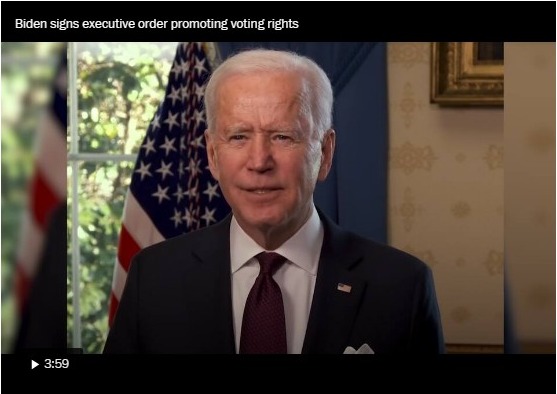
WASHINGTON – President Joe Biden on Sunday signed an executive order aimed at promoting voting rights amid a push by Republican-led state legislatures to roll back voting access in the wake of former president Donald Trump’s 2020 loss and his baseless effort to cast doubt on the integrity of U.S. elections.

The order comes on the 56th anniversary of “Bloody Sunday,” the day on which state troopers violently beat hundreds of marchers, including John Lewis, the late civil rights icon and Democratic congressman from Georgia, on the Edmund Pettus Bridge in Selma, Ala.

“Today, on the anniversary of Bloody Sunday, I am signing an executive order to make it easier for eligible voters to register to vote and improve access to voting,” Biden said Sunday in a videotaped address to the Martin and Coretta Scott King Unity Breakfast. “Every eligible voter should be able to vote and have that vote counted. If you have the best ideas, you have nothing to hide. Let the people vote.”

The order directs federal agencies to develop a strategic plan for promoting voter registration and participation, including potentially applying to be a state-designated voter registration agency and providing recommendations on leave for federal employees to vote or to serve as poll workers.

Some states have programs to automatically register eligible Americans to vote, unless they opt out, when they interact with DMVs as well as state agencies that administer federal programs such as military recruitment, Medicaid and food stamps. Under the Trump administration, however, some federal agencies refused to share the data that would allow states to automatically register voters this way, citing concerns about the privacy of health data. Biden’s executive order instructs federal agencies to relax that policy.

The order also aims to expand access to voting among active-duty members of the military as well as to all eligible federally incarcerated people.

And it establishes a steering group on Native American voting rights tasked with producing recommendations by next year on expanding voter outreach and turnout among Native American communities.

Biden’s move comes days after the House passed expansive legislation to create uniform national voting standards, overhaul campaign finance laws and outlaw partisan redistricting. The measure, H.R. 1, largely mirrors a bill passed by the chamber two years ago. But it has faced fierce Republican attacks that threaten to stop it cold in the Senate.

The bill’s voting provisions would guarantee no-excuse mail voting and at least 15 days of early voting for federal elections; require states to use their government records to automatically register citizens to vote; restore voting rights to felons who have completed their prison sentences; and mandate the use of paper ballots.

During his remarks at the Conservative Political Action Conference last month, Trump blasted H.R. 1, accusing Democrats of wanting to register all welfare recipients to vote.

No Republicans voted for the bill in 2019 or last week, when it was approved 220 to 210.

John Ratcliffe, Trump’s former director of national intelligence, quickly accused Biden and Democrats of “trying to fix a problem that didn’t exist.”

“For all the complaints that you heard about the election in 2020, the complaint that no one said was, ‘It was too difficult to vote,'” Ratcliffe said on Fox News Channel’s “Sunday Morning Futures.” “And yet, what (House Speaker) Nancy Pelosi and President Biden say is, ‘Well, we have got to remove obstacles from people voting,’ when, in fact, that really was not a problem.”

Dozens of Republican-controlled state legislatures, meanwhile, are considering sweeping new laws that would restrict voting options ahead of the 2022 midterms.

Some of the measures would restrict absentee balloting, while others would limit early voting and other aspects of election administration.

One bill in Georgia would block early voting on Sundays, which critics consider a flagrant attempt to thwart Souls to the Polls, the Democratic turnout effort focused on Black churchgoers on the final Sunday before an election.

In his remarks Sunday, Biden noted that in 2020, even with the obstacles presented by the coronavirus pandemic, “more Americans voted than ever before.”

But he also warned that the country is witnessing a “never-before-seen effort to ignore, undermine and undo the will of the people.” He cited both the Jan. 6 attack on the Capitol by a pro-Trump mob as well as the 250 bills introduced by lawmakers in 43 states this legislative session aimed at making it more difficult to vote.

“We cannot let them succeed,” he said.

Biden’s $1.9 trillion relief plan reflects seismic shifts in U.S. politics #SootinClaimon.Com

#SootinClaimon.Com : ขอบคุณแหล่งข้อมูล : หนังสือพิมพ์ The Nation.

https://www.nationthailand.com/news/30403417

Biden’s $1.9 trillion relief plan reflects seismic shifts in U.S. politics

InternationalMar 08. 2021President Joe Biden and first lady Jill Biden walk to Marine One on the South Lawn of the White House on Feb. 26. MUST CREDIT: Washington Post photo by Demetrius FreemanPresident Joe Biden and first lady Jill Biden walk to Marine One on the South Lawn of the White House on Feb. 26. MUST CREDIT: Washington Post photo by Demetrius Freeman

By The Washington Post · Jeff Stein

WASHINGTON – A new Democratic administration facing down a massive economic crisis pushes a $800 billion stimulus package. A bloc of centrist Democrats balk at the price-tag, and Republicans are thrown into a frenzy warning about the impact to the federal deficit.

A little more than a decade later, another new Democratic administration takes office facing a different economic crisis. This time, it proposes spending an additional $1.9 trillion in spending, even though the federal deficit last year was $3.1 trillion – much larger than during the last crisis. Centrist Democrats unify behind passing the measure, and the GOP rejects it but in a more muted fashion.

The disparity between the reception to President Barack Obama’s 2009 stimulus plan and President Joe Biden’s is the result of several seismic shifts in American politics – the most dramatic of which may be the apparent impact of the pandemic on attitudes about the role of government in helping the economy.

Since the outset of the coronavirus, polling has found substantial support among Americans for providing more government aid for those in need. That is partially due to the nature of the current crisis, which for a time opened a deeper economic hole than even the Great Recession. But the shift is also the result of a reorientation on economic policy – both on the left and on the right – that has transformed the political landscape.

On the right, congressional Republican lawmakers may still fret about higher deficits – but the most popular politician among their voters does not. Both as a candidate and as president, Donald Trump blew past Republican concerns about the deficit, pushing for trillions in additional spending and tax cuts and running unprecedented peacetime debt levels.

And on the left, Democratic lawmakers have increasingly learned to ignore fears about spending too much. Party leaders have said they suffered crippling political defeats in the 2010s precisely because they did not deliver enough meaningful economic relief under Obama – a mistake that they see an opportunity to correct under Biden. Democrats also repeatedly tout the 2017 Republican tax cut, which is expected to add approximately $2 trillion to the national deficit, as a reason to be skeptical of GOP concerns about fiscal restraint.

“It’s been a major shift. People have gone from being anti-government, to beyond being even neutral on it, to thinking: ‘We need the government; it has to help us,’ ” said former congressman Barney Frank, D-Mass., who helped craft Congress’ response to the financial crisis and Great Recession.

“You have a new consensus in America – that the government has an important role, and that Ronald Reagan was wrong. For the first time in my lifetime, people are saying that the government has done too little rather than doing too much.”

The upshot is that Americans overall have appeared largely supportive of Biden’s stimulus blitz, which would push the total national debt beyond $23 trillion. This change has helped speed Biden’s massive relief package through Congress with relative ease, despite unified Republican opposition and last-minute changes pushed by moderate Democrats. Centrist Senate Democrats trimmed unemployment benefits but did not significantly reduce the overall size of Biden’s legislation.

A Monmouth University poll taken in late February found more than 60 percent of Americans supported the $1.9 trillion measure. More than two-thirds of Americans also said they would rather the relief package include $1,400 stimulus checks than see bipartisan support for the effort, Monmouth found. Quinnipiac University found in a poll released in February that Americans supported $1,400 stimulus payments, with 78 percent in favor and only 18 percent opposed.

“What happened in 2009 and ’10 is, we tried to work with the Republicans, the package ended up being much too small, and the recession lasted for five years,” Senate Majority Leader Chuck Schumer, D-N.Y., said in an interview. “People got sour; we lost the election.”

This emerging consensus is not without its detractors. Congressional Republicans widely panned Biden’s relief bill as providing far more funding than is necessary, arguing much of it goes to waste. A number of leading economists, influential Washington groups, and Wall Street analysts have said key parts of Biden’s bill are poorly targeted to the specific needs of the current crisis – particularly given some encouraging signs related to the vaccine and job market.

Although the bill is popular right now, congressional Republicans have also projected confidence that will change once its provisions become more widely known and they have a chance to campaign against it.

Every Republican in both the House and Senate voted against the bill, undermining Biden’s campaign promises to work across the aisle and find common ground. The president’s difficulty at points securing the support of centrist Senate Democrats – a process that led to a nine-hour standoff with Sen. Joe Manchin III, D-W.Va., on Friday – also suggests the challenges he is likely to face securing support for his next legislative effort. Moderate lawmakers of Biden’s party may be less likely to back a narrowly partisan effort the next time, if not responsive to an economic emergency.

“I think it’s important for the American people and our Democratic colleagues to recognize that when they’re going to propose spending money that’s not needed and that’s wasteful – and they lard up a piece of legislation – that we’re not going to just sit back and take it,” Sen. Mitt Romney, R-Utah, told reporters on Thursday. “We’re going to fight back.”

The bill’s $1.9 trillion cost – budget experts say the ultimate price-tag may be $1.8 trillion – makes it one of the most expensive pieces of legislation in terms of its single-year impact, particularly when considered in tandem with the approximately $900 billion bill approved in December. An analysis from the Committee for a Responsible Federal Budget, which argues for lower deficits, found the package could ultimately cost $4 trillion if key provisions are extended.

Democrats are blowing past these concerns. Democratic lawmakers and aides say they have heard very few complaints from constituents about concerns the relief plan will drive up the deficit. Even senators representing states that Trump won by huge margins, such as Jon Tester, D-Mont., have gone along with the bill’s price tag.

The White House has pointed to a range of economic analyses showing that without dramatic federal intervention it could take as long as two years for employment to fully recover. Economists have also pointed to low interest rates as enabling historic borrowing at relatively low costs. The U.S. jobs report showed the economy added close to 400,000 jobs in February, but the number of Americans out of work is still over 9 million more than it was pre-pandemic.

Biden is in some ways the ideal messenger for their spending blitz. A septuagenarian who spent four decades in Congress, the president is hard to portray as a socialist or radical leftist – even as he advances some ambitious expansions of government spending, including a major new child tax benefit.

“Biden’s style and his persona have allowed him to be heard as pragmatic on policies that if articulated by other people would sound ideological,” said Celinda Lake, a Democratic pollster who advised Biden’s 2020 presidential campaign. “Just by temperament and culture and background, Joe Biden seems less ideological and more pragmatic.”

That has also appeared to contribute to a more muted reaction to Biden’s spending plans than Obama’s. Reports from the Conservative Political Action Conference, held this year in Florida, indicated that the debt and deficits were not major themes energizing the conservative base.

The shift has been accelerated by the party’s leader. Trump has so far largely avoided critiquing Biden’s stimulus plan. He did recently blast Senate Minority Leader Mitch McConnell, R-Ky., for refusing to support his and Democrats’ push for $2,000 stimulus payments in December, a decision that Trump said cost the GOP the Georgia runoff elections that determined control of the Senate.

“In the background leading to the Obama era, $300 billion deficits were considered a crisis, and in that context an $800 billion stimulus was an enormous sticker shock even among Democrats,” said Brian Riedl, a former aide to Sen. Rob Portman, R-Ohio, now at the libertarian-leaning Manhattan Institute. “It has been a massive shift toward the view (that) almost no level of borrowing will have negative consequences. Billions just became trillions.”

Dave Hopkins, a professor of political science at Boston College who studies the Democratic Party, said the Republican base is no longer “stoked” by criticisms of overspending.

“Moderate vulnerable Democrats feel a lot more freedom to vote for a big spending bill in the current moment – because the polls suggest it’s popular, and because the case against Democrats is being made on Dr. Seuss and Mr. Potato Head, not the debt,” Hopkins said.

Beyond the shifting politics, Democratic lawmakers have themselves shifted in their beliefs.

In the 1990s, Rep. Don Beyer, D-Va., now vice-chair of the House’s Joint Economic Committee, supported the Democratic presidential candidates who most seriously campaigned on closing the national deficit.

Beyer’s thinking has changed. He cited conversations with a range of economists on wonky issues such as the relationship between employment and inflation, as well as watching the impact of covid relief aid as it was sprayed across the American economy.

Beyer sits on the House Ways and Means Committee, which writes the nation’s tax laws.

“We’re always doing things like the Employee Retention Tax Credit,” he said of a refundable credit to reimburse businesses hit by covid for keeping employees on payroll. “I don’t want to diminish those kinds of things, but they don’t feel real to people the way the $600 check does.”

Beyer added: “I was knocking doors for Joe Biden in Pennsylvania (last fall), and the most memorable conversation I had was with a guy who said, ‘I just want to know who will send me the checks.’ … Covid has given us the opportunity to provide very meaningful benefits to these folks.”

Democrats were not always so concerned with the marketing of their plans.

In 2009, Pennsylvania Gov. Ed Rendell, a Democrat, went to the White House and begged Obama officials to have the treasury secretary send letters to millions of American households explaining how they would benefit from a $1,000 tax cut in Obama’s stimulus. The administration refused.

“If you went to the streets of Philadelphia in 2010 and asked every man and woman if they got a tax cut from Obama’s stimulus, they would have said no,” Rendell said.

The White House is now aiming for the opposite. In remarks on Saturday, Biden emphasized the direct cash that the plan will send to millions of Americans – in direct stimulus payments, new child benefits, and unemployment assistance, among other provisions.

White House spokeswoman Jen Psaki said Friday the administration would aim to do a much better job than the Obama administration had in ensuring people saw how they were being helped by the government.

“Quite frankly, without the overwhelming, bipartisan support of the American people, this would not have happened,” Biden said after the Senate passed the measure. Biden touted the “real, tangible results” delivered by the package. Americans, he said, “will be able to see and know and feel the changes in their own lives.”