Oshkosh admitted weakness on EVs before shock win in postal deal #SootinClaimon.Com

#SootinClaimon.Com : ขอบคุณแหล่งข้อมูล : หนังสือพิมพ์ The Nation.

https://www.nationthailand.com/news/30403556

Oshkosh admitted weakness on EVs before shock win in postal deal

InternationalMar 11. 2021A U.S. Postal Service truck drives in Crockett, Calif., on Aug. 17, 2020. MUST CREDIT: Bloomberg photo by David Paul Morris.A U.S. Postal Service truck drives in Crockett, Calif., on Aug. 17, 2020. MUST CREDIT: Bloomberg photo by David Paul Morris.

By Syndication Washington Post, Bloomberg · Todd Shields, Ari Natter ·

Oshkosh Corp. executives cautioned investors that they lacked expertise in building electric vehicles several months before the company won a lucrative U.S. Postal Service contract to build next-generation mail-delivery vans with batteries or internal-combustion engines.

Oshkosh in a November securities filing said it “may not have the expertise or resources” to compete as vehicle manufacturers turn increasingly to EVs. But in a January investors’ call and again after winning the 10-year, $6 billion postal contract last month, the company said its vehicle could use either type of engine and could be retrofitted to batteries “as that technology evolves.”

The earlier admission to regulators in an annual report may add to criticism of the Postal Service’s Feb. 23 choice of Oshkosh to build tens of thousands of trucks. The agency bypassed electric-vehicle specialist Workhorse Group Inc. in awarding the contract, even after President Joe Biden ordered a clean-energy federal fleet.

Postmaster General Louis DeJoy told Congress after the contract was awarded that just 10% of the mail-delivery fleet is expected to be electric — a proportion he said could rise if an extra $3 billion to $4 billion could be found to pay for them. DeJoy told lawmakers Feb. 24 that with additional funding “every vehicle could be converted to electric.”

DeJoy is scheduled to testify Thursday before House appropriators.

The contract calls for 50,000 to 165,000 vehicles over 10 years. It offers an initial $482 million to complete the design and prepare a factory, the Postal Service said.

“We imagined an electric vehicle future,” Kimberly Frum, a spokeswoman for the Postal Service, said in an email. “The challenge remains the Postal Service’s billions in annual operating losses.”

“With the right level of support, the majority of the Postal Service’s fleet can be electric by the end of the decade,” Frum said.

Supporters of the Postal Service move say it’s urgent to replace older mail vehicles with mounting repair costs. The award favored a veteran manufacturer over Loveland, Ohio-based upstart Workhorse, they say.

Wisconsin-based Oshkosh, with 14,000 workers, has a history dating to 1917 and is an established maker of military gear, fire trucks and concrete mixers. Workhorse, with 130 employees, traces its past to a vehicle-electrification company in 2007 and says it has delivered about 370 trucks to date. It also offers truck-mounted drones.

“Oshkosh is a real company. They can deliver vehicles,” said Greg Lewis, an analyst with BTIG. “They’re not going to be the electric vehicles like some people wanted.”

Oshkosh declined to comment for this article. In a Feb. 24th interview, Chief Operating Office John Pfeifer said that “our proposal includes zero-emission battery-electric vehicle, absolutely and it also includes a low-emission internal combustion vehicle. We submitted both.”

“You have the ability to change compulsion systems as technology develops,” Pfeifer said. “This perfectly dovetails with what” Biden has ordered “because we provide a very cost-effective electric vehicle for the Postal Service.”

Oshkosh told investors in November that “many manufacturers” foresee increasing importance of electric-powered vehicles.

“We may not have the expertise or resources to successfully address these pressures on a cost-effective basis or at all,” the company said in listing “risk factors” in an annual filing with the U.S. Securities and Exchange Commission.

Advocates of clean energy were critical of the contract award, saying the mail-delivery trucks will stay on the streets spewing pollution for decades.

The 10% electric goal “wouldn’t cut it,” said James O’Dea, senior vehicles analyst with the Union of Concerned Scientists. Postal vehicles last decades and “we don’t have another 27 years to spare in the transition from combustion to zero-emission vehicles,” he said.

Oshkosh’s surprise win boosted its shares almost 8% over its pre-award price. Over the same time Workhorse has surrendered almost 50% of its value.

“We are raising hell to figure out what happened here,” Representative Tim Ryan, an Ohio Democrat who is supporting the Workhorse bid, said in an interview. “It just doesn’t make any sense. Why we wouldn’t we want to go all in to go all electric? We are going to look very closely at it.”

Other critics have proposed legislation to overturn the award, or provide the Postal Service with enough money to get electric vehicles.

Workhorse declined to comment. The company earlier said it had hired attorneys and was considering what to do about losing the contract. It faces a prolonged process if it challenges the decision.

Stanley Elliott, an analyst at Stifel Nicolaus & Co., said he isn’t skeptical of Oshkosh’s ability to produce electric-powered mail trucks.

“Historically they’ve done a very good job of delivering large contracts to the government,” Elliott said in an interview. “They’ve got some experience. This isn’t just out of the blue.”

Saudi Arabia Vows to Protect Oil Facilities After Drone Strike #SootinClaimon.Com

#SootinClaimon.Com : ขอบคุณแหล่งข้อมูล : หนังสือพิมพ์ The Nation.

https://www.nationthailand.com/news/30403554

Saudi Arabia Vows to Protect Oil Facilities After Drone Strike

InternationalMar 11. 2021A flame burns off waste gas at Saudi Aramco's Ras Tanura oil refinery and terminal in Ras Tanura, Saudi Arabia, on Oct. 1, 2018. MUST CREDIT: Bloomberg photo by Simon Dawson.A flame burns off waste gas at Saudi Aramco’s Ras Tanura oil refinery and terminal in Ras Tanura, Saudi Arabia, on Oct. 1, 2018. MUST CREDIT: Bloomberg photo by Simon Dawson.

By Syndication Washington Post, Bloomberg · Vivian Nereim, Dana Khraiche

Saudi Arabia said it would guarantee global energy security and deter further attacks on its infrastructure days after a missile and drone assault on the world’s largest oil-export terminal.

The attack on the kingdom’s Ras Tanura port on Sunday caused a brief spike in oil prices and was claimed by Iran-backed Houthi fighters in neighboring Yemen, who are battling a Saudi-led coalition. The missiles were intercepted but the incident marked a serious escalation and has further stirred regional tensions at a time when U.S. President Joe Biden is aiming to re-start nuclear diplomacy with Tehran.

“The kingdom will take necessary and deterrent measures to protect its national resources,” Foreign Minister Prince Faisal bin Farhan said in Riyadh, alongside visiting Russian counterpart Sergei Lavrov. “The failed attempts to target the port of Ras Tanura do not only target the security of the economy and Saudi Arabia. They target the global economy and its oil supplies.”

The international community needs to take a strong stance to prevent such attacks, Prince Faisal said, blaming Iran for supplying the Houthis with ballistic weapons. Shrapnel from one projectile landed close to a residential compound for employees of Saudi Aramco, which operates Ras Tanura on the kingdom’s east coast.

Benchmark Brent crude has surged 75% since early November to $68 a barrel as the OPEC+ cartel restricts supplies and major economies roll out coronavirus vaccines. It briefly topped $71 on Monday in the wake of the attacks and after the alliance — comprising members of the Organization of Petroleum Exporting Countries and others including Russia and Mexico — surprised markets last week by deciding against raising output in April.

Moscow had tried earlier this year to convince Riyadh to increase production, fearing that higher prices would lead rival shale companies in the U.S. to pump more and boost their market share.

Yet Lavrov said on Wednesday that Russia and Saudi Arabia, the two de facto leaders of OPEC+, were still aligned on energy policy.

“We do not see any events that will negatively impact our will to continue cooperating,” he said. “This is the reality and it will remain so for the long-term.”

The Saudi coalition intervened in Yemen’s civil war on the side of the United Nations-recognized government six years ago. The UN says the conflict has caused the world’s worst humanitarian crisis.

The Houthis have claimed regular attacks on Saudi cities and ports in recent years. The Shia group said it was responsible for striking Aramco’s Abqaiq oil-processing plant and Khurais field in September 2019. Armed drones temporarily knocked out about half of Saudi Arabia’s production capacity. The UN concluded those missiles were probably of Iranian origin.

Houthis have stepped up their attacks this year. Last week, they said they bombed an air base in southwestern Saudi Arabia and hit an Aramco fuel depot in Jeddah, the kingdom’s second-biggest city. They targeted Riyadh, the capital, late last month with drones and missiles.

Former U.S. president Donald Trump classified the Houthis as a terrorist organization last year, shortly after a number of attacks on oil tankers in the Red Sea. Biden rescinded that designation, saying it was hindering the efforts of aid workers to provide food and shelter to Yemenis living under Houthi control.

“The kingdom is committed to ending the war in Yemen through a political resolution, but on the other side of this conflict is a group driven by the extremist ideology of the Iranian regime,” Saudi Arabia’s ambassador to the U.S., Princess Reema bint Bandar, said in a statement Tuesday. “We are exercising extreme restraint in the face of a daily barrage of weaponized drones and ballistic missiles.”

On Lake Baikal, Russia’s hockey greats play ‘last game’ for threatened environment #SootinClaimon.Com

#SootinClaimon.Com : ขอบคุณแหล่งข้อมูล : หนังสือพิมพ์ The Nation.

https://www.nationthailand.com/news/30403518

On Lake Baikal, Russia’s hockey greats play ‘last game’ for threatened environment

InternationalMar 10. 2021Lake Baikal provides the setting for a friendly game of hockey stars, a benefit event to raise environmental awareness. MUST CREDIT: Photo for The Washington Post by Elena AnosovaLake Baikal provides the setting for a friendly game of hockey stars, a benefit event to raise environmental awareness. MUST CREDIT: Photo for The Washington Post by Elena Anosova

By The Washington Post · Isabelle Khurshudyan

LAKE BAIKAL, Russia – The Lake Baikal ice was the real star even among a gathering of some of Russia’s hockey greats.

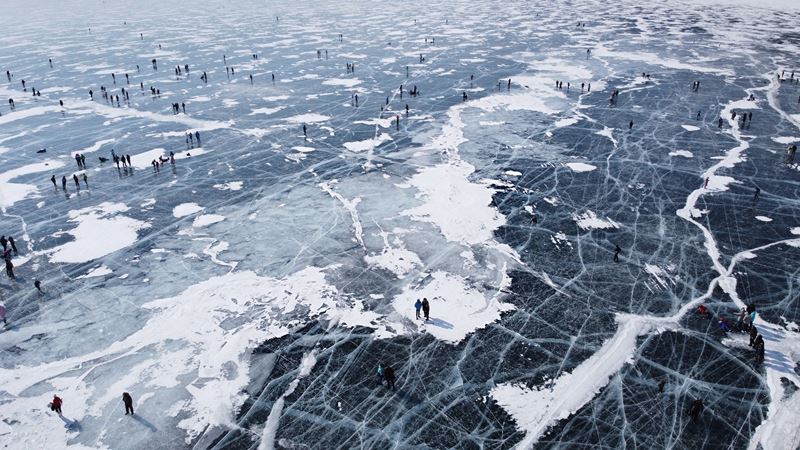
The ice in the Siberian UNESCO World Heritage site is famously clear, with cracks weaving through the deep blue depths like white veins. Small air bubbles below its surface are visible. During Russia’s winter months, cars can safely drive on it for hours.

On Monday, Baikal hosted a hockey match, called the “Last Game” intended to bring awareness to climate change and also how to safeguard the lake itself with its unique ecosystem.

Weekends draw throngs of visitors to the clear ice of Russia's Lake Baikal. MUST CREDIT: Photo for The Washington Post by Elena Anosova

Weekends draw throngs of visitors to the clear ice of Russia’s Lake Baikal. MUST CREDIT: Photo for The Washington Post by Elena Anosova

But the event was met with some eye rolling from local environmental activists. The Russian government – which backed the hockey event – also has rolled back regulations this year protecting the lake. Now allowed are development projects that pose a risk to previously untouched areas among other actions.

“People in our country have woken up, and they’re worried about [the environment],” said Viacheslav Fetisov, a Hockey Hall of Famer and the Russian ambassador to the U.N. Environment Programme. “But what we don’t need is to engage in extremism either.” | Along with Fetisov, the Baikal game featured former Russian hockey stars Valeri Kamensky and Alexei Kasatonov. Other notable guests included British and Portuguese diplomats as well as local government officials. Fetisov’s team won.

“I think this was the best game of my career,” he said with a chuckle. “Most importantly, the rink was made with love.”

Russian hockey stars take to the ice on Lake Baikal for the "Last Game" It was intended to bring awareness to climate change and also how to safeguard the lake itself with its unique ecosystem. MUST CREDIT: Photo for The Washington Post by Elena Anosova

Russian hockey stars take to the ice on Lake Baikal for the “Last Game” It was intended to bring awareness to climate change and also how to safeguard the lake itself with its unique ecosystem. MUST CREDIT: Photo for The Washington Post by Elena Anosova

The playing surface was outlined with a clear ice wall. Like many days on Lake Baikal – about 2,700 miles east of Moscow – it was sunny, but the wind made it feel like 14 degrees. The ice occasionally crackled under the weight of a crowd that had the afternoon off for International Women’s Day, a national holiday in Russia.

“The ice is speaking,” said Alyona Trubnyakova, a volunteer who works as a tour guide in the region.

Once the game was over, people frolicked far across the frozen. Some set up picnics of hot tea and snacks while others took their dogs for a walk across the ice.

Tourists all over the region wonder at the lake’s clarity. Some camp on it. Others take long walks or bike rides. Wagons, called bukhankas, transport up to eight passengers at a time along a makeshift road on the ice, stopping to peek inside the many ice caves on the way.

Monday’s game was a mostly local crowd, the very audience that cares most about the lake’s future.

“Everyone today has to work on the very important issue of preserving this great Lake Baikal,” Fetisov said before the game.

Million-dollar showrooms in malls are the new battleground for China EVs #SootinClaimon.Com

#SootinClaimon.Com : ขอบคุณแหล่งข้อมูล : หนังสือพิมพ์ The Nation.

https://www.nationthailand.com/news/30403516

Million-dollar showrooms in malls are the new battleground for China EVs

InternationalMar 10. 2021Shoppers stand in front of the Tesla Inc. showroom at the Chamtime Plaza in Shanghai on March 8, 2021. MUST CREDIT: Bloomberg photo by Qilai ShenShoppers stand in front of the Tesla Inc. showroom at the Chamtime Plaza in Shanghai on March 8, 2021. MUST CREDIT: Bloomberg photo by Qilai Shen

By Syndication Washington Post, Bloomberg

China’s electric-car makers are paying top-dollar rents to open showrooms in luxury malls as they seek an edge in the hypercompetitive market.

More than half the malls in Shanghai have at least one electric-vehicle showroom and more are planned, according to real-estate service provider Jones Lang LaSalle Inc. They are now part of the “standard configuration” of shopping centers in medium-to-large cities, the firm said in a recent report.

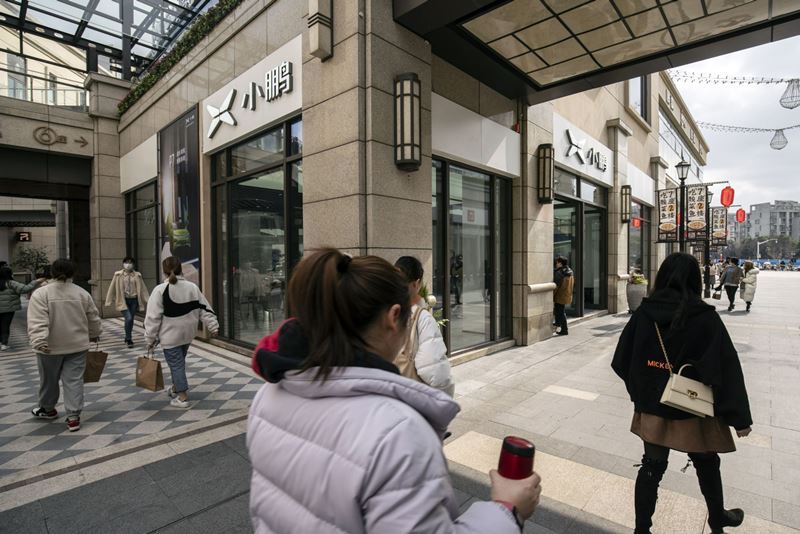
With dozens of EV makers in various stages of development jockeying for a slice of what is the world’s largest EV market, upstart brands like Nio Inc. and Xpeng Inc., and the new-energy arms of SAIC Motor Corp. and Geely Automobile Holdings Ltd., are staking out ground in malls to burnish their image as premium goods for the middle class and differentiate themselves from more established automakers. Rents for a 2,150- to 3,230-square-foot (200- to 300-square-meter) showroom in prime areas of China’s biggest cities run to around $1 million a year, according to JLL.

“They pay big rent because they want to be seen,” said Zino Helmlinger, head of retail in eastern China at real estate firm CBRE Global Inc. “In China, you have many EV brands competing for a still very small market share, and every two to three months there’s a new car released. It’s crazy.”

The influx of EV makers to shopping centers is also a boon for mall owners who are looking for a new breed of tenants as sales of shopping center drawcards like clothes, shoes and electronics increasingly shift online. EV makers tend to want space on the first floor — which is also usually the most expensive — to attract passing shoppers, and also for ease of access for display cars and test drives.

“There’s an overlap between the target consumer groups of electric vehicles and premium commercial developers,” said Vivian Zhu, director of retail at JLL Shanghai. “Those middle-class visitors who tend to shop for cosmetics or luxuries on the ground floor are also regarded as potential buyers for a Tesla or Nio.”

Shoppers pass the XPeng Inc. showroom at the Chamtime Plaza in Shanghai on March 8, 2021. MUST CREDIT: Bloomberg photo by Qilai Shen

Shoppers pass the XPeng Inc. showroom at the Chamtime Plaza in Shanghai on March 8, 2021. MUST CREDIT: Bloomberg photo by Qilai Shen

Electric-vehicle demand in the world’s biggest car market is forecast to soar in coming years as consumers embrace cleaner automobiles and the cost of EVs tumbles. Research firm Canalys said in a report last month that EV sales in China may climb more than 50% in 2021.

Read more: Xpeng Posts Shrinking Losses as EV Deliveries Rise

To be sure, the likes of Nio are stepping back from the splashy club-style “Nio House” showrooms that sought to embed the carmaker into a customer’s life, after burning through cash. Its flagship Shanghai outlet, opened in the upscale HKRI Taikoo Hui mall in 2017 before it even started mass production, included a library, art gallery and open kitchen to entice customers with a high-end lifestyle that would come from buying one of its cars.

It signed a five-year lease, with monthly rent starting at 1.1 million yuan ($170,000) and rising to 1.7 million yuan in 2021, according to a public court document.

Read more: EVs Could Make Dealerships a Thing of the Past

It has since focused on opening smaller Nio Spaces, which are about a tenth of the size of the Nio Houses and more akin to a typical showroom, without the added lifestyle benefits. It plans to open about 120 this year. Having temporarily suspended developing more Nio Houses during a cash crunch that threatened to sink the company, it now plans to open 20 more this year.

“We have significantly lowered the operating cost of Nio Houses,” Chief Finance Officer Steven Feng said on an earnings call last week, when the company reported a wider-than-expected loss. “It’s only about 40% of the original cost.”

The expansion of showrooms into malls “is in line with automakers’ product development,” said JLL’s Zhu. Those that have missed their original targets for product launches or mass production have faded from key city areas. What was once the Shanghai display room for Byton Ltd., which has delayed production plans several times, now houses the flagship store for Xpeng, which delivered more than 27,000 vehicles last year.

“EV companies are now way more cautious with the location they open,” said CBRE’s Helmlinger. “Three years ago they were trying to break the market. Now, they’re very selective with the mall. It’s quality over quantity.”

Haunted by 2008, China and U.S. diverge on stimulus plans #SootinClaimon.Com

#SootinClaimon.Com : ขอบคุณแหล่งข้อมูล : หนังสือพิมพ์ The Nation.

https://www.nationthailand.com/news/30403515

Haunted by 2008, China and U.S. diverge on stimulus plans

InternationalMar 10. 2021The U.S. and Chinese national flags. MUST CREDIT: Bloomberg photo by Tomohiro OhsumiThe U.S. and Chinese national flags. MUST CREDIT: Bloomberg photo by Tomohiro Ohsumi

By Syndication Washington Post, Bloomberg · Christopher Anstey, Enda Curran, Rich Miller

The U.S. and China are pursuing divergent economic policies in the aftermath of the coronavirus recession in a role reversal from last time the world economy was recovering from a shock.

One of the takeaways from the annual National People’s Congress underway in Beijing is a conservative growth goal, with a tighter fiscal-deficit target and restrained monetary settings. That’s a big contrast with Washington, where President Biden is preparing a second major fiscal package after he gets final approval for his $1.9 trillion stimulus.

The widening policy divergence is putting strains on exchange rates and could potentially reshape global capital flows. It stems, in part, from different policy lessons from the 2007-09 crisis.

A stunted and choppy U.S. recovery left key Democrats concluding it’s vital to “go big” on stimulus and keep it flowing. For monetary policy the moral was: “Don’t hold back” and “don’t stop until the job is done,” Federal Reserve Chair Jerome Powell said last week.

China’s leaders have a different take. A massive unleashing of credit growth back then led to unused infrastructure, ghost towns, excess industrial capacity and an overhang of debt. While rapid containment of the pandemic meant the economy didn’t need as much help in 2020, President Xi Jinping and his team are now winding things back to refocus on longer-term initiatives to strengthen the technology sector and tamp down debt risks.

“Each learned a lesson from the previous episode, and so it is kind of a swap of positions,” said Nathan Sheets, head of global economic research at PGIM Fixed Income and a former U.S. Treasury undersecretary for international affairs. The policy mix now makes “a compelling case for renminbi appreciation,” Sheets said.

That’s a view that’s widely shared: the median forecast in a Bloomberg survey is for a strengthening to 6.35 against the dollar by the end of the year, from 6.5114 in Shanghai late Tuesday.

One of China’s financial regulators, Guo Shuqing, highlighted in a briefing just days before the opening of the annual legislative gathering that high leverage within the financial system must continue to be addressed. Guo pointed to worries about inflated property prices and the risk of overseas money pouring in to take advantage of the premiums China’s assets offer. He also indicated the nation’s lending rates will likely go up this year.

While U.S. Treasury yields have surged recently, 10-year rates remain less than half those in China, where the central bank has forsworn Western-style zero interest rates or quantitative easing.

“Unlike many of its peers, including the Fed, China’s central bank has continued to calibrate its policy partially with a view to prevent an excessive rise in asset prices,” said Frederic Neumann, co-head of Asian economics research at HSBC Holdings Plc in Hong Kong. Confronted with currency-appreciation risks, China will be hoping for a “well-timed exit from the Fed’s ultra-ease stance.”

That’s unlikely to come soon. In three appearances in the past two weeks, Powell has made clear the Fed is going to keep policy rates near zero until well into the economic recovery, when most jobless Americans are brought back into employment. He also gave no indication asset purchases will be tapered as Biden’s fiscal stimulus kicks in in coming months.

As China contends with capital inflows, the U.S. is likely to be pumping out a greater supply of dollars into the global economy — via a widening current-account deficit — as its growth revs up, supercharged by Biden’s stimulus and the Fed’s easy stance.

“There’s been a regime break,” in the U.S. with the outsize Biden relief bill and a planned longer-term follow-up, said Robin Brooks, chief economist at the Institute of International Finance. As growth soars past 6% this year, a wider current-account deficit will be “the pressure valve” given domestic production constraints, he said.

Brooks projects that deficit will hit 4% of gross domestic product this year. That would be the highest since large shortfalls during the 2002-08 period, when a broad measure of the dollar tumbled as much as 27%.

“As our fiscal support goes into uncharted territory, it puts enormous pressure on our budget deficits — and by inference our domestic saving rate and the current account and trade deficit, with the consequences primarily falling on the currency,” said Stephen Roach, a Yale University senior fellow and former chairman of Morgan Stanley Asia.

China’s reluctance toward the kind of “go big” message of Treasury Secretary Janet Yellen dates back many years. After unleashing a fiscal package of $586 billion at the time (4 trillion yuan) and an unprecedented surge in broader credit after the 2008 crisis, Beijing by 2012 was saying it wouldn’t do that again.

Reticence toward across-the-board stimulus later turned into a concerted push to rein in leverage. A May 2016 front-page treatise in the People’s Daily — the Communist Party’s mouthpiece — blasted excessive debt as the “original sin” sowing risks across financial and real-estate markets. The anonymous article — widely said to have been written by Vice Premier Liu He, Xi’s top economic adviser — called stimulating the economy through easy monetary policy a “fantasy.” So with the country’s success in applying draconian restrictions to contain the coronavirus, it should come as little surprise that Beijing is returning toward its pre-pandemic focus on building domestic tech capabilities and managing down debt risks.

After ditching an annual growth target for 2020 given the turmoil caused by Covid-19, China’s leadership set a goal of a GDP increase of more than 6% this year — conservative since it’s well below economists’ projections for this year’s expansion.

In the meantime, surging American GDP gains are set to lift China’s prospects as well. Exports to the U.S. soared more than 87% in the first two months of this year compared with the pandemic-hit period a year before, faster than China’s overall rise of just under 61%.

“The U.S. locomotive is back on track,” said Catherine Mann, global chief economist at Citigroup Inc.

Russia secures Sputnik production in Italy for vaccine push #SootinClaimon.Com

#SootinClaimon.Com : ขอบคุณแหล่งข้อมูล : หนังสือพิมพ์ The Nation.

https://www.nationthailand.com/news/30403512

Russia secures Sputnik production in Italy for vaccine push

InternationalMar 10. 2021Vials of the Russian Sputnik V Covid-19 vaccine sit at a Comprehensive Diagnostic Center in Caracas, Venezuela, on Feb. 25, 2021. MUST CREDIT: Bloomberg photo by Carolina Cabral.Vials of the Russian Sputnik V Covid-19 vaccine sit at a Comprehensive Diagnostic Center in Caracas, Venezuela, on Feb. 25, 2021. MUST CREDIT: Bloomberg photo by Carolina Cabral.

By Syndication Washington Post, Bloomberg · Alessandro Speciale

Russia is pushing ahead with plans to make its Covid-19 vaccine in Europe, securing a deal to produce the Sputnik V shot in Italy and discussing production in Germany and France.

Adienne Pharma & Biotech signed an agreement to manufacture the vaccine at its production site in the Milan region, founder and President Antonio Francesco Di Naro told Bloomberg in an interview.

The Lugano, Switzerland-based company’s deal with the Russian Direct Investment Fund is the first European production agreement for the vaccine. While Russia was first to approve a shot for the general public and promoted it as a way to help end the pandemic globally, it has been slower than some rivals to scale up output.

Sputnik is more complicated to manufacture than some other vaccines because it’s based on two different adenoviruses for its two doses. Developers taking a similar approach, such as the University of Oxford and AstraZeneca, have used only one virus.

The vaccine is under review by authorities in the European Union, which has struggled to ramp up inoculations amid a lack of supply. The sluggish rollout has prodded some countries to consider their own purchasing deals in a challenge to the bloc’s solidarity.

“There are many Italian regions which are enthusiastic about having Sputnik, they would also want to produce it,” Kirill Dmitriev, CEO of RDIF, a sovereign wealth fund, told Italian Rai3 television on Sunday. “We have a partnership in Germany. We’re talking to several French companies.”

Sputnik’s developers have had contact with German vaccine maker IDT Biologika, according to IDT spokesman Ulrich Gartner, who confirmed a report by German broadcaster MDR. He said that the company cannot comment on the details of ongoing talks with potential customers.

IDT, based in the state of Saxony-Anhalt, signed a letter of intent last month to help Astra boost supply of its vaccine.

Dmitriev, who is in charge of Sputnik’s international rollout and backed its development, said in the Italian TV interview that production in the country could start in June. The timing depends on approval from Italian regulators, and Di Naro said he couldn’t set production targets as of now.

EU officials are skeptical about the impact of these deals, according to a person with knowledge of their thinking. Supply in Russia is so low that the EU is expecting to donate or sell large quantities of Western vaccines to the Russians in due course to make up the shortfall, said the person, who didn’t want to be identified because the discussions are private.

The deal comes as Prime Minister Mario Draghi pledged to speed up Italy’s fledgling vaccination campaign amid a new rise in infections from the disease that’s led to more than 100,000 fatalities in the country.

Draghi blocked the export of Astra’s vaccine earlier this month after the company sharply reduced planned deliveries to the EU. He was the first European leader to use the recently-introduced powers, highlighting the sensitivity in the region over the supply of Covid-19 shots.

European Commission President Ursula von der Leyen on Monday lashed out at manufacturers for failing to uphold their commitments as countries in Europe struggle to step up the pace of inoculations.

Officials are also bracing for delays in the delivery of a new vaccine from Johnson & Johnson, according to two people with knowledge of the process.

The shots, which are due to be approved by the European Medicines Agency this week, were due to start arriving at the beginning of April but now aren’t expected until the middle of the month at the earliest, one of the officials said.

The EU has administered 9.35 doses per 100 people, compared with nearly 28 for the U.S. and more than 35 for the U.K., according to Bloomberg’s Coronavirus Vaccine Tracker.

The European Medicines Agency said March 4 that it started a rolling review of Sputnik V to test compliance with safety and quality standards, the first major step in gaining approval for use in the European Union. The Russian vaccine started to gain broader international recognition after The Lancet medical journal published peer-reviewed results of interim trials showing 91.6% efficacy.

Despite the progress, it’s unclear what role political tension would play in the distribution of the Sputnik vaccine in Europe. Tensions between Russia and the EU have deteriorated further in recent months, especially after the jailing of opposition leader Alexey Navalny.

In a sign of the tensions, the shot’s developer took to Twitter to demand an apology from an EMA official over comments that “raise serious questions about possible political interference” in the agency’s review.

Christa Wirthumer-Hoche, EMA’s management board chairwoman, told Austrian broadcaster ORF late Sunday that national emergency authorizations are like “Russian roulette.”

Hong Kong minister warns against ‘oblivious’ criticism of China #SootinClaimon.Com

#SootinClaimon.Com : ขอบคุณแหล่งข้อมูล : หนังสือพิมพ์ The Nation.

https://www.nationthailand.com/news/30403511

Hong Kong minister warns against ‘oblivious’ criticism of China

InternationalMar 10. 2021Teresa Cheng, Hong Kong's secretary for justice, during an interview in Hong Kong on March 9, 2021. MUST CREDIT: Bloomberg photo by Paul YeungTeresa Cheng, Hong Kong’s secretary for justice, during an interview in Hong Kong on March 9, 2021. MUST CREDIT: Bloomberg photo by Paul Yeung

By Syndication Washington Post, Bloomberg · Iain Marlow, Stephen Engle

Hong Kong’s top legal official warned residents to steer clear of criticisms of the government that stray too far from the facts as officials defend Beijing’s plan to overhaul the city’s elections.

Hong Kong Justice Secretary Teresa Cheng said in an interview Tuesday that opinions were “no more than an utterance of no value” if the facts weren’t established. Cheng was answering a question about what kind of criticism would be legal in the former British colony as Beijing implements a range of legal changes including a national security law and the electoral overhaul.

“Some of the statements that are sometimes uttered, that we hear, are actually not based on facts, or perhaps oblivious of the facts that exist,” Cheng told Bloomberg Television. “And I think that is what one has to be very careful not to embark upon.”

Officials in Beijing and Hong Kong are fanning out to defend the most significant changes to the city’s political system since its return to Chinese rule in 1997. Chinese lawmakers are expected to approve a sweeping electoral overhaul later this week that will require future candidates for elected office to be “patriots” and secure nominations from a pro-Beijing committee.

An official in China’s Foreign Ministry office in Hong Kong provided the clearest definition yet of what that quality entails, saying, “Patriots should respect the Chinese Communist Party.”

“Anyone who challenges the fundamental system of the state and undermines Hong Kong’s constitutional order does not count as a true patriot,” said Song Ru’an, a deputy commissioner in the office.

Beijing’s moves, including its imposition of a national security law on Hong Kong outlawing speech deemed subversive or secessionist, have been criticized by the U.S. and U.K. as a violation of China’s treaty commitment to maintain the city’s “high degree of autonomy.” On Monday, a bipartisan group of U.S. lawmakers, including Senators Ed Markey and Mitt Romney, called on the Biden administration to work with allies and partners to support the people of Hong Kong.

Cheng, who was among senior officials sanctioned by the U.S. Treasury in August on allegations of “undermining Hong Kong’s autonomy,” on Tuesday reiterated the government’s argument that the security law had restored stability. “Please look at the actual facts and then see what’s happening in Hong Kong,” she said in response to the lawmakers’ statement.

Hong Kong authorities have so far arrested 100 people on allegations of violating the security law, with most accused of participating in some form of political activity, such as displaying banners or posting in support of the city’s independence. The total includes 47 opposition figures charged last week with “conspiracy to commit subversion” over their aborted “35-plus” election campaign last year to win a majority on the Legislative Council and force Chief Executive Carrie Lam to resign by voting down her budget.

The electoral overhaul would go further by making it harder to for such opposition politicians to seek and win office, effectively ending the only open elections under Beijing’s rule. Lam said Monday that the proposal being drafted behind closed doors in Beijing would be locally enacted without the usual public consultation process.

“The political structure is no longer ensuring the governance of the — the efficacy of — of the whole administration into a proper efficient way that serves the people in Hong Kong,” Cheng said. “And it is for that reason that the National People’s Congress sees the pressing need for that to be taken.”

Cheng, who sits on the security committee established by the law, declined to explain why “35-plus” campaign constituted subversion, saying she couldn’t comment on specific cases. “We should move away from this topic and talk about other things, because we cannot talk about a case,” Cheng said.

She also rejected as “totally absurd” criticism that the national security law had undermined the independence of Hong Kong’s judiciary. “There is no threat on the judicial independence — and I say it loud and clear and with confidence,” Cheng said.

In December, the Communist Party’s People Daily newspaper published a commentary warning that the government could transfer media tycoon Jimmy Lai’s foreign collusion case to mainland courts after a decision to grant him bail. Lai was later sent back to jail after Hong Kong’s highest court affirmed a higher standards for releasing security law suspects before trial.

The security law lets Cheng issue certificates requiring some cases to be tried without a jury, a power that local media including the South China Morning Post say she exercised to prosecute an activist accused of driving a motorcycle into a group of police officers in July. Cheng said the power would be “exercised independently and fairly and without any interference” and that a three-judge panel would uphold defendants’ rights.

“One talks about ‘no jury’ as if it’s something that is such a big, worrying thing,” Cheng said. “We’re going to write down the reasons, and the, and the findings of fact and the legal basis upon which the conclusion of the verdict — be it convict or acquit — is going to be.”

How Africa can save the world from a never-ending pandemic #SootinClaimon.Com

#SootinClaimon.Com : ขอบคุณแหล่งข้อมูล : หนังสือพิมพ์ The Nation.

https://www.nationthailand.com/news/30403510

How Africa can save the world from a never-ending pandemic

InternationalMar 10. 2021A coronavirus testing unit sign is displayed outside Groote Schuur hospital in Cape Town, South Africa, on Jan. 11, 2021. MUST CREDIT: Bloomberg photo by Dwayne Senior.A coronavirus testing unit sign is displayed outside Groote Schuur hospital in Cape Town, South Africa, on Jan. 11, 2021. MUST CREDIT: Bloomberg photo by Dwayne Senior.

By Syndication Washington Post, Bloomberg · Antony Sguazzin

As the rest of the world prepares for a vaccine-driven return to normal over the next few months, at her community health center in a poor, working class neighborhood of Cape Town, Andrea Mendelsohn is dreading the arrival of April and May – that’s when the weather will get cooler in the southern hemisphere and bring a surge in coronavirus cases.

Few people in South Africa – aside from medical staff like Mendelsohn – will be vaccinated by then. Elsewhere on the continent even health workers won’t be inoculated, making Africa a large reservoir of the virus that has infected almost 117 million people across the globe and killed more than 2.5 million.

“The arrival of vaccines is going to have zero impact on the third wave but at least I can be confident that when I go to work I won’t die,” Mendelsohn, a senior medical officer in the Western Cape Province’s Department of Health, said in an interview. “I am sure health workers in Malawi and Tanzania want to have the same relief.”

Most countries in Africa have yet to start inoculating their citizens. While developed countries have rushed to vaccinate their populations against Covid-19, fewer than half a million people have received shots in Sub-Saharan Africa, a region of 1.1 billion people. In contrast, the U.S., with a population of about 330 million, has administered over 90 million vaccine doses, while more than a third of the U.K.’s 67 million people have gotten at least one shot.

But anyone in the developed world who thinks they are unaffected by large swaths of un-vaccinated people in Africa needs to think again, says Phionah Atuhebwe, the New Vaccines Introduction Medical Officer on the continent for the World Health Organization. As long as the pandemic continues to rage among un-vaccinated populations, spawning new, more virulent, vaccine-resistant strains, no one is safe, she said.

“The virus will definitely mutate and will keep mutating; the longer we keep the virus around the more mutations we’ll see,” Atuhebwe said in an interview from Brazzaville, in the Republic of Congo. “If Africa is not vaccinated and we are a source of mutations, we put the whole world at risk.”

Already the vaccine developed by AstraZeneca and the University of Oxford has proved largely ineffective in preventing mild disease from infections with a strain of the virus first identified in South Africa. That mutation has spread to at least 48 countries, including the U.K. and the U.S.

Rich nations pre-paid for their vaccines and also got organized quicker and earlier, leaving countries in Africa scrambling for scraps. The affluent world’s vaccine grab was characterized in January by WHO Director-General Tedros Adhanom Ghebreyesus as a “catastrophic moral failure.” Just 10 countries administered 75% of all vaccinations, United Nations Secretary-General Antonio Guterres said in February, calling it “wildly uneven and unfair.”

A report by anti-poverty group One said last month that the world’s richest countries are on track to accumulate over 1 billion more doses than they need to fully vaccinate their populations, adding that the excess shots alone would be sufficient to inoculate the entire adult population of Africa.

“It’ll be a fatal mistake if the developed world sees this as a case where we’ll vaccinate our people and then people in other parts of the world take care of their own business,” said John Nkengasong, director of the Africa Center for Disease Control and Prevention. “Covid won’t be defeated until it’s defeated everywhere.”

The mad dash to corner vaccines shows rich countries have learned little from the global swine flu pandemic in 2009, when poor nations were left high and dry, says Helen Rees, chairwoman of the South African Health Products Regulatory Authority. Despite the heightened risk of the virus spreading with increased interconnectedness, “there was not a thought about what would happen to the rest of the world,” she said.

Countries from Nigeria to Ethiopia and Zimbabwe have large numbers of their citizens living and working in Europe, North America and even Asia, and regular flights mean that just as easily as the virus arrived in Africa from Europe, mutated strains could be spread into the developed world by returning travelers.

In addition, a slow vaccine rollout could further delay the economic recovery in Africa, which contracted for the first time in 25 years last year. Already, Zambia has defaulted on its debt and Ethiopia and Chad are seeking debt relief. The developed world relies on the continent’s natural resources for much of the raw materials it needs. West Africa accounts for 60% of the world’s cocoa supply, the Democratic Republic of Congo is the key source of cobalt needed for electric vehicles and tantalum used in mobile phones. South Africa is the world’s biggest source of platinum.

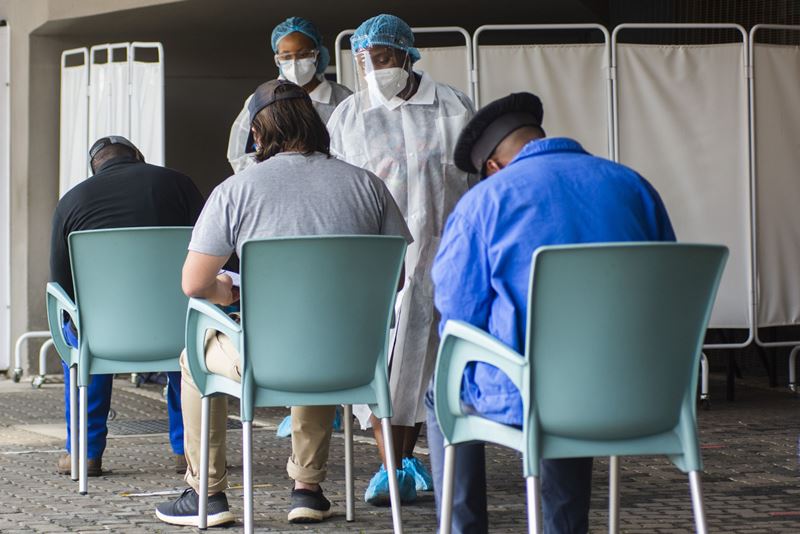
Health workers register patients at a Covid-19 testing station in Johannesburg, South Africa, on Feb. 10, 2021. MUST CREDIT: Bloomberg photo by Waldo Swiegers.

Health workers register patients at a Covid-19 testing station in Johannesburg, South Africa, on Feb. 10, 2021. MUST CREDIT: Bloomberg photo by Waldo Swiegers.

Vaccines are slowly trickling into Africa. The African Union has secured some supplies, China has provided vaccines to Zimbabwe and other African nations and countries such as Israel are beginning to donate excess supplies. Still, most African countries are almost entirely reliant on Covax – the initiative backed by the WHO, the vaccine alliance Gavi and the Coalition for Epidemic Preparedness Innovations that offers vaccines cheaply to developing countries. Covax began distributing vaccines to countries such as Ghana and the Ivory Coast last month.

But the program will only cover 20% of the populations of its members by year-end. Of the 304 million doses administered worldwide so far, fewer than 0.2% have been in Sub-Saharan Africa, home to 14% of the world’s population.

Richer nations are beginning to acknowledge that poorer countries need better access to vaccines. In an interview with the Financial Times in February, French President Emmanuel Macron called the vaccine gap “an unprecedented acceleration of global inequality.” At their meeting last month, leaders of the G7 countries pledged $7.5 billion to Covax and also called on countries to donate surplus supplies.

Granted, African governments haven’t helped themselves. Few made attempts to secure supplies directly from pharmaceutical companies, with South Africa – which has a wealth of medical expertise and is the site of five coronavirus vaccine trials – only signing deals this year.

“The bulk of the blame should be placed on African leaders for being somewhat nonchalant and non-proactive,” said Ifeoluwapu Asekun-Olarinmoye, an epidemiologist at Nigeria’s Babcock University.

That’s in part because the official Covid-related death toll across Africa is just under 106,000 with almost 4 million cases reported, small compared to the rest of the world. But testing has been sparse and many infections and deaths have gone unrecorded. At times over the last few months hospitals from Cape Town to Harare and Lagos have groaned under the strain. Doctors and oxygen have been in short supply and people have taken to social media to search for beds for their afflicted relatives.

With vaccines beginning to arrive, other challenges are coming to the fore. The continent is plagued by poor health infrastructure, a shortage of trained personnel and inadequate data on the people who need to be vaccinated.

Take Nigeria, for instance. Africa’s most populous nation has about 214 million people, most living in areas that are hard to reach. Fewer than a third of the country’s 195,000 kilometer (121,170-mile) road network is paved; power supply – even in the biggest cities – is unreliable, making it a challenge to keep vaccines refrigerated; and a 15-year gap since the last census means the government has little idea about the whereabouts of vulnerable groups like the elderly. The same applies to many African countries.

“We don’t know where they live, we don’t know how many there are, we don’t know how to find them,” Atuhebwe said in a webinar.

In countries like Tanzania virus denial is holding back attempts to immunize the population. President John Magufuli has declared his country Covid-free even as people continue to die from it. Vaccine skepticism runs high in some countries, with 15 high school students taken to hospital in south-west Cameroon last month after leaping from the second floor to escape what they thought was a team of medics arriving to vaccinate them.

Meanwhile, some shots – like Russia’s Sputnik V and vaccines from China’s CanSino Biologics – have sparked concern. They use a cold germ to carry the genetic material of the Covid virus into patients’ cells to trigger an immune response. A trial in South Africa of an HIV vaccine using the same vector more than a decade ago was tied to an increase in HIV infections. South Africa has the world’s biggest AIDS epidemic and many of its neighbors have similar infection rates.

Even when vaccines are suitable, some African countries can’t afford shots outside the Covax system. Since African countries didn’t contribute to the development of the shots and didn’t pre-order, they don’t get the discounts offered to richer countries. In January, Anban Pillay, a deputy director general in South Africa’s Department of Health, said the country would pay $5.25 per dose of AstraZeneca’s shot compared with about $3 the European Union was paying.

All that has meant a very slow pace of vaccination. South Africa, the continent’s most developed country, is inoculating at most about 11,000 people a day with the single-dose Johnson & Johnson shot, a pace that would take a decade to cover the 40 million people the government wants to vaccinate. Most vaccines available to African nations require two shots. If a double-dose regime is followed and 780 million Africans inoculated over 12 months to attain herd immunity, there would need to be 7 million vaccinations a day, according to Ernest Darkoh, founder of Cape Town-based Broadreach Group, which works with governments on healthcare.

That’s unlikely to happen without a lot of help.

“The whole world needs to walk this journey together,” said Mmboneni Muofhe, a deputy director general at South Africa’s Department of Science and Technology. “We are going to find ourselves sitting with a variant that defies all the vaccines. We are sitting on a ticking time bomb.”

Night raid on Myanmar protesters draws international alarm #SootinClaimon.Com

#SootinClaimon.Com : ขอบคุณแหล่งข้อมูล : หนังสือพิมพ์ The Nation.

https://www.nationthailand.com/news/30403509

Night raid on Myanmar protesters draws international alarm

InternationalMar 10. 2021

By Syndication Washington Post, Bloomberg

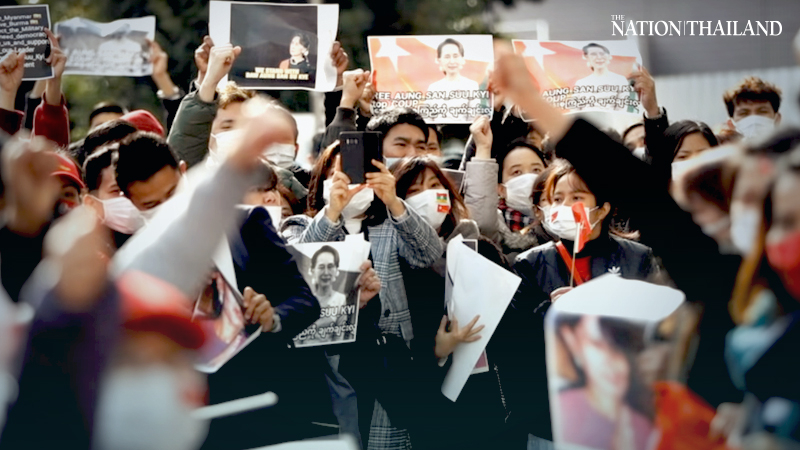
Myanmar authorities cordoned off part of the commercial capital of Yangon on Monday night while searching for student protesters, drawing international condemnation as crowds defied a curfew to resist the crackdown.

Embassies of the U.S., U.K., Canada, Germany and others sent tweets late Monday warning that security forces had surrounded a group of young people in the Sanchaung neighborhood of Yangon. People in surrounding areas swarmed the streets as videos of the situation spread on social media.

By midnight, there were no reports of deaths from the standoff, the Associated Press reported. Security forces chased crowds, fired stun grenades and harassed residents watching from their windows, it said. Myanmar has regularly shut down the internet in the early-morning hours, making it difficult to get information.

Residents said security forces used sound bombs, slingshots, tear gas shells and fired warning shots to disperse several hundred peaceful protesters in the Sanchaung area.

“They blocked all the four main roads so these protesters had nowhere to go but to run into nearby apartments and hide inside the apartments with the support of house owners,” resident Zaw Moe Aung said. “They were raising their voices very peacefully, chanting to release detained leaders and immediately end the military dictatorship.”

The troops, who stayed in the neighborhood late into the night, also threatened to enter home and buildings to search for the demonstrators, according to Myo Win Maung, who witnessed the scenes but eventually left after locals and people from other Yangon neighborhoods poured into the streets to protect the protesters.

Aung San Suu Kyi’s National League for Democracy issued a statement in support of the protesters and decried the violence, saying, “We warn against such efforts which must end soonest.”

“The Embassy is very concerned about reports of many young people being trapped in Sanchaung and other parts of Yangon,” the German Embassy in Yangon said. “We urgently appeal to the security forces to abstain from the use of force and detentions against residents and others, and to let all peaceful protesters return to their homes immediately.”

The military government of Myanmar, also known as Burma, also moved to close five local media outlets reporting on the protests. An order from the junta-appointed information minister revoked the licenses of Mizzima, DVB, 7Day News, Myanmar Now and Khit Thit Media, banning them from publishing any content.

Junta chief Min Aung Hlaing accused media outlets of misleading the international community, saying that security authorities used minimal force against protesters. He put the death toll at 34, about half of the figures reported by local media outlets, according to a broadcast on state-run MRTV.

The general also said the detention of Sean Turnell, an Australian economic adviser to detained former leader Aung San Suu Kyi, had revealed some state economic secrets. “We managed to detain Sean Turnell in time when he’s about to leave the country,” Min Aung Hlaing was quoted as saying.

Australia, which suspended defense cooperation with Myanmar after the coup, has demanded Turnell’s release.

U.S. prepares to send checks, but big stimulus challenges loom #SootinClaimon.Com

#SootinClaimon.Com : ขอบคุณแหล่งข้อมูล : หนังสือพิมพ์ The Nation.

https://www.nationthailand.com/news/30403508

U.S. prepares to send checks, but big stimulus challenges loom

InternationalMar 10. 2021Joe BidenJoe Biden

By The Washington Post · Tony Romm, Jeff Stein, Rachel Siegel

WASHINGTON – Congress is set to give the final green light to a $1.9 trillion coronavirus stimulus package Wednesday, setting in motion a Washington-wide effort to administer one of the largest economic relief packages in U.S. history.

Over the coming weeks, the Biden administration may send another round of one-time checks to millions of families, rethink vast portions of the U.S. tax code and dole out sums to help cash-strapped Americans, seeking to swiftly blunt an economic crisis that has left millions without jobs and falling further behind financially.

Biden and his aides have promised that a large number of Americans could receive their $1,400 stimulus payments before the end of March. But some of the other ambitious elements of the soon-to-be law – including new child tax support, aid to local governments and money to help families pay rent – could take much longer to disburse. The sheer volume of new programs threatens to swamp federal agencies, including the Internal Revenue Service, leaving some lawmakers fearful about early delays.

Congressional aid packages that became law over the past year have proved instrumental in helping the country rebound from one of the worst economic crises since the Great Depression. But the federal bureaucracy at times has strained to deliver some of that support in a tight time frame. Few Americans have benefited so far from the $25 billion in rental and utility assistance that lawmakers approved in December, housing experts said, and other programs to help workers and businesses pay their bills have not yet fully come online.

“Implementation is the ballgame. You can have the best priorities in the world, whether it’s the well-being of children [or] the needs of those who have been laid off of no fault of their own,” said Sen. Ron Wyden, D-Ore., the chairman of the Senate Finance Committee. “It doesn’t mean a whole lot if you can’t get the benefits out so people can make ends meet.”

The White House did not respond to a request for comment.

The challenges ahead reflect the high stakes facing Biden as he prepares to sign his first major legislative accomplishment into law this week. The president’s economic agenda and political legacy – and the trajectory of the country’s recovery from the pandemic – will depend on the ability of the federal government to get the next few months right.

Dubbed the American Rescue Plan, the $1.9 trillion package marks the sixth major stimulus adopted by Congress since the coronavirus arrived in the United States last year. Democrats this week have hailed it as the largest anti-poverty measure in a generation, and top White House officials in recent days have fanned out to tout its potential – and the party’s early efforts to meet its 2020 campaign promises to deliver economic relief.

The president on Tuesday toured a local hardware store that had benefited from a loan under a prior stimulus initiative, the nearly $1 trillion Paycheck Protection Program, adopted last year. Bharat Ramamurti, the deputy director of the National Economic Council, later said at a White House briefing that the administration’s efforts alone had helped almost 200,000 first-time borrowers obtain loans. He said the new stimulus would serve as a “big step” toward recovering some of the roughly 10 million jobs still lost as a result of the pandemic.

“We promised to send people back to work by helping to revive and supercharge the economy – mission accomplished,” said Rep. Hakeem Jeffries, D-N.Y., heralding the stimulus on Capitol Hill for delivering on commitments made to voters last year to provide swift, robust relief. “We promised to help small businesses – mission accomplished.”

Republicans criticized the bill, days after every GOP senator voted against the measure this weekend. Many noted that significant sums from past stimulus measures remain unspent, making the new injection of federal aid set to be authorized by the House on Wednesday morning unnecessary in their eyes.

“We can’t just keep borrowing money; that’s why we wanted a narrower approach to covid relief, including using the existing hundreds of billions of dollars that haven’t been spent before you go borrow money that do things that have nothing to do with covid,” said Rep. Steve Scalise, R-La., the House minority whip.

But the extent of the help – and the speed at which it reaches Americans – may depend on the critical months ahead.

Some of the most ambitious new programs hinge on the IRS, an agency tasked under the stimulus law with vast responsibilities to disburse payments to millions of Americans and process significant changes to the tax code. The IRS has grown familiar with the one-time payments, having dispatched two rounds of such aid since the pandemic began, and White House press secretary Jen Psaki said Tuesday that the agency is working “tirelessly to make that happen.” But the agency for the first time will begin distributing regular support to families with children as part of a massive change in the way the government assists families in need.

The IRS would need to craft rules for new advance payments of the expanded child tax credits; stand up a system to pay them out, perhaps on a monthly basis; and process other changes under the rescue plan, including fresh help to unemployed Americans. The sheer volume of work that would need to be done – all while managing tax filing season this spring – has led even staunch supporters of the stimulus to raise early red flags about its implementation.

“I think struggle is inevitable,” said Rep. Gerald Connolly, D-Va., who chairs a key House committee overseeing government operations, when asked about the IRS.

Connolly cited years of budget cuts under Republicans – and outdated computer systems at the IRS – as potential threats to the agency’s ability to administer the new stimulus programs. The $1.9 trillion package includes money to help the IRS fix some of these deficiencies.

“It’s a very critical public policy program to be implemented,” he said. “But I think they’re going to be struggling with it, not because of intrinsic flaws of the IRS but because we’re paying a price for the disinvestment in the IRS over the past decade.”

The IRS did not respond to a request for comment.

Wyden said he hopes to see tax aid made available “this summer,” pledging close oversight of the agency – and others implementing the stimulus – in the months ahead.

“We’re going to be watchdogging this every single step of the way,” he said.

For those still out of work, meanwhile, the relief package authorizes another round of $300 in additional weekly benefits, a major boon to millions who would have lost those checks without congressional action by March 14.

But the extension may take time for states to implement, once again resulting in potential disruptions to jobless aid. The delays may feel familiar to Americans who repeatedly have been left without checks because of technical glitches – and congressional quarreling – dating back to the beginning of the pandemic.

“We expect there will be some lapse in benefits for probably a matter of weeks before payments start going out the door again to those who will exhaust their benefits this week,” said Julia Simon-Mishel, a top lawyer at Philadelphia Legal Assistance.

Lawmakers also allowed some recipients of weekly jobless aid to obtain new relief on their taxes. Yet the Biden administration ultimately must decide how to implement the change in the midst of tax season, possibly creating headaches for jobless Americans who filed their 2020 returns before the stimulus bill passed.

Other funds may prove easier to disburse, building on coronavirus relief programs approved last year. The package includes $5 billion in new pandemic food benefits, for example, which augments aid Congress passed in 2020 to help people struggling to eat. Another tranche of support, $30 billion to help renters catch up on their past-due housing costs, roughly doubles the size of a fund lawmakers approved as part of a smaller stimulus package in December.

Andrew Olmem, who served as deputy director of the White House National Economic Council under President Donald Trump, said the approach could make implementation of some of the new stimulus “easier than for the prior bills,” including the $2 trillion Cares Act adopted at the height of the crisis last March.

“But the bill’s new funding programs will take time to set up as the personnel, financial, legal and organizational requirements for establishing a new program need to be completed,” Olmem added. “Every new program invariably runs into unexpected obstacles and challenges.”

With rental relief, for example, the U.S. government started working to deliver the money to cash-strapped tenants and landlords after lawmakers voted last year. But confusing government rules, a paucity of local infrastructure to disburse the money and a changeover from the Trump to the Biden administration meant that most of the $25 billion in aid has not helped families in need, roughly three months after Trump signed it into law.

“Very little of the $25 billion has reached low-income renters and landlords yet,” said Diane Yentel, president of the National Low Income Housing Coalition. She predicted that recent changes under Biden – and the new aid approved by Congress this week – will help speed money to renters in great need. “I expect the numbers to increase significantly in the coming days and weeks.”

A slew of other efforts to help struggling businesses similarly have been trapped in the federal bureaucracy. In December, for example, Congress approved $15 billion in emergency assistance for independent entertainment venues affected by the pandemic. Initially dubbed the Save Our Stages Act, the initiative enabled the Small Business Administration to issue grants as a financial life raft for concert and theater venues that have had little to no business for almost an entire year.

But Audrey Fix Schaefer, a board member of the National Independent Venue Association, said none of the $15 billion has been disbursed. The SBA has not even issued grant applications, Schaefer said, leaving businesses unaware of when they might see a check. Many of those businesses passed on the Paycheck Protection Program, hoping they would be able to get more money from this entertainment-specific aid.

“We imagine that isn’t easy to administer, but we were always hoping the money would start to flow by the middle of February,” Schaefer said.

The new stimulus would task the SBA with another round of responsibilities, including the administration of a $25 billion-plus fund for restaurants that have seen precipitous drops in dining because of coronavirus restrictions. The restaurant fund is similar to the one set aside for theaters, leading Sean Kennedy, the executive vice president for public affairs for the National Restaurant Association, to say this week that it will probably be “months and not weeks” before the money starts to flow.

The Biden administration also faces particularly steep challenges in the disbursal of approximately $350 billion in new stimulus aid for states, cities, tribes and territories. At the core are logistical questions about how and when that money gets sent, as Washington manages tens of billions in grants to local governments for other programs, such as education and vaccine deployment, all of which must be sorted quickly.

“It’s just a logistical nightmare,” said Bill Hoagland, a senior vice president at the Bipartisan Policy Center and former Republican staff director for the Senate Budget Committee. “It becomes a real management problem and management issue.”