Disneyland and other theme parks in California will be able to reopen for the first time in more than a year – at reduced capacity, and with mandatory masking – as early as April 1, under new guidelines released Friday by the California Department of Public Health.
In a news release, the department said the capacity allowed at amusement parks will be determined based on what tier they’re in, which is based on a series of health metrics. Those in the red tier will only be able to open at 15% capacity; that will increase to 25% in the orange tier and 35% in yellow.
Previously, counties had to be in the least-restrictive yellow tier for theme parks to reopen, according to the L.A. Times. Both Orange county and Los Angeles county, where Disneyland and University Studios Hollywood are located, are now in the most-restrictive purple tier. But according to news reports, both are close to moving up to red.
The new guidelines also let outdoor sports and live performances start with limited numbers of people on April 1. Capacity will also be tied to which tier the county is in, according to the state’s announcement.
Only residents of California will be allowed to visit the amusement parks.
Both Disneyland and Universal have opened some shops and restaurants in their retail areas to visitors, and both have announced ticketed food festival-type events this month. But those did not include rides or other typical theme park attractions.
Disneyland did not immediately announce a reopening date Friday, but acknowledged the state’s announcement. Both it and Walt Disney World in Florida closed in March of 2020; Disney World reopened in July.
“We are encouraged that theme parks now have a path toward reopening this spring, getting thousands of people back to work and greatly helping neighboring businesses and our entire community,” Ken Potrock, president of Disneyland Resort, said in a statement. “With responsible Disney safety protocols already implemented around the world, we can’t wait to welcome our guests back and look forward to sharing an opening date soon.”
A coalition of women’s rights and sexual abuse survivor advocates asked the New York attorney general on Friday to adopt rules to protect accusers and avoid political interference in the investigation into whether Gov. Andrew Cuomo, a Democrat, sexually harassed his subordinates, while demanding his resignation if the claims against him are upheld.
The letter was intended both as a message to the state’s chief legal officer, Letitia James, who is leading the investigation, and the broader public about how a fair and transparent investigation of workplace misconduct should be handled.
The groups asked for James to adopt a civil law standard for determining Cuomo’s potential wrongdoing, as opposed to the criminal standard of “beyond a reasonable doubt.” They asked for “the full collection of relevant evidence” from contemporaneous sources and witnesses, and for the accusers not to be discounted because of questions of their sexual history, mental health struggles or record of championing “women’s causes.”
“Transparency is critical with respect to the survivor’s right to seek justice. If there is a credible finding that sexual harassment or assault occurred, there must be consequences; in this case, Gov. Cuomo’s resignation,” the coalition wrote in the letter.
“There is not a broad public understanding of what fair and thorough investigations look like,” said Shaunna Thomas, the co-founder of UltraViolet, a feminist group focused on ending sexism, who helped draft the letter. “This is a potentially crucial and paradigm-shifting moment for survivor justice.”
The letter was signed by 14 organizations, including Time’s Up, the National Alliance to End Sexual Violence, the National Women’s Law Center, Survivors Know and Women’s March. Other signatories include the ‘me too’ Movement, a group founded by Tarana Burke; Tewa Women United, a Native American group in New Mexico; Girls for Gender Equity; and PB Work Solutions, a workplace training consultancy headed by Paula Brantner.
Cuomo, 63, has maintained that he had never touched any woman “inappropriately” but has admitted and apologized for behavior that had caused harm in ways he said he did not recognize at the time. He has refused calls to resign and asked the public to await the conclusion of James’s investigation before passing judgment on him.
He initially worked to limit James’s independent authority over the inquiry, proposing that a retired federal judge lead the probe and then that James work with the chief judge of New York, Janet DiFiore, to pick someone to lead the investigation. James refused those terms, after which Cuomo agreed to refer the matter to her for an independent investigation with subpoena power.
The letter writers said they do not doubt James’s intent to conduct a fair investigation of the Cuomo accusations, but nonetheless said a “comprehensive list of characteristics” for such an investigation needs to be publicly declared. A spokesperson for James announced Friday that she had asked Cuomo’s office to retain all documents that could be germane to the investigation.
“It is really important that no matter where you sit in this situation, if you are working with someone who is really powerful and famous, or powerful and famous only to you, that we normalize the idea that there are fair and appropriate approaches to these allegations,” said Fatima Goss Graves, president of the National Women’s Law Center.
They emphasize that the news reporting on allegations is not a substitute for an independent investigation.
“Frequently, the media gives equal weight to the survivor and perpetrator without taking into account the difference in positions of power,” the letter read. “Negative press coverage has very different ramifications for a governor who comes from a politically connected family, rather than a young woman with little or no political influence.”
The question of what legal standard to use in a harassment investigation has been a point of contention in recent years. The Obama administration instructed schools that receive federal funds to use the lower “preponderance of evidence” standard in sexual misconduct cases.
That decision was rescinded by the Trump administration, which said schools could use either the Obama standard or a “clear and convincing” standard, which sets a higher bar for finding wrongdoing.
Cuomo’s office did not reply to a request for comment Friday morning. A spokesperson for the attorney general, who has not yet announced who will be hired to conduct the probe, said Friday that the letter was under review.
Cuomo recently has been accused by three women of inappropriate behavior in separate incidents. Charlotte Bennett, 25, a former executive assistant, told the New York Times that the governor asked her about her sex life, including a past sexual assault. She said he told her in a private meeting that he was lonely and open to dating much younger women. She said she understood that he was trying to sleep with her.
Bennett expanded on her claims in a CBS News interview broadcast Friday morning, when she said that the day after that conversation he met with her again privately. She said he asked her for help with his phone and asked her “if I have found him a girlfriend yet.” She responded by saying she was working on it.
“I was terrified. I was shaking,” she said. “I thought at any moment something could happen, and I have no power here.”
Bennett also said a senior attorney for Cuomo, Judith Mogul, told her in a subsequent meeting about her allegations that the interaction did not need to be investigated, a prospect that Bennett hoped to avoid at that time.
“She said you came to us before anything serious happened. It was just grooming, and it was not yet considered sexual harassment, so for that we do not need to investigate,” Bennett told CBS.
An attorney for Bennett, Debra Katz, has argued that this was a violation of state regulations that require “any complaint” to be referred to the Governor’s Office of Employee Relations for investigation. A spokesman for Cuomo did not respond late Friday to a request for comment on this new allegation.
A former New York state economic development official, Lindsey Boylan, 36, told the Times earlier that Cuomo suggested a game of strip poker and kissed her on the mouth without consent in a different set of interactions.
In the third instance, Anna Ruch, 33, who was not a government employee, said the governor touched her back at a 2019 wedding that he attended. When she removed his hand, he clasped her face, kissed her and called her aggressive, she said. She also made public a photo of Cuomo’s hands on her face.
A Quinnipiac University poll this week found 55% of the state’s voters say Cuomo should not resign, but the poll also found that 59% of voters did not want him to seek a fourth term as governor in 2022. By a margin of roughly 2 to 1, New Yorkers said they were not satisfied with Cuomo’s explanation and apology for the sexual harassment allegations against him.
Cuomo is facing a separate investigation by federal prosecutors into his administration’s decision last year to not release the full number of nursing-home patients who died of covid-19, the disease caused by the coronavirus. Reports by the New York Times and the Wall Street Journal on Thursday said state documents showed the governor’s decision to hold back the accurate numbers led to internal fights with state health officials.
Cuomo advisers, the newspapers reported, rewrote a report to remove the full count of nursing-home deaths. Cuomo advisers have since said they were concerned that the data could be used as a political weapon by Cuomo’s critics, including those in the Trump administration.
Nicola Pagett, a British stage and screen actress who dazzled millions of television viewers as Elizabeth Bellamy, a headstrong daughter of Edwardian aristocrats who grows up to become a militant suffragette in the acclaimed period drama “Upstairs, Downstairs,” died March 3 at a hospice center in Esher, a London suburb. She was 75.
The cause was brain cancer, said her daughter, Eve Swannell. Pagett had been diagnosed with the disease less than three weeks earlier.
Pagett performed in plays by Harold Pinter, Shakespeare and Molière – “great minds,” she once said, “that rub off into your everyday life” – and had already shared the stage with Vivien Leigh and Alec Guinness by the time she turned 30. But she was perhaps best known for playing strong-willed aristocrats in television shows that made her famous on both sides of the Atlantic.
As Elizabeth Bellamy, Pagett played a central role in early seasons of “Upstairs, Downstairs” (1971-75), which chronicled the decline of the British aristocracy by focusing on the Bellamy family and their servants. While Elizabeth’s father Richard Bellamy (David Langton) rules “upstairs” at 165 Eaton Place, a lavish London townhouse, “downstairs” is the domain of staffers such as Hudson (Gordon Jackson), the authoritarian butler.
The show began in the Edwardian era and spanned nearly three decades, with characters fighting in World War I, drowning on the Titanic and losing their fortunes in the 1929 stock market crash. For her part, Pagett’s character becomes involved with a group of socialist poets – marrying one of them – and joins the women’s suffrage movement.
Airing on ITV in Britain and on public television’s “Masterpiece Theatre” in the United States, “Upstairs, Downstairs,” attracted some 11 million American viewers a week, earned seven Emmy Awards and influenced period dramas such as Robert Altman’s “Gosford Park” and the television series “Downton Abbey.”
Pagett reveled in the show’s success – “There’s nothing more gratifying than busting into people’s homes,” she later joked – but left after two seasons, fearing she would be typecast by the role. The writers dispatched her character to New York.
She later appeared in the television movie “Frankenstein: The True Story” (1973), opposite Leonard Whiting and James Mason, and starred in the BBC’s 10-episode adaptation of “Anna Karenina” (1977), taking a role that had previously been played on-screen by Leigh and Greta Garbo.
Praising Pagett’s performance, a Time magazine reviewer called her “a breathtaking star” with “a face of strange beauty” that seemed perfectly suited to Tolstoy’s character. As Pagett put it in an interview with the New York Times, distinguishing herself from earlier Annas: “There’s nothing remotely ethereal or delicate about me. I’m sort of peasant stock. Words won’t blow me off my feet. I’m not fragile – not that sort of lady.”
Pagett was certainly not “fragile,” a term that was often used to stigmatize people with mental health issues. Two decades later, at a time when few celebrities or politicians spoke openly about mental health, she published a frank, lyrical memoir detailing her battle with manic depression, now known as bipolar disorder.
As Pagett told it, she was working on a National Theatre production of Joe Orton’s “What the Butler Saw” in 1995 when she had “a crack-up, breakdown, burnout – call it what you will.” She became infatuated with a public figure, whom she nicknamed “The Stranger” (he was later identified as Alastair Campbell, spokesman for Labour leader Tony Blair), and began writing him rambling letters. One included a check for six billion pounds, signed “Moi.”
In the grip of psychosis, Pagett accused her husband of incest and feeding their daughter heroin. She went to a psychiatric hospital three times, she said, before beginning to manage her condition with help from lithium, a prescription medication.
“Sometimes when I think about where I went, my breath gets caught,” she wrote in her memoir, “Diamonds Behind My Eyes” (1997). “But now, when I look at people, and I can tell they’ve been there and back, I feel quite proud. I’ve got a tale too, I want to whisper.”
Pagett noted that she risked losing future parts by discussing bipolar disorder, and soon stopped acting altogether. But she said she believed she needed to tell her story, as few celebrities seemed interested in addressing mental health concerns, and was happy with what she had accomplished in getting treatment.
“I’ve never respected myself until now,” she told the Guardian, shortly before her book came out. “If I can deal with this, it’s like shaking hands with myself.”
Nicola Mary Paget Scott was born in Cairo, where her father worked as a Shell oil executive, on June 15, 1945. (After graduating high school she changed her last name to Pagett – with two Ts, although only one was on her birth certificate.) Her father’s job led the family to move to Cyprus, Hong Kong and eventually Japan, where Pagett attended a Yokohama convent school and began acting at age 8, playing Snow White.
She later studied at an English boarding school in Bexhill-on-Sea before successfully auditioning for the Royal Academy of Dramatic Art in London. By age 19, she was performing in a West Sussex repertory company, acting in a different play each week, with two days to learn a part.
Pagett seemed on the verge of a professional breakthrough when she joined a 1965 touring production of “La Contessa,” a Paul Osborn play that starred Leigh but never made it to the West End. She later said she developed an eating disorder – another taboo subject for the times – while working on the play, which persisted until the birth of her daughter.
“There was a general consensus that I was a bit chubby and had to lose weight,” she told the Daily Mail in 1995. “I was only a size 10, but it was the Sixties and Twiggy reigned supreme. . . . I thought I would be worth more if I was thinner. Even when I appeared in ‘Anna Karenina’ on TV I thought I was too large. You wake up feeling fat although you’re not.”
Pagett made her London stage debut in “A Boston Story” (1968), adapted by Ronald Gow from a novel by Henry James, and launched her film career with movies such as “Anne of the Thousand Days” (1969), a period drama, and “There’s a Girl in My Soup” (1970), a romantic comedy with Peter Sellers and Goldie Hawn.
She later appeared in the 1985 miniseries “A Woman of Substance,” about the makings of a business empire, and starred as the sexually promiscuous Liz Rodenhurst in the 1989 series “A Bit of a Do.” Her other screen credits include the marital sitcom “Ain’t Misbehavin’ ” (1994-95) and the coming-of-age film “An Awfully Big Adventure” (1995), starring Hugh Grant and Alan Rickman.
Pagett also continued acting onstage, notably starring in a 1985 revival of Pinter’s love-triangle play “Old Times” alongside Liv Ullmann and the playwright himself. Pinter played Pagett’s possessive husband, two years after directing her when she played Helen of Troy in a National Theatre production of “The Trojan War Will Not Take Place.”
In 1975 she married Graham Swannell, an actor turned playwright. They divorced in the late 1990s. In addition to her daughter, of Twickenham, England, survivors include a sister.
Pagett once said she began to gain confidence as an actress after performing at the Citizens Theatre in Glasgow, where she appeared in major works by Shakespeare and Racine. At the time, her dream was to perform on the West End.
“I wanted to go to London and act there – and I have, and I love it. But I don’t love it for the reasons I thought I would,” she told the Independent in 1992. “It doesn’t make me feel important, it doesn’t make me feel successful. I adore being in the paper and I love people knowing who I am, especially if they’re nice to me in the supermarket but, more than anything, I like looking into the eyes of someone whose work I respect and seeing them look back as if to say ‘I think you can do it, too.’ If anything means anything, that does.”
Preschool teacher Michele Ryan was nearly in tears when she filled out her 2020 taxes and learned that she owes the government more than $3,100 despite being unemployed for a significant portion of last year. She owes about $1,000 in taxes on unemployment income, but the bulk of her bill – $2,100 – is to repay some of the subsidy she received to buy health insurance last year.
According to the federal government, Ryan earned too much money on unemployment. It was more money than she would have made working as a preschool teacher, and it bumped her into a different income bracket that reduced her Affordable Care Act insurance subsidy. She’s desperate to keep health insurance in the middle of the pandemic and is trying to figure out how to pay the hefty bill.
“Where do I come up with all of this money to pay them back during the pandemic?” said Ryan, 50, who lives in Bergen County, N.J. “What did they expect us to do? Drop Obamacare during the pandemic?”
Ryan is among the millions of Americans encountering surprisingly large tax bills in the midst of a global health crisis. She was finally able to go back to work at a day-care center, but she says she doesn’t have $3,100. She used what savings she had to move from Pennsylvania to New Jersey when a job opened up in her field.
“We’re just trying to get back on our feet, and we’re now slammed with all these bills we owe,” said Ryan, who lives with her boyfriend.
Congress is trying to fix this problem so that low-income Americans don’t drop their health insurance because they can’t afford it. The $1.9 trillion stimulus package that is expected to pass by mid-March would forgive these tax bills. (Under a deal reached late Friday, households earning under $150,000 would also be spared taxes on the first $10,200 in unemployment income.)
Politicians and health experts say the United States needs to keep as many people on health insurance as possible during the deadly pandemic. But this subsidy issue that Ryan and millions of others are now facing is making that difficult.
Low-income workers and the self-employed typically turn to Affordable Care Act marketplaces to buy health insurance. If workers earn between roughly $18,000 and $51,000, they are eligible for a government subsidy to make plans more affordable. But the catch comes if they signed up for health insurance in November or December 2019 – before the pandemic became a national emergency.
People like Ryan estimated their earnings for 2020 and ended up being way off, largely because of the extra $600 a week that Congress gave unemployed people from April through July. Workers like preschool teachers, teacher’s aides, waiters and the self-employed often ended up making more on unemployment last spring than at their regular jobs. Now they owe the government money to repay some of their health subsidy.
This happens every year to some low-income Americans, but experts say it is particularly widespread now since so many people’s livelihoods were disrupted dramatically.
About 3.2 million low-income Americans owed the government money on their health subsidy in 2018, according to Internal Revenue Service data. That number is expected to be above 5 million for 2020, according to estimates from the Joint Committee on Taxation and the Kaiser Family Foundation.
“This just goes to show how complicated it is to subsidize people’s health care through the tax system,” said Larry Levitt, executive vice president for health policy at the Kaiser Family Foundation. “In the midst of tremendous uncertainty for people, it would certainly be helpful if they didn’t have to pay back subsidies because they misstated their income.”
For 2021, the stimulus bill says anyone who is on unemployment would automatically qualify for the full health insurance subsidy. If the legislation is enacted, these Americans will not get a shock tax bill next year, and they should be able to afford health coverage now.
The Biden administration has also reopened sign-ups for health insurance. Americans can enroll in the Affordable Care Act marketplace from Feb. 15 through May 15.
Advocates for the poor welcomed these latest initiatives by Congress and the White House, but they lamented that it has taken a year for lawmakers to figure out how to help.
“We’ve been in a pandemic since March, and Congress hasn’t done anything until this point to give more people access to health insurance,” said Tara Straw, a senior health policy analyst at the left-leaning Center on Budget and Policy Priorities.
And while there is a fix on the way, some Americans like Shawn McCreary of Doylestown, Pa., have already paid their taxes – and the health insurance credit penalty.
“This year I owed $3,565 in federal taxes, apparently $1,300 of which is from the health-care exchange ‘overpayment’ because my unemployment was more than my projected income in November of 2019,” said McCreary. “This was a complete surprise to me.”
McCreary, 36, is a special-education teacher. He was working as a substitute when the pandemic caused most schools to shut down last March. Since he was a substitute teacher, he was not on the school district’s insurance plan. He had purchased insurance through the health exchange and says he even tried to overestimate his 2020 income to avoid paying a penalty later on, but he ended up being unemployed for most of the year.
As an asthmatic, McCreary already has large health bills. He’s also been cautious about returning to the classroom until he has been vaccinated. His grandmother died of covid-19 in July.
“The pandemic has really completely reshaped my life from top to bottom,” McCreary said. “I don’t have $3,500 I can just hand back to the government. I almost wish they had just paid me less to begin with.”
McCreary filed his taxes last month and started a payment plan with the IRS. He will probably have to file an amended return if Congress passes the stimulus bill, which would waive the money he owes on the health subsidy.
For the unemployed, this is one more twist in a harsh year. Health experts say they just hope the stimulus passes soon and people will realize they can refile.
Senate Democrats announce deal on unemployment insurance, allowing Biden bill to move forward
InternationalMar 06. 2021Senate Majority Leader Chuck Schumer, D-N.Y., appears at a news conference on Capitol Hill last month. Washington Post photo by Salwan Georges.
By Erica Werner, Jeff Stein, Tony Romm The Washington Post
WASHINGTON – Senate Democratic leaders reached an agreement over unemployment benefits with moderate Democratic Sen. Joe Manchin III of West Virginia, late Friday, ending a nine-hour standoff that threatened to derail action on President Joe Biden’s $1.9 trillion coronavirus relief bill.
The agreement would extend the existing $300 weekly unemployment benefit through Sept. 6, as well as provide tax relief on up to $10,200 in unemployment benefits for households making under $150,000.
“We have reached a compromise that enables the economy to rebound quickly while also protecting those receiving unemployment benefits from being hit with [an] unexpected tax bill next year,” Manchin said in a statement.
The deal revived action on Biden’s relief bill, his first major legislative initiative, which had stood in limbo in the Senate over hours of uncertainty after an earlier attempted compromise on unemployment insurance unraveled – raising questions about Democrats’ ability to govern with a 50-50 Senate.
With Manchin on board, Democrats are now within reach of passing the sweeping legislation that would send out a new round of $1,400 stimulus checks, $350 billion to cities and states, $130 billion to schools, billions for a national vaccine program and more – although they’ll first have to plow through dozens of other amendments in a chaotic process known as a “vote-a-rama” certain to last into the early morning hours Saturday.
“The president supports the compromise agreement, and is grateful to all the senators who worked so hard to reach this outcome,” said White House press secretary Jen Psaki. “It extends supplemental unemployment benefit into September, and helps the vast majority of unemployment insurance recipients avoid unanticipated tax bills. Most importantly, this agreement allows us to move forward on the urgently needed American Rescue Plan.”
The legislation would still have to go back to the House for final passage before getting sent to Biden to sign, something that’s expected to happen early next week. House Speaker Nancy Pelosi, D-Calif., has guaranteed the House will pass the Senate’s version of the bill, though House liberals were voicing growing discomfort over changes pushed by Senate moderates they said watered down the bill.
The announcement of the final deal with Manchin capped a confounding day that began with Senate Majority Leader Charles Schumer, D-N.Y., vowing passage of Biden’s relief bill – only to watch the process go off the rails as it became clear Manchin was not on board with an earlier version of the unemployment insurance agreement.
As originally passed by the House, the relief legislation would have increased the existing $300 weekly benefit to $400 and extended it through August. The benefits are now set to expire March 14, which Democrats and the Biden administration are eyeing as the deadline for passing the wide-ranging relief bill into law.
But Manchin had voiced persistent concerns about increasing the unemployment benefit over $300 per week, suggesting that doing so could keep workers from rejoining the workforce just as the economy tries to get back on its feet. So Friday morning Democratic aides announced that an agreement had been reached on a compromise amendment, to be offered by Sen. Thomas Carper, D-Del., that would keep unemployment benefits at $300 a week and extend them through September, while also making the first $10,200 in benefits nontaxable to avoid tax shock hitting some Americans who’ve received the benefits.
Instead of clearing the way for action on the legislation, however, the supposed deal brought the Senate floor to a standstill for hours as Manchin huddled with Republicans who were offering competing amendments – and multiple other senators and aides milled about with little clear idea of what was happening.
In its final form, the deal extends the $300 weekly benefit to Sept. 6, instead of through the end of September as proposed Friday morning, and makes tax relief available only to those with household incomes below $150,000.
Despite Democrats’ ultimate success in breaking the logjam, the baffling developments underscored the challenges Biden faces in getting his agenda through Congress given the exceedingly narrow Democratic majorities in both chambers. After disavowing bipartisan negotiations to pass a sweeping relief bill opposed by the GOP, Biden confronted a scenario where a single balky moderate Democrat had the ability to upset his plans.
As the day wore on Friday , Sen. John Thune, R-S.D., and others jokingly expressed concern for Manchin, who single-handedly had the ability to throw Biden’s first major legislative effort off-track.
“I hope the Geneva Conventions applies to him,” Thune said.
“Save Joe Manchin!” said Sen. Lindsey Graham, R-S.C.
Even after the deal was announced around 8 p.m. Friday evening, floor action was delayed as senators worked on setting up an amendment schedule for the night. In the process the Senate broke a record for longest roll-call vote ever, since a vote that opened at 11:03 a.m. Friday morning on an motion by Bernie Sanders, I-Vt., aimed at restoring the $15 minimum wage was never officially gaveled shut even though it was headed for defeat. The previous record of 10 hours and 8 minutes for a roll-call vote was set in 2019 on a defense measure.
Senate Finance Chairman Ron Wyden, D-Ore., said in an interview that he had spent the day in several conversations with Manchin and Schumer about the unemployment provisions in the bill. While disappointed the weekly benefit amount would not grow, Wyden praised the extension of benefits through the first week of September, expressing concern about the implications had they been set to expire in August with Congress out of session.
“We felt very strongly about avoiding this August cliff … having a cliff in August is a prescription for chaos. Our priority was avoiding that; we have been able to do that,” Wyden said. He added: “These are not my first choices. Not by a long shot.”
The extended unemployment benefits are just one piece of a much larger bill that Biden insisted anew on Friday was critical to shoring up the economy and helping to stabilize the health-care system.
“The rescue plan is absolutely essential to turning this around, getting kids back to school safely, giving a lifeline to small businesses and getting the upper hand on covid-19,” Biden said at an event at the White House.
Republicans, however, attacked the legislation as a liberal wish-list and said the chaotic events of Friday demonstrated the dangers of attempting to govern on a partisan basis in a narrowly divided Congress.
“That’s why reconciliation is a bad idea. They should have worked with us,” said Sen. Rob Portman, R-Ohio, referring to the “budget reconciliation” process Democrats are using to push the legislation through the Senate on a simple majority vote, instead of with the 60 normally required.
Portman had authored an alternate unemployment insurance amendment that would have extended the $300 weekly benefit into mid-July, and had spoken with Manchin throughout the day Friday to try to bring him on board, ultimately unsuccessfully.
The uncertainty around the unemployment insurance provisions arose as the Senate was about to plunge into a grueling “vote-a-rama,” which involves votes on dozens of amendments, one after another, hour after hour until senators exhaust themselves and stop.
The first to be offered was by Sanders on the minimum wage. The complicated rules governing reconciliation bills prohibit certain items without a particular budgetary impact, and the Senate parliamentarian ruled last month that the minimum wage increase, a top priority for many liberals, did not pass that test.
The Senate was poised to defeat Sanders’s move, with Republicans united against it along with eight Democrats – but the vote was held open for hours to accommodate the drawn-out behind-the-scenes drama over jobless benefits.
Schumer vowed to stay in session until Democrats passed the underlying bill.
“We need to get this done. It would be so much better if we could in a bipartisan way, but we need to get it done,” Schumer said. “We’re not going to make the same mistake we made after the last economic downturn, when Congress did too little to help the nation rebound. . . . We’re not going to be timid in the face of big challenges.”
Minority Leader Mitch McConnell, R-Ky., lambasted Democrats for using a partisan procedure to rush through the giant legislation after Biden campaigned on promises to unify the nation – but conceded there was little Republicans could do to stop it.
“In this supposed new era of healing leadership we’re about to watch one party ram through a partisan package on the thinnest of margins,” McConnell said. “Go figure.”
Friday’s debate kicked off after Sen. Ron Johnson, R-Wis., forced Senate clerks to read the entire 628-page bill aloud, a process that took almost 11 hours and concluded around 2:05 a.m. Friday. That came after the Senate voted 51 to 50 on party lines Thursday afternoon to open debate, with Vice President Harris breaking the tie. The partisan vote to start debate was a likely sign of the final outcome, although Sen. Lisa Murkowski, R-Alaska, said she was still examining the bill after Democrats made some last-minute changes that could help her state and others.
The last-minute wheeling-and-dealing was a sign of Democratic leaders’ determination to hold together to pass Biden’s first major piece of legislation. It would be one of the largest bills ever enacted in congressional history, and its passage would stand as an early success for the new president.
Even before the late change on unemployment benefits, Biden and Democratic leaders already had agreed to some other changes aimed at addressing concerns raised by moderate Democrats, including narrowing eligibility for stimulus payments and earmarking some of the state and local funding for capital projects.
Congress passed a series of bills last year totaling some $4 trillion to fight the pandemic, including $900 billion in December, and Republicans said that was more than enough.
The debate came as the U.S. economy saw encouraging news on Friday in a jobs report showing 379,000 jobs had been added in February. Still, the unemployment rate remained dramatically elevated above pre-coronavirus levels with more than 9 million Americans remaining jobless.
By Maria Sacchetti, Nick Miroff, Silvia Foster-Frau The Washington Post
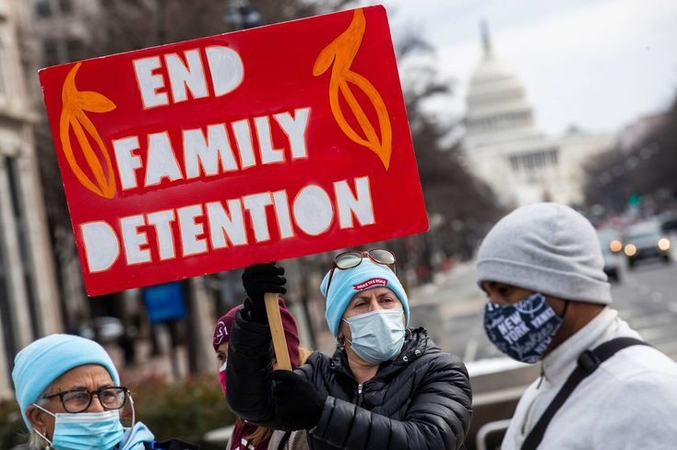
WASHINGTON – The Biden administration is preparing to convert its immigrant family detention centers in South Texas into Ellis Island-style rapid-processing hubs that will screen migrant parents and children with a goal of releasing them into the United States within 72 hours, according to Department of Homeland Security draft plans obtained by The Washington Post.
The plans show the Biden administration is racing to absorb a growing number of migrants crossing the U.S.-Mexico border amid shortages of bed space and personnel. Republicans and some Democrats fear that relaxing detention policies will exacerbate a surge that is already straining the Biden administration.
Russell Hott, a senior official with Immigration and Customs Enforcement, notified staff of the rapid-processing plan in an email Thursday that said arrivals by unaccompanied minors and families this year “are expected to be the highest numbers observed in over 20 years.”
If U.S. border officials continue to take in more than 500 family members per day, the change in use to the family detention centers “may not be sufficient to keep pace with apprehensions,” Hott warned in his email, which was reviewed by The Post.
Individuals who cannot be housed in one of the rapid-processing centers may need to be placed in hotels, Hott wrote. MVM, an ICE contractor, will help transport the families to hotels if there is no longer capacity at the rapid-processing centers, he said, adding that the company plans to use hotels in McAllen and El Paso, Texas, and Phoenix.
“We welcome the change, because the detention of families – we never thought that was a good system or a good policy at all,” said Edna Yang, co-executive director of American Gateways, an immigration legal aid organization in Texas. “They shouldn’t be detained, and they should be given the opportunity to go before the immigration judge and be released in the community and not held like prisoners.”
The plans come as Republicans are criticizing President Joe Biden for relaxing immigration policies, saying he could encourage more migrants to travel to the border.
“There is no question there’s a crisis at the border,” Rep. James Comer, R-Ky., said Thursday on Fox News. “It’s Joe Biden’s fault. Joe Biden has signaled to the world that he’s not going to take border security seriously.”
Transforming family detention amounts to a wholesale repudiation of not only Donald Trump’s policies but also Barack Obama’s and presents a significantly different vision of how to handle the fast-changing character of mass migration at the southern border.
For decades, single adults – particularly men – dominated the flows northward into the United States, but the number of families and minors traveling without their parents has increased substantially in recent years. Before the coronavirus pandemic, migrant families and unaccompanied minors were a majority of those taken into custody at the southwest border, a trend that more closely resembles refugee streams worldwide.
During the Obama and Trump administrations, most families were quickly released or deported. But some were held in dormitory-style facilities for weeks or months, if not longer, for immigration proceedings. Advocates for these families have long said they are fleeing violence and poverty and shouldn’t be detained at all – a sentiment Biden echoed on the campaign trail last year.
“Children should be released from ICE detention with their parents immediately,” Biden wrote on Twitter in June. “This is pretty simple, and I can’t believe I have to say it: Families belong together.”
Six weeks into Biden’s presidency, advocates are frustrated that his administration has continued to detain families and expel them from the border under a public-health order. The number of detained family members more than doubled, from 228 adults and children before Biden took office to 476 last week, federal records show.
Although the tally is a fraction of the combined capacity of 3,300 people at three family residential centers, the uptick baffled child-welfare advocates who hoped that the detention centers would finally close. They noted that Biden and Alejandro Mayorkas, now the homeland security secretary, helped to expand use of these detention centers during the Obama administration.
“There needs to be open expression of what they’re going to do with these facilities,” said Bridget Cambria, a lawyer representing migrant families in Pennsylvania. “They shouldn’t detain families or children even for one second.”
ICE oversees three family residential centers for immigrants facing deportation: the 96-bed Berks Family Residential Center in Leesport, Pa., and a pair of larger facilities outside San Antonio, a 2,400-bed center in Dilley and an 839-bed center in Karnes City.
The Biden administration has said it is reviewing the way it uses family detention facilities and told a federal judge last week in a lawsuit over the detentions that the policies had not changed.
“A detention center is not where a family belongs,” Mayorkas told NBC News in an interview this week, hinting at the plans.
DHS officials, speaking on the condition of anonymity to describe the unpublicized plans, said the transition to rapid-release centers is already underway.
ICE emptied out the Berks center Feb. 26, releasing all 21 people there. ICE confirmed that the facility is empty but would not say why.
Officials are considering turning Berks into a women-only center, a DHS official said, while Dilley and Karnes would serve as quick-release intake facilities that would screen migrant families, check their backgrounds and release them pending an immigration court hearing. Some would enroll in “alternatives to detention,” such as ankle-monitoring programs. Families would undergo coronavirus testing, and nonprofits would then help them secure airplane or bus tickets to their final destinations in the United States, typically with relatives or friends.
The goal is to process and release 100 families per day, the plans show. Migrants who test positive for the coronavirus would be quarantined for 10 days.
Advocates for immigrants have cheered the preliminary plans in recent days – albeit cautiously because DHS has not made a formal announcement.
In Texas, advocates said the region’s top immigration officials held an emergency conference call with them on Feb. 20 to discuss plans to transform the centers into shorter-term facilities. Officials told them to prepare for more migrants to be released from Dilley and Karnes.
“It’s incredibly encouraging to hear a completely different philosophy and attitude for people coming into this country,” said Daniel Klein, board chairman for the Interfaith Welcome Coalition, who was on the call, which was first reported by the San Antonio Express-News.
Klein said that the nonprofit has added more volunteers at the bus station in downtown San Antonio to help migrants find shelter or make travel plans and that it has sometimes spent $1,000 a night on food, water and bus tickets.
Biden has pledged to create a more humane immigration system and restore the asylum process, but he is also eager to skirt a border crisis that could imperil his legislative agenda, including an effort to legalize 11 million longtime undocumented immigrants.
Some Democrats from southern border communities worried that rising migration would burden communities reeling from the coronavirus and a winter storm that cut power to millions and killed more than 30 in Texas.
“Our country is currently unprepared to handle a surge in migrants in the middle of this pandemic,” Rep. Henry Cuellar, D-Texas, tweeted Thursday. “I urge the Biden administration to listen and work with the communities on the southern border who are dealing with this influx. Inaction is not an option.”
The Biden administration has not detailed how it would handle another influx.
In 2014 – when Biden was vice president and Mayorkas was deputy DHS secretary – the United States received an influx of 68,000 families, up from 14,800 the year before. At the time, Biden said the “crisis” was “untenable and unsustainable,” and he and Mayorkas worked to stem flows from Central America and expanded family detention by opening the facilities in Dilley and Karnes. Mayorkas said then that he would ensure that “the detention of adults with children is done as humanely as possible.”
After the centers expanded, the number of migrant families apprehended at the border dropped below 40,000, but detention did not stop the flows. After a judge ruled that officials could not detain children in unlicensed facilities for more than 20 days, the numbers began to rise again.
Advocates for immigrants said detention had little impact because of the severe conditions in Central America and the Caribbean that are driving migrants north, such as violence, climate change, poverty and government corruption.
The numbers have only continued to grow.
More than 470,000 migrant families and 76,000 unaccompanied minors arrived in fiscal 2019, a record on both counts, and most were released into the United States pending a court hearing.
Dora Schriro, who led ICE’s office of detention policy and planning, said ICE’s experience with family detention shows that it is harmful to children and their parents by placing them in conditions where they are afraid. She said she reduced the capacity in Pennsylvania to 84 beds before leaving in 2009.
After the Obama administration expanded the detention centers to more than 3,300 beds, she said, DHS asked her and others to issue recommendations in a report published in late 2016. Their first recommendation: “Detention is never in the best interest of children.”
“DHS should discontinue the general use of family detention, reserving it for rare cases when necessary,” such as because someone is a flight risk or a danger to the community, the report said.
Soon after, Trump took office. He sought to detain families and separated parents from their children in a failed attempt to stem the rising flows of migrants.
Schriro said the Biden administration faces dual challenges at the border: keeping its international obligations to offer refuge to people feeling harm, and making sure Americans are safe.
“You’ve got two really critical commitments, and this administration is finding a path to honor both of those obligations,” she said. “The trick is not sacrificing one for the other.”
By The Washington Post · Mustafa Salim, Louisa Loveluck
BAGHDAD – A U.S. contractor died during rocket attacks on an Iraqi military base Wednesday, the Pentagon said, posing a fresh challenge to the Biden administration days after it launched military action in retaliation for an earlier attack.
Iraq’s military said that 10 Grad rockets had landed on the Ain al-Asad air base in the western province of Anbar, and that the vehicle they were launched from had also been located. Around half of the rockets were intercepted by a U.S. aerial defense system, American and Iraqi officials said.
“A U.S. civilian contractor suffered a cardiac episode while sheltering and sadly passed away shortly after,” said Pentagon spokesman John Kirby, sharing no further information about the person’s identity. “There are no current reports of U.S. service member injuries, and all are accounted for.”
The attack came during an acutely sensitive period for the President Joe Biden and the Iraqi government. While similar rocket attacks have routinely been claimed by or blamed on Iran-backed militia groups, Washington is trying to blunt the tensions that soared between Washington and Tehran during President Donald Trump’s years in office.
Biden said Wednesday: “We are following that through right now. Thank God no one was killed by the rocket. One individual, a contractor, died of a heart attack. But we’re identifying who’s responsible, and we’ll make judgments from that point.”
Western officials point to Biden’s response to rocket attacks on U.S. service personnel in Iraq last week as a case in point. Although the strikes resulted in the first unilateral military action of Biden’s presidency, the Iran-backed militants it targeted were across the border in Syria, not Iraq, a move that seemed consciously calibrated to avoid further escalation.
In Baghdad, meanwhile, officials have all hands on deck for the arrival of Pope Francis on Friday, with the pontif’s visit representing an opportunity for the embattled government here to showcase Iraq’s relative stability in the wake of the Islamic State’s military defeat.
“Iraqi security forces are on scene and investigating. We cannot attribute responsibility at this time, and we do not have a complete picture of the extent of the damage,” Kirby said in a statement. “We stand by as needed to assist our Iraqi partners as they investigate.”
Rocket attacks on U.S. diplomatic and military targets have escalated in the year since Trump ordered the killing of Iran’s most influential military strategist, Maj. Gen. Qasem Soleimani, and the Iraqi militia leader, Abu Mahdi al-Muhandis, responsible for maintaining cohesion among the country’s disparate network of militia groups.
Recent attacks on U.S.-linked bases have been claimed by splinter groups that have announced themselves since the deaths of Soleimani and Muhandis. Although U.S. officials say that those groups are backed by Iran, the extent of Tehran’s control over individual attacks remains unclear.
As night fell Wednesday, there was no claim of responsibility for the latest rocket attacks.
Asia rebuffs U.S. sanctions on Myanmar, giving generals lifeline
InternationalMar 04. 2021A demonstrator wears a National League for Democracy (NLD) party themed protective mask during a protest outside the Embassy of Myanmar in Bangkok, Thailand, on Feb. 1 2021. MUST CREDIT: Bloomberg photo by Andre Malerba.
By Syndication Washington Post, Bloomberg · Philip J. Heijmans
As the U.S. looks to build a coalition to further punish Myanmar’s generals, it is not having much success convincing governments in Asia to follow suit.
The standing of army chief Min Aung Hlaing’s regime has slipped even further in the West after his envoy to the United Nations denounced the military takeover and Myanmar authorities killed at least 18 protesters on Sunday, the deadliest day since the Feb. 1 coup. While the junta has since told security forces to avoid using live bullets, reports emerged that protesters were still being shot with them. At least two more were killed on Wednesday in the city of Mandalay.
The U.S. has led the international pushback, with National Security Advisor Jake Sullivan saying the country was “coordinating closely with allies and partners in the Indo-Pacific region” and would take additional actions after imposing targeted sanctions on the coup makers. The U.K. also sanctioned the generals and the European Union has said its working on punitive measures.
Asian countries, by contrast, haven’t taken any concrete action. While Indonesia has conducted shuttle diplomacy and Singapore has said its “appalled by the violence,” no countries in the region so far have indicated they would support sanctions or any other measures that would hit the military’s finances.
On Tuesday, foreign ministers of the 10-member Association of Southeast Asian Nations, which includes Myanmar, called “on all parties to refrain from instigating further violence” and for “a peaceful solution through constructive dialogue.” While some individual ministers called for the release of Aung San Suu Kyi and a return to democracy, the statement didn’t mention her by name and refrained from using the word “coup.” It also said Asean, which is based on the principle of nonintervention, was ready “to assist Myanmar in a positive, peaceful and constructive manner.”
Singapore Prime Minister Lee Hsien Loong separately said sanctions would only hurt the population at large and push Myanmar closer to those willing to talk to them like China.
“You can ostracize them, condemn them, and pass resolutions or not, but it really has very little influence,” Lee told the BBC, according to comments distributed by his office. “We have to express disapproval for what is done, which is against the values of many other countries, and in fact a large part of humanity. But to say that I will take action against them, where does this lead?”
For Myanmar’s generals, Asia’s reluctance to join in U.S.-led sanctions or even cut them out of meetings effectively offers a diplomatic lifeline as they struggle to gain control of the country. Prior to Myanmar’s opening about a decade ago, business ties with Asia allowed the junta to survive for years despite much broader Western sanctions than are currently in place.
“Asean has an unmatched track record of indifference to authoritarian rule in Myanmar,” said Lee Morgenbesser, a lecturer at Australia’s Griffith University whose researches Southeast Asian politics.
Among Southeast Asia’s 10 countries, two are run by military men who staged coups, two are Communist regimes with no elections, two have had ruling parties in power for more than two decades and one is an absolute monarchy. Malaysia, Indonesia and the Philippines are the only democracies that have seen peaceful transfers of power from one party to another in recent years.
Countries in Asia also avoided sanctioning Myanmar’s generals over allegations of genocide against the Muslim Rohingya minority that forced more than 700,000 people to flee across the border into Bangladesh. An independent UN fact-finding mission found in 2019 that at least 59 foreign firms — most from Asia — had either joint ventures or commercial ties with the military, producing revenue that “substantially enhances its ability to carry out gross violations of human rights with impunity.”
“In some ways, Asean allowed the military to get away with what happened with the Rohingya crisis and I think that they are faced with something more dangerous,” said Bridget Welsh, honorary research associate at the Asia Research Institute, University of Nottingham Malaysia. “This is going to be much more difficult for them to wrestle with.”
Myanmar’s generals have made clear they have no intention of returning the nation to isolation, vowing to hold elections after a yearlong state of emergency. The junta has appointed Aung Naing Oo — a familiar face to foreign investors — as investment minister.
China and Thailand alone accounted for about half of Myanmar’s trade in 2019, the latest year for which data is available, with the U.S. and Europe comprising roughly 13%. Asian economies represented seven of Myanmar’s top 10 foreign investors as of January, led by China and Singapore, according to data from the Directorate of Investment and Company Administration.
Vietnam’s Viettel Group, a state-owned enterprise operated by the Ministry of Defense, announced in 2018 that it was investing $1.5 billion to set up the mobile operator Mytel. Thailand’s state-owned PTT, meanwhile, has imported natural gas from Myanmar for years via the Gulf of Martaban, and its exploration arm said last month it didn’t expect the political situation to impact its operations or plans in the country.
Asean should take a clear stand particularly on avoiding more civilian casualties, according to Ong Keng Yong, a former secretary-general of the bloc. He likened Myanmar to a neighbor who infringes on the rights of nearby home owners.
“You can rearrange the furniture and setup in your home,” he said. “But if that involves more use of scarce electricity and water resources, the others in the gated compound can have a say.”
Samsung details plans for $17 billion chip facility in U.S.
InternationalMar 04. 2021The Samsung Electronics logo is displayed in a window at the company’s D’light flagship store in Seoul, South Korea, on Oct. 6, 2020. MUST CREDIT: Bloomberg photo by SeongJoon Cho.
By Syndication Washington Post, Bloomberg · Sohee Kim
Samsung Electronics Co. revealed additional details about its plans to build a cutting-edge semiconductor facility in the U.S. in a filing with the state of Texas, making the disclosure as the Biden administration vows to make the security of the U.S. chip supply a national priority.
The South Korean company plans to invest about $17 billion in its Project Silicon Silver and create about 1,800 jobs over the first ten years, according to an economic impact study prepared by a local consultant. Some $5.1 billion would go into buildings and property improvements, while $9.9 billion would be spent on machinery and equipment.
The filing with the Texas comptroller warned the chips project is “highly competitive.” Samsung is evaluating alternatives sites in Arizona and New York, as well as in Korea.
“Because of its strong ties to the local community and the successful past 25 years of manufacturing in Texas, Samsung Austin Semiconductor would like to continue to invest in the city and the state,” the study said.
In their first weeks in office, the Biden administration has emphasized the importance of advanced technologies, including semiconductors, artificial intelligence and next-generation networks. The president has ordered a global supply chain review for microchips as well as large-capacity batteries, pharmaceuticals and critical minerals and strategic materials such as rare earths.
Bloomberg News first reported in January that Samsung was considering building an advanced chipmaking plant in the U.S., in hopes of winning more American clients and narrowing the gap with industry leader Taiwan Semiconductor Manufacturing Co. The company was in discussions to locate a facility in Austin, Texas, capable of fabricating chips as advanced as 3 nanometers, people familiar with the matter said at the time.
Details of Samsung’s discussions with local governments have since leaked out in filings and other revelations. The economic impact study was prepared by Impact DataSource, an Austin, Texas-based economic consulting, research and analysis firm.
The report shows Samsung’s Project Silicon Silver would add approximately 7 million square feet of new space to the Austin campus, where the company has had operations for decades. It estimates that 542 new workers would move to the city, contributing to an addition of 1,626 new residents.
Property tax abatements would total about $1.5 billion over 20 years at the city and county levels, while direct and indirect economic output would be about $8.6 billion and salaries would total $7.3 billion.
A January filing detailed the likely timeline for the project. If Samsung chooses Austin, it would break ground in the second quarter of 2021 with the expectation that production would be up and running by the fourth quarter of 2023, it said.
Separately, Samsung’s current foundry plant in Austin hasn’t resumed operations since Feb. 16 after it was ordered to halt operations by Austin Energy due to blackouts in the region. Power and water are back but it will take more time to fully restart operations, officials said.
WASHINGTON – President Biden has agreed to narrow eligibility for a new round of $1,400 stimulus payments in his $1.9 trillion coronavirus relief bill, a concession to moderate Senate Democrats as party leaders moved Wednesday to lock down support and finalize the sweeping legislation.
Under the new structure, the checks would phase out faster for those at higher income levels, compared to the way the direct payments were structured in Biden’s initial proposal and the version of the bill passed by the House on Saturday.
The change came as the Senate prepared to take an initial procedural vote to move forward on the bill as early as Thursday. Biden and Senate Democratic leaders were scrambling to keep their caucus united since they cannot lose a single Democrat in the 50-50 Senate if Republicans unite against the legislation.
In addition to the stimulus checks, the sweeping economic package would also extend unemployment benefits through August, as well as set aside $350 billion for state and local aide; $130 billion for schools; $160 billion for vaccinations, testing and other health care system support; increased the child tax credit; and spend billions more on a variety of other provisions including rental aid and food assistance.
Biden made a closing pitch for the package to House Democrats on Wednesday evening, citing public polling in favor of the measure and telling them: “I know parts of this and everything else we seek to do are not easy, but people are going to remember how we showed up in this moment, how we listened to them . . . and how we took action.”
At least one Senate Republican, Lisa Murkowksi of Alaska, appeared open to considering a vote in favor of the legislation, telling reporters, “My state needs relief.” Elsewhere, though, GOP opposition was hardening, as Sen. Ron Johnson, R-Wis., announced plans to force Senate officials to read the entire 600-page-plus bill aloud before debate could even begin — a process he predicted would take around 10 hours.
“I don’t want to sound like a leftist, but I’m gonna resist,” Johnson told a talk radio host in Wisconsin.
The action in the Senate was unfolding against a backdrop of tightened security around the Capitol complex, as the sergeant-at-arms and the Capitol Police warned of potential violent unrest over the coming days. The House moved up votes to allow members to avoid the Capitol on Thursday, the day some conspiracy theorists have identified as when former president Donald Trump should rightfully be inaugurated. The Senate is scheduled to remain at work.
Under the plan for stimulus checks passed by the House, individuals earning up to $75,000 per year and couples making up to $150,000 per year would qualify for the full $1,400 payment. The size of the payments would then begin to scale down before zeroing out for individuals making $100,000 per year and couples making $200,000.
Under the changes agreed to by Biden and Senate Democratic leadership, individuals earning $75,000 per year and couples earning $150,000 would still receive the full $1,400-per-person benefit. However, the benefit would disappear for individuals earning more than $80,000 annually and couples earning more than $160,000.
That means singles making between $80,000 and $100,000 and couples earning between $160,000 and $200,000 would be newly excluded from seeing any benefit under the revised structure Biden agreed to.
The changes were confirmed by a Democratic aide who spoke on the condition of anonymity to describe internal deliberations.
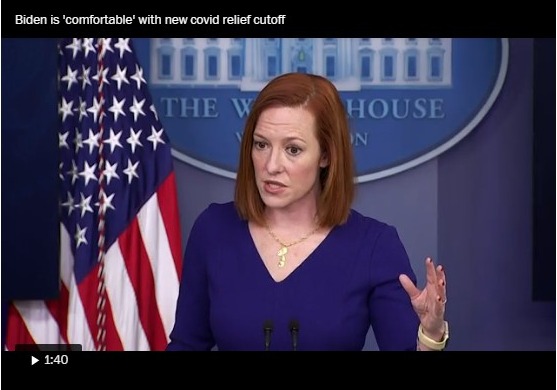
White House press secretary Jen Psaki said Biden has always been open to a faster phaseout for higher-earning individuals and “he is comfortable with where the negotiations stand.”
“He is comfortable and knows there will be tweaks on the margin,” Psaki said Wednesday’s White House briefing. “What his firm viewpoint is, is that it needs to meet the scope of the challenge, it needs to be the size he’s proposed, it needs to have the core components in order to have the impact on the American people.”
Sen. Jeanne Shaheen, D-N.H., was among those who had called for changing the eligibility levels for checks, telling reporters this week, “I think we could drop it below the $200,000 and still get households that really need it.”
She said she would hope to redirect the savings from that change toward other needs, such as hospitals.
Narrowing eligibility for the stimulus checks was just one change moderates like Sens. Shaheen and Joe Manchin, W.Va., had been seeking. Several were also eyeing better targeting money for state and local governments, and changing the structure of weekly federal unemployment benefits in the bill, to keep them at the current level of $300 rather than raise them to $400 as proposed by Biden and passed by the House.
Senate Democrats do not intend to adopt the suggested change to unemployment benefits, and they will stay at $400-per-week, the aide said. The unemployment benefits currently are set to expire March 14; the Biden bill would extend them through August. Democrats are aiming for final passage of the bill ahead of the March 14 deadline.
About 12 million fewer adults and 5 million fewer children would get the stimulus payments under the new Biden-Senate compromise, according to preliminary estimates from the Institute on Taxation and Economic Policy, a left-leaning think tank. About 280 million Americans in total – 200 million adults and 80 million children – would be eligible for the checks under the new structure.
Centrist Senate Democrats initially had pushed for even more aggressive restrictions on the stimulus payments. Senior Democratic officials had at one point considered dropping the full benefit for those making more than $50,000 per year, a change they ultimately abandoned after a backlash led by Senate Finance Chair Ron Wyden, D-Ore., and Senate Budget Chair Bernie Sanders, I-Vt.
Still, liberal lawmakers bristled at the new changes. House liberals have suggested it could be difficult for them to approve the package if it’s watered down significantly in the Senate. Presuming the Senate passes the package this week, it would still have to go back to the House for final approval.
“I don’t understand the political or economic wisdom in allowing Trump to give more people relief checks than a Democratic administration,” Rep. Alexandria Ocasio-Cortez, D-N.Y., said in a statement. “People went far too long without relief last year – if anything we should be more generous, not more stingy. It’s also an insensitive compromise for the roughly 80 percent of Americans that live in urban areas, which are known for higher costs of living.”
Biden acknowledged in his comments to House Democrats that “I know we’re all making some small compromises,” but he said staying united to pass the relief bill, his first major piece of legislation, would help restore the public’s faith in government and open the door to further successes.
“It’s a show of strength,” Biden said. “We know how much we have to do, but it all starts here, it starts by bringing this home.”
On a portion of his call with House Democrats that was not public, Biden told Rep. Suzan DelBene, D-Wash., that he supports legislation that would permanently increase the child tax credit to $3,000 per child, according to two people on the call who spoke on the condition of anonymity to share details of the conversation. The legislation as currently written would do so for one year.
Senate moderates were discussing further changes and GOP senators also were preparing amendments aimed at further targeting the legislation, which could peel off Democratic votes as the legislation moves through the Senate.
Democrats are advancing the package under a process called “budget reconciliation” that allows it to pass with a simple majority instead of the 60 votes normally required. With only 50 votes in the Senate and GOP support uncertain, Democrats must ensure they remain united to pass the legislation with Vice President Kamala Harris breaking the tie.
Attention has focused on Senate moderates who have voiced skepticism about various elements of the bill. Psaki expressed optimism Wednesday that Democratic moderates such as Manchin would support the bill.


 Senate Majority Leader Chuck Schumer, D-N.Y., appears at a news conference on Capitol Hill last month. Washington Post photo by Salwan Georges.


 A demonstrator wears a National League for Democracy (NLD) party themed protective mask during a protest outside the Embassy of Myanmar in Bangkok, Thailand, on Feb. 1 2021. MUST CREDIT: Bloomberg photo by Andre Malerba.
 The Samsung Electronics logo is displayed in a window at the company’s D’light flagship store in Seoul, South Korea, on Oct. 6, 2020. MUST CREDIT: Bloomberg photo by SeongJoon Cho.
 SootinClaimon.Com