More than 2,700 arrested across Russia as protests swell for jailed opposition leader Navalny #SootinClaimon.Com

#SootinClaimon.Com : ขอบคุณแหล่งข้อมูล : หนังสือพิมพ์ The Nation.

More than 2,700 arrested across Russia as protests swell for jailed opposition leader Navalny

InternationalJan 24. 2021

By The Washington Post · Robyn Dixon, Isabelle Khurshudyan

MOSCOW – More than 2,700 people were arrested Saturday in protests spanning nearly 70 cities and towns across Russia calling for the release of jailed opposition leader Alexei Navalny – a massive show of defiance against President Vladimir Putin and his widening crackdowns against challenges to his power.

Among the detained was Navalny’s wife, Yulia, and many heads of Navalny’s regional offices. It was the largest number of protesters taken into custody in a day since the Russian rights group OVD-Info began monitoring demonstrations in 2011.

The rallies – from Russia’s Far East to central Moscow – came less than a week after Navalny returned from Germany, where he recovered from a nerve agent poisoning in August during a trip to Siberia. Navalny was arrested shortly after stepping off the plane.

The wide turnout sent apowerful message to the Kremlin on the reach and resolve of Navalny’s network. The swift crackdowns by authorities underscored the pressure facing Russian authorities who must decide whether to keep Navalny behind bars.

Navalny once more proved he can mobilize mass support to confront Putin’s government, particularly among young Russians, and even when he is behind bars.

Scuffles broke out in central Moscow, and police beat protesters with batons, according to video posted by independent media. Protesters at times pelted police with snowballs and plastic bottles.

“Putin is a thief,” some chanted in Moscow. “This is my home, I’m not afraid!” Passing cars honked in support.

Police loudspeakers bellowed: “Respected citizens, the current event is illegal. We are doing everything to ensure your safety.”

Protesters cried: “Police are the shame of Russia.”

After nightfall, police charged at groups of young protesters trying to get close to the Matrosskaya Tishina detention center, where Navalny is held. Some protesters were wrestled to the ground before being dragging to police buses. Dozens were arrested near the detention center.

Some 40,000 people participated in the Moscow protest, Reuters reported, while police said 4,000 people took part.

According to OVD-Info, more than 2,700 people were taken into custody around Russia, including about 900 in Moscow. Russian officials did not immediately give figures on detentions.

Video posted on social media showed sporadic clashes, including police beating protesters with batons. Protests took place in nearly 70 locales, OVD-Info reported.

Navalny’s wife, Yulia, wearing a black woolen hat and black jacket, posted a selfie at the protest, saying: “What happiness that you’re all here. Thank you!” Minutes later, she sent a selfie from the inside of a police van, saying she had been detained. Local media showed video of police leading her to the van. She was released from police custody after several hours, the Russia news outlet RIA Novosti reported.

The protests marked one of the most forceful displays of opposition to Putin since anti-government rallies in Moscow in summer 2019 over the banning of candidates for local elections.

Saturday’s demonstrations came after a sweeping national crackdown in which police detained opposition activists and courts locked up Navalny’s press secretary, Kira Yarmysh, and another team member, Georgy Alburov, co-author of the bombshell viral YouTube video “Putin’s Palace – History of the World’s Largest Bribe.”

The video, posted Tuesday, alleging colossal corruption in the construction of a vast Black Sea palace for Putin, has been viewed more than 70 million times. The Kremlin denies any relationship between Putin and the palace.

Navalny has led opposition to Putin for more than a decade. But Putin has recently moved to crush dissent, with some measures that appear aimed squarely at Navalny.

New Russian laws allow authorities to brand individual activists as “foreign agents,” while others have made it more difficult to express dissent, organize and protest. It follows constitutional changes last summer that gave Putin the opportunity to stay in power until 2036.

The showdowns in Russia could pose an early foreign policy challenge for the Biden administration as it looks to define its relations with Putin. A State Department statement said the United States “strongly condemns the use of harsh tactics” and called for Navalny’s “the immediate and unconditional release.”

In Moscow, key Navalny ally Lyubov Sobol, an investigator at his Anti-Corruption Foundation, was arrested at the square soon after the protest started. She was later charged with repeatedly participating in illegal protests.

Sobol live-streamed a message directly from the police truck after her arrest, urging Russians: “Don’t be silent! Don’t be afraid.

“I believe that I am right,” she said as other arrested protesters cheered in the police truck. “You cannot close your eyes to what is going on in Russia right now.”

Nikolai Agilko, 23, one of the protesters in Moscow, said he was inspired by Navalny’s return to Russia on Jan. 17. “He’s like a hero, I think. It’s very inspiring. He’s brave, so we should all be brave today.”

“I have a lot of friends who are scared in this situation, so they’re not here,” he said. “But I wanted to be brave and come here today.”

Ruslan Ivanov, 79, stood out in the Moscow crowd amid many young demonstrators. “I wanted to come out to support all of the young people here, to show that their demands are correct,” he said, referring to the calls for to release Navalny.

Elena, 60, who declined to give her name because the protest was not authorized by authorities, said she came out in support of Navalny, but also because she was unhappy at “how people in this country live.”

“I have five grandchildren, and I want them to live in a different country – a free country,” she said.

Navalny accuses Putin of ordering the nerve agent attack that left him in a coma and under medical care for months in Berlin. The Kremlin denies any links to the poisoning, but ithas refused to open a criminal investigation.

In Khabarovsk – about 3,800 miles east of Moscow – riot police wrestled protesters to the ground and dragged them to waiting police trucks, according to videos posted online from the city.

Popular Russian video blogger Yury Dud, whose YouTube channel has more than 8.6 million subscribers, participated in the Vladivostok protest in support of Navalny. Another popular blogger, Ilya Varlamov, was detained in Moscow. Journalists from independent media outlets Mediazona and Meduza were arrested in St. Petersburg.

Many coordinators of Navalny’s regional headquarters were detained in different Russian cities, according to the director of Navalny’s Anti-Corruption Foundation, Ivan Zhdanov.

Zhdanov made the comments on a live YouTube broadcast on Saturday with more than 200,000 viewers.

A court ordered Navalny jailed on Monday over allegations that he violated the terms of a suspended sentence in a fraud case, a case that the European Court of Human Rights has declared was political. Facing two other criminal cases in a justice system notorious for politicizing cases, he could face years in jail.

Navalny says the cases against him are political.

“Russian authorities arresting peaceful protesters, journalists – appears to be concerted campaign to suppress free speech, peaceful assembly,” said Rebecca Ross, spokeswoman for the U.S. Embassy in Moscow. “This continues years of Russia tightening restrictions, repressive actions against civil society, independent media, political opposition.”

Russian authorities said Friday that the embassy posted information on the website on the planned location of the protests. Russian Foreign Ministry spokeswoman Maria Zakharova said U.S. Embassy officials would be summoned to address the Russian complaints.

France advises delaying second covid shots to speed vaccines #SootinClaimon.Com

#SootinClaimon.Com : ขอบคุณแหล่งข้อมูล : หนังสือพิมพ์ The Nation.

France advises delaying second covid shots to speed vaccines

InternationalJan 24. 2021A healthcare worker receives a dose of the Pfizer-BioNTech covid-19 vaccine in a care home in Paris on Jan. 7, 2021. MUST CREDIT: Bloomberg photo by Nathan Laine.A healthcare worker receives a dose of the Pfizer-BioNTech covid-19 vaccine in a care home in Paris on Jan. 7, 2021. MUST CREDIT: Bloomberg photo by Nathan Laine.
By Syndication Washington Post, Bloomberg · Tara Patel, Suzy Waite

France’s top health authority is recommending doubling the time between the two required covid-19 vaccine shots as a way to stretch supplies and inoculate as many people as possible amid a resurgence in the spread of the coronavirus.

Giving a second injection six weeks after the first would allow at least 700,000 more people to be protected with a first shot during the first month, the country’s Haute Autorite de Sante said in a statement Saturday. The advice is for the vaccine made by Pfizer Inc. and BioNTech SE as well as another supplied by Moderna Inc., it said.

“The risk of a loss of efficacy appears limited,” the health body said, noting that the regime recommended by the companies is for a lag of three or four weeks between shots, but that protection from the virus actually begins between 12 and 14 days after the first jab.

Surging covid infections from the spread of a new virulent strain and supply issues have increased pressure on some governments to experiment with dosing regimens. The U.S. Centers for Disease Control and Prevention this week said that said follow-up doses could be given up to six weeks later.

The U.K. has already pushed the maximum wait time from three weeks to 12 weeks as Boris Johnson’s government seeks to vaccinate 15 million people by Feb. 15. That strategy is now facing some resistance. A group of senior doctors called on England’s chief medical officer to cut the gap between the first and second doses of the Pfizer Inc. and BioNTech vaccine by half, according to the BBC.

The British Medical Association on Saturday urged Chris Whitty, England’s chief medical officer, to “urgently review the U.K.’s current position of second doses after 12 weeks,” the AP reported. The association said there was “growing concern from the medical profession regarding the delay of the second dose of the Pfizer-BioNTech vaccine as Britain’s strategy has become increasingly isolated from many other countries.”

“No other nation has adopted the U.K.’s approach,” Dr. Chaand Nagpaul, chairman of the BMA council, told the BBC, the AP said. He noted the World Health Organization recommended that the second Pfizer vaccine could be given six weeks after the first but only in “exceptional circumstances.”

“I do understand the trade-off and the rationale, but if that was the right thing to do then we would see other nations following suit,” Nagpaul said, according to the AP. The BBC cited a private letter sent from the association to Whitty.

The government’s Joint Committee on Vaccination and Immunisation says unpublished data shows that the Oxford-AstraZeneca vaccine is still effective with doses 12 weeks apart, but Pfizer has said it has tested its vaccine’s efficacy only when the two doses were given up to 21 days apart, the BBC said.

The French health authority said it based its new recommendation on models carried out by France’s Institut Pasteur and U.S. and Canadian studies.

In its recommendation released on Jan. 21, the U.S. CDC said that if it’s impossible to get the follow-up shot on time, people may schedule it as long as six weeks, or 42 days, after their initial dose. There is “limited data on efficacy” of the Pfizer and Moderna vaccines beyond that interval, according to the guidance, but if the second dose is administered later, “there is no need to restart the series.”

Both those vaccines are authorized for emergency use in the U.S. and were cleared based on trials of two doses weeks apart. A grace period of four days ahead of schedule would be considered valid for a second dose, but people shouldn’t receive the second dose earlier than that.

As president, Trump made 30,573 false claims #SootinClaimon.Com

#SootinClaimon.Com : ขอบคุณแหล่งข้อมูล : หนังสือพิมพ์ The Nation.

As president, Trump made 30,573 false claims

InternationalJan 24. 2021

By The Washington Post · Glenn Kessler

The assault on truth began on Inauguration Day 2017 almost immediately after President Donald Trump took power and uttered his first words.

He overstated the “carnage” he was inheriting, then later exaggerated his “massive” crowd and claimed, despite clear evidence to the contrary, that it had not rained during his address. He repeated the rain claim the next day, along with the fabricated notion that he held the “all-time record” for appearing on the cover of Time magazine.

And so it went, day after day, week after week, claim after claim, from the most mundane of topics to the most pressing issues.

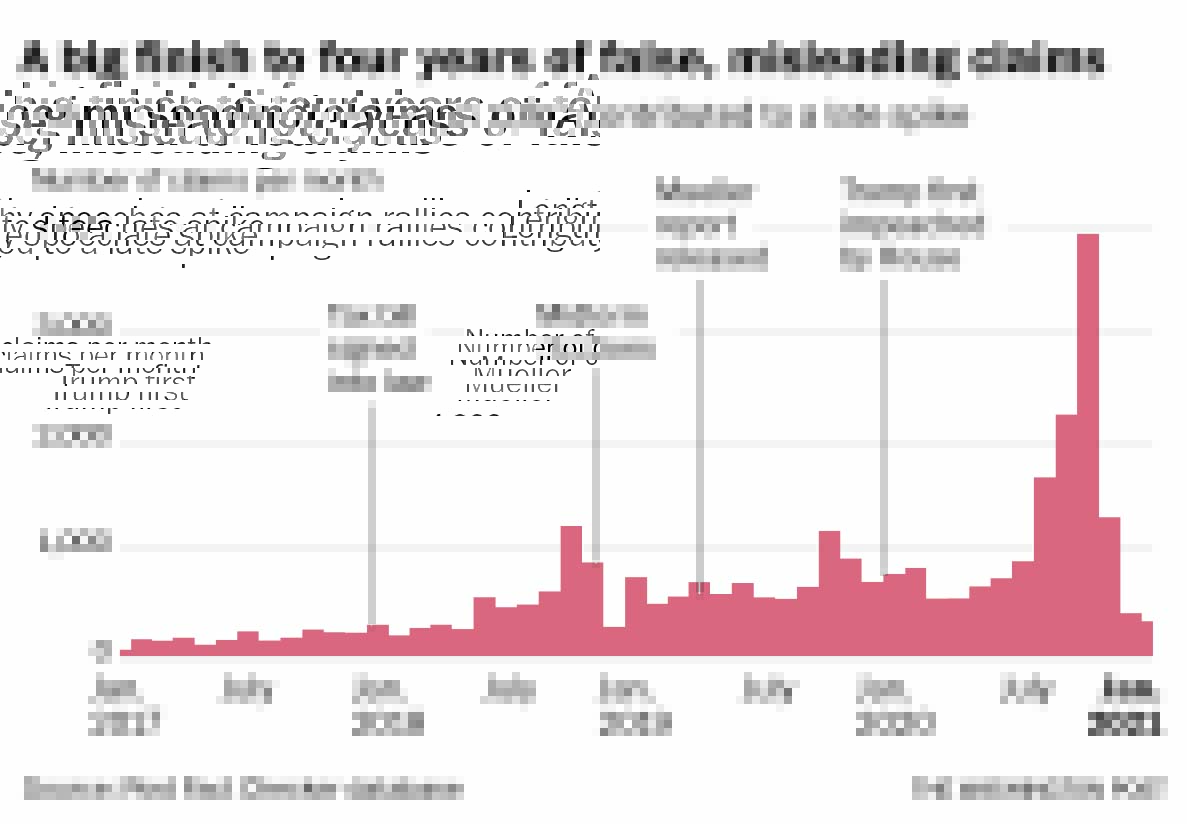
Over time, Trump unleashed his falsehoods with increasing frequency and ferocity, often by the scores in a single campaign speech or tweetstorm. What began as a relative trickle of misrepresentations, including 10 on his first day and five on the second, built into a torrent through Trump’s final days as he frenetically spread wild theories that the coronavirus pandemic would disappear “like a miracle” and that the presidential election had been stolen – the claim that inspired Trump supporters to attack Congress on Jan. 6 and prompted his second impeachment.

The final tally of Trump’s presidency: 30,573 false or misleading claims – with nearly half coming in his final year.

For more than 10 years, The Fact Checker has assessed the accuracy of claims made by politicians in both parties, and that practice will continue. But Trump, with his unusually flagrant disregard for facts, posed a new challenge, as so many of his claims did not merit full-fledged fact checks. What started as a weekly feature – “What Trump got wrong on Twitter this week” – turned into a project for Trump’s first 100 days. Then, in response to reader requests, the Trump database was maintained for four years, despite the increasing burden of keeping it up.

The database became an untruth tracker for the ages, widely cited around the world as a measuring stick of Trump’s presidency – and as of noon Wednesday it was officially retired.

Whether such a tracker will be necessary for future presidents is unclear. Nonetheless, the impact of Trump’s rhetoric may reverberate for years.

“As a result of Trump’s constant lying through the presidential megaphone, more Americans are skeptical of genuine facts than ever before,” presidential historian Michael Beschloss said.

An assessment of the Fact Checker database shows the dramatic escalation in the rate of Trump’s dishonesty over time. Trump averaged about six claims a day in his first year as president, 16 claims day in his second year, 22 claims day in his third year – and 39 claims a day in his final year. Put another way, it took him 27 months to reach 10,000 claims and another 14 months to reach 20,000. He then exceeded the 30,000 mark less than five months later.

Trump made false claims about just about everything, big and small, so the Fact Checker database provides a window into his obsessions (and the news cycle) at the time. When Trump felt under siege or in trouble, he responded by trying to craft an alternative reality for his supporters – and to viciously attack his foes. Nearly half of the false claims were communicated at his campaign rallies or via his now-suspended Twitter account.

Claims about immigration spiked just before the 2018 midterm elections, as Trump unsuccessfully tried to keep the House of Representatives in GOP hands with exaggerated claims about “caravans” of undocumented immigrants approaching the border. Then in late 2019 he responded to the uproar over a phone call in which he urged Ukraine’s president to announce an investigation of former vice president Joe Biden with more than 1,000 false and misleading claims on the issue in just four months.

False and misleading claims about the coronavirus pandemic emerged in 2020, so that by year’s end he had made more than 2,500 cornavirus-related claims – more than all of his trade claims over four years, even though trade has been one of the animating features of his presidency. Trump touted phony metrics to claim he successfully defeated the virus, pitched ineffective “cures” and constantly attacked former president Barack Obama for alleged failures, such as leaving a “bare cupboard” of ventilators (there were almost 17,000) and bungling the response to the swine flu pandemic in 2009-2010 (the response was considered a success).

In October, Trump was largely quiet for six days as he recovered from his own bout with covid-19. But even so, he made nearly 4,000 false or misleading claims that month, an average of 150 a day on the days he was not ill.

In speech after speech, he laid the groundwork for challenging the election, making baseless claims of potential election fraud, while attacking Biden as a mental incompetent – and a “grimy, sleazy and corrupt career politician” – who could not possibly emerge as the victor.

“It’s going to be a fraud,” Trump told Sean Hannity of Fox News a month before voters went to the polls. “This is a terrible thing that’s happening to our country.”

After his election defeat, Trump spoke or tweeted about little except to offer lies about a stolen election, even as he or his supporters lost more than 60 court cases as judges repeatedly rejected his claims as bogus. After Nov. 3, he made more than 800 false or misleading claims about election fraud, including 76 times offering some variation of “rigged election.”

At his Jan. 6 speech at the Ellipse, in which he incited the attack on the Capitol, Trump made 107 false or misleading claims, almost all about the election.

The aftermath of what Biden and other Democrats now call the “big lie” hovers over Washington as both parties figure out whether there can be a return to a shared set of facts undergirding national debate, or whether one of the major political parties will remain captive to the sorts of conspiracy theories that marked so many of Trump’s final year of claims.

The events of Trump’s final weeks demonstrated the extent to which his alternate reality became woven into the fabric of the Republican Party, with the majority of GOP lawmakers voting against certifying Biden’s victory even after the pro-Trump mob stormed the Capitol.

One hallmark of Trump’s fibs was his willingness to constantly repeat the same claims, no matter how often they had been debunked. One-fifth of his nearly 2,500 claims about the economy was the same falsehood – that he was responsible for creating the greatest economy in U.S. history. After the coronavirus outbreak tanked the economy, he amped up the rhetoric to say he had created the greatest economy in world history. Neither claim is true; under just about every metric, Dwight D. Eisenhower, Lyndon B. Johnson and Bill Clinton had more robust economies during their presidencies. Even before the pandemic, Trump’s economy was already faltering because of his trade wars, with the manufacturing sector in a technical recession.

Nearly 300 times Trump falsely said that he passed the biggest tax cut in history. Even before his tax cut was crafted, he promised that it would be the biggest in U.S. history – bigger than President Ronald Reagan’s in 1981. Reagan’s tax cut amounted to 2.9% of the gross domestic product, and none of the proposals under consideration came close to that level. Yet Trump persisted in this fiction even when the tax cut was eventually crafted to be the equivalent of 0.9% of the gross domestic product, making it the eighth-largest tax cut in 100 years.

Trump’s penchant for repeating false claims is demonstrated by the fact that the Fact Checker database has recorded about 750 instances in which he has repeated a variation of the same claim at least three times.

The Fact Checker also tracked Three- or Four-Pinocchio claims that Trump has said at least 20 times, earning him a Bottomless Pinocchio. Trump completed his term with 56 of those entries, including three – about the “rigged election,” allegations that Dominion voting machines changed votes and the falsehood that GOP poll watchers were denied access to vote-counting – that only emerged in the final months of his presidency.

The Bottomless Pinocchio list gives a rough approximation of the types of major falsehoods Trump said during his presidency. Roughly 25% exaggerated about his accomplishments, and 15% misled about his policies. Another 15% dissembled about the Russian investigation or the probe into the Ukraine phone call. Roughly 10% each were fibs made out of whole cloth, attacks on people he considered foes, falsehoods about the coronavirus, phony claims about the election, or false statements about Biden and his proposals.

As the 2020 election neared, Trump nearly 50 times falsely reassured his supporters that Mexico was footing the $15 billion bill for his barrier along the southern border. U.S. taxpayers are paying, mostly via money Trump diverted from authorized military construction projects. This was perhaps Trump’s most famous campaign promise – during the 2016 campaign, Trump more than 200 times said Mexico would pay for the wall – so he simply pretended he had fulfilled it in an effort to reassure his base that he had succeeded.

Many repeated claims just barely missed the cutoff for a Bottomless Pinocchio, such as the claim that he repealed a provision of the U.S. tax code that prohibits religious organizations from endorsing or opposing political candidates. (All he did was issue a toothless executive order, but he obviously thought it was important to evangelical groups that he falsely claimed he achieved one of their key political objectives.)

Trump rarely abandons his falsehoods, so as he neared the end of his presidency his campaign rallies became longer and longer. Each speech had a familiar pattern. He would cycle through various grievances about the investigation by special counsel Robert Mueller III and the impeachment over his Ukraine call. He trashed Obama, various Democrats and of course Biden. He falsely extolled his achievements in trade, foreign policy, the economy and immigration. He offered false assurances about the pandemic and warned darkly about fraud in the upcoming election.

The growth of falsehoods over the course of Trump’s presidency is illustrated by one remarkable statistic.

The Fact Checker team recorded 492 suspect claims in Trump’s first 100 days. Just on Nov. 2, the day before the 2020 election, Trump made 503 false or misleading claims as he barnstormed across the country in a desperate effort to save his presidency.

The database website has a search engine that will quickly locate suspect statements made by Trump. Readers can also isolate claims by time period, subject or venue.

Maintaining the database over four years required detailed examination of every Trump speech, news conference, press gaggle, campaign rally and interview, as well as more than 25,000 tweets. The fact checks of Trump’s statements in the database amount to about 5 million words.

The database includes any statement that might merit Two or more Pinocchios under The Fact Checker’s rating scale. Trump often would repeat the same falsehood two or more times in a speech but only one instance of a claim per venue would be counted. The database did not include Facebook posts because they were often duplicative of tweets and likely staff-generated. The tally also generally did not count retweets, except for retweets of false or misleading videos.

Justice Department, FBI debate not charging some of the Capitol rioters #SootinClaimon.Com

#SootinClaimon.Com : ขอบคุณแหล่งข้อมูล : หนังสือพิมพ์ The Nation.

Justice Department, FBI debate not charging some of the Capitol rioters

InternationalJan 24. 2021Thousands of Trump supporters violently storm the U.S. Capitol on Jan. 6, 2021, to support President Donald Trump's baseless claims that he won the election. MUST CREDIT: Washington Post photo by Michael Robinson ChavezThousands of Trump supporters violently storm the U.S. Capitol on Jan. 6, 2021, to support President Donald Trump’s baseless claims that he won the election. MUST CREDIT: Washington Post photo by Michael Robinson Chavez

By The Washington Post · Devlin Barrett, Spencer S. Hsu

WASHINGTON – Federal law enforcement officials are privately debating whether they should decline to charge some of the individuals who stormed the U.S. Capitol this month – a politically loaded proposition but one alert to the practical concern that hundreds of such cases could swamp the local courthouse.

The internal discussions are in their early stages, and no decisions have been reached about whether to forgo charging some of those who illegally entered the Capitol on Jan. 6, according to multiple people familiar with the discussions.

Justice Department officials have promised a relentless effort to identify and arrest those who stormed the Capitol that day, but internally there is robust back-and-forth about whether charging them all is the best course of action. That debate comes at a time when officials are keenly sensitive that the credibility of the Justice Department and the FBI are at stake in such decisions, given the apparent security and intelligence failures that preceded the riot, these people said, speaking on the condition of anonymity to discuss legal deliberations.

Federal officials estimate that roughly 800 people surged into the building, though they caution that such numbers are imprecise, and the real figure could be 100 people or more in either direction.

Among those roughly 800 people, FBI agents and prosecutors have so far seen a broad mix of behavior – from people dressed for military battle, moving in formation, to wanton vandalism, to simply going with the crowd into the building.

Due to the wide variety of behavior, some federal officials have argued internally that those people who are known only to have committed unlawful entry – and were not engaged in violent, threatening or destructive behavior – should not be charged, according to people familiar with the discussions.

Other agents and prosecutors have pushed back against that suggestion, arguing that it is important to send a forceful message that the kind of political violence and mayhem on display Jan. 6 needs to be punished to the full extent of the law, so as to discourage similar conduct in the future.

There are a host of other factors complicating the discussions, many of which center not around the politics of the riot, but the real-world work of investigators and prosecutors, these people said.

The Justice Department has already charged more than 135 individuals with committing crimes in or around the Capitol building, and many more are expected to be charged in the coming weeks and months. By mid-January, the FBI had already received more than 200,000 tips from the public about the riot, in addition to news footage and police officer testimony.

“There is absolute resolve from the Department of Justice to hold all who intentionally engaged in criminal acts at the Capitol accountable,” Justice Department spokesman Marc Raimondi said in an email. “We have consistently made clear that we will follow the facts and evidence and charge individuals accordingly. We remain confident that the U.S. District Court for Washington, DC can appropriately handle the docket related to any resulting charges.”

The primary objective for authorities is to determine which individuals, if any, planned, orchestrated or directed the violence. To that end, the FBI has already found worrying linkages within such extremist groups as the Proud Boys, Oath Keepers, and Three Percenters, and is looking to see if those groups coordinated with each other to storm the building, according to people familiar with the investigation.

Prosecutors have signaled they are looking to bring charges of seditious conspiracy against anyone who planned and carried out violence aimed at the government – a charge that carries a maximum possible prison sentence of 20 years.

But even as Justice Department officials look to bring those types of cases, they privately acknowledge those more determined and dangerous individuals may have operated within a broader sea of people who rushed through the doors but didn’t do much else, and prosecutors will ultimately have to decide if all of those lesser offenders should be charged.

Officials insisted they are not under pressure in regards to timing of decisions about how to handle those type of cases. For one thing, investigators are still gathering evidence, and agents could easily turn up additional photos or online postings that show a person they initially believed was harmless had, in fact, encouraged or engaged in other crimes.

Investigators also expect that some of those charged in the riot will eventually cooperate and provide evidence against others, and that could change their understanding of what certain people said or did that day, these people said.

Nevertheless, these people said, some in federal law enforcement are concerned that charging people solely with unlawful entry, when they are not known to have committed any other bad acts, could lead to losses if they go to trial.

“If an old man says all he did was walk in and no one tried to stop him, and he walked out and no one tried to stop him, and that’s all we know about what he did, that’s a case we may not win,” one official said.

Another official noted most of those arrested so far have no criminal records.

Meanwhile, defense lawyers for some of those charged are contemplating something akin to a “Trump defense” – that the president or other authority figures gave them permission or invited them to commit an otherwise illegal act.

“If you think of yourself as a soldier doing the bidding of the commander in chief, you don’t try to hide your actions. You assume you will be held up as a hero by the nation,” criminal defense lawyers Teri Kanefield and Mark Reichel wrote last week.

Such a defense might not forestall charges but could be effective at trial or sentencing. Trump’s looming impeachment trial in the Senate will also focus further attention on his actions and raise questions about the culpability of followers for the misinformation spread by leaders around bogus election-fraud claims rejected by courts and state voting officials.

“It’s not a like a bunch of people gathered on their own and decided to do this, it’s not like a mob. It’s people who were asked to come by the president, encouraged to come by the president, and encouraged to do what they did by the president and a number of others,” said one attorney representing defendants charged in the breach who spoke on the condition of anonymity to discuss legal strategy.

Prosecutors have other options. For rioters with no previous criminal records or convictions and whose known behavior inside the Capitol was not violent or destructive, the government could enter into deferred plea agreements, a diversion program akin to pretrial probation in which prosecutors agree to drop charges if a defendant commits no offenses over a certain time period.

Such a resolution would not result in even a misdemeanor conviction, and has been used before in some cases involving individuals with a history of mental illness who were arrested for jumping the White House fence. Criminal defense attorneys note there may be further distinctions between individuals who may have witnessed illegal activity or otherwise had reason to know they were entering a restricted area, and those for whom prosecutors can’t show such awareness.

There is also a question over whether charging all of the rioters could swamp the federal court system. In 2019, D.C. federal courts recorded only about 430 criminal cases, and fewer than 300 last year, when the legal system slowed significantly due to the pandemic. Many of those cases, however, had multiple defendants.

The workload of prosecuting the rioters could be eased if some of the cases were farmed out to other U.S. attorney offices around the country, but so far D.C. prosecutors have shown no interest in doing so. The law generally requires that individuals be prosecuted in the district in which a crime occurred.

“The crime happened here. Prosecutors and judges can see the crime scene from their office windows. I find it strange anyone would suggest it be done anywhere else,” a person familiar with the investigation said, speaking on the condition of anonymity to discuss an internal debate.

Beyond all the evidence-gathering and charging decisions left to do, federal officials concede there will likely be some number of people who were there that day and are simply never identified, due to some combination of luck, masks or lack of social media posts.

Biden aims for ‘normal’ after four years of tumult #SootinClaimon.Com

#SootinClaimon.Com : ขอบคุณแหล่งข้อมูล : หนังสือพิมพ์ The Nation.

Biden aims for ‘normal’ after four years of tumult

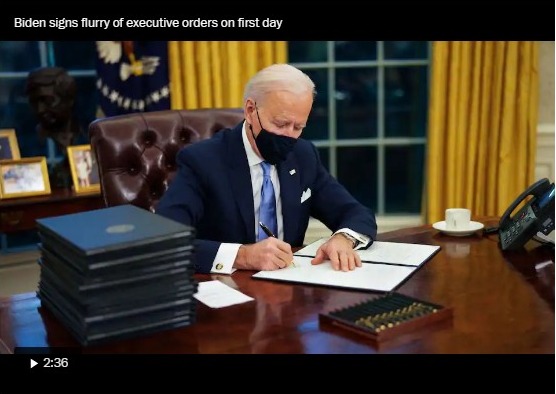
InternationalJan 24. 2021President Biden speaks about the economy before signing executive orders in the State Dining Room at the White House on Jan. 22, 2021. MUST CREDIT: Washington Post photo by Jabin Botsford.President Biden speaks about the economy before signing executive orders in the State Dining Room at the White House on Jan. 22, 2021. MUST CREDIT: Washington Post photo by Jabin Botsford.

By The Washington Post · Annie Linskey, Ashley Parker

WASHINGTON – President Joe Biden and his team issued 17 executive actions and directives, fielded 28 questions during a news briefing and swore in more than 1,100 people to serve in his administration. And that was just on Day One.

https://www.washingtonpost.com/video/c/embed/69656a42-cafb-4651-878a-5b2485047473?ptvads=block&playthrough=false 

In the first few days of Biden’s administration, aides to the new president have also blasted out fact sheets and memorandums – a veritable redwood worth of paperwork – and quietly reached out to a range of interest groups and politicians of both parties.

The technocrats, in other words, are back – complete with their return to regular order and aspirations of rigorous monotony.

The whirlwind of activity, both public and private, was part of a planned launch of his presidency that began in late April – before Biden had formally clinched the Democratic nomination – designed to showcase Biden’s promise to restore what he and his aides view as normalcy to the White House.

“They are running normal policy processes,” said Neil Bradley, the executive vice president and chief policy officer at the U.S. Chamber of Commerce. “For those of us who’ve been in Washington a long time, it is the normal policymaking process that we’ve been familiar with for a long time. And that, from our perspective, seems to produce better, more informed policy.”

https://www.washingtonpost.com/video/c/embed/2da4ddae-6c13-48c2-bc27-27127bfbdd4e?ptvads=block&playthrough=false

But if Biden and his team view his mantra of “Build Back Better” as a lofty goal, many Republicans see it as a return of the swamp. Former president Donald Trump’s rise was fueled by voters who viewed Washington as a town of bureaucrats and elites removed from the struggles of their daily lives – and who appreciated Trump’s disdain for the usual way of doing things.

“I’m not sure what a new normal looks like, because I think the Trump way of doing things and his nonpolitical approach has a certain appeal to voters, and that’s going to have to be part of this new normal,” said Neil Newhouse, a Republican pollster.

Referring to Biden’s relatively staid Twitter feed, Newhouse joked, “Are we still waiting for his first tweet? Many Americans are used to right now communication by Twitter. I think some people actually miss that.”

The president’s team is betting that most Americans won’t.

Biden tapped former senator Ted Kaufman, D-Del., to run his transition on April 22. He pulled in several others, and what started as handful of trusted Biden advisers ballooned to a staff of more than 400 paid transition employees by Jan. 20.

Another 1,000 volunteers also helped in a number of ways, including vetting potential hires – a mammoth task that involved more than 8,000 interviews.

Guided by Biden’s speeches and remarks on the campaign trail, they turned the candidate’s public decrees and promises into legislative language. When Biden delivered his major economic speeches over the summer, they took the text and broke it down into separate executive orders and tracked what he was promising on the first day, first week and first 100 days.

“Every single one of the things you’re seeing, there is a massive amount of planning,” said Kaufman, referring to the opening days of the administration.

“You’ve got to sit down and figure out, ‘What do I want to have on day one, two, three, four and five?’ ” he said. “Then, ‘When do I have to have the substance ready to go?’

Proposals were drafted and then vetted by multiple rounds of attorneys, including career lawyers inside the Justice Department. Two major pieces of legislation were put together: One for coronavirus relief and another on immigration.

There was also an employee handbook for the transition. “There is no transition without a successful campaign” was one quote from the book. Another focused on tone: “No egos, no drama, no task too small for anyone. We have each other’s backs.”

Their work accelerated once Biden was elected, with transition officials reaching out to interest groups in key players in Washington, making over 3,500 calls to organizations, according to a transition official.

The groups included the typical constituencies that are part of the Democratic coalition including labor unions, civil rights organizations and women’s groups. But they also targeted those more typically aligned with the GOP.

“Uniting America is not about just giving speeches – it’s not even about announcing policies,” Kaufman said. “It’s about getting down, doing the hard work and talking to members of Congress, talking to governors and talking to people in normally Republican areas.”

Bradley, whose group has commonly aligned with Republicans, called it “a highly organized, I would say very efficient process.”

“It removes multiple layers of uncertainty or confusion,” he said. “We may not always agree with the direction that they’re going, but at least you have a sense of understanding it and that is exceptionally helpful to the business community – just knowing how policy is unfolding.”

With the Trump administration, by contrast, “everyone was scrambling to figure out what was going on,” he said.

Biden’s nominees have also been making the rounds, such as a visit by Treasury Secretary nominee Janet Yellen with the National Association of Manufacturers executive committee.

It was “a very candid, open, frank conversation,” said Jay Timmons, the group’s president.

Timmons, who was once the head of the National Republican Senatorial Committee, said that Biden’s approach has been “refreshing.”

It helps that he’s known Biden since he was a Senate aide two decades ago. “In Joe Biden, you have just a decent human being,” Timmons said. “He’s willing to listen to all points of view.”

The outreach provided an early benefit when these right-leaning groups, including the Chamber, NAM and the Business Roundtable issued statements on Jan. 4 urging members of Congress and others to accept Biden’s electoral college victory.

That happened in some cases after the Biden transition reached out asking for the help, according to a business lobbyist familiar with the effort who requested anonymity to discuss private talks.

“They expressed their concerns about the road that we were going down and where that might lead, which were, frankly, concerns that a lot of people in the business community shared,” the lobbyist said.

The Biden team’s message was clear: “Folks speaking up would be helpful,” the lobbyist recalled. “A lot of folks in the business community were happy to.” Biden’s transition confirmed the outreach to business groups, but noted that in some cases business organizations proactively asked how they could help.

White House press secretary Jen Psaki has highlighted the support for Biden’s covid relief package from business groups, saying there has been an “outpouring of support” for various parts of the package “from everyone from Bernie Sanders to the Chamber of Commerce.”

But the Biden team’s concerted effort to revive some of the basic traditions of past White Houses also has its risks. Washington trying to work together can look an awful lot like elites palling around, or the overly clubby atmosphere that gave rise to the early enthusiasm for Trump’s candidacy.

And key Republican senators have already expressed skepticism, if not outright opposition, to Biden’s $1.9 trillion covid-19 relief proposal.

“President Biden is talking like a centrist, he is using the words of the center, talking about unity, but he is governing like someone from the far left,” Sen. Marco Rubio, R-Fla., said in a video message on Friday.

“He has ordered more executive fiats than anyone in such a short period of time – ever. More than Obama, more than Trump, more than anyone,” Rubio said, referring to the flurry of executive actions Biden has signed.

Over about 48 hours, Biden signed more than two dozen executive actions and one piece of legislation – granting his Defense Secretary Lloyd Austin a waiver exempting him from a law requiring the head of the Pentagon to have been out of uniform for at least seven years.

He took aim at Trump’s record on climate change, immediately rejoining the Paris climate accords and rescinding the permit for the Keystone XL pipeline. He reoriented his administration on the response to the coronavirus pandemic, reversing Trump’s decision to withdraw from the World Health Organization and imposing a mask mandate on federal property.

The Biden White House is also engaging in some age-old traditions, like blaming the previous administration for the crises they face. Jeff Zients, the head of Biden’s coronavirus task force, told reporters recently that “what we are inheriting from the Trump administration is much worse than we could have imagined,” and other aides – without providing specifics – have anonymously claimed that the Trump team left behind absolutely no coronavirus strategy.

Biden’s team says it plans to bring back the practice of daily press briefings, and promised transparency with the American public. But that doesn’t mean they are above the timeless tradition of skilled obfuscation: Psaki, for instance, has repeatedly declined to share Biden’s position on whether he believes Trump should be convicted of inciting the Jan. 6 Capitol riot in the upcoming Senate impeachment trial.

“Well, he’s no longer in the Senate, and he believes that it’s up to the Senate and Congress to determine how they will hold the former president accountable and what the mechanics and timeline of that process will be,” Psaki said Friday.

For many Democrats, the return of the so-called establishment – or the “seasoned,” in the preferred nomenclature of Rep. Debbie Dingell, D-Mich. – is a welcome change.

“I don’t care what anyone says – it was a beautiful, wonderful inauguration but 26,000 National Guard troops surrounding you isn’t a sense of calm, and I think just normal is good,” Dingell said, referring to the heavy security implemented in the wake of the Jan. 6 siege by pro-Trump supporters. “People want to hug each other and go out to dinner and we can’t do that, but at least here’s a process by which you can try to get things done.”

In another return to tradition reaching out to North American allies, Biden made Canadian Prime Minister Justin Trudeau his first phone call with a foreign leader Friday, followed by Mexican President Andrés Manuel López Obrador.

The Biden White House also reinstated its subscriptions of the New York Times and The Washington Post in the West Wing – a practice stopped under Trump during a moment of fury at the publications, though he continued to avidly consume news from both papers.

And during a new conference Friday, Psaki jokingly made clear that Biden’s priorities are distinctly different than those of his predecessor.

“I can confirm to you here: The president has not spent a moment thinking about the color scheme of Air Force One,” Psaki said, a jab at Trump’s fixation on replacing the traditional baby blue of the presidential aircraft with colors inspired by the American flag.

Biden may not have the same chance Obama did for early legislative wins #SootinClaimon.Com

#SootinClaimon.Com : ขอบคุณแหล่งข้อมูล : หนังสือพิมพ์ The Nation.

Biden may not have the same chance Obama did for early legislative wins

InternationalJan 24. 2021President Biden, with Vice President Harris by his side, signs executive orders at the White House on Jan. 22. MUST CREDIT: Washington Post photo by Jabin Botsford.President Biden, with Vice President Harris by his side, signs executive orders at the White House on Jan. 22. MUST CREDIT: Washington Post photo by Jabin Botsford.

By The Washington Post · Paul Kane

WASHINGTON – On Jan. 29, 2009, President Barack Obama signed the Lilly Ledbetter Fair Pay Act into law, delivering on a longtime liberal goal of equal salary opportunities for women.

Six days later, he expanded a program to provide health insurance for more than 4 million lower-income children.

And on Feb. 17, Obama and his vice president, Joe Biden, flew to Denver to sign the roughly $800 billion Recovery Act, the finale of a rapid-fire first few weeks.

“Less than a month into his presidency, the president is about to sign into law what is, I believe, a landmark achievement. Because of what he did, America can take a first, very strong step leading us out of this very difficult road to recovery we find ourselves on,” Biden said that day.

That’s how Democrats came out of the gate the last time they controlled Congress and the White House. They orchestrated their first few weeks the way a smart football coach scripts his offense’s first few possessions of the ball, winning quick passage of key laws and setting the tone for the first two years of the Obama presidency.

Twelve years later, the early days of Biden’s presidency may be consumed by a host of side issues that could delay his Cabinet appointments and, more importantly, any legislative victories. No issue has emerged as a bigger obstacle than the impeachment trial of former president Donald Trump.

Senate Majority Leader Chuck Schumer, D-N.Y., announced early Friday that House Speaker Nancy Pelosi, D-Calif., would send over the impeachment article Monday, charging Trump with inciting the Jan. 6 riot at the Capitol.

Republicans warned that would mean the Senate would stop all business until it completes the trial.

“If the impeachment articles come over Monday, the opportunity for President Biden to get a Cabinet in place is done until impeachment is done,” Sen. John Barrasso, R-Wyo., told reporters Friday.

By Friday afternoon, Biden signaled some concern about a trial getting in the way of his early work. Hours later, Schumer announced a bipartisan plan to start the full trial Feb. 9, giving the Senate more than two weeks to get moving on confirming the Cabinet.

Still, there’s little time to get any legislative victories. Pelosi set the coming week as committee work, with no votes on legislation, leaving only a week with both chambers in session before the trial begins.

Biden and some senators have discussed a “bifurcated” setup, doing legislation or nominations in the mornings, before the 1 p.m. mandate to start each day’s trial proceedings. History suggests that’s unlikely.

The previous two presidential impeachment trials, of Bill Clinton in 1999 and of Trump in 2020, lasted five weeks and nearly three weeks, respectively. No other business was conducted as the trials consumed the Senate.

As much as they want to punish Trump for encouraging his supporters to descend on the Capitol, some Democrats grimace at the idea of putting Biden’s early days on hold for a man already ejected from the Oval Office.

“I want to focus as much attention right now on the Biden agenda as possible, and minimize the attention on anything other than the Biden agenda,” said Sen. Tim Kaine, D-Va., his party’s 2016 vice-presidential nominee. He would prefer to punish Trump with legislation to bar him from holding office in the future.

“It would give us more time to focus on the things that are most important to the public,” Kaine told reporters Friday.

Pelosi and Schumer have set up a timeline that will allow for the most critical Cabinet posts to be filled, but with little chance for substantive victories emerging from Congress. Biden has issued more than two dozen executive orders, some reversing controversial decisions by Trump, but nothing with the full force of an actual law.

Back in early 2009, Democrats did not face an impeachment dilemma. They were able to begin immediately moving initiatives that had been stalled during George W. Bush’s presidency. In an April 2017 interview, Rahm Emanuel reflected on those early Obama days when he was chief of staff, how even some of the less ambitious legislation helped keep momentum going.

“The bunt singles,” he said, explaining how any bill getting to the president’s desk helps.

Emanuel, then the Chicago mayor, was critiquing the first months of the Trump administration, arguing that they kept swinging for legislative home runs but striking out.

So far, that critique applies to the Biden White House and his Democratic allies.

There are no “bunt singles” waiting on the legislative deck. Instead, the leaders are trying to pack everything they can into one massive package, with a current price tag of $1.9 trillion, dwarfing the combined annual funding for every federal agency, and whatever can’t fit into that package will go into another massive bill later in the fall.

This isn’t just swinging for the home-run fences. It’s akin to trying to hit 10 grand slams with just two swings of the legislative bat.

Part of the Democratic dilemma is their minuscule margin for error. Their current House majority has 35 fewer seats than in early 2009 and, with just 50 members in Schumer’s caucus, they have eight fewer votes to bank on than in early 2009.

Back then, Biden got dispatched to lobby old friends such as Sen. Susan Collins, R-Maine, who rallied two other Republicans to pass the Recovery Act.

Now, even Collins is shrugging at the need for Biden’s nearly $2 trillion pandemic relief proposal. “It’s hard for me to see, when we just passed $900 billion worth of assistance, why we would have a package that big. Now maybe a couple of months from now, the needs will be evident,” Collins told reporters Friday.

So, in this polarized environment, congressional leaders try to pack everything they can into one massive, grand-slam legislation, everything from actual coronavirus relief to raising the minimum wage.

Even without the impeachment trial, mid- to late February would have been optimistic to pass the initial massive Biden package. Now, with the trial potentially sidelining Senate action until the end of February, Biden will have to wait quite a while before a big win.

Turned off by Biden’s approach, GOP opposition to stimulus relief intensifies #SootinClaimon.Com

#SootinClaimon.Com : ขอบคุณแหล่งข้อมูล : หนังสือพิมพ์ The Nation.

Turned off by Biden’s approach, GOP opposition to stimulus relief intensifies

InternationalJan 24. 2021President Biden speaks about the coronavirus pandemic before signing executive orders at the White House on Jan. 21. MUST CREDIT: Washington Post photo by Jabin Botsford.President Biden speaks about the coronavirus pandemic before signing executive orders at the White House on Jan. 21. MUST CREDIT: Washington Post photo by Jabin Botsford.

By The Washington Post · Erica Werner, Seung Min Kim, Jeff Stein

WASHINGTON – President Joe Biden’s pitch for bipartisan unity to defeat the coronavirus and resurrect the economy is crashing into a partisan buzz saw on Capitol Hill, where Republicans and Democrats can’t agree on ground rules for running the Senate – let alone pass a $1.9 trillion stimulus bill.

Biden’s relief package is being declared dead on arrival by senior Senate Republicans, some of whom say there has been little, if any, outreach from the Biden team to get their support. Liberals are demanding the president abandon attempts to make a bipartisan deal altogether and instead ram the massive legislation through without GOP votes. And outside groups are turning up the pressure for Biden and the Democrats who control Congress to enact economic relief quickly, even if it means cutting Republicans out of the deal.

In the face of these competing pressures, Biden may discover he can get a big covid-19 stimulus bill or a bipartisan deal – but not both. The path Biden chooses with his first major piece of legislation could set the tone for the remainder of his first term in office, revealing whether he can make good on his promise to unify Congress and the country.

“It’s important that Democrats deliver for America. If the best path to that is to do it in a way that can bring Republicans along, I’m all in favor of that,” Sen. Elizabeth Warren, D-Mass., said. “But if Republicans want to cut back to the point that we’re not delivering what needs to be done, then we need to be prepared to fight them. Our job is to deliver for the American people.”

Publicly, top aides insist Biden is serious about wanting a bipartisan deal on the relief bill. They say this should be achievable given the magnitude of the economic and health-care crisis besetting the nation a year after the pandemic began, with more than 412,000 dead and the economy newly shedding jobs. Some Democrats have expressed optimism that GOP frustration with how the Trump administration ended could convince some Republicans to be more open to a fresh start with a Democratic president, especially since longtime lawmakers know Biden from his decades in the Senate and as vice president.

But when Biden’s relief plan rang in at nearly $2 trillion this month, and included liberal priorities like an increase in the federal minimum wage to $15 an hour, some Republicans saw it as a sign that Biden wasn’t really serious about getting their support. Even those Republicans who have suggested they’re open to making a deal have made clear that the package would need to undergo significant changes.

“I suspect the whole package is a nonstarter, but it’s got plenty of starters in it. And a lot of them are things that we proposed in terms of more assistance to the states,” said Sen. Roy Blunt, R-Mo., referring to money for vaccine distribution and the Centers for Disease Control and Prevention. “There’s some things in there that aren’t going to happen. There’s some things that can happen. And that’s how this process should work.”

Outreach to GOP lawmakers before and after the plan’s release appears to have occurred only at the staff level so far and has been confined to a limited number of senators, including members of a bipartisan group who helped break a stalemate over coronavirus relief legislation late last year.

On Sunday, Biden economic adviser Brian Deese is scheduled to directly brief the senators in that group on a Zoom call. But as of Friday, Senate GOP leadership had not been formally briefed, and multiple GOP lawmakers who are part of the bipartisan talks said they had heard nothing from the White House, even though Biden pitched himself on the campaign trail as a bipartisan dealmaker.

“I have not personally [heard from the White House], and I’m disappointed in that, not about me but about, you know, it’s one thing to talk about outreach, another thing to do it,” said Sen. Rob Portman, R-Ohio, a senior lawmaker who is a member of the bipartisan group that will confer Sunday with Deese.

“It’s much more successful around here if you try to get the bipartisanship at the start so that it’s a foundation of trust,” Portman added.

Instead, Biden unveiled his $1.9 trillion plan without any bipartisan buy-in, leaving Republicans to question the need for such a big new package coming on the heels of the $900 billion Congress approved in December for economic relief, vaccines and more. Including that legislation, Congress has already devoted about $4 trillion to fighting the pandemic and the economic devastation it wrought.

“I look forward to hearing their views. My own thought is that we should only be spending money where there is need that needs to be met, and so I’d like to see the figures and calculations behind their proposal,” Sen. Mitt Romney, R-Utah, another member of the bipartisan group, said. “I think there’s a recognition on both sides of the aisle that where there’s need, we in Congress have a responsibility to help meet that. But we don’t want to be borrowing money that’s not absolutely necessary.”

Questioned about how a nearly $2 trillion package filled with proposals that are anathema to Republicans could be described as a bipartisan overture, White House press secretary Jen Psaki insisted it was.

“Is unemployment insurance only an issue that Democrats in the country want? Do only Democrats want their kids to go back to schools? Do only Democrats want vaccines to be distributed across the country?” Psaki said at a White House press briefing. “He feels that package is designed for bipartisan support.”

She said Biden would be getting personally engaged in finding support for his plan. “He’s very eager to be closely involved, roll up the sleeves . . . and make the calls himself,” she said.

Psaki said that in trying to sell the package to Republicans, the White House approach would be to ask them which priorities they would cut. The wide-ranging proposal includes a new round of $1,400 stimulus checks to individuals, an extension and increase in emergency unemployment benefits that would otherwise expire in mid-March, and an enhanced child tax credit, as well as hundreds of billions of dollars to help schools reopen and increase testing and vaccine production and delivery.

Some Republicans are open to a number of these provisions but view others – such as the minimum wage increase – as unrelated to the coronavirus and designed to appease an antsy liberal base more than garner bipartisan backing.

“Biden’s opening order was such an overreach that instead of opening negotiations, it just scared Republicans away,” said Brian Riedl, policy expert at the libertarian-leaning Manhattan Institute and a former GOP Senate aide. Riedl said Republicans may be open to a deal somewhere between $500 billion and $1 trillion but that Biden’s opening bid made that less likely. “The opening offer can be so extreme it can poison the well and push the other side away.”

While insisting that Biden’s preference is for a bipartisan deal, Psaki has repeatedly declined to rule out moving forward under special Senate rules that allow legislation to pass with a simple majority vote instead of the 60 votes normally required. That was how President Barack Obama enacted the Affordable Care Act and how Republicans passed their massive tax cut early in President Donald Trump’s first term. The procedure could allow Biden to pass his coronavirus relief package with only Democratic votes.

But the path forward under this so-called “budget reconciliation” process could be tricky. The Senate is split 50-50 between Democrats and Republicans, giving Democrats control only because Vice President Kamala Harris can cast tie-breaking votes. That means any individual Democratic senator could hold the legislation up with an array of demands.

Also, Senate leaders thus far haven’t even been able to agree on a deal on how to operate the Senate with a 50-50 split, and they’re also still arguing over the timing and process for Trump’s impeachment trial. Both issues are emerging as impediments to Biden getting his Cabinet confirmed and also probably need to get resolved before the Senate could take up a relief bill.

Democrats in Congress and within the White House are split on how much time to devote to trying to strike a bipartisan deal before turning to budget reconciliation and leaving Republicans behind. Biden was vice president when Obama devoted many weeks to futile negotiations with Republicans over the Affordable Care Act, before finally passing the legislation without a single GOP vote. Biden was also involved in negotiations over the $787 billion stimulus bill Obama signed in February 2009 in the throes of the financial crisis. Many Democrats wanted a larger package at the time, but Republicans balked; subsequently, many economists have concluded that a larger stimulus bill would have helped the nation climb out of the Great Recession more quickly.

With that history in mind, budget reconciliation has emerged as the clear preference for many liberal Democrats, especially in the House, where Speaker Nancy Pelosi, D-Calif., suggested in a conversation with donors Thursday evening that she was open to advancing Biden’s proposal via the reconciliation process in coming weeks, according to a person familiar with her remarks. The person spoke on the condition of anonymity to confirm the private comments, which were first reported by Punchbowl News.

House Budget Committee Chairman John Yarmuth, D-Ky., said he wasn’t aware of a final decision on how to proceed but that Democrats were wary of spending too much time negotiating with Republicans at a moment of urgency.

“To haggle over every little provision of Biden’s plan (with Republicans) might not be able to be done on a timely basis,” Yarmuth said.

Rep. Suzan DelBene, D-Wash., chair of the New Democrat Coalition, noted that last year Republicans refused for months to pass any additional relief, after a spate of legislation in the spring, before finally agreeing to another bill in December.

“We can’t let that happen again,” DelBene said. “People need certainty and visibility going forward, and that’s why this package is so important.”

Repeal of Trump’s ‘Muslim ban’ offers new hope to frustrated immigrants and long-suffering families #SootinClaimon.Com

#SootinClaimon.Com : ขอบคุณแหล่งข้อมูล : หนังสือพิมพ์ The Nation.

Repeal of Trump’s ‘Muslim ban’ offers new hope to frustrated immigrants and long-suffering families

InternationalJan 24. 2021President Biden picks up a pen in the Oval Office to sign a raft of executive orders, including one that repealed his predecessor's Muslim travel ban, on Jan. 20. MUST CREDIT: Washington Post photo by Jabin Botsford.President Biden picks up a pen in the Oval Office to sign a raft of executive orders, including one that repealed his predecessor’s Muslim travel ban, on Jan. 20. MUST CREDIT: Washington Post photo by Jabin Botsford.

By The Washington Post · Kareem Fahim, Durrie Bouscaren, Louisa Loveluck

ISTANBUL – Danah Harbi went to another doctor’s appointment this week without her fiance, as she has for most of her six-month pregnancy, as she has for all manner of appointments and engagements during their long, forced separation. Maybe they will be together when the child is born this spring, but the last few years have been cruel and capricious, and the future has been hard to predict.

Harbi, 38, lives in Falls Church, Va. Her fiance, Mashaal Hamoud, 34, a Syrian national who lives in Lebanon, has been unable to obtain a U.S. visa for several years because of the Trump administration’s 2017 ban on entry to people from a group of Muslim-majority countries, including Syria. The couple had done their best to work around the restrictions. Harbi, an optometrist, traveled to Lebanon several times but was forced to curtail those trips when she learned she was pregnant.

As one of his first acts, President Joe Biden on Wednesday repealed what critics called the “Muslim ban,” offering hope to thousands of families affected by the Trump-era regulations, if not an immediate solution, given the enormous volume of visa and waiver cases that must be resolved.

But the ban’s legacy will remain. For many of those affected, there will be no regaining what was lost: the moments with loved ones, the money spent on visits to stranded partners or far-flung consulates, the opportunities to live in the United States that were dangled, then dashed or delayed.

“It takes a toll on you emotionally, financially to travel back and forth. Physically and mentally,” said Harbi, who took a leave of absence from her job last year to be with Hamoud in Lebanon and was unemployed for six months.

The ban initially applied to seven countries – Iran, Iraq, Libya, Somalia, Sudan, Syria and Yemen – but Iraq and Sudan were taken off the list after a court challenge. (Six Asian and African countries, including Sudan again, were added to the list last year.) The Trump administration said the measure was needed to combat terrorism.

Refugees, their advocates and many others around the world saw something else: anti-Muslim bigotry. The ban heaped hardship on people who had already had their fill, including survivors of conflicts in Syria, Iraq and Yemen. For a time, many of the ban’s victims – doctoral students, professionals and blue-collar workers – were stranded around the world, their lives upended.

Harbi met Hamoud in 2016, when Harbi went to Lebanon to deliver donations to a nonprofit organization helping Syrian refugees. Hamoud worked for that group, and before long, their relationship developed and Harbi began traveling to Lebanon regularly. In 2017, they decided to get married. As the fiance of an American citizen, Hamoud was entitled to apply for a visa to enter the United States.

“I didn’t think the travel ban was going to impact us,” Harbi said in a telephone interview this week. But from the beginning, Hamoud’s application process was beset by delays. After delivering the required documents, the couple said they heard nothing.

“As time went by, I realized that this isn’t about keeping us safe,” Harbi said. “As an American, I felt like we were being discriminated against.”

Now she is more hopeful. “He’s such an incredible person,” Harbi said of her fiance. “I can’t wait for him to prove that to everyone that prevented him from coming here because they thought he was a threat.”

Mohamed Abdo Ali Mohamed, a 49-year old Yemeni, has ferried his family around the world trying to obtain a U.S. visa. His lawyers reckon he has spent tens of thousands of dollars trying to secure a U.S. visa that would allow him to leave war-ravaged Yemen and join his father and his siblings in Buffalo, where they had lived for decades, according to Ibraham Qatabi, a senior legal worker at the Center for Constitutional Rights, which filed a lawsuit on Mohamed’s behalf.

Much of that money was spent during a fruitless trip from Mohamed’s home in Yemen’s capital, Sanaa, to the East African country of Djibouti after U.S. officials granted him an interview and then told him, at long last, that he and his family would be issued visas, said Omar Mohamed, one of Mohamed’s sons.

They had risked everything to get there – traveling 300 miles across the war’s front lines just to get to an airport, then spending more than a year in Djibouti and thousands of dollars every month waiting for an answer. But the visas never came, held up because of the travel ban, said Omar, 31, who now lives in Malaysia and is still waiting for a visa.

“We told them our country is at war. We have to reunite with our family. They didn’t do anything,” he said.

Rand Mubarak, a 25-year old Iraqi refugee, recalled watching her father’s health deteriorate as her family waited in Egypt for the Trump administration to decide whether to admit them to the United States.

Her father, Mubarak Mubarak, had worked as a translator for the U.S. military in Iraq, she said. The family fled their country after receiving death threats during the violent era that followed the U.S.-led invasion in 2003. By 2017, they had reached Egypt’s coastal city of Alexandria and received news from the International Organization for Migration, or IOM, that they could soon travel to the United States.

Then came Trump’s announcement and, with the stroke of his pen, their dreams of a fresh start were in doubt. Mubarak developed a heart condition. The doctor said a simple operation would help him, but he would need to leave Egypt. Rand called the IOM weekly, telling them her father needed to be transferred to an American hospital.

“He worked for the Americans, after all,” she said. “They just told us that they had strict instructions not to process applications.” The freeze was in place even though Iraq had been officially removed from the travel and immigration ban.

Mubarak died in July. Now, Rand said, her mother is sick too.

“It’s the most hideous feeling, a feeling of being let down, a feeling of being left behind,” Rand said.

Days before Biden’s inauguration, Pamela Raghebi, who lives in Seattle, misplaced her driver’s license. It should not have been a big deal, she said, but she panicked. It was one of those ordinary moments when her Iranian-born husband, Afshin Raghebi, would have known exactly what to do.

“I’m not as young as I was,” Raghebi, 75, said. “Afshin would say to me, ‘Sit down, relax, think about it.’ He protects me. He recognizes that when I get flustered, I get frightened.”

But he had been gone since 2018, trapped overseas after traveling to the United Arab Emirates for an interview to finalize his petition for a green card, the couple said in separate interviews.

The two had met at the retirement home where she worked when he came to install windows. They’ve been married for a decade and now jointly own a window installation business. Afshin had entered the United States illegally in 2006 but was granted a legal waiver to apply for U.S. permanent residency after they were married. Following his interview at the U.S. Embassy in Abu Dhabi, the couple learned that Afshin would not be allowed to reenter the United States because of the travel ban.

Afshin, now 52, settled in southern Turkey, which was relatively inexpensive. He had some money in a bank account and to help support him, Pamela sold her car. At the beginning, Afshin went to the beach to pass the time or socialized with other Iranian exiles, but both pastimes had become “boring,” he said.

When Biden took office on Wednesday, Afshin splurged on a bottle of wine to celebrate.

“The U.S., I loved that country. I still love it,” he said. “They’re playing with our lives.”

CDC says 2nd coronavirus vaccine shot may be scheduled up to 6 weeks later #SootinClaimon.Com

#SootinClaimon.Com : ขอบคุณแหล่งข้อมูล : หนังสือพิมพ์ The Nation.

CDC says 2nd coronavirus vaccine shot may be scheduled up to 6 weeks later

InternationalJan 23. 2021

By The Washington Post, Lena H. Sun

WASHINGTON – People who have received their first dose of a coronavirus vaccine can schedule their second shot up to six weeks later if they are not able to get one in the recommended time frame, according to updated guidance this week from the Centers for Disease Control and Prevention.

The agency also said that in “exceptional situations,” patients may switch from one of the authorized vaccines to the other between the first and second doses.

The recommended interval between doses is three weeks for the Pfizer-BioNTech vaccine and four weeks for Moderna’s.

“The second dose should be administered as close to the recommended interval as possible,” according to guidance updated Thursday. But if it is not feasible to get the second dose in that period, the CDC says a second shot may be scheduled “up to 6 weeks (42 days)” after the first shot.

“We’re just ensuring clinicians that if they can’t do it at exactly 21 days or 28 days, that there’s leeway or flexibility,” CDC spokeswoman Kristen Nordlund said.

The CDC updated its initial guidance after it “received feedback that some flexibility in our language might be helpful to reduce barriers to vaccination, especially if there are challenges around returning on a specific date or if someone’s circumstances had changed,” such as being discharged from or entering a long-term care facility, Nordlund said.

“As always,” she said, “CDC encourages people to follow our guidance around intervals and interchangeability, but we also don’t want our guidance to be so rigid that it creates unintended barriers.”

The updated guidance comes as the United States and other countries seek to accelerate vaccination efforts while health officials warn of broader circulation of more transmissible variants of the coronavirus. In the United States, the often-chaotic vaccine rollout has led to confusion, last-minute cancellations of appointments because of vaccine shortages and delays, sign-up websites crashing and long lines outside clinics.

Spacing the doses out would allow for more people to get vaccine, experts said. Although there is limited data on how well the vaccines will work when doses are given six weeks apart, the additional two-week delay is unlikely to compromise a person’s immunity during that period, said Jeanne Marrazzo, an infectious-diseases expert at the University of Alabama at Birmingham School of Medicine.

The vaccines were authorized and began rolling out in December. “Now, we’re transitioning from clinical trials to the real world,” where some states awaiting shipments of vaccine have had to cancel appointments, said Helen Boucher, an infectious-diseases expert at Tufts Medical Center in Boston.

The six-week interval for a second dose lets patients know “there’s no scare, no terrible upheaval” if they don’t get their second dose at 21 or 28 days, Boucher said.

This month, the World Health Organization’s vaccine advisory group recommended the Pfizer-BioNTech vaccine and urged that the vaccine doses be given 21 to 28 days apart. But in certain situations, the WHO said, that can stretch up to six weeks.

In the United Kingdom, vaccine advisers recently recommended 12-week intervals between shots of the two vaccines cleared for use there, Pfizer-BioNTech and Oxford-AstraZeneca, because of shortages.

There is little data about the safety and effectiveness of mixing the Pfizer and Moderna vaccines, experts said. But because the two vaccines rely on the same underlying genetic technology, known as mRNA, and because they trigger the body to produce the same immune response to the virus, a person getting one dose of one vaccine and a second dose of another would have protection, Marrazzo said.

She said the newly revised CDC guidance was a practical solution that makes sense scientifically given the similar mechanisms and composition of the two vaccines. “Your cells are being instructed to make the exact same protein [to fight the virus], no matter which one you get,” she said.

The CDC guidance says, “Every effort should be made to determine which vaccine product was received as the first dose, in order to ensure completion of the vaccine series with the same product.” But it also states: “In exceptional situations in which the first-dose vaccine product cannot be determined or is no longer available, any available mRNA COVID-19 vaccine may be administered at a minimum interval of 28 days between doses to complete the mRNA COVID-19 series.”

The CDC’s Nordlund said such situations could include someone who gets a first dose but doesn’t know whether it is the Pfizer or Moderna product and clinicians and health officials also can’t figure it out. People getting their first shots are given a card that records the vaccination they received. That information is supposed to be entered into state immunization registries.

Another exceptional situation could involve a resident of a long-term care facility who is vaccinated and later discharged to the community, where the same vaccine is not available for the second dose, and there would be “significant barriers to getting the right vaccine product,” which could result in the person getting only one dose, Nordlund said.

Senate ends standoff, agrees to start Trump’s impeachment trial on Feb. 9 #SootinClaimon.Com

#SootinClaimon.Com : ขอบคุณแหล่งข้อมูล : หนังสือพิมพ์ The Nation.

Senate ends standoff, agrees to start Trump’s impeachment trial on Feb. 9

InternationalJan 23. 2021Sen. Charles Schumer, D-N.Y. MUST CREDIT: Washington Post photo by Jahi Chikwendiu
Sen. Charles Schumer, D-N.Y. MUST CREDIT: Washington Post photo by Jahi Chikwendiu

By The Washington Post, Mike DeBonis

WASHINGTON – The impeachment trial of former president Donald Trump will begin Feb. 9 under a deal reached Friday by top Senate leaders – delaying by two weeks the high-stakes proceedings over whether Trump incited the violent Jan. 6 attack on the U.S. Capitol.

The agreement was made by Senate Majority Leader Charles Schumer, D-N.Y., and Minority Leader Mitch McConnell, R-Ky., following a standoff over the timing of the trial, which could permanently bar Trump from holding public office.

The House on Jan. 13 passed a sole impeachment article, alleging “incitement of insurrection.” House leaders could have forced the Senate to begin the trial immediately by transmitting the papers across the Capitol. But a delay serves the former and current presidents: Trump has struggled to assemble a legal team and muster a defense, and President Biden needs the Senate to confirm most of his Cabinet appointees.

McConnell pushed Thursday for a three-week delay, but Schumer and House Speaker Nancy Pelosi, D-Calif., on Friday morning announced their intention to deliver the impeachment papers Monday – setting up a trial as soon as Tuesday. Later in the day, Biden publicly called for a delay, saying, “the more time we have to get up and running to meet these crises, the better.”

Announcing the two-week timetable Friday, Schumer said the wait would allow the Senate to make further progress on Biden’s nominations and his $2 trillion pandemic relief proposal – the centerpiece of his early legislative agenda – before shifting to Trump.

“We all want to put this awful chapter in our nation’s history behind us, but healing and unity will only come if there is truth and accountability, and that is what this trial will provide,” he said.

Doug Andres, a spokesman for McConnell, called the agreement “a win for due process and fairness.”

“Republicans set out to ensure the Senate’s next steps will respect former president Trump’s rights and due process, the institution of the Senate, and the office of the presidency,” he said. “That goal has been achieved.”

Had no accord been reached, the trial would have started Tuesday and run uninterrupted by other Senate business until the Senate rendered its verdict. The agreement does not resolve another brewing conflict between Schumer and McConnell: over how the Senate will handle a 50-50 partisan split, with Vice President Harris breaking ties in Democrats’ favor.

The trial agreement came as some rank-and-file Democrats expressed alarm at the prospect of putting the new president’s priorities on hold to focus the nation’s attention on Trump.

“I want to focus as much attention right now on the Biden agenda as possible and minimize the attention on anything other than the Biden agenda,” said Sen. Tim Kaine, D-Va.

Kaine is part of a small group of Democrats pushing the idea of passing a resolution stating that Trump violated the 14th Amendment – which forbids federal officials from ever holding office if they “engaged in insurrection or rebellion” against the government – and in that manner ban him from running again for president.

The debate over the trial’s timing played out through the day Friday. Announcing the plan to transmit the single article to the Senate on Monday, Pelosi said in a morning statement that Trump “will have had the same amount of time to prepare for trial as our managers.”

Around the same time on the Senate floor, Schumer said he and McConnell continued to discuss the “timing and duration” of the trial.

“But make no mistake, a trial will be held in the United States Senate, and there will be a vote on whether to convict the president,” he said, adding: “It will be a full trial; it will be a fair trial.”

McConnell and other Republican senators, meanwhile, publicly warned that rushing into the trial after the rapid House impeachment vote – which took place one week after the Capitol riot, with no evidentiary hearings or opportunity for Trump to mount a defense – would taint the process.

“Senate Republicans strongly believe we need a full and fair process where the former president can mount a defense and the Senate can properly consider the factual, legal and constitutional questions at stake,” McConnell said Friday.

Democrats could not ignore the warning, since McConnell is among a small group of Senate Republicans who have signaled deep unease with Trump’s conduct surrounding the Jan. 6 riot. Many Democrats doubt McConnell will ultimately vote to convict Trump, despite his remarks this week that the mob was “provoked by the president and other powerful people,” but they understand that they must have his support if the Senate is ultimately going to bar Trump from future office.

Another potential Republican vote for conviction, Sen. Lisa Murkowski, R-Alaska, also expressed reservations Friday about a rushed trial. “The process has to be fair,” she said.

Sen. Lindsey Graham, R-S.C., a key Trump ally, told reporters it would be “ridiculous” for Democrats not to agree to at least some delay, noting that Trump retained the first member of his defense team – South Carolina lawyer Karl S. “Butch” Bowers Jr. – only on Thursday.

“If the trial starts right away, that would be an affront to everything every American claims to hold near and dear,” Graham said. “You get a chance to defend yourself.”

In the nine days since the House impeached Trump, Democrats – including Biden – had floated the possibility that the Senate could come to an agreement to both conduct Trump’s trial and proceed with regular business simultaneously, but Republicans made clear they were not interested in a split schedule.

“Once we take the trial up, we have to do the trial,” Graham said. “If you want to impeach the president, we’re going to do it like we’ve always done it. We’re not going to split the day. . . . That’s the business of the Senate once we go into it.”

Although senators of both parties have suggested this trial could be shorter than Trump’s first one, which wrapped up in February 2020 after 21 days, there are no guarantees of such brevity. The House managers or Trump’s lawyers, for instance, could seek to call witnesses and present evidence, extending the proceedings indefinitely.

Sen. John Barrasso, R-Wyo., the No. 3 GOP leader, said that once the trial begins, “the opportunity for President Biden to get a Cabinet in place is done until impeachment is done.”

“This basically stops President Biden in his tracks at a time when a number of Republicans believe that President Biden ought to be able to put a Cabinet in place,” Barrasso also said.

The Senate confirmed Avril Haines as director of national intelligence on Wednesday and confirmed retired Gen. Lloyd Austin as defense secretary on Friday.

As Senate leaders sparred over the timing and structure of the trial, more Senate Republicans signaled Friday that they are uncomfortable with holding a trial for an ex-president.

Under the Constitution, Trump could suffer “disqualification to hold and enjoy any office of honor, trust or profit under the United States,” and the House impeachment article seeks to do that.

Graham and others have urged colleagues to reject the notion that a president can be tried after leaving office, leaving moot the implications of his conduct – which includes spreading baseless claims that Biden lost the November election, urging his vice president to reject duly cast electoral college votes, summoning his supporters to rally in Washington as Congress finalized Biden’s win and urging them that day to march to the Capitol.

Schumer sought to rebut that argument Friday on the Senate floor. “It makes no sense whatsoever that a president or any official could commit a heinous crime against our country, and then be permitted to resign, so as to avoid accountability and a vote to disbar them from future office,” he said.

Other GOP senators in recent days have aired misgivings about the process, signaling that they are disinclined to support a conviction – which will require 17 Republicans to join the expected 50 Democrats and independents who caucus with Democrats.

“We kind of have an inkling of what the outcome is going to be,” said Sen. John Cornyn, R-Texas. “I mean, Democrats this time didn’t even bother to go through the motions of getting sworn testimony and having hearings in the House. This is not a serious effort. It is a serious issue, but it’s not a serious effort to comply with the requirements of due process of the Constitution when it comes to impeachment.”