Trump’s bid to discredit election raise fears that he will undermine a smooth transfer of power
InternationalNov 08. 2020President Trump at the White House on Thursday. MUST CREDIT: Washington Post photo by Jabin Botsford.
By The Washington Post · David Nakamura · NATIONAL, POLITICS WASHINGTON – President Donald Trump’s bid to discredit the integrity of the U.S. election results and use legal action to block the completion of vote tallies in some states has raised fears, even among his own aides, that he will refuse to concede and seek to undermine a potential transfer of power after Joe Biden’s victory Saturday.
President Trump supporters gathered outside the Maryland State House in Annapolis, Md., to support the president’s baseless claims of electoral fraud in the wake of Joe Biden’s victory on Saturday. MUST CREDIT: Washington Post photo by Michael Robinson Chavez.
Trump associates have said privately that the president is unlikely to formally concede the race under any circumstances in the traditional manner of a concession speech and a phone call to Biden. And though some aides have suggested that they are hoping to convince him to publicly commit to a peaceful transition, experts warned that Trump could work to scuttle cooperation with Biden’s team in ensuring a smooth turnover of the management of the federal government on Inauguration Day come Jan. 20.
“I WON THIS ELECTION, BY A LOT!” Trump tweeted Saturday shortly before all major news organizations called the contest for Biden.
“Donald Trump is behaving like a tin-pot dictator who just lost power and refuses to accept the results,” presidential historian Douglas Brinkley said.
“Trump could be like Bartleby the scrivener and say, ‘I prefer not to leave the presidency.’ That is unprecedented in history,” he added, referring to a Herman Melville story about a legal aide who is forcibly removed after refusing to do his job.
Trump spent months impugning mail-in voting as fraudulent before, in the early hours after Tuesday’s election, falsely citing the ongoing counts in Pennsylvania and Arizona – which Biden flipped after Trump won them in 2016 – and Georgia, which is headed for a recount, as evidence that he was right. Public officials in those states have said the ballots were cast legally and there are no signs of fraud or abuse.
Trump has dispatched a team of lawyers and White House surrogates to the contested states to challenge the integrity of some ballots, halt the counting of others and seek statewide recounts. He delivered eviscerating remarks about the election system from the White House briefing room on Thursday – one laced with so many falsehoods that TV networks cut away from their live coverage while he was still talking.
White House spokesman Judd Deere emphasized that transition coordination with Biden’s team has been underway for months as required by federal law. Biden’s transition team already has been granted 10,000 square feet of office space at the Commerce Department.
Trump “will accept the results of a free and fair election,” Deere said. “The Trump Administration is following all statutory requirements.”
As of midday Saturday, however, there was no sign of an acknowledgment of Biden’s victory from Trump or the White House.
Biden and his aides have ramped up warnings that they will not wait for Trump to accept defeat. In remarks late Friday, Biden asked the nation to be patient as the votes were counted but made clear he was on track to victory.
“While we’re waiting for the final results, I want people to know we are not waiting to get to work done and start the process,” he added, noting that he and running mate Kamala D. Harris met a day earlier with public health experts to discuss the coronavirus pandemic, which has killed more than 236,000 Americans.
Biden campaign spokesman Andrew Bates was more pointed, reacting to reports that Trump would refuse to concede by saying that “the American people will decide this election. And the United States government is perfectly capable of escorting trespassers out of the White House.”
Transition experts said it will be crucial for Biden to gain quick and full cooperation from Trump’s team. Under the Presidential Transition Act of 1963, the formal transition would begin once Emily Murphy, the Trump-appointed head of the General Services Administration, ascertains that a winner has been determined.
That would greenlight a series of mandatory steps in which Biden’s transition would gain access to federal funding and additional federal office space, along with access to government agencies and briefing materials.
A team of about two dozen GSA officials, most of them career civil service workers, would help oversee the process, experts said.
In 2000, during the contested election between George W. Bush and then-Vice President Al Gore, the transition was delayed 36 days, launching in mid-December after Bush won a legal battle at the Supreme Court and claimed victory.
In a memo on the importance of a smooth transfer of power, the nonpartisan Center for Presidential Transition cited the Sept. 11, 2001, terrorist attacks during Bush’s first year in office and noted that his national security team was not fully in place until the late spring and summer of that year.
An expert who has worked closely on presidential transitions said that the challenge is particularly daunting given the coronavirus pandemic, citing federal efforts to help private companies develop, test and, ultimately, distribute a vaccine.
“The stakes are just incredibly high to have a smooth and peaceful transition. Our national security depends on it,” said this person, who spoke on the condition of anonymity because the election had not yet been called at the time the person was speaking.
“The tone at the top is really, really important,” said the person, adding of Murphy, the GSA administration head: “I think she’ll be in a tough position. She’ll see what the right thing to do is and have political pressure not to do it.”
House Democrats have criticized Murphy, who was unanimously confirmed by the Senate in 2017, over the GSA’s oversight of the Trump International Hotel, which is leased on federal property. Some raised questions over whether Trump had pressured GSA to scuttle plans to relocate the FBI headquarters out of the city and redevelop its property because the president was concerned that a new development would compete with his hotel. Murphy has said he was not involved in the decision.
Former GSA officials emphasized that the agency strives to be apolitical and that the staffing of career officials in the transition unit will help shield it from potential White House pressure.
But Trump allies have already taken to social media to baselessly accuse the president’s aides, including Cabinet officials, of illegally cooperating with Biden’s team.
Democrats expressed concerns that Trump, even if he ultimately leaves office peacefully, is intent on doing as much as possible to set back Biden’s presidency and make it more challenging for him to manage the government during an ongoing crisis.
“What’s interesting is that Trump is now the leader of the resistance,” said Simon Rosenberg, founder of the liberal NDN think tank. “He can do a lot to make it far more difficult under what is already very difficult circumstances because of covid. He’s going to create a powerful logic for a third to 40 percent of the country that Biden’s presidency is illegal from the start, and he’s working really hard to continue to build that narrative.”
InternationalNov 08. 2020Sen. Kamala Harris, D-Calif., makes a campaign stop at the University of Texas Rio Grande Valley in Edinburg on Oct. 30, 2020. Photo for The Washington Post by Julia Robinson.
By The Washington Post Chelsea Janes
A vice president-elect stepped forward on Saturday and for the first time in American history she was not a man.
Kamala Devi Harris, a daughter of Indian and Jamaican immigrants, is set to become the highest-ranking woman in the nation’s 244-year existence, as well as a high-profile representation of the country’s increasingly diverse composition.
Harris’s victory comes 55 years after the Voting Rights Act abolished laws that disenfranchised Black Americans, 36 years after the first woman ran on a presidential ticket and four years after Democrats were devastated by the defeat of Hillary Clinton, the only woman to win the presidential nomination of a major party.
Though her own run for president fell apart last year partly because of a lack of enthusiasm, Harris has since been embraced by Democrats, who saw in her a reflection of themselves – a party supported by women and, especially, Black women.
Sen. Kamala Harris speaks in Phoenix, Arizona, on Oct. 28, 2020. Photo for The Washington Post by Caitlin O’Hara
“To see the joy of what is happening in this important moment in American history, with African American, Indian, Asian, Latino women coming together and seeing it in one woman, we understand that her election . . . will not only benefit all women, but her perspective of being able to look at the world through a lens of color will bring inclusion and opportunity,” poet-activist Sonia Sanchez said.
Black women helped propel Harris and president-elect Joe Biden to victory by elevating turnout in places like Detroit, Milwaukee and Philadelphia. Those women will finally see themselves represented in the White House as Biden and Harris replace President Donald Trump, who started his political career by perpetuating a racist birther lie about President Barack Obama and has a long track record of making misogynistic comments.
Harris’s identity has revealed itself in ways both large and small. When she referred to members of her extended family circle as “chitthis” during her nomination acceptance speech, Indian Americans around the country cheered. When she questioned Trump nominees who might challenge abortion rights, women came to know her as an unrelenting advocate. A Howard University graduate, she was the first major-party nominee to hold a degree from a historically Black college or university and is a member of Alpha Kappa Alpha, the nation’s oldest Black sorority. She is the only Black woman in the U.S. Senate, and is the second elected to serve there – joining the body nearly 25 years after the first.
Harris, who steadily rose from a prosecutor to California attorney general to the U.S. Senate, has emerged as a cultural figure with reach beyond the political sphere. When she wore Chuck Taylors on the campaign trail, social media exploded, and supporters started wearing them to events and to the polls.
Harris has appeared with many of the highest-profile Black radio and digital media hosts and is impersonated by the popular comedic actress Maya Rudolph on “Saturday Night Live.” She popped into a Verzuz battle between R&B stars Brandy and Monica, which was watched by more than 1 million people, and did an Instagram Live with Lizzo. Harris’s facial expressions during congressional hearings were made into memes and pasted on T-shirts. While the vice-presidential nominee is usually a bland choice, Harris emerged as a presence of her own.
“I work in entertainment, and representation is always on my mind. Seeing someone like you on the screen is really powerful. But seeing someone like you in the White House feeds your soul,” said Nik Dodani, an Indian American actor and comedian. “We’re about to have Vice President Auntie. That is exactly the type of energy we need after four years of Mike Pence.”
Harris often bends down to speak to young girls at eye level, urging them to be themselves and aim high.Though she couldn’t hold big rallies because of the coronavirus pandemic, she drew crowds anyway: One day as she walked down the streets of a predominantly Black neighborhood in Philadelphia, a man – haircut not yet done, cape still on – ran out of a barbershop to shake her hand.Others crossed traffic to get close enough to wave and to see her wave back.
“She brought the names of Black women in history to the stage when she accepted her nomination,” said Glynda Carr, co-founder of the political advocacy group Higher Heights, which recruits and supports Black women in politics. “Maya Angelou used to say, ‘I come as one, but stand as 10,000.’ That is what she is going to do when she steps into the Oval Office with Joe Biden.”
Harris also endured racist attacks on the campaign trail, including when Sen. David Perdue (R-Ga.) intentionally mispronounced her name at a rally with Trump last month. She and Biden will now lead a deeply polarized nation that is grappling with a movement to end systemic racism, sparked by the deaths of numerous Black people at the hands of police in recent years.
As a vice-presidential candidate, Harris became a forceful voice for racial justice, speaking privately with Black activists nationwide and showing up to Black Lives Matter protests. She met with the family of Jacob Blake, a Black man shot seven times by a White police officer in Kenosha, Wis.
“When I talk to Senator Harris, I say, ‘You have to remember, Black people feel like there’s nobody in the federal government now trying to champion our cause for equal justice. We just feel like it’s all on us.’ We have to be champions for each other,” said attorney Ben Crump, who represents Blake’s family and several families of those killed by police.
“Right now, we’re championing her, and we fully expect that she will champion our cause – all those marginalized minority communities who are just so proud that we are close to having the first woman of color to be a heartbeat away from the presidency, from the leader of the free world,” he said.
Harris initially ran against Biden for president – a campaign that began with great energy and a massive rally in Oakland, Calif. – but ultimatelyended her bid months before the Iowa caucuses. Harris struggled to find a base of supportin a crowded primary field and faced criticism over her record as a prosecutor. One of her most memorable moments came when she unleashed a searing attack on Biden, her future running mate, for his past comments on school desegregation.
Now, Harris will take her place as the Democratic heir apparent to a president who will be 78 when he is inaugurated and has described himself as a transitional figure. It is a role likely to draw more scrutiny over Harris’s work, including from fellow Democrats who may see her as a rival for the Oval Office.
Born in Oakland, Harris spent years as a prosecutor in the Bay Area. She was elected San Francisco district attorney in 2003 and attorney general of California in 2010, high-profile jobs in the nation’s most-populous state – but not enough to build widespread name recognition.
She easily won a Senate seat in 2016 and soon made waves in Washington. A week after being sworn into office, she subjected John F. Kelly, Trump’s nominee to lead the Department of Homeland Security, to forceful interrogation. She established herself as an uncompromising critic of Trump appointees, particularly during confirmation hearings for Supreme Court Justice Brett M. Kavanaugh and Attorney General William P. Barr.
Although Harris did not emerge as a legislative force, she signed on to or introduced several bills that had little chance of passing but were nevertheless symbolic, including Medicare-for-all and other health-care reform plans. She introduced bills aimed at reducing racial disparities in health care, the economy and the criminal justice system.
Harris was just two years into her Senate tenure – but at the top of the candidate list – when Democrats started speculating about who would be best positioned to run against Trump in 2020. Then, at a moment when the Democrats were grappling with how best to represent their increasingly diverse coalition, many party members found a flaw in Harris, who – as a child of immigrants, an HBCU graduate and a woman – had seemed like a good fit.
Her record as a prosecutor became the subject of intense scrutiny, with key voting blocs – young Black men, older Black voters and far-left voters – concluding in significant numbers that she had not done enough to combat systemic racism in the criminal justice system when she had the power to do so.
Allies argued that Harris was ahead of her time in reducing marijuana convictions, creating a reentry program for nonviolent offenders and trying to use the San Francisco District Attorney’s Office to address other social issues like truancy.
Support flagged, pulled down by shifting campaign messages that never seemed to click with the candidate or voters. The energy around her campaign dissipated, and she could never dislodge deep-rooted Black support for Biden, which limited her ability to expand her base.
When her campaign ran out of money in early December, Harris abruptly withdrew from the race. Rep. James E. Clyburn (D-S.C.), who urged Biden to pick a Black woman as his running mate, said he “made it very clear that putting a Black woman on the ticket would be a great thing to do.” Harris was one of several Black women Biden considered, including Rep. Barbara Lee (D-Calif.) and former Georgia gubernatorial candidate Stacey Abrams.
When he chose Harris in August, the decision was met with tremendous enthusiasm. The campaign raised $34.2 million in the two days after she was added to the ticket.
In the months since, Harris and her husband, Doug Emhoff, have gained even more national prominence. Tuesday evening, hours before polls began to close, Harris and Emhoff joined an all-staff call with the Biden team from a campaign stop in Philadelphia. Harris was still bundled in the coat she’d been wearing all day. Emhoff, described by people inside the campaign as an unrelentingly, almost incomprehensibly enthusiastic surrogate, began to cry as he thanked his staff.
Harris patted him on the back, comforting the man who was so concerned with his wife’s well-being on the trail that he would often surveil the audience during her events, sometimes appearing out of nowhere to step between Harris and anyone who seemed to be moving toward her in the wrong way.
Emhoff is breaking ground, too. He will be the first Jewish person to be among the group of presidents, vice presidents and their spouses – and the first male spouse, ever. No one is even quite sure what he’ll be called in his role. For 2½ centuries, presidential and vice-presidential spouses were known as first and second ladies. Some floated a title of “second gentleman,” though he, too, is a first.
But it is Harris who will punch through the glass ceiling, raised there by decades of work by generations of women who could never quite reach it, but hoped someday someone would.
“I wake up in a different curl – you know how you curl up to go to sleep? During these past four years, I’ve curled up in a tight knot,” Sanchez, the poet and activist, said in an interview from her home in Philadelphia. “But I woke up this morning in a curl all over my bed. I had taken over the expanse of this big bed because one feels a breath, the possibility of progress and of teaching us the real idea of democracy.”
Trump may soon join history’s club of one-term presidents, rejected by Americans they led
InternationalNov 08. 2020George Bush is showered with confetti at a campaign rally in Cleveland on Nov. 1, 1992. Washington Post photo by Frank Johnston.
By The Washington Post Gillian Brockell
The counting continues but the race is over. former vice president Joe Biden was projected Saturday to defeat President Trump to become the nation’s 46th commander in chief. Now Trump joins history’s bitter club of one-term presidents – those who were elected, served one full term, and tried and failed to be reelected.
Some one-term presidents don’t qualify for this distinction. President John Tyler, for example, who took over after the death of President William Henry Harrison before losing reelection, does not count. Neither does President Lyndon B. Johnson, who declined to run for reelection in 1968. Three presidents – James K. Polk, James Buchanan and Rutherford B. Hayes – made and kept promises to serve only one term.
But Trump would join nine other presidents who were rejected by the American voters they’d led for four years.
– John Adams, 1797-1801. Our second president was the first to lose reelection. John Adams is remembered warmly as one of our founders, but his presidency was marred by clashes with Treasury Secretary Alexander Hamilton, Vice President Thomas Jefferson, France, German-speaking farmers and pretty much anyone who insulted him (see: Alien and Sedition Acts). In the 1800 presidential election, he came in third behind Jefferson and Aaron Burr.
– John Quincy Adams, 1825-1829. There wasn’t another one-term president for nearly 25 years. Amazingly, when it finally happened again, it was John Adams’s son, John Quincy Adams. The younger Adams was one of the most qualified men ever to be president, having previously served as a senator, diplomat and Secretary of State. But the manner in which he won doomed his presidency: He came in second in a four-way race, and the final decision was kicked to Congress. House Speaker Henry Clay was also the man in fourth place – he threw his support to Adams, and Adams was voted president. Then Clay became his secretary of state. The guy in first place, Andrew Jackson, did not appreciate this “corrupt bargain” and spent the next four years vowing to best Adams in a rematch, which he did.
– Martin Van Buren, 1837-1841. Martin Van Buren served Jackson faithfully during his eight years in office, first as his secretary of state, then as vice president. He was a natural choice to succeed Jackson in 1837. Unfortunately for Van Buren, the economy crashed a few months into his term. It was more Jackson’s fault than his, but everything Van Buren did to try to make it better made it worse. He was defeated four years later by William Henry Harrison after a truly bananas election.
– Franklin Pierce, 1853-1857. Franklin who? Yeah, we really had a president named Franklin Pierce, and he was also somewhat of an unknown to voters when they elected him in 1852. A New Englander who made a lot of concessions to Southerners in the run-up to the Civil War, the whole “Bleeding Kansas” episode happened on his watch. He had every intention of running for reelection, but his own party chose to nominate someone else.
– Benjamin Harrison, 1889-1893. Benjamin Harrison was one of the first to become president by losing the popular vote but winning the electoral college, ousting incumbent Grover Cleveland. His presidency was dominated by tariff issues (Trade Wars: Not easy to win!), and four years later he lost to Cleveland, making him the only president to succeed and be succeeded by the same person (or, in more technical terms, Cleveland made a Harrison sandwich).
– William Howard Taft, 1909-1913. Like Van Buren, William Howard Taft was the hand-picked successor to a popular president, in this case Teddy Roosevelt. He was a skilled administrator and got a lot of thankless tasks done (Three cheers for the Interstate Commerce Commission!), but he butted heads with the more progressive wing of the Republican Party. In fact, Roosevelt started a new Progressive party and ran against him in 1912. Neither man won. Taft later became Chief Justice of the Supreme Court, which he liked much better, once writing, “I don’t remember that I ever was President.”
– Herbert Hoover, 1929-1933. Herbert Hoover often makes it onto “worst presidents” lists, and, man, did he pack a lot of incompetence into a single term. The stock market crashed seven months into his administration, marking the beginning of the Great Depression. Like Van Buren, it wasn’t his fault, but his feckless response made it much worse. By the time he was voted out, millions of people made homeless by the economic collapse were living in shantytowns dubbed “Hoovervilles.” Yikes.
– Jimmy Carter, 1977-1981. Despite serving only one term, no one has had a post-presidency as long and active as Jimmy Carter. At 96 and counting, he is both the president with the longest lifespan and the president with the longest post-presidency (nearly 40 years). His presidency was plagued by economic problems and the Iran hostage crisis; his post-presidency has been devoted to human rights, diplomacy and alleviating poverty. He has even published poetry, negotiated for hostage release in North Korea and been awarded a Nobel Peace Prize.
– George H.W. Bush, 1989-1993. Like other one-termers, George H.W. Bush was the successor to a larger-than-life president, Ronald Reagan. His presidency saw the fall of the Berlin Wall and the end of the Cold War, and after a quick victory in the Persian Gulf War in 1991, Bush enjoyed 89 percent approval rating. But just over a year later, as a recession took its toll, Bush lost the White House to Bill Clinton. Bush also enjoyed a long post-presidency before his death in 2018, during which he occasionally teamed with other ex-presidents for humanitarian campaigns like tsunami relief.
By The Washington Post Matthew Cappucci, Jason Samenow
Former hurricane Eta has finally departed Central America, where the devastating storm left at least 57 dead and many more missing. Now, Eta has regained tropical storm strength as it churns through the Caribbean and is set to unload torrential rain and strong winds in Cuba and South Florida.
Tropical storm warnings have been posted for the Florida Keys and extreme South Florida, including Miami. Warnings are also in effect for the Cayman Islands, the northwest Bahamas and all but western Cuba (which is under a tropical storm watch).
Tropical storm watches expand farther north in South Florida, and include Naples and Cape Coral on the west coast and West Palm Beach, Port St. Lucie, and Titusville on the east coast.
Significant heavy rainfall and flooding are forecast in South Florida, where the National Hurricane Center predicts rainfall of 5 to 10 inches or more. Tropical-storm-storm force winds are also possible by Sunday night into Monday when the storm center makes its closest approach.
“Flooding is one of the greatest potential impacts from #Eta,” tweeted the National Weather Service forecast office in Miami. “This risk should increase this weekend into early next week due to periods of heavy rainfall.”
In South Florida, as well as the Florida Keys, a storm surge of 1 to 3 feet is also possible in coastal areas Sunday into Monday.
At 10 a.m. Saturday, the center of Eta was located 45 miles west-northwest of Grand Cayman on the Cayman Islands. Maximum winds were around 40 mph as the system barreled northeastward at 17 mph.
Still somewhat disheveled, the Hurricane Center noted the one-time Category 4 hurricane was becoming “a little better organized” Saturday morning. Currently, most of the heavy rainfall is found east of the center, the storm still rather lopsided.
After 3 to 6 inches on Friday, the Cayman Islands National Weather Service was calling for a broad 6 to 10 inches Saturday with a few more on Sunday. Some locales could approach 20 inches total. The group was also predicting “torrential rain and intermittent thunderstorms.”
Rain was just beginning to arrive along the south coast of central Cuba early Saturday, the precipitation set to increase in coverage and intensity late day and into the overnight. Bands of heavy downpours should last through the morning hours on Sunday, a widespread 5 to 10 inches falling with localized totals of 25 inches.
Sancti Spritus, Santa Clara, Morón, and Camaguey could all find themselves along the axis of heaviest rainfall.
Occasional rain showers, some heavy, are possible in South Florida throughout the weekend as Eta’s moisture is drawn northward.
Overnight Sunday into Monday, Eta is expected to slip north of Cuba and curl westward. That will yank it up the Florida Straits, likely over the Florida Keys before it meanders into the eastern Gulf of Mexico. The heaviest rain is likely to fall east of its track.
In South Florida and the Keys, a general 5 to 10 inches of rain is likely, with a few totals up to 15 inches. The bulk of it falls Sunday night through Monday, but intermittent, scattered downpours are possible starting Saturday and may linger into early Wednesday. A flood watch has been hoisted for the region until late Tuesday, a stalled cold front likely to help focus Eta’s downpours.
Miami’s 2020 rainfall is running 14 inches above average to date after persistent heavy rains soaked the area. Nearly a foot fell in October, the ground saturated and more prone to flooding.
Eventually, Eta will track north into the eastern Gulf of Mexico, but its future is highly uncertain. It appears unlikely to become a hurricane, since cooler waters and a disruptive change of wind speed and/or direction with height known as “wind shear” will serve as obstacles.
What remains of the system may get drawn into the northern Gulf Coast during the second half of the next week and ingested into a cold front sweeping across the eastern U.S.
Warren Buffett has gone from shunning stock buybacks to being one of the world’s biggest repurchasers.
The famed investor’s Berkshire Hathaway Inc. spent the third quarter buying back about $9 billion of its own stock, more than it had repurchased in any full year in its history. Buffett abandoned his long-held aversion to that use of capital a couple years ago as he struggled to find big deals and has ramped up the practice in 2020.
While many companies have stopped or slashed share repurchases to preserve capital during the pandemic, Buffett sees his own firm’s shares as a good investment at a time when he’s expressed concern about several other industries. Last quarter’s buying spree takes this year’s total buybacks to $16 billion, and the most recent pace would be the biggest of any U.S. company except Apple Inc., which happens to be Buffett’s largest investment.
“The forceful share buybacks suggest that at least one lever that can be pulled more forcefully as the price lingers is the one that he’s doing,” Thomas Russo, who oversees more than $9 billion including Berkshire shares at Gardner Russo & Gardner, said in a phone interview. “I’m delighted to see that kind of commitment.”
The buybacks allowed Buffett to chip away at Berkshire’s cash pile in the third quarter, with that war chest dropping slightly to $145.7 billion. The funds, which still give him plenty of capital to deploy into acquisitions, stock purchases or buybacks, have recently been accumulating faster than Buffett can put them to work in higher-returning assets.
The heightened buybacks could indicate more optimism in the conglomerate’s prospects, just months after Buffett told Berkshire shareholders at the annual meeting in May that repurchasing shares wasn’t more compelling than when the stock was much higher before the pandemic.
Berkshire stock climbed 20% in the third quarter, surpassing the 8.5% gain in the S&P 500 Index during the same period. The company accelerated its repurchases even as the shares climbed through the quarter. Still, Berkshire stock is overall cheaper than it was at the end of last year, with Class A shares down 7.6% through Friday’s close.
The conglomerate’s businesses have bounced back slightly from the depths of the slump in the second quarter. Profit at the railroad, while still down from a year earlier, was higher than the three months ended June 30, and Berkshire’s utilities posted its highest quarterly profit in more than a decade. Still, operating profit dropped 32%, hurt by the insurance unit’s first underwriting loss since the end of 2019.
Buffett’s businessses have been battered by the pandemic this year. Aerospace parts-maker Precision Castparts, which was hit by a $10 billion charge in the second quarter, reported an 80% drop in pretax earnings in the three months that ended Sept. 30. Retailers such as See’s Candies and Oriental Trading have experienced “significant declines” in earnings this year.
Berkshire’s board announced a policy change in July 2018 that allowed Buffett and his business partner, Charles Munger, to buy back stock when the price is below whatever they consider Berkshire’s intrinsic value. Previously, they couldn’t make repurchases if the price was more than 20% above current book value.
Buffett’s appetite for equities wasn’t limited to his own shares. After selling the most stocks on a net basis in more than a decade during the second quarter, Berkshire reversed course in the following months, purchasing $4.79 billion of stocks on a net basis during the third quarter.
The company’s investments delivered almost $25 billion in investment gains amid the market rally, helping net income almost double despite the drop in operating profit.
Trump berated and baffled European allies. They aren’t sad to see him go.
InternationalNov 08. 2020President Trump leaves after speaking in a press briefing room at the White House on Thursday. MUST CREDIT: Washington Post photo by Jabin Botsford.
By The Washington Post Michael Birnbaum, Loveday Morris
President Donald Trump called Europe a “foe.” He said the continent’s cities were migrant-ridden, dangerous “no-go zones.” He threw leaders into a panic with threats to withdraw from NATO.
And as Europeans watched the United States elect Joe Biden as its next president, many embraced his promises to respect long-standing alliances and regain the world’s trust in his country.
Few Europeans expect Inauguration Day to repair all the damage – the close election suggests Trumpism will endure in some capacity, and the divergence of U.S. and European interests is part of a long-term trend. But policymakers here say they will be glad for summits without Trump there to dominate the agenda and burn valuable face-time complaining that Russian President Vladimir Putin had not been invited.
“It has been like a roller coaster,” said Margot Wallström, who was Sweden’s foreign minister until last year, including when Trump mysteriously warned his supporters “you look at what’s happening last night in Sweden.”
“It’s erratic behavior from the president and his team,” Wallström said, “so you never know how this might end.”
Trump spent four years dismantling U.S. policies that many Europeans consider key to their security interests. Sometimes, policymakers here felt, he made decisions specifically because he knew it would infuriate them. They were shattered when he pulled the United States out of the Paris climate accords. They have spent years holding together the Iran nuclear deal, which has been faltering ever since he denounced it and slapped new sanctions on Tehran. They have been exasperated by his admiration for authoritarian leaders and his distaste for them.
And when they have been the target of his funhouse mirror approach to distorting the truth, they have found it deeply disconcerting, such as when Swedes found themselves searching for what, exactly had happened the previous evening in their country.
“When we heard it, we wondered, ‘What? What happened last night?'” Wallström said. Trump later said he was referring to a misinformation-filled segment about Swedish migration that he had seen on Fox News.
Trump is not universally disliked in Europe. His 2016 election gave a jolt of energy to the continent’s populists. The right-wing leaders of Poland and Hungary – who have been sanctioned by the European Union for dismantling courts and undermining their opponents – get along well with him. The far-right prime minister of Slovenia fired off a tweet this past week declaring Trump’s victory.
But most leaders here will be glad to see Trump’s back and eager to trade him in for a more conventional counterpart.
“You had people working in the White House, all the way up to the national security adviser, who would sometimes be completely surprised by decisions the president had taken,” said Boris Ruge, who was Germany’s deputy ambassador in Washington until last year.
Once, Ruge said, he was at the White House discussing Iran policy when there was a “substantial” announcement from the president on the Iran nuclear deal that people working on the file weren’t aware of. “At the end of the day, on a whole range of issues, you could not be sure of U.S. policy until you had heard it from the president himself,” he said. “That was different.”
Biden’s “first-day” promises alone could fill a European wishlist. He has said he will immediately rejoin the World Health Organization by executive order. Same for the Paris climate accord, only he says he wants to make it tougher.
“Day 1, if I win, I’m going to be on the phone with our NATO allies saying we’re back,” he told Phoenix TV station KPNX in July. “We’re back and you can count on us again.”
Biden wants to return to the Iran nuclear deal, too, though that may take more time.
But with Trump allies still in control of the Senate, at least for now, and making gains in the House and in state legislatures across the country, some Europeans say a Biden presidency may only offer temporary respite from a United States that is more permanently inward-looking and skeptical about global entanglements. And there is bipartisan agreement in Washington on issues ranging from the need for greater European defense spending to fears about China’s role in the world, issues that have fueled tensions in the Trump era and won’t go away in a Biden presidency.
“The relief that many people feel here should not crowd out the fact that those people are there. Trump has created a movement that will continue,” Ruge said. Given Europe will still have to work with both sides of the aisle, some of the more gleeful comments from Berlin have been “not well advised,” he said.
Still, few European policymakers are likely to miss contorting themselves to mollify Trump’s moods. At NATO, diplomats carefully choreographed their summits to reduce the chances that, in a huff, the U.S. president would pull out of the alliance.
U.S. diplomats “would ask us not to compliment him too much when we met him in person at the summit,” said Tomas Valasek, a Slovak lawmaker who was his country’s ambassador to NATO ahead of the first summit with Trump in 2017. “His own diplomats didn’t want him to know too much about what his own administration was doing for NATO and against Russia, because they didn’t think the president would approve.”
After Trump deliberately avoided mentioning the foundational all-for-one, one-for-all defense pledge at the 2017 summit, diplomats the following year signed on to a wide-ranging set of agreements ahead of a second summit so that Trump couldn’t derail them. He still nearly did, by threatening not to defend countries if leaders didn’t up their military spending on the spot.
By last year, the NATO summit had been shortened to half a day – the better to avoid Trump’s mischief – and moved to London, so he wouldn’t be infuriated by NATO’s expensive new headquarters in Brussels, diplomats said.
“We know his instincts are to take the United States out of NATO, so there is a sense of relief,” Valasek said. “Whatever the Biden era can throw at us will be better than the uncertainty of whether the alliances will be around at all.”
In Germany, a main target of Trump’s anger about trade and defense spending, the close U.S. vote put a damper on the cork-popping.
The election shows a country “more divided than ever,” said Norbert Röttgen, chairman of the foreign policy committee in the German parliament and a contender to take over Christian Democratic party leadership from Chancellor Angela Merkel. “Overcoming these rifts will take a lot of time and energy for the Biden administration,” he said.
He said he welcomed a return to “multinational cooperation” and that he expected changes in climate and foreign policy. “But there will be no return to the good old days,” he said.
Among leaders who have dealt with Trump and his subordinates, there is excitement about a return to more conventional diplomacy. At a meeting last year of foreign ministers of the Arctic Council, which is composed of countries that ring the Arctic, Secretary of State Mike Pompeo disrupted the proceedings when he refused to mention climate change in the routine declaration that gives diplomats their marching orders after such gatherings, said Wallström, the former Swedish foreign minister.
Climate change “was of course part of every discussion, it was part of every story about what life is like for people who live in the Arctic zone,” she said. “This was totally absurd.”
In the end, the meeting broke up without an agreement.
“It was an insensitivity that I have almost never experienced,” she said. “It was just horrible, just awful. They just imposed their power onto everyone else.”
– – –
Birnbaum reported from Riga, Latvia, and Morris reported from Berlin. Luisa Beck in Berlin also contributed to this report.
Joe Biden triumphs over Trump as voters repudiate divisive, bullying president
InternationalNov 08. 2020Democratic presidential candidate Joe Biden addresses a crowd in Durham, N.C., on Oct. 18. Washington Post photo by Demetrius Freeman.
By The Washington Post Toluse Olorunnipa, Annie Linskey, Philip Rucker
Joseph Robinette Biden Jr. was elected the nation’s 46th president Saturday in a repudiation of President Donald Trump powered by legions of women and minority voters who rejected his handling of the coronavirus pandemic and his divisive, bullying conduct in office.
Biden’s victory, the culmination of four years of struggle for Democrats, came after a hotly contested election in which it took four days for a winner to be declared after the former vice president was projected to win a series of battleground states, the latest of which wasthe state where he was born, Pennsylvania.
Voters also made history in electing as vice president Kamala Devi Harris, 56, a senator from California and daughter of Jamaican and Indian immigrants who will become the country’s first woman, first Black person and first Asian American to hold the No. 2 job.
Sen. Kamala Harris, D-Calif., makes a campaign stop at the University of Texas Rio Grande Valley in Edinburg on Oct. 30. Photo for The Washington Post by (Julia Robinson.
Biden had no immediate comment, but late Thursday, he had declared that he had “a mandate” on a number of policy issues.
“I know watching these vote tallies on TV moves as slow as it gets and can be numbing,” he said in remarks from Wilmington, Del. “But never forget, the tallies aren’t just numbers. They represent votes and voters, men and women who exercised their fundamental right to have their voice heard.”
Biden won three swing states that Trump had claimed in 2016 – Michigan, Wisconsin and Pennsylvania – reconstituting the “blue wall” that had protected previous Democratic nominees. He also was leading in the formerly Republican terrain of Arizona and Georgia as he boosted Democratic votes across the Sun Belt, and he remained ahead in Nevada. By early Saturday, Biden had amassed a record 74.4 million votes, beating Trump by more than 4 million, a margin that was expected to increase once all ballots are certified.
The Trump campaign has called any “false projection” of a Biden victory “far from final.” It has filed multiple lawsuits since Election Day, and without detailing evidence
“From the beginning, we have said that all legal ballots must be counted and all illegal ballots should not be counted, yet we have met resistance to this basic principle by Democrats at every turn,” Trump said in a statement Friday, falsely characterizing the Democratic position in the statement released by his campaign. “We will pursue this process through every aspect of the law to guarantee that the American people have confidence in our government.”
By denying Trump a second term, a country convulsed by health, economic and social crises brought to an end a tumultuous presidency that polarized the nation and was characterized by attacks on undocumented immigrants, political adversaries and, at times, the rule of law.
After the voting, Biden had made repeated appearances at which he expressed his confidence in his eventual victory but counseled Americans to be patient as election workers tallied the ballots. He also vowed to be a president for all Americans, not just those who elected him.
“It’s been a long and difficult campaign,” Biden said Wednesday in Wilmington, Del. “But it’s been a more difficult time for our country, a hard time.”
“I know how deep and hard the opposing views are in our country,” he added. “But I also know this as well: To make progress, we have to stop treating our opponents as enemies. We are not enemies.”
Trump, meanwhile, continued to vent his frustration on Twitter and in a defiant speech from the White House on Thursday night. He and his aides alternately demanded that vote counting end or continue as they searched for dwindling opportunities for a path to 270 electoral votes. They filed multiple legal challenges over the election in several states.
Voters punctuated the extraordinarily ugly and disruptive campaign season by choosing as Trump’s successor his antithesis – a career Democratic politician who offered himself as a healer with the compassion and empathy he said was needed to usher in an era of civility and restore the soul of America. He won the presidency on the 48th anniversary of his first election to the Senate, on Nov. 7, 1972.
Biden, who will be 78 when he is sworn in on Jan. 20, will become the nation’s oldest president and will arrive with nearly a half-century in elected office, including eight years as vice president and 36 years representing Delaware in the Senate.
Harris’s ascent to one of the nation’s two highest offices marked a particularly momentous occasion in the history of women’s rights and came a century after the 19th Amendment guaranteed all women the right to vote – and four years after the first female presidential nominee of a major political party lost unexpectedly to Trump.
It came as a record number of women have been elected to offices across the country, amid the tenure of a president who has insulted women, demeaned their looks and belittled the #MeToo movement against sexual assault.
Biden’s win was powered by a record number of votes by women, with Black women providing an especially large boost, according to preliminary exit polls. More than 90 percent of Black women supported the Biden-Harris ticket, making for the widest margin in any voting bloc in the country.
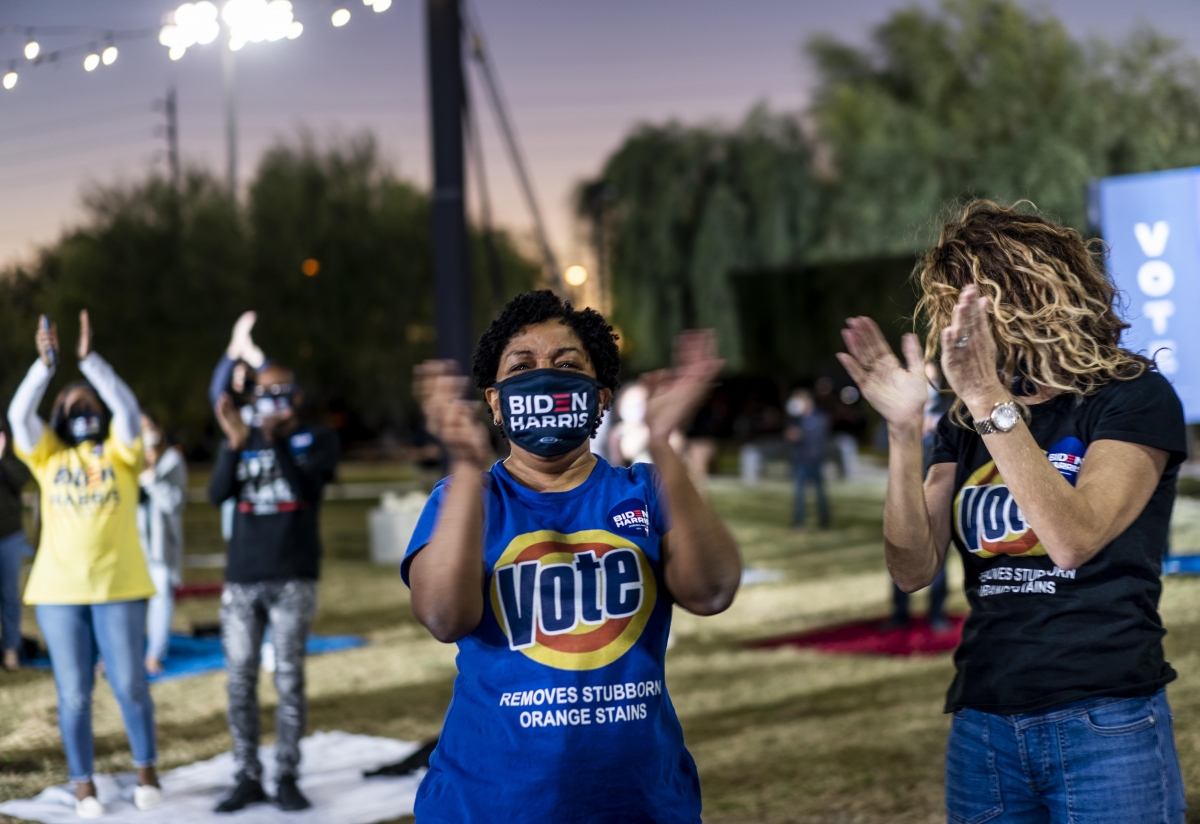
Nevada residents attend a socially distanced campaign event with Sen. Kamala Harris at Kianga Isoke Palacio Park in Las Vegas on Oct. 27. Washington Post photo by Melina Mara.
Harris, who attended Howard University in Washington, is also the first graduate of a historically Black university to be elected to serve in the White House.
Biden nodded to some of the history of his election during remarks Wednesday in his hometown of Wilmington, where he was awaiting final results in a close electoral college race.
Calling the voter turnout “extraordinary,” Biden said he and Harris were “on track to win more votes than any ticket in the history of this country.”
While Biden’s path to victory became clearer Wednesday after he secured wins in key battleground states, the apparently narrow margins in several states left the outcome in doubt for days. During that period, Trump made baseless claims of voter fraud and dispatched his campaign and legal team to file lawsuits in multiple states.
Trump has previously declined multiple opportunities to commit to a peaceful transition of power, saying he reserved the right to object to what he has defined as fraud despite the lack of evidence.
Throughout the campaign, Biden pitched himself to voters as a uniter who would restore the nation’s governing norms, respect long-standing institutions and reconnect relationships with international allies that have frayed as Trump embraced autocrats and brushed aside leaders of other democracies.
Unlike in his two other attempts at the White House, in the 1988 and 2008 contests, Biden entered the race at the top of the polls. He crafted a decidedly centrist pitch as many other candidates vied for attention from the energized liberal wing of the Democratic Party.
But his candidacy struggled in the early contests. He placed a dismal fourth in Iowa, then sank to fifth in New Hampshire.
Biden’s chances brightened in Nevada, where he was powered by a more diverse electorate. And then the race moved onto turf far more agreeable to a man who had long worked with Black elected officials and served the first African American president – South Carolina, and its predominantly Black Democratic electorate.
Boosted by support from Rep. James E. Clyburn, an influential Black Democrat in the state, he rallied to an easy victory, and he replicated it in a host of states over the next few weeks to effectively clinch the nomination just as the nation closed down under the explosion of the coronavirus.
Even in the general election, the campaign tried to maintain a low profile, with Biden avoiding showmanship and making a point to elevate others in the party.
He focused insistently on the coronavirus, keeping a card with an updated death count with him at all times and deploying his own personal story of loss to convey a sense of empathy that he said the president lacked. He hoped that his experience with the death of his first wife and their daughter in a 1972 car accident and the 2015 death from cancer of his son Beau would help him connect with a country in mourning.
Biden’s campaign also reflected his desire to model the guidance of public health officials in minimizing the spread of a virus that has killed more than 236,000 Americans. He wore a mask at all public appearances, at times for entire speeches, unless he was yards from anyone else, and urged Americans to follow suit. Even as the president resurrected mass gatherings, filled with maskless supporters who refused to socially distance, Biden held no large rallies, instead speaking before parking lots full of cars as supporters honked in agreement.
He rarely left his Wilmington home over the summer – occasionally holding news conferences at a nearby high school to announce new policies – even though it was just miles from the border of swing state Pennsylvania.
Until the final week of the campaign ushered in a few multiple-event days, the splashiest the campaign got was a day spent on a train ride through eastern Ohio and western Pennsylvania. Biden’s wife, Jill, frequently told supporters that during a Biden administration they would be a little bored as they flipped through newspapers.
The light, coronavirus-safe campaign schedule worried Democrats who grew concerned that Biden was not exciting voters or vigorously making a case for his candidacy. And the campaign’s decision to shut down an in-person door-knocking operation, a tactic long used by Democrats to motivate infrequent voters, was criticized as creating a huge disadvantage, especially as Republicans sent volunteers door-to-door to pitch Trump. Under pressure, Biden’s campaign partially restarted a field operation in October.
Clinching the nomination early offered advantages, affording Biden time to unite the Democratic Party. He rolled out back-to-back-to-back virtual endorsements by former rivals in which they would appear together on video, events that fostered a sense of Democratic bonhomie after a bruising primary. He worked with Sen. Bernie Sanders (I-Vt.) and his supporters to develop policies, effectively muting the criticism from the left that had hounded the 2016 nominee, Hillary Clinton.
Trump used the cooperation as an attack line, saying the “manifesto” that the two wings of the party developed showed that Biden was controlled by the left. To respond, Biden would point to his long record as a moderate. “The party is me. Right now, I am the Democratic Party,” Biden snapped to Trump as the president made a case that the Democratic Party is controlled by its liberal base.
Though Biden’s team largely avoided major shifts in his message and tended not to respond to news events, the campaign made a rare exception after the May 25 killing of George Floyd in police custody in Minneapolis and the accompanying unrest. Biden lifted his self-imposed travel ban to fly to Texas to meet with Floyd’s family to show solidarity with the burgeoning Black Lives Matter movement. But he also resisted pressure from the left to endorse defunding the police and highlighted his plans to increase funding to local law enforcement while also saying his sympathies were with peaceful demonstrators.
Biden, known historically for gaffes, made some self-inflicted errors. In May, toward the end of an interview on the radio show “The Breakfast Club,” he sounded as if he was taking Black voter support for granted when the topic turned to undecided listeners.
“If you have a problem figuring out whether you’re for me or Trump, then you ain’t Black,” Biden said to Charlamagne tha God, a host of the show. Biden quickly offered regret for the comments, but within hours the GOP – trying to drive a wedge between Black voters and Biden – plastered the comment on T-shirts, and it became a frequent attack line.
The GOP also tried to weaponize Biden’s authorship of the 1994 crime bill, which critics say led to mass incarceration. Biden never apologized for his role in shepherding the legislation, which also included a 10-year ban on assault weapons. But while the Republican effort appeared to have nominally boosted Trump’s support among Black men, Biden retained the overwhelming backing of non-White voting groups.
Biden’s ascent to the White House reflects a decades-long quest for the presidency and a remarkable rise from his roots in Scranton, Pa., a childhood he often references in his speeches.
His family moved to Delaware when he was a boy, but Biden maintained his ties to his native town. On Election Day, he made a campaign stop at his former home and wrote a note on the living room wall. “From this house to the White House with the grace of God,” Biden wrote.
His first White House campaign, in 1987, ended when he bowed out after being accused of plagiarizing. His second, in 2008, ended after a bad showing in Iowa but put him on the path to becoming vice president.
But Biden situated himself as an institutionalist and creature of the Senate, where he served for six terms. He chaired the Senate Foreign Relations and Judiciary committees, overseeing the hot-button Supreme Court confirmation hearings of Robert Bork and Clarence Thomas. His regrets over how Anita Hill was treated as a witness during the latter hearings led him to push to add women to the Judiciary Committee and ultimately to elevate Harris as his vice-presidential pick.
Trump is set to leave office with a tenuous legacy and a long string of unfulfilled promises. His final months in office aren’t likely to change that, with the country beset by a surging public health crisis.
Although he launched his first campaign promising to be “the greatest jobs president God ever made,” his loss all but ensures that he will be the first president since Herbert Hoover to leave office with fewer Americans employed than when he was sworn in. The 6.9 percent unemployment rate in October, while down from the pandemic high of more than 14 percent, is still significantly above the 4.7 percent rate when he took over in January 2017.
The national debt has soared, thousands of troops remain in overseas war zones and the kind of Washington influence-peddling Trump calls “the swamp” has only increased under his watch. Trade deficits persist, and the fence project on the border with Mexico has been neither completed nor, as Trump promised, financed by the Mexican government.
The president’s decision to sign hundreds of executive orders and bypass Congress rather than securing policy changes via legislation means that much of his legacy can easily be overturned. Yet while Biden campaigned on a promise to roll back Trump’s signature legislative victory – a tax cut passed in 2017 – he may not be able to do so if Republicans maintain their Senate majority.
Trump also will leave office with the country more divided and bitter than it was when he won in 2016, after using that unexpected victory to promise a return to unity but diverging constantly from that vow.
“Now it’s time for America to bind the wounds of division. We have to get together,” Trump said four years ago on the night of his 2016 victory. “To all Republicans, Democrats and independents across this nation, I say it is time for us to come together as one united people.”
Instead, Trump used his national platform to spew insults, denigrate foes and tweet about matters big and small.
Still, Trump’s term in office will be recorded in history books as turbulent, norm-shattering and consequential on numerous fronts. He was impeached by the House last year for alleged abuse of power and obstruction of Congress after he encouraged Ukraine’s president to investigate Biden and his son Hunter. He was ultimately acquitted by the Senate, but remains only the third president in American history to be impeached.
He has cemented his impact on the federal judiciary, appointing more than 200 judges and three Supreme Court justices. Their impact on American life will extend long past Trump’s term.
When Biden is sworn in, he will have an opportunity to leave his own stamp on a country he has served in public office for the vast majority of his adult life.
“What brings us together as Americans is so much stronger than anything that can tear us apart,” he said Wednesday. “We are campaigning as a Democrat. But I will govern as an American president. The presidency itself is not a partisan institution. It is the one office in this nation that represents everyone. And it demands a duty of care for all Americans. And that is precisely what I will do.”
White House chief of staff Mark Meadows has the coronavirus, official says
InternationalNov 07. 2020White House Chief of Staff Mark Meadows arrives to hear President Trump speak at the White House in the wee hours Wednesday morning. MUST CREDIT: Washington Post photo by Jabin Botsford
By The Washington Post · Amy B Wang, Josh Dawsey · NATIONAL, HEALTH, POLITICS, HEALTH-NEWS
WASHINGTON – White House chief of staff Mark Meadows has tested positive for the coronavirus, according to an official with knowledge of the situation.
The diagnosis comes a little more than a month after President Donald Trump and other members of his family and inner circle also tested positive for covid-19. About two weeks ago, Meadows appeared on CNN to say the administration had effectively given up on trying to slow the virus’s spread.
“We’re not going to control the pandemic,” Meadows said on CNN’s “State of the Union” on Oct. 25. “We are going to control the fact that we get vaccines, therapeutics and other mitigations.”
Meadows has for months openly brushed off the importance of wearing masks during the pandemic. On Election Day, Meadows visited the Trump campaign headquarters in Arlington, Va., where he was photographed without a mask.
Meadows was also among those in the East Room of the White House when Trump gave remarks around 3 a.m. Wednesday to a crowd of about 150 of his top aides, donors and allies. During that event, Meadows worked the room and stood near Trump campaign adviser Corey Lewandowski, one of the few people there who was wearing a mask.
Ben Williamson, a Meadows spokesman, could not be reached for comment. The White House declined to comment Friday night.
By The Washington Post · Annie Linskey · NATIONAL, POLITICS
WILMINGTON, Del. – On Day 4 of election night, outside the Chase Center here, a gathering place emerged from a state of suspended animation.
People arrive at the Chase Center in Wilmington, Del., on Friday. MUST CREDIT: Washington Post photo by Jonathan Newton
Cranes lifted massive lights into the sky. Forklifts moved concrete barriers. Workers yanked protective plastic off scaffolding. Balloons were tied to a metal fence, marking a perimeter.
It was Friday evening, and Joe Biden’s campaign was getting ready for a socially distanced celebration party.
Again.
But it was all for naught.
Rather than declare victory on a commanding and brilliantly lit stage, shortly before 11 p.m. Biden stood behind a plain lectern on a smaller space set up in an atrium of the Chase Center to urge patience.
“My fellow Americans, we don’t have a final declaration of victory yet,” Biden said, with his running mate, Sen. Kamala Harris, D-Calif., standing nearby. “But the numbers tell us it’s clear – tell us a clear and convincing story. We’re going to win this race.”
Biden said he’d work for all Americans, regardless of party. “We may be opponents but we’re not enemies. We’re Americans,” he said, with his senior staff watching from the back of the room. “I’ll work as hard for those who voted against me as I will for those who voted for me.”
For Biden’s staff, after 18 months of campaigning, being snubbed by party donors, enduring a fourth-place finish in Iowa, then sinking to fifth in New Hampshire, and after ultimately clinching the nomination and listening to Democrats complain about how they were running an overly cosseted campaign for months, they believed they had proved critics wrong.
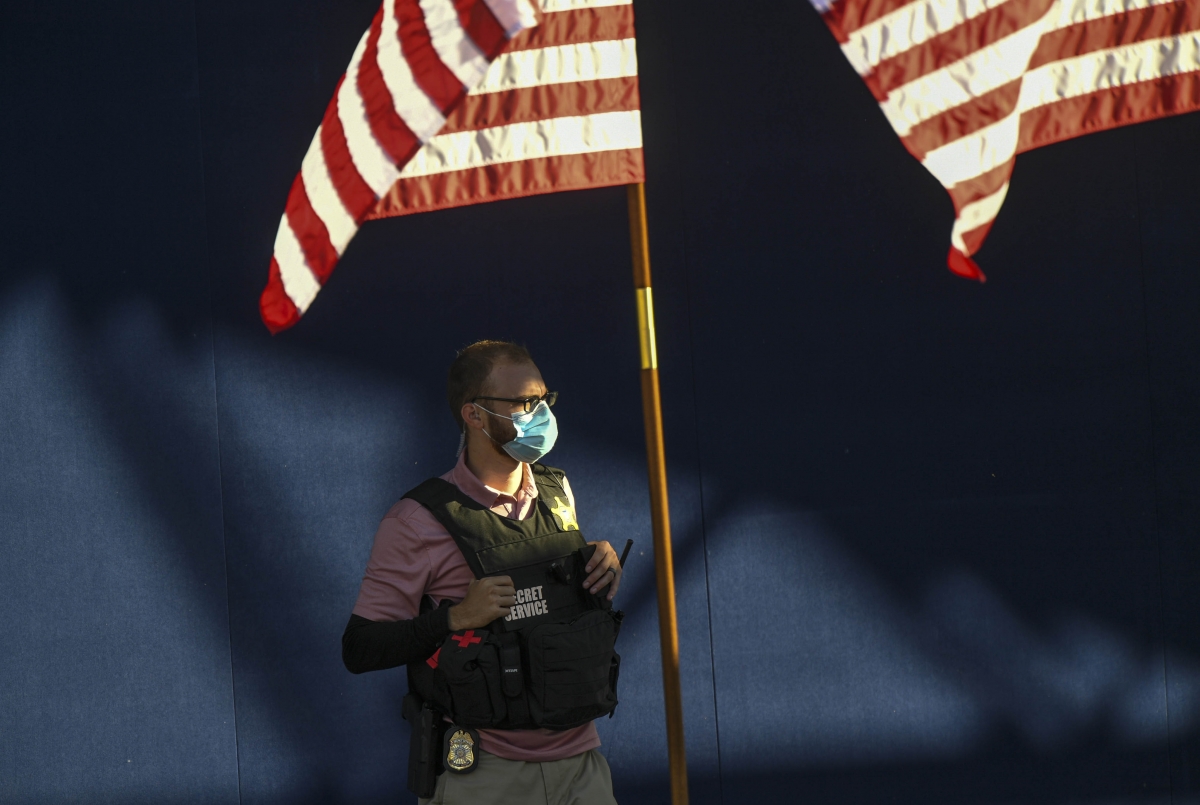
A Secret Service agent guards the stage at the Chase Center on Friday. MUST CREDIT: Washington Post photo by Jonathan Newton
Now all they needed was one or two networks to call the race and declare Biden president-elect. They needed a larger lead in Pennsylvania or bigger margins in Georgia or some more votes in Arizona and a call in Nevada.
As member of Biden’s team allowed themselves to absorb the news that they had nearly won, the landscape around them was changing. The next president might be in their midst. The Federal Aviation Administration posted temporary flight restrictions over Wilmington airspace starting 2 p.m. Friday through the following Wednesday.
The Secret Service sent reinforcements to Delaware to provide security fitting for a team that would soon lead the country. Officers already in Wilmington extended their occupation of coveted rooms in the Westin adjacent to the Chase Center, where Biden’s team set up its election-night headquarters.
Now they just needed a few more votes to make it official.
Local supporters began arriving at the Wilmington riverfront area by early afternoon, taking advantage of the unseasonably warm, 70-degree weather to get a glimpse of history.
Ron Ozer, a chemical engineering professor at Villanova University, set up a picnic with his wife just outside a black fence blocking off a secure area. They had an iPad to listen to MSNBC. They had crackers. They had folding chairs. They were ready to wait.
They didn’t come down Tuesday night, and they said as the evening wore on they became “disappointed” to see so much support for President Trump.
“We kind of knew, logically, that there were a lot of ballots to count,” Ozer said. “But it didn’t really sink in.”
Justin Smith, 16, drove from New Jersey to Wilmington with his family to see Biden on Friday. “He has the positive demeanor to make America whole again,” Smith said. “Not so much great, because I feel like America can never be great again because of the racial [tension] and the bad politics in the justice system,” added Smith, who is African American.
Nathan Jenkins sold blue T-shirts and sweatshirts that read “I survived Covid-19” and “virus 45,” a reference to Trump. Jenkins said the extended election aftermath was “a little nerve-wrecking.”
“Sometimes you think it is going to be 2016 all over again,” he said. “But as things started to progress, I was feeling better. Election night I was a little nervous, to be honest.”
As the day wore on, Biden allies shifted their tone about the potential for festivities – with networks not calling results, the Biden campaign contemplated the possibility that it could wait one more day before sending Biden and his running mate, Sen. Kamala Harris, D-Calif., out to declare victory.
There were mixed signals about what the evening would hold.
By around 4 p.m., some top Biden staffers were spotted walking out of the Chase Center, back to their hotel rooms. It was the wrong direction for a celebration.
Then around 5:20 p.m., a van used to transport the press that follow Biden’s every move pulled up to the Westin. Was this a sign that Biden would soon be collected from his nearby home?
As longtime Biden watchers chatted, many agreed that the tardy results seemed to be a fitting coda for a campaign operation that itself was chronically (and often inexplicably) late.
Election night had unofficially started around 3 p.m. Tuesday, when Biden aides recommended reporters show up at the Westin hotel and set up in a second-floor conference room to wait for results. Somebody delivered dozens of white roses to the Biden staff, to honor the work they had done.
It was a skeleton crew, with just a few staff members, a small handful of journalists and production-crew staffers prepared to see Biden and Harris deliver a victory speech.
Instead Biden and his wife emerged briefly, promising an update the following day.
In the harshly lit Westin hotel lobby around 1 a.m. Wednesday, Biden strategist Mike Donilon waited for a van to shuttle him elsewhere. He fended off reporters eager for some snippet.
About eight hours later, in the same lobby, top strategist Anita Dunn briefly chatted with reporters after taking her daily coronavirus test. She’d had just one hour of sleep. “You guys cannot stand this close to me,” she told journalists as she outlined why the team was confident.
“We always said the goal was to get 270 electoral votes,” Dunn said. “We feel very confident that after the votes have been counted that’s where we’re going to be.”
Biden came to the Chase Center on Wednesday, too, speaking briefly to reporters, with Harris at his side, to urge patience. “Power can’t be taken or asserted,” Biden said. “It flows from the people.”
By Thursday, as results kept dripping in, the resources on the Wilmington riverfront were showing strain. A Starbucks ran out of most pastries. A nearby restaurant at the Hotel Du Pont ran out of butternut squash soup. Hotel rooms disappeared. Biden and Harris received briefings on the pandemic and the economy. Secret Service agents began knowing the regulars going in and out of the secure area by face.
Dunn and her husband, Bob Bauer, a top election lawyer for the campaign, were spotted walking along the Christina River, a tributary to the Delaware River.
Friday began with a sense of new excitement among top Biden campaign staffers as they began gathering at the Westin midmorning for their daily coronavirus tests. Overnight the campaign had taken a slight lead in Georgia. And by 8:45 a.m. counts also showed Biden ahead in his native Pennsylvania.
“When we took the lead in Pennsylvania, it felt more real than it has,” said one aide who sipped an iced coffee near a security checkpoint. “Twitter lit up. Signal lit up,” the aide said, referring to the secure texting platform many in politics use.
The aide was coy about exactly when a Biden victory speech might happen, but many had expected it to be Friday evening.
The aide, who was not authorized to comment publicly and spoke on the condition of anonymity, previewed Biden’s message. “Joe Biden from the day he announced his candidacy has been about bringing people together and about ending that sort of toxic, chaotic divisive mood of the country,” the aide said, adding that Biden “would want to go out and continue to deliver that message.”
But as the sun set in Wilmington on Friday, the likelihood of a victory speech from Biden faded.
And as for those white roses that had arrived on Election Day, they had wilted.
Pennsylvania GOP asks Supreme Court to enforce segregation of late-arriving ballots that officials have already set aside
InternationalNov 07. 2020Election observers watch Allegheny County officials manually check ballots on Friday in Pittsburgh. MUST CREDIT: Washington Post photo by Michael S. Williamson
By The Washington Post · Elise Viebeck, Robert Barnes · NATIONAL, POLITICS
Legal jockeying in Pennsylvania intensified Friday as Republicans asked the U.S. Supreme Court to ensure county election officials were segregating mail ballots delivered after Election Day, the latest effort by the GOP to use the courts to intervene in the vote count as former vice president Joe Biden’s advantage grew.
Even if the high court were to grant the request, the impact would likely be muted: Pennsylvania officials said they are already setting aside the small number of mail ballots that have been arrived since Tuesday.
But the move was part of a broader scramble in the courts by President Donald Trump’s campaign and other Republican figures as Biden improved his lead in Pennsylvania, Georgia and Nevada.
The GOP has sought to halt or delay the ballot count in a number of lawsuits filed or revived this week around the country since Tuesday. At least 35 lawyers – including newly appointed “legal directors” in those states and Arizona – have been drafted by the campaign to bring cases alleging voting irregularities or missteps by election officials in the wake of an election that ran largely smoothly on Nov. 3.
But judges have responded skeptically as Republicans struggle to provide specific evidence to support Trump’s claim of widespread fraud or irregularities, leading them to deny GOP claims or dismiss complaints outright in key battleground states.
On Thursday, judges in three states rejected lawsuits filed by the Trump campaign that challenged the ballot-counting process. Friday brought additional defeat for the president in Michigan, as judges rejected a pair of lawsuits by the Trump campaign and a conservative nonprofit alleging rules were broken during vote-counting.
The GOP’s most intense focus was in Pennsylvania, where Biden pulled ahead of Trump in the vote count early Friday.
The Pennsylvania Republican Party filed a new request with the U.S. Supreme Court asking it to keep state officials from counting mail ballots received after Election Day, even though election officials have already set those aside and are not including them in their current tallies.
Under a ruling by the state Supreme Court, election officials in Pennsylvania are allowed to count ballots that were postmarked by Tuesday and arrive by 5 p.m. Friday. But state officials agreed to segregate ballots received after 8 p.m. on Election Day because of pending legal challenges by Republicans.
Despite that, the state GOP said Friday that an official order from the court was necessary to ensure the ballots have been segregated.
The filing acknowledged that the Republican Party did not know of any county not already complying with an order from Pennsylvania Secretary of State Kathy Boockvar to segregate the ballots received in that three-day window.
The filing said that party representatives contacted all 67 counties and that 42 affirmed that they were segregating the relevant ballots. Because the party did not get a response from the rest, the filing said that raised the possibility that the order might not be being enforced in all counties. It also said that Boockvar might change her order at some point.
The court usually requires more proof in an injunction request that an emergency is at hand.
Boockvar has said a very small number of ballots are at stake and that the current count only includes ballots that arrived by Election Day.
“So I think no matter what happens, I don’t think it’s going to be a tremendous impact on this race,” she told CNN Thursday.
In Philadelphia, for example, just 500 ballots came in Wednesday and Thursday, according to city officials.
The Supreme Court has twice passed up the chance to stop the deadline extension for receiving ballots approved by the Pennsylvania Supreme Court. But three justices said they think that court’s order might be unconstitutional, and that they were open to granting a case that looks at the issue. It is because of that state officials agreed to keep the ballots segregated.
Also in Pennsylvania, a state court judge ordered election officials to segregate certain provisional ballots, granting a GOP request in part; another dismissed a similar case.

 President Trump at the White House on Thursday. MUST CREDIT: Washington Post photo by Jabin Botsford.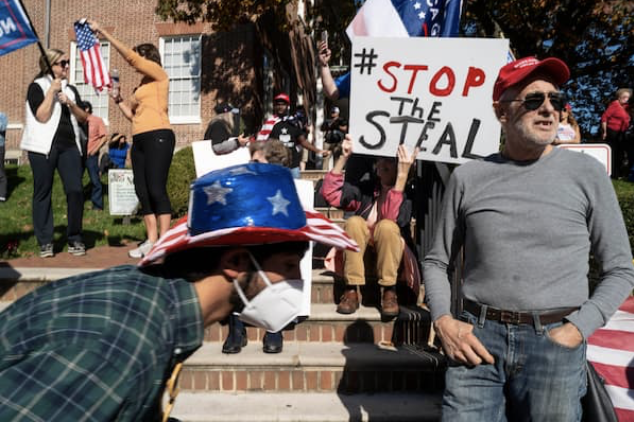
 Sen. Kamala Harris, D-Calif., makes a campaign stop at the University of Texas Rio Grande Valley in Edinburg on Oct. 30, 2020. Photo for The Washington Post by Julia Robinson.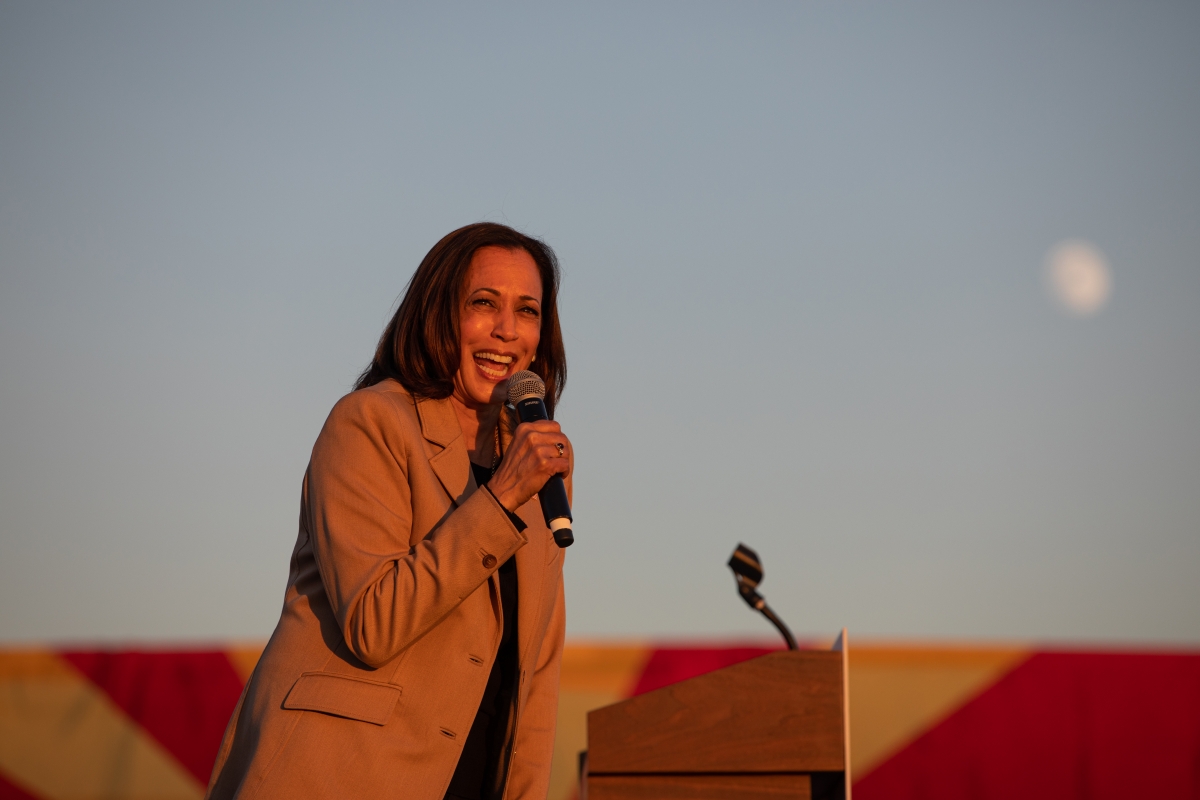
 George Bush is showered with confetti at a campaign rally in Cleveland on Nov. 1, 1992. Washington Post photo by Frank Johnston.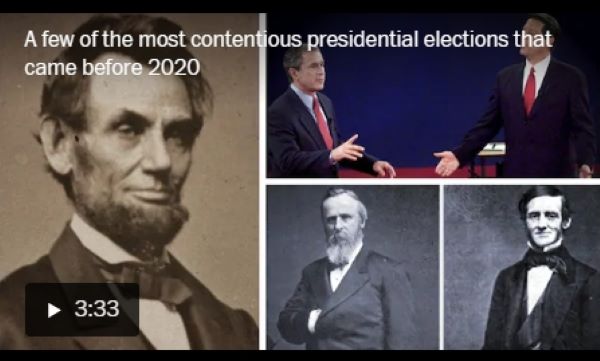


 President Trump leaves after speaking in a press briefing room at the White House on Thursday. MUST CREDIT: Washington Post photo by Jabin Botsford.
  Democratic presidential candidate Joe Biden addresses a crowd in Durham, N.C., on Oct. 18. Washington Post photo by Demetrius Freeman.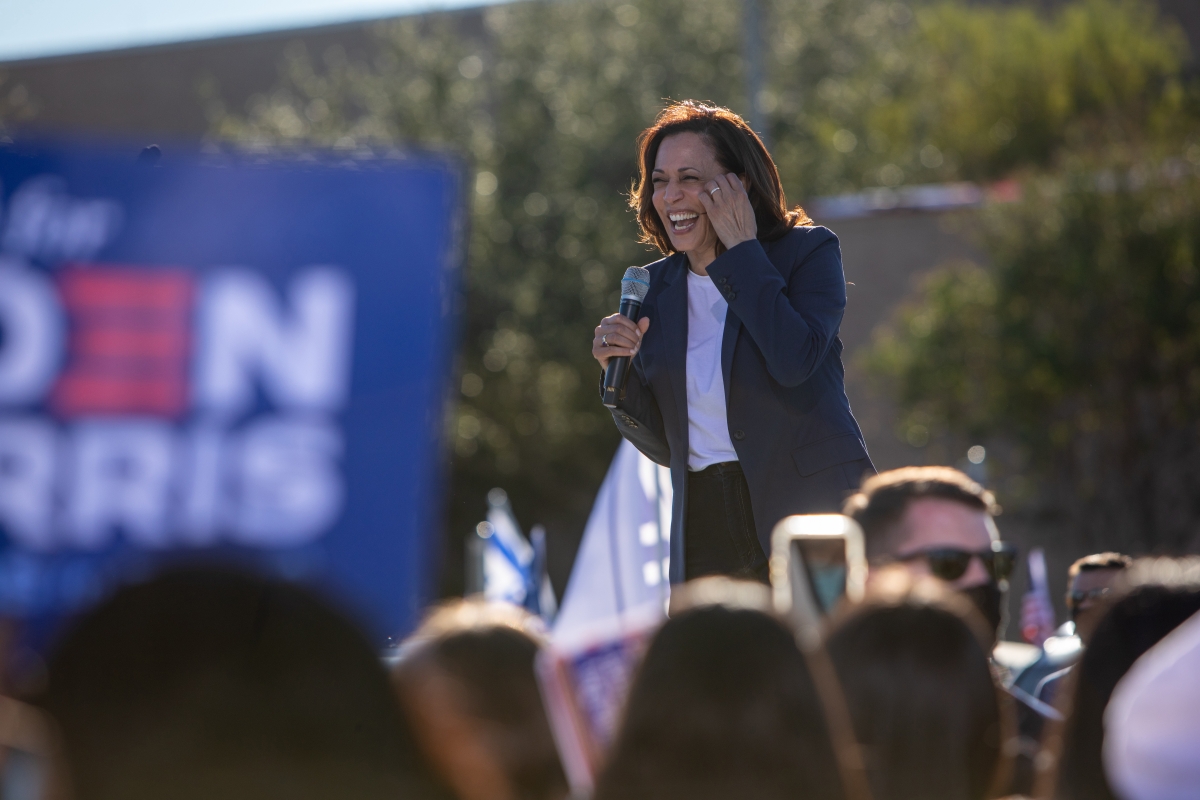
 White House Chief of Staff Mark Meadows arrives to hear President Trump speak at the White House in the wee hours Wednesday morning. MUST CREDIT: Washington Post photo by Jabin Botsford

 Election observers watch Allegheny County officials manually check ballots on Friday in Pittsburgh. MUST CREDIT: Washington Post photo by Michael S. Williamson
  SootinClaimon.Com