The Polish hero who volunteered to go to Auschwitz – and warned the world about the Nazi death machine #ศาสตร์เกษตรดินปุ๋ย

#ศาสตร์เกษตรดินปุ๋ย : ขอบคุณแหล่งข้อมูล : หนังสือพิมพ์ The Nation

https://www.nationthailand.com/lifestyle/30381103?utm_source=category&utm_medium=internal_referral

The Polish hero who volunteered to go to Auschwitz – and warned the world about the Nazi death machine

Jan 27. 2020
Left: A colorized portrait of Witold Pilecki sometime before World War II. Right: Pilecki as prisoner No. 4859 in Auschwitz in 1941. MUST CREDIT: Auschwitz-Birkenau Museum and Memorial

Left: A colorized portrait of Witold Pilecki sometime before World War II. Right: Pilecki as prisoner No. 4859 in Auschwitz in 1941. MUST CREDIT: Auschwitz-Birkenau Museum and Memorial
By POLAND-HISTORY
The Washington Post · Gillian Brockell 

It wasn’t until the 1990s that Zofia and Andrzej Pilecki found out their father was a hero. As teens in postwar Poland, they had been told he was a traitor and an enemy of the state, and they listened to news reports about his 1948 trial and execution on the school radio.

In fact, Witold Pilecki was a Polish resistance fighter who voluntarily went to Auschwitz to start a resistance, and he sent secret messages to the Allies, becoming the first to sound the alarm about the true nature of Nazi Germany’s largest concentration and extermination camp.

Auschwitz was liberated 75 years ago on Monday. In a new book, “The Volunteer: One Man, an Underground Army, and the Secret Mission to Destroy Auschwitz,” former war correspondent Jack Fairweather unearths the story of Pilecki’s heroism.

Pilecki (pronounced peh-LET-skee) was born into an aristocratic Polish farming family in 1901. As a young man, he fought against the Soviets in the Polish-Soviet War, earning citations for gallantry. Upon inheriting the family land, he took up the life of a country gentleman, married and had two children.

When the Nazis invaded Poland in 1939 at the start of World War II, Pilecki was called back to military service. But Poland fell in less than a month, split by the Nazis and the Soviets. Pilecki went into hiding and joined the burgeoning Polish resistance.

“The French resistance is so famous, but in actual fact, over half of all the intelligence from continental Europe to reach London came from the Polish underground,” Fairweather said in an interview with The Washington Post. “It was the biggest operation in Europe, and they provided the highest-quality intelligence – much prized by the Allies – about German capacity and war production.”

As the Nazi occupation’s grip tightened on Polish Jews, some Poles turned against Jews, too, while many others secretly helped their Jewish neighbors. The leader of Pilecki’s resistance cell pushed to make the group Catholic-only. Pilecki was a Catholic, but he argued against the change and pushed successfully to unite the group with a mainstream resistance cell that believed in equal rights for Jews.

“When (the Nazis) are doing their best to try and atomize society and break down the bonds between Poles, Pilecki doesn’t turn inwards, he doesn’t retreat into his ethnicity or his class,” Fairweather said. “He actually does the complete opposite, and begins to reach out to those around him.”

Then Pilecki got his first big mission: get arrested and sent to Auschwitz. At the time, the site run by Germany in occupied Poland was known to be a Nazi work camp for Polish prisoners of war. Pilecki was to gather information about conditions inside and organize a resistance cell, perhaps even an uprising.

The dangerous mission was voluntary; he could have refused. On Sept. 18, 1940, he placed himself in the middle of a Gestapo sweep and was sent to Auschwitz.

Nothing could have prepared him for the brutality he found. As he leaped out of a train car with hundreds of other men, he was beaten with clubs. Ten men were randomly pulled from the group and shot. Another man was asked his profession; when he said he was a doctor, he was beaten to death. Anyone who was educated or Jewish was beaten. Those remaining were robbed of their valuables, stripped, shaved, assigned a number and prison stripes, and then marched out to stand in the first of many roll calls.

“Let none of you imagine that he will ever leave this place alive,” an SS guard announced. “The rations have been calculated so that you will only survive six weeks.”

The mass gassings that came to define the Holocaust had yet to begin, but the crematorium was up and running. The only way out of Auschwitz, another guard said, was through the chimney.

Thus began 2½ years of misery. As Pilecki and other prisoners starved, lice and bedbugs feasted on them. Typhus outbreaks regularly ranged through the camp. Work assignments were exhausting. Guards delighted in punishing them. Prisoners, in desperation, stole from and betrayed one another for scraps. Many killed themselves by leaping into the electrified fence.

But slowly, Pilecki organized his underground. At first it was just a few men he knew from before. In the end, there were nearly a thousand. They formed a network to steal and distribute food and extra clothing, sabotage Nazi plans, hide injured and sick prisoners, and improve morale with a sense of brotherhood and regular news from the outside world.

“With almost a thousand men by 1942, and – barring for one incident with a Gestapo spy – not one of Pilecki’s men betrayed each other, in extraordinary circumstances of starvation and violence,” Fairweather said. “He built something really powerful in that camp.”

Starting in October 1940, the underground worked together to smuggle messages to the resistance outside. The first was sent via prisoner Aleksander Wielopolski. In Auschwitz’s early days, a few prisoners were able to secure their release if their families paid big enough bribes. Wielopolski was one of those few. Rather than risk smuggling out a paper report, Pilecki had him memorize it.

Once free, Wielopolski passed the message on to Pilecki’s friends in the resistance. Pilecki never knew whether his reports reached the Allies, but Fairweather and his researchers were able to track down how they were smuggled across Europe to the highest levels in London.

His first message was blunt: Bomb Auschwitz. Even if it meant killing everyone inside, himself included, it would be merciful. Conditions were horrifying, and the Nazis had to be stopped, he implored.

The British considered Pilecki’s request in early 1941, Fairweather found, but ultimately decided against it. The United States had not yet entered the war, and the British Royal Air Force was down to fewer than 200 planes, all of which lacked radar. It would have stretched the limits of their fuel capacity. And the British had no precedent to take action for humanitarian reasons.

Over the next two years, Pilecki continued to send messages to London via risky escapes by his men and notes passed to Polish farmers neighboring the camp.

Each message was more dire: The Nazis were conducting disgusting medical experiments on patients in the camp hospital. The Nazis killed thousands of Soviet POWs in a mass execution. The Nazis were testing a way to gas prisoners en masse. The camp was expanding. Huge trainloads of Jews were being gassed and cremated. Hundreds of thousands of men, women and children were being murdered.

“Pilecki, by recording every step of the camp’s evolution towards the Holocaust, he was in some ways grappling with the very essence of the Nazi’s evil before anyone else,” Fairweather said.

Pilecki kept asking: Couldn’t the Allies at least bomb the train lines leading to the gas chambers? Or create a distraction so the prisoners could try to rise up and escape?

Fairweather said he gained a lot of sympathy for the British from their initial decision not to bomb the camp. But later, when the United States joined the war, bringing a far superior air force, continuing that decision “becomes untenable,” he said. The Allies fell back on the original decision without considering that both the necessity and their capabilities had changed.

Not bombing Auschwitz is “one of history’s great might-have-beens,” Fairweather said.

By spring 1943, it was clear the Allies weren’t going to help the prisoners of Auschwitz. Without any outside help, an uprising would never succeed. Increasingly frail and in danger of being found out, Pilecki decided it was time for him to leave.

It took months to plan, but he and two friends pulled off an incredible escape through the camp bakery in the early hours of April 27. From there, he sneaked into Warsaw, where he was briefly reunited with his wife and children.

Pilecki began working for the resistance again, but the symptoms of what we might now call post-traumatic stress disorder dragged him down. He “struggled to connect” with his friends and family, according to Fairweather, and wrote day and night about the horrors he had witnessed. He even returned to Auschwitz after the war, where he found other former prisoners living in their old barracks and giving tours to the curious.

In the summer of 1944, the Soviets were advancing on the German army, pushing them westward and out of Poland. The Polish resistance hoped to kick the Germans out of Warsaw ahead of the Soviets’ arrival to re-establish a sovereign state. Pilecki was one of thousands who fought in the Warsaw Uprising, the largest action taken by a European resistance group in World War II. In the end, the Soviets held back their advance so the Nazis could crush the Poles. Then they swooped in and took over.

The Soviets liberated Auschwitz on Jan. 27, 1945. By then, 1.1 million people had been killed there, most of them Jews.

“For a lot of us in the West, we think of May 1945 as the end of the Second World War in Europe, and parades and so on,” Fairweather said. “Pilecki’s story is a powerful reminder that what happened in Eastern Europe was the Allies gave (Soviet leader Joseph) Stalin a free hand to occupy and subjugate half of continental Europe. And the war didn’t end for so many people.”

Poland would spend the next four decades as a communist puppet state behind the Iron Curtain. But Pilecki didn’t see much of it. He remained loyal to the idea of a free Polish republic and continued sending messages to British intelligence. He was arrested by communist authorities in 1947, tortured repeatedly and executed as an enemy of the state the next year.

According to a Polish newspaper, as he was led to his death, he said, “I’ve been trying to live my life so that in the hour of my death I would rather feel joy than fear.”

Pilecki’s reports remained hidden away in Polish archives until the 1990s. Now he has been showered with posthumous awards and hailed as the hero he was. A documentary about him is scheduled for release this year.

He is also a symbol of the way many Poles were forced to bury their war experiences for decades, Fairweather said, comparing it to if the American heroes of D-Day had been treated as traitors and pariahs.

That reckoning continued as leaders from all over the world gathered in Israel on Thursday to commemorate the liberation of Auschwitz. In attendance was Russian President Vladimir Putin, who has recently spread misinformation about the Poles during World War II. He was given a top speaking role at the ceremony, prompting Polish President Andrzej Duda to boycott the event.

Duda is expected to attend a commemoration ceremony at Auschwitz on Monday. Zofia and Andrzej, now 86 and 88, will not be there, Fairweather said – they prefer to honor their father on the day of his execution. For years under communism, Zofia would light a candle alone outside the prison walls where her father was killed. Last year, hundreds of people joined her.

How to survive falling through ice #ศาสตร์เกษตรดินปุ๋ย

#ศาสตร์เกษตรดินปุ๋ย : ขอบคุณแหล่งข้อมูล : หนังสือพิมพ์ The Nation

https://www.nationthailand.com/lifestyle/30381060?utm_source=category&utm_medium=internal_referral

How to survive falling through ice

Jan 26. 2020
From slowing your breath to kicking your feet until your body is horizontal, here's what to do if you fall through ice.
Photo by: The Washington Post — The Washington Post

From slowing your breath to kicking your feet until your body is horizontal, here’s what to do if you fall through ice. Photo by: The Washington Post — The Washington Post
By  The Washington Post · Katie Shepherd · NATIONAL, FEATURES, SPORTS

Similar tragedies shocked neighboring New Jersey suburbs on Wednesday as thin layers of ice on ponds cracked beneath the feet of two teenage boys.

Yousef Khela, 13, slid into frigid water near a public library in East Brunswick around 5 p.m. Just two hours later and 20 miles away, David Tillberg, 14, dropped through the ice in a local park in Carteret.

Neither boy survived the plunge.

“Our small community is saddened and shocked over this tragedy,” Carteret Mayor Dan Reiman said in a statement on Facebook after Tillberg was pronounced dead early Thursday at a hospital.

The neighboring township’s police chief gave a stern warning about the dangers of walking on ice.

“No ice is safe ice. If you see ice on a lake, it’s not safe,” said East Brunswick Police Chief Frank LoSacco, according to WABC. “Don’t go out on any ice unless it’s an ice-skating rink.”

Every year, children and even some old enough to know better venture onto thin ice, despite warnings to stay away. And in many northern states, where ponds and lakes freeze over every winter, going onto the inches-thick slabs of ice is a common, if risky, recreational pastime. People fish, skate and drive snowmobiles on thick, clear ice.

So what should you do if you fall through ice?

“First, try not to panic,” Minnesota state officials advise in a guide to surviving an accidental icy plunge. “This may be easier said than done, unless you have worked out a survival plan in advance.”

1. Stay calm.

Don’t let the shock of falling into the ice-cold water take over. This may be the hardest part of saving yourself.

“Suddenly you find yourself immersed in water so cold it literally takes your breath away,” according to the guide. “And the pain is incredible!”

But you need a clear mind to rescue yourself from the water. You have about 10 minutes before your body gets too cold to pull itself out.

2. Let your winter clothes act as a buoy.

Keep your winter clothes on. Although you might think a heavy coat or snowsuit will immediately soak up freezing water and sink, they can actually hold warm air that will help you float.

“Heavy clothes won’t drag you down,” Minnesota state officials said.

3. Turn back toward the direction you came from and use the solid ice to pull yourself out of the water.

The ice is probably thicker and stronger where it previously held you up. You’ll need solid ice to support your weight as you pull yourself out of the water.

“If your clothes have trapped a lot of water, you may have to lift yourself partially out of the water on your elbows to let the water drain before starting forward,” according to the Minnesota DNR website.

Reach out and place your arms flat on the ice, and begin to squirm back onto the surface of the ice.

“Two words: kick, and pull,” Gordon Giesbrecht, a professor at the University of Manitoba who studies hypothermia and is known as “Professor Popsicle,” told ABC News. “Put your arms on the ice, and just kick your legs, and just try to pull yourself along the ice.”

Ice picks can help a lot. Fishermen and snowmobile drivers often carry them in case ice breaks. Screwdrivers or even nails driven into pieces of wood as a homemade method can also be used to grip the slippery surface and claw your way back onto the ice, Minnesota officials said.

4. Stay horizontal on the ice. Don’t stand up too soon.

When you manage to wiggle your way onto the ice, keep lying down. If you stand up, you might cause the ice to crack again.

“Roll away from the hole to keep your weight spread out,” the Minnesota guide advises.

5. Warm up, quickly and carefully.

Once you’re back on solid ground, the danger is not quite over.

Get somewhere warm, where you can change into dry clothes, as quickly as you can. The water in your clothes will start to freeze immediately, but you should have time before your body begins to lose more heat than it can create.

“It’s going to take at least half an hour [in freezing water] before you became hypothermic,” Giesbrecht told ABC News.

You should also seek medical help once you’re out of the water. Your body can go into shock from the rapid temperature changes, according to the Minnesota guide. Cold blood from your hands and feet can rush into your heart.

“The shock of the chilled blood may cause ventricular fibrillation leading to a heart attack and death,” according to the guide.

Frieda Caplan, ‘Kiwi Queen’ who brought a touch of the exotic to the American fruit basket, dies at 96 #ศาสตร์เกษตรดินปุ๋ย

#ศาสตร์เกษตรดินปุ๋ย : ขอบคุณแหล่งข้อมูล : หนังสือพิมพ์ The Nation

https://www.nationthailand.com/lifestyle/30380991?utm_source=category&utm_medium=internal_referral

Frieda Caplan, ‘Kiwi Queen’ who brought a touch of the exotic to the American fruit basket, dies at 96

Jan 24. 2020
Frieda Caplan, shown here in 2003, displays the toma bella, a pepper and tomato hybrid. MUST CREDIT: Photo by Jonathan Alcorn for The Washington Post

Frieda Caplan, shown here in 2003, displays the toma bella, a pepper and tomato hybrid. MUST CREDIT: Photo by Jonathan Alcorn for The Washington Post
By The Washington Post · Emily Langer 

Arriving each morning at 1 a.m., dressed in a skirt and heels and ready for work in the rough-and-tumble of the Los Angeles Wholesale Produce Market, Frieda Caplan stood out – an exotic exception, much like the wares she began selling there in 1962.

Among the many merchants peddling tomatoes, onions and other mainstays of the traditional American dinner table, Caplan was for many years the lone woman. The staples of her stand were not staples at all. Rather, she dealt in rarities – the kiwi when the furry brown fruit was known as a Chinese gooseberry, alfalfa sprouts before they were a favorite of health-food nuts, and avocados before the brunch crowd began eating them on toast.

With her ever-evolving array of offerings, which she sold to specialty shops as well as to chains including Safeway, Whole Foods, Trader Joe’s and Costco, Caplan was credited with whetting the American appetite for dozens of once-rare fruits and vegetables that today are commonplace in groceries, kitchens and restaurants.

Caplan – known to admirers as the “Kiwi Queen” for her role in popularizing the fruit in the United States – died Jan. 18 at her home in Los Alamitos, California. She was 96. Her daughter Karen Caplan, the president and chief executive of Frieda’s Specialty Produce, which is based in Los Alamitos, confirmed her mother’s death but did not cite a specific cause.

Caplan had no experience in produce sales when she entered the trade in the 1950s as a bookkeeper for the wholesale operation run by her husband’s aunt and uncle. She had recently given birth to Karen, her first daughter, and was seeking work that would provide the flexibility necessary to nurse the baby. The early-morning hours of the wholesale fruit-and-vegetable trade suited her perfectly.

As Caplan told the story, she was managing the stand while the owners were on vacation when a client placed a request for a quantity of mushrooms in the neighborhood of 500 pounds. Frantically searching for a supplier able to satisfy such a large order, Caplan personally drove to a mushroom farm to procure them.

Her spunk and grit so impressed the wholesale market landlords that they invited her to open her own stand. She did, in 1962, and it grew into the modern-day company with annual sales of $60 million, according to Karen Caplan.

When she was starting out, mushrooms and pineapple were considered exotic.

“We didn’t have innovative produce departments,” she told the New York Times in 1985. “The mindset of produce merchandisers was potatoes, onions, grapefruit and apples. It was a matter of finding people who were innovative and progressive and getting them together with people who had something to offer.”

Chief among them was Caplan, and chief among her early successes was the kiwifruit – according to a profile of Caplan published last year in The Washington Post, “the first commercial fruit … introduced to the United States since the banana in the 1880s.”

When a client first requested the Chinese gooseberry, six months went by before she could locate one, Caplan told the Los Angeles Times. In an attempt to increase sales, she marketed the item as kiwifruit – a name suggested by a colleague in the supply chain because the fruit, which was grown in New Zealand, looked like the local kiwi bird.

The fruit took time to catch on – 18 years, by Caplan’s count – but today it is scarcely harder to find than a peach or pear. The New York Times once dubbed the kiwi “the Horatio Alger of exotic fruit.”

Other fruits reportedly introduced or popularized by Caplan included spaghetti squash, sugar snap peas, shiitake mushrooms, shallots, habanero peppers, sunchokes, purple potatoes, Meyer lemons, mangoes, passion fruit and star fruit.

“I couldn’t compete with all the boys on the big items,” Caplan told the Pasadena Star-News (California) in 2003, “so I built the business selling things that were different.”

She further distinguished herself from other vendors by packaging and labeling her more unusual offerings, a godsend to head-scratching grocery store clerks as well as to consumers who might not know how to serve jicama, or how to slice into a kiwano. (Late-night television host David Letterman, who once featured Caplan on his show, jokingly pronounced the latter fruit, also know as the horned melon, as “d— near inedible.”) Customers were invited to send away to Frieda’s for recipes; everyone, she said, received a reply.

Caplan stopped selling items when they became standard fare; by then, she reasoned, her work was done. She once received an industry award honoring the Produce Man of the Year. She declined to accept it until it was renamed the Produce Marketer of the Year.

Frieda Rapoport, a daughter of Jewish immigrants from Russia, was born in Los Angeles on Aug. 10, 1923. Her father was a pattern-cutter for a clothing factory, and her mother was a homemaker. She once recalled to USA Today that when she brought home $2 in earnings from her after-school job at a five-and-dime store, her mother exclaimed, “How wonderful. You’ll never be dependent on a man again.”

She studied political science at the University of California at Los Angeles, where she was active in student government and graduated in 1945. In 1951, she married Alfred Caplan, a labor relations consultant. He died in 1998.

As she was growing her business, Caplan once told the Orange County Register, she slept four hours a night. “The opportunity to introduce people to new fruits and vegetables was very exciting,” she said. One fruit she could not enjoy was the kiwi; she was allergic to it.

She was featured in the 2015 documentary “Fear No Fruit” by filmmaker Mark Brian Smith and said that she “never had a problem with the men on the market, at all.”

“Once they got over the fact that I was a woman and they learned they could make money with the items I was selling,” she said, “I had no problems.”

Caplan continued reporting to work into her 90s, long after she sold her business to her daughters in 1990. In addition to her daughter Karen, of Seal Beach, California, survivors include another daughter, Jackie Caplan Wiggins of Long Beach, California, who is the company’s chief operating officer; and four grandchildren.

For all her success stemming from her entrepreneurial spirit, Caplan sought to give credit where she thought credit due, and that was to the fruits and vegetables she sold.

“There have always been exotic food items,” she told the Los Angeles Times in 1972. “We just showcased them, dressed them up and sold them.”

‘I take pride in my gay son’ #ศาสตร์เกษตรดินปุ๋ย

#ศาสตร์เกษตรดินปุ๋ย : ขอบคุณแหล่งข้อมูล : หนังสือพิมพ์ The Nation

https://www.nationthailand.com/lifestyle/30380925?utm_source=category&utm_medium=internal_referral

‘I take pride in my gay son’

Jan 22. 2020
Hong Jung-seun poses for a photo on Jan. 16 in front of a Catholic church in southwestern Seoul while holding a book, titled “Coming Out Story,” which she co-authored with other parents of LGBT people. (Park Hyun-koo/The Korea Herald)

Hong Jung-seun poses for a photo on Jan. 16 in front of a Catholic church in southwestern Seoul while holding a book, titled “Coming Out Story,” which she co-authored with other parents of LGBT people. (Park Hyun-koo/The Korea Herald)
By The Korea Herald/ANN

Mother helps other parents struggling to accept their LBGT children

When her son Jiho, 38, came out as gay 12 years ago, Hong Jung-seun felt as if her world had stopped.

The ardent Roman Catholic asked God many times why she and her family were facing this personal crisis and what she had done wrong in her life. She begged God to change her son’s sexuality so that he could lead a normal life.

In the end, it was she who changed.

“I had been so devoted to serving God, but why my son? I thought it was a punishment for something I did wrong. I hated God,” Hong said during an interview with The Korea Herald.

For a while, she could not eat. She spent many sleepless nights in shock, denial and guilt. Her mood changed every second.

Her thoughts were fixed on what her son’s sexuality would mean for his life — and for her life — in a society where sexual minorities are often denied, discriminated against and hated.

After spending much time alone praying, she came to the realization that God was teaching her the virtues of love and acceptance, not punishing her.

“My life goal was to send my son to a good university, get him to have a good job and form a good family. But I learned to see and accept him as he is, not as I want him to be,” she said. “God taught me I cannot change a living thing but I can embrace it as it is.

“Without him coming out, I would have lived and died without breaking my prejudices, unable to wholeheartedly sympathize with the socially marginalized,” she said. “My views have been broadened and my world has been enriched. I learned the meaning of gratitude.”

Now, Hong leads a group of parents of sexual minorities who meet for three hours once a month. It’s her way of supporting other parents going through the same agony.

In South Korea, homosexuality is not illegal, but discrimination against sexual minorities remains widespread. Many Korean sexual minorities keep their identities hidden for fear of judgment.

According to the latest Organization for Economic Cooperation and Development report published in 2019, Korea was fourth from the bottom in terms of LGBTQ inclusiveness among member countries surveyed. It scored 2.8 points out of 10, with the OECD average being 5.1.

Teenage sexual minorities appear to be more vulnerable.

A 2014 poll by the National Human Rights Commission of Korea found that 54 percent of LGBTQ teens experienced bullying and discrimination at school, and 19.4 percent had attempted suicide.

Most parents who attend Hong’s group meetings have teenage children who have just come out. Those children, Hong said, are walking on the fence between life and death — and asking for help.

“There was a time when my son was very sensitive and I thought it was just due to stress from studying ahead of the college entrance exam,” she said. “I am sorry that he had to put up with fear and loneliness on his own.”

For her son, Hong hopes for a world where sexual minorities can thrive and find happiness as they are.

“Most urgently, we need an anti-discrimination law. Parents of sexual minorities are worried about their children’s safety every day,” she said. “I just want my gay son to be able to live here safely just like others. I am not asking for any privileges.”

Religion should be a bridge, not a barrier, she added, referring to Protestant groups that have been outspoken in their opposition to gay rights and expression.

Yet, Hong sees signs of positive change, albeit slow.

The group Hong leads won the Lee Don-myung Award — established in memory of the pro-democracy human rights lawyer — from Korea’s Catholic Human Rights Committee earlier this month.

The country’s pride parade is also getting bigger every year, with the 2019 parade in central Seoul attracting a record 80,000 LGBTQ people and their supporters.

Her son is not a source of worry anymore, she said. He is a source of happiness and reason for gratitude, as well as a bridge to a world that is richer and more colorful. For that, she thanks him every day for having appeared in her life and being who he is.

“Thank you, my son, for opening up a bigger world for me,” she said.

(laeticia.ock@heraldcorp.com)

Japanese women face a future of poverty #ศาสตร์เกษตรดินปุ๋ย

#ศาสตร์เกษตรดินปุ๋ย : ขอบคุณแหล่งข้อมูล : หนังสือพิมพ์ The Nation

https://www.nationthailand.com/lifestyle/30380770?utm_source=category&utm_medium=internal_referral

Japanese women face a future of poverty

Jan 19. 2020
A child and her mother look at a diorama of Tokyo at night made with Lego toy bricks at the Lego Land Discovery Center Tokyo on June 14, 2012. MUST CREDIT: Bloomberg photo by Tomohiro Ohsumi.

A child and her mother look at a diorama of Tokyo at night made with Lego toy bricks at the Lego Land Discovery Center Tokyo on June 14, 2012. MUST CREDIT: Bloomberg photo by Tomohiro Ohsumi.
By Syndication Washington Post, Bloomberg · Marika Katanuma 

At first glance, things seem to be getting better for Japanese women. In an economy that’s historically lagged other developed nations when it comes to female workforce participation, a record 71% are now employed, an 11 point leap over a decade ago.

The Japanese government boasts one of the most generous parental leave laws in the world and recently created a “limited full-time worker” category aimed primarily at mothers looking to balance job and family. And one of the most important needs for working families-child daycare-is slowly being expanded.

A woman walks near the Roppongi Hills complex in Tokyo on Sept. 29, 2017. MUST CREDIT: Bloomberg photo by Akio Kon,

A woman walks near the Roppongi Hills complex in Tokyo on Sept. 29, 2017. MUST CREDIT: Bloomberg photo by Akio Kon,

But even with these advantages, Japanese women-whether single or married, full-time or part-time-face a difficult financial future. A confluence of factors that include an aging population, falling birth rates and anachronistic gender dynamics are conspiring to damage their prospects for a comfortable retirement. According to Seiichi Inagaki, a professor at the International University of Health and Welfare, the poverty rate for older Japanese women will more than double over the next 40 years, to 25%.

For single, elderly women, he estimated, the poverty rate could reach 50%.

In Japan, people live longer than almost anywhere else and birth rates are at their lowest since records began. As a result, the nation’s working-age population is projected to have declined by 40% come 2055.

With entitlement costs skyrocketing, the government has responded by scaling back benefits while proposing to raise the retirement age. Some Japanese responded by moving money out of low-interest bank accounts and into 401(k)-style retirement plans, hoping investment gains might soften the blow. But such a strategy requires savings, and women in Japan are less likely to have any.

Japan’s gender pay gap is one of the widest among advanced economies. According to the Organisation for Economic Cooperation and Development, Japanese women make only 73% as much as men. Japan’s demographic crisis is making matters worse: Retired couples who are living longer need an additional $185,000 to survive projected shortfalls in the public pension system, according to a recent government report.

A separate study did the math for Japanese women: They will run out of money 20 years before they die.

Dire pension calculations published by Japan’s Financial Services Agency in June 2019 caused such an outcry that the government quickly rejected the paper, saying it needlessly worried people. But economic observers said the report was dead-on: Japan’s pension system is ranked 31st out of 37 nations due in part to underfunding, according to the Melbourne Mercer Global Pension Index.

Takashi Oshio, a professor at the Institute of Economic Research at Hitotsubashi University in Tokyo, said private pensions and market-based retirement investments are now much more important than they once were. Machiko Osawa, a professor at Japan Women’s University, was more blunt: The days of being “totally dependent on a public pension” are over.

But there are additional obstacles for Japanese women. Although 3.5 million of them have entered the workforce since Prime Minister Shinzo Abe took office in 2012, two-thirds are working only part-time.

Japanese men generally see their compensation rise until they reach 60. For women, average compensation stays largely the same from their late 20s to their 60s, a fact attributable to pauses in employment tied to having children or part-time, rather than full-time, work. Since the mid-2000s, part-time employment rates have fallen for women in more than half the countries that make up the OECD. But in Japan, the trend is reversed, with part-time work among women rising over the past 15 years.

One of Abe’s stated goals is to encourage more women to keep working after giving birth, part of his so-called Womenomics initiative. But according to a recent government study, almost 40% of women who had full-time jobs when they became pregnant subsequently switched to part-time work or left the workforce.

Machiko Nakajima’s employment trajectory is typical of this state of affairs. Nakajima, who used to work full time at a tourism company, left her position at age 31 when she became pregnant.

“I had no desire to work while taking care of my kid,” she said in an interview. Instead, Nakajima spent a decade raising two children before returning to work. Now 46, the mother of two works as a part-time receptionist at a Tokyo tennis center. Though her husband, who also is 46, has a full time job, Nakajima said she fears for her future, given the faltering pension system.

“It makes me wonder how I’m going to live the rest of my” life, she said.

– – –

According to government data, the monthly cost of living for a Japanese household with more than two people is 287,315 yen ($2,650). Some 15.7% of Japanese households live below the poverty line, which is about $937 per month.

More than 40% of part-time working women earn 1 million yen ($9,100) or less a year, according to Japan’s Internal Affairs and Communications Ministry. The lack of benefits, job security and opportunity for advancement-hallmarks of full-time employment in Japan-make such women financially vulnerable, particularly if they don’t have a partner to share expenses with.

Yanfei Zhou, a researcher at the Japan Institute for Labor Policy & Training and author of a book on the subject, “Japan’s Married Stay-at-Home Mothers in Poverty,” contends there’s a gap of 200 million yen ($1.82 million) in lifetime income between women who work full-time and women who switch from full-time to part-time at the age of 40.

“It’s not easy to save for retirement as a part-time worker,” she said. Single mothers need to make at least 3 million yen annually, or about $27,600-numbers you can’t hit “if you work part-time.”

In Japan, public pensions account for 61% of income among elderly households. The system provides basic benefits to all citizens and is funded by workers from age 20 to age 59-and by government subsidies. Many retirees get additional income from company pension plans.

While widows can claim some portion of a deceased spouse’s pension, the number of unmarried Japanese is steadily rising, having more than tripled since 1980. The latest survey showed the rate for women is 14% versus 23% for men.

One “reason why women’s retirement savings is lower than men’s is that the lifetime salary is low,” said Yoshiko Nakamura, a financial planner and president of Alpha and Associates Inc. “Traditionally, many women chose to limit their workload in order to take advantage of social security spousal benefits, and that created many ‘women’s jobs’ that pay less than 1 million yen.”

Japan has historically created incentives for married women to limit their employment to such non-career track jobs; lower pay means they (and their husbands) can take advantage of spousal deduction benefits. For example, the government gives a 380,000 yen ($3,133) tax deduction to a male worker if his wife earns less than about 1.5 million yen ($13,700) per year.

The private sector does it, too. Many companies give employees a spousal allowance as long as their partner earns less than a certain amount. Some 84% of private companies in Japan offer workers about 17,282 yen per month ($159) as long as their spouse earns less than a certain amount annually-usually 1.5 million yen, though the ceiling is lower for most companies.

Yumiko Fujino, who works as an administrative assistant, should have been happy when the government raised the minimum wage. But she wasn’t: In order for her husband to keep receiving spousal benefits, she had to cut back on her hours.

These limits are known among married women in Japan as the “wall.” Unless a wife is making enough money on a part-time basis to afford income taxes and forgo spousal benefits, it doesn’t make sense to work additional hours. But to work those kind of hours means less time for kids, which is usually the point of working part-time in the first place.

Women who qualify for the spousal benefit, Fujino said, “think less about retirement security and more about the current cost of living.”

Abe’s government is considering changes that would require more part-time workers to contribute to the pension program and mandate that smaller companies participate as well. Takero Doi, professor of economics at Keio University, said the expansion would be a small step toward giving women a financial incentive to work more.

Yoko Kamikawa, a former gender equality minister, agreed that the current pension system-last updated in the 1980s-should be expanded to include part-time workers. Forty years ago, single-income households made up the overwhelming majority in Japan. Since then, Kamikawa said families have become more diverse.

Machiko Osawa, a professor at Japan Women’s University, went farther, saying social security should be based around individuals, not households. “Marriage doesn’t last forever,” she said. “Women used to rely on their husbands for financial support, but now there’s the danger of unemployment, and more men are in jobs where their pay doesn’t rise.”

However, one of the biggest reforms proposed by Abe, “limited full-time worker” status, doesn’t always work as advertised. “Limited full-time” employees often face the same workload they would if they were full-time. Junko Murata, 43, a mother of two, said juggling both work and taking care of her children proved too difficult, so she eventually returned to a part-time job with spousal benefits.

While an increasing number of companies have been giving women the opportunity to work more flexible hours after they return from maternity leave, some women complain of being marginalized, with few opportunities for career growth and advancement.

A government survey released last year offered a bleak outlook. It showed no improvement in gender equality in the workplace, with some 28.4% of women saying they are treated equally at work, up only 0.2 percentage points since 2016.

Yasuko Kato, 42, returned to work as limited full-time accountant three years ago, but said there’s been little change in her responsibilities.

Because she drops off and picks up her kids, she works from 9 a.m. to 4:30 p.m. “I have no extra time at work,” she said. But because of a chronic staff shortage, she doesn’t get any help from full-time employees. As a result, Kato said “it’s difficult to raise my hand for a new role.”

An unlikely parrot love story #ศาสตร์เกษตรดินปุ๋ย

#ศาสตร์เกษตรดินปุ๋ย : ขอบคุณแหล่งข้อมูล : หนังสือพิมพ์ The Nation

https://www.nationthailand.com/lifestyle/30380157?utm_source=category&utm_medium=internal_referral

An unlikely parrot love story

Jan 05. 2020
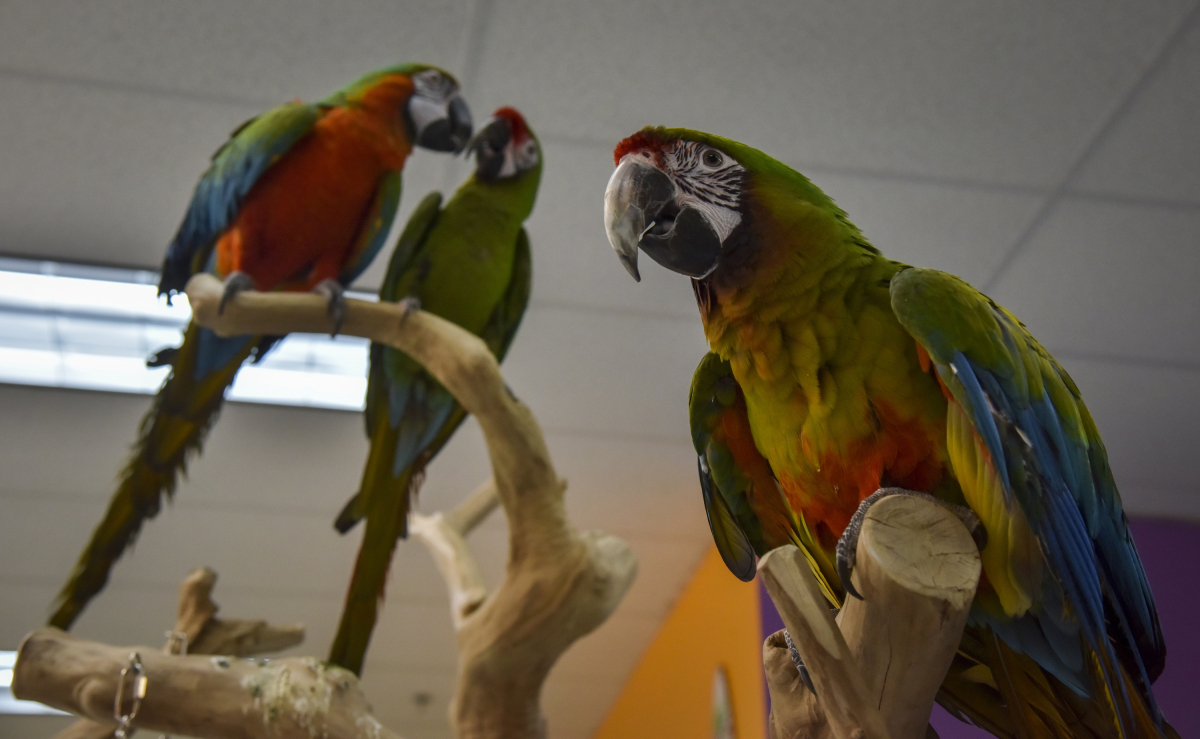
Suzie, a military macaw, left, and Kirby, harlequin macaw, groom each other at TC Feathers Aviary on Jan. 2, 2020. Their offspring may be the first cross between the types of macaws. MUST CREDIT: Washington Post photo by Jahi Chikwendiu

Suzie, a military macaw, left, and Kirby, harlequin macaw, groom each other at TC Feathers Aviary on Jan. 2, 2020. Their offspring may be the first cross between the types of macaws. MUST CREDIT: Washington Post photo by Jahi Chikwendiu
By The Washington Post · Theresa Vargas · NATIONAL, FEATURES, SCIENCE-ENVIRONMENT, ANIMALS

WASHINGTON – When they met, Kirby and Suzie differed in ways that went beyond what people usually notice first about them, their color.

Kuzie, a hybrid, with his parents in the background, at TC Feathers Aviary on Jan. 2, 2020. MUST CREDIT: Washington Post photo by Jahi Chikwendiu

Kuzie, a hybrid, with his parents in the background, at TC Feathers Aviary on Jan. 2, 2020. MUST CREDIT: Washington Post photo by Jahi Chikwendiu

He was large. She was small.

He had spent most of his life in a loving home. She had been abandoned when she was young.

He was bold and a gifted talker. She was sweet and more selective with her words.

Tammy Morgan says she would never have thought of pairing the two – and yet, she saw how they quickly gravitated toward each other, how they soon started sneaking off to be alone and how he now watches over her, ever ready to place himself between her and any perceived danger.

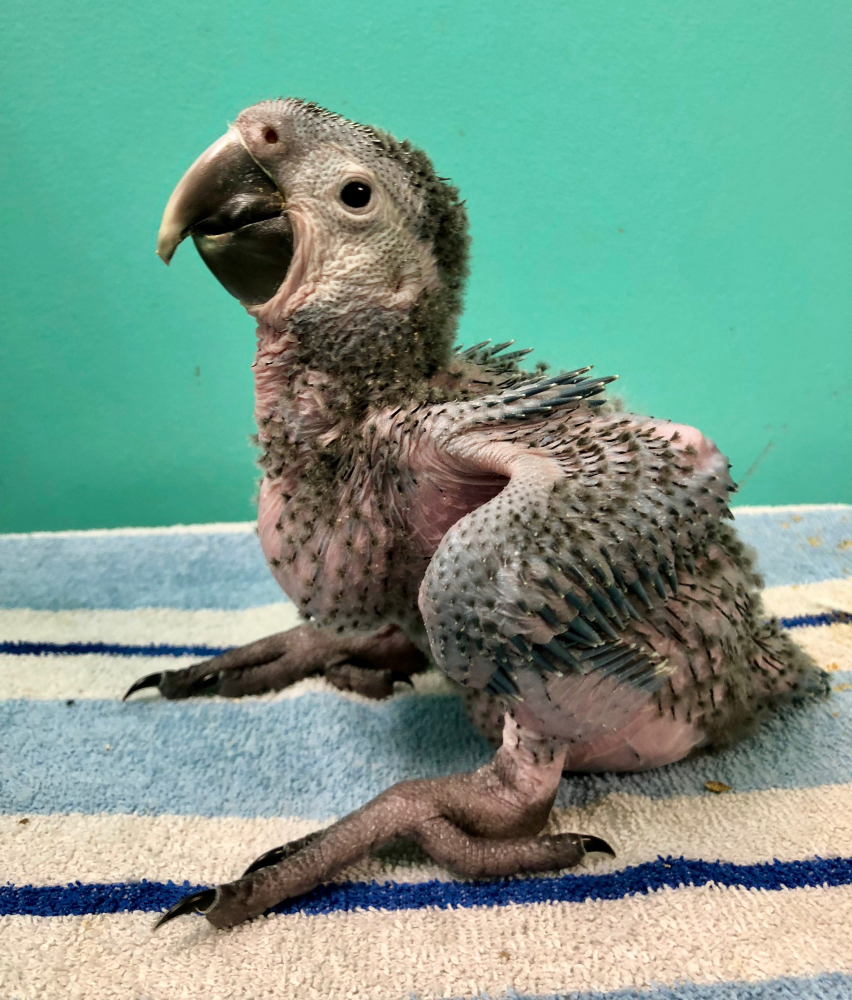
Kuzie at four weeks old. MUST CREDIT: TC Feathers Aviary Photo by: TC Feathers Aviary — The Washington Post Location: Chantilly United States

Kuzie at four weeks old. MUST CREDIT: TC Feathers Aviary Photo by: TC Feathers Aviary — The Washington Post Location: Chantilly United States

“They fell in love,” Morgan says.

There are love stories, and then there is the love story of Suzie and Kirby. Theirs is a rare pairing, one that both defies nature and resulted from it. The two are species of parrots that don’t normally mate: Kirby is a harlequin macaw and Suzie is a military macaw.

In the wild, they likely wouldn’t have come together. In a Virginia aviary, they are inseparable.

They are also parents. About a year ago, their firstborn hatched from an egg, leaving the aviary with a unique quandary: What do you call a species that doesn’t seem to exist anywhere else?

Morgan, who owns TC Feathers Aviary in suburban Virginia along with her wife, Carey Morgan, says the two never intended to breed macaws. It is difficult work even under the best of conditions, says Tammy Morgan, who has bred cockatiels, conures and caiques.

Macaws usually want a quiet, secluded area to mate.

“Not these two,” she says.

In their case, it seems, nature stepped in, threw her arms up and said, “Eh, what rules?” Quiet and secluded does not describe the aviary. It also serves as a store, so it often is a cacophony of birds squawking and customers talking, but that didn’t deter Suzie and Kirby from taking their affection to another level. Around 3:30 p.m. each day, the two would make their way from a backroom, where birds perch on makeshift trees and in cages, to the front of the store, where the cash register sits.

The staff always knew they were coming because as the two waddled, their talons clicked against the tile.

The staff also knew where they were headed. Each day, the two picked the same unlikely place for an avian rendezvous – a cat carrier. The carrier sits against a wall near the front door and is basically a large open cage lined on the bottom with a plush, pink bed. It provides the cats that live in the store (and keep the mice away) a place to lounge.

But when Suzie and Kirby showed up, any cat that happened to be in that carrier knew enough to leave. Everyone knew what was about to happen for the next 20-or-so minutes.

“It would be one thing if they were quiet, but they’re so loud,” Morgan says. “So finally, I put them in the same cage. It was better there than in front of the store, in a cat carrier.”

Morgan first started taking care of Suzie more than a decade ago after she and two other macaws were left in front of her house by a man who lived with his parents and realized he couldn’t take care of the birds. The aviary sees that situation often enough that the staff warns people who come to purchase pets about the responsibility. If someone comes in saying they want a bird that talks or that matches their furniture, that person will leave with instructions to go home and do some research.

“It’s not buying a goldfish,” Morgan says. “Some of these animals are going to live 60 to 70 years. That’s a 60- to 70-year commitment and one you have to be ready for.”

You have to be ready for a pet that is as demanding as it is stunning. I first learned about the aviary, which used to exist under a different name and at a different address, when my husband and I walked in to pick out two newborn cockatiels. Those birds are now two affectionate 8-year-olds with their own personalities and (loud) ways of telling us what they want.

On a recent afternoon, the volume in the backroom of the aviary is deafening. It is almost time for Morgan to feed some of the birds by hand, and they aren’t feeling patient.

Meanwhile, Suzie and Kirby sit quietly on nearby branches of the same makeshift tree.

When Suzie first came to live at the aviary full-time a few years ago, she had suffered a loss. She had paired up with another macaw that died, and “she was really missing” him, Morgan says.

Kirby had been raised since he was young by Morgan’s wife and was one of several male macaws living at the aviary at the time. He was also the biggest bird in the place and had developed a reputation of being rude to other macaws in group situations. With Suzie, though, he was gentle.

They would clean each other’s feathers with their beaks, which is called preening and requires a level of comfort and trust.

When the two began sharing a cage, no one knew what to expect. What they didn’t expect, though, were fertile eggs.

Morgan says Suzie laid two separate sets of egg at the bottom of the cage, but she didn’t know how to take care of them. Instead of sitting on them, she sat next to them, so they didn’t develop properly.

The next time she laid a set of eggs, Morgan pulled them from the cage and placed them in an incubator. Two didn’t make it.

But from the third egg, on a day when the store was crowded with people for the aviary’s inaugural Parrot Fest, came a tiny lump of a bird.

The aviary took suggestions from customers for a name and settled on “Kuzie,” a combination Suzie and Kirby.

The aviary’s staff, along with their friends, relatives and customers, also started researching whether a military macaw and harlequin macaw, which is a hybrid mix between a green-wing macaw and a blue-and-gold macaw, had ever produced an offspring.

They couldn’t find another.

Kuzie, they realized, wasn’t just the product of an unusual love story. He was product of an unusual love story that might have created a one-of-a-kind species.

Unsure what to call this new type of bird, and unable to find a name that already existed, the aviary again took suggestions. And they again picked one that gave a nod to both parents: “miliquin macaw.”

Morgan describes the days and weeks following Kuzie’s birth in October 2018 as both thrilling and scary. She didn’t know if he would survive. For five months, she woke up every 90 minutes in the night to make him formula and feed him.

She did the same in May 2019 when another egg hatched. This time it was a girl and she was named Millie.

Both Kuzie and Millie have lighter beaks than their parents, which they get from one side of their father’s genetics. They also seem to share his ease with words. Kuzie is fond of saying, “peekaboo.” And as Millie nuzzles against Morgan that recent afternoon, she says, “I love you.”

Occasionally someone will ask whether the siblings are for sale, and each time the answer is the same.

“At this point, everyone is so attached, not only us, but also our customers,” Morgan says. “They’re not going anywhere.”

If they produce more miliquins, those will be for sale.

When that time comes, she has just one hope: that Suzie and Kirby will figure out what comes after making those eggs.

“If they could figure out how to take care of their own children,” she says, “I would appreciate that.”

5 kitchen resolutions that you can actually stick with in the new year #ศาสตร์เกษตรดินปุ๋ย

#ศาสตร์เกษตรดินปุ๋ย : ขอบคุณแหล่งข้อมูล : หนังสือพิมพ์ The Nation

https://www.nationthailand.com/lifestyle/30380112?utm_source=category&utm_medium=internal_referral

5 kitchen resolutions that you can actually stick with in the new year

Jan 04. 2020

Tackle one spot - like that

Tackle one spot – like that “miscellaneous drawer” full of tools you use and tons you don’t – when you have 10 or 15 minutes and feel the burden lift. MUST CREDIT: Photo for The Washington Post by Tom McCorkle; food styling for The Washington Post by Lisa Cherkasky
By The Washington Post · Becky Krystal · FEATURES
It’s Jan. 3! Have you already ditched your totally unrealistic, pie-in-the-sky New Year’s resolutions?

Sure, the pressure to make dramatic changes in your life can be a bit daunting, especially if it has to do with food. But let’s take a step back and dial down the stress. Let’s focus on incremental, attainable goals that will help you – and even the planet – in subtle but substantial ways.

Feeling a little less anxious? Good. Now here’s where to start.

1. Organize.

There are a few universal chaos locations in the kitchen. You know, under the sink where you stash all the plastic bags you promise to recycle soon, the cabinet with all the mismatched storage containers and that “miscellaneous drawer” full of tons of tools you use – and tons you don’t. Tackle one spot at a time when you have 10 or 15 minutes and feel the burden lift. Thin out the gadgets you never or rarely reach for (how many digital thermometers do you really need?), and you’ll be much more likely to find and use the ones you do. The same goes for the spice cabinet.

2. Learn to take better care of your tools.

Your kitchen is full of equipment and tools that can last forever as long as you treat them right. So, learn which items are best washed by hand – knives, pots and skillets are at the top of the list – and how to do that best. Keep your knives sharp (and safe). Keep your cast iron seasoned, and don’t let it sit around wet to develop rust. Don’t use your nonstick cookware on high heat. Don’t heat an empty enameled cast-iron Dutch oven on the stove top. When in doubt, read the manual.

3. Use less plastic and disposables.

Granted, this may be the hardest one on this list. If you’re a plastic wrap and aluminum foil addict, try to eliminate, or at least reduce, your habit. You can find reusable options for almost any kitchen staple these days, whether it’s beeswax wraps, silicone bags, cotton or mesh produce pouches, metal straws and food covers. Shopping the bulk bins to fill your own containers with exactly what you need cuts back on both packaging and food waste.

4. Store your fruits and vegetables better so they get eaten and not tossed.

Produce is essentially a living, breathing thing. If you think you can just toss it in your fridge and assume it will be OK, you’ll be disappointed. Learn which foods benefit from humidity (generally, fruit needs less and vegetables more) and which should not be stored together (separate ethylene-producing items from ethylene-sensitive items). Some – potatoes, onions – shouldn’t be stored in the refrigerator at all. With just a few small adjustments, you’ll save money and food.

5. Keep your kitchen cleaner.

This is always an admirable goal. Whether you’re a clean-as-you-go or clean-at-the-end, you never want to walk away from the kitchen without having tidied up. Procrastination here does not pay off, especially if there are dishes to wash and messes to wipe up. Of course, the kitchen is full of annoying little cracks and crevices, and stubborn stains. Inexpensive tools like wooden skewers, a Magic Eraser scrubber, and toothbrushes are among cheap tools to help you get the job done. You’d also do yourself a favor to spend a few bucks on a canister of Bar Keepers Friend.

7 science-based strategies to boost your willpower and succeed with your New Year’s resolutions #ศาสตร์เกษตรดินปุ๋ย

#ศาสตร์เกษตรดินปุ๋ย : ขอบคุณแหล่งข้อมูล : หนังสือพิมพ์ The Nation

https://www.nationthailand.com/lifestyle/30379978?utm_source=category&utm_medium=internal_referral

7 science-based strategies to boost your willpower and succeed with your New Year’s resolutions

Dec 29. 2019
How can you increase your willpower and fulfill your New Year’s promise to yourself? (Shutterstock/Melinda Nagy)

How can you increase your willpower and fulfill your New Year’s promise to yourself? (Shutterstock/Melinda Nagy)
By The Jakarta Post/ANN

It’s that time of year when people make their New Year’s resolutions – indeed, 93% of people set them, according to the American Psychological Association. The most common resolutions are related to losing weight, eating healthier, exercising regularly and saving money.

However, research shows that 45% of people fail to keep their resolutions by February, and only 19% keep them for two years. Lack of willpower or self-control is the top cited reason for not following through.

How can you increase your willpower and fulfill your New Year’s promise to yourself? These seven strategies are based on behavioral science and my clinical work with hundreds of people trying to achieve their long-term goals.

1. Clarify and honor your values

Ask yourself why this goal matters to you. Do you want to lose weight because you value getting in shape to return to a favorite pastime of hiking, or because of societal expectations and pressures? People who are guided by their authentic values are better at achieving their goals. They also don’t run out of willpower, because they perceive it as a limitless resource. Figure out what makes you tick, and choose goals consistent with those values.

2. Frame goals and your life in positive terms

Focus on what you want to accomplish, not what you don’t. Instead of planning not to drink alcohol on workdays during the new year, commit to drinking your favorite sparkling water with Sunday to Thursday evening meals. Struggling to suppress thoughts takes a lot of energy, and they have a way of returning to your mind with a vengeance.

It also helps to reflect on the aspects of yourself and your life that you are already happy with. Although you might fear that this will spur complacency and inaction, studies show that gratitude and other positive emotions lead to better self-control in the long run.

3. Change your environment to make it easier

Research suggests that people with high willpower are exceptionally good at arranging their environment to avoid temptations. So, banish all credit cards from your wallet if your goal is to save money. And don’t keep a bowl of M&M’s at your work desk if you intend to eat healthy.

If your coworkers regularly bring sweets to work, ask them to help you with your goals (they might get inspired to join in!) and bring cookies only for special occasions. Supportive friends and family can dramatically increase your chances of achieving your resolutions. Joining a group whose members practice behaviors you’d like to adopt is another great way to bolster your willpower, because having role models improves self-control.

4. Be prepared with ‘if-then’ strategies

Even the best resolution falls apart when your busy schedule and exhaustion take over. Formulate a series of plans for what to do when obstacles present themselves. These “if-then” plans are shown to improve self-control and goal attainment.

Each time you wake up in the middle of the night craving candies or chips, you can plan instead to read a guilty-pleasure magazine, or log into your online community of healthy eaters for inspiration, or eat an apple slowly and mindfully, savoring each bit. When you’re tired and about to skip that gym class you signed up for, call your supportive sister who is on standby. Anticipate as many situations as possible and make specific plans, vividly imagining the situations and what you will do in the moment.

5. Use a gradual approach

When you embark on a new goal, start small and build on early successes. Use one less spoonful of sugar in your coffee. Eventually, you might be able to forgo any sweeteners at all. If resisting that muffin initially proves to be too hard, try waiting 10 minutes. By the end of it, your urge will likely subside.

You might be surprised to realize that change in one domain of life – like abstaining from sweet processed foods – tends to spread to other areas. You might find you are able to bike longer distances, or moderate your caffeine intake more easily.

If it feels like the payoffs are in the distant future, you can plan a small gift for yourself along the way. (Shutterstock.com/shurkin_son)

If it feels like the payoffs are in the distant future, you can plan a small gift for yourself along the way. (Shutterstock.com/shurkin_son)

6. Imagine rewards and then enjoy them

Picture the feeling of endorphins circulating through your body after a run, or the sun on your skin as you approach a mountain summit. Pay attention to all your senses: smell, sight, hearing, touch and taste. Visualizing rewards improves your chances of engaging in the activity that results in them.

If it’s hard to imagine or experience these rewards in the beginning, decide on small, meaningful gifts you can give yourself until the positive effects of the new behaviors kick in. For example, imagine yourself taking a half-day off work each month after you pay down your credit card debt: visualize exactly what you would do and how you would feel. And then do it.

7. Be kind to yourself, even during setbacks

Most people believe the way to increase willpower is to “whip oneself into shape,” because being kind to oneself is indulgent and lacks self discipline. But the exact opposite is true – people who harshly blame themselves for even small willpower failures tend to do worse in accomplishing their goals in the long run.

Try self-compassion instead. Cut yourself some slack and remember that being human means being imperfect. When you fall for that doughnut, don’t despair, and don’t throw in the towel. Treat yourself with care and understanding and then recommit to your goal the following day.

Remember, you aren’t likely to achieve your New Year’s resolutions by being self-critical and hard on yourself. Instead, boost your willpower through a series of small and strategic steps that will help you succeed.

Jelena Kecmanovic, Adjunct Professor of Psychology, Georgetown University

This article is republished from The Conversation under a Creative Commons license. Read the original article.

Yoga in prison: another life choice for inmates

#ศาสตร์เกษตรดินปุ๋ย : ขอบคุณแหล่งข้อมูล : หนังสือพิมพ์ The Nation

https://www.nationthailand.com/lifestyle/30378981?utm_source=category&utm_medium=internal_referral

Yoga in prison: another life choice for inmates

Dec 02. 2019
By The Nation

2,261 Viewed

Stretching and bending on the mat, one female prisoner says it is the only time she feels free and no in pain.

Prison life in by its definition limiting and yes, painful, too as the minutes tick by slowly with little to occupy the mind or body. For the fortunate few, there are a number of volunteers doing projects in prisons including art activities, knitting, making furniture, making Buddha statues, all activities that could lead to income-earning work once they are released. There’s yoga too though that appears to be less-accepted on the outside

The Prison Yoga Project is being run by Thirawan Watthanothai, former dean of the Faculty of Architecture, Rajamangala University of Technology Thanyaburi (RMUTT) and introduced in 2011 at Ratchaburi Central Prison before expanding to other prisons. She also plans to initiate a yoga practice project for men in prisons.

After more than 8 years of running her yoga programme in prisons, Thirawan is determined to continue and expand, noting that it has been shown to be useful to the inmates.

“Ninety per cent of the inmates who come to practise yoga have their own unique abilities and what we need to do is encourage society to accept them once they are released. Most yoga studios refuse to give them work even if they pass the test. I want society to give people an opportunity. There was a case of a female inmate in Udon Thani, whose foreign boyfriend helped her move to Switzerland an even opened a yoga studio for her. She was proud that she learned yoga at the prison, “said Thirawan who started to learn yoga with an Indian instructor after overworking, feeling stressed and unable to sleep.

The idea to launch yoga in prison came about after she helped a fellow teacher prepare a report on life in prison and discovered the levels of stress from which female inmates suffer. She felt yoga could be the answer and set off on a journey to get her idea accepted. It took a while but Thirawan was determined.

“We ask the officers to select young people serving long sentences for yoga practice. If we want to mould them into yoga teachers, they must study from 9am to 2pm every day for several months. We saw how it improved not just their state of mind but also helped with lowering blood sugar. After three weeks, the body adapts and the students want to continue. We selected 25 people to teach yoga, most of them with 20 years to run on their jail terms. Prison administrators and staff cooperate to organize morning yoga classes for female inmates. ”

India, America, England, Australia and Scandinavia have also expressed interest in using yoga as part of their jail rehabilitation programmes and studies have shown that prisoners who have been practising yoga enjoy positive physical and mental or even spiritual health. Research in US prisons has found that yoga helps with concentration, makes the body and mind relax and reduces stress and anxiety.

Patcharee Mungmai, 30, a former inmate was given the opportunity to teach yoga to other inmates. She said that yoga is very helpful to her because while she was in prison, she almost lost her mind.

“In prison, the scariest thing is not being beaten but the possibility of going insane. Yoga really made us more conscious. I was sentenced to 16 years and 8 months, but only served 8 years and 1 day. I was arrested during my 4th year in university as part of a drug round up,” she says. Today she is a speaker on drug prevention at the probation office in Ubon Ratchathani Province.

Flower-bedecked Rama IX Park hosting markets, music, soothsayers

#ศาสตร์เกษตรดินปุ๋ย : ขอบคุณแหล่งข้อมูล : หนังสือพิมพ์ The Nation

https://www.nationthailand.com/lifestyle/30378954?utm_source=category&utm_medium=internal_referral

Flower-bedecked Rama IX Park hosting markets, music, soothsayers

Dec 01. 2019
By The Nation

1,689 Viewed

The birthday of His Majesty the late King Bhumibol Adulyadej the Great is being commemorated all this week at his namesake park in southeast Bangkok.

King Rama IX Park in Prawet district is hosting its annual “Aram Ngam” Sunday (December 1) through December 10, daily from 8am-7pm.

The 500-rai park is a floral wonderland, adorned with hundreds of thousands of flowers and other ornamental plants including petunias, impatiens, verbena, vinca, hollyhocks, zinnia and many species from Europe.

Amid this natural beauty, a recreated “royal palace market” as it would have appeared in the early Rattanakosin Period is selling food and crafts “in the royal style”.

Handicrafts and dishes from each region of the country are on sale at both a dry market and a floating market.

There are cultural performances, DIY activities where you can make something creative to take home, and fortune tellers ready to study your personal horoscope and offer advice.

The park opened on December 5, 1987, in celebration of King Bhumibol’s 60th birthday.

It’s a wonderful place for picnics and exercise and interesting because of its botanical gardens, which have nearly 3,000 species of trees, shrubs, herbaceous plants, flowers, foliage and whole woodlots under academic study.

The park is open daily from 5am-7pm, with an entrance fee (Bt10 per person, Bt20 per van and Bt30 per bus) collected only between 9am and 5pm.