A total of 575 cases of Covid-19 have been detected in Bangkok since the new outbreak began on December 20, said City Hall on Monday. Of these, 431 are Bangkok residents and 134 are from other provinces.
Most of the infections were contracted either from close contacts at home, from visiting entertainment venues or red-zone provinces, and at large gatherings, said the Bangkok Metropolitan Administration (BMA).
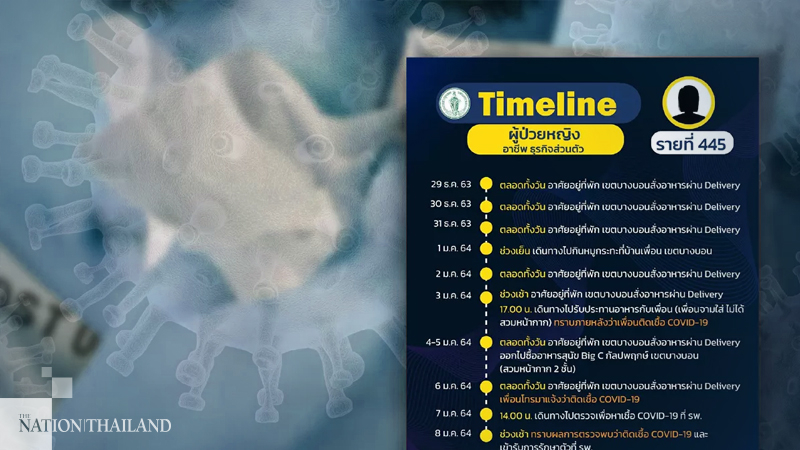
The BMA highlighted the 445th case, a female businesswoman, who mostly stayed home and ordered food via delivery applications. However, she went out with a friend on January 3 to grab dinner. Her friend sneezed at her while not wearing a mask. After learning on January 6 that her friend had contracted the virus, she visited hospital for a test and was confirmed infected with Covid-19 on the morning of January 8.
The Thai Retailers Association is pleading for government help after Covid-19 sent the retail index plunging from 2.8 per cent growth in 2019 to a deficit of 12 per cent last year – its first ever two-digit contraction.
Association chairman Yol Phokasub asked the government to allow hourly employment in addition to monthly employment in the retail sector. Hourly employment would protect least 52,000 positions and could be expanded to 200,000 in the long term, he said.
Meanwhile the government should grant soft loans to SME operators and farmers, through retail platforms accessible to them, said Yol.
He also urged the government to collect VAT and import duty from imports sold in the e-marketplace in Thailand. The Thai e-commerce market, which is worth around Bt300 billion per year, should be managed to ensure fairness and protection for domestic SMEs, he added.
The association also pushed the government to stimulate the domestic market by focusing on customers with purchasing power. It also urged imposing duties on certain imports, especially lifestyle products.
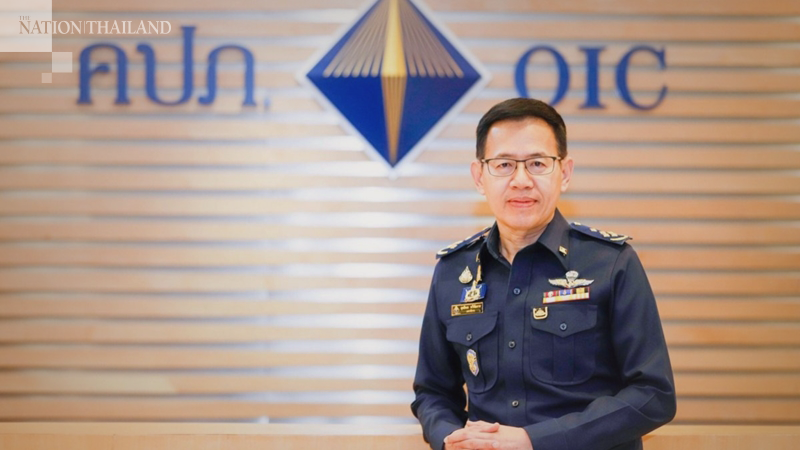
Office of Insurance Commission (OIC) is extending the deadline for its measures to help insurers and insurance businesses that have been hit by the Covid-19 outbreak to June this year.
“The OIC board has agreed to extend the measures introduced when Covid-19 first hit Thailand early last year. These measures were to expire in December 2020,” OIC secretary-general Suthiphon Thaweechaiyagarn said on Monday. “OIC’s legal committee is reviewing the details. Once that is completed, the measures will be announced and become retroactively effective from January 1 to June 31.”
The measures that OIC rolled out last year include:
• Allowing insurers to delay the payment of insurance premiums by 60 days. More than 420,000 applied for this aid.
• Allowing casualty insurance premium to be paid in instalments. Over 1.1 million have applied for this measure.
• Allowing temporary suspension of coverage under accident insurance for tour operators and tour guides. About 6,200 have applied for this measure.
• Allowing travel and transport entrepreneurs to pay insurance premium in instalments. Over 26,000 entrepreneurs have applied for this.
• Allowing changes in coverage of casualty and car insurance. Over 255,000 insurers have applied.
• Allowing car insurance premium to be paid on daily, monthly or quarterly basis instead of yearly basis. Over 10,500 insurers have applied for this measure.
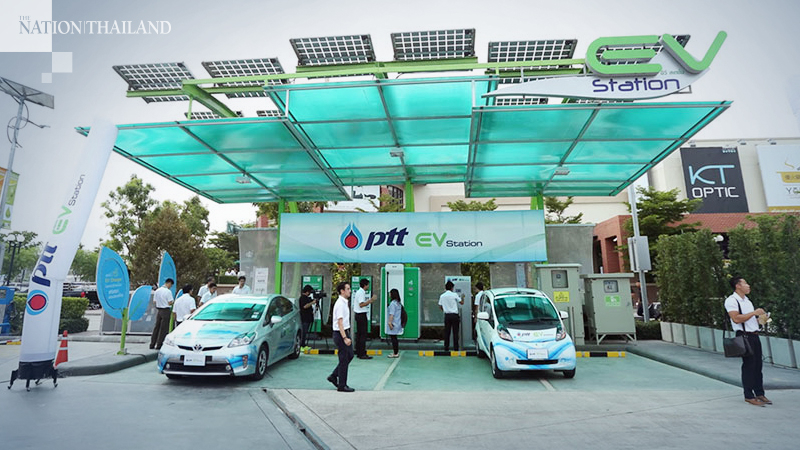
The Energy Regulatory Commission (ERC) said it will determine the new rate for charging electric vehicles (EV) once the time period for the current rate of Bt2.63 per unit is over.
ERC secretary-general Komkrit Tantravanich said the EV charging rate had been set at Bt2.63 per unit because it wanted to encourage relevant agencies to set up more EV charging stations in the provinces.
He said ERC will determine a new, more permanent rate once more stations are set up.
Meanwhile, the Electricity Generating Authority of Thailand (EGAT) has been studying the setting up of new charging stations to see whether they should be a collaboration between Egat and petrol-station operators, or a standalone sub-station.
Egat assistant governor Jiraporn Sirikum added that her organisation will focus on the construction of quick-charge stations in the provinces to encourage people living upcountry to opt for electric vehicles. She also said details of the charging-stations operations should become clearer within this year.
The automotive industry estimates this year’s sales to come in at 840,000 vehicles marking a rise of 6 per cent compared to 2020, though it will depend on how fast the economy recovers from the new wave of Covid-19 infections.
“Last year’s total sales was expected to come in at 790,000 vehicles, or 20 per cent less than the previous year due to the outbreak,” said Charnchai Trakarn-udomsuk, president of Mazda Sales Thailand. “As for this year, the company expects total sales to hit 840,000 units, a slight increase from last year, because the country is still struggling with the new wave.
“Mazda will strengthen its line-up for this year with the new BT-50 pro-pickup truck, which should help push the company’s sales past the 50,000 milestone or rise 27 per cent year on year,” he added.
Meanwhile, Phongsak Lertrudeewatthanawong, deputy managing director at MG Sales (Thailand), agreed that the auto market will witness sales of up to 840,000 units this year, with the most popular choices being small vehicles and pick-up trucks.
“MG will launch a new electric vehicle to add to our ZS EV and EP series,” he said. “We will also build an additional 600 quick charge stations nationwide to ensure our users have access to a comprehensive charging network, while urging normal car owners to switch to electric vehicles.”
Toshiaki Maekawa, president of Tri Petch Isuzu Sales, said the auto market has been improving gradually since September last year, especially in the small truck and pick-up truck sectors due mostly to the expansion of e-commerce and home-delivery services.
“Many people have returned home after losing their jobs in big cities and started new professions in agriculture or delivery, which has driven up the sale of pick-up trucks for commercial use,” he said. “However, the sale of large trucks is still low because the export industry is struggling under the Covid-19 restrictions imposed by foreign trade partners.”
As for motorcycle markets, Shigeto Kimura, president of AP Honda, said the sale of motorcycles rose slowly in the last quarter of 2020, coming in at 1.52 million units all year.
“This year, we expect sales to come in at 1.54 million units or a 1 per cent rise despite the new wave of Covid-19, since we believe in the government’s measures to keep the outbreak under control.”
The Food and Drug Administration (FDA) has denied a private hospital’s claim that the state agency was taking three months to register Sinovac Covid-19 inactivated vaccine.
FDA secretary-general Dr Paisan Dankhum said that there is a registration for Sinovac by Government Pharmaceutical Organization (GPO), not from the hospital. The FDA also had never been contacted by the private hospital, except registration for approval of vaccine reservation on January 11.
The FDA is responsible for reviewing the vaccines that will be used in Thailand, which must be evaluated before use. To be suitable for Thai people, the vaccine will be evaluated for quality, safety and effectiveness. A person who wants to register must show documentary information to assess the qualifications of the vaccine in all three areas, after which the FDA is ready to fully facilitate registration.
The secretary-general added that the FDA was aware of the current situation regarding the Covid-19 epidemic and had adjusted operating guidelines to allow all types of health products to meet the needs of people during the period, including offering advice or answer questions all the time.
The State Railway of Thailand (SRT) is hastening the delivery of land for the three-airport high-speed railway link, with construction scheduled to kick off within this year.
The Eastern Economic Corridor (EEC) Policy Committee said that CP Group is currently studying SRT’s study and is expected to confirm the layout by next month. The project will link Don Mueang, Suvarnabhumi and U-Tapao airports.
Meanwhile, CP has said the entrances in some stations, such as Pattaya, Sri Racha and Chonburi, are not large enough considering population density, which will cause traffic jams.
“CP has to spend time designing, adapting construction details. If the layout adjustment is not completed, construction for the first phase – Suvarnabhumi-U-Tapao – cannot begin in time even if land is delivered in October. The contract stipulates that construction of the project has to be completed in five years from the date of land delivery. Land for the Phya Thai-Don Mueang section is expected to be delivered by October 2023,” an EEC source said.
As for expropriation of land, SRT has had to apply for permission again amid the new wave of Covid-19 infections, and due to the outbreak, it will take time for officials to enter the areas being expropriated.
The contract, expected to be drawn up by January 20, will detail the plots of land being taken, how much owners will get for it and when. Those who do not accept the compensation have the right to demand that SRT conduct another survey. Negotiation for the land plots is expected to be completed by August.
Meanwhile, contracts for areas around Suvarnabhumi Airport are not very clear because the land to expropriated overlaps with areas under the Highways Department jurisdiction.
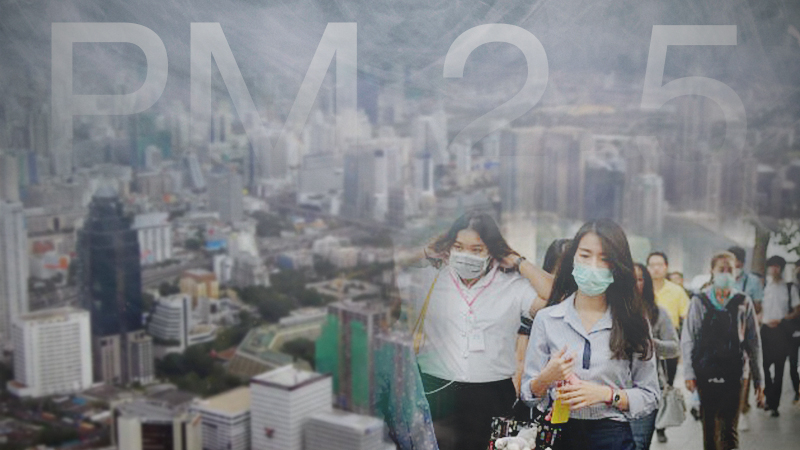
Air pollution in three areas in and around Bangkok hit unsafe levels on Monday, with PM2.5 readings in the morning coming in at between 29 and 71 micrograms per cubic metre of air (μg/m3), the Pollution Control Department reported.
Thailand’s standard for safe levels of PM2.5 (particles less than 2.5 micrometres in diameter) is 50μg/m3, while that of the World Health Organisation is 25μg/m3.
The three areas hit are:
▪︎ Bang Khunthien (71μg/m3)
▪︎ Phra Khanong (51μg/m3)
▪︎ Samut Prakan’s Pak Nam area (54μg/m3)
In other regions of the country, air quality hit unhealthy levels in Chiang Mai, Lampang, Phitsanulok, Tak, Saraburi and Ratchaburi.
In the North, PM2.5 readings came in at between 28 and 90μg/m3, with nine areas exceeding the safe standard.
In the Northeast, the readings were 25 to 35μg/m3, which is considered good overall.
In the Central region and West, PM2.5 readings were between 29 and 68μg/m3, with two areas exceeding the standard.
In the East PM2.5 readings stood at 31 and 43μg/m3, which can be considered moderate, while in the South, the air was very good considering PM2.5 readings came in at 14 to 27μg/m3.
People living in areas where PM2.5 pollution is bad have been advised to monitor their health and stay indoors, especially the elderly, children and patients with respiratory diseases.
The level of PM2.5 pollution in different areas can be followed via the Air4Thai.com website or smartphone app, or via bangkokairquality.com.
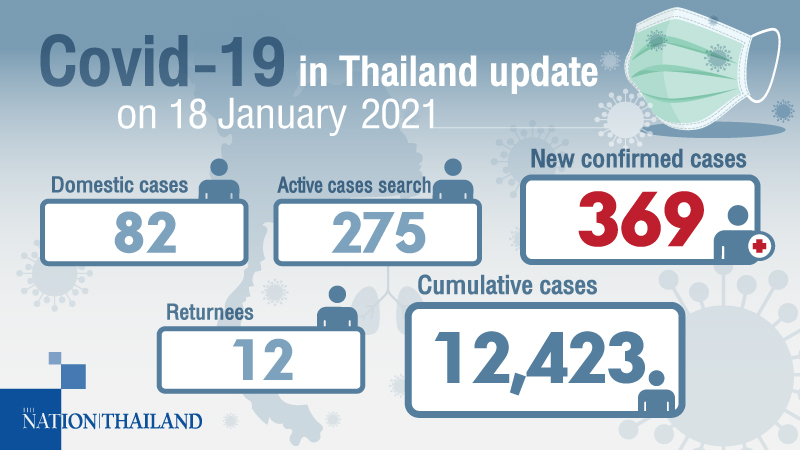
The Centre for Covid-19 Situation Administration (CCSA) reported 369 new cases on Monday, including 12 people who arrived from overseas.
Of the returnees, eight are Thai nationals — one from the United Kingdom, one from Germany, five from Malaysia, and one from Bahrain.
Also testing positive were two American men, a French man and an Omani woman, who flew in from their respective nations.
Of the new cases, 82 were exposed to the virus while visiting high-risk areas. Provinces with the highest number of infections were Bangkok with 12 and Samut Sakhon with 51.
Proactive testing led to 275 cases, mostly in Samut Sakhon where 269 foreigners tested positive.
Meanwhile, 191 patients have recovered and been discharged.
The total number of confirmed cases in Thailand has risen to 12,423 – 10,134 of which were contracted domestically, including 3,982 found via proactive testing and 2,289 returnees. So far, 9,206 have recovered and been discharged, 3,147 patients are still in hospital and the death toll remains at 70.
According to Worldometer, as of midnight on Sunday, the total number of confirmed cases globally had risen to 95.48 million (up by 532,235), 68.17 million have recovered, 25.27 million are active cases (113,185 in severe condition) and 2.04 million have died (up by 9,151).
Thailand ranks 128th on the global list of most cases, while the US tops the list with 24.48 million, followed by India 10.57 million, Brazil 8.49 million, Russia 3.57 million and the United Kingdom 3.4 million.
The baht opened at 30.07 to the US dollar on Monday, strengthening from Friday’s closing rate of 30.10.
The Thai currency is likely to move between 30 and 30.15 on Monday and 29.85 and 30.20 within this week, said Krungthai market strategist Poon Panichpibool.
Poon forecast that the financial market would remain in a risk-off state this week, from factors worth monitoring, such as the US political situation and the Covid-19 crisis across the world.
In the US, the Mfg. & Services purchasing managers index for this month fell from December to 53 points, pointing to reduced economic activities in that time.
Meanwhile, the EU has been pressured by the virus crisis. This situation would compel the European Central Bank (ECB) to continue with relaxed financial policies, such as a freezing of the deposit facility rate at minus 0.50 per cent.
Moreover, the market is monitoring a meeting of EU finance ministers to discuss the EU recovery fund, which was a key factor to stimulate the EU economy amid the Covid-19 crisis.
In Thailand, December exports to be announced this month will tend to contract by 2 per cent from exports in December 2019, due to a problem with containers across the world, though demand for products had recovered.
In the short term, the dollar will still be supported by the market, amid the market’s concerns about the present economy. At the same time, the baht tends to fluctuate from funds flowing out from Thai stock and bond markets.
However, according to the market strategist, the baht will weaken only slightly, since foreign exporters want to sell the currency when it weakens near 30.20 per US dollar.