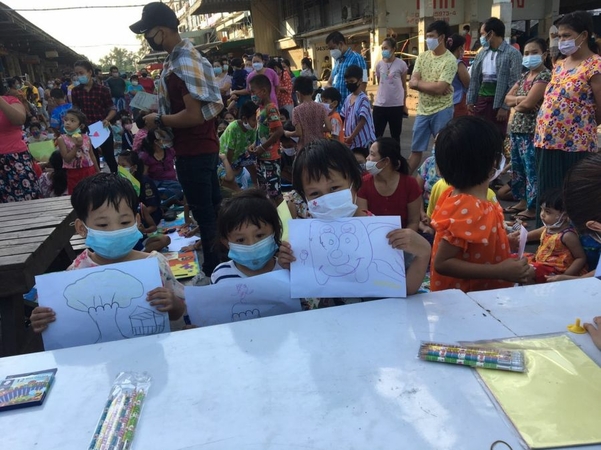
A mental health team is checking up on children quarantined after the outbreak of Covid-9 at the Central Shrimp Market in Samut Sakhon.
Thousands were placed in isolation in the province, 45 kilometres southwest of Bangkok, after the outbreak was discovered in mid-December.
Children affected are being given a three-day course (January 11-13) by staff from the Mental Health Department’s Rajanukul Institute and the local Mental Health Centre.
The mental health team has launched activities for three groups – parents and toddlers, children aged 3-5, and children aged 6 years old and over.
Each group will contain around 50 participants per round.
The teams are also providing masks, hand cleaning gel, milk and snacks for children to boost their spirits.
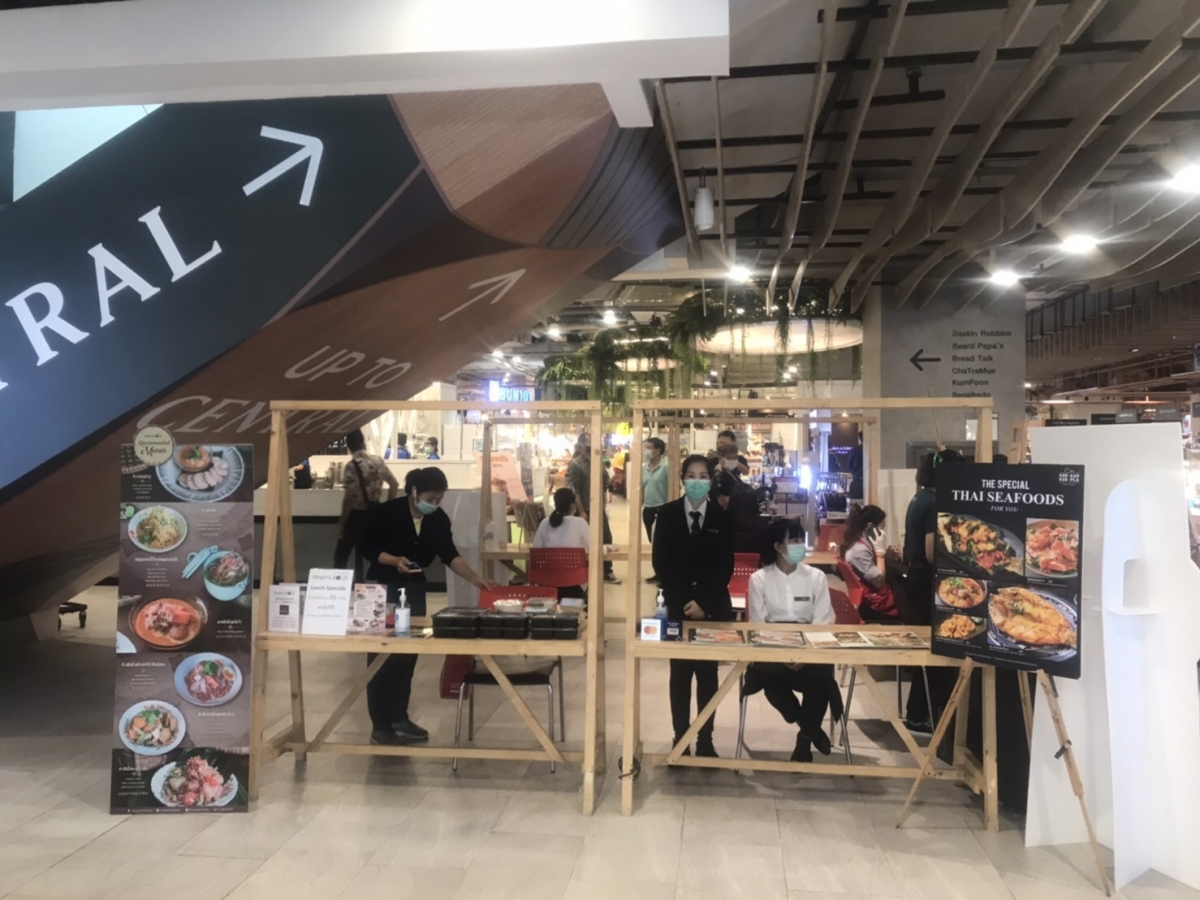
Central Pattana Plc is piloting free counter service space for delivery and take-away food in order to help spur sales for 300 of its tenant restaurants at 18 branches of Central Pattana shopping centres nationwide. Central Pattana said the measure would offer extra convenience for customers, under its “Hygiene and Safety” master plan.
Takeaway counters in front of restaurants, plus discounts and promotions, meant everyone could enjoy their favourite dishes at home, or still choose to dine-in under social-distancing guidelines, said the mall operator
“We need to unite and join forces in order to get through this crisis together,” said Nattakit Tangpoonsinthana, executive vice president of marketing for Central Pattana.
The operator said cleanliness and safety in all 33 shopping centres across the country has been enhanced to the highest possible standards.
The Labour Ministry is gathering a list of more than 58,000 available positions to help workers made jobless by the fresh Covid-19 outbreak.
The ministry’s Department of Employment (DoE) will advertise 58,151 job positions from private firms and government agencies, said DoE director-general Suchat Pornchaiwiseskul on Tuesday.
The virus pandemic wiped out 81 million jobs in Asia-Pacific last year, with Thailand one of the worst-hit
“Since the new wave was reported in December, 82,238 people have registered to receive unemployment benefit from the department, with the total registered as unemployed at 539,474,” he said.
“The department estimates this number could increase in the months ahead as the outbreak situation has yet to be resolved, so we started gathering vacant positions for jobseekers.”
DoE statistics show the 10 most sought-after jobs in the current are:
1. General labourer
2. Assembly labourer
3. Manufacturing labourer
4. Sales staff and product presenter
5. Sales agent for service businesses
6. Delivery staff
7. Cashier
8. Service staff
9. Shop clerk
10. Sales representative
“Those who are interested can register and browse available positions online at https://smartjob.doe.go.th/ or at www.ไทยมีงานทำ.com, which is a great way to avoid the risk of contracting Covid-19,” said Suchat. “Alternately, you can contact your local Provincial Employment Office.
For more information, jobseekers can contact hotline 1506 press 2.
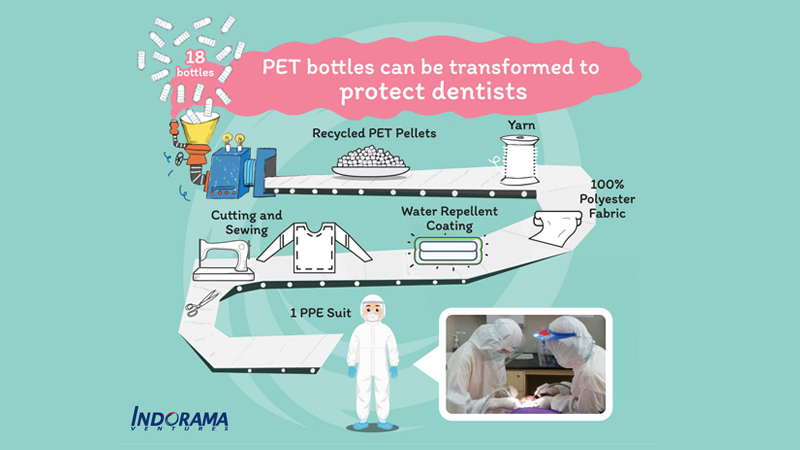
Indorama Ventures Pcl (IVL), a global chemical producer, together with 101 True Digital Park, Bangkok Hospital, Bitec, Esplanade Cineplex Ngamwongwan-Khae Rai, Major Cineplex, Michelin Thailand, Panyapiwat Institute of Management, Trash Lucky and Suan Sunandha Rajabhat University, are supporting the production of PPE coveralls made from recycled PET yarns.
The project is called “Separate PET Bottles to Help Dentists”, led by Less Plastics Thailand. In collaboration with these nine partners, PET bottles have been collected for recycling and conversion to high-quality recycled PET yarns by Thailand’s sole source of medical-grade rPET yarns at IVL’s Nakhon Pathom recycling plant. These yarns were used to produce 2,100 PPE coveralls handed over to the Dental Council of Thailand in support of dental students, who are driving this environmental project at their universities.
This collaboration has been extended from the “Separate PET Bottles to Help Doctors” programme, which has been successfully conducted since August 2020. It was Thailand’s first PPE coverall made from yarn recycled from post-consumer PET bottles, with 100 per cent collected domestically. Some 16,500 level 2 and level 3 PPE coveralls have been donated to more than 200 hospitals across the country to help fight the Covid-19 pandemic together.
Samornmit Lamsam, the founder of Less Plastic Thailand, an environmental conservation network, said, “There has been a great response to the project, carried out over the past half-year. We witnessed the benefits of recycling PET bottles and realised that there are other groups of medical personnel who require PPE as they perform their duties, not just doctors. “Therefore, the project has been extended to help dentists through the Dental Council of Thailand, which received cooperation from partners, from the collection of post-consumer PET bottles to the completion of the PPE coveralls handed over to dental students.”
Yash Lohia, chief sustainability officer at Indorama Ventures, said, “IVL is delighted to see such strong leadership among our partner organisations. With more advocates and focus on separating PET bottles from day-to-day packaging, we were able to utilise our extensive know-how of the PET recycling business to develop yarn for PPE coveralls made of 100 per cent IVL rPET yarns for the first time in Thailand, without the need to import from abroad. As the sole manufacturer of yarns for PPE made from recycled PET bottles in Thailand, we are proud to acknowledge that they are being used for the benefit of the medical profession across the country.
This reflects the benefits of plastic as a hygienic and recyclable material, which brings more value to society and maximises our resource consumption to follow a truly circular economy.”
Some 200 Thais working in casinos across the border in Myanmar, along with some who have crossed over illegally for work or to gamble are now asking to return home, 3rd Army commander Lt-General Apichet Suesat said.
Apichet is in charge of the northern region.
He said close to 400 Thais and foreigners working in casinos in Myanmar’s Myawaddy district have applied to return to Thailand. So far, only 75 of them have been allowed across officially, of whom 35 tested positive for Covid-19.
Meanwhile, three to five people are arrested daily for crossing the border illegally. So far, 52 of the arrested illegal crossers have tested positive.
“Rumours that the Army is involved in human trafficking is false. In Mae Sai, the military caught illegal border crossers with help from locals. But that is also where rumours began. So, in the case of Thais wanting to cross over from Myawaddy, they will have to contact officials in Tak province themselves,” he said.
He added that only 120 beds were available, which is not enough to accommodate everyone wanting to cross over. Hence, he said, local officials need to find an area to build a field hospital first in case the number of infected returnees exceeds the number of beds available.
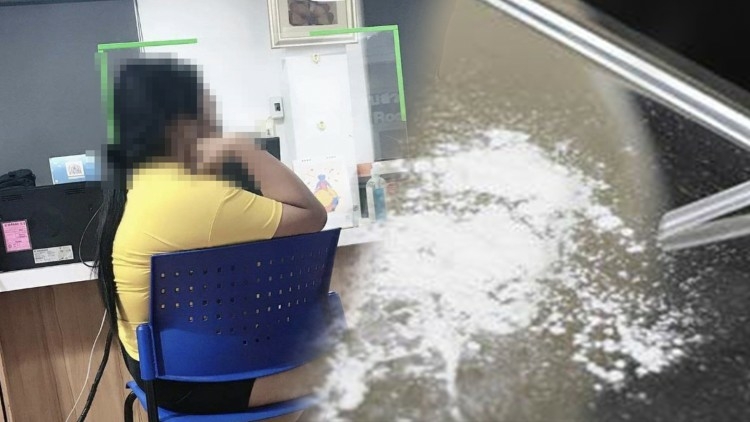
Police raided a house in Bangkok’s Sai Mai district on Monday night and arrested Sirikarn Chuaketkam, 23, for allegedly selling a new narcotic called “K Nomphong”.
This drug, a mixture of ketamine, methamphetamine, heroin and a sleeping pill called “Rose”, made the headlines last week when up to 10 people reportedly died from overdosing on it. The drug is believed to be popular in the outskirts of Bangkok near Pathum Thani province.
Initial investigation led police to the suspect, who allegedly confessed that she had purchased the drug from her boyfriend for Bt470 per gram and sold it at Bt600 per gram.
She faces charges for drug possession.
The drug is called “K Nomphong” because it looks like milk powder, or “nomphong” in Thai.
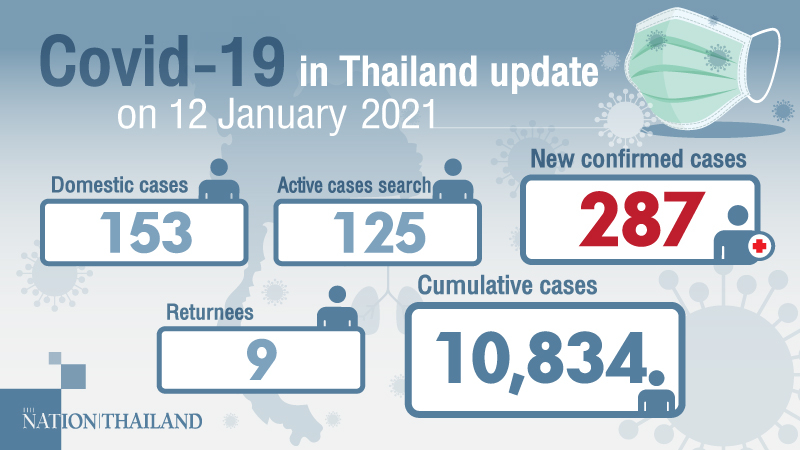
The Centre for Covid-19 Situation Administration (CCSA) reported 287 new cases on Tuesday, including nine people testing positive in quarantine facilities.
Two Thais had flown back from the United States, one from the United Arab Emirates as well as a Taiwanese man from China, a Japanese businessman, two British people, an Indian man, and an Indonesian man from their respective countries.
Of the cases, 139 were exposed to the virus while visiting high-risk places. Provinces with two-digit cases are Bangkok (31) and Samut Sakhon (51).
Proactive testing led to 125 positive cases being found in Samut Sakhon (121 foreigners and four Thais)
In addition, the source of infection of 14 cases is still being sought in Rayong (2), Bangkok (1), Chonburi (9), and Samut Prakarn (2).
Meanwhile, 166 patients have recovered and been discharged.
The total number of confirmed cases in Thailand has increased to 10,834 – 8,659 of which were contracted domestically, including 2,964 found in proactive testing, and 2,175 were returnees. So far, 6,732 have recovered and been discharged, 4,035 patients are being treated in hospitals, while 67 have died.
According to Worldometer, as of midnight on Monday, the total number of confirmed cases globally had risen to 91.31 million (up by 578,421), 65.29 million have recovered, 24 million are active cases (108,804 in severe condition) and 1.95 million have died (up by 9,212).
Thailand ranks 128th on the global list of most cases, while the US tops the list with 23.14 million, followed by India 10.47 million, Brazil 8.13 million, Russia 3.42 million and the United Kingdom 3.11 million.
The baht opened at 30.17 to the US dollar on Tuesday, weakening from 30.15 at close on Monday.
The Thai currency is likely to move between 30.12 and 30.32, said Jitipol Puksamatanan, the head of the “Easy Invest” team at SCB Securities.
On Monday night, the financial markets were stirred by investors selling stocks that grew at the beginning of this year.
Some observers are concerned about the ban on Donald Trump by social media companies, raising questions about the limits of these companies’ powers.
The Nasdaq index fell by 1.25 per cent, while the S&P 500 and Stoxx 600 dropped by 0.6 and 0.7 per cent, respectively.
The risk-off situation of the market strengthened the dollar to its highest level in the past three weeks, while the Australia and New Zealand dollars weakened by 0.6 and 0.9 per cent respectively.
The price of Bitcoin also dropped by 8 per cent to $35,500, and the US Ten-Year Treasury yield decreased by 1 per cent to 1.13 per cent.
Jitipol added that the price of WTI crude oil and gold had changed slightly on Monday.
In Thailand, the baht weakened, pressured by the stronger dollar, prompting foreign investors to sell risk assets in Thailand for speculation.
On Tuesday, he advised investors to monitor capital markets, explaining that a change in Asian markets could pressure the baht and other currencies in emerging markets to continually weaken.
Non-performing loans (NPL) of small and medium-sized enterprises (SMEs) have risen to Bt229 billion, or 6 per cent of the country’s total loans, due to impact from the Covid-19 pandemic, the Federation of Thai SMEs said.
“Small and medium entrepreneurs have been suffering since the Covid-19 outbreak in Thailand in 2019,” said Saengchai Theerakulwanich, the federation’s secretary-general. “The Bank of Thailand has revealed that total NPLs of SMEs made up 6 per cent of the country’s Bt3.5-trillion total loans, or about Bt229 billion.
“Small businesses have been hit the hardest, especially small restaurants and tour operators, who have been ordered by the government to temporarily shut down their businesses in a bid to curb the outbreak,” he added.
“Although the government has provided soft loans to SMEs totalling about Bt500 billion, only about 70,000 SMEs could access the loan, while the rest are not qualified due to the criteria set by financial institutions that provide them. The SMEs also had a hard time accessing the Social Security Fund, which is worth Bt30 billion.”
The federation is worried that the latest outbreak reported since last December will worsen the situation despite the arrival of the Covid-19 vaccine. “We estimate that it could be the third or fourth quarter of 2021 when the situation could return to normal for SMEs,” he said.
Saengchai added that there were about 3.1 million SMEs in Thailand who hire about 12 million people and contribute up to 35 per cent of the country’s GDP.
“SMEs are the foundation of the country’s economy, therefore the government must make sure that they can access financial aid during the new Covid-19 wave to mitigate the impact on their operations.”
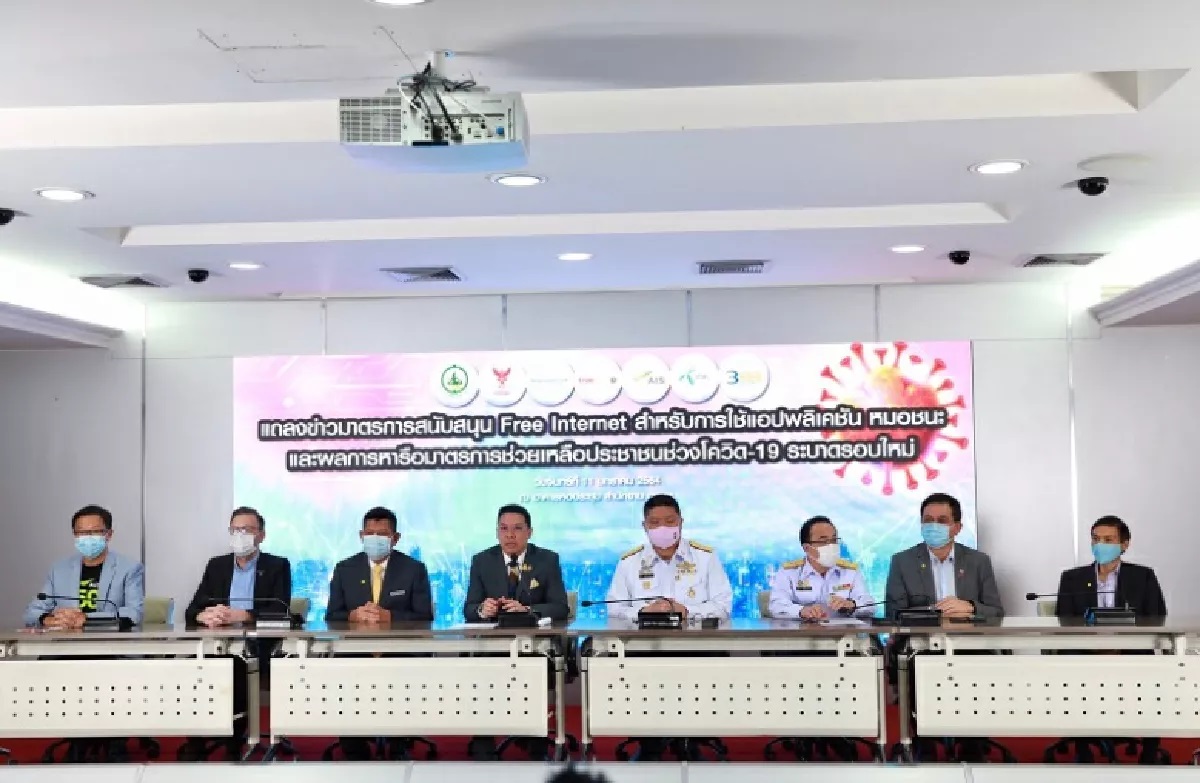
Mobile operators AIS, True, DTAC, NT (National Telecom Plc) and 3BB will not charge data usage fee for users of the “MorChana” (Doctors Win) application for three months, starting January 11, the National Broadcasting and Telecommunications Commission (NBTC) said on Monday.
The move follows discussions the NBTC held with mobile and internet operators to come up with measures to help alleviate people’s financial burden amid the new Covid-19 outbreak, NBTC acting secretary-general Trairat Wiriyasirikul said.
The “MorChana” application, launched on April 10 last year, records users’ movements in order to track and trace new infections. The app also provides information on the risk of infection in different places, which are marked red, orange, yellow or green, based on exposure to the virus.
To promote working from home and reduce the risk of the virus spreading, the NBTC and operators have also come up with more assistance for internet users.
“Users of fixed broadband or home internet would receive free speed adjustment to at least 100/100Mbps for fiber network, and at maximum capacity of non-fiber network [such as xDSL],” said Trairat. “Meanwhile, users of mobile broadband can choose a special package priced at Bt79 per month, which will provide unlimited data at maximum speed of 10Mbps for 30 days.
“The NBTC has also urged all operators to maintain their signal stability to support those who have to work from home, as well as during the registration of the second phase of the government’s ‘Let’s Go Halves’ co-payment shopping campaign,” Trairat added.



 Suchat Pornchaiwiseskul
 Apichet Suesat