Jul 03. 2020Photo Credit: Nation Photo by Charoon Thongnual
By The Nation
A troupe of crab-eating macaques has emerged from Surat Thani’s Khun Talay mangrove forest and forged a bond with kind-hearted locals who are feeding them vegetables and fruits.
Local residents say that although the monkeys are not pets, they show the same friendliness towards humans as dogs and cats.
Human residents are taking advantage of Surat Thani’s rambutan season to serve up a daily banquet for the macaques. And as the coronavirus lockdown eases, the crab-eating monkeys can look forward to feasting on a wider variety of delicious fruits.
An 18-year-old photographer turned himself in at Chonburi’s Nongprue Police Station for trying to rape a model during a photoshoot on Thursday (July 2).
The incident came to light when the model, 19, posted her experience on Facebook, explaining how she managed to escape sexual assault and filed a report at the police station.
The offender showed up later to meet the investigators and confessed to all accusations, before he was charged with attempting to rape.
The suspect said he had been turned on while taking photographs of the model posing in the swimming pool and that he had no intentions to hurt the victim.
The model said the photographer showed up while she was changing clothes in the bathroom, and tried to rape her, but fled when someone walked by and she screamed for help.
He later reportedly sent her a text later saying he could not control himself.
An animal rights group has accused an American dog breeder in Chiang Mai of torturing more than 60 dogs he kept in cages.
Staffs from Watchdog Thailand visited Chiang Mai’s Saraphi station on Wednesday and Thursday (July 1 and 2) with evidence and a complaint following their inspection of the illegal dog-selling operation.
Watchdog Thailand’s Waraya Bumrungpong said that her staff visited the American’s house on Monday after he asked them for help taking care of one of his dogs. They arrived to discover dozens of sick and hungry dogs kept in cages, she said.
The animal rights group immediately informed police and local animal welfare agencies, who removed the dogs for treatment.
Watchdog Thailand staff told police on Thursday that the dealer had no breeding licence and had bred his puppies from sick dogs to sell abroad at $3,000 (Bt93,300) apiece.
However, the Covid-19 crisis meant the American could no longer trade, meaning his collection of dogs had grown.
The accused dog dealer has launched a counter-complaint with police, accusing Watchdog Thailand of stealing his assets (the dogs) and claiming he asked the foundation to visit his house since he was sick and could not take care of the dogs by himself. He denied running a “dog farm” and said the animals had been caged to prevent them biting each other.
More than 1,700 medical tourists have registered to enter Thailand from July 1 but strict quarantine will prevent any from importing Covid-19, the Centre for Covid-19 Situation Administration (CCSA) announced today (July 3).
Among the first foreigners to be allowed back into the country, medical tourists will be allowed to travel around Thailand from August 1, once their 14-day quarantine and treatment had been completed, said CCSA spokesperson Taweesin Visanuyothin.
Special tour packages for medical tourists will include massage and spa, fitness centres, healthy food, herbal products, and visa services, while accommodation will be provided by hotels with the Amazing Thailand Safety and Health Administration (SHA) certificates and the “Well Hotel” standard.
The first batch of 1,700 medical tourists come from 17 countries, including Myanmar (478), Laos (477), Vietnam (39), China (65), the United Arab Emirates (223), Oman (187), Kuwait (137), Qatar (95) and Saudi Arabia (14).
“Villa Quarantine”, for foreigners who stay in their accommodation and don’t travel, could be ready by August, said Taweesin.
Meanwhile, a September launch date was being eyed for the “travel bubble” plan to allow entry to foreigners from countries at low-risk of Covid-19 transmission, he added.
The medical tourism and wellness programme offers two types of quarantine depending on treatment: Hospital Quarantine for patients receiving short treatments within their 14-day quarantine and Alternative Hospital Quarantine for longer procedures such as infertility treatment (Gamete Intra-Fallopian Transfer or GIFT).
Taweesin emphasised that all patients must complete the 14-day quarantine even if they recover early since Covid-19 can be detected on the very last day of quarantine. Any medical tourists who test positive for Covid-19 can continue with virus treatment in separate areas prepared for foreigners at private hospitals.
Medical tourists will be tested three times for Covid-19: before departing for Thailand, on arrival, and before returning home. Only medical tourists who travel by air would be granted entry to Thailand and all must be carrying a certificate of entry (COE) from a Thai embassy.
At least 62 private hospitals have registered as quarantine hospitals for medical tourists.
Staff tasked with screening patients for Covid-19 join a protest today to demand a higher quota of government jobs, in line with their status as front-line “troops” in the virus battle.
Around 300 medical record keepers gathered in front of the Public Health Ministry in Nonthaburi to protest that while government quotas for doctors, nurses and other medical staff had risen dramatically, theirs had remained the same.
The record keepers said they had joined other medical staff in putting their lives on the line to fight the Covid-19 crisis, but had not received the same recognition in terms of more government jobs.
Signs at the protest read “Did you forget us?” and “We have fought Covid-19 together”.
Around 3,000 medical record keepers are tasked with processing patients, screening at-risk cases, and providing medical records in hospitals nationwide.
However, the ministry did not include them in special government quotas for front-line Covid-19 staff in April.
The officials protesting on Friday added that around 600 medical record keepers had worked closely with Covid-19 patients.
Deputy Health Minister Satit Pitutecha received a proposal from the protesting staff and said a ministry committee would deal with their complaint.
A Facebook user has set up a community clothes rack in front of her house in Khon Kaen to provide free unused school uniforms and school shoes for families suffering from the Covid-19 fallout.
After schools reopened on July 1, reports emerged of parents stealing school uniforms and shoes for their children because they lacked money to buy them due to the Covid-19 crisis.
In response, Facebook user “Araishop Toys” got the idea to set up a “clothes rack of sharing”, inspired by community pantries to share food that have sprung up across the country.
“I would like to invite children to set up a clothes rack of sharing in front of their house to provide unused school uniforms and school shoes for other children in their community,” she said.
“People unable to set up a clothes rack can send unused school uniforms and school shoes to Kaennakhon Witthayalai School in Khon Kaen.”
She added that people in other provinces who would like to participate in this activity can contact her via Facebook.
“We will cooperate with our networks to handout unused school uniforms and school shoes to children in remote areas,” she added.
Thai entrepreneurs made greater use of the Generalised System of Preferences (GSP) while the use of free trade agreements (FTAs) saw a fall due to the Covid-19 outbreak.
GSP use increased by 3.3 per cent for Thai export of rubber gloves, air-conditioners, and processed food, while FTA use decreased by 13 per cent.
The Department of Foreign Trade (DFT) informed that the total value of benefits, exercised by Thai entrepreneurs under the GSP and FTAs was $21.340 billion between January and April, decreasing by 12.08 per cent.
Department director-general Keerati Rushchano added that $1.793 billion of total benefits used was under GSP, while the balance $19.546 billion came from FTAs.
GSP benefits exercised in the four months increased by 3.87 per cent, and the market Thailand exporters tapped the most was the US, accounting for Bt1.644 billion, rising by 3.34 per cent.
The director-general added that th products that benefited from the use of trade privileges were drinks and processed foods, which were in demand amid the virus crisis across the world.
He added that the use of FTA privileges amounted to $19.546 billion, decreasing by 13.30 per cent, due to the pandemic.
The baht opened at 31.11 to the US dollar on Friday morning (July 3), weakening from Thursday’s close of 31.09.
The Thai currency is expected to move between 31.02 and 31.22 on Friday, said Jitipol Puksamatanan, head of Markets Strategy at SCB Securities.
On Thursday night, the financial markets in the US rose after economic numbers in its labour market pointed to a partial economic recovery.
The S&P 500 increased by 0.5 per cent, while Euro Stoxx 600 recovered by 2 per cent due to investors expecting the European Central Bank (ECB) to be supported by the German and French governments.
The US nonfarm payroll increased by 4.8 million positions, lowering the unemployment rate to 11.1 per cent from 13.3 per cent last month. Most of the new employment, or 2.08 million positions, was in tourism and recreation industries.
The US Ten-Year Treasury yield stayed at 0.66 per cent, with a hope that the Fed would issue policies to control the yields in the long term. Meanwhile, the German and Italian Ten-Year Treasury yields decreased to minus 0.43 per cent and minus 1.20 per cent, respectively, since investors expected the monetary policies of the ECB to be more relaxed.
In the financial markets, the dollar recovered by 0.1 per cent because of the economic recovery. At the same time, the baht was sold by foreign holders, due to concerns the currency is weakening amid the strengthening of other currencies in Asia.
Hin Kong Power Holding (HKH), the winner of the Hin Kong Power Plant project in Ratchaburi province, is in the process of sourcing liquefied national gas (LNG) to fuel the power plant, a source from the Electricity Generating Authority of Thailand (Egat) said.
The power plant will have the capacity to generate 1,400 megawatts per year.
HKH is a joint venture between Ratch Group Pcl (51 per cent shareholding) and Gulf Energy Development Plc (49 per cent).
“HKH is awaiting approval from the Ministry of Energy which will meet with the Energy Policy and Planning Office this month to source new LNG shippers, besides PTT and Egat,” it said. “Once the new shippers are approved, HKH will be importing LNG at 1.4 million tonnes per year.”
The source added that HKH is aware of the risk in sourcing LNG under non-pool gas system in case the government adjusts the formula in gas price calculation, and that it has prepared measures to manage the potential risks.
“If HKH does not sign a GSA [gas supply agreement] with PTT under the PPA [power purchase agreement] conditions that are based on a pool gas system, they could import LNG at a lower price,” said the source. “If that is the case, Egat may consider reducing the cost of electricity generation for the benefit of electricity users nationwide.”
Funeral allowance for people insured under the social security scheme has been increased by Bt10,000, following a new Ministry of Labour regulation published on the Royal Gazette website on Thursday (July 2).
Signed by Labour Minister MR Chatumongol Sonakul, the regulation stipulates that an insured person who dies from an accident or illness not related to work will be entitled to a Bt50,000 funeral allowance under Social Security Act BE 2563.
The funeral allowance for deaths in such cases, granted since 2007, was Bt40,000.
The ministry cited compensation suitable for the current economic status as reason for the adjustment.

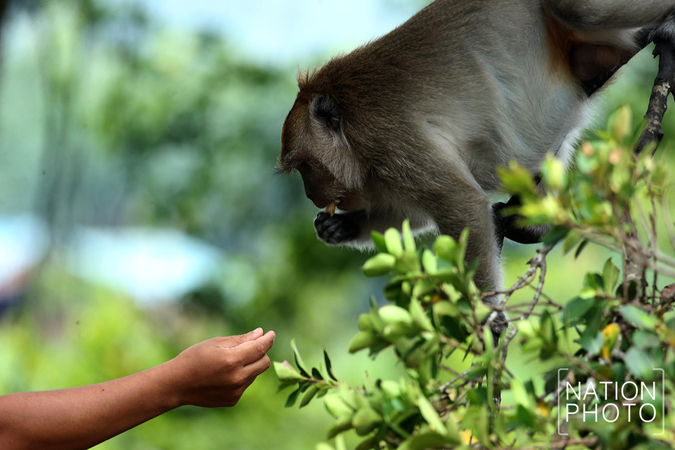 Photo Credit: Nation Photo by Charoon Thongnual

 Human residents are taking advantage of Surat Thani’s rambutan season to serve up a daily banquet for the macaques. And as the coronavirus lockdown eases, the crab-eating monkeys can look forward to feasting on a wider variety of delicious fruits.


