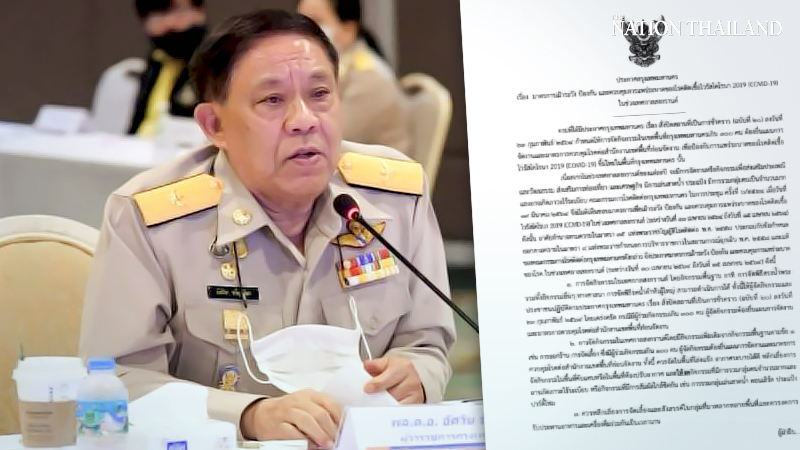
In a keynote address at a seminar on how cannabis can help revive the economy, Deputy Public Health Minister Satit Pitutecha said the goal became crystal clear when the government removed the herb from the list of narcotics.
Now, cannabis and hemp can be used under the Food and Drug Administration (FDA) regulations.
“We now offer opportunities to different organisations, institutions and businesses to grow cannabis. So far, more than 100 applications have been sent in and nearly half have been approved,” he said, adding that the plant is being grown on a trial basis. “Extracts are also being made for use in hospitals. There is hope and progress,” Satit said.
He added that once the cannabis industry is standardised in two years, Thailand will have the potential to become a global hub for marijuana.
Public Health Minister Anutin Charnvirakul has confirmed Thailand is in talks for travel bubbles with other countries.
Anutin spoke after receiving his second injection of Chinese Sinovac vaccine on Tuesday, three days after Thailand took delivery of another 800,000 doses. The country has so far received 1 million Sinovac doses, with another 1 million due to arrive in April.
Anutin, his deputy minister and executives reported no side effects from the second jab.
He said people who have had two doses will receive a certificate that will act as a vaccine passport to keep with them wherever they go.
Thailand is now negotiating with many countries for travel bubbles that will begin operating when more people have been vaccinated, Anutin revealed.
Meanwhile, Disease Control Department chief Dr Opas Karnkawinpong said the 800,000 Sinovac doses are being used in three areas.
Covid-19 hotspots will get 300,000 doses: Samut Sakhon (100,000), Bangkok (50,000), Pathum Thani (25,000), Samut Prakan (25,000), Nonthaburi (25,000) and Tak (75,000).
Tourism locations will get 240,000 doses: Chonburi (20,000), Rayong (20,000), Chiang Mai (20,000), Khon Kaen (10,000), Krabi (10,000), Phang Nga (10,000), Koh Samui (50,000), and Phuket (100,000).
Economically significant locations will get 50,000 doses: Songkhla (10,000), Sa Kaew (10,000), Chiang Rai (5,000), Mukdahan (5,000), Narathiwat (5,000), Ranong (5,000), Nong Khai (5,000), and Chanthaburi (5,000).
The remaining 210,000 doses will go to health workers dealing with the Bang Khae cluster which has spread to at least 10 provinces.
The 800,000 shots are expected to reach their destination by Sunday (March 28).
So far, around 80,000 people have had their first dose of vaccine in Thailand, and around 300 people have had their second.
On Saturday, Anutin revealed Thailand was negotiating for another 5 million Sinovac jabs.
Meanwhile, 26 million AstraZeneca doses made locally by Siam Bioscience are due to be available in June to August with another 35 million to follow later this year.
Co-leader of the anti-establishment movement, Parit “Penguin” Chiwarak, announced via the Facebook page of the United Front of Thammasat and Demonstration that he will only consume water and electrolytes from Wednesday onwards.
Parit has been on a partial fast for eight days now, and his lawyer, who visited him in prison on Tuesday, said the young man looks fatigued.
The lawyer also said that Parit told him he would intensify his fast, consuming only water and electrolyte beverages.
The protest leader had announced on March 15 that he would go on a hunger strike until he and others accused of insulting the monarchy are granted bail.
The anti-establishment movement, meanwhile, announced it will hold a rally at Bangkok’s Ratchaprasong intersection on Wednesday evening.
The announcement also said that the protesters will be addressed by three key speakers, namely Pasarawalee “Mind” Thanakitwibulpol, Benja Apan and Attapon “Kru Yai” Buapat.
These three speakers are among the 13 protesters who were hit with lese majeste charges in relation to the rally outside the German embassy on October 26 last year.
The protesters had gathered at the mission to call on Berlin to investigate whether the Thai monarch violated German sovereignty by conducting state business on German soil.
The Cabinet on Tuesday agreed to launch a third phase of the “Rao Tiew Duay Kan” (We Travel Together) to cover an additional 2 million applicants and has also approved the “Tour Tiew Thai” packaged tour scheme.
The Rao Tiew Duay Kan stimulus measure’s third phase will run from May to August 31.
The Tourism Authority of Thailand has said it will verify the identities of the 2 million new applicants and discuss the matter with Krungthai Bank.
The new Tour Tiew Thai co-payment scheme will see the government covering up to 40 per cent of tour packages for a maximum of one million people. The subsidy is capped at Bt5,000 per trip.
To be eligible, people must purchase a tour package of up to Bt12,000 from selected tourist agencies and the packages must be for at least two nights.
One tour company can sell up to 1,000 packages under this measure, which will also run from May to August 31.
A 39-year-old woman who suffered a gruesome attack for “stealing” another woman’s boyfriend died on Tuesday from fatal injuries.
Yupa Sukthong, along with her daughter and son, reportedly attacked the victim, identified only as Jirawan, for allegedly having an affair with Yupa’s boyfriend.
The attackers allegedly stripped Jirawan naked, beat her up and even stuck a broom handle in her private parts. The persons reportedly recorded their attack on video and took photographs, which were then posted online.
The incident took place on Sunday at a resort in Nakhon Si Thammarat’s Phra Phrome district.
The victim’s daughter, Jirasa Nitsomboon, 21, said the man her mother was having an affair with had picked up her mother and dropped her off at the resort.
When he left, Yupa and her children arrived and began attacking Jirawan, and reportedly refused to stop despite onlookers’ continued efforts to rescue the victim.
Jirasa added that the man was not seen again.
The attackers, meanwhile, have denied the accusations and are threatening to take legal action against Jirasa and her family.
However, police have said they will collect evidence and apply for arrest warrants. Officers also said the attackers will face murder charges, not attempted murder because the victim has succumbed to her injuries.
“All culprits will be arrested,” the police promised.
Air pollution in Bangkok, Samut Prakan, Samut Sakhon, Chiang Rai and Mae Hong Son hit unsafe levels on Wednesday morning, the Centre for Air Pollution Mitigation reported.
Thailand’s standard for safe levels of PM2.5 (particles less than 2.5 micrometres in diameter) is 50 micrograms per cubic metre (μg/m3), though the World Health Organisation sets it at 25 μg/m3.
Here are the PM2.5 per cubic metre readings in different parts of Thailand:
• North: 23-113μg/m3
• Northeast: 18-37μg/m3
• Central Region and West: 17-45μg/m3
• East: 12-34 μg/m3
• South: 8-28 μg/m3
• Bangkok and its vicinity: 33-73μg/m3
Meanwhile, the Bangkok Air Quality and Noise Management Division said air quality was unsafe in 10 districts of Bangkok and its vicinity. Samut Sakhon’s Muang district topped the list with 73μg/m3, followed by Bangkok’s Bangkok Yai (61μg/m3) and Taling Chan districts (60μg/m3).
The Centre for Covid-19 Situation Administration (CCSA) on Wednesday reported 69 new cases, eight of whom are from overseas.
Of the cases, 44 were exposed to the virus while visiting high-risk areas. Bangkok leads this list with 30 cases, followed by six in Samut Sakhon, two each in Tak and Pathum Thani and one each in Nakhon Pathom, Nonthaburi, Samut Prakan and Nong Bua Lam Phu.
Meanwhile, proactive testing led to the discovery of 17 cases, 13 of which were in Bangkok, three in Samut Sakhon and one in Pathum Thani.
Of the arrivals, seven Thais and one Indian national tested positive.
Separately, 107 patients have recovered and been discharged.
As of Wednesday, the number of confirmed cases in Thailand had risen to 28,346. Of these, 25,336 had been contracted locally, including 15,846 who were found via proactive testing, while 3,010 were returnees. So far, 26,873 have recovered, 1,381 patients are still being treated, while the death toll remains unchanged at 92.
According to Worldometer, as of 10am, the number of confirmed cases globally had risen to 124.81 million (up by 486,240), 100.84 million have recovered, 21.22 million are active cases (91,417 in severe condition) and 2.75 million have died (up by 10,214).
Thailand ranks 116th on the global list of most cases, which is topped by the US with 30.64 million, followed by Brazil 12.14 million, India 11.7 million, Russia 4.47 million and France 4.31 million.
The third phase of the “Khon La Khrueng” (Let’s Go Halves) government co-payment scheme will be launched in the third quarter, Finance Minister Arkhom Termpittayapaisith said on Wednesday.
He said the ministry would find ways to deal with corruption after the second phase of the scheme ends on March 31, adding that the ministry is keeping an eye on hundreds of shops involved in graft.
“Besides, the ministry will check details of consumer spending in the first and second quarters after a series of economic stimulus schemes were launched, while the government will evaluate the performance of each scheme on how much it has helped boost the economy,” he explained.
Meanwhile, Fiscal Policy Office director-general Kulaya Tantitemit said the third phase of Let’s Go Halves is expected to be launched after the “Rao Chana” (We Win) and “Mor33 Rao Rak Kan” (Section33 We Love Each Other) schemes end in May.
She said registrants eligible under the previous phases may not have to register for the third phase as their information has been saved in the Paotang smartphone application.
“The Finance Ministry will use the remaining budget under the loan agreement to operate the third phase of the co-payment scheme,” she added.
Under the Kon La Khreung scheme, eligible registrants can avail of daily discounts on their shopping of up to Bt150, capped at Bt3,500.
Chiang Mai University’s (CMU) Faculty of Fine Arts came out to defend itself after being criticised for removing certain art installations at an exhibition, saying: “We decided to move the art pieces since they could be seen as illegal things.”
On Monday, a video clip showing a CMU art professor attacking university executives for removing students’ art installations went viral.
The story started when a group of people attired in yellow entered the exhibition and began moving some pieces on display to a parked pick-up truck that belonged to the faculty.
The installations appeared to depict the aftermath of protests.
The executives ignored students and other officials who tried to stop them until art professor Thasnai Sethaseree appeared at the scene.
Thasnai immediately began asking the execs to explain themselves, and when they couldn’t, he began attacking them for not appreciating art. The incident was live-streamed on Facebook and went viral.
The execs eventually agreed to bring back the pieces they had removed, claiming they thought they were “clearing trash”.
The university management has also called on the executives to explain themselves.
On Tuesday, the Faculty of Fine Arts issued a statement clarifying their controversial action. The statement explained that some “suspicious” art pieces – such as an adapted flag with improper sentences – were found, and was not claimed by anyone. So the executives decided to move the particular pieces as they could be seen as “illegal”, in order to protect the whole faculty – professors and students.
Bangkok announced three strict measures to control Covid-19 during the Songkran festival from April 10-15. Violators may be imprisoned for up to two years or fined up to Bt40,000 or both.
Governor Aswin Kwanmuang ordered the three measures, decided by the capital’s communicable disease committee, following concern of a possible new Covid-19 outbreak during Songkran.
The measures are:
1) Traditional Songkran activities such as religious ceremonies and paying respects to one’s elders can proceed as normal. But any activity with more than 300 persons needs to first gain permission from the Bangkok Metropolitan Administration district office.
2) Organisers of any other activities during Songkran, such as a banquet with more than 100 participants, must submit an event plan and disease control measures to the district office before the event.
The event, if given the go-ahead, should be arranged in an open area with good ventilation. Activities in confined spaces or in air-conditioned rooms must be avoided. The organiser must also strictly refrain from activities that involve large groups of people that may lead to disorder, or activities involving close contact, such as group gatherings, splashing of water, concerts, or foam parties.
3) It is best to avoid catering to or socialising in groups, “lengthy” eating and drinking should be avoided.



 Arkhom Termpittayapaisith