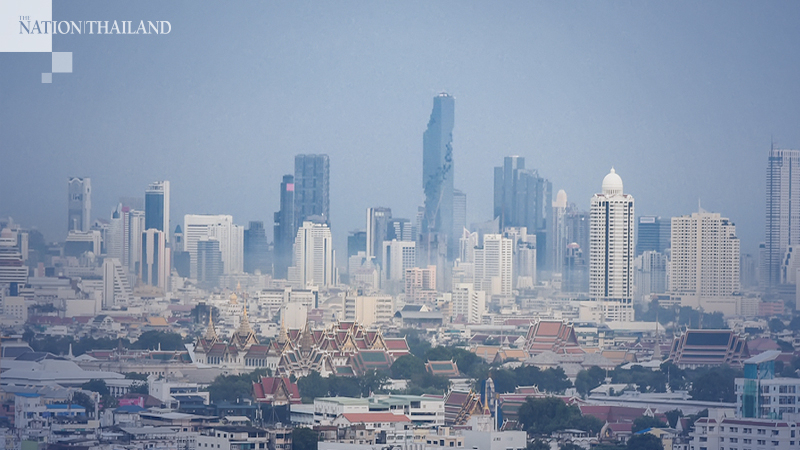
Air pollution hit unsafe levels in 14 provinces on Monday morning, the Air Quality and Noise Management Bureau reported.
Thailand’s standard for safe levels of PM2.5 (particles less than 2.5 micrometres in diameter) is 50 micrograms per cubic metre of air (μg/m3), while that of the World Health Organisation is 25μg/m3.
The 14 provinces struggling with pollution are Chiang Rai, Phayao, Nan, Lamphun, Chiang Mai, Lampang, Sukhothai, Phitsanulok, Tak, Kamphaeng Phet, Lopburi, Saraburi, Nong Khai and Ubon Ratchathani.
As of Monday morning, PM2.5 readings in different regions of Thailand came in as follows:
North: 32-83μg/m3.
Northeast: 26-59μg/m3.
Central Region and West: 12-60μg/m3.
East: 21-36μg/m3.
South: 17-27μg/m3.
Bangkok and its vicinity: 20-49μg/m3.
The elderly, children and people with respiratory diseases have been monitored to stay indoors in areas where pollution is bad.
People can monitor air quality via Air4Thai.com and bangkokairquality.com websites, or via Air4Thai and AirBKK smartphone applications.
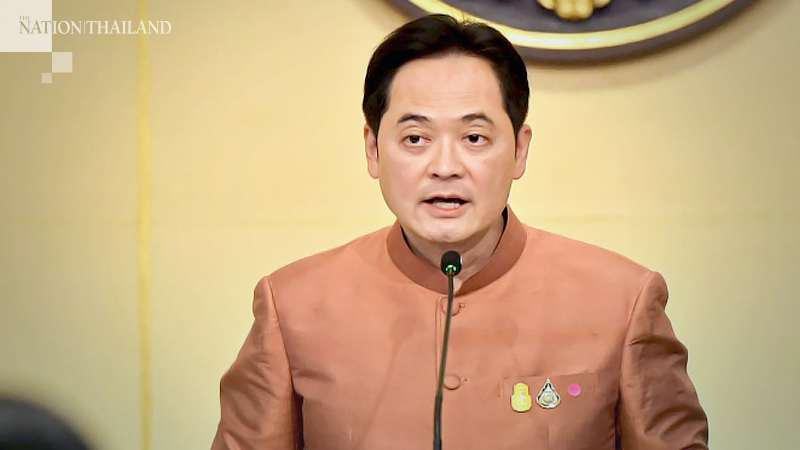
The Thailand Board of Investment (BOI) provided investment privileges for 1,717 projects worth Bt481.15 billion to private companies last year, Government Spokesman Anucha Burapachaisri said on Sunday.
The BOI revealed the figures during a meeting with Prime Minister General Prayut Chan-o-cha last week.
Companies approved by the BOI will be exempted from corporate income tax equivalent to 100 per cent of their investment value, excluding land fee and rotational funds.
“Of the total investment privileges provided, 48 per cent are in target industries that the government deemed important to drive the country’s economy forward, such as electrical and electronics [Bt50.3 billion investment], agriculture and food processing [Bt41.1 billion], automotive components [Bt37.7 billion], petrochemical [Bt36 billion], and biotechnology [Bt30 billion],” said Anucha.
“Medical industry is the sector with remarkable expansion in privilege applications filed with the BOI at 83 projects, a 177 per cent increase compared to those in 2019, with total investment value at Bt22.2 billion, increasing 165 per cent year on year,” he added.
The BOI also reported that in 2020 there were 453 projects receiving investment privileges in the Eastern Economic Corridor (EEC) areas, with total investment value at Bt208.7 billion, most of which are in infrastructure, basic industrial services and transportation.
“Prayut has said that in 2021 investment promotion by the BOI should focus on BCG [bio-circular green], medical, and digital industries that use high technology to improve the country’s manufacturing and service structure and increase our competitive edge in modern industries after the Covid-19 situation improves,” added Anucha.
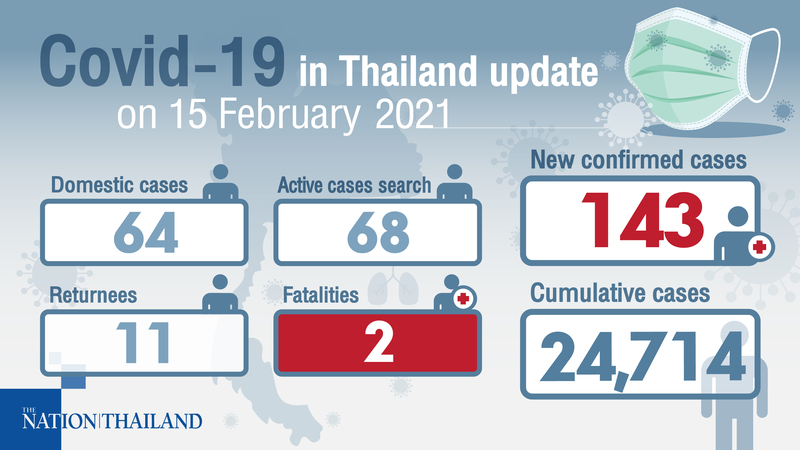
The Centre for Covid-19 Situation Administration (CCSA) on Monday reported 143 new cases with two fatalities, of whom 11 are returnees in quarantine facilities.
Of the 64 patients who were exposed to the disease while visiting high-risk areas. 53 were in Samut Sakhon, followed by eight cases in Nakhon Pathom, two in Chonburi, and one in Samut Songkhram.
Meanwhile, proactive testing led to the discovery of 68 cases, 50 of them in Pathum Thani, 16 in Samut Sakhon and one each in Bangkok and Phetchaburi.
Of the 11 overseas travellers who tested positive in quarantine facilities, six were Thais who had returned from Egypt, the United Kingdom, the United Arab Emirates and the United States, a Dutch national travelling from Germany and four Britons from their home country.
A male vegetable merchant, 62, in Ubon Ratchathani province who had diabetes, kidney disease, and high blood pressure died on February 14. He started coughing on January 5 and developed breathing difficulty on January 8. He tested positive for Covid-19 on February 9 with severe pneumonia. He entered critical stage on February 13 and died the following day.
A 78-year-old man succumbed to the disease on February 13 in Samut Sakhon province. On January 19, the patient started coughing. He tested positive on January 22 and was found to have severe pneumonia. His condition became critical due to his many underlying chronic diseases and he died on February 13.
Meanwhile, 772 patients have recovered and been discharged.
As of Monday, the number of confirmed cases in Thailand had risen to 24,714. Of these, 22,064 had been contracted locally, including 13,990 who were found via proactive testing, while 2,647 were returnees. So far, 22,883 have recovered and been discharged, 1,749 patients are still in hospitals, and the death toll has risen to 82.
According to Worldometer, as of 10am on Monday, the number of confirmed cases globally had risen to 109.4 million (up by 290,079), 81.47 million have recovered, 25.32 million are active cases (98,496 in severe condition) and 2.41 million have died (up by 6,792).
Thailand ranks 114th on the global list of most cases, which is topped by the US with 28.26 million, followed by India 10.92 million, Brazil 9.84 million, Russia 4.07 million and the United Kingdom 4.04 million.
The Medical Council of Thailand slammed the police for violence against a volunteer medic at a pro-democracy demonstration on Saturday.
The council issued a statement on Monday saying people have the right to rally for their rights, but that it will not condone violent actions from either side.
The statement also called on all sides to not attack medical personnel or volunteers, medical equipment and ambulances in line with the principles of the Red Cross.
The council called on related agencies to take care of medics and give them arm bands that can separate them from other protesters. It also lauded medics for helping the injured without demanding returns.
Bottles and smoke bombs were thrown when protesters and police officers clashed on Saturday night, injuring some 25 people.
The protest calling for the release of four leaders of the anti-establishment movement started at Bangkok’s Democracy Monument, before activists marched to the City Pillar Shrine near Sanam Luang.
The Stock Exchange of Thailand (SET) Index rose by 7.69 points, or 0.51 per cent, to 1,516.04 in the morning session on Monday.
A Krungsri Securities analyst expected the SET to rebound to between 1,520 and 1,525 on hopes of a rollout of the US economic relief package, rising oil price, and 12.7 per cent growth in Japan’s fourth-quarter gross domestic product.
“However, investors should beware of mass sell-offs of stocks due to tight index valuation,” he warned, adding that the SET price to earnings ratio was 30 times.
▪︎ CBG, ICHI, OSP, SAPPE, RBF, DOD and PTG, which benefit from positive news on hemp production and its general use.
The SET Index closed at 1,508.35 on Thursday, down 8.59 points or 0.57 per cent. Total transactions amounted to Bt106.41 billion with an index high of 1,521.31 and a low of 1,503.19.
The SET Index was closed on Friday for Chinese New Year.
Students’ group calls for action over alleged attack by police on medical volunteer
NationalFeb 15. 2021Police arrested a protester on Saturday
By THE NATION
The Society for Medical Students of Thailand (SMST) has called on the police to investigate the assault on a medical volunteer during the February 13 pro-democracy protests in Bangkok and bring the offenders to justice.
SMST released a statement on Sunday after pictures of a medical volunteer being beaten up by the police were widely shared on social media. Medical volunteers had been stationed there to provide medical services at the pro-democracy rally in front of the Supreme Court in Bangkok’s Phra Nakhon district on Saturday night.
“This is not the first time that medical volunteers were affected by police officials’ actions during protest events,” SMST said.
“Medical volunteers are not only there to treat injured protesters, but they could also ensure public safety in the areas where standard medical units and ambulances cannot access the injured persons on time.
“These volunteers are ‘street medics’ or ‘action medics’ who provide prehospital care to injured persons and maximise their survival rate. The attack on these volunteers is therefore unacceptable and violates human rights,” it said.
“The SMST would like to urge the commander of crowd control police to take responsibility by investigating and clarifying the incident to the public with full transparency, as well as bring the offender to justice.”
National Police chief Pol General Suwat Jangyodsuk said on Sunday while visiting injured officers that the attacked doctor was a troublemaker and such a person “was a contributor to the chaos”.
Saturday’s clashes with protesters saw 23 police officers being hospitalised with non-severe injuries.
The baht opened at 29.90 to the US dollar on Monday, weakening from Friday’s close of 29.88.
The Thai currency is likely to move between 29.85 and 29.95 on Monday and 29.80 and 30.10 this week, Krungthai market strategist Poon Panichpibool said.
He said the baht was waiting for new factors to move it. However, the currency this time has moved in line with the dollar, and would tend to fluctuate.
Poon added that the dollar would tend to strengthen in case the US economy recovered more than other regions.
He added that another factor to affect the baht was the fund flow of foreign investors. This week, there will be an offering of Thai Ten-Year Treasury, which would be of interest to some investors and strengthen the baht slightly.
The US economy is showing gradual recovery. National retail sales this month will increase 1 per cent over January due to the US government’s $600 cash handout package.
Meanwhile, industrial production in the US was believed to grow continually by 0.4 per cent from the previous month. Besides, the Capacity Utilization Rate will reach 74.8 per cent, supporting a demand for goods in the market.
In Japan, the economy in the fourth quarter of 2020, to be announced soon, was seen as growing 9.5 per cent over the third quarter.
The price of gold was unchanged in morning trade on Monday after rising by Bt50 per baht weight last week, the Gold Traders Association reported.
As of 9.23am, the buying price of a gold bar was Bt25,750 per baht weight and selling price Bt25,850, while gold ornaments were priced at Bt25,286.88 and Bt26,350, respectively.
Spot gold price rose to US$1,826 (Bt54,523) per ounce in the morning after falling by $3.6 to $1,823.2 per ounce on Friday due to the rise in US treasury yield and the strengthening dollar.
Also, gold was pressured by mass sell-offs of the precious metal to cope with risks during President’s Day.
Hong Kong gold price rose by HK$40 to $17,050 (Bt65,666) per tael, the Chinese Gold and Silver Exchange Society reported.
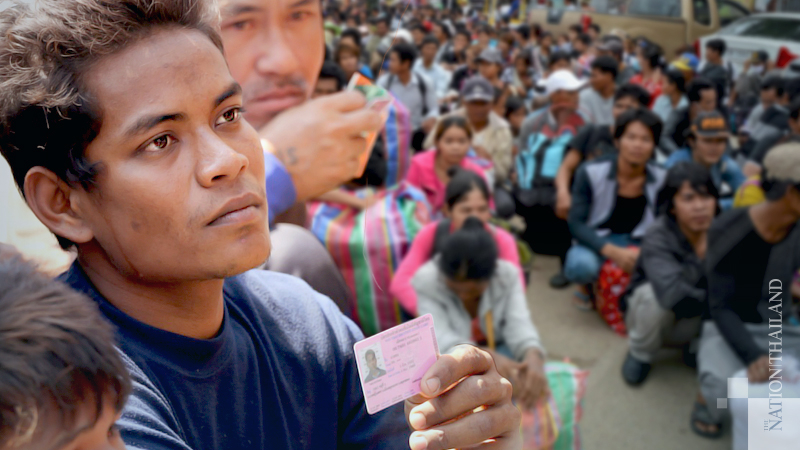
A total of 654,864 foreign workers from Cambodia, Laos and Myanmar have registered since January 15 to screen for Covid-19 after the online registration system closed at midnight on February 13. Personal identities will be completely recorded within April 16, Labour Minister Suchart Chomklin said.
The registration process follows a Cabinet resolution on December 29, 2020.
The first group of aliens whose employers have submitted the list has 596,502 foreigners — 180,476 Cambodian, 63,482 Lao and 352,544 Myanmar.
Two groups of 58,362 non-employers comprise 23,203 Cambodians, 3,626 Laos and 31,533 Myanmar.
The two groups totalled 654,864 people — Cambodian 203,679, Lao 67,108 and Myanmar 384,077.
The top 5 provinces that approved the list of aliens are Bangkok 120,163, Chonburi 47,326, Pathum Thani 38,994, Samut Prakarn 37,621 and Samut Sakhon 28,953.
The top five types of businesses approved on the list of foreigners are construction 148,332 people, agriculture and livestock 117,430, selling food and beverages 49,702, services 45,118, and agricultural-related 39,025.
The Department of Disease Control (DDC) has found one patient infected with the South Africa Covid-19 strain in state quarantine facility.
The Thai male had travelled to Tanzania and Ethiopia before returning to Thailand.
Dr Opas Karnkawinpong, director-general of DDC, said on Sunday this was the first case found in Thailand. The 41-year-old Thai patient has an asthmatic congenital disease, high blood pressure, and is overweight, he said.
According to his travel history, he had spent two months working in Tanzania to buy gemstones and said that people in that area rarely wore face masks.
On January 29, the patient arrived at Suvarnabhumi Airport after visiting Ethiopia and was quarantined in a state facility. On February 3, a positive Covid-19 test result was found and delivered a genetic transcription test sample since he was travelling from Africa. On February 12, the results were found to be a South African species.
“I assure that the South African species, found in state quarantine, hasn’t spread to any community.” Dr Opas said.
Guidelines for screening people coming from countries with South African mutated virus have been adjusted to be more sensitive, such as collecting samples immediately upon arrival in Thailand, screening and sending people with symptoms and history of risk to the hospital. There is also a system to monitor new species before travellers leave the hospital. The strict screening will help prevent this species from spreading to the community.
Dr Opas said that the world now had an eye on the South African strain of Covid-19. However, there were no other strains found to make the symptoms more severe. In Thailand, it was found that the strains that spread in the country were a G species which does not have more severe symptoms, but it spreads more easily compared to other species.
 Police arrested a protester on Saturday

 Dr Opas Karnkawinpong

