Pro-democracy activists gathered outside Bangkok Remand Prison in Ngamwongwan district to protest lese majeste detentions on Wednesday.
The activists read out 112 letters, symbolising Article 112 (the lese majeste law), in support of 10 protesters being held in the jail on lese majeste and other charges.
Prominent pro-democracy activist Panusaya “Rung” Sithijirawattanakul led the peaceful demonstration from 10am.
Activists also placed messages of support for the lese majeste detainees on the prison’s gate and sign.
Among the 10 protesters being held in the jail are Parit “Penguin” Chiwarak, Arnon Nampa, Somyot Phurksakasemsuk and Patiwat “Mor Lam Bank” Saraiyaem. Dozens of pro-democracy protesters have been charged with lese majeste since October last year.
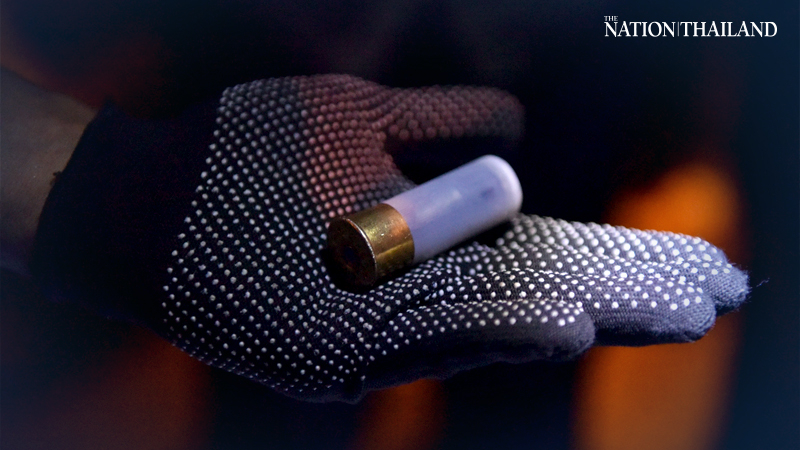
Several protesters were hit by the so-called “not so lethal” rubber bullets on Sunday night. Here’s what you should know about this ammunition:
Purpose:
Rubber bullets are used when the aim is not to kill people.
The Prime Minister’s Office in 2015 issued a statement listing 48 weapons that can be used to control crowds, and rubber bullets was one of them.
Other weapons included in the list are tear gas, pepper spray and water cannon.
Effect:
Even though they are called “rubber” bullets, they are only partially made from rubber. If shot at close range, they can cause severe injuries, shatter bones or even kill the victim. So far, 3 per cent of people hit by a rubber bullet have succumbed to their injuries, the BMJ Journal reported in 2017 citing a study on 1,984 samples.
The same study found that 15 per cent of the victims were disabled, while 80 per cent were blinded.
A new study conducted by the University of California pointed out that rubber or plastic bullets should not be used to control crowds, as they can cause severe injuries resulting in permanent disability.
The authorities have dismissed the anti-establishment REDEM (Restart Democracy) group’s claims of police using violent measures in the crackdown on Sunday.
Things got ugly when riot police stepped in to control the crowd as it tried to make its way to Prime Minister Prayut Chan-o-cha’s Army residence in the 1st Infantry Regiment complex in Bangkok.
In posts on the Free Youth group’s Facebook page, REDEM members said they were powerless against police officers armed with shields, batons, rubber bullets, tear gas and water cannon.
According to the Erawan Emergency Medical Service Centre, 32 people – 22 police officers and 10 protesters – were injured during clashes, and a police officer died from a heart attack while on duty.
National Police chief Pol General Suwat Jangyodsuk visited the injured officers before announcing the crackdown on Sunday was in line with international standards.
He admitted that though some officers were armed with stun guns, they did not use them against the protesters.
As for police officers’ refusal to answer questions about where the arrested protesters had been taken, he said officers will be instructed to provide details on the detainees.
Suwat also denied REDEM’s claim that the deputy inspector from Thammasala Police Station had suffered a heart attack because he had been made to exert himself too much during the crackdown.
The video clip of a pro-democracy protester from the REDEM (Restore Democracy) group urinating on a riot police officer’s head has created quite a furore on social media.
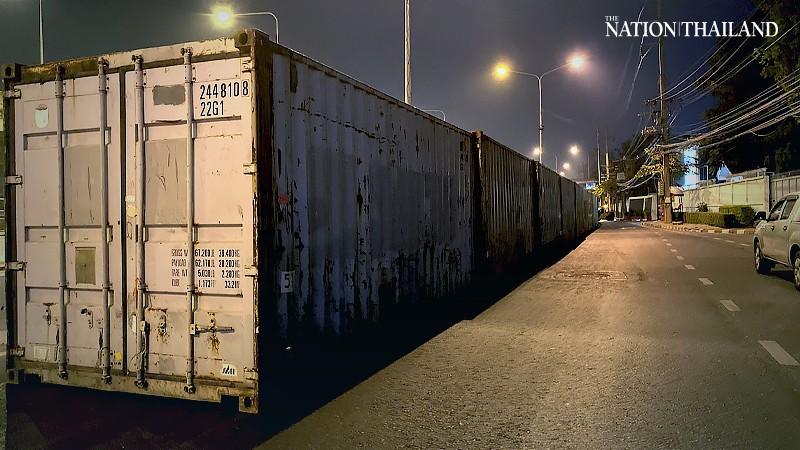
The clip shows a protester climbing up on a shipping container used as a barrier outside the 1st Infantry Regiment compound on Sunday night before spraying the officer below.
The protesters were trying to make their way to Prime Minister Prayut Chan-o-cha’s house in the compound to demand his resignation.
The clip recording the “pee protest” won different reactions on social media, with some saying it was “just desserts” for the police crackdown on protesters, while others said it was unacceptable.
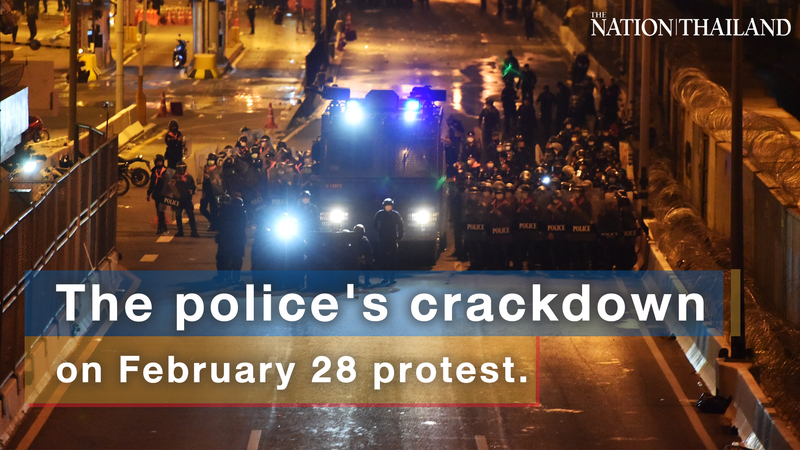
Police cracked down on protesters on Sunday night, hitting them with water cannons, tear gas and even rubber bullets.
The Erawan Emergency Medical Service Centre reported 32 injuries, 22 of whom were police officers, while one police officer died from a heart attack in the chaos.
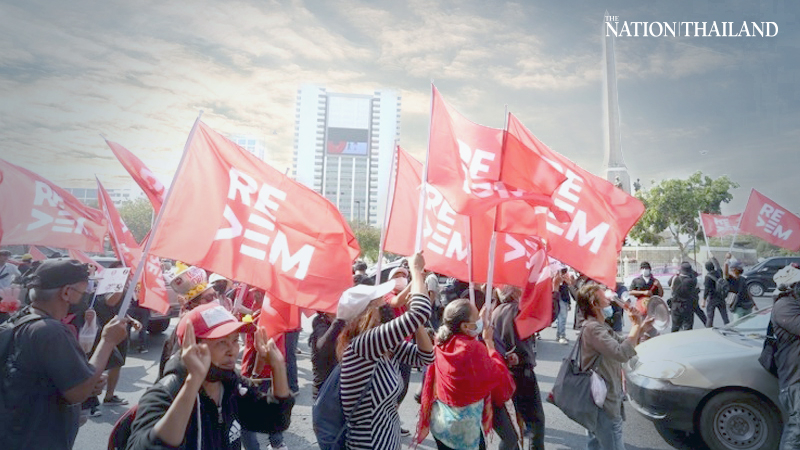
Some 1,500 protesters under the REDEM or Restore Democracy banner take to the streets on Sunday, which results in an ugly confrontation with police and several arrests.
Here is a timeline of events on Sunday:
2.20pm: REDEM protesters gather at Victory Monument.
3.15pm: A superintendent from the Phaya Thai Police Station inform the group of the Public Assembly Act, but the protesters bang utensils in response.
3.30pm: Protest leaders lead the crowds to Prime Minister Prayut Chan-o-cha’s Army residence at the First Infantry Battalion of the Royal Guards on Vibhavadi Rangsit Road.
4pm: Two water trucks are deployed at the Veterans General Hospital and Sutthisan intersection. Pol General Krisana Pattanacharoen, deputy spokesman of the Royal Thai Police, warns protesters to maintain peace.
5pm: Protesters begin marching down Vibhavadi Rangsit Road, shouting for Prayut’s resignation.
6pm: Riot police crackdown on protesters as they try to dismantle containers and barbed wire near the Veterans General Hospital.
6.10pm: A military officer warns protesters to stay away, but the crowd continues dismantling blockade until they arrive at the entrance of the 1st Infantry Battalion compound.
6.30pm: Police officers start arresting protesters, while protest leaders instruct those dismantling containers to deal with the police.
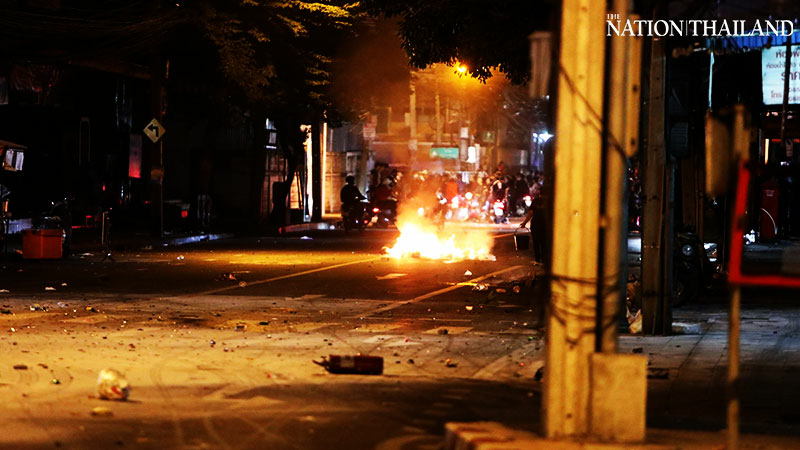
6.45pm: Male protesters confront riot police, while some lob firecrackers at the officers. Some protesters also use canvas to protect themselves from tear gas.
6.55pm: Riot control police retreat and protesters escape the tear gas.
7pm: Protesters’ medical team negotiates with police to avoid confrontation.
7.22pm: Clash erupts as protesters begin throwing objects, including firecrackers, at police who respond by shooting rubber bullets at the crowd.
7.44pm: Police officers say they will stop shooting if protesters retreat, but the crowd continues with its bid to enter the compound and make its way to Prayut’s residence.
7.50pm: Some protesters enter the 1st Infantry Battalion compound.
8pm: Riot police train water cannons and tear gas at protesters from the Veterans General Hospital and Sutthisan intersection.
8.30pm: Protesters vote via messaging app Telegram to call off the rally, though some continue confronting police.
9.35pm: Police once again fire water cannons and tear gas at protesters, who begin retreating.
10.20pm: National Police chief Pol General Suwat Jangyodsuk has the crowd under control outside Veterans General Hospital.
10.30pm: Several protesters were arrested. According to the Thai Lawyers for Human Rights, at least 20 protesters including a 16-year-old had been arrested.
11.20pm: Erawan Emergency Medical Service Centre reports at least 16 injured during the protest.
12am: Riot police shift to Din Daeng Police Station where protesters gather in support of those arrested earlier.
By The NationMultiple clashes between anti-government protesters and police in front of the 1st Infantry Regiment headquarters left people injured on both sides with many sent to hospitals.
Some protesters were arrested before charges were filed against them.
Metropolitan Police Bureau (MPB) deputy commissioner Piya Tawichai said that 22 protesters were detained at the Border Patrol Police Division 1. They will face at least three charges — violating the Emergency Decree, Disease Control Act, and breaking property. Police will consider them on a case by case and an announcement will be made on Monday, he said.
A large number of pro-democracy protesters gathered at 3pm on Sunday at the Victory Monument around Phya Thai. According to a FreeYouth Facebook fan page, the rally would have no leader, no guards and no toilet facilities, but would invite people to join the march at 4pm. It defined the assembly as a revolution by the people.
The FreeYouth Group stated on Twitter that they would start the march from Victory Monument, take the Ratchawithi Road, then head to Din Daeng and turn left onto Vibhavadi Rangsit outbound road amd head towards the 1st Infantry Regiment, King’s Close Bodyguard Regiment, where Prayut’s army house is located.
Police came out to warn that the gathering was in violation of the emergency decree and Disease Control Act, which led to insults from the protesters, forcing police to retreat.
Prime Minister Prayut Chan-o-cha has urged people to take the Covid-19 vaccine, confirming that it was safe and in line with standards.
He made the remarks after overseeing the vaccination drive at Bamrasnaradura Infectious Diseases Institute in Nonthaburi province.
Public Health Minister Anutin Charnvirakul became the first Thai person to be vaccinated against Covid-19, followed by Public Health Deputy Minister Sathit Pitutecha, Culture Minister Itthiphol Kunplome, Public Health permanent secretary Kiattiphum Wongrajit, Department of Disease Control director-general Opas Karnkawinpong and Education Deputy Minister Kanokwan Wilawan.
Prayut added that this move was not related to the country’s politics.
“The government and medical personnel have overcome this crisis many times so far. This shows that Thailand can contain the spread of Covid-19 effectively,” he said.
He added that Anutin currently didn’t have any symptoms after the Covid-19 vaccination.
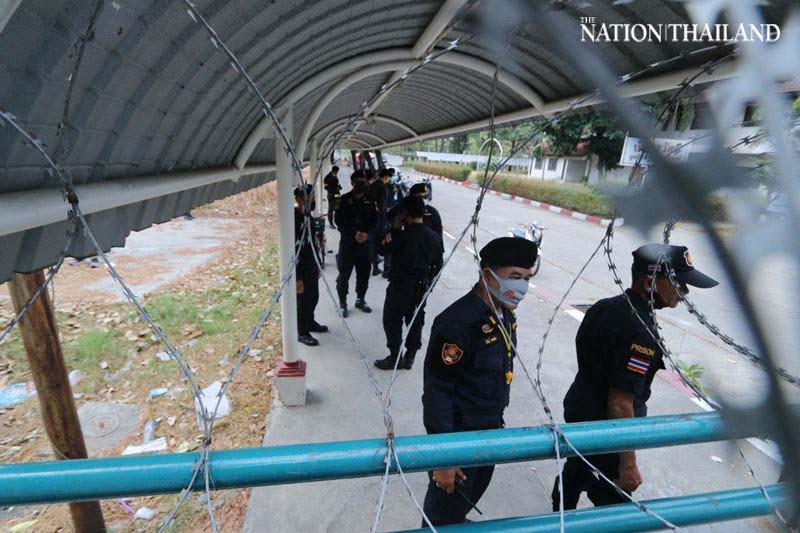
Police officers have set up barriers with barbed wires and containers on Vibhavadi Rangsit parallel road near the 1st Infantry Battalion, 1st King’s Close Bodyguard Regiment, to deal with a pro-democracy protesters’ rally planned for later in the day on Sunday.
REDEM, or Free Youth group, on Thursday had called on people to participate in their rally against dictatorship on Sunday starting at 3pm. The group’s march will start at Victory Monument to Prayut’s army house in the 1st Infantry Regiment, King’s Close Bodyguard Regiment.
“This is a fight for equal, democratic socialism. REDEM demands a limit to royal power by curbing undemocratic power, liberate democracy by ousting the military from politics, and defeat poverty by building state welfare for all,” the group said.
The traffic on Vibhavadi Rangsit parallel road from Veterans General Hospital to Royal Thai Army Stadium was temporarily closed, but motorists can use the expressway as usual.
The Appeal Court on Friday granted bail to eight former leaders of the People’s Democratic Reform Committee (PDRC) under the stipulation that they do not leave the country without prior permission.
Suthep Thaugsuban, Nataphol Teepsuwan, Chumpol Julasai, Buddhipongse Punnakanta, Thaworn Senniam, Issara Somchai, Suwit Thongprasert and Samdin Lertbut walked out of the Bangkok Remand prison to be greeted by other PDRC leaders, Palang Pracharath members and supporters.
The eight are among 26 people who were sentenced and detained on Wednesday for their role in street protests that resulted in the May 2014 coup, which ousted Yingluck Shinawatra’s government.
They were indicted on several charges, including insurrection, criminal association, illegal assembly and obstructing voters during street protests between November 2013 and May 2014.
The bail guarantee paid per person was up to Bt800,000, and their lawyer Sawat Charoenpol said they will appeal their sentences because their street protests were in line with the Constitution.

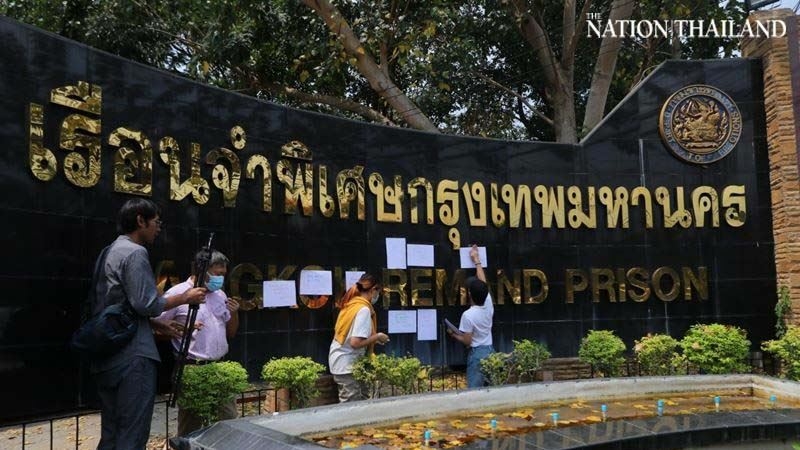
 The activists read out 112 letters, symbolising Article 112 (the lese majeste law), in support of 10 protesters being held in the jail on lese majeste and other charges.



 Pol General Suwat Jangyodsuk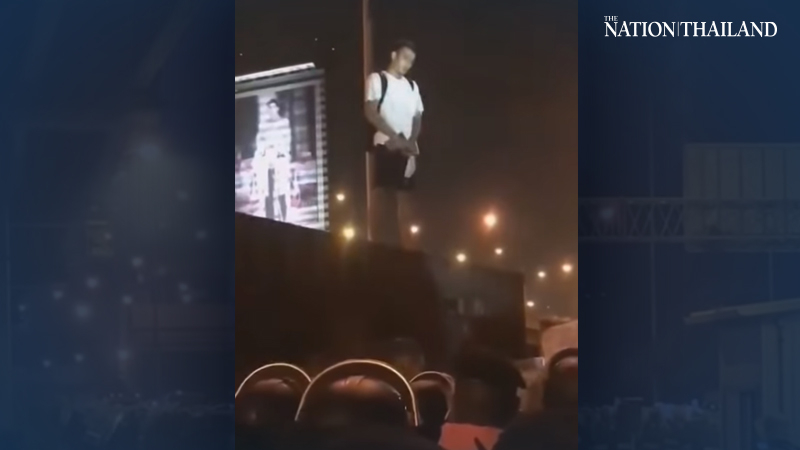




 Prayut Chan-o-cha (centre)




 SootinClaimon.Com